Encyclopedia/2. Technology & The Built World/2. Engineering & Applied Sciences/01. Robotics & Automation • Curated by Admin Timeline.sg
Control theory · Kinematics · Human-computer interaction
Chronological Storyline (29 Milestones)
300 BCE
Heron of Alexandria's automata
Heron of Alexandria described programmable automata and self-moving mechanical devices powered by water, steam, and air pressure in his work Pneumatica and Automata. · Wikipedia: https://en.wikipedia.org/wiki/Heron_of_Alexandria
Hero of Alexandria. Codex of Saint Gregory Nazianzenos. Greek manuscript of the ninth century. By Unknown author - Historia n° 767 - Novembre 2010 - page, Public domain, https://commons.wikimedia.org/w/index.php?curid=12080168
100 BCE
South-pointing chariot
The Chinese south-pointing chariot, a wheeled vehicle using differential gearing to maintain a fixed directional pointer, was described in ancient texts and represents an early mechanical feedback mechanism. Source — Wikipedia:
Model of a Chinese South Pointing Chariot, an early navigational device using a differential gear. By Andy Dingley - Own work, CC BY 3.0, https://commons.wikimedia.org/w/index.php?curid=4944626
132 CE
Zhang Heng's seismoscope
Zhang Heng invented the Houfeng Didong Yi, a seismoscope that detected distant earthquakes, and built a water-powered armillary sphere for astronomical observation. Source — Wikipedia:
Tomb of Zhang Heng By Windmemories - Own work, CC BY-SA 4.0, https://commons.wikimedia.org/w/index.php?curid=176246974
850 CE
Banu Musa brothers' ingenious devices
The Banu Musa brothers in Baghdad wrote the Book of Ingenious Devices, describing over 100 mechanical automata including self-operating valves and feedback control mechanisms. Source — Wikipedia:
Original illustration of a self trimming lamp discussed in the treatise on Mechanical Devices of Ahmad ibn Musa ibn Shakir. Drawing can be found in the "Granger Collection" located in New York. By Unknown author - Book of of Ahmad ibn Musa ibn Shakir, Public domain, https://commons.wikimedia.org/w/index.php?curid=14730630
1092 CE
Su Song's astronomical clock tower
Su Song built a water-driven astronomical clock tower in Kaifeng incorporating an escapement mechanism, an armillary sphere, and a celestial globe, representing a landmark in automated mechanical timekeeping. Source — Wikipedia:
File:Clock_Tower_from_Su_Song's_Book.JPG with smear removed by mixing channels: Red: 0.2 green + blue Green: 0.4 green + 0.65 blue Blue: blue as red is badly smeared, green is slightly smeared but has least noise, and blue is not smeared but has most noise. By Su Song - File:Clock_Tower_from_Su_Song's_Book.JPG, Public domain, https://commons.wikimedia.org/w/index.php?curid=41581041
1206 CE
al-Jazari's programmable automata
Al-Jazari completed the Book of Knowledge of Ingenious Mechanical Devices, describing programmable automata, a camshaft, a crankshaft, and a water clock with moving musicians, advancing automation and mechanical engineering. Source — Wikipedia:
The elephant clock from Al-Jazari's manuscript. By Al-Jazari - http://www.muslimheritage.com/topics/default.cfm?ArticleID=466, Public domain, https://commons.wikimedia.org/w/index.php?curid=4173094
1495 CE
Leonardo da Vinci's mechanical knight
Leonardo da Vinci designed a humanoid automaton known as the mechanical knight, operated by cables and pulleys, representing an early conceptual precursor to humanoid robotics. Source — Wikipedia:
Model of a robot based on drawings by Leonardo da Vinci. By Photo by Erik Möller. Leonardo da Vinci. Mensch - Erfinder - Genie exhibit, Berlin 2005. - Own work, Public domain, https://commons.wikimedia.org/w/index.php?curid=395321
1868 CE
Watt governor and centrifugal control
James Watt's centrifugal governor, developed earlier for steam engines, became a foundational example of feedback control, formally analyzed by James Clerk Maxwell in his 1868 paper On Governors. · Wikipedia: https://en.wikipedia.org/wiki/Centrifugal_governor
Centrifugal governor By R. Routledge - Image from "Discoveries & Inventions of the Nineteenth Century" by R. Routledge, 13th edition, published 1900., Public domain, https://commons.wikimedia.org/w/index.php?curid=231047
1920 CE
Capek coins the word robot
Czech writer Karel Capek introduced the word robot in his play R.U.R. (Rossum's Universal Robots), derived from the Czech word robota meaning forced labor, giving the field its name. Source — Wikipedia:
Cover of the first edition of R.U.R. by Karel Čapek. By Unknown author - Karel Čapek: R.U.R.: Rosumovi Univerzální Roboti. Vydalo Aventinum, Prague 1920.via answcdn.com, Public domain, https://commons.wikimedia.org/w/index.php?curid=41704686
1942 CE
Asimov formulates Three Laws of Robotics
Isaac Asimov introduced the Three Laws of Robotics in his short story Runaround, establishing foundational ethical principles for human-robot interaction that influenced subsequent HCI and robotics discourse. Source — Wikipedia:
1948 CE
Norbert Wiener founds cybernetics
Norbert Wiener published Cybernetics: Or Control and Communication in the Animal and the Machine, establishing the unified study of feedback control in both biological and mechanical systems. Source — Wikipedia:
Cybernetic Loop By Baango - Own work, CC BY-SA 4.0, https://commons.wikimedia.org/w/index.php?curid=40308646
1952 CE
MIT develops first CNC machine
MIT's Servomechanisms Laboratory demonstrated the first numerically controlled milling machine, a milestone in automated manufacturing that combined control theory with machine tool kinematics. Source — Wikipedia:
CNC woodworking machine with variable suction fastening table By Elma Verhouden - Own work, Public domain, https://commons.wikimedia.org/w/index.php?curid=11950632
1954 CE
George Devol patents Unimate
George Devol filed a patent for a programmable manipulator, later named Unimate, widely regarded as the first industrial robot, launching the era of factory automation. Source — Wikipedia:
Representation of a polar robot. The figure is inspired by the first industrial robot, the Unimate, and it is based on the image from the following webpage https://www.yaskawa-global.com/product/robotics/about By EBatlleP - Own work, CC BY-SA 4.0, https://commons.wikimedia.org/w/index.php?curid=82462316
1960 CE
Rosenblatt's Perceptron and learning
Frank Rosenblatt demonstrated the Perceptron, an early neural network model, at the Cornell Aeronautical Laboratory, contributing foundational ideas for machine learning that later enabled adaptive robotic control. Source — Wikipedia:
1961 CE
First industrial robot installed
A Unimate robot was installed at a General Motors plant in New Jersey, performing die-casting operations and marking the first commercial deployment of an industrial robot on a factory floor. Source — Wikipedia:
Representation of a polar robot. The figure is inspired by the first industrial robot, the Unimate, and it is based on the image from the following webpage https://www.yaskawa-global.com/product/robotics/about By EBatlleP - Own work, CC BY-SA 4.0, https://commons.wikimedia.org/w/index.php?curid=82462316
1969 CE
Sutherland's head-mounted display
Ivan Sutherland developed the first computer-driven head-mounted display at Harvard, a landmark in human-computer interaction that laid groundwork for immersive interfaces used in teleoperation and robotics. Source — Wikipedia:
إيفان سذرلاند، في الاحتفال بعيد ميلاده السبعين في متحف تاريخ الحاسوب. By Dick Lyon - personal camera, CC BY-SA 3.0, https://commons.wikimedia.org/w/index.php?curid=4093700
1969 CE
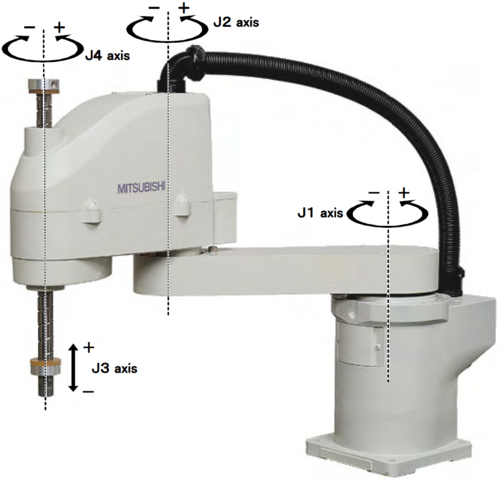
SCARA robot concept emerges
Japanese engineers at Yamanashi University began developing the SCARA (Selective Compliance Assembly Robot Arm), a kinematic configuration optimized for pick-and-place assembly tasks. Source — Wikipedia:
Serial SCARA robot By Mitsubishi Electric Automation, Inc. 500 Corporate Woods Pkwy - Vernon Hills, IL - 60061 - US - www.meau.com, CC BY-SA 4.0, https://commons.wikimedia.org/w/index.php?curid=133585140
1970 CE
Shakey the robot at SRI
SRI International developed Shakey, the first mobile robot capable of reasoning about its actions, integrating perception, planning, and control in a landmark for autonomous robotics. Source — Wikipedia:
SRI Shakey robot, 1969, Computer History Museum By The wub - Own work, CC BY-SA 4.0, https://commons.wikimedia.org/w/index.php?curid=158377025
1973 CE
WABOT-1 humanoid robot built
Waseda University in Tokyo completed WABOT-1, the first full-scale humanoid intelligent robot, with limb control, vision, and tactile sensors, representing a milestone in humanoid robotics and HCI. #contemporary #science
1979 CE
Denavit-Hartenberg convention
Jacques Denavit and Richard Hartenberg's 1955 kinematic notation became the standard method for representing robot joint configurations, formalized in their 1964 textbook and widely adopted by 1979. Source — Wikipedia:
Illustrates the transformation parameters of a pair of reference frames laid out according to Denavit-Hartenberg convention By Ethan Tira-Thompson - Own work, CC BY-SA 3.0, https://commons.wikimedia.org/w/index.php?curid=8329294
1986 CE
Honda begins humanoid robot program
Honda secretly initiated its humanoid robotics research program, which would eventually produce the P-series robots and the ASIMO humanoid, advancing bipedal locomotion control. Source — Wikipedia:
Tokyo Motor Show 2011: ASIMO (version 2011) By Morio - photo taken by Morio, CC BY-SA 3.0, https://commons.wikimedia.org/w/index.php?curid=17674119
1997 CE
Sojourner rover on Mars
NASA's Mars Pathfinder mission deployed the Sojourner microrover, the first autonomous robotic vehicle to operate on another planet, demonstrating remote autonomous navigation and control. Source — Wikipedia: )
Sojourner Rover Near The Dice By NASA - http://photojournal.jpl.nasa.gov/catalog/PIA01122, Public domain, https://commons.wikimedia.org/w/index.php?curid=328753Mars Pathfinder - 20th Anniversary Special
2000 CE
ASIMO humanoid unveiled
Honda unveiled ASIMO, a humanoid robot capable of walking, running, and interacting with humans, representing a major advance in bipedal locomotion kinematics and human-robot interaction. Source — Wikipedia:
Tokyo Motor Show 2011: ASIMO (version 2011) By Morio - photo taken by Morio, CC BY-SA 3.0, https://commons.wikimedia.org/w/index.php?curid=17674119
2002 CE
iRobot launches Roomba
iRobot released the Roomba, the first mass-produced autonomous home cleaning robot, bringing mobile robot navigation and consumer human-robot interaction into everyday households. Source — Wikipedia:
First generation Roomba (Roomba is a trademark of iRobot). By Larry D. Moore - Own work, CC BY 4.0, https://commons.wikimedia.org/w/index.php?curid=610397
2005 CE
Boston Dynamics reveals BigDog
Boston Dynamics introduced BigDog, a quadruped robot using dynamic balance control to traverse rough terrain, advancing the field of legged locomotion and autonomous stabilization. Source — Wikipedia:
BigDog robots trot around in the shadow of an MV-22 Osprey. BigDog is a dynamically stable quadruped robot created in 2005 by Boston Dynamics with Foster Miller, the Jet Propulsion Laboratory, and the Harvard University Concord Field Station. By U.S. Marine Corps photo by Lance Cpl. M. L. Meier. - Provenance page, Image page, Public domain, https://commons.wikimedia.org/w/index.php?curid=3492725Boston Dynamics - BigDog
2011 CE
Curiosity rover lands on Mars
NASA's Curiosity rover successfully landed on Mars using a sky-crane descent system, operating as a sophisticated autonomous robotic laboratory for planetary exploration. Source — Wikipedia: )
This self-portrait of NASA's Curiosity Mars rover shows the vehicle at the "Big Sky" site, where its drill collected the mission's fifth taste of Mount Sharp. The scene combines dozens of images taken during the 1,126th Martian day, or sol, of Curiosity's work during Mars (Oct. 6, 2015, PDT), by the Mars Hand Lens Imager (MAHLI) camera at the end of the rover's robotic arm. The rock drilled at this site is sandstone in the Stimson geological unit inside Gale Crater. The view is centered toward the west-northwest. It does not include the rover's robotic arm, though the shadow of the arm is visible on the ground. Wrist motions and turret rotations on the arm allowed MAHLI to acquire the mosaic's component images. The arm was positioned out of the shot in the images, or portions of images, that were used in this mosaic. This portrait of the rover was designed to show the Chemistry and Camera (ChemCam) instrument atop the rover appearing level. This causes the horizon to appear to tilt toward the left, but in reality, it appears fairly flat. For scale, the rover's wheels are 20 inches (50 centimeters) in diameter and about 16 inches (40 centimeters) wide. The drilled hole in the rock, appearing grey near the lower left corner of the image (image cropped, see original source), is 0.63 inch (1.6 centimeters) in diameter. By NASA - http://photojournal.jpl.nasa.gov/catalog/PIA19920, Public domain, https://commons.wikimedia.org/w/index.php?curid=448270647 Minutes of Terror: The Challenges of Getting to Mars
2016 CE
AlphaGo defeats Lee Sedol
DeepMind's AlphaGo defeated world champion Lee Sedol at Go, demonstrating deep reinforcement learning capabilities with implications for autonomous decision-making in robotics. · Wikipedia: https://en.wikipedia.org/wiki/AlphaGo
The Story of AlphaGo: How AI Conquered the World's Hardest Game
2021 CE
Perseverance and Ingenuity on Mars
NASA's Perseverance rover deployed the Ingenuity helicopter, the first powered controlled flight on another planet, advancing autonomous robotic exploration and real-time control in extreme environments. Source — Wikipedia: )
Mars helicopter on sol 46 By NASA - https://mars.nasa.gov/mars2020/multimedia/raw-images/SI1_0046_0671022109_238ECM_N0031416SRLC07021_000085J, Public domain, https://commons.wikimedia.org/w/index.php?curid=103218073First Video of NASA's Ingenuity Mars Helicopter in Flight, Includes Takeoff and Landing (High-Res)
2022 CE
Tesla reveals Optimus humanoid
Tesla unveiled the Optimus humanoid robot prototype, aiming to mass-produce general-purpose humanoid robots for industrial and domestic tasks, reflecting the trend toward accessible bipedal automation. Source — Wikipedia: )
Optimus bot at Tesla showroom By Sikander - Own work, CC BY-SA 4.0, https://commons.wikimedia.org/w/index.php?curid=178721148