Encyclopedia/2. Technology & The Built World/1. Computing, AI & Information Technology/01. Hardware & Electronics • Curated by Admin Timeline.sg
Machine learning · Neural architectures · Natural language processing
Chronological Storyline (25 Milestones)
2500 BCE
Mesopotamian abacus emerges
The earliest counting boards appear in Mesopotamia, providing a tangible tool for arithmetic that would influence computational aids for millennia across civilizations. · Wikipedia: https://en.wikipedia.org/wiki/Abacus
Line art drawing of an abacus By Pearson Scott Foresman - This image has been extracted from another file, Public domain, https://commons.wikimedia.org/w/index.php?curid=3503686
500 BCE
Panini formalizes Sanskrit grammar
The Indian scholar Panini produces the Ashtadhyayi, a rigorous formal grammar of Sanskrit with production rules that anticipate modern formal-language theory and computational linguistics. Source — Wikipedia:
200 BCE
Chinese counting rods in use
Counting rods are used in China for positional decimal arithmetic and solving linear equations, representing one of the earliest systematic mechanical aids for mathematical computation. Source — Wikipedia:
Drawing of Pascal's Triangle published in C.E.1303 by Zhu Shijie (C.E.1260-1320), in his Si Yuan Yu Jian. It was called Jia Xian triangle or Yanghui Triangle by the Chinese, after the mathematician Jia Xian & Yang Hui. By Yáng Huī (楊輝), ca. 1238–1298) - w:en:Image:Yanghui_triangle.gif, Public domain, https://commons.wikimedia.org/w/index.php?curid=1189650
820 CE
al-Khwarizmi systematizes algebra
Persian scholar al-Khwarizmi writes Al-Jabr, formalizing algebraic methods of solving equations; his name gives us the word 'algorithm,' foundational to all computer science. · Wikipedia: https://en.wikipedia.org/wiki/Muhammad_ibn_Musa_al-Khwarizmi
Monumento a Muhammad al-Juarismi en la Ciudad Universitaria de Madrid By Zarateman - Own work, CC0, https://commons.wikimedia.org/w/index.php?curid=162213187
1206 CE
al-Jazari builds programmable automata
Arab engineer al-Jazari designs a musical automaton with adjustable camshafts, an early example of programmable mechanical control described in his Book of Knowledge of Ingenious Mechanical Devices. · Wikipedia: https://en.wikipedia.org/wiki/Ismail_al-Jazari
The elephant clock from Al-Jazari's manuscript. By Al-Jazari - http://www.muslimheritage.com/topics/default.cfm?ArticleID=466, Public domain, https://commons.wikimedia.org/w/index.php?curid=4173094
1936 CE
Turing defines universal computation
Alan Turing publishes 'On Computable Numbers,' defining the universal Turing machine and establishing the mathematical foundations for all general-purpose computation. · Wikipedia: https://en.wikipedia.org/wiki/Turing_machine
Turing Machine, reconstructed by Mike Davey as seen at Go Ask ALICE at Harvard University By Rocky Acosta - Own work, CC BY 3.0, https://commons.wikimedia.org/w/index.php?curid=24369879
1943 CE
McCulloch and Pitts model neurons
Warren McCulloch and Walter Pitts propose the first mathematical model of a biological neuron, showing that networks of such units can in principle compute any logical function. · Wikipedia: https://en.wikipedia.org/wiki/McCulloch%E2%80%93Pitts_neuron
Atrificial neuron structure By Funcs - Own work, CC0, https://commons.wikimedia.org/w/index.php?curid=148910507
1950 CE
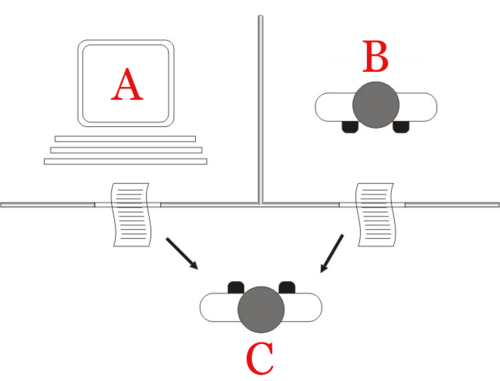
Turing proposes the imitation game
Alan Turing publishes 'Computing Machinery and Intelligence,' introducing the Turing Test as a criterion for machine intelligence and framing the question 'Can machines think?' · Wikipedia: https://en.wikipedia.org/wiki/Turing_test
Diagram of the Turing test. This file was derived from: Test de Turing.jpg: By Juan Alberto Sánchez Margallo - File:Test_de_Turing.jpg, CC BY 2.5, https://commons.wikimedia.org/w/index.php?curid=57298943
Jun 1, 1956 CE
Dartmouth Conference founds AI
John McCarthy, Marvin Minsky, Claude Shannon, and Nathaniel Rochester organize the Dartmouth Summer Research Project, coining the term 'artificial intelligence' and establishing it as a field. Source — Wikipedia:
1958 CE
Rosenblatt invents the perceptron
Frank Rosenblatt introduces the perceptron, the first trainable neural network model, enabling machines to learn binary classification from data. Source — Wikipedia:
1966 CE
Weizenbaum creates ELIZA chatbot
Joseph Weizenbaum at MIT builds ELIZA, a natural language processing program that simulates a Rogerian psychotherapist and demonstrates surprisingly human-like conversational ability. · Wikipedia: https://en.wikipedia.org/wiki/ELIZA
A conversation with the ELIZA chatbot. By Unknown author - File:ELIZA conversation.jpg, Public domain, https://commons.wikimedia.org/w/index.php?curid=99305439
1969 CE
Minsky and Papert limit perceptrons
Marvin Minsky and Seymour Papert publish 'Perceptrons,' proving single-layer networks cannot solve XOR and contributing to reduced neural network funding for years. Source — Wikipedia: )
1980 CE
Fukushima proposes Neocognitron
Kunihiko Fukushima introduces the Neocognitron, a hierarchical multilayer neural network inspired by visual cortex that is a direct precursor to convolutional neural networks. · Wikipedia: https://en.wikipedia.org/wiki/Neocognitron
1986 CE
Backpropagation popularized
David Rumelhart, Geoffrey Hinton, and Ronald Williams publish the backpropagation learning algorithm, enabling effective training of multi-layer neural networks and reviving the field. · Wikipedia: https://en.wikipedia.org/wiki/Backpropagation
May 11, 1997 CE
Deep Blue defeats world chess champion
IBM's Deep Blue defeats Garry Kasparov, marking the first time a machine beats a reigning world chess champion under tournament conditions and a milestone in game-playing AI. Source — Wikipedia: )
Deep Blue, a computer similar to this one defeated chess world champion Garry Kasparov in May 1997. It is the first computer to win a match against a world champion. Photo taken at the Computer History Museum. By James the photographer - https://www.flickr.com/photos/22453761@N00/592436598/, CC BY 2.0, https://commons.wikimedia.org/w/index.php?curid=3511068Deep Blue vs Kasparov: How a computer beat best chess player in the world - BBC News
1997 CE
Hochreiter proposes LSTM networks
Sepp Hochreiter and Jürgen Schmidhuber introduce Long Short-Term Memory networks, solving the vanishing gradient problem and enabling recurrent networks to learn long-range dependencies. · Wikipedia: https://en.wikipedia.org/wiki/Long_short-term_memory
Precise visual depiction of a LSTM Cell. By Leouscin - Own work, CC0, https://commons.wikimedia.org/w/index.php?curid=179763179
Feb 16, 2011 CE
Watson wins Jeopardy!
IBM's Watson defeats human champions Ken Jennings and Brad Rutter on Jeopardy!, demonstrating advanced natural language understanding and question-answering at scale. Source — Wikipedia:
An early prototype of Watson in Yorktown Heights, NY. The cognitive computing system was originally the size of a master bedroom in 2011. By Clockready - Own work, CC BY-SA 3.0, https://commons.wikimedia.org/w/index.php?curid=15891787Watson and the Jeopardy! Challenge
Sep 30, 2012 CE
AlexNet wins ImageNet competition
Alex Krizhevsky, Ilya Sutskever, and Geoffrey Hinton's AlexNet wins the ImageNet competition by a large margin, igniting the deep learning revolution through GPU-trained convolutional networks. · Wikipedia: https://en.wikipedia.org/wiki/AlexNet
AlexNet block diagram By Zhang, Aston and Lipton, Zachary C. and Li, Mu and Smola, Alexander J. - https://github.com/d2l-ai/d2l-en, CC BY-SA 4.0, https://commons.wikimedia.org/w/index.php?curid=152265712
2014 CE
Goodfellow introduces GANs
Ian Goodfellow and colleagues invent Generative Adversarial Networks, pitting generator against discriminator to produce realistic synthetic data and advancing generative modeling. · Wikipedia: https://en.wikipedia.org/wiki/Generative_adversarial_network
Generative adversarial network By Zhang, Aston and Lipton, Zachary C. and Li, Mu and Smola, Alexander J. - https://github.com/d2l-ai/d2l-en, CC BY-SA 4.0, https://commons.wikimedia.org/w/index.php?curid=152265649
Mar 15, 2016 CE
AlphaGo defeats Lee Sedol
DeepMind's AlphaGo defeats world champion Lee Sedol in Go, a game long thought resistant to AI, using deep reinforcement learning and Monte Carlo tree search. · Wikipedia: https://en.wikipedia.org/wiki/AlphaGo
Match 1 - Google DeepMind Challenge Match: Lee Sedol vs AlphaGo
Jun 1, 2017 CE
Transformer architecture published
Ashish Vaswani and colleagues at Google publish 'Attention Is All You Need,' introducing the Transformer architecture that enables parallel training and revolutionizes natural language processing. · Wikipedia: https://en.wikipedia.org/wiki/Transformer_(deep_learning_architecture)
Illustrations for the Transformer, and attention mechanism. Transformer, full architecture. By dvgodoy - https://github.com/dvgodoy/dl-visuals/?tab=readme-ov-file, CC BY 4.0, https://commons.wikimedia.org/w/index.php?curid=151216016
Jun 1, 2018 CE
BERT transforms language understanding
Jacob Devlin and colleagues at Google release BERT, a bidirectional Transformer model that sets new state-of-the-art results across natural language understanding benchmarks. · Wikipedia: https://en.wikipedia.org/wiki/BERT_(language_model)
Jun 1, 2020 CE
GPT-3 demonstrates few-shot learning
OpenAI releases GPT-3, a 175-billion-parameter language model that demonstrates remarkable few-shot learning across diverse natural language tasks, showcasing emergent capabilities of scale. · Wikipedia: https://en.wikipedia.org/wiki/GPT-3
Nov 30, 2022 CE
ChatGPT brings conversational AI to millions
OpenAI launches ChatGPT, a conversational interface to GPT-3.5 that reaches 100 million users in two months and makes large language models a mainstream technology. Source — Wikipedia:
OpenAI's blossom logo, used since February 2025 By OpenAI - This file was derived from: OpenAI logo 2025.svg, Public domain, https://commons.wikimedia.org/w/index.php?curid=159145630The ChatGPT Revolution | CBS Reports
Mar 14, 2023 CE
GPT-4 released with multimodal capability
OpenAI releases GPT-4, a multimodal model that accepts both text and images while achieving human-level performance on many professional and academic benchmarks. Source — Wikipedia: