Encyclopedia/3. History, Societies & Civilizations/09. Modern Nations/05. Europe • Curated by Admin Timeline.sg
History of Lithuania (AI-generated, sourced to Wikipedia).
Chronological Storyline (34 Milestones)
Mar 9, 1009 CE
First written mention of Lithuania
The Annals of Quedlinburg record the name 'Litua' in connection with the missionary Bruno of Querfurt, marking the first known written reference to Lithuania. Source — Wikipedia, "Lithuania":
Flag of Lithuania By Original: Jonas Basanavičius, Tadas Daugirdas and Antanas Žmuidzinavičius Vector: SKopp The SVG code is valid. This flag was created with a text editor.Previous version had been created with Inkscape (1930 bytes) f now 14.15% of previous size Please do not replace the simplified code of this file with a version created with Inkscape or any other graphical vector graphics editor - Own work, Public domain, https://commons.wikimedia.org/w/index.php?curid=343633Video
Jul 6, 1253 CE
Mindaugas crowned king
Mindaugas was crowned King of Lithuania, uniting Baltic tribes into a single state and briefly accepting Christianity to secure his royal title. Source — Wikipedia, "Lithuania":
Depiction of the Lithuanian King Mindaugas. By Alexander Guagnini - Kronika Sarmacyey Europskiey, w Ktorey Sie Zamyka krolestwo Polskie ze wszystkiemi Państwy, Xięstwy, y Prowincyami swemi: tudzież też Wielkie Xięstwo Lithew: Ruskie, Pruskie, Zmudzkie, Inflantskie, Moskiewskie, y część Tatarow. Przez Alexandra Gwagnina z Werony ... W Krakowie, w Drukarni Mikołaia Loba, Roku Pańskiego 1611., Public domain, https://commons.wikimedia.org/w/index.php?curid=13961052
1323 CE
Vilnius first mentioned
Grand Duke Gediminas sent letters to European cities mentioning Vilnius as the capital, inviting craftsmen and merchants to settle in the growing city. Source — Wikipedia, "Lithuania":
The White Bridge and Šnipiškės district in Vilnius, Lithuania. By Augustas Didžgalvis - Source, CC-BY-SA-4.0, https://en.wikipedia.org/w/index.php?curid=77206702
1362 CE
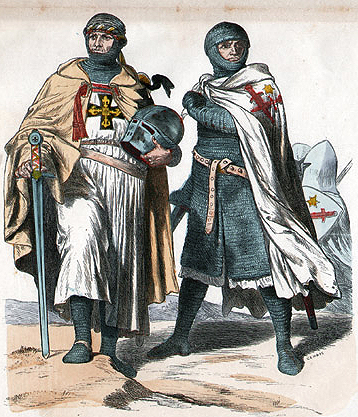
Teutonic Knights sack Kaunas
The Teutonic Order captured and destroyed the Kaunas Castle, part of centuries of conflict between the crusading order and the Lithuanian state. Source — Wikipedia, "Lithuania":
Hofmeiser des Deutschen Ordens / Schwertbrüder By Unknown author - en:Münchener Bilderbogen; file Nr 733., Public domain, https://commons.wikimedia.org/w/index.php?curid=109348653
Aug 14, 1385 CE
Union of Krewo
Grand Duke Jogaila agreed to marry Jadwiga of Poland and convert to Christianity, beginning the long political union between Lithuania and Poland. Source — Wikipedia, "Lithuania":
Union of Krewo By en:Jogaila - http://dziedzictwo.polska.pl/katalog/slide,Akt_unii_polsko-litewskiej_wystawiony_w_Krewie_dnia_14_VIII_1385_r,pid,183415,gid,183401,cid,177.htm, Public domain, https://commons.wikimedia.org/w/index.php?curid=18338485
1387 CE
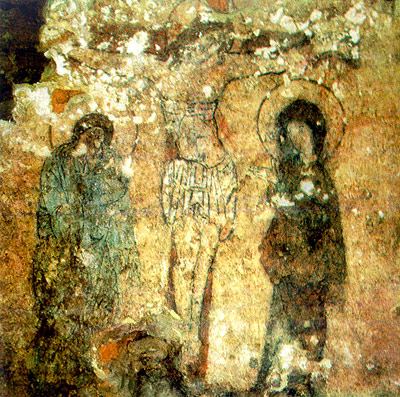
Lithuania officially Christianized
Jogaila, now Władysław II Jagiełło, led the formal Christianization of Lithuania, ending the last pagan state in Europe. Source — Wikipedia, "Lithuania":
Fresco in Vilnius Cathedral crypt. 14 century, author unknown. Fresco portraying crucified Jesus with St. Mary and St. John By Unknown author - taken from, Public domain, https://commons.wikimedia.org/w/index.php?curid=1230821
Jul 15, 1410 CE
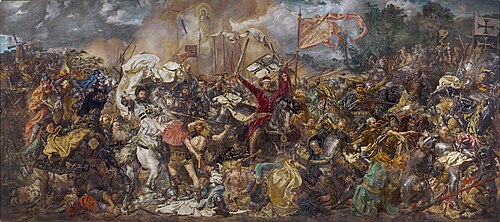
Battle of Grunwald
Polish and Lithuanian forces decisively defeated the Teutonic Knights at the Battle of Grunwald (Tannenberg), one of the largest medieval battles in European history. Source — Wikipedia, "Lithuania":
Jan Matejko. "The Battle of Grunwald" (1878) By Jan Matejko - http://cyfrowe.mnw.art.pl/dmuseion/docmetadata?id=4799, Public domain, https://commons.wikimedia.org/w/index.php?curid=49004656Video
1429 CE
Lithuania proposed as kingdom
At the Congress of Lutsk, Emperor Sigismund proposed elevating Lithuania to a kingdom, though Polish opposition prevented the coronation of Vytautas. Source — Wikipedia, "Lithuania":
Portrait seal of Grand Duke of Lithuania Vytautas the Great. By Unknown author - http://alkas.lt/2012/10/21/traku-pilyje-vytauto-didziojo-mirties-metiniu-minejimas-ir-knygos-didzioji-lietuva-pristatymas/, Public domain, https://commons.wikimedia.org/w/index.php?curid=84169488
1492 CE
Casimir IV dies
Casimir IV Jagiellon, Grand Duke of Lithuania and King of Poland, died after a reign that expanded the Jagiellonian dynasty across Central and Eastern Europe. Source — Wikipedia, "Lithuania":
Potrait of Casimir IV Jagiellon, King of Poland and Grand Duke of Lithuania, from the 17th century By Unknown author - Muzeum Zamkowe w Malborku (Malbork Castle), Public domain, https://commons.wikimedia.org/w/index.php?curid=26687653
1529 CE
First Lithuanian Statute
The Grand Duchy of Lithuania adopted its first legal code, the First Statute of Lithuania, one of the most advanced legal documents in contemporary Europe. Source — Wikipedia, "Lithuania":
Coat of arms of the Grand Duchy of Lithuania from the Statutes of Lithuania Statute (1614) By Unknown author - This image has been extracted from another file, Public domain, https://commons.wikimedia.org/w/index.php?curid=116752743
Jul 1, 1569 CE
Union of Lublin
Lithuania and Poland merged into the Polish-Lithuanian Commonwealth, creating one of the largest and most populous states in Europe. Source — Wikipedia, "Lithuania":
Głównym dziełem sejmu radomskiego 1505 r. miało być trwałe zjednoczenie z Polską Litwy oraz Prus. Zarówno konstytucje wydane na tym sejmie, jak i opublikowanie zbioru praw miały na celu między innymi ukazanie Korony jako Rzeczypospolitej praworządnej i sprawiedliwej, w której los poddanych nie jest zależny od samowoli władcy, lecz chroniony jest przez rozumne prawo i sprawiedliwość. Miał to być sygnał wysłany sąsiednim krajom, połączonym już wieloma węzłami z Polską, który miał wzbudzić ich zaufanie, co do ściślejszego z nią zespolenia aż do całkowitej unifikacji. Jak pisał Michał Bobrzyński, niezwykle uroczyście na zjeździe panów litewskich w Brześciu 25 lutego 1505 wystąpił kanclerz Jan Łaski. W imieniu polskiego senatu przedstawił on zagadnienia istotne z punktu widzenia unii, takie jak wspólna elekcja władcy, zapewnienie mu dochodów z dóbr stołowych takich, ażeby wystarczały nie tylko na utrzymanie dworu, lecz także na obronę państwa, organizacja dworu królewskiego. Pojawiła się tu także propozycja ustanowienia jednej stolicy w centrum połączonych krajów (prawdopodobnie miał nią być królewski Radom, do którego zwołano sejm walny, rozpoczęty 30 marca). Istotne były kwestie formy rządów i obrony państwa, rozstrzygania sporów, wspólnej dyplomacji oraz sejmów. Wzywając zaś panów litewskich do przybycia na sejm radomski, zwołany bez wątpienia głównie celem ostatecznego przypieczętowania integracji państw jagiellońskich, przemówić miał Łaski w te słowa: "Wiecie, jak sławna, jak straszna była potęga królów polskich, kiedy Korona razem z Wielkim Księstwem występowała i wojny połączonemi siłami toczyła, wiecie, jak bogaty był wówczas nasz wspólny monarcha, a teraz jak upadła powaga imienia królewskiego i potęga obojga rzeczy pospolitych, naszej i waszej". Była to zatem druga próba wcielenia w życie projektu wielkiego dzieła, który po raz pierwszy ujawniono w akcie tzw. unii piotrkowsko-mielnickiej. Jej artykuł pierwszy przewidywał, iż Regnum Poloniae et Magnus Ducatus Lithwaniae uniantur et conglutinentur in unum et indivisum ac indifferens corpus, ut sit una gens, unus populus, una fraternitas et communia consilia eidemque corpori perpetuo unum caput, unus rex unusque dominus in loco et tempore assignatis per praesentes et ad electionem convenientes votis communibus eligatur quodque absentium obstantia electio non impediatur et decretum electionis in Regno semper sit iuxta consuetudines circa illud ex antiquo servatas. Tym razem sprawy te miały zostać uregulowane już ostatecznie i nieodwołalnie podlegać realizacji. Był to jednak program jedynie panów koronnych; program, którego nie można było jeszcze zrealizować w początku XVI w. Członkowie rady wielkoksiążęcej, którzy zjechali do Radomia w maju 1505 nie dysponowali żadnymi pełnomocnictwami w tym zakresie, strona litewska nie wystawiła także rewersałów unii z roku 1501. Takim obrotem sprawy nie była zainteresowana także dynastia Jagiellonów, która w ten sposób utraciłaby swe dziedziczne prawa na Litwie. Szczególnie doniosłe znaczenie przyznać należy dziełu podjętemu w roku 1505. Podjęta została wówczas niezwykle ważna próba przebudowy całego systemu państwowego i politycznego. Nie mogła ona zakończyć się stuprocentowym powodzeniem, nie była, bowiem jeszcze możliwa w tym czasie ścisła integracja z Koroną wszystkich ziem z nią w jakiś sposób związanych. Udało się jednak dokonać na gruncie prawnym zmian ustrojowych w systemie władzy państwowej, a ponadto położyć fundament, na którym z czasem wzniesiono gmach Rzeczypospolitej Wielu Narodów, czego najdonioślejszym akcentem był prezentowany tutaj akt Unii Lubelskiej 1569 roku. By Unknown author - This file was provided to Wikimedia Commons by the Polish Central Archives of Historical Records as part of a cooperation project with Association "Archivum Patriae" and Wikimedia Polska., Public domain, https://commons.wikimedia.org/w/index.php?curid=33701093
1579 CE
University of Vilnius founded
Jesuit Stefan Batory founded the University of Vilnius, which became a major center of learning and culture in the Commonwealth. Source — Wikipedia, "Lithuania":
Flag of Lithuania By Original: Jonas Basanavičius, Tadas Daugirdas and Antanas Žmuidzinavičius Vector: SKopp The SVG code is valid. This flag was created with a text editor.Previous version had been created with Inkscape (1930 bytes) f now 14.15% of previous size Please do not replace the simplified code of this file with a version created with Inkscape or any other graphical vector graphics editor - Own work, Public domain, https://commons.wikimedia.org/w/index.php?curid=343633
1655 CE
Russians occupy Vilnius
During the Russo-Polish War, Muscovite forces captured and devastated Vilnius, killing much of the population and burning large parts of the city. Source — Wikipedia, "Lithuania":
Осада Ляхович русскими войсками в 1660 году By Unknown author - http://www.reenactor.ru/ARH/PDF/Babylin_02_pdf.rar, Public domain, https://commons.wikimedia.org/w/index.php?curid=8028104
1710 CE
Great Northern War plague
A devastating plague outbreak during the Great Northern War killed an estimated one-third of Lithuania's population, compounding wartime destruction. Source — Wikipedia, "Lithuania":
Flag of Lithuania By Original: Jonas Basanavičius, Tadas Daugirdas and Antanas Žmuidzinavičius Vector: SKopp The SVG code is valid. This flag was created with a text editor.Previous version had been created with Inkscape (1930 bytes) f now 14.15% of previous size Please do not replace the simplified code of this file with a version created with Inkscape or any other graphical vector graphics editor - Own work, Public domain, https://commons.wikimedia.org/w/index.php?curid=343633
1772 CE
First Partition
The Polish-Lithuanian Commonwealth lost territory to Russia, Prussia, and Austria in the First Partition, beginning the dismantling of the state. Source — Wikipedia, "Lithuania":
Polish-Lithuanian Commonwealth 1773-1789 By User:Mathiasrex, Maciej Szczepańczyk, vased on layers of User:Halibutt - Own work, CC BY 3.0, https://commons.wikimedia.org/w/index.php?curid=6584744
May 3, 1791 CE
Constitution of 3 May
The Commonwealth adopted Europe's first modern codified constitution, attempting reforms to preserve the state before its final partitions. Source — Wikipedia, "Lithuania":
Manuscript of the Constitution of the 3rd May 1791 By Ignacy Potocki (1750–1809), Hugo Kołłątaj (1750–1812), Stanisław August Poniatowski (1732–1798) - http://dziedzictwo.polska.pl/katalog/skarb,Rekopis_Konstytucji_3_Maja_z_1791_roku,gid,111046,cid,1074.htm, Public domain, https://commons.wikimedia.org/w/index.php?curid=8753597
1795 CE
Final Partition erases state
The Third Partition of the Polish-Lithuanian Commonwealth extinguished the state entirely, with most Lithuanian lands annexed by the Russian Empire. Source — Wikipedia, "Lithuania":
Partitions of the Polish-Lithuanian Commonwealth in 1772, 1793 and 1795. By Rzeczpospolita_Rozbiory_3.png: Halibutt derivative work: Sneecs (talk) - Rzeczpospolita_Rozbiory_3.png, CC BY-SA 3.0, https://commons.wikimedia.org/w/index.php?curid=6098211
1831 CE
November Uprising in Lithuania
Lithuanians joined the November Uprising against Russian rule; its suppression led to intensified Russification policies and the closure of Vilnius University in 1832. Source — Wikipedia, "Lithuania":
November Uprising in Lithuania By Marcin Zaleski - http://cyfrowe.mnw.art.pl/dmuseion/docmetadata?id=5274, Public domain, https://commons.wikimedia.org/w/index.php?curid=43386385
1864 CE
Lithuanian press ban imposed
After the January Uprising, Russian authorities banned Lithuanian publications in the Latin alphabet, lasting four decades and sparking large-scale book smuggling. Source — Wikipedia, "Lithuania":
Popular Lithuanian prayer book "Auksa altorius" (Golden Altar) published in Latin alphabet just before the times of Lithuanian press ban. By Published by Jozapa Zawadzki printing house - Cropped from PowerPoint presentation by Giedrius Subačius, Associate Professor at the University of Illinois, Public domain, https://commons.wikimedia.org/w/index.php?curid=2662516
1883 CE
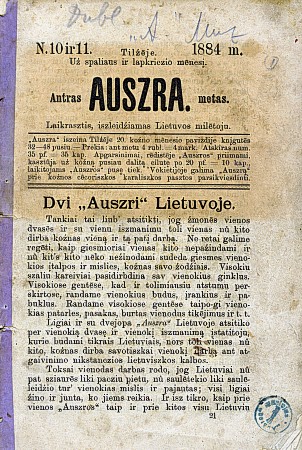
Aušra newspaper published
The first Lithuanian-language newspaper in the Latin alphabet was published in East Prussia, becoming a cornerstone of the Lithuanian national revival. Source — Wikipedia, "Lithuania":
Aušra newspaper issues 10&11 published in 1884 By Unknown author - From Šiauliai Aušra Museum, Public domain, https://commons.wikimedia.org/w/index.php?curid=1496847
May 7, 1904 CE
Press ban lifted
Tsar Nicholas II lifted the ban on Lithuanian-language press in the Latin alphabet, ending 40 years of censorship and book smuggling. Source — Wikipedia, "Lithuania":
Popular Lithuanian prayer book "Auksa altorius" (Golden Altar) published in Latin alphabet just before the times of Lithuanian press ban. By Published by Jozapa Zawadzki printing house - Cropped from PowerPoint presentation by Giedrius Subačius, Associate Professor at the University of Illinois, Public domain, https://commons.wikimedia.org/w/index.php?curid=2662516
Feb 16, 1918 CE
Independence declared
The Council of Lithuania signed the Act of Independence, restoring a sovereign Lithuanian state after 123 years of foreign rule. Source — Wikipedia, "Lithuania":
Scan of the original Act of Independence of Lithuania hand-written in Lithuanian language and with twenty original signatures, which was found on 29 March 2017 by Vytautas Magnus University professor Liudas Mažylis at the Federal Foreign Office Political Archive in Berlin, Germany. By Council of Lithuania - https://www.facebook.com/photo.php?fbid=1480682095289159&set=a.717198831637493.1073741825.100000421494419&type=3&theater, Public domain, https://commons.wikimedia.org/w/index.php?curid=57590648Video
Jul 12, 1920 CE
Treaty of Moscow signed
Soviet Russia recognized Lithuania's independence and sovereignty in the Treaty of Moscow, ceding claims to Lithuanian territory. Source — Wikipedia, "Lithuania":
Map of territorial disputes and claims regarding Lithuania in 1939-1940. For the legend see the description page for the source file at image:Lithuania territory 1939-1940.svg. By Renata3 - Self-made using Inkscape; used Image:LithuaniaPhysicalMap-Clean.svg by Knutux for some background features; Source map: (2001) Lietuvos istorijos atlasas, Vilnius: Vaga, p. 44 & 45, CC BY-SA 4.0, https://commons.wikimedia.org/w/index.php?curid=3788418
Jan 1, 1923 CE
Klaipėda Revolt
Lithuanian forces staged a revolt and annexed the Klaipėda (Memel) region, gaining Lithuania's only major Baltic seaport. Source — Wikipedia, "Lithuania":
Germany's province of East Prussia from 1923 to 1939, with Memel occupied by Lithuania since 1923 By original SVG file created by Matthead (based on East_Prussia_1939.kpg from English Wikipedia) - A version of File:East Prussia 1923-1939 map-fr.svg with French text changed to English, CC BY-SA 4.0, https://commons.wikimedia.org/w/index.php?curid=59081410
Jun 15, 1940 CE
Soviet occupation begins
The Soviet Union occupied and annexed Lithuania following the Molotov-Ribbentrop Pact, ending two decades of interwar independence. Source — Wikipedia, "Lithuania":
A Baltic exilee protest sign from the second half of the 20th century calling on U.N. to abolish Soviet colonialism in Lithuania, Latvia and Estonia, exhibition "Nyet, nyet, Soviet! Political protests and demonstrations outside Latvia 1945-1991" at the Latvian Railway History Museum. By Turaids - Own work, CC BY-SA 4.0, https://commons.wikimedia.org/w/index.php?curid=118235649
Jun 1, 1941 CE
June Uprising and Holocaust
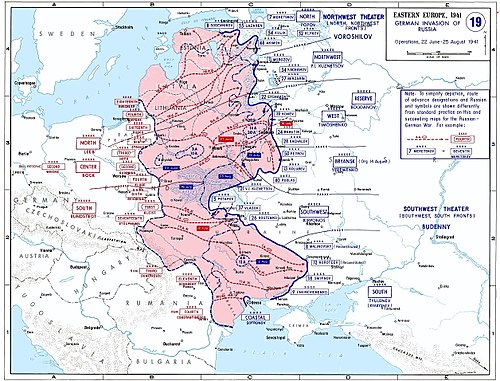
Lithuanians staged an anti-Soviet uprising as Nazi Germany invaded, but the subsequent German occupation brought the near-total destruction of Lithuanian Jewry. Source — Wikipedia, "Lithuania":
Axis Invasion of the Soviet Union, 22 June to 25 August 1941. By Unknown US Army Cartographer - The Department of History, United States Military Academy [1] archive of the exact map, Public domain, https://commons.wikimedia.org/w/index.php?curid=1400224
1944 CE
Second Soviet occupation
The Red Army reoccupied Lithuania, forcing it back into the Soviet Union and sparking an armed partisan resistance that lasted into the 1950s. Source — Wikipedia, "Lithuania":
Lithuanian partisans of the Vytautas military district Tigras (Tiger) team in 1947. By Unknown author - 15min.lt, Public domain, https://commons.wikimedia.org/w/index.php?curid=113487215
May 14, 1972 CE
Romas Kalanta self-immolation
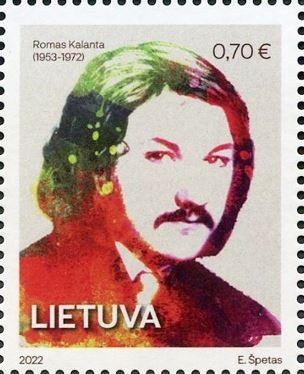
Nineteen-year-old student Romas Kalanta set himself on fire in Kaunas to protest Soviet occupation, sparking mass demonstrations across Lithuania. Source — Wikipedia, "Lithuania":
Romas Kalanta By E. Špetas (Post of Lithuania) - https://post.lt/lt/filatelijos-naujienos, Public domain, https://commons.wikimedia.org/w/index.php?curid=118143240
Aug 23, 1989 CE
Baltic Way human chain
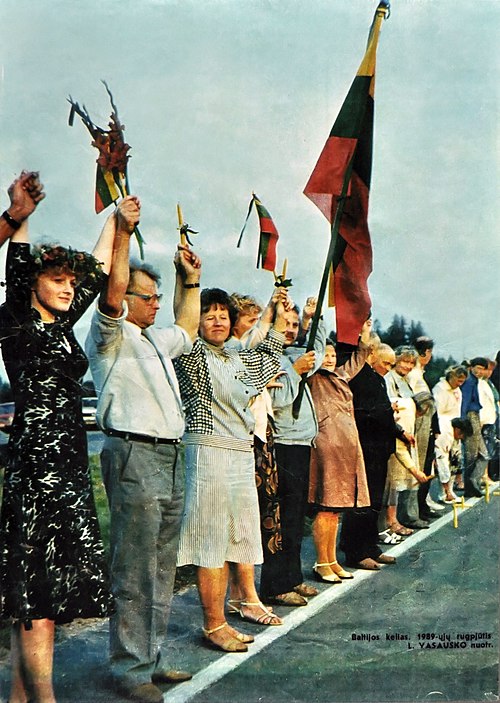
Some two million people joined hands in a 600-km chain from Tallinn to Vilnius to protest the Molotov-Ribbentrop Pact on its 50th anniversary. Source — Wikipedia, "Lithuania":
Photo of the Baltic Way published in Moteris magazine. Participants hold candles and Lithuanian flags with black ribbons to express mourning and disagreement about the situation they are living. By L. Vasauskas - Europeana 1989 (more details; direct link to file), CC BY-SA 4.0, https://commons.wikimedia.org/w/index.php?curid=81607619Video
Mar 11, 1990 CE
Independence restored
The Supreme Council of Lithuania adopted the Act of the Re-Establishment of the State of Lithuania, the first Soviet republic to declare independence. Source — Wikipedia, "Lithuania":
Act of Restoration of Independence of Lithuania. By Supreme Council of Lithuania - [1], Public domain, https://commons.wikimedia.org/w/index.php?curid=34595224
Jan 13, 1991 CE
January Events
Soviet troops attacked the Vilnius TV Tower, killing 14 unarmed civilians, but Lithuania's independence drive could not be reversed. Source — Wikipedia, "Lithuania":
January 13 events in Vilnius, Lithuania By Unspecified - http://www.kam.lt/images/2734/8629, GFDL, https://commons.wikimedia.org/w/index.php?curid=8258108Video
Mar 29, 2004 CE
Joins NATO
Lithuania became a member of NATO, securing collective defense guarantees as part of the alliance's eastward expansion. Source — Wikipedia, "Lithuania":
Flag of Lithuania By Original: Jonas Basanavičius, Tadas Daugirdas and Antanas Žmuidzinavičius Vector: SKopp The SVG code is valid. This flag was created with a text editor.Previous version had been created with Inkscape (1930 bytes) f now 14.15% of previous size Please do not replace the simplified code of this file with a version created with Inkscape or any other graphical vector graphics editor - Own work, Public domain, https://commons.wikimedia.org/w/index.php?curid=343633
May 1, 2004 CE
Joins European Union
Lithuania acceded to the European Union along with nine other countries, completing its reintegration into Western political and economic structures. Source — Wikipedia, "Lithuania":
European Union Die alten Mitgliedsländer Die zehn neuen Mitgliedsländer By Europe_countries.svg: Júlio Reis derivative work: Kolja21 (talk) - EU25-2004_European_Union_map.svg, CC BY-SA 2.5, https://commons.wikimedia.org/w/index.php?curid=6814207
2009 CE
Vilnius European Capital of Culture
Vilnius was named a European Capital of Culture, celebrating the city's millennium and showcasing Lithuanian arts and heritage to an international audience. Source — Wikipedia, "Lithuania":
The White Bridge and Šnipiškės district in Vilnius, Lithuania. By Augustas Didžgalvis - Source, CC-BY-SA-4.0, https://en.wikipedia.org/w/index.php?curid=77206702