Encyclopedia/2. Technology & The Built World/3. Civil, Architectural & Structural Engineering/01. Infrastructure & Architecture • Curated by Admin Timeline.sg
Signal processing · Antenna theory · Wireless network architecture
Chronological Storyline (25 Milestones)
700 BCE
Great Wall beacon-tower relay system
Chinese beacon towers along the Great Wall relayed smoke and fire signals across vast distances, enabling rapid military communication between frontier posts and the imperial capital. Source — Wikipedia:
The Great Wall of China at Jinshanling By Severin.stalder - Own work, CC BY-SA 3.0, https://commons.wikimedia.org/w/index.php?curid=39661035
600 BCE
Achaemenid Persian relay post system
The Persian Empire established the Angarium, a mounted postal relay network that Herodotus described as enabling messages to travel across the empire faster than a crane could fly. Source — Wikipedia:
Achaemenid Empire at its greatest extent according to Oxford Atlas of World History 2002. Sources: Visible online: 2002 Oxford Atlas of World History p.42 (West portion of the Achaemenid Empire) and p.43 (East portion of the Achaemenid Empire).(in English) (2002) Atlas of World History, Oxford University Press, pp. 42−43 ISBN: 9780195219210. Visible online: Philip's Atlas of World History (1999) The Times Atlas of World History, p.79 (1989)(in English) (1989) The Times Atlas of World History, Times Books, p. 79 ISBN: 9780723003041. By Original creator: Mossmaps Corrections according to Oxford Atlas of World History 2002, The Times Atlas of World History (1989), Philip's Atlas of World History (1999) by पाटलिपुत्र (talk) - This file was derived from: The Achaemenid Empire at its Greatest Extent.jpg, CC BY-SA 4.0, https://commons.wikimedia.org/w/index.php?curid=73745174
200 BCE
Han Dynasty drum and flag relay communication
Han Dynasty China employed drum-tower and flag-signal relay systems for government and military communication, standardizing signalling codes across the empire's administrative network. Source — Wikipedia:
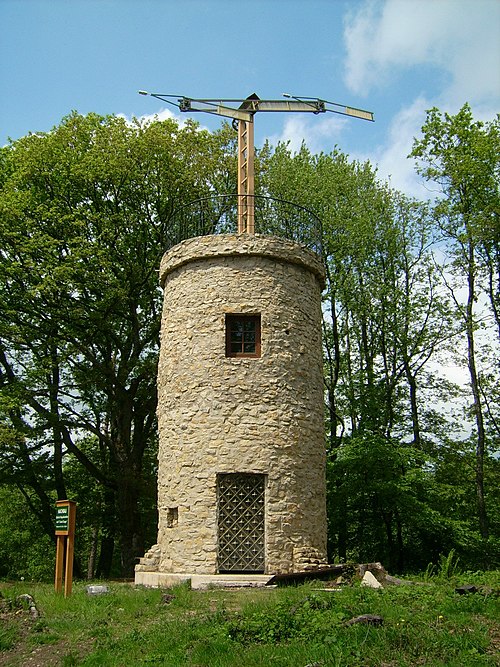
"Optischer Telegraf" (Replikation) von Claude Chappe auf dem "Litermont" bei Nalbach in Deutschland. By Lokilech at German Wikipedia - Own work, CC BY-SA 3.0, https://commons.wikimedia.org/w/index.php?curid=784410
1088 CE
Shen Kuo documents magnetic declination
Chinese polymath Shen Kuo first described magnetic declination in his Dream Pool Essays, advancing the compass for navigation and laying groundwork for understanding Earth's magnetic field relevant to later radio propagation. Source — Wikipedia:
Exhibition description: Shen Kuo (1031-1095 AD) A prominent scientist and astrononmer of the Song Dynasty. Shen Kuo was the head official of the Bureau of Astronomy in the Song court, where he improved the design of several local astronomical instruments, including the amillary aphere, the gnomon and the clepsydra clock. He also formulated a solar calendar named the Twelve Solar Terms Calendar, which was used in agriculture. His work are summed up in his Dream Pool Essays, one of the greatest books of that time. By Hans A. Rosbach - Own work, CC BY-SA 3.0, https://commons.wikimedia.org/w/index.php?curid=89508454
1792 CE
Claude Chappe's optical telegraph
French inventor Claude Chappe built the first practical semaphore telegraph system between Paris and Lille, transmitting encoded messages via mechanically articulated visual signals on towers. Source — Wikipedia:
Claude Chappe's optical telegraph By Henri Rousseau - Album du Centenaire; photographs by User:Havang(nl), Public domain, https://commons.wikimedia.org/w/index.php?curid=11980708
1831 CE
Faraday discovers electromagnetic induction
Michael Faraday at the Royal Institution demonstrated electromagnetic induction, establishing the fundamental relationship between electricity and magnetism that underpins all radio-frequency technology. Source — Wikipedia:
Michael Faraday By Unknown author - [1], Public domain, https://commons.wikimedia.org/w/index.php?curid=141504840
1865 CE
Maxwell publishes electromagnetic theory
James Clerk Maxwell published 'A Dynamical Theory of the Electromagnetic Field,' mathematically unifying electricity and magnetism and predicting electromagnetic waves traveling at the speed of light. · Wikipedia: https://en.wikipedia.org/wiki/A_Dynamical_Theory_of_the_Electromagnetic_Field
1887 CE
Hertz demonstrates radio waves
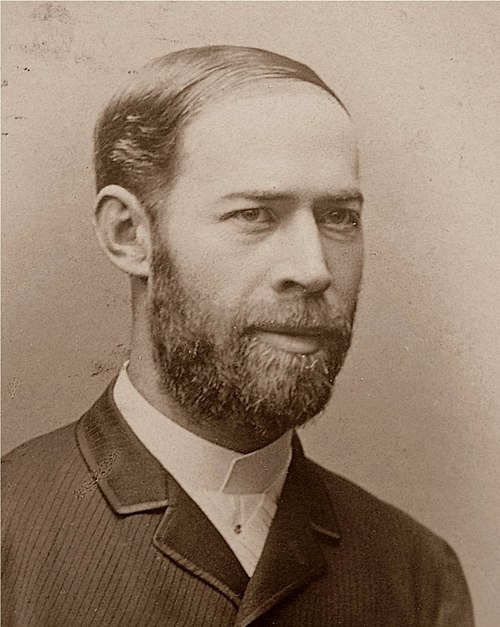
Heinrich Hertz experimentally verified Maxwell's predicted electromagnetic waves in his Karlsruhe laboratory, generating and detecting radio-frequency waves and measuring their properties. Source — Wikipedia:
Heinrich Rudolf Hertz (1857 - 1894), was a German physicist. By Robert Krewaldt, Kaiserplatz 16, Bonn - Cabinetphotograph, Kabinettfotografie, Public domain, https://commons.wikimedia.org/w/index.php?curid=26781773Heinrich Hertz: The Physicist Who Proved Electromagnetic Waves! (1857–1894)
May 7, 1895 CE
Marconi's first wireless transmission
Guglielmo Marconi transmitted wireless signals over a distance of 1.5 kilometers on his family estate in Bologna, launching the practical era of radio communication. · Wikipedia: https://en.wikipedia.org/wiki/Guglielmo_Marconi
Guglielmo Marconi, portrait, head and shoulders, facing left. By Pach Brothers - This image is available from the United States Library of Congress's Prints and Photographs division under the digital ID cph.3a40043.This tag does not indicate the copyright status of the attached work. A normal copyright tag is still required. See Commons:Licensing., Public domain, https://commons.wikimedia.org/w/index.php?curid=122016Guglielmo Marconi: The Invention of Wireless Telegraphy & Radio | History of Communication
Dec 12, 1901 CE
First transatlantic radio signal
Marconi received the letter 'S' transmitted from Poldhu, Cornwall, at St. John's, Newfoundland, proving that radio waves could cross the Atlantic Ocean despite the curvature of the Earth. #modern #science
Dec 24, 1906 CE
Fessenden's first radio broadcast
Reginald Fessenden transmitted the first amplitude-modulation radio voice and music broadcast from Brant Rock, Massachusetts, demonstrating audio transmission via radio waves. Source — Wikipedia:
Reginald Fessenden By None listed - "American Wireless Telegraphy", Harper's Weekly Magazine, February 21, 1903, page 298, Public domain, https://commons.wikimedia.org/w/index.php?curid=926432
1924 CE
Yagi-Uda antenna published
Hidetsugu Yagi and Shintaro Uda in Japan developed the highly directional Yagi-Uda antenna, which became one of the most widely used antenna designs in television and radio communications worldwide. Source — Wikipedia:
A television antenna from a 1954 advertisement by the Radiart Corp., Cleveland, Ohio. It is a Yagi-Uda antenna for use on the 'low band' analog channels 2-4, 47 - 68 MHz. It has three director elements (crossbars on left) and one reflector (crossbar on right), and it's direction of greatest sensitivity (main lobe) is of the end of the antenna to the left. The driven element is a folded dipole to match the 300 ohm twin lead feedline to the TV set. The antenna is made of aluminum tubing, the elements are roughly 6 feet across. Changes to image: Cropped out advertising copy and adjacent intruding images, redrew minor areas in image that were smudged through poor copying. By Unknown author - Retrieved September 11, 2014 from Tele-Tech magazine, published by Caldwell-Clements Inc., New York, Vol. 13, No. 3, March 1954, p. 36 on American Radio History website, Public domain, https://commons.wikimedia.org/w/index.php?curid=35322643
1933 CE
Armstrong invents FM radio
Edwin Howard Armstrong demonstrated frequency modulation for radio, dramatically reducing static and noise compared to AM and enabling high-fidelity radio broadcasting. Source — Wikipedia:
Edwin Armstrong, FM radio inventor By Unknown author - http://www.photolib.noaa.gov/htmls/pers0077.htm, Public domain, https://commons.wikimedia.org/w/index.php?curid=926566
1945 CE
Arthur C. Clarke proposes geostationary satellites
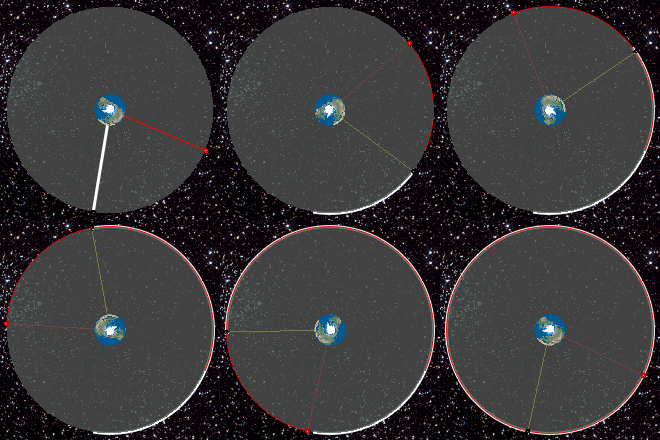
British science writer Arthur C. Clarke published a paper proposing geostationary communications satellites, foreseeing a global relay network for television and telecommunications. Source — Wikipedia:
Top View of Geostationary orbit. To an observer on the rotating Earth (Africa on the Earth ), the satellite appears stationary in the sky as shown by the yellow radius. A red satellite is also geostationary above its own point on the Earth (Singapore) By Lookang many thanks to author of original simulation = Francisco Esquembre author of Easy Java Simulation = Francisco Esquembre - Own work, CC BY-SA 3.0, https://commons.wikimedia.org/w/index.php?curid=15629388
Dec 23, 1947 CE
Bardeen, Brattain, Shockley invent transistor
John Bardeen, Walter Brattain, and William Shockley at Bell Labs invented the point-contact transistor, the foundational active component for all modern RF amplification and signal processing. · Wikipedia: https://en.wikipedia.org/wiki/Transistor
Bauformen von Transistoren By Ulfbastel - Own work, CC BY-SA 3.0, https://commons.wikimedia.org/w/index.php?curid=3123331Transistor Full Documentary
Jul 10, 1962 CE
Telstar 1 first active communications satellite
NASA and AT&T launched Telstar 1, the first active communications satellite, enabling the first transatlantic television broadcasts and telephone calls via space relay. Source — Wikipedia:
Telstar 1 first active communications satellite By Rama - Own work, CC BY-SA 3.0 fr, https://commons.wikimedia.org/w/index.php?curid=70029227Telstar: The Dawn of Global Communication (1962 Historic Footage)
Apr 3, 1973 CE
Cooper makes first mobile phone call
Motorola engineer Martin Cooper made the first handheld cellular phone call in New York City, inaugurating the era of personal mobile wireless communication. Source — Wikipedia: )
Picture of Martin Cooper standing in front of Two Antennas, dated October 2007 By GS200 - Taken by friend on a rooftop on October 2007 Previously published: Twitter @MartyMobile, CC BY-SA 3.0, https://commons.wikimedia.org/w/index.php?curid=26014559Cell phone inventor Marty Cooper on making his first public call
1979 CE
NTT launches first 1G cellular network
Nippon Telegraph and Telephone launched the world's first commercial automated cellular network in Tokyo, Japan, providing analog mobile phone service to customers. Source — Wikipedia:
1991 CE
2G GSM network launches in Finland
Radiolinja launched the first GSM digital cellular network in Finland, enabling encrypted digital voice and SMS text messaging on a standardized global platform. Source — Wikipedia:
Cellular network standards and generation timeline By Michel Bakni - TIA/EIA IS-3: TIA/EIA IS-3 Cellular System Mobile Station - Land Station Compatibility Specification IS-54, IS-136 & cdma 2000: Huurdeman, Anton (2003) The worldwide history of telecommunications, Category:New York: J. Wiley, p. 533−535 ISBN: 9780471205050. CDMA 2000 1x: Burbank, Jack (2013) Wireless networking : understanding internetworking challenges, Hoboken: John Wiley ISBN: 9781118590782. and Dahlman, Erik (2011) 4G LTE/LTE-Advanced for mobile broadband, Amsterdam Boston: Elsevier/Academic Press, p. 405 ISBN: 978-0-12-385489-6. WiMaX: 802.16, 802.16e-2005, IEEE 802.16m-2011, and 802.16t 3GPP releases: 3GPP releases, CC BY-SA 4.0, https://commons.wikimedia.org/w/index.php?curid=115525138
Jun 26, 1997 CE
Wi-Fi standard IEEE 802.11 published
The IEEE published the 802.11 wireless local area network standard, enabling high-speed short-range wireless networking and creating the foundation for Wi-Fi adoption worldwide. Source — Wikipedia:
A Linksys wireless-G router, model number WRT54GS. By Evan-Amos - Own work, Public domain, https://commons.wikimedia.org/w/index.php?curid=16128630
Oct 1, 2001 CE
NTT DoCoMo launches first 3G network
NTT DoCoMo launched the world's first commercial 3G W-CDMA network in Japan, enabling mobile internet access, video calling, and higher-speed data services. Source — Wikipedia:
USB modem for PC, 2008. Adaptible for 3G mobile data (UMTS, HSxPA). Telenor version, Norway. By HLundgaard - Own work, CC BY-SA 3.0, https://commons.wikimedia.org/w/index.php?curid=19126324
Dec 14, 2009 CE
TeliaSonera launches first commercial 4G LTE
TeliaSonera launched the world's first commercial 4G LTE network in Stockholm, Sweden, and Oslo, Norway, delivering broadband-speed mobile data for smartphones and tablets. Source — Wikipedia:
Cellular network standards and generation timeline By Michel Bakni - TIA/EIA IS-3: TIA/EIA IS-3 Cellular System Mobile Station - Land Station Compatibility Specification IS-54, IS-136 & cdma 2000: Huurdeman, Anton (2003) The worldwide history of telecommunications, Category:New York: J. Wiley, p. 533−535 ISBN: 9780471205050. CDMA 2000 1x: Burbank, Jack (2013) Wireless networking : understanding internetworking challenges, Hoboken: John Wiley ISBN: 9781118590782. and Dahlman, Erik (2011) 4G LTE/LTE-Advanced for mobile broadband, Amsterdam Boston: Elsevier/Academic Press, p. 405 ISBN: 978-0-12-385489-6. WiMaX: 802.16, 802.16e-2005, IEEE 802.16m-2011, and 802.16t 3GPP releases: 3GPP releases, CC BY-SA 4.0, https://commons.wikimedia.org/w/index.php?curid=115525138
Aug 16, 2016 CE
China launches Micius quantum satellite
China launched the Micius satellite, the world's first quantum science satellite, enabling intercontinental quantum-encrypted video calls between Beijing and Vienna. · Wikipedia: https://en.wikipedia.org/wiki/Micius_(satellite)
Apr 3, 2019 CE
South Korea launches world's first 5G network
SK Telecom, KT, and LG Uplus launched the world's first commercial 5G mobile network in South Korea, enabling gigabit-speed wireless data and ultra-low-latency applications. Source — Wikipedia:
Cellular network standards and generation timeline By Michel Bakni - TIA/EIA IS-3: TIA/EIA IS-3 Cellular System Mobile Station - Land Station Compatibility Specification IS-54, IS-136 & cdma 2000: Huurdeman, Anton (2003) The worldwide history of telecommunications, Category:New York: J. Wiley, p. 533−535 ISBN: 9780471205050. CDMA 2000 1x: Burbank, Jack (2013) Wireless networking : understanding internetworking challenges, Hoboken: John Wiley ISBN: 9781118590782. and Dahlman, Erik (2011) 4G LTE/LTE-Advanced for mobile broadband, Amsterdam Boston: Elsevier/Academic Press, p. 405 ISBN: 978-0-12-385489-6. WiMaX: 802.16, 802.16e-2005, IEEE 802.16m-2011, and 802.16t 3GPP releases: 3GPP releases, CC BY-SA 4.0, https://commons.wikimedia.org/w/index.php?curid=115525138
2024 CE
India reaches 800 million telecom subscribers
India's Department of Telecommunications reported over 800 million wireless subscribers, making it the world's second-largest telecom market and a leader in low-cost 4G data scale. Source — Wikipedia: