Encyclopedia/2. Technology & The Built World/3. Civil, Architectural & Structural Engineering/01. Infrastructure & Architecture • Curated by Admin Timeline.sg
Fusion/Fission · Renewable energy storage · Grid distribution
Chronological Storyline (28 Milestones)
4000 BCE
Early coal use in China
Archaeological evidence indicates that ancient Chinese communities in the Liaoning region began burning coal for heating and cooking by the late Neolithic period, marking humanity's earliest known use of fossil fuels. Source — Wikipedia:
Harry Fain, coal miner in Wheelwright, Kentucky, 1946 By Russell Lee - This tag does not indicate the copyright status of the attached work. A normal copyright tag is still required. See Commons:Licensing., Public domain, https://commons.wikimedia.org/w/index.php?curid=145833370
200 BCE
Han dynasty bamboo gas pipelines
During the Han dynasty in China's Sichuan province, natural gas was discovered and transported through bamboo pipelines to boil brine for salt production, representing one of the earliest known uses of natural gas as an energy source. Source — Wikipedia:
Han dynasty bamboo gas pipelines By Unknown author, CC BY-SA 2.0, https://commons.wikimedia.org/w/index.php?curid=1622711
100 BCE
Waterwheels across Asia
Waterwheels for grinding grain and powering machinery were in widespread use across Asia, the Mediterranean, and the Near East, converting flowing water's kinetic energy into mechanical work and forming the backbone of pre-industrial power generation. Source — Wikipedia:
The "Brucker Wasserrad", a noria in Bruck, a district of Erlangen, Germany, at work for about one minute. By Spike - Own work, CC BY-SA 4.0, https://commons.wikimedia.org/w/index.php?curid=92174848
31 CE
Du Shi's water-powered bellows
Chinese metallurgist and engineer Du Shi invented a water-powered reciprocating bellows (shui pai) for blast furnaces, dramatically increasing iron production efficiency by harnessing water energy for air delivery. Source — Wikipedia:
This medieval printed illustration depicts waterwheels powering the bellows of a blast furnace in creating cast iron. This illustration is taken from the 14th century treatise Nong Shu, written by Wang Zhen in 1313 AD, during the Chinese Yuan Dynasty. By Wang Zhen - http://www.waterhistory.org/histories/waterwheels/, Public domain, https://commons.wikimedia.org/w/index.php?curid=3288905
644 CE
Persian panemone windmills
Persian engineers in the region of Nashtifan developed vertical-axis panemone windmills to grind grain, representing one of the earliest known wind-powered machines and a foundational technology in renewable energy history. Source — Wikipedia:
Windmill in Sønderho, Fanø, Denmark. Dutch type, built in 1895 to replace an older mill destroyed by fire in 1894. By Cnyborg - Own work, CC BY-SA 3.0, https://commons.wikimedia.org/w/index.php?curid=209855
800 CE
Gunpowder discovered in China
Chinese alchemists discovered gunpowder during the Tang dynasty, creating the first known chemical explosive and a new form of stored chemical energy that would transform warfare and engineering worldwide. Source — Wikipedia:
Black Powder in a Glass Jar (Moscow, Russia) By Lord Mountbatten - Own work, CC BY-SA 3.0, https://commons.wikimedia.org/w/index.php?curid=23036022
852 CE
Banu Musa steam-driven devices
The Banu Musa brothers in Baghdad described self-operating steam-driven devices and fountains in their 'Book of Ingenious Devices,' representing early Islamic explorations of steam power and mechanical automation. Source — Wikipedia:
Original illustration of a self trimming lamp discussed in the treatise on Mechanical Devices of Ahmad ibn Musa ibn Shakir. Drawing can be found in the "Granger Collection" located in New York. By Unknown author - Book of of Ahmad ibn Musa ibn Shakir, Public domain, https://commons.wikimedia.org/w/index.php?curid=14730630
1206 CE
Al-Jazari's water-raising machines
Arab engineer Al-Jazari described advanced water-raising machines and water clocks in his 'Book of Knowledge of Ingenious Mechanical Devices,' advancing the engineering of water-powered energy systems in the medieval Islamic world. Source — Wikipedia:
The elephant clock from Al-Jazari's manuscript. By Al-Jazari - http://www.muslimheritage.com/topics/default.cfm?ArticleID=466, Public domain, https://commons.wikimedia.org/w/index.php?curid=4173094
1698 CE
Savery's steam engine patented
English engineer Thomas Savery patented the first practical steam engine, designed to pump water from mines, marking the beginning of the steam age and the Industrial Revolution's mechanical power era. Source — Wikipedia:
מתוך ספרו של Thurston מ-1878 על התפתחות מנוע הקיטור. By Unknown author - http://www.history.rochester.edu/steam/thurston/1878/Chapter1.html http://www.moah.org/steam/steam.html, Public domain, https://commons.wikimedia.org/w/index.php?curid=3586402
1800 CE
Volta invents the battery
Italian physicist Alessandro Volta invented the voltaic pile, the first electrical battery capable of providing a continuous and reliable electric current, founding the field of electrochemical energy storage. Source — Wikipedia:
A copper-zinc voltaic pile By Borbrav, svg version by Luigi Chiesa - Image:Voltaic pile.png, CC BY-SA 3.0, https://commons.wikimedia.org/w/index.php?curid=5091724
1831 CE
Faraday discovers electromagnetic induction
Michael Faraday discovered electromagnetic induction, demonstrating that a changing magnetic field could produce an electric current, which became the foundational principle for electric generators and transformers in power grids. Source — Wikipedia:
Alternating electric current flows through the solenoid, producing a changing magnetic field. This field causes an electric current to flow in a wire loop by electromagnetic induction. By Ponor - Own work, CC BY-SA 4.0, https://commons.wikimedia.org/w/index.php?curid=95026784Michael Faraday and the Discovery of Electromagnetic Induction
1859 CE
First commercial oil well drilled
Edwin Drake drilled the first commercial oil well in Titusville, Pennsylvania, launching the modern petroleum industry and establishing oil as a dominant global energy source. Source — Wikipedia:
Photograpy of en:Edwin L. Drake (1819-1880) By Unknown author - Ohio Department for Natural Resources - see [1] (copied from n.wikipedia.org), Public domain, https://commons.wikimedia.org/w/index.php?curid=1048454
1859 CE
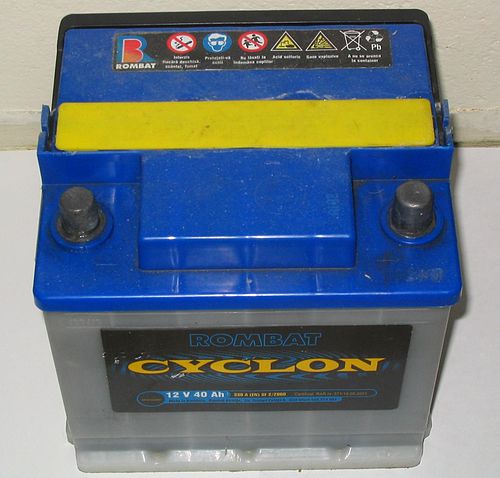
Lead-acid battery invented
French physicist Gaston Planté invented the lead-acid battery, the first rechargeable battery, which became fundamental to automotive starting systems and early electrical energy storage applications. Source — Wikipedia:
Acumulador para automóvil. By No machine-readable author provided. Shaddack assumed (based on copyright claims). - No machine-readable source provided. Own work assumed (based on copyright claims)., Public domain, https://commons.wikimedia.org/w/index.php?curid=401224
1882 CE
First commercial power station
Thomas Edison opened the first commercial central power station on Pearl Street in New York City, providing direct current electricity to 85 customers and establishing the model for centralized electric grid distribution. Source — Wikipedia:
A sketch of the Pearl Street Station By Earl Morter - IEEE Global History Network and Consolidated Edison Company of New York, Public domain, https://commons.wikimedia.org/w/index.php?curid=80161484th September 1882: Thomas Edison opens the world's first power plant
1888 CE
First AC wind turbine for electricity
Charles F. Brush built the first automatically operating wind turbine for electricity generation in Cleveland, Ohio, pioneering wind power as a renewable electricity source. Source — Wikipedia:
Charles Francis Brush, (March 17, 1849 – June 15, 1929) was a U.S. inventor, entrepreneur and philanthropist By Unknown author - http://omp.ohiolink.edu/Images/Bdg/Hist1MDS/d154/1030697033709.Om56_138.jpg, Public domain, https://commons.wikimedia.org/w/index.php?curid=5597037
1891 CE
First three-phase AC transmission
The first long-distance three-phase alternating current power transmission was demonstrated at the International Electrotechnical Exhibition in Frankfurt, proving AC's superiority for grid distribution over long distances. Source — Wikipedia:
25. August 1891. Der elektrifizierte Arkadenbogen Internationalen Elektrotechnischen Ausstellung in Frankfurt am Main, bestückt mit 1000 Glühbirnen, deren Energie über eine 175 km lange Überlandleitung aus Lauffen am Neckar übertragen wurde. Daneben der künstliche Wasserfall. Zeitgenössische Lithographie. By unbekannt, verstorben/ unknown, dead - Lithography stone (mirrored) / Scan vom Lithostein, (horizontal gespiegelt), Public domain, https://commons.wikimedia.org/w/index.php?curid=1733618
Dec 2, 1942 CE
First self-sustaining nuclear chain reaction
Enrico Fermi and his team at the University of Chicago achieved the first controlled, self-sustaining nuclear chain reaction in Chicago Pile-1, launching the nuclear age and the path to fission energy. Source — Wikipedia:
The first nuclear reactor was erected in 1942 in the West Stands section of Stagg Field at the University of Chicago. On December 2, 1942 a group of scientists achieved the first self-sustaining chain reaction and thereby initiated the controlled release of nuclear energy. The reactor consisted of uranium and uranium oxide lumps spaced in a cubic lattice embedded in graphite. In 1943 it was dismantled and reassembled at the Palos Park unit of the Argonne National Laboratory. By Melvin A. Miller of the Argonne National Laboratory - http://narademo.umiacs.umd.edu/cgi-bin/isadg/viewobject.pl?object=95120, Public domain, https://commons.wikimedia.org/w/index.php?curid=8147703Argonne nuclear pioneers: Chicago Pile 1
Jun 27, 1954 CE
First grid-connected nuclear power plant
The Obninsk Nuclear Power Plant in the Soviet Union became the world's first grid-connected nuclear power plant, generating approximately 5 megawatts of electricity and proving nuclear fission's viability for commercial power. Source — Wikipedia:
“World's first nuclear power plant in Obninsk”. The world's first nuclear power plant in Obninsk, which was shut down in 2002 to house a nuclear power museum. By Pavel Bykov / Павел Быков - RIA Novosti archive, image #409173, http://visualrian.ru/ru/site/gallery/#409173 Digital / Цифра, CC BY-SA 3.0, https://commons.wikimedia.org/w/index.php?curid=16787574
1958 CE
Project Sherwood fusion program
The United States established Project Sherwood, a classified program to develop controlled nuclear fusion for peaceful power generation, marking the beginning of sustained government investment in fusion energy research. Source — Wikipedia:
1973 CE
OPEC oil embargo sparks energy research
The OPEC oil embargo triggered a global energy crisis, dramatically increasing investment in renewable energy, energy storage, and alternative energy sources worldwide. Source — Wikipedia:
West Texas Intermediate oil price history from 1950–2000, with an annotation for the 1973 oil crisis. Gnuplot code below (with some manual editing in Inkscape). Inflation adjustment uses the US CPI average, rebased to 1947. This is to better illustrate the effect of the 1973 oil crisis, and should not be used for contemporary comparisons. By Isochrone - Own work using: Spot Crude Oil Price: West Texas Intermediate (WTI), Dollars per Barrel, Monthly, Not Seasonally Adjusted WTI Spot Crude Oil Price, via the Federal Reserve Bank of St. Louis Inflation adjusted using: CPI Average, via the Federal Reserve Bank of St. Louis, CC BY-SA 4.0, https://commons.wikimedia.org/w/index.php?curid=156152880OPEC OIL EMBARGO - 1973
1980 CE
Lithium-ion battery concept patented
John Goodenough and his team at Oxford developed the lithium cobalt oxide cathode, enabling the lithium-ion battery, which would revolutionize portable energy storage and electric vehicles. Source — Wikipedia:
Li ion battery from a laptop computer. By Kristoferb - Own work (enwiki), CC BY-SA 3.0, https://commons.wikimedia.org/w/index.php?curid=12279566
1985 CE
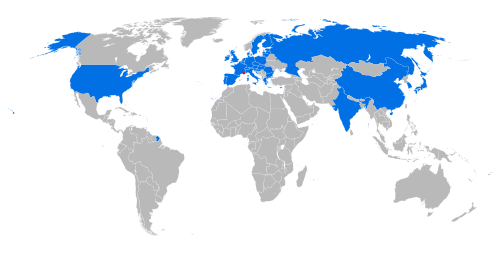
ITER fusion project initiated
The ITER (International Thermonuclear Experimental Reactor) project was formally initiated as an international collaboration to build the world's largest experimental fusion reactor, aiming to prove fusion energy's feasibility. Source — Wikipedia:
world map of countries participating in the ITER program By Rfassbind - Own work., Public domain, https://commons.wikimedia.org/w/index.php?curid=32503440
1991 CE
First commercial lithium-ion batteries
Sony Corporation commercialized the first lithium-ion rechargeable battery, revolutionizing portable electronics and laying the groundwork for modern electric vehicle energy storage. Source — Wikipedia:
Li ion battery from a laptop computer. By Kristoferb - Own work (enwiki), CC BY-SA 3.0, https://commons.wikimedia.org/w/index.php?curid=12279566
1997 CE
First mass-produced hybrid electric car
Toyota launched the Prius, the world's first mass-produced hybrid electric vehicle, combining gasoline and electric power and demonstrating the viability of advanced battery storage in transportation. Source — Wikipedia:
China's rapid expansion of wind power capacity began, eventually making it the world's largest producer of wind energy by installed capacity, reflecting a major shift in global renewable energy leadership. Source — Wikipedia:
Wind power plants in Xinjiang, China (Taken with a Nikon D70.) By 林 慕尧 / Chris Lim from East Coast (东海岸), Singapore (新加坡) - Windmills in China?{D70 series}, CC BY-SA 2.0, https://commons.wikimedia.org/w/index.php?curid=2909338
Dec 12, 2015 CE
Paris Agreement on energy transition
The Paris Agreement was adopted, committing nations to limit global warming by transitioning to renewable energy sources and reducing fossil fuel dependence, reshaping global energy policy and grid planning. Source — Wikipedia:
Signatories (yellow) and parties (blue) to the Paris Agreement Signatories Parties Withdrew Parties also covered by EU ratification By L.tak - This file uses File:Detailed Blank World Map.svg as a basis. Changes to the paths and their classes, are shown in the Changelog, which is included at the beginning of the file. Please do also update the Changelog, so that at any time the file can be updated easily if the political map (state borders) changes in the future., CC BY-SA 4.0, https://commons.wikimedia.org/w/index.php?curid=48320267
Dec 13, 2022 CE
NIF achieves fusion ignition
The National Ignition Facility at Lawrence Livermore National Laboratory achieved fusion ignition, producing more energy from a fusion reaction than the laser energy used to drive it, a historic milestone in fusion energy science. Source — Wikipedia:
The exterior of the National Ignition Facility, a ten-story building the size of three football fields, is pictured at sunset. NIF is the world's largest and highest-energy laser system and the nation's largest scientific project. It is located at Lawrence Livermore National Laboratory in northern California. By Lawrence Livermore National Security - Own work, CC BY-SA 3.0, https://commons.wikimedia.org/w/index.php?curid=19898650The Remarkable Story of Fusion Ignition at the National Ignition Facility
2024 CE
Global renewable capacity surpasses milestones
Global installed renewable energy capacity surpassed 4,000 gigawatts, with solar and wind accounting for the majority of new additions, marking a turning point in the worldwide energy transition toward sustainable power. Source — Wikipedia:
Andasol Solar Power Station By kallerna - Own work, CC BY-SA 4.0, https://commons.wikimedia.org/w/index.php?curid=103494974