Encyclopedia/3. History, Societies & Civilizations/01. East Asian Civilizations/01. Chinese Dynasties • Curated by Admin Timeline.sg
The Shang Dynasty (c. 1600–1046 BCE) was China's first historically attested state, pioneering bronze metallurgy, oracle bone script, and ancestor worship before its conquest by the Zhou.
Chronological Storyline (14 Milestones)
1600 BCE
Tang overthrows Xia (汤灭夏)
King Tang of Shang (商汤, Shāng Tāng) defeated the tyrant Jie of Xia (夏桀, Xià Jié) at the Battle of Mingtiao (鸣条之战, Míngtiáo zhī zhàn), establishing the Shang Dynasty and founding the capital at Bo (亳, Bó). This marked the beginning of China's first historically verified dynasty. #politics #war #dynasty
Map of Shang Dynasty from Bamboo Annals By Lamassu Design Gurdjieff (talk) - Image by Author, CC BY-SA 3.0, https://commons.wikimedia.org/w/index.php?curid=10381870
1556 BCE
Zhong Ding relocates capital (仲丁迁隞)
King Zhong Ding (仲丁, Zhòng Dīng) moved the Shang capital from Bo to Ao (隞, Áo), near modern Zhengzhou (郑州, Zhèngzhōu). This began the 'Five Capital Relocations' (五迁, Wǔ Qiān) period, reflecting political instability and power struggles among royal factions. #politics #disaster
1500 BCE
Erligang culture flourishes (二里岗文化)
The Erligang culture (二里岗文化, Èrlǐgǎng wénhuà) reached its peak, representing the early Shang's greatest territorial expansion. Massive rammed-earth walls at Zhengzhou Shang City (郑州商城, Zhèngzhōu Shāngchéng) enclosed over 3,000 hectares, demonstrating advanced urban planning and centralized labor control. #culture #architecture #science
Area of the Erligang culture (1500–1300 BC) in northern China, based on Liu Li and Chen Xingcan (2012), The Archaeology of China: From the Late Paleolithic to the Early Bronze Age, Cambridge University Press, ISBN 978-0-521-64310-8, p279. By Kanguole - This file was derived from: Eastern China blank relief map.svg, CC BY-SA 3.0, https://commons.wikimedia.org/w/index.php?curid=40692455
1400 BCE
Pan Geng moves to Yin (盘庚迁殷)
King Pan Geng (盘庚, Pán Gēng) relocated the capital to Yin (殷, Yīn), modern Anyang (安阳, Ānyáng), ending decades of instability. This 'Yin Ruins' (殷墟, Yīnxū) settlement became the Shang's permanent capital for 273 years, yielding the vast majority of oracle bone inscriptions discovered to date. #politics #culture #archaeology
殷墟博物馆新馆 By Tim Wu - Own work, CC BY-SA 4.0, https://commons.wikimedia.org/w/index.php?curid=153646910
1350 BCE
Oracle bone script matures (甲骨文成熟)
Oracle bone script (甲骨文, jiǎgǔwén) reached sophisticated form under kings Wu Ding (武丁, Wǔ Dīng) and his successors. Diviners inscribed questions on ox scapulae and turtle plastrons about warfare, agriculture, weather, and royal tours—creating China's earliest mature writing system and the ancestor of all later Chinese scripts. #literature #science #religion
Oracle bone from the Bīn 賓 group of diviners from period I, corresponding to the reign of King Wu Ding (late Shang dynasty). By Unknown author - Gary Lee Todd 2011-09-01 12:34:54 https://www.flickr.com/photos/101561334@N08/9830601816/, CC0, https://commons.wikimedia.org/w/index.php?curid=96430584
1324 BCE
Lady Fu Hao's military campaigns (妇好征伐)
Lady Fu Hao (妇好, Fù Hǎo), consort of King Wu Ding, led armies of up to 13,000 troops against the Tu Fang (土方, Tǔfāng), Yi Fang (夷方, Yífāng), and Qiang (羌, Qiāng) peoples. Her unlooted tomb at Yinxu, discovered in 1976, contained 468 bronze vessels and 755 jade objects, revealing women's unprecedented political-military authority. #war #politics #culture
Reconstructed tomb (Original Artifacts in National Museum in Beijing and Henan Museum in Zhengzhou). Yin Ruins Tomb, Chariot Burials, and Museum, Anyang, final capital of Shang Dynasty, c. 1400-1100 BC. Complete indexed photo collection at WorldHistoryPics.com. By Gary Todd from Xinzheng, China - Fu Hao Tomb and Statue, c. 1200 BC, Reign of King Wu Ding, Shang Dynasty, CC0, https://commons.wikimedia.org/w/index.php?curid=103252988
1300 BCE
Bronze casting pinnacle (青铜铸造巅峰)
Shang bronze metallurgy achieved extraordinary sophistication, employing piece-mold casting (范铸法, fànzhù fǎ) to create the 832.84 kg Houmuwu Ding (后母戊鼎, Hòumǔwù Dǐng)—the heaviest ancient bronze vessel ever found. These ritual vessels, with their taotie (饕餮, tāotiè) monster masks, symbolized royal power and ancestral communication. #science #art #culture
Houmuwu Ding, also known as Simuwu Ding (wine vessel) is the heaviest piece of bronze work found in China so far. It was made in the late Shang Dynasty at Anyang (c. 1300 – 1046 BC). Height 133 cm, width 112 cm, depth 79.2 cm, weight 875 kg. This picture shows the genuine piece when it was on display at the National Museum of China. By Mlogic - Own work, CC BY-SA 3.0, https://commons.wikimedia.org/w/index.php?curid=16028177
1250 BCE
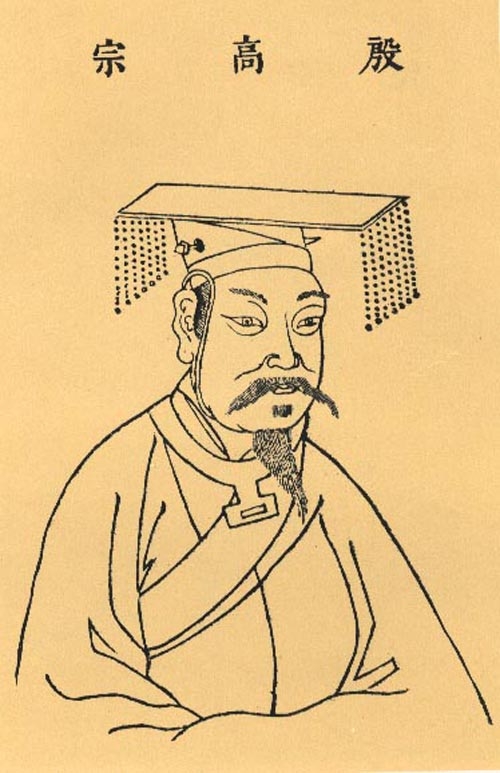
Wu Ding's golden age (武丁中兴)
King Wu Ding (武丁, Wǔ Dīng) reigned for 59 years, the Shang's longest and most prosperous period. He expanded territory through campaigns against western Qiang, southern Jing (荆, Jīng), and eastern Yi (夷, Yí) peoples, while consolidating a complex bureaucracy of 'many officers' (多尹, duō yǐn) managing agriculture, warfare, and rituals. #politics #war #commerce
Buting By Wang Qiji of the Ming Dynasty, Wanli engraved "Three Talents Picture Club" - http://www.zhlhh.com/ReadRoom/aazhlsyy/person.aspx?PersonName=%E6%AD%A6%E4%B8%81&PersonNianDai=xsxz, Public domain, https://commons.wikimedia.org/w/index.php?curid=122102114
1200 BCE
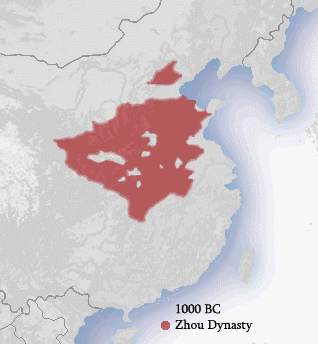
Shang-Zhou tributary relations (商周宗藩)
The Zhou people (周, Zhōu), inhabiting the Wei River valley (渭水流域, Wèishuǐ liúyù) in present-day Shaanxi (陕西, Shǎnxī), became nominal vassals of the Shang. King Wen of Zhou's (周文王, Zhōu Wénwáng) grandfather Gugong Danfu (古公亶父, Gǔgōng Dǎnfù) had migrated there to escape Rongdi (戎狄, Róngdí) pressures, gradually building Zhou power. #foreignrelations #politics
The approximate territory of the Zhou dynasty in China. Drawn by Ian Kiu. Derived from China_map.png by Nat. By Territories_of_Dynasties_in_China.gif: Ian Kiu - Territories_of_Dynasties_in_China.gif: Albert Herrmann (1935). History and Commercial Atlas of China. Harvard University Press. from "The Chou Dynasty, 11th-9th Centuries B.C.", CC BY-SA 3.0, https://commons.wikimedia.org/w/index.php?curid=13309273
1180 BCE
Agricultural intensification (农业集约化)
Shang agriculture employed massive labor corvées to clear land, cultivate millet (粟, sù), wheat (麦, mài), and rice (稻, dào) in the Yellow River floodplain. Oracle bones record prayers for rain and harvest, while bronze spades and stone sickles indicate continued mixed tool use; royal hunts also served to clear forests for cultivation. #agriculture #science #religion
A farmer of the Hani minority near his village of Puduo, Yuanyang county, Yunnan, China By Takeaway - Own work, CC BY-SA 3.0, https://commons.wikimedia.org/w/index.php?curid=4561662
1150 BCE
Religious human sacrifice peaks (人祭鼎盛)
Ancestor worship (祖先崇拜, zǔxiān chóngbài) and shamanistic divination dominated Shang religion, with kings serving as chief priests. Mass human sacrifice (人祭, rénjì) accompanied royal burials and building foundations; the Yinxu cemetery contains thousands of sacrificial victims, including Qiang prisoners of war offered to royal ancestors. #religion #culture #disaster
Image of Roman mosaic found in excavations in 1849 Empúries booted up in 1937. Photographed at the Museum of Empúries and digitally retouched the original user By Desconeguts (unknown) - Fotografia presa al Museu Arqueològic de Catalunya deu d'Empúries (L'Escala, Catalunya, Espanya), Public domain, https://commons.wikimedia.org/w/index.php?curid=16363172
1147 BCE
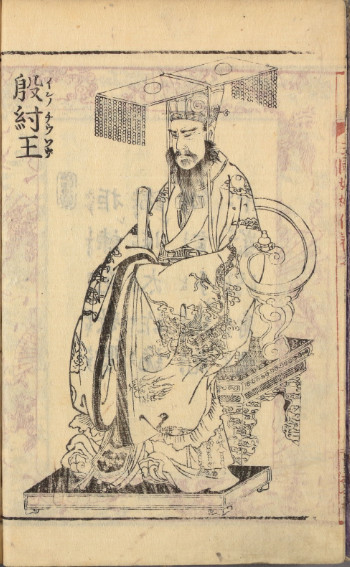
Di Xin becomes king (帝辛即位)
King Di Xin (帝辛, Dì Xīn), posthumously demonized as Zhou (纣, Zhòu)—the 'criminal'—ascended the throne. Traditional accounts depict his reign as tyrannical, though modern scholarship questions this as Zhou propaganda; he did expand against eastern Yi peoples, exhausting Shang military resources and enabling Zhou rebellion. #politics #war
King Yin, from the picture book Three Kingdoms Youfuden. By 高井 伴寛、蹄斎 北馬 (Hiroshi Takai, Hossai Hokuma) - 絵本三国妖婦伝. 上,中,下編 / 高井伴寛 作; 蹄斎北馬 画 (Picture book 3 Kingdoms Youfuden. Part 1, 2, 2 / Written by: Tomohiro Takai; Painted by: Hokuma Teisai), Public domain, https://commons.wikimedia.org/w/index.php?curid=52609256
1122 BCE
Zhou conquest of Shang (武王伐纣)
King Wu of Zhou (周武王, Zhōu Wǔwáng), allied with disaffected Shang nobles and eight hundred western tribes, defeated Di Xin at the Battle of Muye (牧野之战, Mùyě zhī zhàn). Di Xin reportedly immolated himself in his Deer Terrace Palace (鹿台, Lùtái); the Zhou established their dynasty while permitting Shang descendants to rule as vassals under the 'Three Supervisors' (三监, Sān Jiān). #war #politics #dynasty
Battle of Muye, the battle during which Zhou overthrew Shang dynasty. By SY - Own work, CC BY-SA 4.0, https://commons.wikimedia.org/w/index.php?curid=62649514
1046 BCE
Shang loyalists rebel (三监之乱)
The 'Rebellion of the Three Supervisors' (三监之乱, Sān Jiān zhī luàn) saw Shang prince Wu Geng (武庚, Wǔ Gēng) and Zhou supervisors revolt against the regent Duke of Zhou (周公, Zhōu Gōng). After three years of warfare, the Zhou crushed the rebellion, relocated Shang remnants to Luoyi (洛邑, Luòyì), and dispersed the 'Yin people' (殷民, Yīnmín) as colonists—formally ending organized Shang resistance. #war #politics #disaster
Map of the course of war of the w:en:Rebellion of the Three Guards. By File:EN-WesternZhouStates.jpg: Philg88 derivative work: Applodion - This file was derived from: EN-WesternZhouStates.jpg: Li, Feng (2006). Axel Menges, ed. Landscape and Power in Early China: The Crisis and Fall of the Western Zhou 1045-771 BC. Cambridge: Cambridge University Press., CC BY-SA 3.0, https://commons.wikimedia.org/w/index.php?curid=44124882