Encyclopedia/3. History, Societies & Civilizations/09. Modern Nations/05. Europe • Curated by Admin Timeline.sg
History of Ireland, sourced from Wikipedia's "Timeline of Irish history".
Chronological Storyline (103 Milestones)
8000 BCE
Mesolithic
Mesolithic hunter-gatherers migrate to Ireland Source — Wikipedia, "Timeline of Irish history" (Mesolithic and neolithic periods):
Hunter gatherer's camp at Irish National Heritage Park Exhibit showing how a 7000 B.C. campsite of Mesolithic period hunter gatherers would have looked. They were nomadic and built temporary houses. Wood, bone and flint were the materials of their tools. They fished using dugout canoes - there is one in the photo. More photos in the park, see https://www.geograph.org.uk/gallery/irish_national_heritage_park_county_wexford_10033 . By David Hawgood - From geograph.org.uk, CC BY-SA 2.0, https://commons.wikimedia.org/w/index.php?curid=13976927
6500 BCE
Mount Sandel Mesolithic site
Mesolithic hunter-gatherers occupy sites such as that at Mount Sandel in Ulster Source — Wikipedia, "Timeline of Irish history" (Mesolithic and neolithic periods):
Ulster Museum Model (hypothetical but evidence based) of a Mesolithic hut at Mount Sandel, Co. Londonderry, Ireland. The remains of six round huts were found at Mount Sandel from about six meters in diameter with a central hearth. The seventh House is small, only about three feet in diameter and has an outer stove. The huts were made a frame of bent, set in post holes in the bottom branches, which were probably covered with skins. By Notafly - Own work, CC BY-SA 3.0, https://commons.wikimedia.org/w/index.php?curid=70337877
4000 BCE
Céide Fields
Agriculture (including the keeping of livestock, and crop farming) has its beginnings in Ireland, at sites such as the Céide Fields in Connacht Source — Wikipedia, "Timeline of Irish history" (Mesolithic and neolithic periods):
Image of the Céide Fields Visitor Center. By Mmedich - Own work, CC0, https://commons.wikimedia.org/w/index.php?curid=192879074
3500 BCE
Neolithic
The Neolithic peoples of the Boyne Valley built a complex of chamber tombs, standing stones and enclosures over a period of hundreds of years. (Newgrange itself is dated to 3300–2900 BC). Source — Wikipedia, "Timeline of Irish history" (Mesolithic and neolithic periods):
6176 By Sarah Murray from Palo Alto, CA - 6176 Uploaded by stegop, CC BY-SA 2.0, https://commons.wikimedia.org/w/index.php?curid=12606879
2000 BCE
Bronze Age
Bronze Age technologies start to arrive in Ireland, including the moulding of Ballybeg-type flat axes, and the beginnings of copper mining at Ross Island, Killarney and Mount Gabriel. Source — Wikipedia, "Timeline of Irish history" (Bronze and Iron Ages):
Map of the diffusion of metallurgy. By User:Want - File:Diffusion métallurgie.png: After M. Otte (2007) Vers la Préhistoire, de Boeck, Bruxelles, CC BY-SA 3.0 cz, https://commons.wikimedia.org/w/index.php?curid=41316620
500 BCE
Iron Age
During the Iron Age in Ireland, Celtic influence in art, language and culture begins to take hold. Source — Wikipedia, "Timeline of Irish history" (Bronze and Iron Ages):
Weapons and fibulae from a warrior's grave, c. 350 BC. Grave no. 91, Celtic burial site, "Rain", Münsingen, Switzerland. By Unknown author - Own photograph by Sandstein, CC BY 3.0, https://commons.wikimedia.org/w/index.php?curid=8656346
300 BCE
Clonycavan Man
Murder of Clonycavan Man, according to radiocarbon dating Source — Wikipedia, "Timeline of Irish history" (Bronze and Iron Ages):
Bog body Clonycavan Man at National Museum of Ireland, Dublin, around 4th or 3rd century BC By Mark Healey - https://www.flickr.com/photos/markjhealey/6039082651/sizes/o/in/photostream/, CC BY-SA 2.0, https://commons.wikimedia.org/w/index.php?curid=16318445
200 BCE
La Tène culture
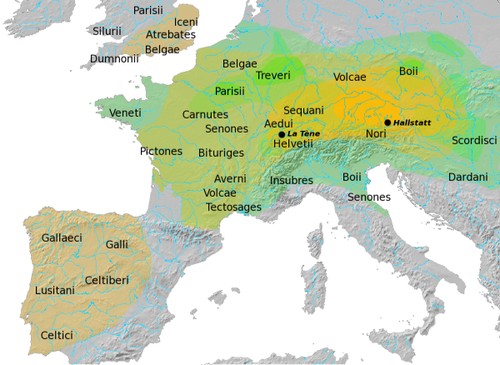
La Tène influence from continental Europe influences carvings on the Turoe Stone, Bullaun, County Galway. Source — Wikipedia, "Timeline of Irish history" (Bronze and Iron Ages):
Overview map of the Hallstatt (yellow) and La Tène (green) cultures. After Atlas of the Celtic World, by John Haywood; London Thames & Hudson Ltd., 2001, pp. 30-37. Map update desirable, see here for discussion. By Dbachmann - Own work, CC BY-SA 3.0, https://commons.wikimedia.org/w/index.php?curid=4003285
100 BCE
Navan Fort
Additional works expand the site at Navan Fort (Emain Macha), first occupied in the Neolithic period Source — Wikipedia, "Timeline of Irish history" (Bronze and Iron Ages):
Navan Fort, County Armagh. Navan Fort, aka Emain Macha, ancient capital of Ulster. Settlement dates back to the Bronze Age. In 95BC a circular 40m structure was built, burnt down and covered with earth and turf to form the mound, thereafter used for the inauguration of kings. By Patrick Brown - From geograph.org.uk, CC BY-SA 2.0, https://commons.wikimedia.org/w/index.php?curid=9169647
16 BCE
Last Glacial Maximum
During the Last Glacial Maximum, Ireland is covered in ice sheets Source — Wikipedia, "Timeline of Irish history" (Mesolithic and neolithic periods):
Last Glacial Maximum By Unknown author, CC BY-SA 3.0, https://commons.wikimedia.org/w/index.php?curid=2623176
12 BCE
Prehistoric Ireland
A narrow channel forms between Prehistoric Ireland and southwest Scotland Source — Wikipedia, "Timeline of Irish history" (Mesolithic and neolithic periods):
A front view of the Newgrange monument taken from outside the grounds By Tjp finn - Own work, CC BY-SA 4.0, https://commons.wikimedia.org/w/index.php?curid=51765798
10 BCE
Paleolithic
Carbon-dating on bear bones indicate the presence of Paleolithic people in County Clare. Source — Wikipedia, "Timeline of Irish history" (Mesolithic and neolithic periods):
Glyptodon. By Heinrich Harder (1858-1935) - The Wonderful Paleo Art of Heinrich Harder, Public domain, https://commons.wikimedia.org/w/index.php?curid=1143767
5 CE
Annals of Ulster
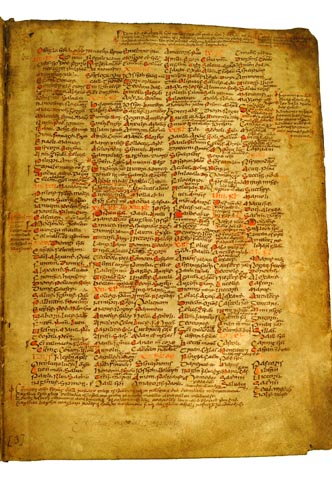
According to the Annals of Ulster (and other chronicles), Saint Patrick returns to Ireland. Source — Wikipedia, "Timeline of Irish history" (5th century):
Manuscript of the Annals of Ulster 500-1000AD By Unknown author - http://www.medievalists.net/2012/10/01/annals-of-ulster-of-the-early-middle-ages-ad-500-1000/, Public domain, https://commons.wikimedia.org/w/index.php?curid=37070732
5 CE
Palladius
Palladius is sent as the first bishop "to the Irish believing in Christ" by Pope Celestine I Source — Wikipedia, "Timeline of Irish history" (5th century):
Stained glass depiction of Celestine I, Ireland (JPG version) By Andreas F. Borchert - https://commons.wikimedia.org/wiki/File:Dundalk_Saint_Patrick%27s_Pro-Cathedral_West_Aisle_Window_06_Lower_Lights_2013_09_23.jpg, CC BY-SA 3.0, https://commons.wikimedia.org/w/index.php?curid=185522788
100 CE
Black Pig's Dyke
Construction of a series of defensive ditches between the provinces of Ulster and Connacht Source — Wikipedia, "Timeline of Irish history" (1st century):
A Black Wild Boar By Niko Pirosmani - diary-or-notes.cocolog-nifty.com Source of the first version: www.russianavantgard.com, Public domain, https://commons.wikimedia.org/w/index.php?curid=2636525
140 CE
Ptolemy
Ptolemy's Geographia provides the earliest known written reference to habitation in the Dublin area, referring to a settlement in the area as Eblana Civitas Source — Wikipedia, "Timeline of Irish history" (2nd century):
Ptolemy with a armillary sphere model. With a large version he claimed his solstice observations. By Justus van Gent / Pedro Berruguete - Public domainPublic domainfalsefalse This work is in the public domain in its country of origin and other countries and areas where the copyright term is the author's life plus 100 years or fewer. You must also include a United States public domain tag to indicate why this work is in the public domain in the United States. This file has been identified as being free of known restrictions under copyright law, including all related and neighboring rights. https://creativecommons.org/publicdomain/mark/1.0/PDMCreative Commons Public Domain Mark 1.0falsefalse, Public domain, https://commons.wikimedia.org/w/index.php?curid=16043714
220 CE
Annals of the Four Masters
The Annals of the Four Masters, Foras Feasa ar Éirinn, and other semi-historical (non-contemporary) texts, place Cormac mac Airt as a longstanding High King of Ireland. (The Annals date his reign as 226–266, but scholars vary in their assessment of Mac Airt's reign as legend or historical fact) Source — Wikipedia, "Timeline of Irish history" (3rd century):
Page from a 350-year-old book: Annals of the Four Masters, entry for year AD432 By Unknown author - From english wiki, Public domain, https://commons.wikimedia.org/w/index.php?curid=1591543
300 CE
Irish Dark Age
Pollen data records from the late Iron Age indicate a resurgence in human activity after a relatively stagnant period Source — Wikipedia, "Timeline of Irish history" (4th century):
A front view of the Newgrange monument taken from outside the grounds By Tjp finn - Own work, CC BY-SA 4.0, https://commons.wikimedia.org/w/index.php?curid=51765798
400 CE
Niall of the Nine Hostages
Niall Noígíallach is placed by Medieval texts as a legendary Goidelic High King of Ireland (the Annals of the Four Masters dates his reign as 378–405) Source — Wikipedia, "Timeline of Irish history" (5th century):
Red Hand of Ulster, dexter (right) hand version, as used today in Ulster (Northern Ireland) by Protestants as a political symbol. The sinister (left hand) version is used by baronets. By (Lobsterthermidor (talk) 12:11, 11 October 2015 (UTC)) - Modified from commons File:Meuble héraldique Main.svg by User:Zigeuner, CC BY-SA 3.0, https://commons.wikimedia.org/w/index.php?curid=44156702
536 CE
Volcanic winter of 536
A seemingly global climate event (possibly a volcanic winter) causes crop failures and famine in Ireland. Source — Wikipedia, "Timeline of Irish history" (6th century):
Milan - Church of Saints Philip and James at Nosedo. Funerary inscription dated 536 AD. Photo by Giovanni Dall'Orto, 3 July 2022. By Giovanni Dall'Orto - Own work, Attribution, https://commons.wikimedia.org/w/index.php?curid=120120080
563 CE
Golden age of Ireland
Irish monastic influence during the Golden Age peaks with the foundation of monastic schools by Saint Columba and Saint Brendan at Iona and Clonfert. (Saint Columbanus would later set up similar institutions in continental Europe, Fursa in East Anglia and Gaul, Aidan at Lindisfarne. Etc.) Source — Wikipedia, "Timeline of Irish history" (6th century):
This map of Ireland was published by Nicolaes Visscher II (1649-1702) about 1689. These facts are known because the map is dedicated to stadholder William III and his wife Mary Stuart who were crowned as king and queen of England, Scotland and Ireland in 1689. By Nicolaes Visscher II - This digital media file - and/or the physical objects depicted on it - originates from the digital and/or physical collections of the Koninklijke Bibliotheek, national library of the Netherlands., Public domain, https://commons.wikimedia.org/w/index.php?curid=41668236
664 CE
yellow fever
Several sources record a pervasive "yellow plague" on the island. Source — Wikipedia, "Timeline of Irish history" (7th century):
فيروس الحمّى الصفراء. By Erskine Palmer, Ph.D. - This media comes from the Centers for Disease Control and Prevention's Public Health Image Library (PHIL), with identification number #8239. Note: Not all PHIL images are public domain; be sure to check copyright status and credit authors and content providers. العربية | Deutsch | English | македонски | slovenščina | +/−, Public domain, https://commons.wikimedia.org/w/index.php?curid=611723
795 CE
Viking
First Viking raids on Iona, Rathlin Island, and Inishmurray. Source — Wikipedia, "Timeline of Irish history" (8th century):
Viking attack on Guérande By Abbey of Saint-Aubin - https://gallica.bnf.fr/ark:/12148/btv1b105157428/f27.item, Public domain, https://commons.wikimedia.org/w/index.php?curid=99222344
830 CE
Óengus of Tallaght
Óengus of Tallaght writes the Martyrology of Tallaght, the Prologue of which speaks of the last vestiges of paganism in Ireland Source — Wikipedia, "Timeline of Irish history" (9th century):
Óengus of Tallaght By Unknown author, Public domain, https://commons.wikimedia.org/w/index.php?curid=881593
852 CE
Ivar Beinlaus
Vikings Ivar Beinlaus and Olaf the White land in Dublin Bay, and establish a fortress close to where the city of Dublin now stands Source — Wikipedia, "Timeline of Irish history" (9th century):
Dublin aerial photograph By 瑞丽江的河水 - Own work, CC BY-SA 4.0, https://commons.wikimedia.org/w/index.php?curid=170090198
980 CE
King of Dublin
The King of Dublin Olaf Cuaran abdicates following defeat at the Battle of Tara to Máel Sechnaill mac Domnaill. Source — Wikipedia, "Timeline of Irish history" (10th century):
Map showing the Viking settlements in Ireland By Yorkshirian - http://en.wikipedia.org/wiki/File:Viking_Ireland.png, CC BY-SA 3.0, https://commons.wikimedia.org/w/index.php?curid=6045713
988 CE
Máel Sechnaill mac Domnaill
Máel Sechnaill demands (and is paid) "tribute" by the Vikings at Dublin (this tribute date is sometimes recognised as the "foundation date" of Dublin as a city) Source — Wikipedia, "Timeline of Irish history" (10th century):
A sculpture of Máel Seachnaill in Trim, Co. Meath, by James McKenna. By William Murphy - flickr.com, CC BY 2.0, https://commons.wikimedia.org/w/index.php?curid=39252535
Apr 23, 1014 CE
Máel Mórda mac Murchada
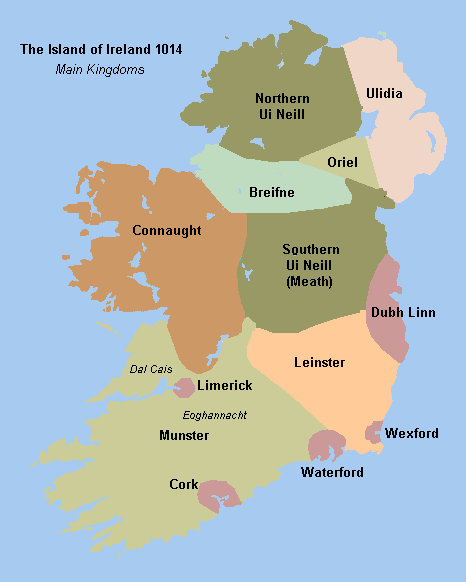
Defeat of Máel Mórda mac Murchada and Viking forces by the armies of Brian Boru at the Battle of Clontarf marks the beginning of the decline of Viking power in Ireland. Source — Wikipedia, "Timeline of Irish history" (11th century):
An eighteenth-century illustration of Brian Bóruma mac Cennétig (died 1014). By Unknown author - The General History of Ireland, Public domain, https://commons.wikimedia.org/w/index.php?curid=83848984
1167 CE
Ruaidrí Ua Conchobair
Following exile by Ruaidrí Ua Conchobair, Dermot MacMurrough seeks support from Henry II of England to reclaim his Kingship. Source — Wikipedia, "Timeline of Irish history" (12th century):
Stone carving of Rory O'Conor from a doorway in the grounds of Cong Abbey By ClintMalpaso - Own work, Public domain, https://commons.wikimedia.org/w/index.php?curid=6070650
1171 CE
Waterford
Henry II of England lands at Waterford and declares his youngest son John Lord of Ireland. Source — Wikipedia, "Timeline of Irish history" (12th century):
View of Waterford Marina, Cathedral, Reginald's Tower, piece of Waterford Crystal, Waterford Quay by night. By Original photos by [1], Ticketautomat, TR001, Philip Halling (collage idea by ColmanHuge2 - Own work, CC BY-SA 3.0, https://commons.wikimedia.org/w/index.php?curid=15197658
Oct 6, 1175 CE
Treaty of Windsor
The Treaty of Windsor consolidates Norman influence in Ireland. Source — Wikipedia, "Timeline of Irish history" (12th century):
Treaty of Windsor By Unknown author, Attribution, https://commons.wikimedia.org/w/index.php?curid=12835052
Nov 12, 1216 CE
Great Charter of Ireland
Great Charter of Ireland issued by Henry III of England. Source — Wikipedia, "Timeline of Irish history" (13th century):
The coat of arms of the former lordship of Ireland, SVG version. By NsMn - Own work, CC BY 3.0, https://commons.wikimedia.org/w/index.php?curid=11397603
1252 CE
Annals of the Four Masters
The Annals of the Four Masters records a summer-time heat wave and drought. Source — Wikipedia, "Timeline of Irish history" (13th century):
Page from a 350-year-old book: Annals of the Four Masters, entry for year AD432 By Unknown author - From english wiki, Public domain, https://commons.wikimedia.org/w/index.php?curid=1591543
1297 CE
Parliament of Ireland
The first representative Irish Parliament (of the Lordship of Ireland) meets in Dublin. Source — Wikipedia, "Timeline of Irish history" (13th century):
Shield of Arms of Ireland By Sodacan - Own work., CC BY-SA 3.0, https://commons.wikimedia.org/w/index.php?curid=12113443
May 26, 1315 CE
Edward Bruce
Edward Bruce arrives in Ireland and rallies many Irish lords against Anglo-Norman control. Source — Wikipedia, "Timeline of Irish history" (14th century):
The grave of Edward Bruce at the Hill of Faughart By Eric Jones - Geograph Britain and Ireland, CC BY-SA 2.0, https://commons.wikimedia.org/w/index.php?curid=140807850
Apr 20, 1366 CE
Statutes of Kilkenny
The Statutes of Kilkenny are passed at Kilkenny to curb the decline of the Hiberno-Norman Lordship of Ireland. Source — Wikipedia, "Timeline of Irish history" (14th century):
The coat of arms of the former lordship of Ireland, SVG version. By NsMn - Own work, CC BY 3.0, https://commons.wikimedia.org/w/index.php?curid=11397603
1398 CE
Gerald FitzGerald, 3rd Earl of Desmond
Gerald FitzGerald, 3rd Earl of Desmond, mysteriously disappears; Gearóid Íarla is forever afterwards judged to be sleeping in a cave under Lough Gur, waiting to gallop out on his silver-shod horse and rescue Ireland at the moment of greatest need. Source — Wikipedia, "Timeline of Irish history" (14th century):
Gerald FitzGerald, 3rd Earl of Desmond By Unknown author - Own work using: Blason-hermine-plain.svg: and Type pièce Sautoir.svg:, CC BY-SA 4.0, https://commons.wikimedia.org/w/index.php?curid=184327157
1472 CE
Annals of the Four Masters
The Annals of the Four Masters records that the King of England sent an exotic animal (possibly a giraffe) to Ireland. Source — Wikipedia, "Timeline of Irish history" (15th century):
Page from a 350-year-old book: Annals of the Four Masters, entry for year AD432 By Unknown author - From english wiki, Public domain, https://commons.wikimedia.org/w/index.php?curid=1591543
1490 CE
County Mayo
An earthquake takes place at Sliabh Gamh in County Mayo. Source — Wikipedia, "Timeline of Irish history" (15th century):
Dec 1, 1494 CE
Edward Poyning
A parliament summoned by Edward Poyning, Henry VII of England's Lord Deputy, passes Poynings' Law, under which the Irish parliament is to pass no law without the prior consent of the English parliament. Source — Wikipedia, "Timeline of Irish history" (15th century):
Coat of arms of Sir Edward Poynings, KG. Poynings quartering Paston. By Rs-nourse - Own work, CC BY-SA 3.0, https://commons.wikimedia.org/w/index.php?curid=29468126
1497 CE
The Annals of the Four Masters
The Annals of the Four Masters refers to a famine which "prevailed through all Ireland". Source — Wikipedia, "Timeline of Irish history" (15th century):
Jun 11, 1534 CE
Thomas FitzGerald, 10th Earl of Kildare
Thomas FitzGerald, the 10th Earl of Kildare, publicly renounces his allegiance to Henry VIII of England. Source — Wikipedia, "Timeline of Irish history" (16th century):
Thomas FitzGerald, 10th Earl of Kildare, c. 1530 By Attributed to Anthony van Dyck - http://4.bp.blogspot.com/-6URUb8WB_XI/TqrWwAmcx9I/AAAAAAAANa8/iLbk8Faf6y4/s640/Silken+Thomas.jpg, Public domain, https://commons.wikimedia.org/w/index.php?curid=38929370
Feb 3, 1537 CE
Thomas FitzGerald, 10th Earl of Kildare
FitzGerald is hanged, drawn and quartered at Tyburn. Source — Wikipedia, "Timeline of Irish history" (16th century):
Thomas FitzGerald, 10th Earl of Kildare, c. 1530 By Attributed to Anthony van Dyck - http://4.bp.blogspot.com/-6URUb8WB_XI/TqrWwAmcx9I/AAAAAAAANa8/iLbk8Faf6y4/s640/Silken+Thomas.jpg, Public domain, https://commons.wikimedia.org/w/index.php?curid=38929370
1542 CE
Parliament of Ireland
The Irish parliament passes the Crown of Ireland Act, which establishes a Kingdom of Ireland to be ruled by Henry VIII and his successors. Source — Wikipedia, "Timeline of Irish history" (16th century):
Shield of Arms of Ireland By Sodacan - Own work., CC BY-SA 3.0, https://commons.wikimedia.org/w/index.php?curid=12113443
Feb 25, 1570 CE
Pope Pius V
Pope Pius V issues a papal bull, Regnans in Excelsis, declaring Elizabeth I of England a heretic and releasing her subjects from any allegiance to her. Source — Wikipedia, "Timeline of Irish history" (16th century):
The aging, enthroned pope turns toward the viewer while making the sign of blessing with his right hand. Pius V (1566-1572) belonged to the Ghislieri family, and on the top of the back of the throne is his family's coat of arms crowned by the papal tiara and the keys of St. Peter, a symbol of the papacy's descent from Christ's apostle. The identifying inscription below is a later addition. Passerotti worked in the mannerist style, which is characterized by strikingly elongated proportions. The pope's bony appearance reveals both his age and the artist's knowledge of human anatomy. By Bartolomeo Passarotti and workshop - https://art.thewalters.org/detail/23806/portrait-of-pope-pius-v/, Public domain, https://commons.wikimedia.org/w/index.php?curid=112800161
May 1, 1575 CE
Annals of the Four Masters
The Annals of the Four Masters records a drought, in which no rain fell "from Bealtaine to Lammas" (1 May to 1 August), resulting in disease and plague. Source — Wikipedia, "Timeline of Irish history" (16th century):
Page from a 350-year-old book: Annals of the Four Masters, entry for year AD432 By Unknown author - From english wiki, Public domain, https://commons.wikimedia.org/w/index.php?curid=1591543
Nov 1, 1577 CE
Great Comet of 1577
The Annals of the Four Masters records that the Great Comet of 1577 "was wondered at by all universally". Source — Wikipedia, "Timeline of Irish history" (16th century):
About a terrible and marvelous comet as appeared the Tuesday after St. Martin's Day (1577-11-12) on heaven. (Written by Peter Codicillus of Tulechova) A depiction of the Great Comet of 1577 over Prague. In addition to the comet, five zodiac symbols appear in the sky: (L-R) Aries, Pisces, Aquarius, Capricorn, and Sagittarius. Below the comet's tail are the crescent moon and Saturn, depicted as a star with the astronomical symbol ♄. At the bottom center, a man draws the comet by the light of a lantern. By Jiřrí Jakubuv Dačický - Zentralbibliothek Zürich, Public domain, https://commons.wikimedia.org/w/index.php?curid=70591808
Jul 16, 1579 CE
Second Desmond Rebellion
Second Desmond Rebellion: James FitzMaurice FitzGerald, a cousin of the 14th Earl of Desmond, lands a small force of rebels at Dingle. Source — Wikipedia, "Timeline of Irish history" (16th century):
Second Desmond Rebellion By Unknown author - Own work using: Blason-hermine-plain.svg: and Type pièce Sautoir.svg:, CC BY-SA 4.0, https://commons.wikimedia.org/w/index.php?curid=184327157
1594 CE
Nine Years' War
The Nine Years' War commences in Ulster, as Hugh O'Neill and Red Hugh O'Donnell rebel against Elizabeth I's authority in Ulster. Source — Wikipedia, "Timeline of Irish history" (16th century):
Map of Ireland in early 1600 at the height of rebel control during the Nine Years' War. Blue: Allied with or largely occupied by England Red: Allied with or largely occupied by Irish Rebels Grey: Remained officially neutral By Jacobfrid - Own work, CC BY-SA 4.0, https://commons.wikimedia.org/w/index.php?curid=48786567
Sep 14, 1607 CE
Flight of the Earls
The Flight of the Earls: The departure from Ireland of Hugh O'Neill, 2nd Earl of Tyrone and Rory O'Donnell, 1st Earl of Tyrconnell. Source — Wikipedia, "Timeline of Irish history" (17th century):
A section of a larger fresco in the Vatican, painted circa 1610, which depicts the 1608 canonization of Frances of Rome by Pope Paul V. This section of the fresco depicts Hugh O'Neill, Earl of Tyrone (left) and Rory O'Donnell, Earl of Tyrconnell (right) attending the ceremony. By Unknown author - https://www.academia.edu/43816384, Public domain, https://commons.wikimedia.org/w/index.php?curid=154041913
1609 CE
Plantation of Ulster
Plantation of Ulster by Scottish Presbyterians begins on a large scale. Source — Wikipedia, "Timeline of Irish history" (17th century):
A map highlighting the areas subjected to British plantations in Ulster, using modern county boundaries. By User:Asarlaí - Based on [1] and File:Plantations in Ireland.png., Public domain, https://commons.wikimedia.org/w/index.php?curid=12052509
Oct 22, 1641 CE
Irish Rebellion of 1641
Irish Rebellion of 1641: Phelim O'Neill leads the capture of several forts in the north of Ireland. Source — Wikipedia, "Timeline of Irish history" (17th century):
Sir Felim O'Neill of Kinard. By English School - National Portrait Gallery, Public domain, https://commons.wikimedia.org/w/index.php?curid=39253013
1642 CE
Irish Confederate Wars
Irish Confederate Wars: The Irish Catholic Confederation is established, under the nominal overlordship of Charles I of England, with its capital at Kilkenny. Source — Wikipedia, "Timeline of Irish history" (17th century):
"Companyes of the Rebells meeting with the English flyinge for their lives falling downe before them cryinge for mercy thrust theire into their childrens bellyes & threw them into the water." Depiction of supposed Irish atrocities during the Rebellion of 1641 By Wenceslaus Hollar - http://catalogue.nli.ie/Record/vtls000182187, Public domain, https://commons.wikimedia.org/w/index.php?curid=33987575
Mar 28, 1646 CE
Confederate Ireland
The Supreme Council of the Irish Catholic Confederation signs an agreement with a representative of Charles I, which procures some rights for Catholics in return for their military support of the royalists in England. Source — Wikipedia, "Timeline of Irish history" (17th century):
A traditional green harp flag of Ireland with a slightly different harp from File:Arms of Ireland (Historical).svg. By Raymond1922A - Own work, CC BY-SA 3.0, https://commons.wikimedia.org/w/index.php?curid=25437767
1647 CE
Charles I of England
A more favourable agreement is reached with Charles's representative, which promises toleration of Catholicism, a repeal of Poynings' Law, and recognition of lands taken by Irish Catholics during the war. Source — Wikipedia, "Timeline of Irish history" (17th century):
Charles I of England By Workshop of Anthony van Dyck - she-philosopher.com(original upload)Sothebys 2012 (higher resolution upload), Public domain, https://commons.wikimedia.org/w/index.php?curid=3852590
Jul 1, 1690 CE
Battle of the Boyne
Battle of the Boyne Source — Wikipedia, "Timeline of Irish history" (17th century):
De slag aan de Boyne (Ierland) tussen de legers van Jacobus II en Willem III, 12 juli 1690. In het midden vindt een gevecht tussen ruiters plaats. Op de grond liggen gedode soldaten en paarden. By Jan van Huchtenburgh - http://hdl.handle.net/10934/RM0001.COLLECT.8785, Public domain, https://commons.wikimedia.org/w/index.php?curid=34318617
Jul 12, 1691 CE
Battle of Aughrim
Battle of Aughrim; One of the bloodiest fought in Ireland, with up to 7,000 people killed Source — Wikipedia, "Timeline of Irish history" (17th century):
View of the Battle of Aughrim, 1691, from the Williamite lines, looking toward the Jacobite positions By Jan Wyk - Drawing by Jan Wyk (d.1700), Public domain, https://commons.wikimedia.org/w/index.php?curid=170049426
1695 CE
Education Act 1695
The Education Act, one of a series of Penal Laws, is passed in 1695. It prohibits Catholics from sending their children to be educated abroad, and remains in place until 1782. Source — Wikipedia, "Timeline of Irish history" (17th century):
Shield of Arms of Ireland By Sodacan - Own work., CC BY-SA 3.0, https://commons.wikimedia.org/w/index.php?curid=12113443
1740 CE
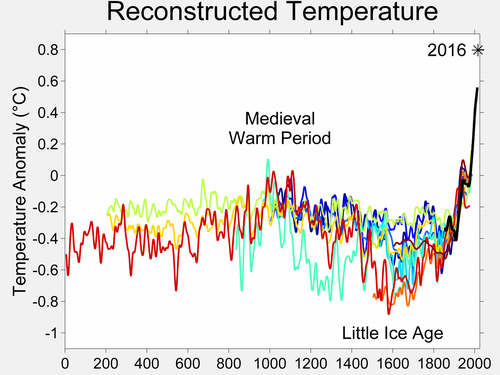
Little ice age
Extreme winters in successive years result in poor harvests, causing a large-scale famine in which between 300,000 and 480,000 die. Source — Wikipedia, "Timeline of Irish history" (18th century):
Little ice age By Unknown author, CC BY-SA 3.0, https://commons.wikimedia.org/w/index.php?curid=466264
Feb 1, 1760 CE
Battle of Carrickfergus
Battle of Carrickfergus: A French invasion. Source — Wikipedia, "Timeline of Irish history" (18th century):
View of Carrickfergus in Ireland late eighteenth century. By Nicolas Ozanne (1728-1811) - http://www.culture.gouv.fr/public/mistral/joconde_fr?ACTION=CHERCHER&FIELD_1=REF&VALUE_1=50350211432, Public domain, https://commons.wikimedia.org/w/index.php?curid=12776508
1782 CE
Irish Volunteers
After agitation by the Irish Volunteers, the Parliament of Great Britain passes a number of reforms—including the implicit repeal of Poynings' Law—collectively referred to as the Constitution of 1782. Source — Wikipedia, "Timeline of Irish history" (18th century):
Belt plate of the Belfast Volunteers corps By Robert Day - Ulster Journal of Archaeology, Second Series, Vol. 4, No. 2 (Jan., 1898), Public domain, https://commons.wikimedia.org/w/index.php?curid=20467976
Dec 1, 1796 CE
Expédition d'Irlande
Expédition d'Irlande: Attempted French invasion. Source — Wikipedia, "Timeline of Irish history" (18th century):
End of the Irish Invasion ; — or — the Destruction of the French Armada Js. Gillray, inv. et f. SUMMARY: French warships, labeled Le Révolutionaire, L'Egalité and The Revolutionary Jolly Boat, being tossed about during a storm blown up by Pitt, Dundas, Grenville and Windham, whose heads appear from the clouds. Charles Fox is the figurehead on Le Révolutionaire which is floundering with broken mast. The Revolutionary Jolly Boat is being swamped, throwing Sheridan, Hall, Erskine, M.A. Taylor and Thelwall overboard. MEDIUM: 1 print : etching, hand-colored. CREATED/PUBLISHED: [London] : H. Humphrey, 1797 Jany. 20th. According to Wright & Evans, Historical and Descriptive Account of the Caricatures of James Gillray (1851, OCLC 59510372), pp. 89–90, "On the French expedition to Bantry Bay, at the end of 1796. Pitt, Dundas, Grenville, and Windham are the four winds which blow up the storm to destroy the invaders. FFox, as the carved figure at the head of the Revolution, is represented as influencing the United Irishmen. The crew of the jolly-boat are Sheridan, Liberty Hall, Erskine, M. A. Taylor, and Thelwall, who, it is insinuated, were all approvers, at least, of the Irish rebellion." By James Gillray - Library of Congress, Prints & Photographs Division, LC-USZC4-8768 (color film copy transparency), uncompressed archival TIFF version (49 MB), level color (pick white point, adjust black level), cropped, and converted to JPEG (quality level 88) with the GIMP 2.4.5., Public domain, https://commons.wikimedia.org/w/index.php?curid=4576874
May 24, 1798 CE
Battle of Ballymore-Eustace
Battle of Ballymore-Eustace: A miscarried surprise attack on the British garrison at Ballymore in County Kildare is counterattacked and defeated. Source — Wikipedia, "Timeline of Irish history" (18th century):
The pre-1801 Union Flag (of w:United Kingdom of Great Britain). By Hoshie - Made by Hoshie Sodipodi flag collection (original file) Dead link as of: 4FEB2009 Colours: vexilla mundi Dead link as of: 12DEC2007 (Archived from 12MAR2007) Proportions: Zscout370 and Madden, Public domain, https://commons.wikimedia.org/w/index.php?curid=365635
Jan 1, 1801 CE
Acts of Union 1800
Acts of Union 1800 comes into effect; the Kingdom of Ireland unites with Great Britain, forming the United Kingdom of Great Britain and Ireland. Source — Wikipedia, "Timeline of Irish history" (19th century):
Coat of Arms of Great Britain from 1714 to 1801 used by King George I, George II and George III “ Quarterly, First quarter, Per pale, dexter, Gules three lions passant guardant in pale Or armed and langued Azure (for England), sinister, Or a lion rampant within a double tressure flory counter-flory Gules (for Scotland), Second quarter Azure three fleurs de lys Or (For France), Third quarter Azure a harp Or stringed Argent (for Ireland), Fourth quarter, Tierced per pale and per chevron, First Gules two lions passant guardant Or (for Brunswick), Second Or semée of hearts Gules a lion rampant Azure (For Luneburg), Third Gules a horse courant Argent (For Hanover), an inescutcheon over all three, Gules the Crown of Charlemagne Proper (As Archtreasurer of the Holy Roman Empire), the whole surrounded by the Garter; for a Crest, upon the Royal helm the imperial crown Proper, thereon a lion statant guardant Or imperially crowned Proper; Mantling Or and ermine; for Supporters, dexter a lion rampant guardant Or crowned as the Crest, sinister a unicorn Argent armed, crined and unguled Proper, gorged with a coronet Or composed of crosses patée and fleurs de lys a chain affixed thereto passing between the forelegs and reflexed over the back also Or; Motto 'Dieu et mon Droit' in the compartment below the shield, with the Union rose, shamrock and thistle engrafted on the same stem. ” PINCHES, J.H & R.V., The Royal Heraldry of England, 1974, Heraldry Today. By Sodacan - Own work, CC BY-SA 3.0, https://commons.wikimedia.org/w/index.php?curid=10952376
Jul 23, 1803 CE
Robert Emmet
Second United Irishmen rebellion: The Irish nationalist Robert Emmet attempts to seize Dublin Castle. Source — Wikipedia, "Timeline of Irish history" (19th century):
A watercolor on ivory miniature portrait(6.9 x 5.7 cm) by John Comerford of Robert Emmet. It is believed to have be sketched by Comerford during Emmet's trial and is the finest likeness of him made. It was transferred to the National Gallery of Ireland by a descendant of Emmet in 1970. By John Comerford - National Gallery of Ireland, Public domain, https://commons.wikimedia.org/w/index.php?curid=48370313
Mar 24, 1829 CE
Catholic Emancipation
Catholic Emancipation: The Roman Catholic Relief Act 1829 is passed, allowing Catholics to sit in the UK Parliament. Source — Wikipedia, "Timeline of Irish history" (19th century):
Coat of Arms of the United Kingdom from 1816 to 1837 used by King George III, George IV and William IV “ Quarterly, First and Fourth Gules three lions passant guardant in pale Or armed and langued Azure (for England), Second quarter Or a lion rampant within a double tressure flory counter-flory Gules (for Scotland), Third quarter Azure a harp Or stringed Argent (for Ireland), over all an inescutcheon, ensigned by an arched royal crown, Tierced per pale and per chevron, First Gules two lions passant guardant Or (for Brunswick), Second Or semée of hearts Gules a lion rampant Azure (For Luneburg), Third Gules a horse courant Argent (For Hanover), an inescutcheon over all three, Gules the Crown of Charlemagne Proper (As Archtreasurer of the Holy Roman Empire), the whole surrounded by the Garter; for a Crest, upon the Royal helm the imperial crown Proper, thereon a lion statant guardant Or imperially crowned Proper; Mantling Or and ermine; for Supporters, dexter a lion rampant guardant Or crowned as the Crest, sinister a unicorn Argent armed, crined and unguled Proper, gorged with a coronet Or composed of crosses patée and fleurs de lys a chain affixed thereto passing between the forelegs and reflexed over the back also Or; Motto 'Dieu et mon Droit' in the compartment below the shield, with the Union rose, shamrock and thistle engrafted on the same stem. ” PINCHES, J.H & R.V., The Royal Heraldry of England, 1974, Heraldry Today. By Sodacan - Own work, CC BY-SA 3.0, https://commons.wikimedia.org/w/index.php?curid=10952335
May 3, 1831 CE
Tithe War
Tithe War: A force of one hundred and twenty armed police forcibly takes possession of cattle belonging to a Roman Catholic priest, in lieu of his compulsory tithe to the Anglican Church of Ireland. Source — Wikipedia, "Timeline of Irish history" (19th century):
A lithographic print depicting the Rathmore-Gortroe massacre, which occurred near Rathcormac, County Cork on 18 December 1834. Soldiers of the 29th Regiment of Foot are depicted firing on a group of tenant farmers who attempt to escape and hide behind haystacks near a farmhouse. The print is attributed to The Reverend Matthew Morgan and dated to August 1848 (fourteen years after the event occurred). See en:Rathcormac massacre By Revd. Matthew Morgan - National Library of Ireland, Public domain, https://commons.wikimedia.org/w/index.php?curid=101365766
Dec 17, 1834 CE
Dublin and Kingstown Railway
Dublin and Kingstown Railway is opened as the first commercial railway in Ireland. Source — Wikipedia, "Timeline of Irish history" (19th century):
The 2-2-0 steam locomotive Hibernia, built in 1834. This was the first locomotive to run on the Dublin and Kingstown Railway, Ireland's first railway. The locomotive's components are labeled with capital letters as follows: A: frame, B: boiler, C: firebox, D: spark arrestor, E: water level gauge cocks, F: reversing levers, G: adjustable safety valve, H: fixed safety valve, I: steam inlet pipe, K: steam chest, L: cylinder, M: piston rod, N: bell crank, O: connecting rod, P: feedwater pump driving rod, Q: feedwater pump, R: steam exhaust pipe. Signed CLAYTON SC. By Robert Clayton - "Locomotive Engines on the Dublin and Kingstown Railway", The Dublin Penny Journal, Vol. 3, No. 125, p. 165. Also published in Thirteen views on the Dublin and Kingstown Railway, Dublin, 1834, see Google Books ., Public domain, https://commons.wikimedia.org/w/index.php?curid=27840269
1836 CE
Tithe Commutation Act 1836
Tithe War: The passage of the Tithe Commutation Act 1836 reduces the amount of the church's tithe and changes the manner of payment, which largely ends the unrest. Source — Wikipedia, "Timeline of Irish history" (19th century):
Coat of Arms of the United Kingdom from 1816 to 1837 used by King George III, George IV and William IV “ Quarterly, First and Fourth Gules three lions passant guardant in pale Or armed and langued Azure (for England), Second quarter Or a lion rampant within a double tressure flory counter-flory Gules (for Scotland), Third quarter Azure a harp Or stringed Argent (for Ireland), over all an inescutcheon, ensigned by an arched royal crown, Tierced per pale and per chevron, First Gules two lions passant guardant Or (for Brunswick), Second Or semée of hearts Gules a lion rampant Azure (For Luneburg), Third Gules a horse courant Argent (For Hanover), an inescutcheon over all three, Gules the Crown of Charlemagne Proper (As Archtreasurer of the Holy Roman Empire), the whole surrounded by the Garter; for a Crest, upon the Royal helm the imperial crown Proper, thereon a lion statant guardant Or imperially crowned Proper; Mantling Or and ermine; for Supporters, dexter a lion rampant guardant Or crowned as the Crest, sinister a unicorn Argent armed, crined and unguled Proper, gorged with a coronet Or composed of crosses patée and fleurs de lys a chain affixed thereto passing between the forelegs and reflexed over the back also Or; Motto 'Dieu et mon Droit' in the compartment below the shield, with the Union rose, shamrock and thistle engrafted on the same stem. ” PINCHES, J.H & R.V., The Royal Heraldry of England, 1974, Heraldry Today. By Sodacan - Own work, CC BY-SA 3.0, https://commons.wikimedia.org/w/index.php?curid=10952335
1845 CE
Great Irish Famine
Great Irish Famine: A potato blight destroys two-thirds of Ireland's staple crop, leading to an estimated 1 million deaths and emigration of a further 1 million people. Source — Wikipedia, "Timeline of Irish history" (19th century):
The scene at Skibbereen, west Cork, in 1847. From a series of illustrations by Cork artist James Mahony (1810–1879), commissioned by Illustrated London News 1847. “The first Sketch is taken on the road, at Cahera, of a famished boy and girl turning up the ground to seek for a potato to appease their hunger. ‘Not far from the spot where I made this sketch,’ says Mr. Mahoney, ‘and less than fifty perches from the high road, is another of the many sepulchres above ground, where six dead bodies had lain for twelve days, without the least chance of interment, owing to their being so far from the town.'” By James Mahony - http://seanduke.com/2011/08/08/is-there-a-genetic-memory-of-the-irish-famine-the-holocaust/, Public domain, https://commons.wikimedia.org/w/index.php?curid=24088245
Identifier: harpersweeklyv11bonn (find matches) Title: Harper's weekly Year: 1857 (1850s) Authors: Bonner, John, 1828-1899 Curtis, George William, 1824-1892 Alden, Henry Mills, 1836-1919 Conant, Samuel Stillman, 1831-1885? Schuyler, Montgomery, 1843-1914 Foord, John, 1842-1922 Davis, Richard Harding, 1864-1916 Schurz, Carl, 1829-1906 Nelson, Henry Loomis, 1846-1908 Bangs, John Kendrick, 1862-1922 Harvey, George Brinton McClellan, 1864-1928 Hapgood, Norman, 1868-1937 Subjects: Publisher: New York : Harper & Brothers Contributing Library: Lincoln Financial Foundation Collection Digitizing Sponsor: The Institute of Museum and Library Services through an Indiana State Library LSTA Grant View Book Page: Book Viewer About This Book: Catalog Entry View All Images: All Images From Book Click here to view book online to see this illustration in context in a browseable online version of this book. Text Appearing Before Image: WI..1 WFATlL-i;. .u»h the Littkc«e:muv-winged butterfly saU- 1 ling HARPERS WEEKLY. (April 13, 1867. Text Appearing After Image: April 13, 1867.) U \i;iKl,S WEEKLY. Note About Images Please note that these images are extracted from scanned page images that may have been digitally enhanced for readability - coloration and appearance of these illustrations may not perfectly resemble the original work. By Bonner, John, 1828-1899; Curtis, George William, 1824-1892; Alden, Henry Mills, 1836-1919; Conant, Samuel Stillman, 1831-1885?; Schuyler, Montgomery, 1843-1914; Foord, John, 1842-1922; Davis, Richard Harding, 1864-1916; Schurz, Carl, 1829-1906; Nelson, Henry Loomis, 1846-1908; Bangs, John Kendrick, 1862-1922; Harvey, George Brinton McClellan, 1864-1928; Hapgood, Norman, 1868-1937 - https://www.flickr.com/photos/internetarchivebookimages/14759904866/ Source book page: https://archive.org/stream/harpersweeklyv11bonn/harpersweeklyv11bonn#page/n240/mode/1up, No restrictions, https://commons.wikimedia.org/w/index.php?curid=42687981
1879 CE
Land War
The "Land War," a period of rural agitation for fair rents and free sale of land to liberate Irish peasants from generations of debt and tenancy. Source — Wikipedia, "Timeline of Irish history" (19th century):
Irish family evicted at Moyasta, County Clare during Land War, c.1879. By Unknown author - Lawrence Collection, National Library of Ireland. [1] archive copy at the Wayback Machine, Public domain, https://commons.wikimedia.org/w/index.php?curid=45953
1886 CE
Government of Ireland Bill 1886
1st Home Rule Bill, also known as the Government of Ireland Bill 1886. Source — Wikipedia, "Timeline of Irish history" (19th century):
This map satirizes the Irish Home Rule crisis of 1886 and appeared two years later in the Conservative St. Stephen’s Review. " By William Mecham - St. Stephens Review, June 9, 1888. Cornell University: Persuasive Cartography: The PJ Mode Collection, Public domain, https://commons.wikimedia.org/w/index.php?curid=49451622
1893 CE
Government of Ireland Bill 1893
2nd Home Rule Bill, also known as the Government of Ireland Bill 1893. Source — Wikipedia, "Timeline of Irish history" (19th century):
Aug 19, 1913 CE
Dublin
A Dublin businessman, William Martin Murphy, fires forty workers he suspects belong to the Irish Transport and General Workers' Union (ITGWU). A resulting strike and related civil unrest, the Dublin Lockout, lasts from August 1913 to January 1914. Source — Wikipedia, "Timeline of Irish history" (20th century):
Dublin aerial photograph By 瑞丽江的河水 - Own work, CC BY-SA 4.0, https://commons.wikimedia.org/w/index.php?curid=170090198
Sep 18, 1914 CE
Government of Ireland Act 1914
Government of Ireland Act is passed, providing for Irish Home Rule, but its application is simultaneously postponed for the duration of World War I. Source — Wikipedia, "Timeline of Irish history" (20th century):
Coat of Arms of the United Kingdom from 1901 to 1952 used by King Edward VII, George V, Edward VIII and George VI. “ Quarterly, First and Fourth Gules three lions passant guardant in pale Or armed and langued Azure (for England), Second quarter Or a lion rampant within a double tressure flory counter-flory Gules (for Scotland), Third quarter Azure a harp Or stringed Argent (for Ireland), the whole surrounded by the Garter; for a Crest, upon the Royal helm the imperial crown Proper, thereon a lion statant guardant Or imperially crowned Proper; Mantling Or and ermine; for Supporters, dexter a lion rampant guardant Or crowned as the Crest, sinister a unicorn Argent armed, crined and unguled Proper, gorged with a coronet Or composed of crosses patée and fleurs de lys a chain affixed thereto passing between the forelegs and reflexed over the back also Or; Motto 'Dieu et mon Droit' in the compartment below the shield, with the Union rose, shamrock and thistle engrafted on the same stem. ” PINCHES, J.H & R.V., The Royal Heraldry of England, 1974, Heraldry Today. By Sodacan - Own work, CC BY-SA 3.0, https://commons.wikimedia.org/w/index.php?curid=10952295
Apr 24, 1916 CE
Easter Rising
Easter Rising: The Irish Republican Brotherhood leads an action which seizes key government buildings in Dublin, and issues the Proclamation of the Irish Republic. The Rising lasts til 29 April 1916. Source — Wikipedia, "Timeline of Irish history" (20th century):
The shell of the G.P.O. on Sackville Street (later O'Connell Street), Dublin in the aftermath of the 1916 Rising. Date: May? 1916 NLI Ref.: Ke 121 By Keogh Brothers Ltd., photographers [1] - Life goes on..., National Library of Ireland on The Commons, No restrictions, https://commons.wikimedia.org/w/index.php?curid=24252282
Apr 18, 1918 CE
Mansion House, Dublin
Acting on a resolution of Dublin Corporation, the Lord Mayor convenes a conference at the Mansion House to devise plans to resist conscription. Source — Wikipedia, "Timeline of Irish history" (20th century):
Mansion House in Dublin. By Digital Eye - Own work, CC BY-SA 4.0, https://commons.wikimedia.org/w/index.php?curid=43814582
Jan 21, 1919 CE
1st Dáil
The First Dáil of the Irish Republic meets and issues a Declaration of Independence from the UK. Source — Wikipedia, "Timeline of Irish history" (20th century):
Note that the green portion of the flag was designed to represent the majority Catholic residents of the island, the orange side the minority Protestant and the white middle part peace and harmony between them. By Éire - Drawn by User:SKopp, Public domain, https://commons.wikimedia.org/w/index.php?curid=343611
May 3, 1921 CE
Northern Ireland
Northern Ireland is established. Source — Wikipedia, "Timeline of Irish history" (20th century):
A map of Northern Ireland within the United Kingdom and Europe. The map is a polar orthographic projection. Northern Ireland Great Britain/United Kingdom except Northern Ireland Europe (except UK) By Blank map of Europe (with disputed regions).svg: maix derivative work Alphathon /'æɫfə.θɒn/ - This file was derived from: Blank map of Europe (with disputed regions).svg:, CC BY-SA 3.0, https://commons.wikimedia.org/w/index.php?curid=18497746
Dec 6, 1921 CE
British government
Irish War of Independence: The War of Independence ends when negotiations between the British government and representatives of the de facto Irish Republic conclude with the signing of the Anglo-Irish Treaty and the creation of the Irish Free State. Source — Wikipedia, "Timeline of Irish history" (20th century):
Note that the green portion of the flag was designed to represent the majority Catholic residents of the island, the orange side the minority Protestant and the white middle part peace and harmony between them. By Éire - Drawn by User:SKopp, Public domain, https://commons.wikimedia.org/w/index.php?curid=343611
Jun 28, 1922 CE
Irish Civil War
Irish Civil War: Bombardment by Michael Collins of Anti-Treaty forces occupying the Four Courts marks the start of the Irish Civil War Source — Wikipedia, "Timeline of Irish history" (20th century):
National Army troops on board a ship bound for a secret destination during the Irish Civil WarNLI Ref: HOG79 By National Library of Ireland on The Commons - Secret Destination, Public domain, https://commons.wikimedia.org/w/index.php?curid=24252514
May 24, 1923 CE
Frank Aiken
Irish Civil War: IRA Chief of Staff Frank Aiken orders volunteers to dump arms, effectively ending the Civil War. Source — Wikipedia, "Timeline of Irish history" (20th century):
Irish Politician Frank Aiken of Fianna Fáil, taken in 1944. By Unknown author - File:Frank_Aiken_1944.jpg, Public domain, https://commons.wikimedia.org/w/index.php?curid=87612153
Sep 17, 1925 CE
1925 Seanad election
An election was held for 19 of the 60 seats in Seanad Éireann. Single transferable vote was used, with the entire state forming a single 19-seat electoral district, the largest number of members elected in one contest in Irish history. Source — Wikipedia, "Timeline of Irish history" (20th century):
Irish politician and member of Cumann na nGaedheal W. T. Cosgrave, circa 1922 By A. H. Poole Studio - https://catalogue.nli.ie/Record/vtls000642414, Public domain, https://commons.wikimedia.org/w/index.php?curid=132668119
Dec 12, 1928 CE
Irish pound
The new Irish Free State introduced its own currency from 1928, the Irish pound. Source — Wikipedia, "Timeline of Irish history" (20th century):
Jun 1, 1932 CE
31st International Eucharistic Congress
The 31st International Eucharistic Congress, held in Dublin 22–26 June 1932. Source — Wikipedia, "Timeline of Irish history" (20th century):
This amazing scene is the closing ceremony of the Eucharistic Congress that was held in Dublin in June 1932. Earlier in the day, there had been a Solemn Pontifical High Mass at 1 p.m. in the Phoenix Park, with a special choir of 500 men and boys. A procession estimated at one million people, described as "miles of praying people", then made its way to O'Connell Bridge. The Service of Benediction and Hymns on O'Connell Bridge took place around 5.30 p.m., and the Papal Legate Cardinal Lorenzo Lauri gave his final address of the Eucharistic Congress from this location. Date: Sunday, 26 June 1932 NLI Ref.: <a href="http://catalogue.nli.ie/Record/vtls000241107" target="_blank" rel="nofollow">INDH2319</a> By National Library of Ireland on The Commons - Flickr: Benediction on the Bridge, No restrictions, https://commons.wikimedia.org/w/index.php?curid=17282803
Dec 29, 1937 CE
Constitution of Ireland
The Constitution of Ireland comes into force, replacing the Irish Free State with a new state called "Éire", or, in the English language, "Ireland" Source — Wikipedia, "Timeline of Irish history" (20th century):
Note that the green portion of the flag was designed to represent the majority Catholic residents of the island, the orange side the minority Protestant and the white middle part peace and harmony between them. By Éire - Drawn by User:SKopp, Public domain, https://commons.wikimedia.org/w/index.php?curid=343611
Apr 18, 1949 CE
Republic of Ireland Act 1948
The Republic of Ireland Act abolishes the statutory functions of the British monarch in relation to Ireland and confers them on the President of Ireland. Source — Wikipedia, "Timeline of Irish history" (20th century):
Arms of Ireland. Blazon: Azure, a harp or stringed argent. With 14 strings shown. By Setanta Saki - Own work. Using 1937 official state updated brian boru harp design as shown on Irish coinage [1], Public domain, https://commons.wikimedia.org/w/index.php?curid=31257608
Dec 14, 1955 CE
United Nations
Ireland joins the United Nations along with sixteen other sovereign states. Source — Wikipedia, "Timeline of Irish history" (20th century):
Flag of the United Nations By See File history below for details. Denelson83, Zscout370 ve Madden - Flag of the United Nations from the Open Clip Art website. Modifications by Denelson83, Zscout370 and Madden. Official construction sheet here.(1946-present United Nations) The United Nations flag code and regulations, as amended November 11, 1952, New York. Archived from the original on 13 September 2001. Retrieved on 2 December 2023. OCLC: 7548838., Public domain, https://commons.wikimedia.org/w/index.php?curid=437460
Aug 1, 1969 CE
the Troubles
Troops are deployed on the streets of Northern Ireland, marking the start of the Troubles. Source — Wikipedia, "Timeline of Irish history" (20th century):
Political capitals of the countries Ireland and Northern Ireland By The original uploader was Jonto at English Wikipedia. - Transferred from en.wikipedia to Commons by Kajasudhakarababu using CommonsHelper., CC BY-SA 3.0, https://commons.wikimedia.org/w/index.php?curid=4790785
Mar 1, 1972 CE
The Parliament of Northern Ireland is
The Parliament of Northern Ireland is prorogued (and abolished later the following year). Source — Wikipedia, "Timeline of Irish history" (20th century):
Jan 1, 1973 CE
European Community
Ireland joins the European Community along with the United Kingdom and Denmark. Source — Wikipedia, "Timeline of Irish history" (20th century):
The Flag of Europe is the flag and emblem of the European Union (EU) and Council of Europe (CoE). It consists of a circle of 12 golden (yellow) stars on a blue background. It was created in 1955 by the CoE and adopted by the EU, then the European Communities, in the 1980s. The CoE and EU are distinct in membership and nature. The CoE is an international organisation with 46 members, dealing with human rights and rule of law, while the EU is a quasi-federal union of 27 states, focused on economic integration and political cooperation. Today, the flag is mostly associated with the latter. It was the intention of the CoE that the flag should come to represent Europe as a whole, and since its adoption the membership of the CoE covers nearly the entire Europe by the number of states involved, although only a little over half of the European continent by territory. This is why the EU adopted the same flag. The flag has been used to represent Europe in sporting events and as a pro-democracy banner outside the European Union. By User:Verdy p, User:-xfi-, User:Paddu, User:Nightstallion, User:Funakoshi, User:Jeltz, User:Dbenbenn, User:Zscout370 - File created by various Wikimedia users (see "Author"). File based on the specification given at [1]., Public domain, https://commons.wikimedia.org/w/index.php?curid=2615952
Jun 1, 1973 CE
Northern Ireland Assembly
The Northern Ireland Assembly is elected. Source — Wikipedia, "Timeline of Irish history" (20th century):
General view of Parliament Buildings By https://www.flickr.com/photos/robertpaulyoung/ - https://www.flickr.com/photos/robertpaulyoung/64563230/sizes/l/in/photostream/, CC BY 2.0, https://commons.wikimedia.org/w/index.php?curid=16255885
Jan 1, 1974 CE
Northern Ireland Executive
A power-sharing Northern Ireland Executive takes office, but resigns in May as a result of the Ulster Workers' Council strike; the Assembly is suspended and later abolished. Source — Wikipedia, "Timeline of Irish history" (20th century):
"Dublin is just a Sunningdale Away" (Ulster Unionist Party, 1974), Troubled Images Exhibition, Linen Hall Library, Donegall Square North, Belfast, Northern Ireland, August 2010 By Ardfern - Own work, CC BY-SA 3.0, https://commons.wikimedia.org/w/index.php?curid=11391017
Sep 29, 1979 CE
Visit by Pope John Paul II to Ireland
Pope John Paul II visited Ireland from Saturday, 29 September to Monday, 1 October 1979, the first trip to Ireland by a Pope. Source — Wikipedia, "Timeline of Irish history" (20th century):
Point where Pope John Paul II touched Irish soil in 1979 at Dublin Airport By Simon Boddy from Maidenhead, Uk - Dublin-Popes Visit, CC BY-SA 2.0, https://commons.wikimedia.org/w/index.php?curid=31619408
Nov 15, 1985 CE
Anglo-Irish Agreement
The governments of Ireland and the United Kingdom sign the Anglo-Irish Agreement. Source — Wikipedia, "Timeline of Irish history" (20th century):
Anglo-Irish Agreement By Rob Bogaerts - Nationaal Archief: entry ad2e0288-d0b4-102d-bcf8-003048976d84, CC0, https://commons.wikimedia.org/w/index.php?curid=27508130
Dec 3, 1990 CE
Mary Robinson
Mary Robinson becomes the first female President of Ireland. Source — Wikipedia, "Timeline of Irish history" (20th century):
Former president of Ireland, Mary Robinson, in Brasilia on 21 August 2024. By Embaixada dos EUA - Brasil - https://www.flickr.com/photos/36232856@N03/53949082279/, Public domain, https://commons.wikimedia.org/w/index.php?curid=153553597
1995 CE
Celtic Tiger
Ireland enters the Celtic Tiger period, a time of high economic growth which continues until 2007. Source — Wikipedia, "Timeline of Irish history" (20th century):
Historical economic growth of Ireland and the UK By Max Roser - Our World in Data, CC BY 4.0, https://commons.wikimedia.org/w/index.php?curid=115226269
Apr 1, 1998 CE
Belfast Agreement
The Belfast Agreement is signed; as a result, the Northern Ireland Assembly is elected, to which powers are devolved in 1999 and a power-sharing Executive takes office. Source — Wikipedia, "Timeline of Irish history" (20th century):
Flag of Northern Ireland Assembly. By Furfur - Own work, CC BY-SA 1.0, https://commons.wikimedia.org/w/index.php?curid=59706342
Jan 1, 1999 CE
Irish pound
Ireland yields its official currency, the Irish pound, and adopts the Euro. Source — Wikipedia, "Timeline of Irish history" (20th century):
Euro Banknotes Europa series as of 28th May 2019 By The RedBurn - File:EUR 5 obverse (2013 issue).png, File:EUR 10 obverse (2014 issue).png, File:The Europa series 20 € obverse side.jpg, File:The Europa series 50 € obverse side.png, File:The Europa series 100 € obverse side.jpg, File:The Europa series 200 € obverse side.jpg, ECB decisions ECB/2003/4 and ECB/2003/5, https://commons.wikimedia.org/w/index.php?curid=190054230
Dec 15, 2013 CE
Economic Adjustment Programme for Ireland
The Economic Adjustment Programme for Ireland, which Ireland entered into in November 2010 following the post-2008 Irish economic downturn and related banking crisis, officially comes to a close. Source — Wikipedia, "Timeline of Irish history" (21st century):
Ireland bond prices By Wikideas1 - Own work https://www.investing.com/rates-bonds/ireland-15-year-bond-yield-historical-data https://www.investing.com/rates-bonds/ireland-10-year-bond-yield-historical-data https://www.investing.com/rates-bonds/ireland-5-year-bond-yield-historical-data https://www.investing.com/rates-bonds/ireland-3-year-bond-yield-historical-data, CC0, https://commons.wikimedia.org/w/index.php?curid=124198944
May 23, 2015 CE
Thirty-fourth Amendment of the Constitution of Ire
A 62% to 38% referendum result makes Ireland the first country to legalise same-sex marriage by popular vote. Source — Wikipedia, "Timeline of Irish history" (21st century):
Aug 1, 2018 CE
Visit by Pope Francis to Ireland
Pope Francis visited Ireland on 25 and 26 August 2018, as part of the World Meeting of Families 2018. Source — Wikipedia, "Timeline of Irish history" (21st century):










![End of the Irish Invasion ; — or — the Destruction of the French Armada Js. Gillray, inv. et f. SUMMARY: French warships, labeled Le Révolutionaire, L'Egalité and The Revolutionary Jolly Boat, being tossed about during a storm blown up by Pitt, Dundas, Grenville and Windham, whose heads appear from the clouds. Charles Fox is the figurehead on Le Révolutionaire which is floundering with broken mast. The Revolutionary Jolly Boat is being swamped, throwing Sheridan, Hall, Erskine, M.A. Taylor and Thelwall overboard. MEDIUM: 1 print : etching, hand-colored. CREATED/PUBLISHED: [London] : H. Humphrey, 1797 Jany. 20th. According to Wright & Evans, Historical and Descriptive Account of the Caricatures of James Gillray (1851, OCLC 59510372), pp. 89–90, "On the French expedition to Bantry Bay, at the end of 1796. Pitt, Dundas, Grenville, and Windham are the four winds which blow up the storm to destroy the invaders. FFox, as the carved figure at the head of the Revolution, is represented as influencing the United Irishmen. The crew of the jolly-boat are Sheridan, Liberty Hall, Erskine, M. A. Taylor, and Thelwall, who, it is insinuated, were all approvers, at least, of the Irish rebellion."](https://upload.wikimedia.org/wikipedia/commons/thumb/a/a1/Irish-Invasion-Gillray.jpeg/500px-Irish-Invasion-Gillray.jpeg)