Encyclopedia/3. History, Societies & Civilizations/09. Modern Nations/02. Americas • Curated by Admin Timeline.sg
History of Guyana (AI-generated, sourced to Wikipedia).
Chronological Storyline (39 Milestones)
Aug 1, 1498 CE
Columbus sights Guyana coast
Christopher Columbus sailed near the coast of present-day Guyana during his third voyage, though he did not land. The region was already inhabited by Arawak and Carib peoples. Source — Wikipedia, "Guyana":
Columbus sights Guyana coast By Sebastiano del Piombo - This file was donated to Wikimedia Commons as part of a project by the Metropolitan Museum of Art. See the Image and Data Resources Open Access Policy, Public domain, https://commons.wikimedia.org/w/index.php?curid=27554267
1595 CE
Raleigh explores in search of El Dorado
Sir Walter Raleigh led an expedition up the Orinoco River seeking the legendary golden city of El Dorado, publishing an account that drew European attention to the Guiana region. Source — Wikipedia, "Guyana":
La icónica y mítica laguna de Guatavita es reconocida como el centro de la Leyenda del Dorado porque en ella se generaban los ritos de oro de la comunidad Muisca que vivia en esta zona By Camilo.Errante - Own work, CC BY-SA 4.0, https://commons.wikimedia.org/w/index.php?curid=169640450
1616 CE
First Dutch settlement established
Dutch traders established the first European settlement in the Essequibo region, building a fort and beginning systematic colonization of the Guiana coast. Source — Wikipedia, "Guyana":
Colony of Dutch Essequibo circa 1800 By ZiaLater - Own work, CC0, https://commons.wikimedia.org/w/index.php?curid=72414111
1627 CE
Berbice colony founded
Dutch colonist Abraham van Peere established a settlement on the Berbice River, creating what would become one of the three colonies that eventually formed Guyana. Source — Wikipedia, "Guyana":
Zoom into this map at maps.bpl.org. Author: Keulen, Johannes van Date: 1780 Location: Berbice River (Guyana), Guyana Dimension 71x111cm Scale: ca. 91,870 Call Number: G5253.M2 1780 .K48x By http://maps.bpl.org - Nieuwe ez zeer accuraate generaale caart van de twee rievieren Berbice en Canja met alle desselts plantagien en gronden op ordre van de Edl. Agtere. Heeren Direceuren van de geoctroyeerde colonie Uploaded by Fentener van Vlissingen, CC BY 2.0, https://commons.wikimedia.org/w/index.php?curid=13227803
1652 CE
Suriname colony established
Dutch settlers established a colony in Suriname, part of broader Dutch expansion across the Guiana coast that included Essequibo, Berbice, and Demerara. Source — Wikipedia, "Guyana":
Flag of the Netherlands By Zscout370 - Own work, Public domain, https://commons.wikimedia.org/w/index.php?curid=363168
1700 CE
Sugar plantations expand
By 1700, Dutch colonists had established extensive sugar plantations along the coast, relying on enslaved Africans brought through the transatlantic slave trade. Source — Wikipedia, "Guyana":
The flag of Guyana By Whitney Smith - Emblems, Flags and Colours of the Regions of the Cooperative Republic of Guyana, Public domain, https://commons.wikimedia.org/w/index.php?curid=343600
Feb 23, 1763 CE
Berbice slave rebellion erupts
Enslaved Africans in Berbice revolted against Dutch plantation owners in one of the largest slave uprisings in Caribbean history, led initially by Cuffy, a house slave. Source — Wikipedia, "Guyana":
Overzicht van de opstandige plantages in Berbice tot 3 maart 1763 By Hans Erren - Own work, CC BY-SA 4.0, https://commons.wikimedia.org/w/index.php?curid=72975981
1781 CE
British capture Dutch colonies
During the Fourth Anglo-Dutch War, British forces captured the Dutch colonies of Essequibo, Demerara, and Berbice, beginning a period of competing European control. Source — Wikipedia, "Guyana":
British capture Dutch colonies By Thomas Luny - National Maritime Museum, Greenwich, London, Public domain, https://commons.wikimedia.org/w/index.php?curid=18445410
1784 CE
Dutch regain colonies
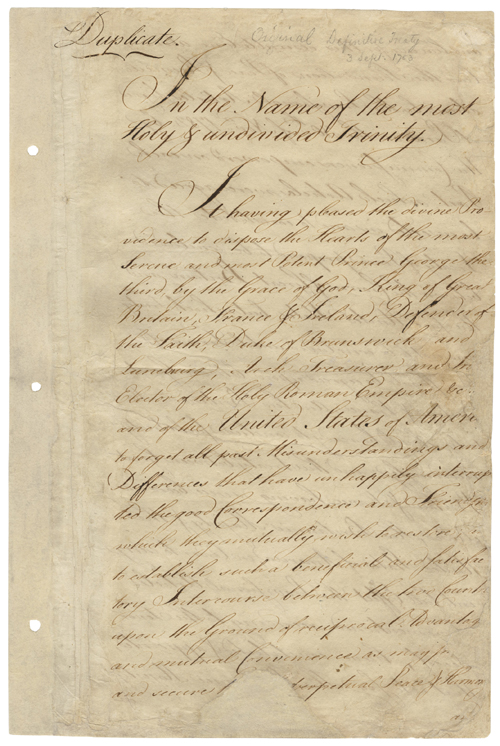
Under the Treaty of Paris, the Dutch regained control of Essequibo, Demerara, and Berbice from the British, restoring Dutch colonial administration. Source — Wikipedia, "Guyana":
First page of the Treaty of Paris in 1783, which forced Britain to recognise the United States as a country. By iDK - This tag does not indicate the copyright status of the attached work. A normal copyright tag is still required. See Commons:Licensing., Public domain, https://commons.wikimedia.org/w/index.php?curid=115507932
1796 CE
British seize Demerara and Essequibo
British forces under Sir Ralph Abercromby captured Demerara and Essequibo from the Dutch during the French Revolutionary Wars, beginning permanent British dominance. Source — Wikipedia, "Guyana":
Map of the Dutch colonies of Essequibo, Demerara and Berbice, ceded in 1815 to the United Kingdom as British Guiana. By P.M. Netscher - dbnl.org, Public domain, https://commons.wikimedia.org/w/index.php?curid=3133258
1814 CE
Britain formally gains colonies
The Anglo-Dutch Treaty of London formally ceded Demerara, Essequibo, and Berbice to Britain, ending Dutch colonial rule in what would become Guyana. Source — Wikipedia, "Guyana":
The flag of Guyana By Whitney Smith - Emblems, Flags and Colours of the Regions of the Cooperative Republic of Guyana, Public domain, https://commons.wikimedia.org/w/index.php?curid=343600
Aug 18, 1823 CE
Demerara slave rebellion
Enslaved Africans in Demerara revolted against plantation owners, inspired by Christian teachings and desire for freedom. The rebellion was brutally suppressed and helped galvanize the British abolitionist movement. Source — Wikipedia, "Guyana":
Account of an insurrection of the negro slaves in the colony of Demerara, which broke out on the 18th of August, 1823. (Retreat of Lt. Brady) Large group of slaves force the retreat of European soldiers. Includes canal, boat, drawbridge, dwellings, guns or muskets, flag, hogs, pigs, dogs, and bayonnets. By Joshua Bryant, Demerara - John Carter Brown Library, Public domain, https://commons.wikimedia.org/w/index.php?curid=8571926
1831 CE
British Guiana unified
Britain merged the colonies of Demerara, Essequibo, and Berbica into a single colony called British Guiana, establishing the political entity that would become modern Guyana. Source — Wikipedia, "Guyana":
Flag of British Guiana (1955–1966) By Sodacan - Own work, CC BY-SA 4.0, https://commons.wikimedia.org/w/index.php?curid=61478168
Aug 1, 1834 CE
Slavery abolished
The British Emancipation Act abolished slavery throughout the empire, freeing approximately 84,000 enslaved people in British Guiana, though they were required to serve an apprenticeship period. Source — Wikipedia, "Guyana":
Coat of Arms of the United Kingdom from 1816 to 1837 used by King George III, George IV and William IV “ Quarterly, First and Fourth Gules three lions passant guardant in pale Or armed and langued Azure (for England), Second quarter Or a lion rampant within a double tressure flory counter-flory Gules (for Scotland), Third quarter Azure a harp Or stringed Argent (for Ireland), over all an inescutcheon, ensigned by an arched royal crown, Tierced per pale and per chevron, First Gules two lions passant guardant Or (for Brunswick), Second Or semée of hearts Gules a lion rampant Azure (For Luneburg), Third Gules a horse courant Argent (For Hanover), an inescutcheon over all three, Gules the Crown of Charlemagne Proper (As Archtreasurer of the Holy Roman Empire), the whole surrounded by the Garter; for a Crest, upon the Royal helm the imperial crown Proper, thereon a lion statant guardant Or imperially crowned Proper; Mantling Or and ermine; for Supporters, dexter a lion rampant guardant Or crowned as the Crest, sinister a unicorn Argent armed, crined and unguled Proper, gorged with a coronet Or composed of crosses patée and fleurs de lys a chain affixed thereto passing between the forelegs and reflexed over the back also Or; Motto 'Dieu et mon Droit' in the compartment below the shield, with the Union rose, shamrock and thistle engrafted on the same stem. ” PINCHES, J.H & R.V., The Royal Heraldry of England, 1974, Heraldry Today. By Sodacan - Own work, CC BY-SA 3.0, https://commons.wikimedia.org/w/index.php?curid=10952335
May 5, 1838 CE
First Indian indentured laborers arrive
The first ship carrying Indian indentured laborers, the Whitby and Hesperus, arrived in British Guiana, beginning a migration that brought over 239,000 Indians to the colony. Source — Wikipedia, "Guyana":
The flag of Guyana By Whitney Smith - Emblems, Flags and Colours of the Regions of the Cooperative Republic of Guyana, Public domain, https://commons.wikimedia.org/w/index.php?curid=343600
Aug 1, 1838 CE
Apprenticeship ends
The apprenticeship system ended, granting full freedom to formerly enslaved people in British Guiana. Many left plantations, creating a labor shortage. Source — Wikipedia, "Guyana":
The flag of Guyana By Whitney Smith - Emblems, Flags and Colours of the Regions of the Cooperative Republic of Guyana, Public domain, https://commons.wikimedia.org/w/index.php?curid=343600
1853 CE
Chinese indentured laborers arrive
Chinese indentured laborers were brought to British Guiana to work on plantations, adding another ethnic group to the colony's increasingly diverse population. Source — Wikipedia, "Guyana":
The flag of Guyana By Whitney Smith - Emblems, Flags and Colours of the Regions of the Cooperative Republic of Guyana, Public domain, https://commons.wikimedia.org/w/index.php?curid=343600
1889 CE
Venezuela border dispute begins
Venezuela formally disputed the boundary with British Guiana, claiming territory west of the Essequibo River, initiating a territorial conflict that persists to the present day. Source — Wikipedia, "Guyana":
The flag of Guyana By Whitney Smith - Emblems, Flags and Colours of the Regions of the Cooperative Republic of Guyana, Public domain, https://commons.wikimedia.org/w/index.php?curid=343600
Oct 3, 1899 CE
Paris Arbitral Award
An international tribunal in Paris awarded most of the disputed territory to British Guiana, establishing the border that Guyana recognizes today, though Venezuela later rejected the award. Source — Wikipedia, "Guyana":
The flag of Guyana By Whitney Smith - Emblems, Flags and Colours of the Regions of the Cooperative Republic of Guyana, Public domain, https://commons.wikimedia.org/w/index.php?curid=343600
1917 CE
Indentured labor system ends
The British government abolished the Indian indentured labor system, ending the migration that had dramatically shaped British Guiana's demographic composition. Source — Wikipedia, "Guyana":
The flag of Guyana By Whitney Smith - Emblems, Flags and Colours of the Regions of the Cooperative Republic of Guyana, Public domain, https://commons.wikimedia.org/w/index.php?curid=343600
1928 CE
New constitution granted
Britain granted British Guiana a new constitution that introduced limited elected representation, marking an early step toward self-governance and political organization. Source — Wikipedia, "Guyana":
Flag of British Guiana (1955–1966) By Sodacan - Own work, CC BY-SA 4.0, https://commons.wikimedia.org/w/index.php?curid=61478168
Jun 16, 1947 CE
Enmore massacre
Police opened fire on striking sugar workers at Enmore plantation, killing five workers. The massacre became a rallying point for the independence movement. Source — Wikipedia, "Guyana":
The flag of Guyana By Whitney Smith - Emblems, Flags and Colours of the Regions of the Cooperative Republic of Guyana, Public domain, https://commons.wikimedia.org/w/index.php?curid=343600
Jan 1, 1950 CE
PPP founded
Cheddi Jagan and Forbes Burnham co-founded the People's Progressive Party, the first mass-based political party in British Guiana, advocating for independence and social reform. Source — Wikipedia, "Guyana":
Flag of the People's Progressive Party/Civic of Guyana. Sometimes seen in a horizontal bunting variant with the gold stripe at the bottom. By Prez001 - Own work, CC BY-SA 4.0, https://commons.wikimedia.org/w/index.php?curid=39758044
Apr 27, 1953 CE
PPP wins first election
The PPP won British Guiana's first universal suffrage election in a landslide. Cheddi Jagan became Chief Minister, but Britain suspended the constitution after just 133 days. Source — Wikipedia, "Guyana":
Guyana Coat of Arms with depth/relief. By Prez001 - Own work, Public domain, https://commons.wikimedia.org/w/index.php?curid=46457322
1955 CE
PPP splits along ethnic lines
The PPP split into two factions led by Cheddi Jagan (largely Indo-Guyanese support) and Forbes Burnham (largely Afro-Guyanese support), creating a political divide that defines Guyanese politics. Source — Wikipedia, "Guyana":
Flag of the People's Progressive Party/Civic of Guyana. Sometimes seen in a horizontal bunting variant with the gold stripe at the bottom. By Prez001 - Own work, CC BY-SA 4.0, https://commons.wikimedia.org/w/index.php?curid=39758044
1961 CE
Self-government granted
Britain granted British Guiana full internal self-government with Cheddi Jagan as Premier, leaving only foreign affairs and defense under British control. Source — Wikipedia, "Guyana":
Flag of British Guiana (1955–1966) By Sodacan - Own work, CC BY-SA 4.0, https://commons.wikimedia.org/w/index.php?curid=61478168
Dec 7, 1964 CE
Proportional representation introduced
Britain imposed a proportional representation electoral system, leading to a PNC-UF coalition government under Forbes Burnham, which took power before independence. Source — Wikipedia, "Guyana":
Guyana Coat of Arms with depth/relief. By Prez001 - Own work, Public domain, https://commons.wikimedia.org/w/index.php?curid=46457322
May 26, 1966 CE
Independence achieved
British Guiana became the independent nation of Guyana, with Forbes Burnham as Prime Minister, ending 150 years of British colonial rule. Source — Wikipedia, "Guyana":
The flag of Guyana By Whitney Smith - Emblems, Flags and Colours of the Regions of the Cooperative Republic of Guyana, Public domain, https://commons.wikimedia.org/w/index.php?curid=343600Video
Feb 23, 1970 CE
Cooperative Republic declared
Guyana became a cooperative republic within the Commonwealth, replacing the Governor-General with a ceremonial President and affirming its commitment to socialism. Source — Wikipedia, "Guyana":
The flag of Guyana By Whitney Smith - Emblems, Flags and Colours of the Regions of the Cooperative Republic of Guyana, Public domain, https://commons.wikimedia.org/w/index.php?curid=343600
1974 CE
Declaration of Sophia
The PNC government issued the Declaration of Sophia, committing Guyana to a socialist path and consolidating state control over the economy and political life. Source — Wikipedia, "Guyana":
The flag of Guyana By Whitney Smith - Emblems, Flags and Colours of the Regions of the Cooperative Republic of Guyana, Public domain, https://commons.wikimedia.org/w/index.php?curid=343600
Nov 18, 1978 CE
Jonestown massacre
Over 900 members of the Peoples Temple, an American cult led by Jim Jones, died in a mass murder-suicide at Jonestown in northwestern Guyana, the largest such event in modern history. Source — Wikipedia, "Guyana":
This image is from "the Jonestown Institute" at San Diego State University. The image is photo of the welcome sign at the entrance into Jonestown that is imaged here. The sign states: "Welcome to Jonestown> Peoples Temple Agricultural Project The site states that: "Tape transcripts, summaries, some primary source documents, and all photographs on this site are free and available to the public for use by crediting: The Jonestown Institute, http://jonestown.sdsu.edu." Home Page Permitting Such Usage By The original uploader was Mosedschurte at English Wikipedia. - Transferred from en.wikipedia to Commons by Josve05a using CommonsHelper., Attribution, https://commons.wikimedia.org/w/index.php?curid=12374156
Oct 6, 1980 CE
New constitution adopted
A new constitution established an executive presidency and was approved by referendum amid allegations of fraud. Forbes Burnham became Executive President with sweeping powers. Source — Wikipedia, "Guyana":
The flag of Guyana By Whitney Smith - Emblems, Flags and Colours of the Regions of the Cooperative Republic of Guyana, Public domain, https://commons.wikimedia.org/w/index.php?curid=343600
Aug 6, 1985 CE
Burnham dies, Hoyte succeeds
Forbes Burnham died in office and was succeeded by Desmond Hoyte, who gradually reversed Burnham's socialist policies and began economic liberalization. Source — Wikipedia, "Guyana":
Desmond Hoyte By People's National Congress - http://www.tributes.com/obituary/photos/Desmond-Hoyte-83730700, CC0, https://commons.wikimedia.org/w/index.php?curid=58538972
Oct 5, 1992 CE
Free elections restore democracy
International observers certified Guyana's first free and fair elections in decades, returning Cheddi Jagan and the PPP to power after 28 years of PNC rule. Source — Wikipedia, "Guyana":
Results by region of the 1992 Guyanese general elections. By FelipeRev - Own work, CC BY-SA 4.0, https://commons.wikimedia.org/w/index.php?curid=80526731
Mar 6, 1997 CE
Cheddi Jagan dies
President Cheddi Jagan died in office. His wife Janet Jagan was subsequently elected president later that year, becoming the first female head of state in Guyana. Source — Wikipedia, "Guyana":
Cheddi Jagan By Unknown author - [1] Dutch National Archives, The Hague, Fotocollectie Algemeen Nederlands Persbureau (ANEFO), 1945-1989 bekijk toegang 2.24.01.04 Bestanddeelnummer 914-5552, CC0, https://commons.wikimedia.org/w/index.php?curid=37149842
Aug 11, 1999 CE
Bharrat Jagdeo becomes president
Janet Jagan resigned due to health reasons, and Bharrat Jagdeo succeeded her as president, going on to win elections in 2001 and 2006. Source — Wikipedia, "Guyana":
#EuropeDay2022 and 50 years of cooperation between the EU and Guyana #peace #democracy #development #Trade #culture By Delegation of the European Union to Guyana, Suriname, and the Dutch OCTs (DELGUYGEO) - https://twitter.com/DELGUYGEO/status/1524035986962980870, Attribution, https://commons.wikimedia.org/w/index.php?curid=119716229
May 11, 2015 CE
APNU+AFC coalition wins
A coalition led by David Granger defeated the PPP, ending 23 years of PPP rule and marking the first peaceful transfer of power to the opposition in Guyana's history. Source — Wikipedia, "Guyana":
Results by region of the 2015 Guyanese general elections. By FelipeRev - Own work, CC BY-SA 4.0, https://commons.wikimedia.org/w/index.php?curid=80752837
Mar 2, 2020 CE
PPP returns to power
After a protracted electoral process and recount, the PPP led by Irfaan Ali was declared winner of the general election, returning the party to power amid significant oil discoveries. Source — Wikipedia, "Guyana":
Secretary of State Michael R. Pompeo holds a joint press availability with Guyanese President Irfaan Ali, in Georgetown, Guyana, on September 18, 2020. [State Department Photo by Ron Przysucha/ Public Domain] By U.S. Department of State from United States - Secretary Pompeo Holds a Joint Press Availability with Guyanese President Ali, Public domain, https://commons.wikimedia.org/w/index.php?curid=94306192
Dec 3, 2023 CE
Venezuela referendum on Essequibo
Venezuela held a referendum claiming sovereignty over the Essequibo region, escalating the long-standing border dispute and prompting international concern and ICJ proceedings. Source — Wikipedia, "Guyana":
The flag of Guyana By Whitney Smith - Emblems, Flags and Colours of the Regions of the Cooperative Republic of Guyana, Public domain, https://commons.wikimedia.org/w/index.php?curid=343600




![Secretary of State Michael R. Pompeo holds a joint press availability with Guyanese President Irfaan Ali, in Georgetown, Guyana, on September 18, 2020. [State Department Photo by Ron Przysucha/ Public Domain]](https://upload.wikimedia.org/wikipedia/commons/thumb/d/dd/Irfaan_Ali_in_2020.jpg/500px-Irfaan_Ali_in_2020.jpg)