Encyclopedia/3. History, Societies & Civilizations/09. Modern Nations/01. Africa • Curated by Admin Timeline.sg
History of Gabon (AI-generated, sourced to Wikipedia).
Chronological Storyline (26 Milestones)
500 CE
Bantu Migrations Reach Gabon
Bantu-speaking peoples migrate into the region, displacing or assimilating indigenous Pygmy hunter-gatherer populations. Source — Wikipedia, "Gabon":
Spread of the "Early Iron Age" in Eastern, Central and Southern Africa, a proxy for the Bantu migrations. Based on K. Shillington, History of Africa (3rd ed. 2005), p. 63. Urewe (Lake Victoria) 250 BCE, Kwale 200 CE, Kisale 300 CE, , Kalundu/Dambwa 100 CE , Kalambo 300 CE, Nkope 300 CE, Gokmere-Ziwa/Bambata 300 CE, presence in South Africa (Kei river) by 400 CE. By Unknown author - East&southern africa early iron age.gif, Public domain, https://commons.wikimedia.org/w/index.php?curid=5444722
Jan 1, 1472 CE
Portuguese Arrive at Estuary
Portuguese navigator Lopo Gonçalves explores the coast, naming the Komo river estuary Gabão due to its cloak-like shape. Source — Wikipedia, "Gabon":
The Portuguese Colonial Empire (locations where at some point part of the Empire) By Gabriel Ziegler - [1], CC BY-SA 4.0, https://commons.wikimedia.org/w/index.php?curid=123204041
1700 CE
Orungu Kingdom Rises
The Orungu Kingdom becomes a dominant regional power, controlling trade along the coast and interior waterways. Source — Wikipedia, "Gabon":
Flag of Gabon By Léon Augé and Pierre Claver Eyeghe - Gabonese Republic, Public domain, https://commons.wikimedia.org/w/index.php?curid=343064
Feb 9, 1839 CE
First French Treaty Signed
French naval officer Bouët-Willaumez signs a protection treaty with King Rapontchombo of the Mpongwe, beginning French influence. Source — Wikipedia, "Gabon":
Royal Standard, raised in the presence of the King of France (used as a state flag by the Kingdom of France under the absolute monarchy). Used from around 1638 to 1790 By Sodacan - Own work based on: “ Pavillon royal de France. il est blanc semé de fleurs de lis d’or, chargé des armes de France, entouré des colliers des ordres de S. Michel & du S. Esprit, & deux anges pour support. ” —Encyclopédie, ou Dictionnaire raisonné des sciences, des arts et des métiers (1751). “ Pavillon Roïal de France. il est blanc, semé de fleurs de lis d'or, & chargé d'un Écusson des armes de France, entouré des Colliers des ordres de St Michel & du St Esprit. ” —La connoissance des pavillons ou bannieres que la plûpart des nations arborent en mer (1737). A depiction of 'Pavillon Royal De France' is shown in the same book. the standard flying from a first rate Admiral's flagship (painted 1693) The standard flying from the Soleil-Royal at the Battle of Barleur (painted 1693 by Ludolf Bakhuizen) 'Pavillons de France' from 'Le Neptune françois, ou Atlas nouveau des cartes marines' (P. Mortier, 1700). Image of the 'Pavillon royal de France' from the 'Encyclopédie, ou Dictionnaire raisonné des sciences' (1751). White flag of France with the fleur-de-lis of the Bourbon kings, flanked by two angels. (Flags through the ages and cross the world 1975 by Whitney Smith.), CC BY-SA 3.0, https://commons.wikimedia.org/w/index.php?curid=32173493
1849 CE
Libreville Founded
French authorities establish Libreville as a settlement for freed slaves, mirroring the founding of Freetown in Sierra Leone. Source — Wikipedia, "Gabon":
Bord de mer du centre administratif de Libreville By Shirmy25 - Own work, CC BY-SA 4.0, https://commons.wikimedia.org/w/index.php?curid=163160491
1862 CE
Cape Lopez Ceded to France
King Louis Dowé signs a treaty ceding the Cape Lopez territory to France, solidifying French coastal control. Source — Wikipedia, "Gabon":
Royal Standard, raised in the presence of the King of France (used as a state flag by the Kingdom of France under the absolute monarchy). Used from around 1638 to 1790 By Sodacan - Own work based on: “ Pavillon royal de France. il est blanc semé de fleurs de lis d’or, chargé des armes de France, entouré des colliers des ordres de S. Michel & du S. Esprit, & deux anges pour support. ” —Encyclopédie, ou Dictionnaire raisonné des sciences, des arts et des métiers (1751). “ Pavillon Roïal de France. il est blanc, semé de fleurs de lis d'or, & chargé d'un Écusson des armes de France, entouré des Colliers des ordres de St Michel & du St Esprit. ” —La connoissance des pavillons ou bannieres que la plûpart des nations arborent en mer (1737). A depiction of 'Pavillon Royal De France' is shown in the same book. the standard flying from a first rate Admiral's flagship (painted 1693) The standard flying from the Soleil-Royal at the Battle of Barleur (painted 1693 by Ludolf Bakhuizen) 'Pavillons de France' from 'Le Neptune françois, ou Atlas nouveau des cartes marines' (P. Mortier, 1700). Image of the 'Pavillon royal de France' from the 'Encyclopédie, ou Dictionnaire raisonné des sciences' (1751). White flag of France with the fleur-de-lis of the Bourbon kings, flanked by two angels. (Flags through the ages and cross the world 1975 by Whitney Smith.), CC BY-SA 3.0, https://commons.wikimedia.org/w/index.php?curid=32173493
1886 CE
French Congo Established
Gabon is officially incorporated into the French Congo, marking the formalization of French colonial administration in the territory. Source — Wikipedia, "Gabon":
Flag of France By Original: Unknown Vector: SKopp - This SVG flag includes elements that have been taken or adapted from this flag:, Public domain, https://commons.wikimedia.org/w/index.php?curid=60739584
1910 CE
French Equatorial Africa Formed
Gabon becomes one of the four territories of French Equatorial Africa, with Brazzaville as the federal capital. Source — Wikipedia, "Gabon":
Flag of France By Original: Unknown Vector: SKopp - This SVG flag includes elements that have been taken or adapted from this flag:, Public domain, https://commons.wikimedia.org/w/index.php?curid=60739584
1914 CE
Fang Revolt Suppressed
The Fang people rebel against French colonial rule and taxation, but the uprising is brutally suppressed by colonial forces. Source — Wikipedia, "Gabon":
Exhibit in the Royal Museum for Central Africa, Tervuren, Belgium. This object is old enough so that it is in the public domain. Photography was permitted in the museum without restriction. By Daderot - Own work, CC0, https://commons.wikimedia.org/w/index.php?curid=36310525
Nov 12, 1940 CE
Battle of Gabon Fought
Free French forces under Charles de Gaulle fight Vichy loyalists, securing Gabon for the Allied cause during WWII. Source — Wikipedia, "Gabon":
1e Compagnie de Chars de Combat de la France Libre during the Battle of Gabon By Unknown author - http://www.france-libre.net/site/wp-content/uploads/2014/01/Gabon40.jpg, Public domain, https://commons.wikimedia.org/w/index.php?curid=47711351
1946 CE
Overseas Territory Status Granted
Gabon becomes an overseas territory of France, gaining representation in the French parliament and a local assembly. Source — Wikipedia, "Gabon":
Flag of France By Original: Unknown Vector: SKopp - This SVG flag includes elements that have been taken or adapted from this flag:, Public domain, https://commons.wikimedia.org/w/index.php?curid=60739584
1956 CE
Framework Law Enacted
The Loi-cadre grants internal autonomy to Gabon, expanding the electorate and establishing a territorial government. Source — Wikipedia, "Gabon":
Gaston Defferre (1910-1986), French politician By Sénat français - Archives du Sénat, CC BY-SA 3.0, https://commons.wikimedia.org/w/index.php?curid=8010273
1959 CE
First Autonomous Government Formed
Léon M'ba becomes the first Prime Minister of Gabon, leading the autonomous government prior to full independence. Source — Wikipedia, "Gabon":
Léon M'ba By Unknown author - [1] Dutch National Archives, The Hague, Fotocollectie Algemeen Nederlands Persbureau (ANeFo), 1945-1989, bekijk toegang 2.24.01.04, Bestanddeelnummer 916-3276, CC BY-SA 3.0 nl, https://commons.wikimedia.org/w/index.php?curid=36747964
Aug 17, 1960 CE
Independence Achieved
Gabon gains full independence from France on August 17, becoming a sovereign republic within the international community. Source — Wikipedia, "Gabon":
Flag of Gabon By Léon Augé and Pierre Claver Eyeghe - Gabonese Republic, Public domain, https://commons.wikimedia.org/w/index.php?curid=343064
1961 CE
Léon M'ba Elected President
Léon M'ba is elected as the first President of Gabon, establishing a presidential system of government. Source — Wikipedia, "Gabon":
Léon M'ba By Unknown author - [1] Dutch National Archives, The Hague, Fotocollectie Algemeen Nederlands Persbureau (ANeFo), 1945-1989, bekijk toegang 2.24.01.04, Bestanddeelnummer 916-3276, CC BY-SA 3.0 nl, https://commons.wikimedia.org/w/index.php?curid=36747964
Feb 18, 1964 CE
Coup and French Intervention
A military coup overthrows M'ba, but French paratroopers intervene and restore him to power within days. Source — Wikipedia, "Gabon":
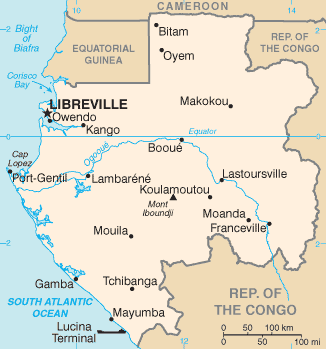
Map of Gabon By CIA - CIA World Factbook, Public domain, https://commons.wikimedia.org/w/index.php?curid=610267
Dec 2, 1967 CE
Omar Bongo Assumes Presidency
Following the death of Léon M'ba, Vice President Omar Bongo becomes President, starting a decades-long rule. Source — Wikipedia, "Gabon":
President Omar Bongo establishes the Gabonese Democratic Party (PDG), making Gabon a single-party state. Source — Wikipedia, "Gabon":
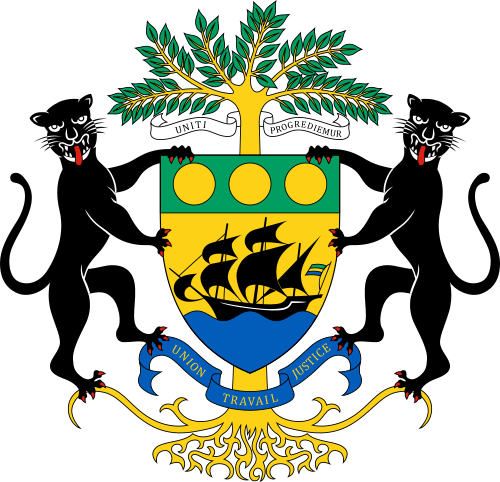
Coat of arms of Gabon By Original by Louis Mühlemann, vectorised by user:Fenn-O-maniC - Own work, based on [1], Public domain, https://commons.wikimedia.org/w/index.php?curid=1861900
1975 CE
Gabon Joins OPEC
Following significant offshore oil discoveries, Gabon joins the Organization of the Petroleum Exporting Countries. Source — Wikipedia, "Gabon":
Flag of the Organization of Petroleum Exporting Countries By Zscout370 - English Wikipedia: en:Image:Flag_of_OPEC.svg, Public domain, https://commons.wikimedia.org/w/index.php?curid=1140939
1990 CE
Multi-Party System Introduced
Amid domestic unrest and pressure, President Bongo concedes to end single-party rule, legalizing opposition parties. Source — Wikipedia, "Gabon":
Coat of arms of Gabon By Original by Louis Mühlemann, vectorised by user:Fenn-O-maniC - Own work, based on [1], Public domain, https://commons.wikimedia.org/w/index.php?curid=1861900
1993 CE
Disputed Presidential Election
Omar Bongo wins the first multi-party presidential election, but the opposition alleges fraud, leading to violent protests. Source — Wikipedia, "Gabon":
Coat of arms of Gabon By Original by Louis Mühlemann, vectorised by user:Fenn-O-maniC - Own work, based on [1], Public domain, https://commons.wikimedia.org/w/index.php?curid=1861900
2002 CE
National Parks Network Created
President Bongo designates over 10% of Gabon's land area as national parks, committing to conservation and eco-tourism. Source — Wikipedia, "Gabon":
Map of the national parks in Gabon By Mleal001 - created in GIS, CC BY-SA 3.0, https://commons.wikimedia.org/w/index.php?curid=19406953
Sep 3, 2009 CE
Ali Bongo Elected President
Following Omar Bongo's death, his son Ali Bongo Ondimba wins a controversial presidential election to succeed him. Source — Wikipedia, "Gabon":
Ali Bongo André Mba Obame Pierre Mamboundou By FelipeRev - Own work, CC BY-SA 4.0, https://commons.wikimedia.org/w/index.php?curid=58123393
2016 CE
Post-Election Violence Erupts
Ali Bongo is declared winner of the presidential election by a narrow margin, sparking deadly clashes and a parliamentary fire. Source — Wikipedia, "Gabon":
Results by region of the 2016 Gabonese presidential election. By FelipeRev - Own work, CC BY-SA 4.0, https://commons.wikimedia.org/w/index.php?curid=113416897
Jan 7, 2019 CE
Failed Military Coup Attempt
A small group of soldiers attempts a coup against Ali Bongo while he is abroad for medical treatment, but it is quickly thwarted. Source — Wikipedia, "Gabon":
Ejército de Gabón en las calles de Libreville durante el intento de golpe de Estado de 2019. By Oumma - YouTube: https://www.youtube.com/watch?v=FCXgLzEXLFg – View/save archived versions on archive.org, CC BY 3.0, https://commons.wikimedia.org/w/index.php?curid=75748412
Aug 30, 2023 CE
Military Coup Ousts Bongo
Military officers overthrow Ali Bongo shortly after his disputed re-election, ending the Bongo family's 56-year rule. Source — Wikipedia, "Gabon":
Carte topographique du Gabon. By Mysid (English version); Bourrichon (French translation) - Traduction de Image:Topographic map of Gabon-en.svg, CC BY-SA 4.0, https://commons.wikimedia.org/w/index.php?curid=3821950