Encyclopedia/1. The Cosmos & The Natural World/5. Life Sciences/02. Genetics & DNA Architecture • Curated by Admin Timeline.sg
Phylogeography · Speciation theory
Chronological Storyline (35 Milestones)
300 BCE
Aristotle classifies animals by reproduction
Aristotle's 'History of Animals' systematically classified over 500 species by mode of reproduction and habitat, establishing an early framework for biological taxonomy that influenced naturalists for two millennia. Source — Wikipedia:
Greek manuscript (Biblioteca Medicea Laurenziana, plut. 87.4, 205v and 206r) Text: from Aristotle, Sense and Sensiblia By Sailko - Own work, CC BY 3.0, https://commons.wikimedia.org/w/index.php?curid=37621581
77 CE
Pliny compiles Natural History encyclopedia
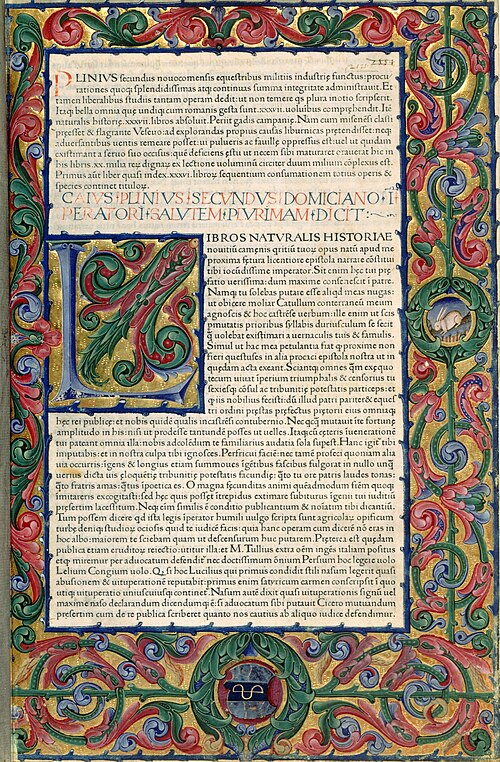
Pliny the Elder's 'Naturalis Historia' compiled knowledge of thousands of species across the Roman world, preserving biological observations that informed later European natural history traditions. Source — Wikipedia: )
First page from the Editio Princeps of the Pliny's "Historia Naturalis" printed by Johann of Speyer. Venice, 1469. Bibliothèque Nationale de France, Réserve des livres rares, VELINS-493 By Pliny the Elder - https://essentiels.bnf.fr/fr/image/2512ab77-3dca-4aa2-809e-0441c8ad777c-historia-naturalis, Public domain, https://commons.wikimedia.org/w/index.php?curid=142196397
860 CE
Al-Jahiz describes ecological interactions
The Islamic scholar al-Jahiz, in his 'Kitab al-Hayawan' (Book of Animals), described food chains, competition, and environmental adaptation—ideas resonating with later evolutionary and ecological thought. Source — Wikipedia:
A Syrian postage stamp with the value of 12 and a half piasters, issued in 1968 on the occasion of the 9th week of science By Syrian Post - (2017) Scott Standard Postage Stamp Catalogue, 6, Scott Publishing, p. 731 ISBN: 0894875120., Public domain, https://commons.wikimedia.org/w/index.php?curid=97494174
1020 CE
Ibn Sina's Canon of Medicine on species
Ibn Sina (Avicenna) systematized biological and medical knowledge in his 'Canon of Medicine,' which included discussions of hereditary traits and disease transmission that shaped medieval biology. Source — Wikipedia:
The Persian manuscript copy of The Canon of Medicine in Museum and Mausoleum of Avicenna, Hamedan, Iran. By Coffeetalkh - Own work, CC BY-SA 3.0, https://commons.wikimedia.org/w/index.php?curid=11906621
1240 CE
Frederick II documents bird behavior
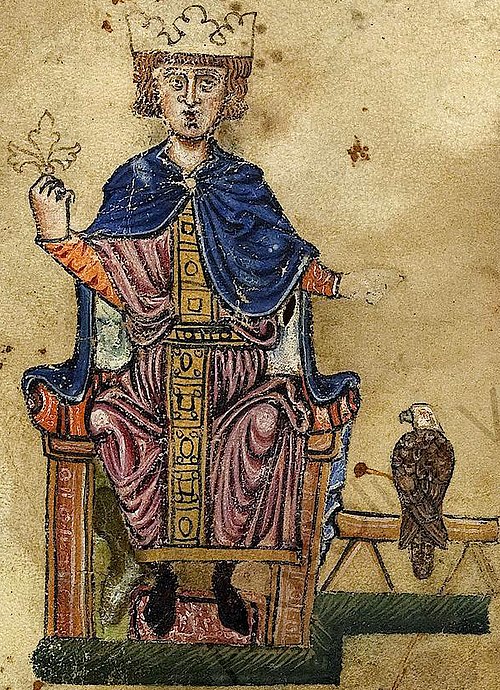
The Holy Roman Emperor Frederick II wrote 'De Arte Venandi cum Avibus' (The Art of Hunting with Birds), containing detailed observations of bird anatomy, behavior, and classification based on firsthand field study. Source — Wikipedia:
Frederick II and his falcon. From his book De arte venandi cum avibus (The art of hunting with birds). From a manuscript in Biblioteca Vaticana, Pal. lat 1071, fol. 1), late 13th century By Unknown author - http://www.fh-augsburg.de/~harsch/Chronologia/Lspost13/FridericusII/fri_arsp.html, Public domain, https://commons.wikimedia.org/w/index.php?curid=443120
1597 CE
Li Shizhen's Bencao Gangmu classifies species
Chinese physician Li Shizhen completed the 'Bencao Gangmu' (Compendium of Materia Medica), classifying over 1,800 biological species with detailed descriptions of morphology and habitat, representing one of history's most comprehensive pre-modern biological taxonomies. Source — Wikipedia:
Illustration from "Account of 814 Plants & Insects, Most of Which Are Reckoned Medicinal by the Chinese"- Copy based on the "Bencao Gangmu" of Li Shizhen (1518–1593), a definitive work on Chinese materia medica. By Unknown author - http://huntbot.andrew.cmu.edu/hibd/departments/Library/ChineseHerbal.shtml, Public domain, https://commons.wikimedia.org/w/index.php?curid=19570678
1758 CE
Linnaean binomial nomenclature established
Carl Linnaeus's 'Systema Naturae' (10th edition) introduced the binomial nomenclature system still used today, providing the standardized species naming framework essential for all later population genetics and speciation work. Source — Wikipedia:
Title page of the 10th edition of Systema naturæ written by Carl Linnæus, published in 1758 by L. Salvius in Stockholm. Digitized in 2004 from an original copy of the 1758 edition held by Göttingen State and University Library, signature <8 H NAT I, 7105 <10>:1>. Uploaded by Francisco Welter-Schultes, I personally checked that the original copy was identical with the digitized version. This is the original title page of the famous 1758 work which provided the base for modern zoological nomenclature. This image can be taken to illustrate the original work of Carl Linnæus. By Carl Linnaeus - Sourced from https://resolver.sub.uni-goettingen.de/purl?PPN362053006, Public domain, https://commons.wikimedia.org/w/index.php?curid=11136563
1798 CE
Malthus publishes on population growth
Thomas Robert Malthus's 'An Essay on the Principle of Population' articulated the tension between population growth and resource limits, directly inspiring both Darwin and Wallace's theories of natural selection. Source — Wikipedia:
Title page of en:Thomas Robert Malthus's en:An Essay on the Principle of Population, J. Johnson, London, 1798. Immediate image source: Leeds University Library. By The original uploader was Lupo at English Wikipedia. - Transferred from en.wikipedia to Commons., Public domain, https://commons.wikimedia.org/w/index.php?curid=3374816
Nov 24, 1859 CE
Darwin's Origin of Species published
Charles Darwin's 'On the Origin of Species' established natural selection as the mechanism of evolution and introduced the concept of descent with modification, providing the theoretical foundation upon which population genetics was later built. Source — Wikipedia:
Cropped and rotated version of File:Origin of Species.jpg, which is of the title page and the facing page of the 1859 Murray edition of the Origin of species by Charles Darwin. By John Murray, Publisher - This image has an extracted file: Origin of Species.jpg., Public domain, https://commons.wikimedia.org/w/index.php?curid=320416The Making of a Theory: Darwin, Wallace, and Natural Selection — HHMI BioInteractive Video
1865 CE
Mendel's laws of inheritance published
Gregor Mendel's experiments with pea plants, published in the Proceedings of the Natural History Society of Brünn, established the quantitative laws of hereditary trait transmission that later became the mechanistic basis of population genetics. Source — Wikipedia:
Gregor Mendel (1822-1884) By Unknown author - NIH, Public domain, https://commons.wikimedia.org/w/index.php?curid=1394893Mendelian Genetics and the Laws of Heredity
1866 CE
Wallace defines the Wallace Line
Alfred Russel Wallace, co-discoverer of natural selection, identified the deep zoogeographical boundary between Asian and Australasian fauna now called the Wallace Line—an early landmark in biogeography that foreshadowed phylogeography. Source — Wikipedia:
Map of Sunda and Sahul (marked by 125m depth contour) and the Wallace Line, the Weber Line and the Lydekker Line. By listfiles/Kanguole - Own work, based on file:map of Sunda and Sahul.png and using Coastline from Natural Earth 1:50m Physical Vectors 125m depth contour derived from 2-Minute Gridded Global Relief Data (ETOPO2) v2, NOAA National Centers for Environmental Information, using gdal_contour (from GDAL)., CC BY-SA 4.0, https://commons.wikimedia.org/w/index.php?curid=127823375
1908 CE
Hardy-Weinberg equilibrium principle
G. H. Hardy and Wilhelm Weinberg independently derived the fundamental equation stating that allele frequencies remain constant in an ideal population, establishing the null model against which evolutionary change is measured in population genetics. Source — Wikipedia:
Hardy–Weinberg principle for two alleles By Johnuniq - Own work, CC BY-SA 3.0, https://commons.wikimedia.org/w/index.php?curid=6045237
1918 CE
Fisher introduces variance partitioning
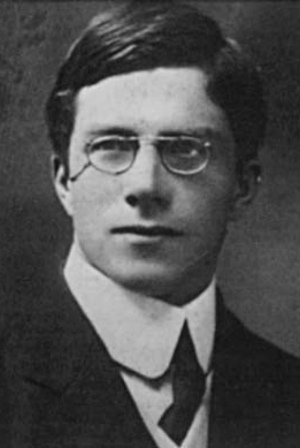
R. A. Fisher's paper 'The Correlation Between Relatives on the Supposition of Mendelian Inheritance' introduced the analysis of variance and reconciled continuous phenotypic variation with discrete Mendelian genetics, founding quantitative genetics. Source — Wikipedia:
Caption from book: "Ronald Aylmer Fisher (1890–1962) in 1912, as a Steward at the First International Eugenics Conference." By Unknown author - Mark Ridley (2003) Evolution (3rd ed.), Wiley, p. 15 ISBN: 978-1-4051-0345-9. Source site https://www.blackwellpublishing.com/ridley/image_gallery/Fisher__R__A__.asp, Public domain, https://commons.wikimedia.org/w/index.php?curid=42415558
1930 CE
Fisher's Genetical Theory of Natural Selection
R. A. Fisher's book formalized the mathematical relationship between fitness and allele frequency change, establishing that the rate of increase in mean fitness equals genetic variance in fitness—a cornerstone of the modern synthesis. Source — Wikipedia:
1931 CE
Wright's shifting balance theory
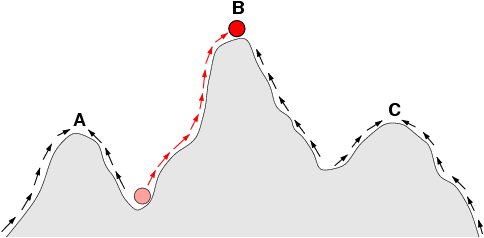
Sewall Wright's paper 'Evolution in Mendelian Populations' introduced the shifting balance theory, emphasizing genetic drift in small populations and population structure as key evolutionary forces, complementing Fisher's selection-centric view. Source — Wikipedia:
In this sketch of a fitness landscape, a population can evolve by following the arrows to the adaptive peak at point B, and the points A and C are local optima where a population could become trapped. Importing fitness landscape cartoon image originally included in Nupedia "fitness landscape" article-in-progress (originally titled "fig1.pdf"). The illustration was created by Claus Wilke in 2001 for Nupedia, under the GFDL. The article was in "open review" at Nupedia, but hadn't yet been approved. This file was converted from PDF to PNG and was originally located here: http://www.nupedia.com/newsystem/upload_file/700/fig1.pdf. As the original copyright holder of the image, I release it into the public domain. By Wilke 06:56, 18 Jul 2004 (UTC) - en: [1], Public domain, https://commons.wikimedia.org/w/index.php?curid=193687
1937 CE
Dobzhansky's Genetics and the Origin of Species
Theodosius Dobzhansky's book integrated Mendelian genetics, population biology, and Darwinian evolution, demonstrating that laboratory and wild populations exhibit extensive genetic variation—cementing the modern evolutionary synthesis. Source — Wikipedia:
1942 CE
Mayr formalizes the biological species concept
Ernst Mayr's 'Systematics and the Origin of Species' defined species as groups of interbreeding natural populations reproductively isolated from others, providing the conceptual framework for speciation theory that dominated for decades. Source — Wikipedia:
Biological classification image created for Wikimediasphere (Wikipedia and all the other Wikimedia sister projects). About the Domains/Kingdoms This diagram implies 3 Domains / 6 Kingdoms (Woese et al. 1990[1]): Archaea, Domain (and Kingdom) Eukarya, Domain Protista, Kingdom Fungi, Kingdom Animalia, Kingdom Plantae, Kingdom Bacteria, Domain (and Kingdom) References ↑ Carl R. Woese, Otto Kandler, Mark L. Wheelis, 1990: "Towards a natural system of organisms: proposal for the domains Archaea, Bacteria, and Eucarya". Proceedings of the National Academy of Sciences of the United States of America, 87(12):4576-9. doi:10.1073/pnas.87.12.4576 By Peter Halasz. (User:Pengo) - Own work, Public domain, https://commons.wikimedia.org/w/index.php?curid=2480732
1943 CE
Luria-Delbrück fluctuation test
Salvador Luria and Max Delbrück's fluctuation test demonstrated that bacterial mutations arise randomly rather than in response to selection, introducing rigorous statistical methods to population genetics and founding microbial genetics. Source — Wikipedia:
Diagram illustrating the two possibilities tested by the Luria-Delbrück experiment (also known as the "Fluctuation test"). By Madprime - Own work, CC BY-SA 3.0, https://commons.wikimedia.org/w/index.php?curid=2103556
1949 CE
Dobzhansky's adaptive chromosomal polymorphism
Dobzhansky's long-term studies of Drosophila pseudoobscura inversion polymorphisms in natural populations demonstrated that chromosomal variation is maintained by natural selection through seasonal environmental changes. Source — Wikipedia:
Apr 25, 1953 CE
DNA double helix structure published
James Watson and Francis Crick's discovery of the DNA double helix, based on Rosalind Franklin's X-ray data, revealed the molecular basis of heredity, enabling the eventual integration of molecular biology with population genetics. · Wikipedia: https://en.wikipedia.org/wiki/Nucleic_acid_double_helix
Static thumb frame of Animation of the structure of a section of DNA. The bases lie horizontally between the two spiraling strands. By 84user adapting file originally uploaded by Richard Wheeler (Zephyris) at en.wikipedia - Derived from File:DNA orbit animated.gif originally from here., CC BY-SA 3.0, https://commons.wikimedia.org/w/index.php?curid=6285050The DNA Double Helix Discovery — HHMI BioInteractive Video
Richard Lewontin and John Hubby's gel electrophoresis studies of Drosophila populations revealed far higher levels of protein polymorphism than expected, transforming understanding of genetic diversity in natural populations. Source — Wikipedia:
1968 CE
Kimura's neutral theory of molecular evolution
Motoo Kimura proposed that most molecular genetic variation is selectively neutral, maintained by mutation and genetic drift rather than natural selection—fundamentally reshaping the interpretation of molecular population genetic data. · Wikipedia: https://en.wikipedia.org/wiki/Neutral_theory_of_molecular_evolution
no original description By . The original uploader was Солярист at Russian Wikipedia. - Transferred from ru.wikipedia to Commons., Public domain, https://commons.wikimedia.org/w/index.php?curid=122615219
1972 CE
Avise pioneers phylogeography with mtDNA
John Avise and colleagues began using mitochondrial DNA restriction fragment patterns to reconstruct the geographic population structure and evolutionary history of animal species, founding the field of phylogeography. Source — Wikipedia:
1975 CE
Wilson and King propose molecular clock
Allan Wilson and Vincent Sarich's earlier work on immunological distances, culminating in the molecular clock hypothesis, enabled dating evolutionary divergences and population splits—essential for phylogeographic inference. Source — Wikipedia:
1983 CE
Templeton defines speciation mechanisms
Alan Templeton's review 'Phylogenetic Constraints and Evolutionary Analyses' formalized frameworks for distinguishing vicariance from dispersal in phylogeographic patterns, integrating speciation theory with molecular biogeography. Source — Wikipedia:
Jan 1, 1987 CE
Mitochondrial Eve identified
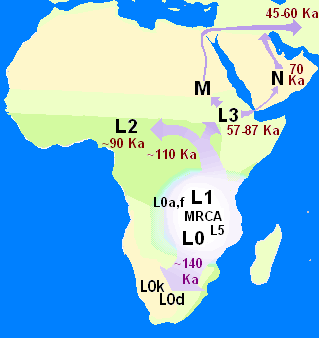
Rebecca Cann, Mark Stoneking, and Allan Wilson used global mtDNA variation to trace all living human maternal lineages to a common African ancestor approximately 200,000 years ago, a landmark in human population genetics. · Wikipedia: https://en.wikipedia.org/wiki/Mitochondrial_Eve
Based on Several studies, Behar et al. 2008, Gonder et al. 2007, Reed and Tishkoff. Two wiki maps of Africa were used as the basis but so heavily modified only the continental outline remains roughly the same. By Pdeitiker - Own work, Public domain, https://commons.wikimedia.org/w/index.php?curid=8741380
1988 CE
Coyne and Orr review speciation genetics
Jerry Coyne and H. Allen Orr's comparative analysis of reproductive isolation in Drosophila species established patterns linking prezygotic and postzygotic isolation to speciation mode, becoming a foundational reference for speciation theory. Source — Wikipedia:
1990 CE
Human Genome Diversity Project proposed
Luigi Cavalli-Sforza and colleagues proposed a global survey of human genetic diversity to reconstruct population history and migration patterns, laying groundwork for large-scale population genomics. Source — Wikipedia:
Apr 14, 2003 CE
Human Genome Project completed
The completion of the Human Genome Project provided the reference sequence essential for identifying population-level genetic variation, enabling genome-wide association and population genomic studies worldwide. · Wikipedia: https://en.wikipedia.org/wiki/Human_Genome_Project
Human Genome Project logo (color). By U.S. Department of Energy, Human Genome Project - http://www.ornl.gov/hgmis, Public domain, https://commons.wikimedia.org/w/index.php?curid=2485616How Scientists Finally Finished the Human Genome
2008 CE
1000 Genomes Project launched
The 1000 Genomes Project, an international consortium including China's BGI, began sequencing genomes from diverse global populations to catalog human genetic variation, creating the foundational dataset for modern population genetics. · Wikipedia: https://en.wikipedia.org/wiki/1000_Genomes_Project
Changes in the number and order of genes (A-D) create genetic diversity within and between populations. By Jthiele (talk) - Own work, CC BY-SA 3.0, https://commons.wikimedia.org/w/index.php?curid=54137526
2010 CE
Neanderthal genome reveals admixture
Svante Pääbo's team at the Max Planck Institute published the Neanderthal genome, demonstrating that non-African modern humans carry 1–4% Neanderthal DNA, revealing ancient interbreeding that reshaped models of human speciation and population history. · Wikipedia: https://en.wikipedia.org/wiki/Neanderthal_genome_project
2012 CE
Denisovan genome sequenced
The sequencing of the Denisovan genome from a single finger bone revealed a distinct archaic hominin population that contributed genetic material to modern Melanesian and Asian populations, further complicating the human speciation narrative. · Wikipedia: https://en.wikipedia.org/wiki/Denisovan
Holotype cranium of Homo longi. Cropped and modified from Figure 1A. By Fu et al. (2025) - https://doi.org/10.1016/j.cell.2025.05.040, CC BY 4.0, https://commons.wikimedia.org/w/index.php?curid=167969953
2015 CE
BGI and Chinese population genomics expand
Researchers at China's BGI and collaborating institutions launched large-scale population genomic studies of Chinese and Asian populations, addressing the historical underrepresentation of non-European groups in genetic databases. #contemporary #science
2018 CE
Ancient DNA transforms phylogeography
Large-scale ancient DNA recovery from archaeological specimens worldwide enabled direct reconstruction of past population movements and admixture events, revolutionizing phylogeographic inference with time-resolved genomic data. Source — Wikipedia:
Cross-Linked DNA Extracted from 4,000-Year-Old Liver of an Ancient Egyptian priest called Nekht-Ankh. By Svante Pääbo, Max Planck Institute for Evolutionary Anthropology - Nicholls H: Ancient DNA Comes of Age. PLoS Biol 3/2/2005: e56. doi:10.1371/journal.pbio.0030056, CC BY 2.5, https://commons.wikimedia.org/w/index.php?curid=1378661
Oct 3, 2022 CE
Svante Pääbo wins Nobel for ancient genomics
Svante Pääbo was awarded the Nobel Prize in Physiology or Medicine for his discoveries concerning the genomes of extinct hominins and human evolution, recognizing the transformative impact of ancient DNA on understanding population history and speciation. · Wikipedia: https://en.wikipedia.org/wiki/Svante_P%C3%A4%C3%A4bo
Svante Pääbo (born 20 April 1955) is a Swedish biologist specializing in evolutionary genetics. One of the founders of paleogenetics, he has worked extensively on the Neanderthal genome. This file is licensed under the Creative Commons Attribution-Share Alike 3.0 Unported license.Attribution: The Royal Society You are free: to share – to copy, distribute and transmit the work to remix – to adapt the work Under the following conditions: attribution – You must give appropriate credit, provide a link to the license, and indicate if changes were made. You may do so in any reasonable manner, but not in any way that suggests the licensor endorses you or your use. share alike – If you remix, transform, or build upon the material, you must distribute your contributions under the same or compatible license as the original.https://creativecommons.org/licenses/by-sa/3.0CC BY-SA 3.0 Creative Commons Attribution-Share Alike 3.0 truetrue .mw-parser-output .messagebox{margin:4px 0;width:auto;border-collapse:collapse;border:2px solid var(--border-color-progressive,#6485d1);background-color:var(--background-color-neutral-subtle,#fbfcff);color:var(--color-base,#202122);box-sizing:border-box;border-inline-start-width:8px}.mw-parser-output .messagebox.mbox-small{font-size:88%;line-height:1.25em}.mw-parser-output .mbox-warning,.mw-parser-output .mbox-speedy{border:2px solid var(--border-color-error,#b22222);background:var(--background-color-error-subtle,#ffdbdb);border-inline-start-width:8px}.mw-parser-output .mbox-serious,.mw-parser-output .mbox-delete,.mw-parser-output .mbox-stop{border:2px solid var(--border-color-error,#b22222);border-inline-start-width:8px}.mw-parser-output .mbox-issue,.mw-parser-output .mbox-content{border:2px solid #f28500;background:var(--background-color-warning-subtle,#ffe);border-inline-start-width:8px}.mw-parser-output .mbox-query,.mw-parser-output .mbox-style{border:2px solid #f4c430;background:var(--background-color-warning-subtle,#ffe);border-inline-start-width:8px}.mw-parser-output .mbox-shit{border:2px solid #960;border-inline-start-width:8px}.mw-parser-output .mbox-license{border:2px solid #88a;border-inline-start-width:initial}.mw-parser-output .mbox-legal{border:2px solid var(--border-color-notice,#666);background:var(--background-color-base,#fff);border-inline-start-width:8px}.mw-parser-output .mbox-honor{border:2px solid #ca3;background:var(--background-color-warning-subtle,#fcf4db);border-inline-start-width:8px}.mw-parser-output .mbox-growth{border:2px solid #8d4;background:var(--background-color-success-subtle,#d5fdf4);border-inline-start-width:8px}.mw-parser-output .mbox-move{border:2px solid #93c;border-inline-start-width:8px}.mw-parser-output .mbox-protection,.mw-parser-output .mbox-message{border:2px solid var(--border-color-base,#aaa);border-inline-start-width:8px}.mw-parser-output .messagebox .mbox-text{border:none;padding:0.25em 0.9em;width:100%}.mw-parser-output .messagebox .mbox-image{border:none;padding:2px 0 2px 0.9em;text-align:center}.mw-parser-output .messagebox .mbox-imageright{border:none;padding:2px 0.9em 2px 0;text-align:center}.mw-parser-output .messagebox .mbox-empty-cell{border:none;padding:0;width:1px}.mw-parser-output .messagebox .mbox-invalid-type{text-align:center}@media(min-width:720px){.mw-parser-output .messagebox{margin:4px 10%}.mw-parser-output .messagebox.mbox-small{clear:right;float:right;margin:4px 0 4px 1em;width:238px}}body.skin--responsive .mw-parser-output table.messagebox img{max-width:none!important}This work is free and may be used by anyone for any purpose. If you wish to use this content, you do not need to request permission as long as you follow any licensing requirements mentioned on this page. The Wikimedia Foundation has received an e-mail confirming that the copyright holder has approved publication under the terms mentioned on this page. This correspondence has been reviewed by a Volunteer Response Team (VRT) member and stored in our permission archive. The correspondence is available to trusted volunteers as ticket #2014062710019796. If you have questions about the archived correspondence, please use the VRT noticeboard. Ticket link: https://ticket.wikimedia.org/otrs/index.pl?Action=AgentTicketZoom&TicketNumber=2014062710019796 Find other files from the same ticket: By Duncan.Hull - Own work, CC BY-SA 4.0, https://commons.wikimedia.org/w/index.php?curid=125399564Announcement of the 2022 Nobel Prize in Physiology or Medicine





![Biological classification image created for Wikimediasphere (Wikipedia and all the other Wikimedia sister projects). About the Domains/Kingdoms This diagram implies 3 Domains / 6 Kingdoms (Woese et al. 1990[1]): Archaea, Domain (and Kingdom) Eukarya, Domain Protista, Kingdom Fungi, Kingdom Animalia, Kingdom Plantae, Kingdom Bacteria, Domain (and Kingdom) References ↑ Carl R. Woese, Otto Kandler, Mark L. Wheelis, 1990: "Towards a natural system of organisms: proposal for the domains Archaea, Bacteria, and Eucarya". Proceedings of the National Academy of Sciences of the United States of America, 87(12):4576-9. doi:10.1073/pnas.87.12.4576](https://upload.wikimedia.org/wikipedia/commons/thumb/a/a5/Biological_classification_L_Pengo_vflip.svg/500px-Biological_classification_L_Pengo_vflip.svg.png)