Encyclopedia/3. History, Societies & Civilizations/09. Modern Nations/05. Europe • Curated by Admin Timeline.sg
History of Greece (AI-generated, sourced to Wikipedia).
Chronological Storyline (30 Milestones)
2700 BCE
Minoan civilization emerges
The Minoan civilization flourishes on Crete, becoming Europe's first advanced civilization with palace complexes at Knossos and a sophisticated maritime trade network. Source — Wikipedia, "Greece":
Map of Minoan Crete. By User:Bibi Saint-Pol - Own work (data from http://metamedia.stanford.edu/imagebin/minoan%20crete%20map.JPG, map background from Image:Map greek sanctuaries-fr.svg)., CC BY-SA 3.0, https://commons.wikimedia.org/w/index.php?curid=1557035
1600 BCE
Mycenaean civilization rises
The Mycenaean Greeks establish a powerful mainland civilization centered on fortified palace-states, developing Linear B script and a warrior culture immortalized in later epic poetry. Source — Wikipedia, "Greece":
Map of Mycenaean Greece 1400-1200 BC: Palaces, main cities and other settlements. By User:Alexikoua, User:Panthera tigris tigris, TL User:Reedside - Ιστορία του Ελληνικού Έθνους, Εκδοτική Αθηνών, τ. Α' χάρτες σε σελ. 263-265, σελ. 290, 292-293 (επίσης [1], CC BY-SA 3.0, https://commons.wikimedia.org/w/index.php?curid=61505445
776 BCE
First Olympic Games held
The first recorded Olympic Games are held at Olympia in honor of Zeus, marking the beginning of a tradition that would endure for over a millennium. Source — Wikipedia, "Greece":
Olympia: Palaestra By Bgabel - Own work, CC BY-SA 3.0, https://commons.wikimedia.org/w/index.php?curid=22678207
594 BCE
Solon's reforms enacted
The Athenian statesman Solon introduces sweeping political and economic reforms, laying early foundations for Athenian democracy by canceling debts and restructuring citizenship. Source — Wikipedia, "Greece":
Ancient Roman busts from the Farnese Collection, now in Naples By Sailko - Own work, CC BY-SA 3.0, https://commons.wikimedia.org/w/index.php?curid=30945032
508 BCE
Cleisthenes founds democracy
Cleisthenes introduces democratic reforms in Athens, reorganizing citizens into demes and establishing the foundations of the world's first democratic system. Source — Wikipedia, "Greece":
Cleisthenes, the father of Greek democracy, reformed traditional Athenian government controlled by ruling tribes into the first government "of the people" (the Demos) democracy. The Cleisthenes Project Committee was initiated by Aristotle Hutras in 2002 to begin the efforts to return to the Statehouse busts of individuals who have become legendary in the development of democratic governance. The first known likeness of Cleisthenes was created by sculptor, Anna Christoforidis. Busts of Cleisthenes and Thomas Jefferson were unveiled on March 24, 2004 in the Ohio House and Senate Chambers. By Unknown author - http://www.ohiostatehouse.org/Multimedia/MediaLibrary/Media.aspx?fileId=117260, Attribution, https://commons.wikimedia.org/w/index.php?curid=6207775
Sep 12, 490 BCE
Battle of Marathon
Athenian forces defeat the invading Persian army at Marathon, a pivotal victory that preserved Greek independence and became a symbol of democratic resilience. Source — Wikipedia, "Greece":
Scene of the Battle of Marathon By John Steeple Davis - The story of the greatest nations, from the dawn of history to the twentieth century (published in 1900), Public domain, https://commons.wikimedia.org/w/index.php?curid=75078967
Aug 11, 480 BCE
Battle of Thermopylae
A small Greek force led by King Leonidas of Sparta makes a legendary last stand against the Persian army of Xerxes at the narrow pass of Thermopylae. Source — Wikipedia, "Greece":
Battle of Thermopylae By Jacques-Louis David - photo Shonagon 2025-03-15, Public domain, https://commons.wikimedia.org/w/index.php?curid=162618408
Sep 1, 480 BCE
Battle of Salamis
The Greek fleet decisively defeats the Persian navy at Salamis, turning the tide of the Greco-Persian Wars and securing Greek independence. Source — Wikipedia, "Greece":
Battle of Thermopylae and movements to Salamis, 480 BC By The Department of History, United States Military Academy - The Department of History, United States Military Academy [1], Public domain, https://commons.wikimedia.org/w/index.php?curid=1307907
461 BCE
Golden Age of Athens begins
Under the leadership of Pericles, Athens enters a golden age of cultural, intellectual, and architectural achievement, including the construction of the Parthenon. Source — Wikipedia, "Greece":
Athènes Parthénon By Harrieta171 - Own work, CC BY-SA 3.0, https://commons.wikimedia.org/w/index.php?curid=594036
431 BCE
Peloponnesian War erupts
The Peloponnesian War breaks out between Athens and Sparta, eventually devastating much of Greece and ending Athenian imperial dominance after decades of conflict. Source — Wikipedia, "Greece":
Map of the Peloponnesian War, translated into English based on w:de:Image:Pelop krieg1.png By Translator was Kenmayer - File:Pelop_krieg1.png, originally uploaded to German wikipedia by user Captain Blood, CC BY-SA 3.0, https://commons.wikimedia.org/w/index.php?curid=29073582
336 BCE
Alexander the Great ascends
Alexander III becomes king of Macedon and launches a campaign of conquest that creates one of the largest empires in history, spreading Hellenistic culture across three continents. Source — Wikipedia, "Greece":
Alexander Mosaic (detail), House of the Faun, Pompeii By Unknown author - This image has been extracted from another file, Public domain, https://commons.wikimedia.org/w/index.php?curid=182741814
146 BCE
Roman conquest of Greece
Rome defeats the Achaean League at the Battle of Corinth, effectively ending Greek political independence and incorporating Greece into the Roman Republic. Source — Wikipedia, "Greece":
The Sack of Corinth By Sailko - Own work, CC BY 3.0, https://commons.wikimedia.org/w/index.php?curid=47345812
May 11, 330 CE
Constantinople inaugurated
Emperor Constantine inaugurates Constantinople as the new capital of the Roman Empire, establishing the center of what would become the Byzantine Empire and Greek Orthodoxy. Source — Wikipedia, "Greece":
Topographical map of Constantinople during the Byzantine period. By Cplakidas - Own work using: Main map source: R. Janin, Constantinople Byzantine. Developpement urbain et repertoire topographique Road network and some other details based on Dumbarton Oaks Papers 54 Data on many churches, especially unidentified ones, taken from the New York University's The Byzantine Churches of Istanbul project Other published maps and accounts of the city have been used for corroboration., CC BY-SA 3.0, https://commons.wikimedia.org/w/index.php?curid=5084599
529 CE
Justinian closes Plato's Academy
Emperor Justinian I orders the closure of the Platonic Academy in Athens, effectively ending the tradition of classical pagan philosophy that had endured for nearly a thousand years. Source — Wikipedia, "Greece":
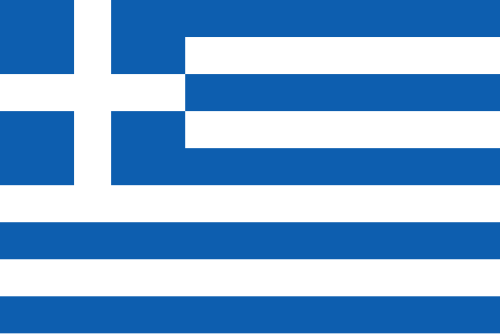
Flag of Greece (since 1978) and Naval Ensign of Greece (since 1828) By Unknown author - ΕΘΝΙΚΗ ΣΗΜΑΙΑ ΤΗΣ ΕΛΛΑΔΟΣ, Public domain, https://commons.wikimedia.org/w/index.php?curid=20939691
Apr 13, 1204 CE
Crusaders sack Constantinople
The Fourth Crusade captures and sacks Constantinople, leading to the partition of the Byzantine Empire and the establishment of Latin states on Greek soil. Source — Wikipedia, "Greece":
Siege of Constantinople in the Fourth Crusade? Cutting off hands? By sailko - Own work, CC BY-SA 3.0, https://commons.wikimedia.org/w/index.php?curid=28219910
May 29, 1453 CE
Fall of Constantinople
Ottoman forces under Sultan Mehmed II capture Constantinople, ending the Byzantine Empire and beginning centuries of Ottoman rule over Greek lands. Source — Wikipedia, "Greece":
Siege of Constantinople fresco, Moldovița monastery, Vatra Moldoviței, 2017 By DimiTalen - Own work, CC0, https://commons.wikimedia.org/w/index.php?curid=140075738
Mar 25, 1821 CE
Greek War of Independence begins
Greeks revolt against Ottoman rule, launching the Greek War of Independence that would eventually secure recognition of a modern Greek state after centuries of subjugation. Source — Wikipedia, "Greece":
Greek war of independence painting collage, a collection of paintings from publicly available resources and wikicommons. By SJCAmerican - Top Left: The camp of at Phaliro. Top Right: The burning of an Ottoman frigate by a Greek fire ship. Bottom Left: Ibrahim Pasha at the Third siege of Missolonghi. Bottom Right: The Battle of Navarino., CC BY-SA 4.0, https://commons.wikimedia.org/w/index.php?curid=66982469
Oct 20, 1827 CE
Battle of Navarino
A combined British, French, and Russian fleet decisively defeats the Ottoman-Egyptian navy at Navarino Bay, a turning point that secured Greek independence. Source — Wikipedia, "Greece":
Battle of Navarino By Ambroise Louis Garneray - uploaded by AYE R (talk · contribs) from chateauversailles.fr, 2017, Public domain, https://commons.wikimedia.org/w/index.php?curid=607946
Feb 3, 1830 CE
Greece recognized as sovereign
The London Protocol formally recognizes Greece as an independent sovereign state, ending nearly four centuries of Ottoman rule and establishing the modern Greek nation. Source — Wikipedia, "Greece":
Signing of the London Protocol, fresco of the frieze of the Trophy Hall of the Greek Parliament By Ludwig Michael von Schwanthaler - https://www.cnn.gr/style/politismos/story/257235/texni-1821-analysi-ton-toixografion-tis-zoforoy-stin-aithoysa-tropaion-tis-voylis?fbclid=IwAR1sC6PHRUSXruZgosNofTGynwfbEyfFGISG2gYFozFTtTB9cDCWR28qpr8, Public domain, https://commons.wikimedia.org/w/index.php?curid=115468056
1832 CE
Otto becomes first king
Prince Otto of Bavaria is selected as the first modern King of Greece, establishing a monarchy that would govern the new state during its formative decades. Source — Wikipedia, "Greece":
Prinz Octavius of Bavaria, King of Greece; after Joseph Stieler (1781–1858) By Friedrich Dürck - http://www.hdbg.eu/koenigreich/web/index.php/objekte/index/herrscher_id/2/id/953, Public domain, https://commons.wikimedia.org/w/index.php?curid=17421646
Apr 6, 1896 CE
First modern Olympic Games
Athens hosts the first modern Olympic Games, reviving the ancient tradition and symbolizing Greece's reemergence on the world stage as a modern nation. Source — Wikipedia, "Greece":
Cover of the official commemorative album of the 1896 Olympic Games in Athens: S. Lambros, N. G. Politis, T. Philimon, C. Anninos, P. de Coubertin, A. Meyer, Ὀλυμιακοὶ Ἀγῶνες – Les Jeux Olympiques / Ἀθῆναι – Athens Designed by Émile Gilliéron; printed by Ch. Beck. Two editions were issued, one in Greek and French (shown here), the other in German and English. The same painting was used as the cover of the program of Olympic events and as a promotional poster. By Émile Gilliéron - L'Olympisme. Une invention moderne, un héritage antique au Louvre (Alain R. Truong, 8 May 2024), Public domain, https://commons.wikimedia.org/w/index.php?curid=152344155
Oct 1, 1912 CE
First Balkan War begins
Greece joins the Balkan League against the Ottoman Empire, successfully liberating Epirus, Macedonia, and many Aegean islands and significantly expanding Greek territory. Source — Wikipedia, "Greece":
Montage for the First Balkan war Main page in Wikipedia By Avidius (talk) - Own work (Original text: I (Avidius (talk)) created this work entirely by myself.) en:Image:5t Dunavska pri Karagach dere.jpg (The Battle of Lule-Burgas) (removed as non-free) Image:Ulazak srpske vojske u Mitrovicu.jpg (Serbian forces entering Mitrovitsa) Image:King George I of Greece and Tsar Ferdinand of Bulgaria at Thessaloniki.jpg (King George I of Greece visits the Bulgarian Tsar Ferdinand in the headquarters of the Bulgarian army in the city of Thessaloniki) Image:Ottoman troops Battle of Kumanovo.jpg (A photograph of the Ottoman soldiers, taken during the Battle Of Kumanovo in 1912) Image:Battle Elli.jpg (Naval Battle of Elli.jpg), Public domain, https://commons.wikimedia.org/w/index.php?curid=25536853
Jan 1, 1923 CE
Population exchange with Turkey
The Treaty of Lausanne mandates a massive population exchange between Greece and Turkey, uprooting over 1.5 million people and reshaping the demographic landscape of both nations. Source — Wikipedia, "Greece":
Population exchange with Turkey By William Neuheisel from DC, US - Kayaköy, CC BY 2.0, https://commons.wikimedia.org/w/index.php?curid=40530991
Oct 28, 1940 CE
Greece rejects Italian ultimatum
Greece rejects Mussolini's ultimatum and successfully repels the Italian invasion, becoming the first Allied nation to score a victory against Axis forces in World War II. Source — Wikipedia, "Greece":
Photo collage of images from the Greco-Italian war. All photos from public domain sources. By SJCAmerican - File:Greek Army during Primavera Offensive Klisura March 1941.JPG it:File:Albania.jpg ({{PD-Italy}} due to age) File:Italian Siai-Marchetti SM-79 bombers over Greek territory in the Autumn of 1940.jpg it:File:Soldati greci ad Argirocastro 1940 1941.jpg ({{PD-Italy}} due to age), CC BY-SA 4.0, https://commons.wikimedia.org/w/index.php?curid=66986128
1946 CE
Greek Civil War begins
A bitter civil war erupts between the Greek government and communist forces, lasting until 1949 and deeply shaping Greece's postwar political alignment within the Western bloc. Source — Wikipedia, "Greece":
Government army unit during the Greek Civil War (1945 - 1949) This media file is produced by Wikipedian in Residence in Category:Wikipedian in Residence at DARM in 2016. By AnonymousUnknown author - The State Archives of the Republic of Macedonia (DARM), Public domain, https://commons.wikimedia.org/w/index.php?curid=53474550
Apr 21, 1967 CE
Military junta seizes power
A right-wing military coup establishes a dictatorship in Greece, suspending democratic institutions and ruling the country for seven years until its collapse in 1974. Source — Wikipedia, "Greece":
Flag of Greece (1970–1975), adopted by the Greek military Junta; Aspect ratio: 7:12 By SeNeKa, redone by Johannes Rössel - Derived from Image:Flag of Greece (1970-1975).PNG, Public domain, https://commons.wikimedia.org/w/index.php?curid=3844472
Jul 1, 1974 CE
Democracy restored
Following the junta's collapse after the Cyprus crisis, democratic governance is restored under Konstantinos Karamanlis, and a referendum abolishes the monarchy in favor of a republic. Source — Wikipedia, "Greece":
Flag of Greece (since 1978) and Naval Ensign of Greece (since 1828) By Unknown author - ΕΘΝΙΚΗ ΣΗΜΑΙΑ ΤΗΣ ΕΛΛΑΔΟΣ, Public domain, https://commons.wikimedia.org/w/index.php?curid=20939691
Jan 1, 1981 CE
Greece joins European Community
Greece becomes the tenth member of the European Community, marking a significant step in its integration into Western European political and economic structures. Source — Wikipedia, "Greece":
Flag of Greece (since 1978) and Naval Ensign of Greece (since 1828) By Unknown author - ΕΘΝΙΚΗ ΣΗΜΑΙΑ ΤΗΣ ΕΛΛΑΔΟΣ, Public domain, https://commons.wikimedia.org/w/index.php?curid=20939691
Aug 13, 2004 CE
Athens hosts Olympics again
Athens hosts the 2004 Summer Olympics, returning the Games to their birthplace and modern home in a showcase of Greece's contemporary identity and heritage. Source — Wikipedia, "Greece":
Flag of Greece (since 1978) and Naval Ensign of Greece (since 1828) By Unknown author - ΕΘΝΙΚΗ ΣΗΜΑΙΑ ΤΗΣ ΕΛΛΑΔΟΣ, Public domain, https://commons.wikimedia.org/w/index.php?curid=20939691
Oct 1, 2009 CE
Greek debt crisis begins
Greece reveals a massive budget deficit, triggering a sovereign debt crisis that leads to severe austerity measures, international bailouts, and profound social and political upheaval. Source — Wikipedia, "Greece":
Greek bonds By Wikideas1 - Own work https://www.investing.com/rates-bonds/greece-3-year-bond-yield-historical-data (it is actually 20 year bond) https://www.investing.com/rates-bonds/greece-15-year-bond-yield-historical-data https://www.investing.com/rates-bonds/greece-10-year-bond-yield-historical-data https://www.investing.com/rates-bonds/greece-5-year-bond-yield-historical-data https://www.investing.com/rates-bonds/greece-6-month-bond-yield-historical-data https://www.investing.com/rates-bonds/greece-3-month-bond-yield-historical-data https://www.investing.com/rates-bonds/greece-7-year-bond-yield-historical-data (it is actually the 1 month bond), CC0, https://commons.wikimedia.org/w/index.php?curid=125555026