Encyclopedia/3. History, Societies & Civilizations/09. Modern Nations/01. Africa • Curated by Admin Timeline.sg
History of Eswatini (AI-generated, sourced to Wikipedia).
Chronological Storyline (27 Milestones)
25000 BCE
San hunter-gatherers inhabit region
Stone Age San peoples lived across present-day Eswatini, leaving rock art in mountainous areas that survives as evidence of early human habitation. Source — Wikipedia, "Eswatini":
The daughters of a small community of bushmen living in Namibia. The baby boy is the girl's brother. By Velatrix - Own work, CC0, https://commons.wikimedia.org/w/index.php?curid=11764443
200 CE
Bantu-speaking peoples migrate south
Bantu-speaking agriculturalists migrated into southern Africa, introducing iron-working, pottery, and settled farming to the region that became Eswatini. Source — Wikipedia, "Eswatini":
Spread of the "Early Iron Age" in Eastern, Central and Southern Africa, a proxy for the Bantu migrations. Based on K. Shillington, History of Africa (3rd ed. 2005), p. 63. Urewe (Lake Victoria) 250 BCE, Kwale 200 CE, Kisale 300 CE, , Kalundu/Dambwa 100 CE , Kalambo 300 CE, Nkope 300 CE, Gokmere-Ziwa/Bambata 300 CE, presence in South Africa (Kei river) by 400 CE. By Unknown author - East&southern africa early iron age.gif, Public domain, https://commons.wikimedia.org/w/index.php?curid=5444722
1750 CE
Ngwane III settles in Swazi heartland
Ngwane III led the Dlamini clan into the Pongola River valley, establishing the foundations of the Swazi nation and is regarded as the first King of Swaziland. Source — Wikipedia, "Eswatini":
Flag of Eswatini By Sobhuza II - Open Clip Art Colours originally regulated under the now redundant British Admiralty System as: Black T11, White T819, Crimson T816, Yellow T820 and Blue R813 or T813., Public domain, https://commons.wikimedia.org/w/index.php?curid=433102
1815 CE
Sobhuza I becomes king
Sobhuza I ascended to the throne during the turbulent Mfecane period, consolidating Swazi territory and forging alliances to protect his people from Zulu expansion. Source — Wikipedia, "Eswatini":
Flag of Eswatini By Sobhuza II - Open Clip Art Colours originally regulated under the now redundant British Admiralty System as: Black T11, White T819, Crimson T816, Yellow T820 and Blue R813 or T813., Public domain, https://commons.wikimedia.org/w/index.php?curid=433102
1839 CE
Mswati II begins reign
Mswati II became king and launched military campaigns that expanded Swazi territory to its greatest extent; the Swazi people took their name from him. Source — Wikipedia, "Eswatini":
Flag of Eswatini By Sobhuza II - Open Clip Art Colours originally regulated under the now redundant British Admiralty System as: Black T11, White T819, Crimson T816, Yellow T820 and Blue R813 or T813., Public domain, https://commons.wikimedia.org/w/index.php?curid=433102
1845 CE
First treaty with Boer settlers
Swazi leadership signed an early agreement with Boer settlers of the Transvaal, initiating a complex series of territorial and diplomatic arrangements. Source — Wikipedia, "Eswatini":
Flag of Eswatini By Sobhuza II - Open Clip Art Colours originally regulated under the now redundant British Admiralty System as: Black T11, White T819, Crimson T816, Yellow T820 and Blue R813 or T813., Public domain, https://commons.wikimedia.org/w/index.php?curid=433102
1875 CE
European settlers and missionaries arrive
Increasing numbers of European missionaries, traders, and concession-seekers entered Swaziland, beginning a period of intense foreign influence and land acquisition. Source — Wikipedia, "Eswatini":
Flag of Eswatini with Black Tassels By VexilAlpaca original image Feitidede current image - Split from File:Flag of Eswatini.svg due to disagreement over the correct colors and improved by Feitidede. Sources for Tassels: https://bnonews.com/wp-content/uploads/2020/12/2020EswatiniPMDlamini.jpg https://pbs.twimg.com/media/E3m1Du9WQAEsbL7.jpg https://pbs.twimg.com/media/EWXbVU-WAAIwOAV.jpg Colours regulated by the government's identity manual, Public domain, https://commons.wikimedia.org/w/index.php?curid=143492615
1881 CE
Pretoria Convention recognizes independence
The Pretoria Convention between Britain and the South African Republic formally recognized Swazi independence, though territorial concessions to foreigners had already begun. Source — Wikipedia, "Eswatini":
Western side panel of the Kruger statue on Church square, Pretoria. Sir Evelyn Wood, who had replaced Colley upon his death on 27 February 1881, signed an armistice to end the First Boer War, and subsequently a peace treaty with Paul Kruger at O'Neil's Cottage on 6 March, bringing the war to an official end on 23 March 1881. O'Neil's Cottage on Farm Stonewall 3109 is named for the owner of Irish descent, Richard Charles O'Neil (1826-1907), incorrectly given as "O'Neill" in many sources. By JMK - Own work, CC BY-SA 3.0, https://commons.wikimedia.org/w/index.php?curid=29865296
1884 CE
London Convention reaffirms Swazi sovereignty
The London Convention again recognized Swazi independence, but the Swazi king had already granted extensive land and mineral concessions to foreign adventurers. Source — Wikipedia, "Eswatini":
Delegates from the South African Republic to the London Convention (1884). The delegates depicted are Gerard Jacob Theodoor Beelaerts van Blokland, a Dutch legal advisor to the republic, General Nicolaas Smit, Ewald Auguste Esselen, President Paul Kruger, and Rev. Stephanus Jacobus du Toit. By Elliott & Fry - Scanned copy of 1900 reproduction in the Times History of the original 1883/1884 photo. The photo was donated to the Zuid-Afrikahuis in Amsterdam (inv. no. TH0000000379) after being added to Wikimedia Commons., Public domain, https://commons.wikimedia.org/w/index.php?curid=73882107
1890 CE
Tripartite administration established
Britain, the South African Republic, and Swazi leadership agreed to a tripartite administration to govern Swaziland amid competing colonial interests. Source — Wikipedia, "Eswatini":
Flag of Eswatini with Black Tassels By VexilAlpaca original image Feitidede current image - Split from File:Flag of Eswatini.svg due to disagreement over the correct colors and improved by Feitidede. Sources for Tassels: https://bnonews.com/wp-content/uploads/2020/12/2020EswatiniPMDlamini.jpg https://pbs.twimg.com/media/E3m1Du9WQAEsbL7.jpg https://pbs.twimg.com/media/EWXbVU-WAAIwOAV.jpg Colours regulated by the government's identity manual, Public domain, https://commons.wikimedia.org/w/index.php?curid=143492615
1894 CE
Swaziland under South African Republic
A convention placed Swaziland under the administration of the South African Republic (Transvaal), reducing Swazi autonomy while nominally preserving the monarchy. Source — Wikipedia, "Eswatini":
Flag of Eswatini with Black Tassels By VexilAlpaca original image Feitidede current image - Split from File:Flag of Eswatini.svg due to disagreement over the correct colors and improved by Feitidede. Sources for Tassels: https://bnonews.com/wp-content/uploads/2020/12/2020EswatiniPMDlamini.jpg https://pbs.twimg.com/media/E3m1Du9WQAEsbL7.jpg https://pbs.twimg.com/media/EWXbVU-WAAIwOAV.jpg Colours regulated by the government's identity manual, Public domain, https://commons.wikimedia.org/w/index.php?curid=143492615
1903 CE
British protectorate declared
Following the Anglo-Boer War, Britain declared Swaziland a protectorate, assuming direct administrative control over the territory. Source — Wikipedia, "Eswatini":
Flag of Eswatini By Sobhuza II - Open Clip Art Colours originally regulated under the now redundant British Admiralty System as: Black T11, White T819, Crimson T816, Yellow T820 and Blue R813 or T813., Public domain, https://commons.wikimedia.org/w/index.php?curid=433102
1907 CE
Land partition divides Swazi territory
The British authorities partitioned land, allocating roughly one-third to the Swazi nation and the rest to European settlers and concessions, creating lasting grievances. Source — Wikipedia, "Eswatini":
Flag of Eswatini with Black Tassels By VexilAlpaca original image Feitidede current image - Split from File:Flag of Eswatini.svg due to disagreement over the correct colors and improved by Feitidede. Sources for Tassels: https://bnonews.com/wp-content/uploads/2020/12/2020EswatiniPMDlamini.jpg https://pbs.twimg.com/media/E3m1Du9WQAEsbL7.jpg https://pbs.twimg.com/media/EWXbVU-WAAIwOAV.jpg Colours regulated by the government's identity manual, Public domain, https://commons.wikimedia.org/w/index.php?curid=143492615
1921 CE
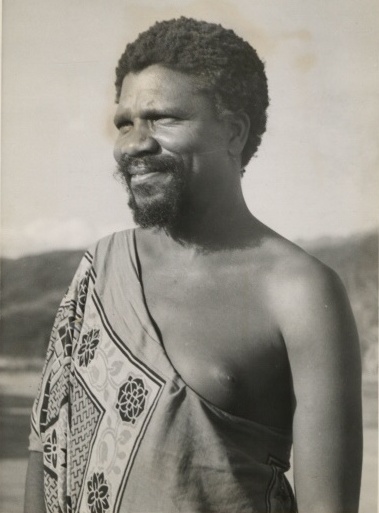
Sobhuza II becomes Paramount Chief
Sobhuza II began his reign as Paramount Chief, eventually becoming the world's longest-reigning monarch and leading Swaziland through decolonization to independence. Source — Wikipedia, "Eswatini":
Sobhuza II - Paramount Chief of Swaziland. By The National Archives UK - Flickr account - This file is from the collections of The National Archives (United Kingdom), catalogued under document record CO1069/228. For high quality reproductions of any item from The National Archives collection please contact the image library., OGL v1.0, https://commons.wikimedia.org/w/index.php?curid=68438657
1944 CE
Swazi National Council established
The British colonial authorities formalized the Swazi National Council (Libandla), giving the Swazi nation an advisory role in governance under colonial rule. Source — Wikipedia, "Eswatini":
Flag of Eswatini with Black Tassels By VexilAlpaca original image Feitidede current image - Split from File:Flag of Eswatini.svg due to disagreement over the correct colors and improved by Feitidede. Sources for Tassels: https://bnonews.com/wp-content/uploads/2020/12/2020EswatiniPMDlamini.jpg https://pbs.twimg.com/media/E3m1Du9WQAEsbL7.jpg https://pbs.twimg.com/media/EWXbVU-WAAIwOAV.jpg Colours regulated by the government's identity manual, Public domain, https://commons.wikimedia.org/w/index.php?curid=143492615
1963 CE
British introduce new constitution
Britain introduced a new constitution providing for limited self-government and elections, which the Swazi royal establishment initially resisted as too restrictive. Source — Wikipedia, "Eswatini":
Flag of Eswatini with Black Tassels By VexilAlpaca original image Feitidede current image - Split from File:Flag of Eswatini.svg due to disagreement over the correct colors and improved by Feitidede. Sources for Tassels: https://bnonews.com/wp-content/uploads/2020/12/2020EswatiniPMDlamini.jpg https://pbs.twimg.com/media/E3m1Du9WQAEsbL7.jpg https://pbs.twimg.com/media/EWXbVU-WAAIwOAV.jpg Colours regulated by the government's identity manual, Public domain, https://commons.wikimedia.org/w/index.php?curid=143492615
Jun 1, 1964 CE
First legislative elections held
Swaziland held its first elections under the 1963 constitution, with the Imbokodvo National Movement, aligned with the monarchy, winning all seats. Source — Wikipedia, "Eswatini":
Flag of Eswatini By Sobhuza II - Open Clip Art Colours originally regulated under the now redundant British Admiralty System as: Black T11, White T819, Crimson T816, Yellow T820 and Blue R813 or T813., Public domain, https://commons.wikimedia.org/w/index.php?curid=433102
Apr 1, 1967 CE
Self-government achieved
Under a new constitution, Swaziland became self-governing with Sobhuza II recognized as King and head of state, a step short of full independence. Source — Wikipedia, "Eswatini":
Flag of Eswatini with Black Tassels By VexilAlpaca original image Feitidede current image - Split from File:Flag of Eswatini.svg due to disagreement over the correct colors and improved by Feitidede. Sources for Tassels: https://bnonews.com/wp-content/uploads/2020/12/2020EswatiniPMDlamini.jpg https://pbs.twimg.com/media/E3m1Du9WQAEsbL7.jpg https://pbs.twimg.com/media/EWXbVU-WAAIwOAV.jpg Colours regulated by the government's identity manual, Public domain, https://commons.wikimedia.org/w/index.php?curid=143492615
Sep 6, 1968 CE
Swaziland gains independence
Swaziland became fully independent from Britain as a constitutional monarchy, joining the Commonwealth and the United Nations. Source — Wikipedia, "Eswatini":
Flag of Eswatini By Sobhuza II - Open Clip Art Colours originally regulated under the now redundant British Admiralty System as: Black T11, White T819, Crimson T816, Yellow T820 and Blue R813 or T813., Public domain, https://commons.wikimedia.org/w/index.php?curid=433102
Apr 12, 1973 CE
King repeals constitution
King Sobhuza II repealed the independence constitution, dissolved parliament, banned political parties, and assumed absolute power, citing the need to preserve Swazi traditions. Source — Wikipedia, "Eswatini":
Sobhuza II - Paramount Chief of Swaziland. By The National Archives UK - Flickr account - This file is from the collections of The National Archives (United Kingdom), catalogued under document record CO1069/228. For high quality reproductions of any item from The National Archives collection please contact the image library., OGL v1.0, https://commons.wikimedia.org/w/index.php?curid=68438657
1978 CE
New decreed constitution
A new constitution was decreed establishing an electoral system based on tinkhundla (traditional councils), entrenching monarchical authority and prohibiting party politics. Source — Wikipedia, "Eswatini":
Flag of Eswatini By Sobhuza II - Open Clip Art Colours originally regulated under the now redundant British Admiralty System as: Black T11, White T819, Crimson T816, Yellow T820 and Blue R813 or T813., Public domain, https://commons.wikimedia.org/w/index.php?curid=433102
Aug 21, 1982 CE
King Sobhuza II dies
Sobhuza II died after a reign of over 82 years, leaving a power vacuum and triggering a succession dispute among the royal family. Source — Wikipedia, "Eswatini":
Sobhuza II - Paramount Chief of Swaziland. By The National Archives UK - Flickr account - This file is from the collections of The National Archives (United Kingdom), catalogued under document record CO1069/228. For high quality reproductions of any item from The National Archives collection please contact the image library., OGL v1.0, https://commons.wikimedia.org/w/index.php?curid=68438657
1983 CE
Queen Regent Dzeliwe deposed
Queen Regent Dzeliwe was removed from power by the Liqoqo (supreme council), replaced by Queen Ntombi as regent amid intense royal factional maneuvering. Source — Wikipedia, "Eswatini":
Dzeliwe of Eswatini illustration by VoA By Voice of America - https://web.archive.org/web/20250306214901/https://projects.voanews.com/african-coups/, Public domain, https://commons.wikimedia.org/w/index.php?curid=162371752
Apr 25, 1986 CE
Mswati III crowned king
Mswati III was crowned at age 18, becoming the world's youngest reigning monarch and continuing the Dlamini dynasty's rule over Swaziland. Source — Wikipedia, "Eswatini":
President Lai, accompanied by His Majesty King Mswati III, visits Eswatini's International Convention Centre (ICC) on 3 May 2026 (Official Photo by Wang Yu Ching / Office of the President) By Taiwan Presidential Office - https://www.flickr.com/photos/40092099@N04/55247161403/, CC BY 4.0, https://commons.wikimedia.org/w/index.php?curid=192741415
Jul 26, 2005 CE
New constitution promulgated
A new constitution came into effect, maintaining the monarchy's absolute powers while formally recognizing some civil rights and freedoms, though political parties remained banned. Source — Wikipedia, "Eswatini":
Coat of arms of Eswatini By RoyFocker 12 - Own work Based: http://www.brandsoftheworld.com/logo/siyinqaba, Public domain, https://commons.wikimedia.org/w/index.php?curid=11101726
Apr 19, 2018 CE
Country renamed Eswatini
King Mswati III announced the country's name change from Swaziland to Eswatini during independence anniversary celebrations, marking 50 years of sovereignty. Source — Wikipedia, "Eswatini":
Flag of Eswatini By Sobhuza II - Open Clip Art Colours originally regulated under the now redundant British Admiralty System as: Black T11, White T819, Crimson T816, Yellow T820 and Blue R813 or T813., Public domain, https://commons.wikimedia.org/w/index.php?curid=433102
Jun 1, 2021 CE
Pro-democracy protests erupt
Widespread pro-democracy protests swept Eswatini, with demonstrators demanding political reforms and an end to absolute monarchy; security forces responded with lethal force. Source — Wikipedia, "Eswatini":
Flag of Eswatini By Sobhuza II - Open Clip Art Colours originally regulated under the now redundant British Admiralty System as: Black T11, White T819, Crimson T816, Yellow T820 and Blue R813 or T813., Public domain, https://commons.wikimedia.org/w/index.php?curid=433102