Encyclopedia/3. History, Societies & Civilizations/09. Modern Nations/10. Middle East & North Africa • Curated by Admin Timeline.sg
History of Yemen, sourced from Wikipedia's "Timeline of Yemeni history".
Chronological Storyline (102 Milestones)
2300 BCE
Arabs
According to some legends, the ethnic Arab inhabitants of South Arabia become unified under the leadership of Qahtan. Source — Wikipedia, "Timeline of Yemeni history" (23rd century BC):
Map of the Arab people around the world. (The map might include people with Arab ancestry or citizenship) Arab world + 5,000,000 + 1,000,000 + 100,000 By Allice Hunter - Empty map: File:World map (Miller cylindrical projection, blank).svg Sources available on page Arabs, Arab diaspora and its linked pages on the English Wikipedia Data for Paraguay: Más de 10 millones de libaneses empujan el crecimiento social y económico de América Latina (European Spanish). Infobae. Retrieved on 2021-12-01., CC BY-SA 4.0, https://commons.wikimedia.org/w/index.php?curid=92714838
2100 BCE
Qahtan
To the East of Qahtan A'ad settles Oman. Source — Wikipedia, "Timeline of Yemeni history" (21st century BC):
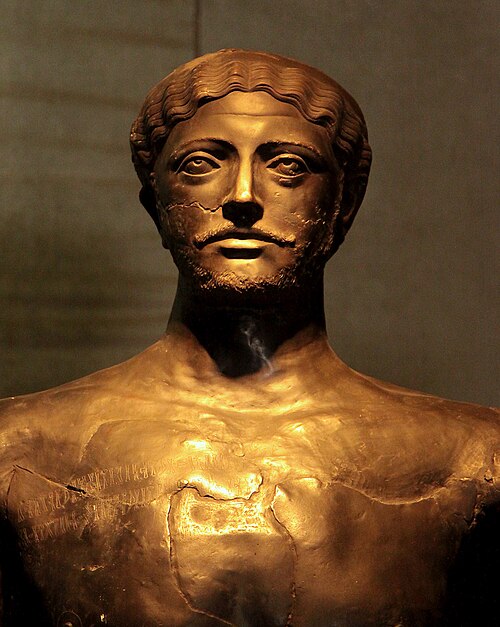
A bronze statue of Dhamar Ali Yahbur II, a Himyarite king who probably reigned in late 3rd or early 4th century AD. Displayed in the Sana'a National Museum. By Retlaw Snellac - Flickr, CC BY 2.0, https://commons.wikimedia.org/w/index.php?curid=22630270
1600 BCE
Tihama
The Qahtanis began to move to the Tihama coasts and the lowlands. A tradeline began to flourish along the red Sea Tihama coasts. During this period the Qahtanis began to settle in small trading colonies in neighboring East Africa. Source — Wikipedia, "Timeline of Yemeni history" (16th century BC):
Map showing the regions of the Arabian Peninsula By Goran_tek-en - Own work based on: ✦ Map of Hadhrami emigrations.svg by Goran tek-en ✦ Maps template-en.svg by Sting ✦ BlankMap-World gray.svg by LivingShadow Own work using: OpenStreetMap Requested by and knowledge from Abo Yemen, CC BY-SA 4.0, https://commons.wikimedia.org/w/index.php?curid=160394048
1200 BCE
Sabaeans
The Sabaean Kingdom came into existence. Source — Wikipedia, "Timeline of Yemeni history" (12th century BC):
Ancient Yemen in 100 BC By User:Schreiber - by User:Schreiber, CC BY-SA 3.0, https://commons.wikimedia.org/w/index.php?curid=1543571
900 BCE
Phoenician alphabet
The Qahtanis began using a variant of the Phoenician script; this will lead to the recording of South Arabian history from this point onwards. Source — Wikipedia, "Timeline of Yemeni history" (9th century BC):
800 BCE
Minaeans
Ma'een kingdom builds its capital in Baraqish. Source — Wikipedia, "Timeline of Yemeni history" (8th century BC):
Map of the Kingdom of Ma'In By Wario2 - Own work, CC BY-SA 4.0, https://commons.wikimedia.org/w/index.php?curid=130347042
719 BCE
Marib
The temple of Marib is finished. Source — Wikipedia, "Timeline of Yemeni history" (8th century BC):
صورة جوية لمدينة مأرب. (تصوير: بدرالدين الشهاري) By بدرالدين الشهاري - Own work, CC BY-SA 4.0, https://commons.wikimedia.org/w/index.php?curid=124561003
718 BCE
Minaeans
War between Ma'een and the Sabeans. Source — Wikipedia, "Timeline of Yemeni history" (8th century BC):
Map of the Kingdom of Ma'In By Wario2 - Own work, CC BY-SA 4.0, https://commons.wikimedia.org/w/index.php?curid=130347042
716 BCE
Marib
After securing their borders with Ma'een the Sabeans moved their capital to the more accessible Marib. Source — Wikipedia, "Timeline of Yemeni history" (8th century BC):
صورة جوية لمدينة مأرب. (تصوير: بدرالدين الشهاري) By بدرالدين الشهاري - Own work, CC BY-SA 4.0, https://commons.wikimedia.org/w/index.php?curid=124561003
715 BCE
Assyria
The Sabeans control the trade line and started recording diplomatic relationships with Assyria. Source — Wikipedia, "Timeline of Yemeni history" (8th century BC):
Emblem of the god Ashur, from an ancient Assyrian relief in Nimrud By Austen Henry Layard (1817–1894) - Austen Henry Layard (1867) Nineveh and its Remains, Public domain, https://commons.wikimedia.org/w/index.php?curid=113673445
700 BCE
Timna
The Qatabanians build Timna and rebel against the authority of Saba. Source — Wikipedia, "Timeline of Yemeni history" (7th century BC):
675 BCE
Karib'il Watar
Karib'il Watar defeats the rebellion and brings all of South Arabia under the Sabean rule. Source — Wikipedia, "Timeline of Yemeni history" (7th century BC):
600 BCE
Dʿmt
Saba reaches its height of power and extends its hegemony across the Red sea establishing the Dm't Kingdom, this will be the nucleus of the Semitic culture of East Africa. Although it is not the first attempt of the Qahtanis to expand their rule to the African coast. Source — Wikipedia, "Timeline of Yemeni history" (6th century BC):
The D'mt culture at its height By El Bux - Own work, CC0, https://commons.wikimedia.org/w/index.php?curid=164951823
500 BCE
Dam of Marib
The Dam of Marib breaks, Saba suffers from drought and rebellions. Source — Wikipedia, "Timeline of Yemeni history" (5th century BC):
Yemen By H. Grobe - Own work, CC BY-SA 3.0, https://commons.wikimedia.org/w/index.php?curid=13283317
370 BCE
Musqat
Qahtani tribes attack the Persians out of Musqat in the Eastern tip of the Arabian peninsula. From that time on Qahtanis replaced the Ancient Arabs 'Ad in Oman. Source — Wikipedia, "Timeline of Yemeni history" (4th century BC):
Musqat By Tristan - Flickr: Al Alam Palace, CC BY 2.0, https://commons.wikimedia.org/w/index.php?curid=12464290
110 BCE
Himyar
Himyar rises against Qataban. Source — Wikipedia, "Timeline of Yemeni history" (2nd century BC):
Map of the Himyarite Kingdom By DamiKarv - Own work, CC BY-SA 4.0, https://commons.wikimedia.org/w/index.php?curid=105530226
100 BCE
Ma'een declines gradually mainly due to
Ma'een declines gradually mainly due to the Roman control of the new sea trade routes. Source — Wikipedia, "Timeline of Yemeni history" (1st century BC):
25 BCE
The Romans encouraged by the civil
The Romans encouraged by the civil war in South Arabia attempt to invade the region, but fail to survive the Arabian desert. Source — Wikipedia, "Timeline of Yemeni history" (1st century BC):
100 CE
Kingdom of Aksum
The Kingdom of Aksum dominates East Africa and takesover the Sabean trading/military colonies. Source — Wikipedia, "Timeline of Yemeni history" (1st century AD):
King Endybis Ethiopia 227-235 A.D By PHGCOM - self-made, photographed at the British Museum, CC BY-SA 3.0, https://commons.wikimedia.org/w/index.php?curid=2350285
Hadhramout allies itself with Qataban and Aksum attacking Himyar from the West and the east. Source — Wikipedia, "Timeline of Yemeni history" (3rd century):
Eastern Hemisphere in 100 BCE. By Thomas Lessman (Contact!) - self-made (For reference information, see below), CC BY-SA 3.0, https://commons.wikimedia.org/w/index.php?curid=158050952
217 CE
Zafar, Yemen
While the Himyarites are fighting the Hadhramout/Qataban alliance in the east, the Aksumites capture the Himyarite capital Zafar. Source — Wikipedia, "Timeline of Yemeni history" (3rd century):
221 CE
Qataban
Hadhramout annexes Qataban and reaches its height of power. Source — Wikipedia, "Timeline of Yemeni history" (3rd century):
Eastern Hemisphere in 100 BCE. By Thomas Lessman (Contact!) - self-made (For reference information, see below), CC BY-SA 3.0, https://commons.wikimedia.org/w/index.php?curid=158050952
222 CE
Kingdom of Aksum
The Aksumites attempt to capture Hadhramout from the coast. Source — Wikipedia, "Timeline of Yemeni history" (3rd century):
King Endybis Ethiopia 227-235 A.D By PHGCOM - self-made, photographed at the British Museum, CC BY-SA 3.0, https://commons.wikimedia.org/w/index.php?curid=2350285
225 CE
Sha'r Awtar
During the reign of Sha`irum Awtar the Himyarites/Sabeans attack the Kingdom of Hadhramout from the East and capture their capital. Source — Wikipedia, "Timeline of Yemeni history" (3rd century):
227 CE
Tihama
The Gurat Sabeans and Himyar ally themselves against the Aksumites and retake Zafar. The Aksumites lose all their territories in South Arabia except for Tihama. Source — Wikipedia, "Timeline of Yemeni history" (3rd century):
Map showing the regions of the Arabian Peninsula By Goran_tek-en - Own work based on: ✦ Map of Hadhrami emigrations.svg by Goran tek-en ✦ Maps template-en.svg by Sting ✦ BlankMap-World gray.svg by LivingShadow Own work using: OpenStreetMap Requested by and knowledge from Abo Yemen, CC BY-SA 4.0, https://commons.wikimedia.org/w/index.php?curid=160394048
229 CE
Tihama
Himyar recaptures Southern Tihama and controls the Major East African ports across from Muza'a. The Aksumites keep the Northern strip of Tihama. Source — Wikipedia, "Timeline of Yemeni history" (3rd century):
Map showing the regions of the Arabian Peninsula By Goran_tek-en - Own work based on: ✦ Map of Hadhrami emigrations.svg by Goran tek-en ✦ Maps template-en.svg by Sting ✦ BlankMap-World gray.svg by LivingShadow Own work using: OpenStreetMap Requested by and knowledge from Abo Yemen, CC BY-SA 4.0, https://commons.wikimedia.org/w/index.php?curid=160394048
231 CE
Jifna bin Azd
The Kahlani Jifna bin Azd branch settles Syria and Lakhm settles Mesopotamia. Source — Wikipedia, "Timeline of Yemeni history" (3rd century):
Map of the Lakhmid Kingdom in the 6th-century. Light green is Sasanian territory governed by the Lakhmids. By MoeyElan - This file was derived from: LakhmidsVassal.png, CC BY-SA 4.0, https://commons.wikimedia.org/w/index.php?curid=105127765
280 CE
Sabaeans
Himyar annexes the last Sabean enclave to its Kingdom. Source — Wikipedia, "Timeline of Yemeni history" (3rd century):
Ancient Yemen in 100 BC By User:Schreiber - by User:Schreiber, CC BY-SA 3.0, https://commons.wikimedia.org/w/index.php?curid=1543571
300 CE
Dhofar
Himyar annexes Hadhramout expanding its borders to Dhofar Oman. to the East of their borders the Azd bin Imran (Azd Uman). Source — Wikipedia, "Timeline of Yemeni history" (3rd century):
Location of governorate and region XY (see filename) in Oman By NordNordWest - Own work, CC BY-SA 3.0 de, https://commons.wikimedia.org/w/index.php?curid=47980535
Socotra By Unknown author, Public domain, https://commons.wikimedia.org/w/index.php?curid=1538812
325 CE
Sayhad
From Al-Ramlah in Yemen, Shiekh of Kindah makes alliances with Adnani tribes of Najd. Source — Wikipedia, "Timeline of Yemeni history" (4th century):
Yemeni Desert By Aysegul Tastaban - flicker, CC BY 2.0, https://commons.wikimedia.org/w/index.php?curid=22874724
390 CE
Tubba Abu Karab As'ad
Abu-Kariba Asad King of Himyar converts to Judaism and spreads the religion in the region. Source — Wikipedia, "Timeline of Yemeni history" (4th century):
Photo by Gila Brand. Judaica - candlesticks, etrog box, shofar, Torah pointer, Tanach, natla (נַטְלָה aka keli) By The original uploader was Gilabrand at English Wikipedia. - Originally from en.wikipedia; description page is/was here., CC BY 2.5, https://commons.wikimedia.org/w/index.php?curid=2471515
425 CE
Akil al-Murar ibn Amr
Himyar appoints Akil al-Murar ibn Amr as the first Hujr of its Northern Kindite colonies. Source — Wikipedia, "Timeline of Yemeni history" (5th century):
Map showing the approximate extent of the Kindite kingdom over the Ma'add tribal confederation in central and northern Arabia, circa 500 CE. Also shown are the approximate locations of Arab tribes, including the constituents of Ma'add, and neighboring states and Arab client kingdoms. Kindite settlements are distinguished from other important settlements. By Al Ameer son - Own work, CC BY-SA 4.0, https://commons.wikimedia.org/w/index.php?curid=113444200
480 CE
Amr al-Mansur ibn Hudjr
Amr al-Mansur ibn Hudjr rises his status to the king (vassal to Himyar) and bring the Northern part of the Arabian peninsula under Himyarite control. Source — Wikipedia, "Timeline of Yemeni history" (5th century):
500 CE
Christianity spreads in Najran/Tihama strip an
Christianity spreads in Najran/Tihama strip an area still allied to the Christian Aksum kingdom. Source — Wikipedia, "Timeline of Yemeni history" (5th century):
523 CE
Dhu Nuwas
King Dhu Nuwas converts to Judaism, he begins a campaign to convert the Himyarites into Judaism. Himyarites convert in big numbers except in Najran. Source — Wikipedia, "Timeline of Yemeni history" (6th century):
Map of the Himyarite Kingdom By DamiKarv - Own work, CC BY-SA 4.0, https://commons.wikimedia.org/w/index.php?curid=105530226
525 CE
Kingdom of Kinda
At this time Himyar included all the Arabian Peninsula (via Kindah) and he was angered by the Najrani chief refusal to leave Christianity. Dhu Nawas took Najran and massacred 20,000 Najrani Christians. Source — Wikipedia, "Timeline of Yemeni history" (6th century):
Map showing the approximate extent of the Kindite kingdom over the Ma'add tribal confederation in central and northern Arabia, circa 500 CE. Also shown are the approximate locations of Arab tribes, including the constituents of Ma'add, and neighboring states and Arab client kingdoms. Kindite settlements are distinguished from other important settlements. By Al Ameer son - Own work, CC BY-SA 4.0, https://commons.wikimedia.org/w/index.php?curid=113444200
570 CE
Dam of Marib
The Dam of Marib broke for the third and final time, triggering another migration of Yemeni tribes. The Qur'an itself refers to the collapse of the Marib Dam as a punishment on the Sabaeans for their ungratefulness to God. Source — Wikipedia, "Timeline of Yemeni history" (6th century):
Yemen By H. Grobe - Own work, CC BY-SA 3.0, https://commons.wikimedia.org/w/index.php?curid=13283317
628 CE
Badhan
The final Persian governor of Yemen, Badhan, converted to Islam, thus nominally submitting the entirety of Yemen to the new faith. Source — Wikipedia, "Timeline of Yemeni history" (7th century):
The Kaabah (Kaaba) is located in the Masjid Al-Haram in Makkah (Mecca, Saudi Arabia). This photo was taken during the 2018 Hajj Season. Performing hajj is one of the pillars of Islam and required once for those who can afford to do it. Here the hajj pilgrims are performing the 'tawaf' around the Kaabah. By Adli Wahid Minor modifications made by Basile Morin, from the original version. - File:The Kaaba during Hajj.jpg, CC BY-SA 4.0, https://commons.wikimedia.org/w/index.php?curid=157575049
632 CE
Al-Aswad Al-Ansi
Al-Aswad al-Ansi proclaims himself prophet and attracts a large following. He captures Sana'a, but is killed by the Persian shortly after. Source — Wikipedia, "Timeline of Yemeni history" (7th century):
660 CE
Umayyad
Yemen is captured by the pro-Umayyad forces during the First Fitna. Source — Wikipedia, "Timeline of Yemeni history" (7th century):
The Umayyad Caliphate at its greatest extent, in 720, under Caliph Umar II. By Ergovius - Own work, CC BY-SA 4.0, https://commons.wikimedia.org/w/index.php?curid=101110977
686 CE
Kharijites
Kharijites under Najda ibn Amir attack Yemen during the Second Fitna. Source — Wikipedia, "Timeline of Yemeni history" (7th century):
Map of the Caliphate during the Second Fitna (Second Muslim Civil War), showing the approximate areas of control of: the Damascus-based Umayyad dynasty the Mecca-based counter-caliph Abd Allah ibn al-Zubayr the Kufa-based pro-Alid ruler al-Muktar al-Thaqafi the Kharijite Azariqa and Najdat factions By original map by Al Ameer son; SVG version by Konstantinos Plakidas - Own work based on: Second Fitna Territorial Control Map ca 686.png by Al Ameer son. For description and sources, cf. there., CC BY-SA 4.0, https://commons.wikimedia.org/w/index.php?curid=82918036
687 CE
Kharijite attacks continue, and Sana'a is
Kharijite attacks continue, and Sana'a is forced to submit to Najda ibn Amir. Source — Wikipedia, "Timeline of Yemeni history" (7th century):
740 CE
Zayd ibn Ali
Imam Zayd ibn Ali, founder of Fiver Islam leads revolt in Kufa against Umayyads. The revolt is brutally crushed and Zayd killed. Some followers remained in Medina, when Imam Al-Hadi Yahya would bring Zaidiyyah to Sa'dah in the thirteenth century. Source — Wikipedia, "Timeline of Yemeni history" (8th century):
A calligraphic logo used by Ansar Allah, a Shia movement in Yemen commonly called the Houthis, with Arabic text: "Oh ye who believe, be supporters of God" (Quran 61:14) By Ansar Allah (Houthis) - Own work using: Middle East Forum, Syria Scope, Public domain, https://commons.wikimedia.org/w/index.php?curid=87018519
893 CE
al-Hadi ila'l-Haqq Yahya
Imam al-Hadi ila'l-Haqq Yahya arrives in Yemen for the first time. Source — Wikipedia, "Timeline of Yemeni history" (9th century):
Dinar of al-Hadi ila'l-Haqq Yahya, first Zaydi imam of Yemen, minted in AH 298 (910/11 CE). Original caption: ISLAMIC, Arabia. Zaydis (Rassids). al-Hadi. AH 284-298 / AD 897-911. AV Dinar (22mm, 2.90 g, 7h). Sa’da mint. Dated AH 298 (AD 1252/3). AGC I 373Ek; Album 1065; ICV 1078. Good VF, lightly toned. By Original: Unknown, medieval mint-master. Photo: CNG coins - CNG Coins, CC BY-SA 2.5, https://commons.wikimedia.org/w/index.php?curid=96539773
897 CE
Saada
Establishment of the Zaydi imamate under al-Hadi at Saada. Source — Wikipedia, "Timeline of Yemeni history" (9th century):
Mud house in Sa'dah, Yemen. By Bernard Gagnon - Own work, CC BY-SA 3.0, https://commons.wikimedia.org/w/index.php?curid=4444310
1165 CE
Mass conversions from Judaism to Islam.
Mass conversions from Judaism to Islam. Source — Wikipedia, "Timeline of Yemeni history" (12th century):
1173 CE
Saladin
Saladin annexes both the Hejaz and Yemen to his Ayyubid sultanate. Source — Wikipedia, "Timeline of Yemeni history" (12th century):
Al-Nasir I Salah al-Din Yusuf (Saladin). AH 564-589 (1169-1193 CE) Æ Dirham (30.1mm, 13.28 g, 6h). Without mint-name. Dated AH 586 (AD 1190-91). Sultan sitting facing, cross-legged, on high-backed throne (obverse) By Classical Numismatic Group (CNG) - This image has been extracted from another file, CC BY-SA 2.5, https://commons.wikimedia.org/w/index.php?curid=146236437
1229 CE
Rasulid dynasty
The Rasulid dynasty rules Yemen until 1454. Source — Wikipedia, "Timeline of Yemeni history" (13th century):
Flag of the Rasulid Dynasty By Abo Yemen - Masalik Al-Ibsar by Al-Omari, Subh Al-Asha by Al-Qalqashandi Al-Qalqashandi said: "The emblem of this sultan is red roses on a white ground." meaning in a white patch Ibn Fadlallah said, explaining the number of roses: "I saw the Yemeni sanjak raised on Arafat in the year 738 AH, and it was white and had five red roses in it." Sanjak: a Turkish word meaning flag or banner. The five roses symbolize the five pillars of Islam., CC BY-SA 4.0, https://commons.wikimedia.org/w/index.php?curid=145588378
1514 CE
Kamaran
In response to Portuguese occupation of Kamaran island, a fleet from the Mamluk Sultanate attack and occupy the western and southern shores of the Timurid territory in Yemen. Source — Wikipedia, "Timeline of Yemeni history" (16th century):
Kamaran Island in Yemen By user:Darwinek - NASA, Public domain, https://commons.wikimedia.org/w/index.php?curid=1017786
1517 CE
Ottoman Empire
Ottomans capture Egypt and eliminate the Mamluk dynasty, then move on to Yemen, where they occupy Aden. Sana'a and the rest of Yemen remain under the Zaidi dynasty. Source — Wikipedia, "Timeline of Yemeni history" (16th century):
The Ottoman flag and Turkey Republic Flag of 1844–1935. Late Ottoman flag which was made based on the historical documents listed in the Source section. Note that a five-pointed star was rarely used in the crescent-and-star symbol before the 19th century. By User:Orwellianist - File:German soldiers celebrate Christmas in Ottoman Empire during WW1.jpg File:Nordenfelt submarine Abdülhamid.jpg Ottoman submarine Abdülhamid (1886) File:Declaration of the 1908 Revolution in Ottoman Empire.png Photo from 1908 http://www.tayyareci.com/digerucaklar/turkiye/preww1/Bleriot%20XI%20b%20TuAF.jpg - Photo from 1912 http://www.manorhouse.clara.net/book2/chapter18.htm (image), alternative link - Photo from 1914 http://www.manorhouse.clara.net/book2/chapter21.htm image - Photo from 1914 File:SultanahmetMitingi.jpg Photo from 1919 http://www.tayyareci.com/digerucaklar/turkiye/ww1/gothawd12.jpg - Photo from 1915 http://www.tayyareci.com/digerucaklar/turkiye/ww1/gothawd2.jpg - Photo from 1915 http://www.tayyareci.com/digerucaklar/turkiye/ww1/gothawd13.jpg - Photo from 1915 http://www.tayyareci.com/digerucaklar/turkiye/ww1/sakir_feyzi_resimleri2.jpg - Photo from 1915 http://www.tayyareci.com/digerucaklar/turkiye/ww1/S.P.A.D13.JPG - Photo from 1918 http://www.tayyareci.com/digerucaklar/turkiye/kurtulus/fiat-r2.jpg - Photo from 1920 http://www.tayyareci.com/digerucaklar/turkiye/kurtulus/breguet14b2.jpg - Photo from 1922 http://www.tayyareci.com/digerucaklar/turkiye/kurtulus/nieuport27-2.jpg - Photo from 1922 File:Bundesarchiv Bild 146-2005-0086, Kaiser Wilhelm II in Konstantinopel.jpg File:Ceremony to decolate the flag of 27th Regiment with Imtiyaz Medals.jpg File:Ottoman troops with flag.jpg File:Ottoman Navy at the Golden Horn.jpg - Postcard from 1914 http://www.osmanzengin.com/ESKi__iSTANBUL/kararkoy02.jpg - Postcard from 1920 http://www.osmanzengin.com/ESKi__iSTANBUL/tepebasi.jpg - Postcard from 1920 http://www.vicmart.com/ext/en/exrw/item=1416 - Ottoman medal from 1850 File:Aff_ciwl_orient_express4_jw.jpg - 1888-1889 season timetable of the Orient Express File:Ottoman conquests.jpg - Ottoman map from 1914, Public domain, https://commons.wikimedia.org/w/index.php?curid=7112828
Aug 1, 1538 CE
Hadım Suleiman Pasha
Admiral Sulayman Pasha captures Aden for Sultan Suleiman the Magnificent in order to provide an Ottoman base for raids against Portuguese possessions on the western coast of the Indian subcontinent. Source — Wikipedia, "Timeline of Yemeni history" (16th century):
Grafik aus dem Klebeband Nr. 1 der Fürstlich Waldeckschen Hofbibliothek Arolsen Illustration aus: Georg Greblinger: Wahre Abbildungen der Türckischen Kayser vnd Persischen Fürsten / so wol auch anderer Helden und Heldinnen von dem Osman / biß auf den andern Mahomet. Johann Ammon, Frankfurt 1648 Motiv: "Soleimanes Bassa" (Süleyman Pasha, wohl Hadım Suleiman Pasha († 1547)) By Johann Theodor de Bry - http://digi.ub.uni-heidelberg.de/fwhb/klebeband1, Public domain, https://commons.wikimedia.org/w/index.php?curid=30207418
1540 CE
Residents of Aden rise up against
Residents of Aden rise up against the Ottomans, slaughter the garrison and invite Portuguese protection. The Portuguese stay until driven out by the Ottoman fleet under Admiral Peri Pasha. Source — Wikipedia, "Timeline of Yemeni history" (16th century):
1595 CE
Imam Al-Qasim ibn Muhammad begins a
Imam Al-Qasim ibn Muhammad begins a rebellion against the Ottomans that would last for 30 years. Source — Wikipedia, "Timeline of Yemeni history" (16th century):
1618 CE
Mocha, Yemen
British establish a "factory" (trading post) at Mocha on the Red Sea coast. Source — Wikipedia, "Timeline of Yemeni history" (17th century):
Mocha Red Sea By tower10 - https://web.archive.org/web/20161011114048/http://www.panoramio.com/photo/2991675, CC BY-SA 3.0, https://commons.wikimedia.org/w/index.php?curid=39606376
1630 CE
East India Company
The East India Company begins trade in coffee from Mocha, which held a monopoly on the plant at the time. Source — Wikipedia, "Timeline of Yemeni history" (17th century):
Flag of the British East India Company, 1801–1858. Data from FOTW http://www.crwflags.com/fotw/flags/gb-eic.html. By No machine-readable author provided. Yaddah assumed (based on copyright claims). - No machine-readable source provided. Own work assumed (based on copyright claims)., Public domain, https://commons.wikimedia.org/w/index.php?curid=837871
1635 CE
The Ottomans are expelled from Yemen.
The Ottomans are expelled from Yemen. Source — Wikipedia, "Timeline of Yemeni history" (17th century):
1728 CE
Sultanate of Lahej
Fadl ibn Ali, chief of the Abdali tribe, declares Lahej an independent sultanate. Source — Wikipedia, "Timeline of Yemeni history" (18th century):
Flag of the Sultanate of Lahej (abolished in 1967). Own work by en:User:Sakurambo. Produced in Adobe Illustrator CS2. Supersedes Image:Lahej_Flag.gif. By No machine-readable author provided. RsAzevedo assumed (based on copyright claims). - No machine-readable source provided. Own work assumed (based on copyright claims)., CC BY-SA 3.0, https://commons.wikimedia.org/w/index.php?curid=4024193
1735 CE
Sultanate of Lahej
Fadl ibn Ali's forces capture Aden and make it part of the Sultanate of Lahej. Source — Wikipedia, "Timeline of Yemeni history" (18th century):
Flag of the Sultanate of Lahej (abolished in 1967). Own work by en:User:Sakurambo. Produced in Adobe Illustrator CS2. Supersedes Image:Lahej_Flag.gif. By No machine-readable author provided. RsAzevedo assumed (based on copyright claims). - No machine-readable source provided. Own work assumed (based on copyright claims)., CC BY-SA 3.0, https://commons.wikimedia.org/w/index.php?curid=4024193
1785 CE
Americans begin to compete with British
Americans begin to compete with British for the coffee trade from Mocha and by 1800 would become the main exporters of Yemen's most important article of foreign trade. Source — Wikipedia, "Timeline of Yemeni history" (18th century):
1837 CE
Muhammad Ali of Egypt
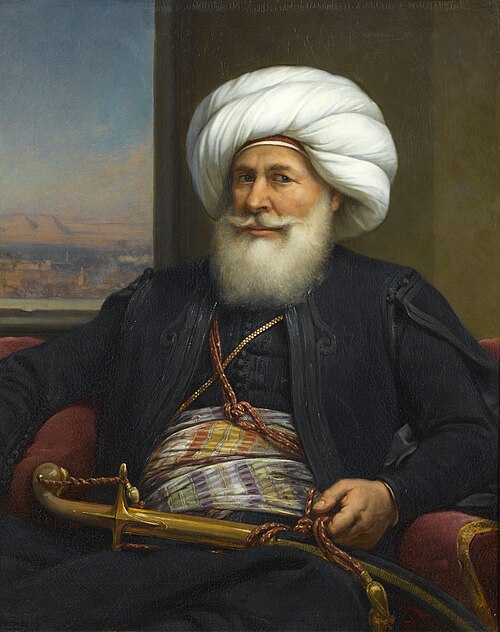
Forces of Muhammad Ali, nominally the Egyptian vassal of the Ottoman Empire, occupy Ta'izz. The British warn him against further military movements. Source — Wikipedia, "Timeline of Yemeni history" (19th century):
Mısır Valisi, Kavalalı Mehmet Ali Paşa . By Auguste Couder - This image comes from the Bibliotheca Alexandrina's Memory of Modern Egypt Digital Archive. Click here to view its thumbnail. Its description page can be located in the archive by copying the Arabic-language description above and pasting it into the search box situated in the upper-left corner of this page.This tag does not indicate the copyright status of the attached work. A valid copyright tag is still required., Public domain, https://commons.wikimedia.org/w/index.php?curid=6356895
1839 CE
Aden
In response to an incident in which Arab traders plundered a British vessel, Captain Haines sailed against Aden and finding resistance bombards then occupies it for the East India Company's Bombay Presidency, requiring the Sultan of Lahej to accept British protection. Aden will serve as a major refueling port when the Suez Canal opens in 1869. Source — Wikipedia, "Timeline of Yemeni history" (19th century):
Mallah District By Ahmedxalkatheri - Own work, CC BY-SA 4.0, https://commons.wikimedia.org/w/index.php?curid=132191450
1849 CE
Ottomans establish presence on the Red
Ottomans establish presence on the Red Sea coast, but the Ottoman force sent to take Sana'a is massacred after accepting invitation to enter the city. Source — Wikipedia, "Timeline of Yemeni history" (19th century):
1850 CE
Beginning of "the time of corruption",
Beginning of "the time of corruption", which would last until the end of the century. Zaidis lost major ports to other tribes; widespread food shortages; rivalry for the imamate; with Qāsimī rule collapsing, Turkish incursions into the highlands meet with support. Source — Wikipedia, "Timeline of Yemeni history" (19th century):
1872 CE
Al-Mutawakkil al-Muhsin
Ottomans occupy the northern Yemen, taking Sana'a and spreading out southward around Taiz. Imam Al-Mutawakkil al-Muhsin withdraws to the north. Source — Wikipedia, "Timeline of Yemeni history" (19th century):
1904 CE
Yahya Muhammad Hamid ed-Din
Yahya Muhammad Hamid ed-Din, a descendant of Imam al-Qasim, becomes Imam and takes regnal name of al-Mutawakkil 'ala Allah ("He who relies on God"). Source — Wikipedia, "Timeline of Yemeni history" (20th century):
İmam Yahya's photo cropped By Aamen Rihani - https://commons.wikimedia.org/wiki/File:Yahya_Muhammad_Hamid_ed-Din.jpg, Public domain, https://commons.wikimedia.org/w/index.php?curid=121189067
Jan 1, 1911 CE
Muhammad ibn Ali al-Idrisi
At a time when the Ottoman Empire was trying to pacify Albania and was facing hostile moves by Italy against Libya, both Imam Yahya and Muhammad ibn Ali al-Idrisi, Emir of Asir rose up against the Turks, causing the Ottomans to send 30,000 troops from Libya to respond. Forced to fight in the highlands, Yemen became "the graveyard of the Turks." Source — Wikipedia, "Timeline of Yemeni history" (20th century):
Muhammad bin Ali al-Idrisi (محمد بن علي الإدريسي) - Imam in Asir 1909-1923 By Unknown author - Unknown source, Public domain, https://commons.wikimedia.org/w/index.php?curid=25545035
Mar 1, 1914 CE
Anglo-Turkish Treaty on boundaries concludes work
Anglo-Turkish Treaty on boundaries concludes work of Anglo-Turkish Boundary Commission which had begun in 1902. The powers agree on division between their respective realms in Yemen, a division that would more-or-less later serve as the boundary between North and South Yemen. Source — Wikipedia, "Timeline of Yemeni history" (20th century):
Dec 1, 1918 CE
Yahya Muhammad Hamid ed-Din
Turkish governor of Yemen informs Imam Yahya that "Franks" (the European allies) had overrun Anatolia and that the Ottomans would be forced to withdraw from Yemen. Through a series of alliances, tribal wars and intrigues Yahya would consolidate Zaidi hold over to the south of Sa'da (including Sana'a) and would begin moving north against the Idrisi state of Asir. Source — Wikipedia, "Timeline of Yemeni history" (20th century):
İmam Yahya's photo cropped By Aamen Rihani - https://commons.wikimedia.org/wiki/File:Yahya_Muhammad_Hamid_ed-Din.jpg, Public domain, https://commons.wikimedia.org/w/index.php?curid=121189067
Sep 2, 1926 CE
Treaty of friendship between Italy and
Treaty of friendship between Italy and Imam Yahya. Italy becomes the first power to recognize Yahya as King of Yemen. Source — Wikipedia, "Timeline of Yemeni history" (20th century):
Feb 11, 1934 CE
Treaty of Sana'a between Yemen and
Treaty of Sana'a between Yemen and Great Britain. The parties agree on a modus vivendi without resolving claims of sovereignty on either side. Source — Wikipedia, "Timeline of Yemeni history" (20th century):
May 20, 1934 CE
Asir
Treaty of Taif ends brief border war between Al-Saud and Yemen. Yemen cedes Asir to Saudi Arabia. Source — Wikipedia, "Timeline of Yemeni history" (20th century):
احد المواقع التراثية المميز في منطقة عسير By Heritage Commission - Own work, CC BY-SA 4.0, https://commons.wikimedia.org/w/index.php?curid=93509323
Jun 1, 1944 CE
Ahmad Muhammad Numan
Having fled the court of the Crown Prince in Ta'izz, Ahmad Muhammad Numan, Muhammad Mahmud al-Zabayri and Zayd al-Mawshki arrive in Aden where later that year they would form the Free Yemeni Party. Source — Wikipedia, "Timeline of Yemeni history" (20th century):
عضو المجلس الرئاسي اليمني أحمد محمد نعمان عام ١٩٤٦. By Unknown author - http://www.eltaher.org/docs_photos/photosYE_p1_ar.html, Public domain, https://commons.wikimedia.org/w/index.php?curid=40713810
Mar 4, 1946 CE
Harry S. Truman
The United States recognizes the Kingdom of Yemen by letter from President Harry S. Truman to Imam Yahya, providing for the appointment of an American Special Diplomatic Mission to the Kingdom. Source — Wikipedia, "Timeline of Yemeni history" (20th century):
Portrait of President Harry S. Truman (ca. 1947). By National Archives and Records Administration. Office of Presidential Libraries. Harry S. Truman Library. - NATIONAL ARCHIVES AND RECORDS ADMINISTRATION (NARA) - CATALOG: AUDIOVISUAL MATERIAL (ID. 7865583)., Public domain, https://commons.wikimedia.org/w/index.php?curid=79198241
Dec 2, 1947 CE
1947 anti-Jewish riots in Aden
Anti-Jewish pogrom in Aden. 82 Jews were killed and 76 were injured by Arabic nationalists. Source — Wikipedia, "Timeline of Yemeni history" (20th century):
The original was taken by one of my parents on their way back from Batavia (Djakarta) to Holland By Taks - Own work, CC BY-SA 3.0, https://commons.wikimedia.org/w/index.php?curid=26190286
Feb 17, 1948 CE
Ahmad bin Yahya
Yahya assassinated. He would be succeeded by his son Ahmad who rallied northern tribesmen to defeat nationalist opponents of feudal rule. Source — Wikipedia, "Timeline of Yemeni history" (20th century):
Ahmad bin Yahya Hamidaddin (1891 – 18 September 1962) was the penultimate king of the Mutawakkilite Kingdom of Yemen from 1948 to 1962. His full name and title was H.M. al-Nasir-li-din Allah Ahmad bin al-Mutawakkil 'Ala Allah Yahya, Imam and Commander of the Faithful, and King of the Mutawakkilite Kingdom of the Yemen. Ahmad was considered to be a despot, and his main focus was on modernising the military. By نجيب - http://www.royalark.net/Yemen/yemen5.htm, Public domain, https://commons.wikimedia.org/w/index.php?curid=12713328
Mar 31, 1955 CE
Muhammad al-Badr
Army officers who objected to Imam Ahmad's conservative rule, especially his harsh and summary punishments, laid siege to the Elurdhi fortress in Taiz while the Imam was inside. The Imam's brothers supported the coup attempt with Emir Abdullah bin Yahyi (purportedly reformist minded) accepting the army's call to replace Ahmad and Emir Abbas telegraphed support from Sana'a. Crown prince al-Badr rallied tribal support and Liberals (local and emigres in Cairo) among others supported him. The siege was raised and Ahmad restored on April 5, and both Abdullah and Abbas were executed. Source — Wikipedia, "Timeline of Yemeni history" (20th century):
Muhammad Al-Badr was the last king of the Mutawakkilite Kingdom of Yemen (North Yemen) and leader of the monarchist regions during the North Yemen Civil War (1962–1970). His full name was Al-Mansur Bi'llah Muhammad Al-Badr bin Al-Nasir-li-dinu'llah Ahmad, Imam and Commander of the Faithful and King of the Mutawakkilite Kingdom of the Yemen. By Unknown photographer - https://www.amazon.com/Vintage-photo-of-Muhammad-al-Badr/dp/B07FJJ9GC2, Public domain, https://commons.wikimedia.org/w/index.php?curid=90854961
Apr 21, 1956 CE
Jeddah
Jiddah Pact: Imam Ahmad, Premier Nasser (of Egypt) and King Saud (of Saudi Arabia) sign pace in Jeddah pledging the armies of all three would be placed under a single command to repel invasion. Nasser expressed his goal to "spoil British imperialist plans in the Middle East," but Egypt had no then pending dispute with Britain unlike Yemen (which disputed the border with Aden and the ownership of the Red Sea island of Kamana) and Saudi Arabia (which Britain accused of fomenting anti-British sentiment among tribes on their border). Source — Wikipedia, "Timeline of Yemeni history" (20th century):
الواجهة البحرية في مدينة جدة غرب السعودية، 2025. By Saudi Press Agency (SPA) - https://cc.spa.gov.sa/ar, CC BY-SA 4.0, https://commons.wikimedia.org/w/index.php?curid=194132697
Mar 8, 1958 CE
United Arab Republic
As a concession to pro-Nasserite opinion and to avoid Egyptian aid to republican opposition, Yemen enters loose federation with the United Arab Republic to form the United Arab States. The signing ceremony took place in Damascus between Egypt's President Nasser and crown prince Muhammad al-Badr. Source — Wikipedia, "Timeline of Yemeni history" (20th century):
It is easy to put a border around this flag image By See File history below for details. For further informations, see also: en:Syrian Arab Republic and the en:United Arab Republic. - Syria Permanent Mission to the United Nations; FOTW BASED ON THIS CONSTRUCTION SHEET:, Public domain, https://commons.wikimedia.org/w/index.php?curid=448257
Feb 11, 1959 CE
Federation of Arab Emirates of the South
Six West Aden protectorate states (but not the colony of Aden itself) join the Federation of Arab Emirates of the South and the Federation and Britain signed a "Treaty of Friendship and Protection," which detailed plans for British financial and military assistance. Source — Wikipedia, "Timeline of Yemeni history" (20th century):
Flag of the Federation of Arab Emirates of the South (1959-1962) By Samhanin - Own work, sources: worldstatesmen.org - "Yemen, Flag of the 'Federation of Arab Emirates of the South', 11 Feb 1959 - 4 Apr 1962, FOTW - "Federation of South Arabia (Yemen) - Arab Amirates of the South (1959-1962)", CC BY-SA 3.0, https://commons.wikimedia.org/w/index.php?curid=93370495
Sep 18, 1962 CE
Muhammad al-Badr
Imam Ahmad dies. Crown prince al-Badr succeeds him, unopposed. Source — Wikipedia, "Timeline of Yemeni history" (20th century):
Muhammad Al-Badr was the last king of the Mutawakkilite Kingdom of Yemen (North Yemen) and leader of the monarchist regions during the North Yemen Civil War (1962–1970). His full name was Al-Mansur Bi'llah Muhammad Al-Badr bin Al-Nasir-li-dinu'llah Ahmad, Imam and Commander of the Faithful and King of the Mutawakkilite Kingdom of the Yemen. By Unknown photographer - https://www.amazon.com/Vintage-photo-of-Muhammad-al-Badr/dp/B07FJJ9GC2, Public domain, https://commons.wikimedia.org/w/index.php?curid=90854961
Oct 14, 1963 CE
Front for the Liberation of Occupied South Yemen
Two nationalist groups, the Front for the Liberation of Occupied South Yemen and the National Liberation Front begin an armed revolt (Aden Emergency) against British control in South Yemen. Fighting began in Radfan, but the British quickly subdued it. Source — Wikipedia, "Timeline of Yemeni history" (20th century):
Flag of the Front for the Liberation of Occupied South Yemen By 愛喝奶茶 - Own work, CC BY-SA 4.0, https://commons.wikimedia.org/w/index.php?curid=155467569
Jun 1, 1965 CE
Britain invokes emergency powers to deal
Britain invokes emergency powers to deal with increasing unrest in Aden. Source — Wikipedia, "Timeline of Yemeni history" (20th century):
Feb 1, 1966 CE
Britain announces (in a reversal) that
Britain announces (in a reversal) that Aden was not vital to its commercial security and would be abandoned (naval base and all) by 1968. Source — Wikipedia, "Timeline of Yemeni history" (20th century):
Nov 30, 1967 CE
South Yemen
South Yemen granted independence by Great Britain and begins a socialist experiment. Source — Wikipedia, "Timeline of Yemeni history" (20th century):
Flag of the People's Democratic Republic of Yemen By National Front - الجبهة القومية - Own work, Public domain, https://commons.wikimedia.org/w/index.php?curid=496127
Jan 13, 1986 CE
Gangland-style assassination attempt by the guard
Gangland-style assassination attempt by the guard of South Yemen President Ali Nasser Mohammed al-Hassani on his rivals in the 15-member Politboro, killing Vice President Ali Antar and sparking gun fight among Politboro members. Twelve days of street fighting in Aden followed until the hard-line Marxists gained control and President Hassani was driven into exile. Source — Wikipedia, "Timeline of Yemeni history" (20th century):
Feb 16, 1989 CE
Arab Cooperation Council
Heads of states of Egypt, Iraq, Jordan and Yemen announce form Baghdad the formation of the Arab Cooperation Council. Source — Wikipedia, "Timeline of Yemeni history" (20th century):
This picture was taken on May 22, 1990, during the establishment of Yemen. That's when, the area of the People's Democratic Republic of Yemen (also known as South Yemen) was united with the Yemen Arab Republic (also known as North Yemen), forming the Republic of Yemen (known as simply Yemen). By The original uploader was يوسف حسين at Arabic Wikipedia. - Transferred from ar.wikipedia to Commons., Public domain, https://commons.wikimedia.org/w/index.php?curid=68223278
May 5, 1994 CE
1994 civil war in Yemen
Southern Yemen attempts to secede, sparking a civil war, which is brought to an end in July when northern forces capture Aden. Source — Wikipedia, "Timeline of Yemeni history" (20th century):
Collage of the Yemeni civil war (1994) created from photos uploaded on Wikimedia Commons By Algirr - Own work, CC BY-SA 4.0, https://commons.wikimedia.org/w/index.php?curid=163002014
Sep 23, 1999 CE
Ali Abdullah Saleh
Ali Abdullah Saleh receives 99.3% of the vote in the first presidential election by universal suffrage. Source — Wikipedia, "Timeline of Yemeni history" (20th century):
Ali Abdullah Saleh, President of the Yemen Arab Republic. Photo taken about 1988. By Government photos in the public domain - Old Yemen Arab Republic (now defunct) government brochure from 1980s in the public domain; Iraqi government under Saddam Hussein (now defunct) pamphlet from 1980s in the public domain, Public domain, https://commons.wikimedia.org/w/index.php?curid=167932215
Oct 12, 2000 CE
USS Cole
While refueling at a water-borne platform off the port of Aden, the USS Cole, a guided-missile destroyer, was attacked by terrorist affiliated with Al-Qaeda who detonated C-4 plastic explosives to tear a whole in the hull, killing 17 soldiers. The next day a bomb exploded at the British embassy in Sana'a but resulted in no casualties. Source — Wikipedia, "Timeline of Yemeni history" (21st century):
000914-N-0000X-002 Eastern Atlantic () -- The U.S. Navy Arleigh Burke class guided missile destroyer USS Cole (DDG 67) underway to the Mediterranean Sea, approximately one month before being attacked by a terrorist-suicide mission in the early morning hours of October 12th, 2000, while refueling in the port city of Aden, Yemen. By U.S. Navy Photo (RELEASED) - http://www.navy.mil/view_image.asp?id=1298, Public domain, https://commons.wikimedia.org/w/index.php?curid=2986436
Jun 18, 2004 CE
Hussein Badreddin al-Houthi
Police crack down on Zaidi demonstrators in capital and arrest large numbers. Fearing the followers of Hussein Badreddin al-Houthi to be an imminent treat and using claims that they were setting up unlicensed religious centers and engaging in violent demonstrations against the US and Israel, President Selah sends troops to northern province of Sa'ada to locate Sheikh al-Houthi and his followers. Resistance by Houti followers triggers Shia insurgency. Source — Wikipedia, "Timeline of Yemeni history" (21st century):
Location of governorate XY (see filename) in Yemen By TUBS - This vector image includes elements that have been taken or adapted from this file:, CC BY-SA 3.0, https://commons.wikimedia.org/w/index.php?curid=16727542
Dec 13, 2009 CE
US begins air strikes on suspected
US begins air strikes on suspected Al-Qaeda personnel and locations at the request of Yemen government. Source — Wikipedia, "Timeline of Yemeni history" (21st century):
Oct 29, 2010 CE
plastic explosive
Two packages, each containing a bomb consisting of 300 to 400 grams (11–14 oz) of plastic explosives and a detonating mechanism, were found on separate cargo planes in transport from Yemen to the United States, an incident since referred to as "the October 2010 (Yemen) incident". Source — Wikipedia, "Timeline of Yemeni history" (21st century):
Photo MONUSCO / Abel Kavanagh By MONUSCO Photos - Preparation of the demolition with explosive charges and wire, CC BY-SA 2.0, https://commons.wikimedia.org/w/index.php?curid=46293361
Mar 18, 2011 CE
Ali Abdullah Saleh
Jumaa al-Karama (Friday of Dignity): Massacre of protestors against President Ali Abdullah Saleh leads to massive protests and the revolution that would end his 22-year rule. Source — Wikipedia, "Timeline of Yemeni history" (21st century):
Ali Abdullah Saleh, President of the Yemen Arab Republic. Photo taken about 1988. By Government photos in the public domain - Old Yemen Arab Republic (now defunct) government brochure from 1980s in the public domain; Iraqi government under Saddam Hussein (now defunct) pamphlet from 1980s in the public domain, Public domain, https://commons.wikimedia.org/w/index.php?curid=167932215
Feb 21, 2012 CE
Abdrabbuh Mansur Hadi
In election to replace President Saleh, Vice President Abdrabbuh Mansur Hadi receives 99.6% of the vote in uncontested race. Despite lack of choice, turnout said to be higher than expected. Source — Wikipedia, "Timeline of Yemeni history" (21st century):
Sitting down for a meeting, Yemen President Abd Rabuh Mansur Hadi listens as Secretary of Defense Chuck Hagel welcomes him to the Pentagon July 30, 2013 By U.S Defense Department - https://www.flickr.com/photos/secdef/9401413723/in/photostream/, CC BY 2.0, https://commons.wikimedia.org/w/index.php?curid=75056785
Mar 18, 2013 CE
National Dialogue, a conference brokered by
National Dialogue, a conference brokered by the Gulf Cooperation Council and endorsed by the United Nations and made up of over 500 delegates representing the wide array of the political spectrum conveneded to draft a new constitution for Yemen, begins. President Hadi says that the unrest in the south is the most difficult issue before them. Source — Wikipedia, "Timeline of Yemeni history" (21st century):
Sep 21, 2014 CE
Houthi
Houthi rebels sign peace agreement brokered by UN envoy Jamal Benomar designed to give the rebels participation in new government and result in withdrawal of rebel military forces from Sana'a. The next day the rebel forces consolidated their hold on the capital. Source — Wikipedia, "Timeline of Yemeni history" (21st century):
Vectorized version of the Houthi Ansarullah "Al-Sarkha" banner. Arabic text, by lines: الله أكبر (Allah is the greatest) الموت لأمريكا (death to America) الموت لإسرائيل (death to Israel) اللعنة على اليهود (a curse upon the Jews) النصر للإسلام (victory to Islam) By RuneAgerhus - Own work, Public domain, https://commons.wikimedia.org/w/index.php?curid=63445205
Jan 22, 2015 CE
Khaled Bahah
Following resignation of cabinet and prime minister Khaled Bahah Yemen's president Abd Rabbuh Mansur Hadi resigns in the face of control of the capital by rebel Huthi forces, which had besieged his residence and abducted his chief of staff, Ahmed Awad bin Mubarak. Source — Wikipedia, "Timeline of Yemeni history" (21st century):
Yemen: Mapping the Way Forward, 14 November 2016, The Royal Society, London, cht.hm/2fzUT9n By Chatham House - This image has been extracted from another file, CC BY 2.0, https://commons.wikimedia.org/w/index.php?curid=55271351
Oct 1, 2016 CE
2016–2022 Yemen cholera outbreak
A cholera outbreak began predominantly in Sanaa, and killed more than 4000 people by 2022. Source — Wikipedia, "Timeline of Yemeni history" (21st century):
A map of the hemisphere centred on 48.25, 15.5, using an orthographic projection, created using gringer's Perl script with Natural Earth Data (1:50000 resolution, simplified to 0.25px). Yemen is highlighted in red. By Addicted04 - Own work, CC BY-SA 3.0, https://commons.wikimedia.org/w/index.php?curid=31241687
Dec 4, 2017 CE
Sanaa
Ali Abdullah Saleh killed two days after publicly breaking with the Houthis. Aides said he died after an explosion at his home in Sanaa; the Houthis said they had killed him in an ambush in the desert. Source — Wikipedia, "Timeline of Yemeni history" (21st century):
Sana'a By Dan from Brussels, Europe - Sana'a, CC BY-SA 2.0, https://commons.wikimedia.org/w/index.php?curid=83636478