Encyclopedia/3. History, Societies & Civilizations/01. East Asian Civilizations/01. Chinese Dynasties • Curated by Admin Timeline.sg
The Republic of China's tumultuous formation in 1912, warlord fragmentation, Nationalist unification, Japanese invasion, civil war, and retreat to Taiwan through 1949.
Chronological Storyline (35 Milestones)
Nov 24, 1894 CE
Revive China Society Founded (兴中会成立)
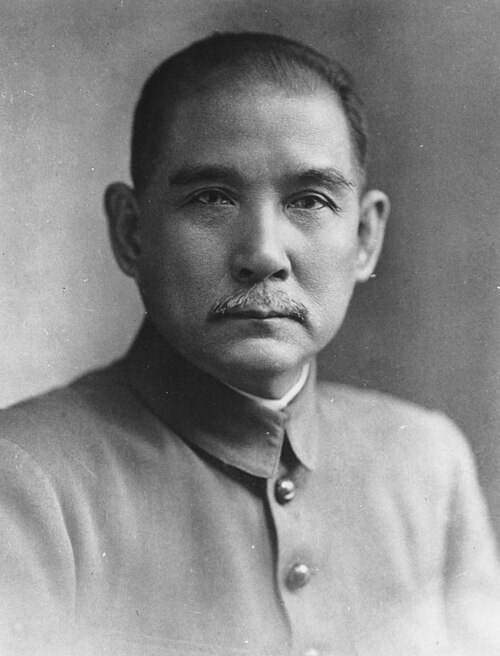
Sun Yat-sen (孙中山 / Sūn Zhōngshān) established the Revive China Society (兴中会 / Xīngzhōnghuì) in Honolulu, marking the beginning of organized revolutionary movement to overthrow the Qing dynasty. #politics #revolution
Portrait of Sun Yat-sen By 上海波尔照相馆 - 孙中山纪念馆 http://cyc7.cycnet.com:8091/leaders/szs/content.jsp?id=6936&s_code=1103, Public domain, https://commons.wikimedia.org/w/index.php?curid=2109692
Aug 20, 1905 CE
Tongmenghui Established (同盟会成立)
Sun Yat-sen united revolutionary groups into the Tongmenghui (同盟会 / Tóngménghuì) in Tokyo, Japan, adopting the Three Principles of the People (三民主义 / Sānmín Zhǔyì): nationalism, democracy, and people's livelihood. #politics #revolution
The Naval Jack of the Republic of China since 1928 (also adopted as canton of the Flag of the Republic of China), now used on Taiwan. This flag is also used as the party flag of Kuomintang. By Lu Haodong - File:Flag of the Republic of China.svg, Public domain, https://commons.wikimedia.org/w/index.php?curid=475392
Apr 6, 1906 CE
Singapore Tongmenghui branch formed
Sun Yat-sen (孙中山) forms the Singapore (新加坡) branch of the Tongmenghui (同盟会) at the Wan Qing Yuan (晚晴园) villa, with the backing of Nanyang (南洋) Chinese merchants Tan Chor Lam (陈楚南), Teo Eng Hock (张永福), and Lim Nee Soon (林义顺) to raise funds and orchestrate regional anti-Qing operations. #modern #history #east-asia
Oct 10, 1911 CE
Wuchang Uprising (武昌起义)
Revolutionaries in Wuchang (武昌 / Wǔchāng) launched the uprising that sparked the Xinhai Revolution (辛亥革命 / Xīnhài Gémìng), leading to the collapse of the Qing dynasty. #war #revolution
Wuchang Uprising (武昌起义) By Unknown author, Public domain, https://commons.wikimedia.org/w/index.php?curid=685617
Jan 1, 1912 CE
ROC Proclaimed (中华民国成立)
Sun Yat-sen was inaugurated as provisional president in Nanjing (南京 / Nánjīng), officially proclaiming the Republic of China (中华民国 / Zhōnghuá Mínguó), ending over two millennia of imperial rule. #politics #history
Omschrijving: Opstanden, revolutie. Inname van de stad Kan-Su door de bende van 'rebellen aanvoerder' Ta-Ko. Soldaten klimmen via houten ladders naar boven. In de muur zitten kogelgaten, op de voorgrond soldaten te paard met wapens. China. By Unknown author - https://beeldbank.spaarnestadphoto.com/search.pp?flush=1&multikeyword=SFA022823302&searchtype=0#ctr-thumbnails, Public domain, https://commons.wikimedia.org/w/index.php?curid=146369974
Feb 12, 1912 CE
Qing Abdication (清帝退位)
The Xuantong Emperor Puyi (溥仪 / Pǔyí) abdicated, Yuan Shikai (袁世凯 / Yuán Shìkǎi) became provisional president in Beijing, shifting power north and compromising the revolution. #politics #history
MANCHURIA PERIOD PUYI By Unknown author - https://www.pinterest.co.uk/amp/pin/471822498445876797/, Public domain, https://commons.wikimedia.org/w/index.php?curid=158392960
Aug 25, 1912 CE
Tongmenghui reorganized into Kuomintang
Sun Yat-sen (孙中山) reorganizes the Tongmenghui (同盟会) into the Kuomintang (国民党) (KMT) political party. #modern #history #east-asia
Mar 22, 1913 CE
Song Jiaoren Assassinated (宋教仁遇刺)
Song Jiaoren (宋教仁 / Sòng Jiàorén), leader of the Kuomintang (国民党 / Guómíndǎng) and advocate of parliamentary democracy, was assassinated in Shanghai, likely on Yuan Shikai's orders. #politics #crime
Song Jiaoren Assassinated (宋教仁遇刺) By Unknown author, Public domain, https://commons.wikimedia.org/w/index.php?curid=431076
Dec 12, 1915 CE
Yuan Shikai's Monarchy (袁世凯称帝)
Yuan Shikai declared himself Hongxian Emperor (洪宪皇帝 / Hóngxiàn Huángdì), attempting to restore monarchy; widespread opposition forced his abdication within months. #politics #history )
Flag of the Empire of China in 1916 By Original: 中華帝國政府 Vector: Gunter Küchler - Own work, Flags of the World - Empire of China, 1916; Official specification, Public domain, https://commons.wikimedia.org/w/index.php?curid=634582
May 4, 1919 CE
May Fourth Movement (五四运动)
Students in Beijing protested against the Treaty of Versailles' Shandong (山东 / Shāndōng) concessions, sparking a cultural and intellectual revolution advocating science, democracy, and vernacular literature. #culture #politics
Tiananmen Square on 4 May 1919. Around 3,000 students from 13 universities in Beijing gathered there to oppose Article 156 of the Treaty of Versailles which handover a German possession in China to Japan (Shandong Problem). This officially sparked the May Fourth Movement. By Unknown author - Hong Kong Central Library (zh:香港中央圖書館) exhibition in April 2019 for the celebration of the 100th anniversary of May Fourth Movement. Taken from April 2019 SSG 17.jpg., Public domain, https://commons.wikimedia.org/w/index.php?curid=437318
Jul 23, 1921 CE
CCP Founded (中共成立)
The Chinese Communist Party (中国共产党 / Zhōngguó Gòngchǎndǎng) was founded in Shanghai's French Concession, with Chen Duxiu (陈独秀 / Chén Dúxiù) as first secretary and Mao Zedong (毛泽东 / Máo Zédōng) among attendees. #politics #history
Emblem of the Communist Party of China. By Converted from File:Flag of the Chinese Communist Party.svg by User:PhiLiP with Inkscape.Optimized version by Mike Rohsopht - Own work based on http://www.gov.cn/zhengce/2021-06/28/content_5621310.htm, Public domain, https://commons.wikimedia.org/w/index.php?curid=607363
Jan 20, 1924 CE
First KMT-CCP United Front (第一次国共合作)
The Kuomintang reorganized with Soviet assistance at its First National Congress in Guangzhou (广州 / Guǎngzhōu), admitting Communists and adopting the Three Principles under Sun Yat-sen's leadership. #politics #diplomacy
Army Flag of the Republic of China, formerly the flag of the National Revolutionary Army. Modified from Flag of the Republic of China.svg. By 中華民國國防部 - 立法院法律系統, Public domain, https://commons.wikimedia.org/w/index.php?curid=551422
Mar 12, 1925 CE
Sun Yat-sen Dies (孙中山逝世)
Sun Yat-sen died in Beijing, leaving his political testament; Chiang Kai-shek (蒋介石 / Jiǎng Jièshí) emerged as military leader of the National Revolutionary Army (国民革命军 / Guómín Gémìng Jūn). #politics #history
Jul 9, 1926 CE
Northern Expedition Launched (北伐开始)
Chiang Kai-shek led the National Revolutionary Army north from Guangzhou to unify China, defeating warlords and extending Nationalist control toward the Yangtze River. #war #politics
A collage of the Northern Expedition. Clockwise from top-left: Chiang inspecting soldiers of the National Revolutionary Army; NRA troops marching northwards; an NRA artillery unit engaged in a battle with warlords; people showing support for the NRA; peasants volunteer to join the expedition; NRA soldiers preparing to launch an attack. By Futuretrillionaire - This collage contains materials from the film China: The Roots of Madness, which is in public domain: File:China The Roots of Madness Part 1.ogg File:China The Roots of Madness Part 2.ogg File:China The Roots of Madness Part 3.ogg, CC BY-SA 3.0, https://commons.wikimedia.org/w/index.php?curid=22789853
Apr 12, 1927 CE
Shanghai Massacre (四一二政变)
Chiang Kai-shek's forces violently suppressed Communists in Shanghai (上海 / Shànghǎi), ending the First United Front and beginning the Chinese Civil War (国共内战 / Guó-Gòng Nèizhàn). #war #politics
Communists being rounded up in one of the purges. By Unknown author - informationwar.org, Public domain, https://commons.wikimedia.org/w/index.php?curid=404540
Jun 4, 1928 CE
Huanggutun Incident (皇姑屯事件)
Japanese Kwantung Army assassinated warlord Zhang Zuolin (张作霖 / Zhāng Zuòlín) by bombing his train, attempting to create chaos for Japanese expansion in Manchuria. #war #politics
張作霖爆殺事件、張作霖が乗車していた列車の残骸 By AQu01rius - en: Huanggutun Incident, Public domain, https://commons.wikimedia.org/w/index.php?curid=6291562
Dec 29, 1928 CE
Northeast Flag Replacement (东北易帜)
Zhang Xueliang (张学良 / Zhāng Xuéliáng) replaced the Beiyang government flag with the Nationalist flag, nominally unifying China under the Nanjing government. #politics #history
National Flag of the Republic of China, used between 1912–1928. Also known as "Five-colored flag". By Original: en:Provisional Government of the Republic of China (1912) Vector: Kibinsky - Own work, Public domain, https://commons.wikimedia.org/w/index.php?curid=549829
Sep 18, 1931 CE
Mukden Incident (九一八事变)
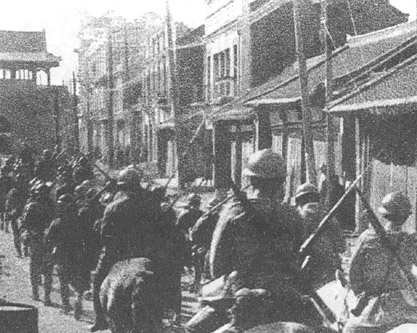
Japanese military staged an explosion near Mukden (Shenyang / 沈阳 / Shěnyáng) as pretext to invade Manchuria, establishing the puppet state Manchukuo (满洲国 / Mǎnzhōuguó) with Puyi as emperor. #war #politics
Japanese cavalry entering Mukden (Shenyang) By Unknown author - http://www.japanfocus.org/-Tomoko-AKAMI/3926, Public domain, https://commons.wikimedia.org/w/index.php?curid=678770
Oct 16, 1934 CE
Long March Begins (长征开始)
Red Army broke through Nationalist encirclement in Jiangxi (江西 / Jiāngxī), beginning the 9,000-kilometer strategic retreat; Mao Zedong rose to leadership during the journey to Yan'an (延安 / Yán'ān). #war #politics
The Long March in China, 1934-1935. By Chinese_civil_war_map_03.jpg: User:Guimard derivative work: Rowanwindwhistler (talk) - LaLargaMarcha19341935.svg by Rowanwindwhistler., CC BY-SA 3.0, https://commons.wikimedia.org/w/index.php?curid=45277819
Dec 12, 1936 CE
Xi'an Incident (西安事变)
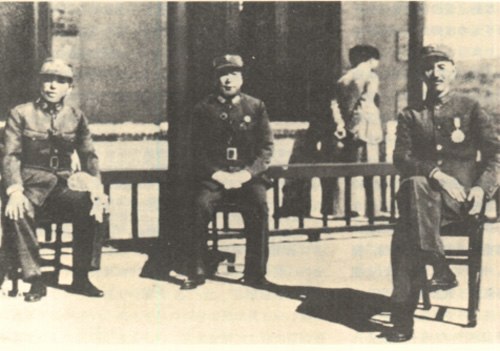
Zhang Xueliang detained Chiang Kai-shek in Xi'an (西安 / Xī'ān), forcing him to agree to a Second United Front against Japan; Zhang was subsequently imprisoned for decades. #politics #war
西安事變主角蔣介石(右)、張學良(左)及楊虎城(中)在事變發生前合影。 By Unknown author - [1], Public domain, https://commons.wikimedia.org/w/index.php?curid=67041363
Jul 7, 1937 CE
Marco Polo Bridge Incident (卢沟桥事变)
Clash at Lugou Bridge (卢沟桥 / Lúgōu Qiáo) near Beijing marked full-scale Japanese invasion; Second Sino-Japanese War (中国抗日战争 / Zhōngguó Kàng Rì Zhànzhēng) began, merging into World War II. #war #history
A Japanese reconnaissance photo of Marco Polo Bridge during the incident. Wanping is opposite side of the river. By Sweeper tamonten (talk) - From "Shina Jihen Kinen Shashincho"(memorial photograph collection on Sino-Japanese War for the period between July, 1937 and January, 1940 by photograph squad of military unit headquarters), Public domain, https://commons.wikimedia.org/w/index.php?curid=6953829
Dec 13, 1937 CE
Nanjing Massacre (南京大屠杀)
Japanese troops captured Nanjing and perpetrated mass atrocities against civilians and POWs, with death toll estimates ranging from hundreds of thousands; the city became the wartime capital. #war #crime
Bodies of victims along Qinhuai River out of Nanjing's west gate during Nanjing Massacre. By Originally Moriyasu Murase, 村瀬守保 - Derivative work of a photograph taken by Moriyasu Murase 村瀬守保写真集 私の従軍中国戦線,日本機関紙出版センター,1987年12月20日,46頁,写真139,ISBN 4-88900-218-9, Public domain, https://commons.wikimedia.org/w/index.php?curid=978955
Jun 9, 1938 CE
Yellow River Flood (花园口决堤)
Chiang Kai-shek's forces breached dikes at Huayuankou (花园口 / Huāyuánkǒu) to slow Japanese advance, causing catastrophic flooding that killed hundreds of thousands and displaced millions. #disaster #war
Map of the flooded area of the 1938 Yellow River flood By Stevenliuyi - Own work, CC BY-SA 4.0, https://commons.wikimedia.org/w/index.php?curid=59053473
Aug 20, 1940 CE
Hundred Regiments Offensive (百团大战)
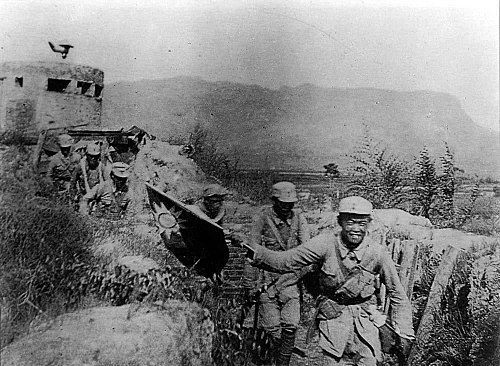
Communist forces under Peng Dehuai (彭德怀 / Péng Déhuái) launched major campaign against Japanese in North China, largest Communist operation of the war but exposed their strength to Nationalists. #war #politics
Transcribed from Xinhua's Military World. Capturing the scene of the capture of Niangzi Pass by the Eighth Route Army during the Second Sino-Japanese War. Taken in 1940. Originally published on Xin Zhonghua Bao, 1940. By The original uploader was Refrain at Chinese Wikipedia. - Transferred from zh.wikipedia to Commons., Public domain, https://commons.wikimedia.org/w/index.php?curid=2592012
Jan 6, 1941 CE
New Fourth Army Incident (皖南事变)
Nationalist forces ambushed Communist New Fourth Army (新四军 / Xīn Sì Jūn) in Anhui (安徽 / Ānhuī), shattering the Second United Front and intensifying civil war tensions during anti-Japanese resistance. #war #politics
转载因特网 時任新四军軍長的葉挺 By User Dice on zh.wikipedia - http://www.jlplib.com.cn/2/kz/2x/118.jpg, Public domain, https://commons.wikimedia.org/w/index.php?curid=966263
Feb 19, 1942 CE
Chinese Expeditionary Force (中国远征军)
China sent troops to Burma (缅甸 / Miǎndiàn) to fight alongside Allies, protecting the Burma Road supply line; General Sun Li-jen (孙立人 / Sūn Lìrén) distinguished himself at the Battle of Yenangyaung. #war #diplomacy
Elements of the Chinese Expeditionary Force (The X Force and the Y Force) converged in Mong-yu, Burma. By Unknown author - China.com.cn, Public domain, https://commons.wikimedia.org/w/index.php?curid=62270598
Nov 22, 1943 CE
Cairo Conference (开罗会议)
Chiang Kai-shek met Roosevelt and Churchill in Cairo, securing Allied commitment to return Manchuria, Taiwan, and the Pescadores to China after Japan's defeat. #diplomacy #politics )
Franklin D. Roosevelt, Chiang Kai-shek, and Winston Churchill at the Cairo Conference, 1943. By Roosevelt, Franklin D. (Franklin Delano), - This tag does not indicate the copyright status of the attached work. A normal copyright tag is still required. See Commons:Licensing., Public domain, https://commons.wikimedia.org/w/index.php?curid=59250
Aug 15, 1945 CE
Japan Surrenders (日本投降)
Emperor Hirohito announced Japan's unconditional surrender; China emerged as one of the Big Four Allied powers, but civil war between KMT and CCP resumed immediately. #war #politics
Japanese Foreign Minister Mamoru Shigemitsu signs the Instrument of Surrender on behalf of the Japanese Government, on board USS Missouri (BB-63), 2 September 1945. Lieutenant General Richard K. Sutherland, U.S. Army, watches from the opposite side of the table. Foreign Ministry representative Toshikazu Kase is assisting Mr. Shigemitsu. By Army Signal Corps photographer LT. Stephen E. Korpanty; restored by Adam Cuerden - Naval Historical Center Photo # SC 213700, Public domain, https://commons.wikimedia.org/w/index.php?curid=93758525
Oct 25, 1945 CE
Taiwan Retrocession (台湾光复)
Japan formally surrendered Taiwan (台湾 / Táiwān) to ROC representative Chen Yi (陈仪 / Chén Yí), ending fifty years of Japanese colonial rule; October 25 became Retrocession Day. #politics #history
1945年10月25日,臺北公會堂舉行「中國戰區臺灣省受降典禮」後,臺灣省警備總司令部全體官兵合影。左半邊掛中國國民黨黨旗,右半邊掛中華民國國旗。 By The original uploader was Howard61313 at Chinese Wikipedia. - [twtp.bokee.com/4995912.html];Transferred from zh.wikipedia to Commons by Pbdragonwang using CommonsHelper., Public domain, https://commons.wikimedia.org/w/index.php?curid=12085121
Jan 10, 1946 CE
Political Consultative Conference (政治协商会议)
KMT and CCP participated in multiparty talks in Chongqing (重庆 / Chóngqìng) to draft a constitution, but negotiations collapsed as both sides prepared for full-scale civil war. #politics #diplomacy
The Chinese People's Political Consultative Conference (CPPCC) logo By Chinese People's Political Consultative Conference - 中国人民政治协商会议会徽制作和使用规定, Public domain, https://commons.wikimedia.org/w/index.php?curid=116618174
Feb 28, 1947 CE
February 28 Incident (二二八事件)
Anti-government uprising in Taiwan against KMT corruption and repression was violently suppressed; thousands killed, creating lasting trauma in Taiwanese identity and politics. #politics #disaster
Taipei Branch of the Bureau of Monopoly, was occupied by angry crowd. By Unknown author - [1], Public domain, https://commons.wikimedia.org/w/index.php?curid=21836
Sep 12, 1948 CE
Liaoshen Campaign (辽沈战役)
Lin Biao (林彪 / Lín Biāo) commanded Communist forces to decisive victory in Manchuria, capturing Shenyang and destroying Nationalist armies; turning point of the civil war. #war #politics
The People's Liberation Army charging toward the city walls of Jinzhou under the cover of heavy artillery fire. By Unknown author - http://www.chinadaily.com.cn/china/2012cpc/2011-08/29/content_15842203_12.htm, Public domain, https://commons.wikimedia.org/w/index.php?curid=11665713
Jan 21, 1949 CE
Chiang Kai-shek Resigns (蒋介石下野)
Chiang Kai-shek resigned as president under military pressure, Li Zongren (李宗仁 / Lǐ Zōngrén) became acting president, but Chiang retained control of KMT and military from behind the scenes. #politics #history
Official portrait of Chiang Kai-shek in 1955 By Unknown photographer - https://www.president.gov.tw/Page/83https://ahonline.drnh.gov.tw/index.php?act=Display/image/1963743AxkcLp=#d7J, Attribution, https://commons.wikimedia.org/w/index.php?curid=58340928
Apr 23, 1949 CE
Nanjing Falls (南京解放)
Communist forces crossed the Yangtze and captured Nanjing, the Nationalist capital; People's Liberation Army (人民解放军 / Rénmín Jiěfàngjūn) continued southward advance. #war #politics
The People's Liberation Army on top of the Presidential Palace in Nanjing. By 邹健东 (Zou Jiandong) - Internet, Public domain, https://commons.wikimedia.org/w/index.php?curid=9763935
Oct 1, 1949 CE
PRC Proclaimed (中华人民共和国成立)
Mao Zedong proclaimed the People's Republic of China in Beijing's Tiananmen (天安门 / Tiān'ānmén); Chiang Kai-shek and Nationalist government retreated to Taiwan in December. #politics #history
Obtained the original monochromatic photograph of Mao Zedong, chairman of the Chinese Communist Party, proclaiming the People's Republic of China on 1 October, 1949 By Orihara1 - Own work, Public domain, https://commons.wikimedia.org/w/index.php?curid=36210407