Encyclopedia/1. The Cosmos & The Natural World/3. Astronomy & Planetary Science/01. Stellar Astrophysics • Curated by Admin Timeline.sg
Exoplanetary science · Astrobiology · Radio astronomy
Chronological Storyline (44 Milestones)
1300 BCE
Earliest recorded eclipse in oracle bones
Shang dynasty oracle-bone inscriptions from Anyang include the earliest documented records of solar eclipses, demonstrating systematic Chinese celestial observation by the late Bronze Age. Source — Wikipedia:
Oracle bone with Old Chinese inscription, attributed to the Lì (歷) diviner group 2 in oracle bone period II (kings Zu Geng and Zu Jia). By Unknown author - User Herr Klugbeisser on de.wikipedia Geschossen von im Shanghai-Museum, Januar 2004 Created and published under the GFDL by User Herr Klugbeisser Originally from de.wikipedia; description page is (was) here 18:41, 2. Mai 2004 Herr Klugbeisser 800 x 800 (91585 Byte) (Orakelknochen), CC BY-SA 3.0, https://commons.wikimedia.org/w/index.php?curid=38023
700 BCE
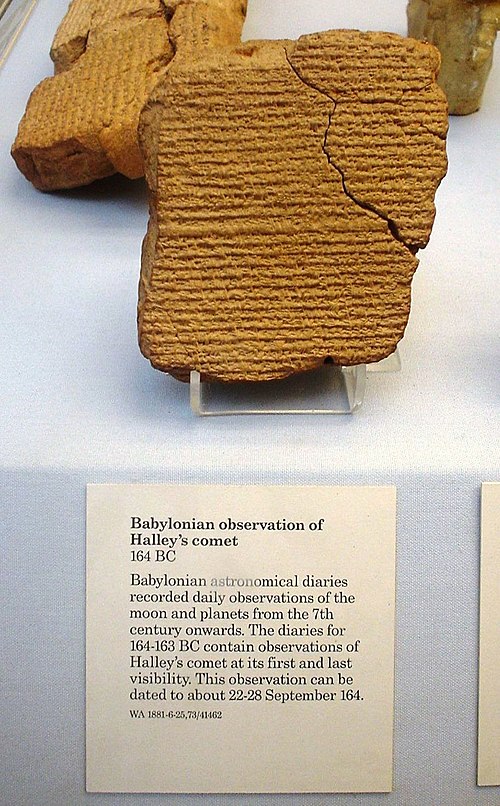
Babylonian astronomical diaries begun
Babylonian astronomers systematically recorded planetary positions, eclipses, and celestial omens on clay tablets, producing the Enuma Anu Enlil omen series and the earliest known ephemerides. Source — Wikipedia:
A Babylonian tablet recording Halley's comet during an appearance in 164 BC. At the British Museum in London By The original uploader was Linguica at English Wikipedia. - Transferred from en.wikipedia to Commons by Calliopejen1 using CommonsHelper., Public domain, https://commons.wikimedia.org/w/index.php?curid=17674029
350 BCE
Gan De and Shi Shen star catalogue
Chinese astronomers Gan De and Shi Shen produced the earliest known star catalogues, with Shi Shen observing approximately 138 stars and Gan De making detailed observations of Jupiter's moons. Source — Wikipedia:
280 BCE
Aristarchus proposes heliocentric model
Greek astronomer Aristarchus of Samos proposed that the Earth revolves around the Sun, the first known heliocentric model, and estimated the relative distances of the Sun and Moon. Source — Wikipedia:
150 BCE
Hipparchus discovers precession of equinoxes
Hipparchus of Nicaea compiled the first comprehensive star catalogue of the Western tradition and discovered the precession of the equinoxes by comparing his observations to earlier Babylonian and Greek records. Source — Wikipedia:
This engraving was made based on a carved amethyst depicting Hipparchus (CARC:1839-881) included among the Poniatowski gems, a collection of early 19th century forgeries passed off as antique engraved gems. It is described in Poniatowski's 1833 catalog (VIII.2.60, vol. 1, p. 105, vol. 2, p. 52): "... Dans le champ de cette pierre on voit une étoile et en beaux caractères le nom du sujet. Améthyste." [In the field of this stone we see a star and in beautiful characters the name of the subject. Amethyst.] The gem was sold at auction in 1839 (Christie's: A catalogue of the very celebrated collection of antique gems of the Prince Poniatowski ..., No. 881) and its whereabouts since are unknown, but in 1842 British naval officer William Henry Smyth sent a letter to the (American) National Institute for the Promotion of Science: Bulletin of the Proceedings of the National Institute for the Promotion of Science, 3 (1842), 1845, Stated Meeting, September 12, 1842, Letters and Communications, p. 258, "From W. H. Smyth, Chelsea, England, August 20, 1842: Acknowledging bulletin No. 2, and forwarding his privately printed catalogue of Roman brass medals; also, specimens of impressions of the head of Hipparchus, from the Poniatowski-gem, intended as a vignette illustration of his work." The engraving here was first used for the title page of Smyth's 1844 book: Smyth, William Henry (1844), A Cycle of Celestial Objects, vol. 2, John W. Parker, title page In 1965 this was the source for a Greek stamp celebrating Hipparchus. See: Wilson, Robin (1989). "Stamp corner". The Mathematical Intelligencer. 11 (1): 72. doi:10.1007/bf03023779 By William Henry Smyth - George F. Chambers, A Handbook of Descriptive and Practical Astronomy, Vol. 3 (4th ed.) https://archive.org/details/handbookofdescri0003geor/page/n10/mode/1up, Public domain, https://commons.wikimedia.org/w/index.php?curid=134619278
150 CE
Ptolemy publishes the Almagest
Claudius Ptolemy of Alexandria published the Almagest, a comprehensive geocentric model of the cosmos with epicycles and deferents that dominated Western and Islamic astronomy for over 1,400 years. Source — Wikipedia:
Almagest, a great and noble work containing all the motions of the heavens. May it go into the light under auspicious stars. By Ptolemy - http://www.univie.ac.at/hwastro/rare/1515_ptolemae.htm, Public domain, https://commons.wikimedia.org/w/index.php?curid=29985717
499 CE
Aryabhata proposes rotating Earth
Indian mathematician-astronomer Aryabhata, in his Aryabhatiya, proposed that the Earth rotates on its axis and calculated the length of the sidereal year with remarkable accuracy. Source — Wikipedia:
Aryabhatta. By Cpjha13 - Own work, CC BY-SA 4.0, https://commons.wikimedia.org/w/index.php?curid=49883192
628 CE
Brahmagupta's Brahmasphutasiddhanta
Indian astronomer Brahmagupta composed the Brahmasphutasiddhanta, a foundational astronomical and mathematical treatise that later influenced Islamic astronomy through its translation into Arabic. Source — Wikipedia:
773 CE
Surya Siddhanta transmitted to Baghdad
The Indian astronomical treatise Surya Siddhanta was brought to Baghdad and translated into Arabic by Muhammad al-Fazari, introducing Indian trigonometric methods to Islamic astronomy. Source — Wikipedia:
A photo of the first verse of the first page of the Indian astronomy Sanskrit text. The edition was published in 1847. The same manuscript, and this specific verse, can be verified in Fitz Edward Hall's publication titled The Surya Siddhanta: An Ancient System of Hindu Astronomy publication in 1859. The verse is a homage to a Hindu god, a typical way early medieval era Hindu texts start. By Ms Sarah Welch - Own work, CC BY-SA 4.0, https://commons.wikimedia.org/w/index.php?curid=61517984
850 CE
al-Battani refines Ptolemy's parameters
Arab astronomer al-Battani (Albatenius) made highly accurate observations of solar and lunar eclipses and refined Ptolemy's measurements of the obliquity of the ecliptic and the length of the year. Source — Wikipedia:
Latin 7266; folio 78r (BnF) By unknown, copied from a work by Al-Battani - https://gallica.bnf.fr/ark:/12148/btv1b52505729k/f161.item.zoom# - a Latin translation of al-Battani's work Kitāb az-Zīj aṣ-Ṣābi’, CC BY-SA 4.0, https://commons.wikimedia.org/w/index.php?curid=128222946
964 CE
al-Sufi's Book of Fixed Stars
Persian astronomer Abd al-Rahman al-Sufi published the Book of Fixed Stars, which included the earliest known recorded observation of the Andromeda Galaxy and detailed stellar magnitudes. Source — Wikipedia:
al-Sufi depicted in Albrecht Dürer's 'The Northern Celestial Hemisphere' By Albrecht Dürer - File:Albrecht_Dürer,_The_Northern_Celestial_Hemisphere,_1515,_NGA_43181.jpg, CC BY-SA 4.0, https://commons.wikimedia.org/w/index.php?curid=131171930
Jul 4, 1054 CE
Chinese record the Crab supernova
Chinese astronomers recorded a guest star (supernova) in the constellation Taurus, visible in daylight for 23 days; its remnant is the Crab Nebula, a key object in modern astrophysics. Source — Wikipedia:
This is a mosaic image, one of the largest ever taken by NASA's Hubble Space Telescope, of the Crab Nebula, a six-light-year-wide expanding remnant of a star's supernova explosion. Japanese and Chinese astronomers recorded this violent event in 1054 CE. The orange filaments are the tattered remains of the star and consist mostly of hydrogen. The rapidly spinning neutron star embedded in the center of the nebula is the dynamo powering the nebula's eerie interior bluish glow. The blue light comes from electrons whirling at nearly the speed of light around magnetic field lines from the neutron star. The neutron star, like a lighthouse, ejects twin beams of radiation that appear to pulse 30 times a second due to the neutron star's rotation. A neutron star is the crushed ultra-dense core of the exploded star. The Crab Nebula derived its name from its appearance in a drawing made by Irish astronomer Lord Rosse in 1844, using a 36-inch telescope. When viewed by Hubble, as well as by large ground-based telescopes such as the European Southern Observatory's Very Large Telescope, the Crab Nebula takes on a more detailed appearance that yields clues into the spectacular demise of a star, 6,500 light-years away. The newly composed image was assembled from 24 individual Wide Field and Planetary Camera 2 exposures taken in October 1999, January 2000, and December 2000. The colors in the image indicate the different elements that were expelled during the explosion. Blue in the filaments in the outer part of the nebula represents neutral oxygen, green is singly-ionized sulfur, and red indicates doubly-ionized oxygen. By NASA, ESA, J. Hester and A. Loll (Arizona State University) - HubbleSite: gallery, release., Public domain, https://commons.wikimedia.org/w/index.php?curid=516106
1100 CE
Maya Dresden Codex Venus tables
The Dresden Codex, a surviving Maya astronomical almanac, contains highly accurate Venus ephemeris tables predicting heliacal risings of Venus over a 104-year cycle. Source — Wikipedia:
Six sheets of the Dresden Codex (pp. 55-59, 74) depicting eclipses, multiplication tables and the flood By Unknown author - SLUB Poster, Public domain, https://commons.wikimedia.org/w/index.php?curid=18620682
1259 CE
Maragheh observatory founded
Nasir al-Din al-Tusi established the Maragheh observatory in northwestern Iran, where the Tusi couple — a planetary model replacing the equant — was developed, later influencing Copernican astronomy. Source — Wikipedia:
The rest of Maragheh observatory By ایوب فارابی اصل - https://web.archive.org/web/20161021102250/http://www.panoramio.com/photo/58601653, CC BY-SA 3.0, https://commons.wikimedia.org/w/index.php?curid=16644829
1276 CE
Guo Shoujing's Shoushi calendar
Chinese astronomer Guo Shoujing directed the construction of giant astronomical instruments at Dengfeng and computed the Shoushi calendar, whose year-length matched the modern Gregorian value to within 26 seconds. Source — Wikipedia:
en:Guo Shoujing, a Chinese astronomer, engineer, and mathematician born in Xingtai, Hebei and living during the Yuan Dynasty By Shizhao - 雕像作者:王一林,1998年10月, CC BY 2.5, https://commons.wikimedia.org/w/index.php?curid=998546
1420 CE
Ulugh Beg's Samarkand observatory
Timurid astronomer Ulugh Beg built the Samarkand observatory and compiled the Zij-i-Sultani star catalogue, whose stellar positions remained the most accurate available for over a century. Source — Wikipedia:
Ulugh Beg Observatory, Samarkand, Uzbekistan By Bgag - Own work, CC0, https://commons.wikimedia.org/w/index.php?curid=142098469
1543 CE
Copernicus publishes De revolutionibus
Nicolaus Copernicus published De revolutionibus orbium coelestium, proposing a heliocentric model of the solar system that displaced the Earth from the center of the cosmos and launched the Copernican Revolution. Source — Wikipedia:
Cropped version of title page By derivative work of Johannes Petreius 1543 edition of File:Nicolai_Copernici_torinensis_De_revolutionibus_orbium_coelestium.djvu - File:Nicolai_Copernici_torinensis_De_revolutionibus_orbium_coelestium.djvu, Public domain, https://commons.wikimedia.org/w/index.php?curid=5611684
1609 CE
Galileo turns telescope to the sky
Galileo Galilei became the first to use a telescope for systematic astronomical observation, discovering Jupiter's four largest moons, lunar craters, and the phases of Venus, confirming Copernican predictions. Source — Wikipedia:
Galileo Galilei (1564-1642) A half-length portrait, in old age, of the Italian mathematician, philosopher and astronomer, who was appointed court mathematician to the Medici dukes of Tuscany at Florence in 1610. He is dressed in black, wears a white beard and is seated in a chair holding a telescope in his right hand. His left hand rests on the arm of the chair and he wears a ring with a clear stone on his fourth finger. He faces forward towards the viewer. Galileo, though not first inventor of the refracting telescope in 1609, enhanced its power, which enabled him to see that the Moon had mountains and that Jupiter had satellites. His championship of the Copernican (Sun-centred) planetary system brought him into serious conflict with the Roman Catholic church, which forced him to make a public recantation and put him under restriction in later life, as noted by the poet John Milton, who met him in Florence in 1638 and recorded in his 'Areopagitica': 'There it was I found the famous Galileo, grown old, a prisoner to the Inquisition for thinking in astronomy otherwise than the Franciscan and Dominican licensers thought.' The artist was a Flemish painter and draughtsman who worked in Florence as court painter to the Medici. He was considered the foremost portrait painter in Italy, with a strong interest in Venetian Renaissance art. This is one of the last portraits of Galileo and several versions and/or copies were made. This one, painted for the Florentine Pandolfini family, may be the original, though there are other contenders. The principal evidence is the inscription on the back of the original canvas: 'No 51. / Galileo / da Giusto Sustermans / della Casa Pandolfini / a Firenza', while an old English label on the stretcher adds that it is 'the best known' portrait and 'That in the Pitti Palace is without hands and has all the appearances of a copy'. The longstanding Pitti version (no. 2397), which is otherwise the best known and often assumed to be the original is cut down all round, just showing the rim of the telescope at the bottom. NMM inspection in 1971 also concluded it was more likely to be a copy. The present painting has a near-intact provenance since 1833. It was purchased in Florence on 26 April that year for 534 pauli (£12 10s) including its fine Florentine frame, from the Marchesa Nimini: its previous history is not known, or whether the Marchesa had a family connection with the Pandolfini. The buyer was a long-resident English collector, the Revd John Sanford (d. 1855). He returned with his large collection to England in 1837 and subsequently put much on the market. The Galileo appears as no.51 (as added above the Italian inscription) in an 1838 printed catalogue of Yates, the dealer, with a reserve of £200 but it did not sell. It was exhibited at the British Institution in 1849 and passed with Sanford's remaining collection to his only daughter, who in 1844 married Frederick Methuen (later second Lord Methuen) of Corsham Court, Wiltshire, the whole becoming part of the larger Methuen collection. It was sold from Corsham at Christie's on 14 May 1920 (lot 38, for 58 guineas), the buyer being the 'Art Collections Association' and probably quickly passed to George H. Gabb, though exactly how is unknown. His collection - mainly of scientific instruments - was purchased and presented to the Museum by Sir James Caird early in 1937. At another Christie’s sale in 1920 he also purchased directly, again for 58 guineas, a pear-wood bust of Galileo from the Sanford holdings at Corsham (SCU0023) and was the immediate source of both the Museum’s other two Galileo oil portraits (BHC2699 and BHC2701), and another bust of him in bronze (SCU0022). The good 19th-century catalogues of the Sanford and Methuen collections are still at Corsham and the Sustermans is no 18. in Sanford’s manuscript catalogue raisonnee of 1847. Like much of his collection it was also recorded in a watercolour copy, also still at Corsham, made in Florence about 1835 by Giovanni Gozzini. The oil features in all three printed catalogues of the Methuen collection (c.1876-1903) and hung near the bust in the lower corridor at Corsham for over 45 years preceding its sale. Waagen, who also saw it in the house, briefly described the Sanford collection origins and noted the painting as 'From the Pandolfini family, for whom it was painted. Of lively conception and broad treatment'. ('Galleries and Cabinets of Art in Great Britain', 1857, p. 397). A more complete account is Benedict Nicolson’s well-illustrated 'The Sanford Collection', in the ‘Burlington Magazine’ (vol. 97, no. 628, July 1955, pp. 207-14), though neither he nor Corsham then knew where the painting was and the image included is from the Gozzini watercolour. NMM notes made in Florence in 1971 mention the Pitti having recently acquired another version of BHC2700 from the Rosselli del Turco collection (only then seen as a photograph in the German Art Institute there), but no further mention of this has been found and it may be a misunderstanding: a third was also noted as existing in Frankfurt. A fourth (exhibited at the B.I. in 1854) was in the Lansdowne sale at Christie's on 7 March 1930 and may be the same as that recorded on the RKD database as again passing through Christie's on 7 May 1995 though, curiously, also from the 'Marquis of Lansdowne, Meikleour House'. The last appears to be early and good, with a fragmentary Latin inscription. Nicholson in 1955 also noted one in the Torre al Gallo, Florence, but the present status and relationship of all these is not yet known to the Museum. The Bodleian Library, Oxford, also has an early copy (omitting the left hand) presented by Galileo's disciple, Vincenzo Viviani, in 1661. Confusion is not helped by the fact that two separate Sustermans portraits of Galileo are sometimes treated as versions of each other, whereas they are somewhat different. The earlier one of 1636, in the Uffizi and of which BHC2701 is a copy, is more dynamic in pose, and probably shows him standing, compared to this later seated ‘Pandofini’ one. For the most modern Italian commentary see Federico Tognoni in 'Iconografia Galileiana' (Le Opere di Galileo Galilei': Appendice, vol 1, Florence, 2013) in which it is item D22, pp.70-71, as by 'Justus Suttermans(?)'. Galileo Galilei, 1564-1642 By Justus Sustermans - http://collections.rmg.co.uk/collections/objects/14174, Public domain, https://commons.wikimedia.org/w/index.php?curid=62614082Galileo: 400 Years of the Telescope
1687 CE
Newton's Principia unifies celestial mechanics
Isaac Newton published Philosophiæ Naturalis Principia Mathematica, deriving Kepler's laws of planetary motion from universal gravitation and establishing the mathematical foundation of celestial mechanics. Source — Wikipedia:
Title page of the 1687 first edition of Philosophiae Naturalis Principia Mathematica, by Isaac Newton. PHILOSOPHIÆ NATURALIS PRINCIPIA MATHEMATICA. Autore IS. NEWTON, Trin. Coll. Cantab. Soc. Matheseos Professore Lucasiano, & Societatis Regalis Sodali. IMPRIMATUR. S. PEPYS, Reg. Soc. PRÆSES. Julii 5. 1686. LONDINI, Jussu Societatis Regiæ ac Typis Josephi Streater. Prostat apud plures Bibliopolas. Anno MDCLXXXVII. By The original uploader was Zhaladshar at English Wikisource. - Transferred from en.wikisource to Commons. (previous image from another copy) Internet Archive (current image from the Bern Dibner copy), Public domain, https://commons.wikimedia.org/w/index.php?curid=2681838
Mar 13, 1781 CE
Herschel discovers Uranus
William Herschel discovered the planet Uranus, the first planet found since antiquity, doubling the known size of the solar system and demonstrating that the heavens were not fully catalogued. Source — Wikipedia:
Herschel discovers Uranus By Lemuel Francis Abbott - one or more third parties have made copyright claims against Wikimedia Commons in relation to the work from which this is sourced or a purely mechanical reproduction thereof. This may be due to recognition of the "sweat of the brow" doctrine, allowing works to be eligible for protection through skill and labour, and not purely by originality as is the case in the United States (where this website is hosted). These claims may or may not be valid in all jurisdictions. As such, use of this image in the jurisdiction of the claimant or other countries may be regarded as copyright infringement. Please see Commons:When to use the PD-Art tag for more information., Public domain, https://commons.wikimedia.org/w/index.php?curid=224367
Sep 23, 1846 CE
Neptune discovered by mathematical prediction
Johann Galle, using predictions by Urbain Le Verrier, discovered Neptune, confirming the power of Newtonian gravitational theory to detect unseen planets through their perturbations. Source — Wikipedia:
Neptune discovered by mathematical prediction By Carl Daniel Freydanck - Leibniz-Institut für Astrophysik Potsdam, Public domain, https://commons.wikimedia.org/w/index.php?curid=928222
1912 CE
Henrietta Leavitt's period-luminosity relation
Henrietta Swan Leavitt discovered the period-luminosity relation for Cepheid variable stars, providing the first reliable standard candle for measuring extragalactic distances and enabling the discovery of the universe's expansion. Source — Wikipedia:
Henrietta Swan Leavitt, age 30 (July 4, 1868 – December 12, 1921) By Unknown author - From here, see also [1]. https://lccn.loc.gov/05025712 Popular Astronomy, v. 30, no. 4, April 1922. https://blogs.loc.gov/inside_adams/2019/12/henriettaleavitt/, Public domain, https://commons.wikimedia.org/w/index.php?curid=1491349
1929 CE
Hubble discovers expansion of the universe
Edwin Hubble demonstrated that galaxies are receding from the Milky Way at velocities proportional to their distances, establishing that the universe is expanding and laying the foundation for Big Bang cosmology. Source — Wikipedia:
raisin bread model of the universe By w:en:User:ScienceApologist - This image was copied from wikipedia:en. The original description was: The raisin bread model of the universe explains how each galaxy can perceive every other galaxy in the universe as receding from it. From the WMAP website., Public domain, https://commons.wikimedia.org/w/index.php?curid=2615116Edwin Hubble, the Expanding Universe, Hubble's Law. Astronomers of the 20th Century.
1933 CE
Jansky detects cosmic radio waves
Karl Jansky of Bell Labs detected radio emission from the Milky Way, founding the field of radio astronomy and opening an entirely new spectral window on the universe beyond visible light. Source — Wikipedia:
Karl Guthe Jansky By NRAO/AUI/NSF - https://public.nrao.edu/gallery/karl-guthe-jansky/, CC BY 4.0, https://commons.wikimedia.org/w/index.php?curid=169680767
1958 CE
NASA established for space exploration
The United States established the National Aeronautics and Space Administration (NASA), which would become the leading agency for space-based astronomical observatories and planetary exploration. Source — Wikipedia:
This is the official NASA seal, originally designed in 1958 by illustrators at the NASA Lewis (now Glenn) Research Center and put forward by James Modarelli, the head of NASA Lewis' Research Reports Division. The seal was officially adopted by executive order in November 1959. The yellow and white spheres represent a planet and an orbiting body; the blue starfield represents space; the red chevron represents aeronautics (based on an advanced supersonic wing model being tested at Langley); and the white orbital curve emerging from the yellow planet represents space travel. An overview of the development of the design, along with references to more detailed and precise sources, can be found in Chapter 6 of Emblems of Exploration. By The original uploader was Vargklo at English Wikipedia. - Great Images in NASA Description Source: NASA Official website, [1], page 65 and [2]. Transferred from en.wikipedia to Commons by NativeForeigner using CommonsHelper., Public domain, https://commons.wikimedia.org/w/index.php?curid=9571669
1963 CE
Maarten Schmidt identifies first quasar
Maarten Schmidt at Palomar Observatory determined that the radio source 3C 273 was an extremely distant, highly luminous object — the first identified quasar — revealing a new class of active galactic nuclei. Source — Wikipedia:
This artist’s impression shows how ULAS J1120+0641, a very distant quasar powered by a black hole with a mass two billion times that of the Sun, may have looked. This quasar is the most distant yet found and is seen as it was just 770 million years after the Big Bang. This object is by far the brightest object yet discovered in the early Universe. By ESO/M. Kornmesser - http://www.eso.org/public/images/eso1122a/, CC BY 4.0, https://commons.wikimedia.org/w/index.php?curid=15700804
1967 CE
Bell Burnell discovers pulsars
Jocelyn Bell Burnell and Antony Hewish discovered the first pulsar, a rapidly rotating neutron star emitting periodic radio pulses, confirming the existence of super-dense stellar remnants predicted by theory. Source — Wikipedia:
Jocelyn Bell Burnell By Launch_of_IYA_2009,_Paris_-_Grygar,_Bell_Burnell.jpg: Astronomical Institute, Academy of Sciences of the Czech Republic derivative work: Anrie (talk) - Launch_of_IYA_2009,_Paris_-_Grygar,_Bell_Burnell.jpg, CC BY-SA 3.0, https://commons.wikimedia.org/w/index.php?curid=9988968
Jul 20, 1969 CE
Apollo 11 lunar samples collected
The Apollo 11 mission returned the first geological samples from another world, enabling direct laboratory analysis of lunar composition and the dating of the Moon's formation. Source — Wikipedia:
Apollo 11 Hasselblad image from film magazine 40/S - EVA. The image of astronaut Neil Armstrong photographing astronaut Aldrin is clearly seen in the reflections on the helmet visor of astronaut Aldrin. Astronaut Armstrong, the Lunar Module Eagle, and the shadow cast by Aldrin are mirrored in the reflection. Astronaut Aldrin showing boots and suit discoloration caused by adhering lunar soil. By Neil A. Armstrong - https://tothemoon.im-ldi.com/gallery/Apollo/11/7#AS11-40-5903, Public domain, https://commons.wikimedia.org/w/index.php?curid=170640780Restored Apollo 11 Moonwalk - Original NASA EVA Mission Video - Walking on the Moon
Aug 15, 1977 CE
Big Ear detects Wow! signal
The Ohio State Big Ear radio telescope detected a 72-second narrowband radio signal from the direction of Sagittarius so anomalous that Jerry Ehman wrote 'Wow!' on the printout; it remains the strongest candidate for an extraterrestrial signal. Source — Wikipedia:
A scan of a color copy of the original computer printout, taken several years after the 1977 arrival of the Wow! signal. By Credit: Big Ear Radio Observatory and North American AstroPhysical Observatory (NAAPO). - http://www.bigear.org/Wow30th/wow30th.htm, Public domain, https://commons.wikimedia.org/w/index.php?curid=4568335
1980 CE
Alvarez hypothesis: impact extinction theory
Luis and Walter Alvarez and colleagues published the hypothesis that a massive asteroid impact caused the Cretaceous-Paleogene mass extinction, linking planetary science to the history of life on Earth and founding modern impact paleontology. Source — Wikipedia:
Luis Walter Alvarez (left) and his son Walter Alvarez (right) at the K-T Boundary in Bottaccione Gorge, near Gubbio, Italy By U S Government - Lawrence Berkeley Laboratory, Public domain, https://commons.wikimedia.org/w/index.php?curid=64226981
Apr 24, 1990 CE
Hubble Space Telescope launched
NASA and ESA launched the Hubble Space Telescope into low Earth orbit, providing unprecedented ultraviolet, visible, and near-infrared imaging that transformed nearly every field of astronomy. Source — Wikipedia:
en:Hubble Space Telescope as seen from the en:Space Shuttle Columbia on mission en:STS-109. By NASA - http://spaceflight.nasa.gov/gallery/images/shuttle/sts-109/hires/s109e5700.jpg http://spaceflight.nasa.gov/gallery/images/shuttle/sts-109/html/sts109-730-027.html Originally from en.wikipedia; description page is/was here., Public domain, https://commons.wikimedia.org/w/index.php?curid=2069334
Jan 9, 1992 CE
First confirmed exoplanets around a pulsar
Aleksander Wolszczan and Dale Frail announced the discovery of two planets orbiting the pulsar PSR B1257+12, the first confirmed exoplanets, detected via precise radio timing of the pulsar's pulses. Source — Wikipedia:
Oct 6, 1995 CE
First exoplanet around a Sun-like star
Michel Mayor and Didier Queloz discovered 51 Pegasi b, the first exoplanet found orbiting a main-sequence star similar to the Sun, launching the modern era of exoplanetary science and earning them the 2019 Nobel Prize in Physics. Source — Wikipedia:
This artist’s view shows the hot Jupiter exoplanet 51 Pegasi b, sometimes referred to as Bellerophon, which orbits a star about 50 light-years from Earth in the northern constellation of Pegasus (The Winged Horse). This was the first exoplanet around a normal star to be found in 1995. Twenty years later this object was also the first exoplanet to be be directly detected spectroscopically in visible light. By ESO/M. Kornmesser/Nick Risinger (skysurvey.org) - ESO website, CC BY 4.0, https://commons.wikimedia.org/w/index.php?curid=39719418
Aug 7, 1996 CE
ALH 84001 meteorite announcement
A NASA-led team reported possible evidence of ancient Martian life in the ALH 84001 meteorite, sparking intense debate and revitalising the field of astrobiology as a formal scientific discipline. Source — Wikipedia:
Fotografía del ALH84001 By NASA - NASA - JSC: http://www-curator.jsc.nasa.gov/curator/antmet/marsmets/posslife.htm (https://web.archive.org/web/20051207152354/http://www-curator.jsc.nasa.gov/curator/antmet/marsmets/posslife.htm mement in web archive 2005-12-07) http://www-curator.jsc.nasa.gov/curator/antmet/marsmets/alh84001/photos.htm http://www-curator.jsc.nasa.gov/curator/antmet/marsmets/alh84001/ALH84001,0.htm, Public domain, https://commons.wikimedia.org/w/index.php?curid=229230
1998 CE
Dark energy and accelerating expansion discovered
The High-Z Supernova Search Team and the Supernova Cosmology Project independently discovered that the expansion of the universe is accelerating, implying the existence of dark energy and earning the 2011 Nobel Prize in Physics. Source — Wikipedia:
CMB Images IMAGES > CMB IMAGES > NINE YEAR MICROWAVE SKY http://map.gsfc.nasa.gov/media/121238/index.html Nine Year Microwave Sky The detailed, all-sky picture of the infant universe created from nine years of WMAP data. The image reveals 13.77 billion year old temperature fluctuations (shown as color differences) that correspond to the seeds that grew to become the galaxies. The signal from our galaxy was subtracted using the multi-frequency data. This image shows a temperature range of ± 200 microKelvin. Credit: NASA / WMAP Science Team WMAP # 121238 Image Caption 9 year WMAP image of background cosmic radiation (2012) By NASA / WMAP Science Team - http://map.gsfc.nasa.gov/media/121238/ilc_9yr_moll4096.png, Public domain, https://commons.wikimedia.org/w/index.php?curid=23285693
2003 CE
WMAP maps the cosmic microwave background
NASA's Wilkinson Microwave Anisotropy Probe produced the first detailed full-sky map of the cosmic microwave background anisotropy, precisely determining the age, geometry, and composition of the universe. Source — Wikipedia:
NASA-created illustration of the Wilkinson Microwave Anisotropy Probe spacecraft By NASA / WMAP Science Team - [1]; converted from the high-resolution TIFF version to a JPEG, Public domain, https://commons.wikimedia.org/w/index.php?curid=3944989
Mar 6, 2009 CE
Kepler mission launched to find Earths
NASA launched the Kepler space telescope, designed to detect Earth-sized exoplanets in the habitable zones of Sun-like stars via the transit method, ultimately discovering over 2,700 confirmed exoplanets. Source — Wikipedia:
Illustration of the Kepler Space Telescope on a transparent background. By NASA - https://science.nasa.gov/toolkits/spacecraft-icons (image link), Public domain, https://commons.wikimedia.org/w/index.php?curid=76268556
Aug 6, 2012 CE
Curiosity rover lands on Mars
NASA's Curiosity rover landed in Gale Crater to assess Martian habitability, detecting ancient lake deposits and complex organic molecules — key data for astrobiology and the search for past life on Mars. Source — Wikipedia: )
This self-portrait of NASA's Curiosity Mars rover shows the vehicle at the "Big Sky" site, where its drill collected the mission's fifth taste of Mount Sharp. The scene combines dozens of images taken during the 1,126th Martian day, or sol, of Curiosity's work during Mars (Oct. 6, 2015, PDT), by the Mars Hand Lens Imager (MAHLI) camera at the end of the rover's robotic arm. The rock drilled at this site is sandstone in the Stimson geological unit inside Gale Crater. The view is centered toward the west-northwest. It does not include the rover's robotic arm, though the shadow of the arm is visible on the ground. Wrist motions and turret rotations on the arm allowed MAHLI to acquire the mosaic's component images. The arm was positioned out of the shot in the images, or portions of images, that were used in this mosaic. This portrait of the rover was designed to show the Chemistry and Camera (ChemCam) instrument atop the rover appearing level. This causes the horizon to appear to tilt toward the left, but in reality, it appears fairly flat. For scale, the rover's wheels are 20 inches (50 centimeters) in diameter and about 16 inches (40 centimeters) wide. The drilled hole in the rock, appearing grey near the lower left corner of the image (image cropped, see original source), is 0.63 inch (1.6 centimeters) in diameter. By NASA - http://photojournal.jpl.nasa.gov/catalog/PIA19920, Public domain, https://commons.wikimedia.org/w/index.php?curid=44827064
Feb 11, 2016 CE
LIGO announces first gravitational wave detection
The LIGO and Virgo collaborations announced the first direct detection of gravitational waves from a binary black hole merger, opening the new field of gravitational-wave astronomy and earning the 2017 Nobel Prize in Physics. Source — Wikipedia:
First observation of gravitational waves by LIGO (signal GW150914). Shows the gravitational wave signals received by the LIGO instruments at Hanford, Washington (left) and Livingston, Louisiana (right) and comparisons of these signals to the signals expected due to a black hole merger event. By B. P. Abbott et al. (LIGO Scientific Collaboration and Virgo Collaboration) — full list at the end of the article - http://physics.aps.org/featured-article-pdf/10.1103/PhysRevLett.116.061102 . See also the associated Jupyter notebook., CC BY 3.0, https://commons.wikimedia.org/w/index.php?curid=46987868[LIVE] FIRST Gravitational Waves Detected | LIGO (Laser Interferometer Gravitational Observatory)
Sep 25, 2016 CE
China's FAST telescope begins operations
China's Five-hundred-meter Aperture Spherical Telescope (FAST), the world's largest filled-aperture radio telescope, began operations in Guizhou Province, dramatically expanding the search for pulsars and fast radio bursts. Source — Wikipedia:
500m Aperture Spherical Radio Telescope located in Guizhou Province, China By SCJiang - Own work, CC BY-SA 4.0, https://commons.wikimedia.org/w/index.php?curid=172271062
Oct 16, 2017 CE
Multi-messenger astronomy: neutron star merger
The LIGO-Virgo collaboration and dozens of electromagnetic observatories detected both gravitational waves and light from a binary neutron star merger, enabling the first direct confirmation that such mergers produce heavy elements via r-process nucleosynthesis. Source — Wikipedia:
Time-frequency representations of data containing the gravitational-wave event GW170817, observed by the LIGO-Hanford (top), LIGO-Livingston (middle), and Virgo (bottom) detectors. Times are shown relative to August 17, 2017 12∶41:04 UTC. The amplitude scale in each detector is normalized to that detector’s noise amplitude spectral density. In the LIGO data, independently observable noise sources and a glitch that occurred in the LIGO-Livingston detector have been subtracted, as described in the text. According to the authors, the signal is not visible in the Virgo data due to the detector's lower binary neutron star (BNS) horizon and due to the detector's orientation relative to the source. By LIGO Scientific Collaboration and Virgo Collaboration - https://journals.aps.org/prl/abstract/10.1103/PhysRevLett.119.161101 This W3C-unspecified plot was created with Matplotlib., CC BY-SA 4.0, https://commons.wikimedia.org/w/index.php?curid=63455773
Apr 10, 2019 CE
Event Horizon Telescope images a black hole
The Event Horizon Telescope collaboration released the first direct image of a black hole — the supermassive object at the center of galaxy M87 — achieved via very-long-baseline interferometry linking radio telescopes worldwide. Source — Wikipedia:
Event Horizon Telescope takes first-ever image of a black hole
Dec 25, 2021 CE
James Webb Space Telescope launched
NASA, ESA, and CSA launched the James Webb Space Telescope, the largest space telescope ever built, designed for infrared observations of the first galaxies, star formation, and exoplanet atmospheres. Source — Wikipedia:
The James Webb Space Telescope (sometimes called JWST or Webb) is an orbiting infrared observatory that complements and extends the discoveries of the Hubble Space Telescope, with longer wavelength coverage and greatly improved sensitivity. The longer wavelengths enable Webb to look much closer to the beginning of time and to hunt for the unobserved formation of the first galaxies, as well as to look inside dust clouds where stars and planetary systems are forming today. By NASA - https://www.jwst.nasa.gov/content/webbLaunch/whereIsWebb.html, Public domain, https://commons.wikimedia.org/w/index.php?curid=114125719
2023 CE
JWST detects exoplanet atmospheric molecules
JWST observations detected carbon-bearing molecules including methane and CO2 in the atmosphere of the sub-Neptune exoplanet K2-18b, and reported a possible detection of dimethyl sulfide, a potential biosignature, advancing astrobiological investigations of habitable-zone worlds. Source — Wikipedia:
This illustration shows what exoplanet K2-18 b could look like based on science data. K2-18 b, an exoplanet 8.6 times as massive as Earth, orbits the cool dwarf star K2-18 in the habitable zone and lies 120 light years from Earth. A new investigation with NASA’s James Webb Space Telescope into K2-18 b, an exoplanet 8.6 times as massive as Earth, has revealed the presence of carbon-bearing molecules including methane and carbon dioxide. The abundance of methane and carbon dioxide, and shortage of ammonia, support the hypothesis that there may be a water ocean underneath a hydrogen-rich atmosphere in K2-18 b. In this illustration, the exoplanet K2-18 c is shown between K2-18 b and its star. By Illustration: NASA, ESA, CSA, Joseph Olmsted (STScI) Science: Nikku Madhusudhan (IoA) - https://webbtelescope.org/contents/media/images/2023/139/01H9R88HG8YXRMARWZ5B1YDT27, Public domain, https://commons.wikimedia.org/w/index.php?curid=137418814

![This engraving was made based on a carved amethyst depicting Hipparchus (CARC:1839-881) included among the Poniatowski gems, a collection of early 19th century forgeries passed off as antique engraved gems. It is described in Poniatowski's 1833 catalog (VIII.2.60, vol. 1, p. 105, vol. 2, p. 52): "... Dans le champ de cette pierre on voit une étoile et en beaux caractères le nom du sujet. Améthyste." [In the field of this stone we see a star and in beautiful characters the name of the subject. Amethyst.] The gem was sold at auction in 1839 (Christie's: A catalogue of the very celebrated collection of antique gems of the Prince Poniatowski ..., No. 881) and its whereabouts since are unknown, but in 1842 British naval officer William Henry Smyth sent a letter to the (American) National Institute for the Promotion of Science: Bulletin of the Proceedings of the National Institute for the Promotion of Science, 3 (1842), 1845, Stated Meeting, September 12, 1842, Letters and Communications, p. 258, "From W. H. Smyth, Chelsea, England, August 20, 1842: Acknowledging bulletin No. 2, and forwarding his privately printed catalogue of Roman brass medals; also, specimens of impressions of the head of Hipparchus, from the Poniatowski-gem, intended as a vignette illustration of his work." The engraving here was first used for the title page of Smyth's 1844 book: Smyth, William Henry (1844), A Cycle of Celestial Objects, vol. 2, John W. Parker, title page In 1965 this was the source for a Greek stamp celebrating Hipparchus. See: Wilson, Robin (1989). "Stamp corner". The Mathematical Intelligencer. 11 (1): 72. doi:10.1007/bf03023779](https://upload.wikimedia.org/wikipedia/commons/c/c6/Head_of_Hipparchus_%28cropped%29.jpg)


