Encyclopedia/3. History, Societies & Civilizations/01. East Asian Civilizations/01. Chinese Dynasties • Curated by Admin Timeline.sg
The Qing dynasty, China's last imperial era founded by Manchu conquerors, expanded to become history's largest Chinese empire before succumbing to internal decay and foreign pressures.
Chronological Storyline (51 Milestones)
Apr 25, 1644 CE
Beijing Falls to Li Zicheng (李自成)
Rebel leader Li Zicheng (李自成, Lǐ Zìchéng) captures Beijing; the Chongzhen Emperor (崇祯帝, Chóngzhēn Dì) commits suicide, ending the Ming dynasty. #war #politics #disaster
位于米脂县北的盘龙山上,盘龙山原名马鞍山,是省级重点文物保护单位。 By Sunatnight - Own work, CC BY-SA 3.0, https://commons.wikimedia.org/w/index.php?curid=155817229
Jun 6, 1644 CE
Shunzhi Emperor Enters Beijing (顺治帝)
The Manchu Shunzhi Emperor (顺治帝, Shùnzhì Dì), aged five, enters Beijing and establishes Qing rule with Dorgon (多尔衮, Duō'ěrgǔn) as regent. #politics #conquest
清世祖顺治皇帝朝服像 By Unknown author - https://www.dpm.org.cn/court/lineage/226262.html, Public domain, https://commons.wikimedia.org/w/index.php?curid=126879296
1645 CE
Queue Order Enforced (剃发令)
The Qing mandates the queue hairstyle (剃发令, tìfàlìng), forcing Han Chinese men to adopt Manchu customs or face execution, sparking fierce resistance in Jiangnan. #culture #politics #war
Queue Order Enforced (剃发令) By Lai Afong - caviarkirch, Public domain, https://commons.wikimedia.org/w/index.php?curid=38325510
1646 CE
Southern Ming Resistance Crushed (南明)
Qing forces defeat the Longwu Emperor (隆武帝, Lóngwǔ Dì) of the Southern Ming (南明, Nán Míng), consolidating control over southern China through brutal campaigns. #war #conquest
Map of Southern Ming regimes. Boundaries are as of November 1644. By SY - Own work, CC BY-SA 4.0, https://commons.wikimedia.org/w/index.php?curid=61061529
1652 CE
Koxinga Resists Qing (郑成功)
Zheng Chenggong (郑成功, Zhèng Chénggōng), known as Koxinga, establishes anti-Qing bases in Fujian and Taiwan, becoming the dynasty's most formidable maritime opponent. #war #politics
Koxinga Resists Qing (郑成功) By AnonymousUnknown author - Selections. The Rebirth of a Painting: Restoring "The Portrait of Koxinga" (exhibit). Taipei: National Palace Museum., Public domain, https://commons.wikimedia.org/w/index.php?curid=34824174
1661 CE
Kangxi Emperor Ascends (康熙帝)
The Kangxi Emperor (康熙帝, Kāngxī Dì), aged seven, begins his 61-year reign that would become the longest in Chinese history and a golden age of Qing power. #politics
Portrait of the Kangxi Emperor in Court Dress By AnonymousUnknown author Qing Dynasty Court Painter - Palace Museum, Beijing, Public domain, https://commons.wikimedia.org/w/index.php?curid=126877712
1662 CE
Koxinga Expels Dutch from Taiwan (台湾)
Zheng Chenggong (郑成功, Zhèng Chénggōng) defeats the Dutch East India Company, ending 38 years of Dutch colonial rule on Taiwan (台湾, Táiwān). #war #conquest
IdentificatieTitel(s): Audiëntie bij een Chinese vorstObjecttype: prent boekillustratie Objectnummer: RP-P-1878-A-483Opschriften / Merken: verzamelaarsmerk, verso midden onder, gestempeld: Lugt 2228; opschrift, buiten de plaatrand, handgeschreven: ‘genomen uit: 't Verwaerloosde Formosa, - door C.E.S. t'Amsterdam, By Jan Claesz ten Hoorn 1675 in 4o’Omschrijving: Een groep Europeanen op audiëntie bij een Chinese vorst. De gezaghebber zit aan tafel in een tent die is omgeven door zijn legers.VervaardigingVervaardiger: prentmaker: Johannes van Baden (vermeld op object), naar eigen ontwerp van: Johannes van Baden (vermeld op object), uitgever: Jan Claesz ten HoornPlaats vervaardiging: AmsterdamDatering: 1675Fysieke kenmerken: etsMateriaal: papier Techniek: etsenAfmetingen: blad: h 196 mm × b 298 mmToelichtingboekillustratie voor: C.E.S., 't Verwaerloosde Formosa, of Waerachtig verhael, hoedanigh door verwaerloosinge der Nederlanders in Oost-Indien, het eylant Formosa, van (...) Coxinja, overrompelt (...) is geworden. Amsterdam, J.C. ten Hoorn en M. Pieters, 1675OnderwerpWat: audition; ruler giving audience. ChineseVerwerving en rechtenVerwerving: aankoop 7-jan-1878Copyright: Publiek domein By Rijksmuseum - http://hdl.handle.net/10934/RM0001.collect.73252, CC0, https://commons.wikimedia.org/w/index.php?curid=84987185
1669 CE
Oboi Regency Ends (鳌拜)
The Kangxi Emperor (康熙帝, Kāngxī Dì) arrests Oboi (鳌拜, Áobài), ending the regency and assuming personal rule at age fifteen. #politics
Portrait of Oboi By Qing Dynasty - Pritzlaff Collection, Public domain, https://commons.wikimedia.org/w/index.php?curid=86349399
1673 CE
Revolt of the Three Feudatories (三藩之乱)
Wu Sangui (吴三桂, Wú Sānguì) and two other generals rebel against Qing centralization; the eight-year war nearly destroys the dynasty before Kangxi's victory. #war #politics
Map showing the Revolt of the Three Feudatories in Qing dynasty By SY - Own work, CC BY-SA 4.0, https://commons.wikimedia.org/w/index.php?curid=61064268
1683 CE
Qing Conquers Taiwan (台湾)
Admiral Shi Lang (施琅, Shī Láng) defeats Zheng forces and the Qing annexes Taiwan (台湾, Táiwān), ending Ming loyalist resistance. #war #conquest
Variant version of a flag of Japan, used between February 27, 1870 and August 13, 1999 (aspect ratio 7:10). By kahusi - (Talk) - kahusi - (Talk)'s file See also: Flags of the World - Japan, 1870 Merchant Flag Construction sheet., Public domain, https://commons.wikimedia.org/w/index.php?curid=7552269
1685 CE
First Sino-Russian Conflict (雅克萨)
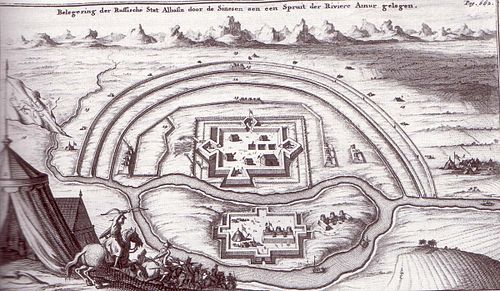
Qing forces attack Albazin (雅克萨, Yǎkèsà), a Russian fort on the Amur River, beginning negotiations that would define the Sino-Russian border. #war #foreignrelations
The Russian fortress Albazin stormed by Manchu/Chinese Qing forces. By Dutch gravure from the XVII century - http://www.srpska.ru/articles/4160/Albazin2.jpg http://altaica.nm.ru/amur/images/albazin.jpg http://gdzimg.sub.uni-goettingen.de/contentserver/contentserver?id:=D145970&imageset-id=3733&pagenumber=180&image-path=/3733/00000180.gif&zoom-factor=100&width=800 Please notice the file was originaly uploaded by en:user:Whlee, I've just moved it to Commons., Public domain, https://commons.wikimedia.org/w/index.php?curid=3874792
1689 CE
Treaty of Nerchinsk (尼布楚条约)
China and Russia sign the Treaty of Nerchinsk (尼布楚条约, Níbùchǔ Tiáoyuē), the first modern treaty with a European power, establishing the northern border. #foreignrelations #politics
Treaty of Nerchinsk By Unknown (goverments of China/Russia) - https://k.sina.com.cn/article_5910774821_1604f442500100w60n.html, Public domain, https://commons.wikimedia.org/w/index.php?curid=119752696
1696 CE
Kangxi Defeats Galdan (噶尔丹)
The Kangxi Emperor (康熙帝, Kāngxī Dì) personally leads armies to defeat Galdan (噶尔丹, Gá'ěrdān), ruler of the Dzungar Khanate, securing Qing control over Mongolia. #war #conquest
A scroll painting depicting the Emperor in camp in 1756, after the Dzungar Dawachi surrenders to the Qing Dynasty. By 钱维城 - 漠西蒙古, Public domain, https://commons.wikimedia.org/w/index.php?curid=12764582
1712 CE
Permanent Freeze of Land Tax (滋生人丁)
Kangxi freezes the head tax (滋生人丁, zīshēng réndīng) at 1712 levels, linking it to population rather than land, a major fiscal reform with unintended consequences. #governance #economics
1715 CE
Matteo Ricci's Successors at Court (耶稣会士)
Jesuit missionaries (耶稣会士, Yēsū huìshì) including Castiglione (郎世宁, Lángshìníng) serve at the Qing court, blending European and Chinese artistic techniques. #culture #art #religion
1722 CE
Yongzheng Emperor Succeeds (雍正帝)
The Yongzheng Emperor (雍正帝, Yōngzhèng Dì) inherits the throne amid succession disputes and implements radical fiscal and administrative reforms. #politics #governance
Yongzheng Emperor Succeeds (雍正帝) By Unknown author - https://www.dpm.org.cn/collection/paint/231803.html, Public domain, https://commons.wikimedia.org/w/index.php?curid=128355328
1729 CE
Grand Council Established (军机处)
Yongzheng creates the Grand Council (军机处, Jūnjī chù), a small privy council that becomes the Qing dynasty's most powerful decision-making body. #governance #politics )
Jun Ji Chu By Gisling - Own work, CC BY 3.0, https://commons.wikimedia.org/w/index.php?curid=4783575
1729 CE
First Opium Prohibition (禁烟令)
Yongzheng issues China's first edict banning opium (禁烟令, jīnyān lìng) except for medicinal use, foreshadowing the century's devastating drug crisis. #governance #health
Opium imports into China 1650–1880 Data Year Opium import in metric tons Source 1650 50 [1] 1729 13 200 chests[2] 1775 75 [1] 1800 286 4,500 chests[2] 1822 347 [1] 1835 1390 [1] 1838 2540 40,000 chests[2] 1839 2553 [1] 1863 4232 [1] 1867 4897 [1] 1880 6500 [1] By TilmannR - Own work, CC BY 4.0, https://commons.wikimedia.org/w/index.php?curid=117004532
1735 CE
Qianlong Emperor Ascends (乾隆帝)
The Qianlong Emperor (乾隆帝, Qiánlóng Dì) begins his sixty-year reign, presiding over the Qing empire's territorial and cultural apogee. #politics #culture
Qianlong Emperor Ascends (乾隆帝) By Giuseppe Castiglione - https://minghuaji.dpm.org.cn/paint/detail?id=420a006ed10d4e13b1075ba6e780f07a, Public domain, https://commons.wikimedia.org/w/index.php?curid=128011643
1755 CE
Conquest of Dzungaria (准噶尔)
Qianlong's campaigns destroy the Dzungar Khanate (准噶尔, Zhǔngá'ěr), with genocidal consequences; Xinjiang (新疆, Xīnjiāng) is incorporated into the Qing empire. #war #conquest #disaster
The Dzungar genocide (Chinese: 準噶爾滅族; lit. 'extermination of the Dzungar tribe') was the mass extermination of the Mongol Dzungar people by the Qing dynasty.[3] The Qianlong Emperor ordered the genocide due to the rebellion in 1755 by Dzungar leader Amursana against Qing rule, after the dynasty first conquered the Dzungar Khanate with Amursana's support. The genocide was perpetrated by Manchu generals of the Qing army sent to crush the Dzungars, supported by Uyghur allies and vassals due to the Uyghur revolt against Dzungar rule. By A collaboration between Chinese and European painters. The Jesuit missionaries involved in producing the drawings in China were Giuseppe Castiglione, Jean-Denis Attiret, Ignace Sichelbart and Jean Damascene. - This image has been extracted from another file, Public domain, https://commons.wikimedia.org/w/index.php?curid=122124405
1757 CE
Canton System Restricts Trade (广州制度)
The Qing restricts all foreign trade to Canton (广州, Guǎngzhōu) through licensed Hong merchants, creating the Canton System (广州制度, Guǎngzhōu zhìdù). #commerce #foreignrelations
Canton (Guangzhou), Die Hongs oder die ausländischen Factoreien am Perlfluß in Canton. Gouache auf Velin, um 1850 By AnonymousUnknown author - http://www.bassenge.com, Public domain, https://commons.wikimedia.org/w/index.php?curid=8922882
1760 CE
Complete Works of Four Treasuries (四库全书)
Qianlong commissions the Siku Quanshu (四库全书, Sìkú Quánshū), the largest collection of Chinese literature ever compiled, while censoring thousands of works. #literature #culture #governance
Siku quanshu (Complete library in four sections), compiled in the Qianlong period of the Qing dynasty, was the largest collection of texts in pre-modern China and has an important historical place in the histories of cultural texts and academic thought in China. The Wenjin ge edition is a manuscript written during the Qianlong reign. It includes a total of 36,304 volumes in 6,144 boxes placed on 128 bookshelves. They comprise 79,309 juan (sections) and were originally kept in the Wenjin Pavilion at the Summer Palace in Rehe (Jehol, now Chengde). In 1914, they became part of the holdings of the Capital Library (now the National Library of China). The complete collection is divided into four sections: classics, histories, masters, and belles-lettres, each bound in the colors of one of the four seasons, for convenient browsing. The texts on which the Wenjin ge edition was based were the books kept in the Palace Treasury, books compiled by the Qing court, books submitted from all quarters of the empire, and books reconstituted from the Yongle Encyclopedia. The complete set of the Siku quanshu in the National Library of China preserves a rich body of literature and historical materials, as well as the original shelving, cases, and books. Qing dynasty, 1644-1911 By Ji, Yun, 1724-1805 - http://www.wdl.org/media/3020/service/thumbnail/6000x6000/1/1.jpg Gallery: http://www.wdl.org/en/item/3020/, Public domain, https://commons.wikimedia.org/w/index.php?curid=31402000
1771 CE
Return of the Torghuts (土尔扈特)
Ubashi Khan leads 170,000 Torghut Mongols (土尔扈特, Tǔ'ěrhùtè) on a desperate migration from Russia back to Qing territory, with only 70,000 surviving. #foreignrelations #culture
Map of the Oirat Confederation By Khiruge - This image has been extracted from another file, CC BY-SA 4.0, https://commons.wikimedia.org/w/index.php?curid=129898948
1782 CE
Dream of the Red Chamber Published (红楼梦)
Cao Xueqin (曹雪芹, Cáo Xuěqín) publishes Dream of the Red Chamber (红楼梦, Hónglóu Mèng), China's greatest novel, depicting aristocratic decline. #literature #culture
Dream of the Red Chamber Published (红楼梦) By Unknown author, Public domain, https://commons.wikimedia.org/w/index.php?curid=567593
1793 CE
Macartney Embassy Rejected (马戛尔尼)
Lord Macartney (马戛尔尼, Mǎjiá'ěrní) refuses to kowtow to Qianlong; the British trade mission fails, deepening mutual incomprehension. #foreignrelations #politics
Lord Macartney Embassy To China 1793. Macartney's first meeting with Qianlong. The boy on the right is the eleven-year-old George Staunton who impressed the Emperor with his spoken Chinese. By William Alexander - "A study of History", Arnold Toynbee (Original in the British Library's collection of Western Drawings [WD 961, f.57][1]), Public domain, https://commons.wikimedia.org/w/index.php?curid=2594135
1796 CE
White Lotus Rebellion Erupts (白莲教)
The White Lotus Rebellion (白莲教, Báiliánjiào) breaks out in Hubei and Sichuan, revealing profound governance failures and draining Qing military resources. #war #religion #disaster
1799 CE
Heshen Executed, Massive Corruption Revealed (和珅)
The Jiaqing Emperor executes Heshen (和珅, Héshēn), Qianlong's favorite, confiscating wealth equal to fifteen years of imperial revenue. #politics #governance
《御筆平定臺灣二十功臣像贊》中的和珅畫像,右邊有清朝乾隆皇帝的御筆題贊:「大學士三等忠襄伯和珅 承訓書諭兼通清漢旁午軍書惟眀且斲平薩拉尔尔曾督戰賜爵勵忠竟成國榦」。《御筆平定臺灣二十功臣像贊》於2014年由紐約iGavel拍賣行拍賣。 By Unknown author - http://bid.igavelauctions.com/Bidding.taf?_function=detail&Auction_uid1=3389535, Public domain, https://commons.wikimedia.org/w/index.php?curid=13616161
1813 CE
Eight Trigrams Uprising (天理教)
Li Zicheng's namesake Li Wencheng (李文成, Lǐ Wénchéng) leads the Eight Trigrams (天理教, Tiānlǐjiào) rebellion, with followers briefly penetrating the Forbidden City. #war #religion
Portrait of Lin Qing 林清 (1770–1813), whose supporters mounted a failed attack on the Imperial Palace during the Eight Trigrams Uprising of 1813 under the Qing dynasty. By Unknown person of the Qing dynasty - Scanned from Zhu Chengru 朱诚如 (editor in chief), Qingshi tudian 清史图典, vol. 8, Jiaqing chao 嘉庆朝 (Beijing, Zijincheng chubanshe, 2002), p. 104., Public domain, https://commons.wikimedia.org/w/index.php?curid=31239938
1820 CE
Daoguang Emperor Succeeds (道光帝)
The Daoguang Emperor (道光帝, Dàoguāng Dì) ascends as the Opium crisis deepens, facing unprecedented internal and external challenges to Qing rule. #politics
Daoguang Emperor Succeeds (道光帝) By Unknown author - https://digicol.dpm.org.cn/cultural/detail?id=4203de6a7e52458788362a27f7810e18, Public domain, https://commons.wikimedia.org/w/index.php?curid=128754660
1839 CE
Lin Zexu Destroys Opium at Humen (虎门销烟)
Commissioner Lin Zexu (林则徐, Lín Zéxú) destroys 20,000 chests of British opium at Humen (虎门, Hǔmén), triggering the First Opium War. #foreignrelations #governance
Destruction of opium at Humen (trad: 虎門銷煙; simp: 虎门销烟) as displayed at Hong Kong Museum of History. Complete indexed photo collection of the author is at WorldHistoryPics.com. By Gary Todd, Professor of History, Sias University (郑州西亚斯学院), Xinzheng, Henan, China. - Model of Lin Zexu Destroying Opium at Canton, 1839, CC0, https://commons.wikimedia.org/w/index.php?curid=92883755
1840 CE
First Opium War Begins (鸦片战争)
British forces attack China, beginning the First Opium War (鸦片战争, Yāpiàn Zhànzhēng) that exposes the Qing military's technological obsolescence. #war #foreignrelations
The East India Company iron steam ship Nemesis, commanded by Lieutenant W. H. Hall, with boats from the Sulphur, Calliope, Larne and Starling, destroying the Chinese war junks in Anson's Bay, on 7 January 1841. An engagement in the First Opium War (1839-42), showing the ‘Nemesis’ (right background, in starboard broadside view) attacking a fleet of Chinese war junks in the middle ground. The war junk third from the left is shown being destroyed with splinters flying up into the air. Two rowing boats with Chinese passengers ew from the left foreground. Various men can be seen overboard and clinging on to debris throughout the scene. The lettering below includes lists of dimensions. PAH8193 and PAH8893 are additional copies, both hand-coloured, and the print is from an oil painting by Duncan presented to the Williamson Art Gallery at Birkenhead in 1925, with another showing Prince Albert visiting iron ships off Woolwich Dockyard. They were a gift from Alderman J.W.P. Laird, one of the Birkenhead shipbuilding family who built the 'Nemesis' and others of the vessels shown in them. On 7 January 1841, the 'Nemesis' of the Bombay Marine (the East India Company's naval service), commanded by William Hutcheon Hall, with boats from the ‘Sulphur’, ‘Calliope’, ‘Larne’ and ‘Starling’, destroyed Chinese war junks in Anson's Bay, Chuenpee, near the Bocca Tigris forts guarding the mouth of the Pearl River up to Canton. British forces then captured the forts themselves. Hall was a Royal Naval master at the time. He had steam experience and had been privately engaged by John Laird to command the 'Nemesis', which the latter had built experimentally as the first fully iron warship, and was so successful in it in China that in 1841 he was specially commissioned as a Naval lieutenant. He went on to later Royal Naval service as a captain in the Crimean War and was a retired admiral at his death in 1875. His portrait (BHC2733) and papers are also in the Museum collection. By Edward Duncan - http://ocw.mit.edu/ans7870/21f/21f.027/opium_wars_01/ow1_gallery/pages/1841_0792_nemesis_jm_nmm.htm, Public domain, https://commons.wikimedia.org/w/index.php?curid=5520025
Aug 1, 1842 CE
Treaty of Nanjing Signed (南京条约)
The Treaty of Nanjing (南京条约, Nánjīng Tiáoyuē) ends the First Opium War, ceding Hong Kong and opening five treaty ports to foreign trade. #foreignrelations #politics
The signing and sealing of the Treaty of Nanking. By Painted by Captain John Platt, Bengal Volunteers. Engraved by John Burnet. - Anne S. K. Brown Military Collection, Public domain, https://commons.wikimedia.org/w/index.php?curid=12229605
1850 CE
Taiping Rebellion Erupts (太平天国)
Hong Xiuquan (洪秀全, Hóng Xiùquán) launches the Taiping Rebellion (太平天国, Tàipíng Tiānguó), a Christian-inspired movement that becomes history's bloodiest civil war. #war #religion #disaster
A scene of the Taiping Rebellion, 1850-1864 By Wu Youru - https://www.battle-of-qurman.com.cn/e/hist.htm, Public domain, https://commons.wikimedia.org/w/index.php?curid=10326396
1856 CE
Second Opium War Begins (第二次鸦片战争)
Anglo-French forces attack China, beginning the Second Opium War (第二次鸦片战争, Dì'èrcì Yāpiàn Zhànzhēng) with demands for expanded treaty rights. #war #foreignrelations
Pa-Li-Kiao's bridge, on the evening of the battle. The Battle of Palikiao (Baliqiao) took place on 21 September 1860 during the Second Opium War (1856-1860). The Anglo-French victory opened a path to Beijing for Western armies. By Émile Bayard - http://www.lessignets.com/signetsdiane/calendrier/sept/21.htm http://www.transasiart.com/voyageurs/voyageurs03/srs03dpalikao.htm, Public domain, https://commons.wikimedia.org/w/index.php?curid=10357305
Oct 1, 1860 CE
Old Summer Palace Burned (圆明园)
British and French troops loot and burn the Old Summer Palace (圆明园, Yuánmíng Yuán), a catastrophic cultural loss symbolizing Qing humiliation. #war #culture #disaster
Remains of the Old Summer Palace By Windmemories - Own work, CC BY-SA 4.0, https://commons.wikimedia.org/w/index.php?curid=144827190
1861 CE
Tongzhi Restoration Begins (同治中兴)
Prince Gong (恭亲王, Gōng Qīnwáng) and Empress Dowager Cixi (慈禧太后, Cíxǐ Tàihòu) initiate the Tongzhi Restoration (同治中兴, Tóngzhì Zhōngxīng), attempting military and administrative reform. #politics #governance
"Portrait of Emperor Muzong Tongzhi of the Qing Dynasty" By Annonymous Qing Dynasty Court Painter - Palace Museum, Beijing, Public domain, https://commons.wikimedia.org/w/index.php?curid=15172630
1864 CE
Taiping Rebellion Crushed (天京陷落)
Qing forces recapture Nanjing (天京, Tiānjīng), ending the Taiping Rebellion after 20 million deaths and devastating the Yangtze economy. #war #disaster
1875 CE
Zuo Zongtang Recovers Xinjiang (左宗棠)
Zuo Zongtang (左宗棠, Zuǒ Zōngtáng) leads campaigns to suppress Yakub Beg and recover Xinjiang (新疆, Xīnjiāng) for the Qing empire. #war #conquest
In 1874-75, the Russian government sent a research and trading mission to China to seek out new overland routes to the Chinese market, report on prospects for increased commerce and locations for consulates and factories, and gather information about the Dungan Revolt then raging in parts of western China. Led by Lieutenant Colonel Iulian A. Sosnovskii of the army General Staff, the nine-man mission included a topographer, Captain Matusovskii; a scientific officer, Dr. Pavel Iakovlevich Piasetskii; Chinese and Russian interpreters; three non-commissioned Cossack soldiers; and the mission photographer, Adolf Erazmovich Boiarskii. The mission proceeded from Saint Petersburg to Shanghai via Ulan Bator (Mongolia), Beijing, and Tianjin, and then followed a route along the Yangtze River, along the Great Silk Road through the Hami oasis, to Lake Zaysan, back to Russia. Boiarskii took some 200 photographs, which constitute a unique resource for the study of China in this period. Most of the photographs are included in this album, which later became part of the Thereza Christina Maria Collection assembled by Emperor Pedro II of Brazil and given by him to the National Library of Brazil. Chinese; Government officials; Memory of the World; Portrait photographs; Qing dynasty, 1644-1911; Zuo, Zongtang, 1812-1885 By Boiarskii, Adolf-Nikolay Erazmovich - http://dl.wdl.org/1904.png Gallery: http://www.wdl.org/en/item/1904/, Public domain, https://commons.wikimedia.org/w/index.php?curid=61756623
1876 CE
First Chinese Embassy Abroad (郭嵩焘)
Guo Songtao (郭嵩焘, Guō Sōngtāo) becomes China's first ambassador to Britain, establishing permanent diplomatic representation in Europe. #foreignrelations #politics
Guo Songtao (1818-91) By Unknown author - http://photoshow.gd.sina.com.cn/upfiles/1077034285_1176097787.jpg, Public domain, https://commons.wikimedia.org/w/index.php?curid=2447468
1884 CE
Sino-French War over Vietnam (中法战争)
Qing and French forces clash over Vietnam (越南, Yuènán); the undeclared war ends with French protectorates over Annam and Tonkin. #war #foreignrelations
Map of the Sino-French war By PHGCOM - self-made. Map background: Topographic90deg N0E90.png, CC BY-SA 4.0, https://commons.wikimedia.org/w/index.php?curid=3971965
1888 CE
Beiyang Fleet Established (北洋水师)
Li Hongzhang (李鸿章, Lǐ Hóngzhāng) creates the Beiyang Fleet (北洋水师, Běiyáng Shuǐshī), China's first modern navy, with ships purchased from Europe. #defence #science
Flag of the Chinese Empire under the Qing dynasty (1889-1912), details per the restoration of Beiyang fleet researcher [1]. By Original: zh:清朝政府 Vector: Sodacan - Own work, Public domain, https://commons.wikimedia.org/w/index.php?curid=39922650
1894 CE
First Sino-Japanese War (甲午战争)
Japan defeats China in the First Sino-Japanese War (甲午战争, Jiǎwǔ Zhànzhēng), ending Chinese regional dominance and beginning Japanese imperial expansion. #war #foreignrelations
旅顺海军公所 By Unknown author - http://blog.sina.com.cn/s/blog_5015e65f0102vh9w.html, Public domain, https://commons.wikimedia.org/w/index.php?curid=95978605
Apr 1, 1895 CE
Treaty of Shimonoseki (马关条约)
The Treaty of Shimonoseki (马关条约, Mǎguān Tiáoyuē) cedes Taiwan and the Liaodong Peninsula to Japan, with the Triple Intervention forcing retrocession. #foreignrelations #politics
Japan_China_Peace_Treaty_17_April_1895. By World Imaging - Own work, photographed at Japan Foreign Ministry Archives, CC BY-SA 3.0, https://commons.wikimedia.org/w/index.php?curid=12765295
1898 CE
Hundred Days' Reform Fails (戊戌变法)
Kang Youwei (康有为, Kāng Yǒuwéi) and Liang Qichao (梁启超, Liáng Qǐchāo) persuade the Guangxu Emperor to implement radical reforms, crushed by Cixi after 103 days. #politics #governance
W. A. P. Martin and faculty of the Chinese Imperial University. By Not identified - W. A. P. Martin (1901). The Lore of Cathay or the Intellect of China. New York: Fleming H. Revell Company. p. 18., Public domain, https://commons.wikimedia.org/w/index.php?curid=11307185
1899 CE
Boxer Rebellion Begins (义和团)
The Boxers (义和团, Yìhétuán), anti-foreign martial artists, emerge in Shandong, attacking missionaries and Chinese Christians with tacit official support. #war #religion #foreignrelations
Landing of German Imperial Navy Seebatallione (marines) at the storming of the Taku Forts during the Boxer Rebellion. By Unknown author - Kaiserliche Marine, Public domain, https://commons.wikimedia.org/w/index.php?curid=10412587
Jun 1, 1900 CE
Boxers Besiege Beijing Legations (围攻使馆)
Boxers and Qing forces besiege foreign legations in Beijing for 55 days, leading to the Eight-Nation Alliance's intervention and occupation. #war #foreignrelations #disaster
I'll Try, Sir!. American troops in the relief of Peking in China on 14 August 1900 during the Boxer Rebellion. During the fiercely opposed relief expedition to Peking in the Boxer Rebellion in 1900, when two companies of the U.S. Army's 14th Infantry Regiment were pinned by heavy fire from the east wall of the Tartar City and the Fox Tower between abutments of the Chinese City Wall near Tung Pien Gate, volunteers were called for to attempt the first perilous ascent of the wall. Trumpeter Calvin P. Titus of E Company immediately stepped forward saying, "I'll try, sir!" Using jagged holes in the stone wall, he succeeded in reaching the top. He was followed by the rest of his company, who climbed unarmed, and hauled up their rifles and ammunition belts by a rope made of rifle slings. As the troops ascended the wall artillery fire from Reilly's battery set fire to the Fox Tower. In the face of continued heavy Chinese fire, the colors broke out in the August breeze as the sign that U.S. Army troops had achieved a major step in the relief of the besieged Legations. For his courageous and daring deed in being the first to climb the wall, Trumpeter Titus was awarded the Congressional Medal of Honor. By H. Charles McBarron, Jr. - http://www.history.army.mil/html/artphoto/pripos/usaia.html (description) http://www.history.army.mil/images/artphoto/pripos/usaia/Sir.jpg (image), Public domain, https://commons.wikimedia.org/w/index.php?curid=9724334
Sep 1, 1901 CE
Boxer Protocol Signed (辛丑条约)
The Boxer Protocol (辛丑条约, Xīnchǒu Tiáoyuē) imposes massive indemnities and foreign garrisons, completing China's reduction to semi-colonial status. #foreignrelations #politics #disaster
Signature page of the Boxer rebellion settlement Protocol in 1901 By Unknown author - Alfons Mumm: Ein Tagebuch in Bildern., Public domain, https://commons.wikimedia.org/w/index.php?curid=73044
1905 CE
Abolition of Civil Service Exams (废科举)
The Qing abolishes the keju (科举, kējǔ) examination system after 1,300 years, ending the scholar-official class's monopoly on government recruitment. #governance #education #culture
Excerpt from the handscroll Viewing the Pass List. Imperial examination candidates gather around the wall where results had been posted. Traditionally attributed to Qiu Ying, but now suspected to be the work of a late-Ming painter with Qiu Ling's name added. By Qiu Ying (仇英) (attributed) - In the collection of the National Palace Museum, Public domain, https://commons.wikimedia.org/w/index.php?curid=598340
1908 CE
Guangxu and Cixi Die (光绪慈禧之死)
The Guangxu Emperor (光绪帝, Guāngxù Dì) and Empress Dowager Cixi (慈禧太后, Cíxǐ Tàihòu) die within a day, leaving the two-year-old Puyi (溥仪, Pǔyí) as heir. #politics #disaster
光绪帝画像 By AnonymousUnknown author - Palace Museum, Public domain, https://commons.wikimedia.org/w/index.php?curid=126880851
Oct 10, 1911 CE
Wuchang Uprising (武昌起义)
Revolutionaries launch the Wuchang Uprising (武昌起义, Wǔchāng Qǐyì), triggering province after province to declare independence from Qing rule. #war #politics
Wuchang Uprising (武昌起义) By Unknown author, Public domain, https://commons.wikimedia.org/w/index.php?curid=685617
Feb 12, 1912 CE
Puyi Abdicates, Qing Ends (清帝退位)
The Xuantong Emperor Puyi (溥仪, Pǔyí) abdicates, ending 268 years of Qing rule and over 2,000 years of imperial Chinese history. #politics
MANCHURIA PERIOD PUYI By Unknown author - https://www.pinterest.co.uk/amp/pin/471822498445876797/, Public domain, https://commons.wikimedia.org/w/index.php?curid=158392960




![Opium imports into China 1650–1880 Data Year Opium import in metric tons Source 1650 50 [1] 1729 13 200 chests[2] 1775 75 [1] 1800 286 4,500 chests[2] 1822 347 [1] 1835 1390 [1] 1838 2540 40,000 chests[2] 1839 2553 [1] 1863 4232 [1] 1867 4897 [1] 1880 6500 [1]](https://upload.wikimedia.org/wikipedia/commons/thumb/2/28/Opium_imports_into_China_1650%E2%80%931880.svg/500px-Opium_imports_into_China_1650%E2%80%931880.svg.png)

![The Dzungar genocide (Chinese: 準噶爾滅族; lit. 'extermination of the Dzungar tribe') was the mass extermination of the Mongol Dzungar people by the Qing dynasty.[3] The Qianlong Emperor ordered the genocide due to the rebellion in 1755 by Dzungar leader Amursana against Qing rule, after the dynasty first conquered the Dzungar Khanate with Amursana's support. The genocide was perpetrated by Manchu generals of the Qing army sent to crush the Dzungars, supported by Uyghur allies and vassals due to the Uyghur revolt against Dzungar rule.](https://upload.wikimedia.org/wikipedia/commons/thumb/2/2d/Dzungar_Tribe_Genocide.png/500px-Dzungar_Tribe_Genocide.png)




![Flag of the Chinese Empire under the Qing dynasty (1889-1912), details per the restoration of Beiyang fleet researcher [1].](https://upload.wikimedia.org/wikipedia/commons/thumb/b/b6/Flag_of_China_%281889%E2%80%931912%29.svg/500px-Flag_of_China_%281889%E2%80%931912%29.svg.png)


