Encyclopedia/1. The Cosmos & The Natural World/2. Physics & Chemistry/10. Foundational & General Physics • Curated by Admin Timeline.sg
Chaos theory · Statistical mechanics
Chronological Storyline (32 Milestones)
400 BCE
Mohist Canon documents optics and mechanics
The Mohist Canon (Mo Jing) in Warring States China described optical phenomena like pinhole image formation and reflection, and mechanical principles of levers and pulleys, representing early quantitative physical reasoning. Source — Wikipedia:
Mozi in Chinese. By White whirlwind - Own work, Public domain, https://commons.wikimedia.org/w/index.php?curid=48854047
300 BCE
Euclid writes Optics and Elements
Euclid of Alexandria authored 'Optics,' applying geometry to perspective and light propagation, and the 'Elements,' which became the foundational mathematical framework for centuries of physical reasoning. Source — Wikipedia:
Euclid writes Optics and Elements By Jusepe de Ribera (Spanish / Italian, 1591 - 1652) (1591 - 1652) – artist (Spanish / Italian) Details on Google Art Project - wAGVeSb2M1HfDA at Google Cultural Institute maximum zoom level, Public domain, https://commons.wikimedia.org/w/index.php?curid=21993409
250 BCE
Archimedes establishes statics and buoyancy
Archimedes of Syracuse formulated the law of the lever and the principle of buoyancy, providing the mathematical foundations of statics and hydrostatics that influenced all subsequent mechanics. Source — Wikipedia:
Archimedes establishes statics and buoyancy By Domenico Fetti - http://archimedes2.mpiwg-berlin.mpg.de/archimedes_templates/popup.htm, Public domain, https://commons.wikimedia.org/w/index.php?curid=146592
150 CE
Ptolemy writes Optics with refraction law
Claudius Ptolemy compiled 'Optics,' presenting an early quantitative study of reflection and refraction, including tabulated refraction angles that prefigured Snell's law by over a millennium. Source — Wikipedia:
Ptolemy with a armillary sphere model. With a large version he claimed his solstice observations. By Justus van Gent / Pedro Berruguete - Public domainPublic domainfalsefalse This work is in the public domain in its country of origin and other countries and areas where the copyright term is the author's life plus 100 years or fewer. You must also include a United States public domain tag to indicate why this work is in the public domain in the United States. This file has been identified as being free of known restrictions under copyright law, including all related and neighboring rights. https://creativecommons.org/publicdomain/mark/1.0/PDMCreative Commons Public Domain Mark 1.0falsefalse, Public domain, https://commons.wikimedia.org/w/index.php?curid=16043714
200 CE
Kanada's Vaisheshika systematomizes matter
The Indian sage Kanada founded the Vaisheshika school, which proposed an atomic theory of matter combining four elemental atom types, offering an early speculative framework for particulate physics. Source — Wikipedia:
1021 CE
Ibn al-Haytham completes Book of Optics
Ibn al-Haytham (Alhazen) completed his seven-volume 'Book of Optics' in Cairo, using experiments to demonstrate that vision occurs by light entering the eye and formulating the first accurate account of pinhole image formation. Source — Wikipedia:
This picture is of the cover page of Ibn al-Haytham's "Book of Optics", 1572. By Ibn al-Haytham, Vitello, Friedrich Risner - University of Oklahoma History of Science Collections et BnF Gallica : http://gallica.bnf.fr/ark:/12148/bpt6k312873d.r=Haytham?rk=407727;2, Public domain, https://commons.wikimedia.org/w/index.php?curid=48189707
1088 CE
Shen Kuo documents magnetic declination
The Chinese polymath Shen Kuo recorded in 'Dream Pool Essays' that the magnetic needle does not point exactly north, documenting magnetic declination and advancing the mathematical geography of magnetism. Source — Wikipedia:
Exhibition description: Shen Kuo (1031-1095 AD) A prominent scientist and astrononmer of the Song Dynasty. Shen Kuo was the head official of the Bureau of Astronomy in the Song court, where he improved the design of several local astronomical instruments, including the amillary aphere, the gnomon and the clepsydra clock. He also formulated a solar calendar named the Twelve Solar Terms Calendar, which was used in agriculture. His work are summed up in his Dream Pool Essays, one of the greatest books of that time. By Hans A. Rosbach - Own work, CC BY-SA 3.0, https://commons.wikimedia.org/w/index.php?curid=89508454
1121 CE
Al-Khazini writes Book of the Balance of Wisdom
Al-Khazini composed the 'Book of the Balance of Wisdom,' which gave hydrostatic balances and specific gravity tables of remarkable accuracy, advancing the mathematical treatment of density and statics. Source — Wikipedia:
13th century Arabic manuscript of al-Khāzinī's Kitāb Mīzān al-ḥikmah depicting the eponymous balances of the treatise. By Unknown author - https://openn.library.upenn.edu/Data/0001/html/ljs386.html, Public domain, https://commons.wikimedia.org/w/index.php?curid=173174072
1687 CE
Newton publishes Principia Mathematica
Isaac Newton's 'Philosophiae Naturalis Principia Mathematica' formulated the laws of motion and universal gravitation, establishing the mathematical framework of classical mechanics that dominated physics for two centuries. Source — Wikipedia:
Title page of the 1687 first edition of Philosophiae Naturalis Principia Mathematica, by Isaac Newton. PHILOSOPHIÆ NATURALIS PRINCIPIA MATHEMATICA. Autore IS. NEWTON, Trin. Coll. Cantab. Soc. Matheseos Professore Lucasiano, & Societatis Regalis Sodali. IMPRIMATUR. S. PEPYS, Reg. Soc. PRÆSES. Julii 5. 1686. LONDINI, Jussu Societatis Regiæ ac Typis Josephi Streater. Prostat apud plures Bibliopolas. Anno MDCLXXXVII. By The original uploader was Zhaladshar at English Wikisource. - Transferred from en.wikisource to Commons. (previous image from another copy) Internet Archive (current image from the Bern Dibner copy), Public domain, https://commons.wikimedia.org/w/index.php?curid=2681838First edition Principia Mathematica! And other Isaac Newton treasures | with Rob Iliffe
1738 CE
Bernoulli publishes Hydrodynamica
Daniel Bernoulli's 'Hydrodynamica' introduced the principle that fluid pressure decreases with flow speed, providing early mathematical foundations for kinetic theory and statistical reasoning about particle motion. Source — Wikipedia:
Portrait of Daniel Bernoulli, c.1720-1725. Oil painting on canvas, Height 90.6 cm, Width 73.8 cm. inventory number 1991.156 (Basel Historical Museum, Peter Portner). Edited version. By UnknownEdited by Bammesk - Basel Historical Museum Link: https://www.hmb.ch/en/museums/objects-in-the-collection/details/s/portraet-des-daniel-bernoulli/, CC BY-SA 4.0, https://commons.wikimedia.org/w/index.php?curid=114825929
1788 CE
Lagrange formulates analytical mechanics
Joseph-Louis Lagrange published 'Mécanique Analytique,' reformulating mechanics purely in terms of algebraic equations without diagrams, introducing the Lagrangian and elevating mechanics to abstract mathematical physics. Source — Wikipedia:
Title page of volume I of Lagrange's "Mécanique Analytique," from 1811. Copies located in the Niels Bohr Library & Archives, American Institute of Physics, in College Park, Maryland. By Joseph-Louis Lagrange - https://libserv.aip.org/ipac20/ipac.jsp?session=IR67574T35919.44001&profile=rev-nbl&source=~!horizon&view=subscriptionsummary&uri=full=3100006~!44233~!15&ri=5&aspect=power&menu=search&ipp=20&spp=20&staffonly=&term=M?anique+Analytique&index=.GW&uindex=&aspect=power&menu=search&ri=5, Public domain, https://commons.wikimedia.org/w/index.php?curid=125029899
1822 CE
Fourier publishes heat equation analysis
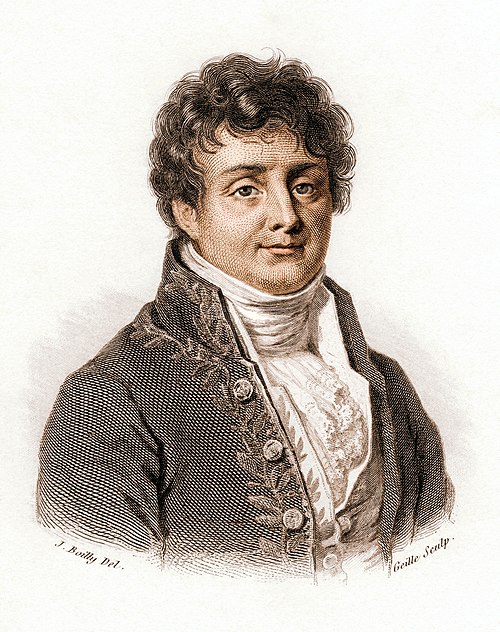
Joseph Fourier's 'Théorie analytique de la chaleur' introduced the heat equation and Fourier analysis, providing mathematical tools essential for thermal physics and later for quantum mechanics and signal processing. Source — Wikipedia:
Engraved portrait of French mathematician Jean Baptiste Joseph Fourier (1768 - 1830), early 19th century. By Julien-Léopold Boilly - This file was derived from: Fourier2.jpg Restored by: Bammesk Original source: https://www.gettyimages.com.au/license/169251384 https://wellcomecollection.org/works/b4qh352u, Public domain, https://commons.wikimedia.org/w/index.php?curid=114366437
1834 CE
Hamilton formulates Hamiltonian mechanics
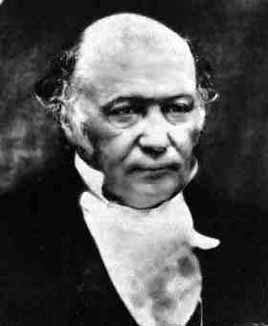
William Rowan Hamilton extended Lagrangian mechanics by introducing the Hamiltonian formulation, recasting mechanics in terms of position and momentum and providing the mathematical structure later central to statistical and quantum mechanics. Source — Wikipedia:
Sir William Rowan Hamilton By Unknown author - http://mathematik-online.de/F77.htm, Public domain, https://commons.wikimedia.org/w/index.php?curid=68222
1859 CE
Maxwell derives Maxwell-Boltzmann distribution
James Clerk Maxwell derived the probability distribution of molecular speeds in a gas, marking the first statistical law in physics and founding the kinetic theory of gases as a branch of mathematical physics. Source — Wikipedia:
Probability distribution function for the Maxwell-Boltzmann distribution By Krishnavedala - Own work, CC0, https://commons.wikimedia.org/w/index.php?curid=22019708
1872 CE
Boltzmann establishes H-theorem and entropy
Ludwig Boltzmann proved the H-theorem, providing a statistical explanation of why entropy increases, and in 1877 linked entropy to the logarithm of the number of microstates, founding statistical mechanics. Source — Wikipedia:
1877 CE
Boltzmann defines entropy statistically
Ludwig Boltzmann published the relation S = k log W, defining entropy as proportional to the logarithm of the number of accessible microstates, providing the conceptual core of statistical mechanics. Source — Wikipedia:
Grave of Ludwig Boltzmann, physicist, on Zentralfriedhof (Central Cemetery), Vienna, Austria By User:Daderot http://en.wikipedia.org/wiki/User:Daderot - http://en.wikipedia.org/wiki/Image:Zentralfriedhof_Vienna_-_Boltzmann.JPG, CC BY-SA 3.0, https://commons.wikimedia.org/w/index.php?curid=12009481
1887 CE
Boltzmann equation describes gas dynamics
Ludwig Boltzmann formulated the integro-differential equation governing the statistical behavior of a dilute gas, becoming a cornerstone of non-equilibrium statistical mechanics and transport theory. Source — Wikipedia:
Stairs of model reduction from microscopic dynamics to macroscopic continuum dynamics. By Jarash The copyright holder of this file, User:Agor153, allows anyone to use it for any purpose, provided that the copyright holder is properly attributed. Redistribution, derivative work, commercial use, and all other use is permitted. Attribution: User:Agor153 Attribution - Own work based on: StairsOfReduction.png, CC BY-SA 3.0, https://commons.wikimedia.org/w/index.php?curid=64588846
1890 CE
Poincaré discovers chaos in three-body problem
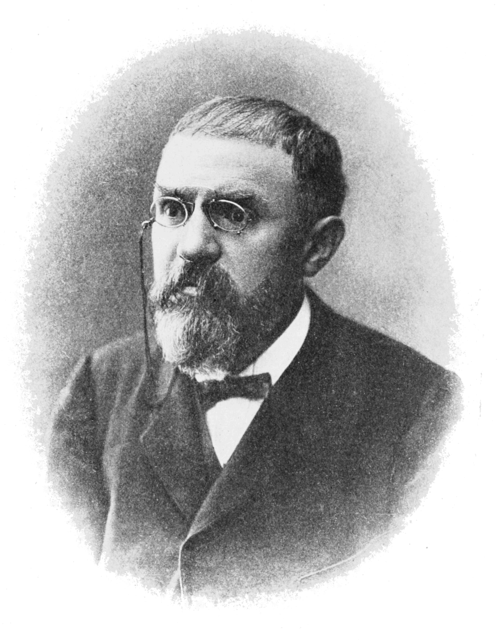
Henri Poincaré showed that the restricted three-body problem exhibits extreme sensitivity to initial conditions, discovering mathematical chaos and founding the qualitative theory of dynamical systems. Source — Wikipedia:
Henri Poincaré By Unknown author - Popular Science Monthly Volume 82, Public domain, https://commons.wikimedia.org/w/index.php?curid=20644432
1900 CE
Gibbs publishes Statistical Mechanics
Josiah Willard Gibbs published 'Elementary Principles in Statistical Mechanics,' systematizing the entire field using ensembles and phase space, providing the framework that remains standard in modern statistical physics. Source — Wikipedia:
Cover page of "Elementary principles in statistical mechanics" by J. Willard Gibbs By J. Willard Gibbs - Library of the University of California, Public domain, https://commons.wikimedia.org/w/index.php?curid=18570388
1900 CE
Planck introduces energy quanta
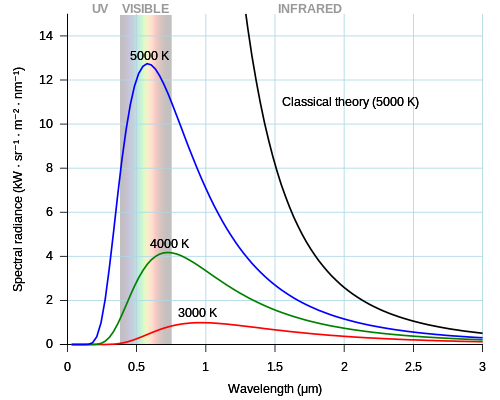
Max Planck derived the blackbody radiation law by postulating that energy is exchanged in discrete quanta, introducing the constant h and launching the mathematical physics of quantum theory. Source — Wikipedia:
Black body spectral radiance curves for various temperatures after Planck, and comparison with the classical theory of Rayleigh-Jeans (in cgs units). By Darth Kule - Own work, Public domain, https://commons.wikimedia.org/w/index.php?curid=10555337Max Planck and the birth of quantum theory, part 1
1902 CE
Gibbs formalizes ensemble theory
Josiah Willard Gibbs's 'Elementary Principles in Statistical Mechanics' introduced the canonical, microcanonical, and grand canonical ensembles, completing the mathematical framework of equilibrium statistical mechanics. Source — Wikipedia: )
1905 CE
Einstein explains Brownian motion
Albert Einstein provided a statistical-mechanical explanation of Brownian motion, relating the random motion of particles to molecular kinetic energy and providing decisive evidence for the atomic nature of matter. Source — Wikipedia:
2 dimension random walk of a silver adatom on a Ag(111) surface By Toshiyouri - Own work, CC BY-SA 4.0, https://commons.wikimedia.org/w/index.php?curid=69356582Albert Einstein: The Size and Existence of Atoms
1925 CE
Born and Heisenberg formulate matrix mechanics
Werner Heisenberg, with Max Born and Pascual Jordan, developed matrix mechanics, the first mathematically rigorous formulation of quantum theory, using infinite-dimensional matrices for physical observables. Source — Wikipedia:
1944 CE
Onsager solves two-dimensional Ising model
Lars Onsager obtained the exact analytical solution of the two-dimensional Ising model, demonstrating a phase transition without approximation and becoming a landmark of mathematical statistical mechanics. Source — Wikipedia:
Two-dimensional Ising model shown as a lattice of interacting spins. By Ta2o - Own work, CC BY 4.0, https://commons.wikimedia.org/w/index.php?curid=161501738
1948 CE
Shannon founds information theory
Claude Shannon's 'A Mathematical Theory of Communication' introduced entropy as a measure of information, creating tools that would profoundly influence statistical mechanics and the study of complexity. Source — Wikipedia:
The FPU computer experiment on a nonlinear vibrating string unexpectedly showed energy recurrence rather than equipartition, becoming a foundational discovery in nonlinear dynamics and chaos theory. Source — Wikipedia:
1963 CE
Lorenz discovers deterministic chaos
Edward Lorenz discovered that a simple three-variable atmospheric model exhibited extreme sensitivity to initial conditions, coining the 'butterfly effect' and establishing chaos theory as a branch of mathematical physics. Source — Wikipedia:
A sample trajectory through phase space is plotted near a Lorenz attractor with σ = 10, ρ = 28, β = 8/3. The color of the solution fades from black to blue as time progresses, and the black dot shows a particle moving along the solution in time. Initial conditions: x(0) = 0, y(0) = 2, z(0) = 20. 0 < t < 35. The 3-dimensional trajectory {x(t), y(t), z(t)} is shown from different angles to demonstrate its structure. By Dan Quinn - Own work, CC BY-SA 3.0, https://commons.wikimedia.org/w/index.php?curid=29370723Patterns of Life – Edward Lorenz and Chaos Theory (#5/5)
1971 CE
Wilson applies renormalization group to critical phenomena
Kenneth Wilson used renormalization group methods to explain critical phenomena and phase transitions, unifying statistical mechanics with quantum field theory and earning the 1982 Nobel Prize in Physics. Source — Wikipedia:
1971 CE
Ruelle and Takens propose strange attractors
David Ruelle and Floris Takens proposed that fluid turbulence arises via strange attractors in dynamical systems, providing a mathematical framework linking chaos theory to statistical physics. Source — Wikipedia:
The (strangely named) poisson saturne strange attractor has been visualized on the website Chaoscope.org since 2007. That image is on Wikimedia Commons as File:Attractor Poisson Saturne.jpg and is widely shared. Unfortunately, the image is only available in very low resolution (640x480 pixels), which limits its use severely. This independent visualization, using the same parameters for the dynamic system, tries to remedy this shortcoming by providing a much higher resolution (12800x9600 pixels). The hope is that this new image will be useful to gain a better understanding of the structure of the attractor and for decorative purposes. The file is produced by a straightforward C program, running 10^11 iterations. Coloring is not the same as the previous image. In particular, it assigns different colors to the two separate components of the set (one yellow/green and one blue/magenta). This is also the first frame in File:Rotating 3D Attractor.webm, a video showing the same attractor rotating and giving further insights into this set. An adoption of the mentioned code, capable of rendering this image, is available. By Bvsydow - Own work, CC BY-SA 4.0, https://commons.wikimedia.org/w/index.php?curid=103472067
1975 CE
Feigenbaum discovers universality in chaos
Mitchell Feigenbaum discovered universal constants governing the period-doubling route to chaos, showing that disparate nonlinear systems share identical mathematical behavior at the onset of chaos. Source — Wikipedia:
Bifurcation diagram: Feigenbaum constant δ expresses the limit of the ratio of distances between consecutive bifurcation diagram on Li / Li + 1 By Jarosław Bielak - pl:, uploaded by Claudemonet, CC BY 2.5, https://commons.wikimedia.org/w/index.php?curid=1250389
1977 CE
Mandelbrot introduces fractal geometry
Benoît Mandelbrot published 'The Fractal Geometry of Nature,' formalizing fractals as mathematical structures with non-integer dimension, providing tools essential for describing chaotic attractors and complex systems. Source — Wikipedia:
Mandelbrot introduces fractal geometry By Unknown author, CC BY 4.0, https://commons.wikimedia.org/w/index.php?curid=149840902Arthur C Clarke - Fractals: The Colours of Infinity (1995)
1984 CE
Prigogine wins Nobel for non-equilibrium thermodynamics
Ilya Prigogine received the Nobel Prize for his contributions to non-equilibrium thermodynamics, particularly the theory of dissipative structures, bridging statistical mechanics with the physics of complex, chaotic systems. Source — Wikipedia:
1977 Press Photo Professor Ilya Prigogine Of Belgium, Nobel Prize For Chemistry By Unknown (Keystone - US) - File:Ilya Prigogine 1977.jpg, Public domain, https://commons.wikimedia.org/w/index.php?curid=70925213