Encyclopedia/1. The Cosmos & The Natural World/2. Physics & Chemistry/10. Foundational & General Physics • Curated by Admin Timeline.sg
Quantum field theory · Particle physics · String theory
Chronological Storyline (26 Milestones)
600 BCE
Kanada founds Indian atomism
The sage Kanada established the Vaisheshika school, propounding that matter is composed of indivisible particles (anus) combining in patterns, an early conceptual root of atomism. · Wikipedia: https://en.wikipedia.org/wiki/Kanada_(philosopher)
Educational illustration depicting the early concept of atomism proposed by Acharya Kanada (c. 6th–2nd century BCE). According to the Vaisheshika Sutra, all matter is composed of fundamental particles called Paramāṇu (atoms). These atoms combine to form Dvyaṇuka (two-atom structures) and Tryaṇuka (three-atom structures), gradually forming visible matter. The diagram also references the classical elemental categories associated with early Indian natural philosophy. Illustration created for educational and visual explanation purposes. By Xaetherion - Own work, CC BY-SA 4.0, https://commons.wikimedia.org/w/index.php?curid=185658968
400 BCE
Mohist Canon documents optics and mechanics
The Mohist Canon (Mo Jing) in Warring States China described pinhole image formation, shadow formation, and lever mechanics, representing early experimental and physical analysis. Source — Wikipedia:
Birth places of notable Chinese philosophers of the Hundred Schools of Thoughts in the Zhou dynasty. By SY - Own work, CC BY-SA 4.0, https://commons.wikimedia.org/w/index.php?curid=65898454
300 BCE
Euclid writes Optics
Euclid's treatise Optics formulated a geometric ray theory of vision, treating light as traveling in straight lines and establishing the mathematical approach to perspective. Source — Wikipedia:
Euclid writes Optics By Jusepe de Ribera (Spanish / Italian, 1591 - 1652) (1591 - 1652) – artist (Spanish / Italian) Details on Google Art Project - wAGVeSb2M1HfDA at Google Cultural Institute maximum zoom level, Public domain, https://commons.wikimedia.org/w/index.php?curid=21993409
250 BCE
Archimedes establishes statics and buoyancy
Archimedes formulated the law of the lever and the principle of buoyancy, laying mathematical foundations for statics and hydrostatics. Source — Wikipedia:
Archimedes establishes statics and buoyancy By Domenico Fetti - http://archimedes2.mpiwg-berlin.mpg.de/archimedes_templates/popup.htm, Public domain, https://commons.wikimedia.org/w/index.php?curid=146592
1021 CE
Ibn al-Haytham completes Book of Optics
Ibn al-Haytham (Alhazen) completed his seven-volume Book of Optics, using experiments to demonstrate that vision occurs by light entering the eye and describing refraction, foundational to the experimental method. Source — Wikipedia:
Cropped version of the frontispiece of Johannes Hevelius, Selenographia, depicting Ibn al-Haytham (Alhazen) By Adolph Boÿ, engraved by Jeremias Falck. Used as the frontispiece to Johannes Hevelius, Selenographia, 1647 - https://www.loc.gov/resource/rbctos.2017rosen1321/?sp=9&r=0.059,0.617,0.327,0.182,0, Public domain, https://commons.wikimedia.org/w/index.php?curid=165125519
1088 CE
Shen Kuo documents magnetic declination
Shen Kuo recorded that a magnetic needle pointed slightly east of true north, the first known documentation of magnetic declination, and described the lodestone compass for navigation. Source — Wikipedia:
Exhibition description: Shen Kuo (1031-1095 AD) A prominent scientist and astrononmer of the Song Dynasty. Shen Kuo was the head official of the Bureau of Astronomy in the Song court, where he improved the design of several local astronomical instruments, including the amillary aphere, the gnomon and the clepsydra clock. He also formulated a solar calendar named the Twelve Solar Terms Calendar, which was used in agriculture. His work are summed up in his Dream Pool Essays, one of the greatest books of that time. By Hans A. Rosbach - Own work, CC BY-SA 3.0, https://commons.wikimedia.org/w/index.php?curid=89508454
1121 CE
Al-Khazini writes Balance of Wisdom
Al-Khazini authored the Book of the Balance of Wisdom, describing a hydrostatic balance and tabulating densities of metals and gems, advancing the science of statics and specific gravity. Source — Wikipedia:
13th century Arabic manuscript of al-Khāzinī's Kitāb Mīzān al-ḥikmah depicting the eponymous balances of the treatise. By Unknown author - https://openn.library.upenn.edu/Data/0001/html/ljs386.html, Public domain, https://commons.wikimedia.org/w/index.php?curid=173174072
1687 CE
Newton publishes Principia
Isaac Newton published Philosophiæ Naturalis Principia Mathematica, formulating the three laws of motion and universal gravitation, unifying celestial and terrestrial mechanics. Source — Wikipedia:
Title page of the 1687 first edition of Philosophiae Naturalis Principia Mathematica, by Isaac Newton. PHILOSOPHIÆ NATURALIS PRINCIPIA MATHEMATICA. Autore IS. NEWTON, Trin. Coll. Cantab. Soc. Matheseos Professore Lucasiano, & Societatis Regalis Sodali. IMPRIMATUR. S. PEPYS, Reg. Soc. PRÆSES. Julii 5. 1686. LONDINI, Jussu Societatis Regiæ ac Typis Josephi Streater. Prostat apud plures Bibliopolas. Anno MDCLXXXVII. By The original uploader was Zhaladshar at English Wikisource. - Transferred from en.wikisource to Commons. (previous image from another copy) Internet Archive (current image from the Bern Dibner copy), Public domain, https://commons.wikimedia.org/w/index.php?curid=2681838Newton's Principia Explained Part I
1905 CE
Einstein introduces special relativity
Albert Einstein published his paper on the electrodynamics of moving bodies, establishing special relativity with the constancy of the speed of light and equivalence of mass and energy. · Wikipedia: https://en.wikipedia.org/wiki/Special_relativity
German-born theoretical physicist Albert Einstein. By Lucien Chavan [1] (1868 - 1942), a friend of Einstein's when he was living in Berne. - Cropped from original at the The Albert Einstein Archives, The Hebrew University of Jerusalem., Public domain, https://commons.wikimedia.org/w/index.php?curid=16699199Albert Einstein and Theory of relativity Full Documentary HD
1915 CE
Einstein formulates general relativity
Einstein presented the field equations of general relativity, describing gravity as the curvature of spacetime by mass and energy, revolutionizing fundamental physics. Source — Wikipedia:
Video simulation of the view which would be seen by a close observer, of the final merger of GW150914, showing the distortion of the star-field from gravity as the black holes orbit and merge. By Simulating eXtreme Spacetimes Lensing (SXS) - https://www.ligo.caltech.edu/video/ligo20160211v3 (video link); see also http://www.black-holes.org/gw150914, CC BY-SA 4.0, https://commons.wikimedia.org/w/index.php?curid=46994894Einstein's General Theory of Relativity Explained | AH Documentary
1927 CE
Dirac pioneers quantum field theory
P. A. M. Dirac published his quantum theory of the electromagnetic field, introducing creation and annihilation operators and laying the groundwork for quantum field theory. · Wikipedia: https://en.wikipedia.org/wiki/Quantum_field_theory
A Feynman diagram showing the radiation of a gluon when an electron and positron are annihilated. By Joel Holdsworth (Joelholdsworth) - Non-Derived SVG of Radiate gluon.png, originally the work of SilverStar at Feynmann-diagram-gluon-radiation.svg, updated by joelholdsworth., Public domain, https://commons.wikimedia.org/w/index.php?curid=1764161
1928 CE
Dirac predicts the positron
Dirac formulated the relativistic wave equation for the electron, which implied the existence of antiparticles; the positron was experimentally confirmed by Anderson in 1932. · Wikipedia: https://en.wikipedia.org/wiki/Dirac_equation
1948 CE
Feynman, Schwinger, Tomonaga develop QED
Richard Feynman, Julian Schwinger, and Sin-Itiro Tomonaga independently developed quantum electrodynamics, a renormalized quantum field theory of electromagnetism, earning the 1965 Nobel Prize. · Wikipedia: https://en.wikipedia.org/wiki/Quantum_electrodynamics
A Feynman diagram showing the radiation of a gluon when an electron and positron are annihilated. By Joel Holdsworth (Joelholdsworth) - Non-Derived SVG of Radiate gluon.png, originally the work of SilverStar at Feynmann-diagram-gluon-radiation.svg, updated by joelholdsworth., Public domain, https://commons.wikimedia.org/w/index.php?curid=1764161
1954 CE
Yang and Mills propose non-Abelian gauge theory
Chen-Ning Yang and Robert Mills published a generalization of gauge theory with non-Abelian symmetry groups, which became the mathematical framework for the strong and weak nuclear forces. · Wikipedia: https://en.wikipedia.org/wiki/Yang%E2%80%93Mills_theory
A Feynman diagram showing the radiation of a gluon when an electron and positron are annihilated. By Joel Holdsworth (Joelholdsworth) - Non-Derived SVG of Radiate gluon.png, originally the work of SilverStar at Feynmann-diagram-gluon-radiation.svg, updated by joelholdsworth., Public domain, https://commons.wikimedia.org/w/index.php?curid=1764161
1961 CE
Gell-Mann introduces the Eightfold Way
Murray Gell-Mann proposed the Eightfold Way classification scheme for hadrons, organizing particles by SU(3) symmetry and predicting the existence of the Omega-minus baryon. Source — Wikipedia: )
Mesons organized into an octet according to the Eightfold way By Laurascudder - Own work, CC BY-SA 3.0, https://commons.wikimedia.org/w/index.php?curid=2379550
1964 CE
Higgs mechanism proposed
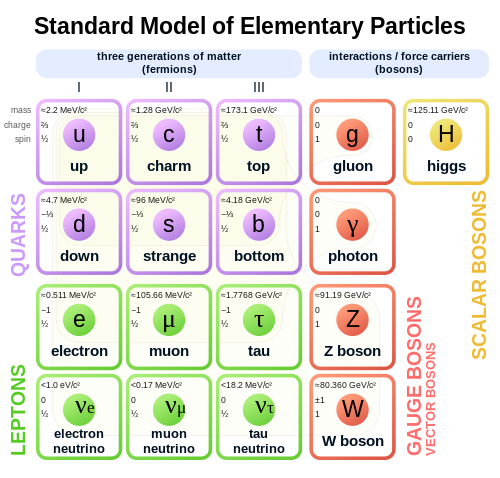
Peter Higgs, and independently François Englert and Robert Brout, proposed a mechanism for electroweak symmetry breaking that gives particles mass via a scalar field, predicting the Higgs boson. )91136-9 · Wikipedia: https://en.wikipedia.org/wiki/Higgs_mechanism
Standard model of elementary particles: the 12 fundamental fermions and 5 fundamental bosons. Brown loops indicate which bosons (red) couple to which fermions (purple and green). Please note that the masses of certain particles are subject to periodic reevaluation by the scientific community. The values currently reflected in this graphic are as of 2024 and may have been adjusted since. For the latest consensus, please visit the Particle Data Group website linked below. By Cush - Own work using: PBS NOVA [1], Fermilab, Office of Science, United States Department of Energy, Particle Data Group, Public domain, https://commons.wikimedia.org/w/index.php?curid=4286964The Higgs Mechanism Explained | Space Time | PBS Digital Studios
1967 CE
Electroweak unification achieved
Steven Weinberg and Abdus Salam, building on Sheldon Glashow's earlier work, formulated the unified electroweak theory combining electromagnetism and the weak nuclear force via SU(2)×U(1) gauge symmetry. · Wikipedia: https://en.wikipedia.org/wiki/Electroweak_interaction
Standard model of elementary particles: the 12 fundamental fermions and 5 fundamental bosons. Brown loops indicate which bosons (red) couple to which fermions (purple and green). Please note that the masses of certain particles are subject to periodic reevaluation by the scientific community. The values currently reflected in this graphic are as of 2024 and may have been adjusted since. For the latest consensus, please visit the Particle Data Group website linked below. By Cush - Own work using: PBS NOVA [1], Fermilab, Office of Science, United States Department of Energy, Particle Data Group, Public domain, https://commons.wikimedia.org/w/index.php?curid=4286964
1968 CE
Veneziano discovers dual resonance model
Gabriele Veneziano discovered that the Euler beta function matched the scattering amplitude of the dual resonance model, a result later recognized as the seed of string theory. Source — Wikipedia:
1970 CE
Nambu, Nielsen, Susskind propose string picture
Yoichiro Nambu, Holger Bech Nielsen, and Leonard Susskind independently showed that the Veneziano amplitude arises from vibrating one-dimensional strings, birthing early string theory. Source — Wikipedia:
David Gross, Frank Wilczek, and David Politzer discovered that the coupling constant of the strong nuclear force decreases at high energies, establishing quantum chromodynamics (QCD) and earning the 2004 Nobel Prize. · Wikipedia: https://en.wikipedia.org/wiki/Asymptotic_freedom
1974 CE
Green and Schwarz begin superstring collaboration
John Schwarz and Joel Scherk proposed that string theory should be interpreted as a theory of quantum gravity, identifying the graviton among string excitations and elevating strings to a fundamental framework. Source — Wikipedia:
1981 CE
Green and Schwarz develop superstring theory
Michael Green and John Schwarz developed superstring theory incorporating supersymmetry, which resolved the tachyon problem and required ten spacetime dimensions. Source — Wikipedia:
1984 CE
First superstring revolution
Green and Schwarz showed that superstring theory is anomaly-free for the SO(32) gauge group, sparking the first superstring revolution and establishing string theory as a candidate for unification. )91565-X · Wikipedia: https://en.wikipedia.org/wiki/First_superstring_revolution
1995 CE
Witten sparks second superstring revolution
Edward Witten proposed that the five consistent superstring theories are limits of a single eleven-dimensional M-theory, unifying them and sparking the second superstring revolution. Source — Wikipedia:
Jul 4, 2012 CE
CERN announces Higgs boson discovery
The ATLAS and CMS collaborations at CERN announced the discovery of a new particle consistent with the Higgs boson, confirming the last predicted piece of the Standard Model. Source — Wikipedia:
Candidate Higgs boson events from collisions between protons in the LHC By CERN for the ATLAS and CMS Collaborations - https://cds.cern.ch/record/1630222, CC BY-SA 3.0, https://commons.wikimedia.org/w/index.php?curid=29737816HIGGS BOSON - HIGHLIGHTS OF THE DISCOVERY
2024 CE
Muon g-2 results strengthen BSM hints
The Fermilab Muon g-2 collaboration released final results confirming a long-standing discrepancy in the muon's magnetic moment, potentially pointing to physics beyond the Standard Model. Source — Wikipedia:
The E989 storage-ring magnet at Fermilab, which was originally designed for the E821 experiment. The geometry allows for a very uniform magnetic field to be established in the ring. By Reidar Hahn - https://vms.fnal.gov/asset/detail?recid=1950114, CC BY-SA 4.0, https://commons.wikimedia.org/w/index.php?curid=58326280