Encyclopedia/1. The Cosmos & The Natural World/2. Physics & Chemistry/03. Chemistry & Periodic Table of Elements • Curated by Admin Timeline.sg
Organic synthesis · Organometallic chemistry
Chronological Storyline (27 Milestones)
1600 BCE
Egyptian wet chemistry and glassmaking
Egyptian artisans systematically produced glass, faience, and cosmetics using controlled heating and mixing, representing early empirical chemistry that influenced later alchemical traditions. Source — Wikipedia:
Glass facade of the office building Wilhelmstrasse 65 in Berlin-Mitte. The building belongs to the German parliament. By Ansgar Koreng - Own work, CC BY 3.0 de, https://commons.wikimedia.org/w/index.php?curid=48263499
300 BCE
Indian rasaśāstra mercurial alchemy emerges
Indian alchemical texts began systematically describing the processing of mercury, sulfur, and mineral substances for medicinal and transmutational purposes, founding rasaśāstra as a chemical discipline. #ancient #science
300 CE
Ge Hong documents alchemical and gunpowder precursors
The Chinese Taoist alchemist Ge Hong recorded formulas involving saltpeter, sulfur, and charcoal in his Baopuzi, preserving early knowledge that led to gunpowder's discovery. Source — Wikipedia:
One of a series of woodcuts of illustrious physicians and legendary founders of Chinese medicine from an edition of Bencao mengquan (Introduction to the Pharmacopoeia), engraved in the Wanli reign period of the Ming dynasty (1573-1620) -- Volume preface, 'Lidai mingyi hua xingshi' (Portraits and names of famous doctors through history). The images are attributed to a Tang (618-907) creator, Gan Bozong. The account in 'Portraits and Names of Famous Doctors through History' states: Ge Hong, a native of Danyang, lived under the Eastern Jin dynasty (317-420). His style-name was Zhichuan, and he also called himself Bao Pu Zi (The one who embraces simplicity). He held the office of magistrate of Gaolou (present-day Beiliu in Guangxi province). He was expert at curing illnesses and well-versed in the classics. A Daoist adept, he knew how to make pills of immortality. He lived as a hermit in Luofu Mountain (a Daoist holy place), where he made pills of immortality and became an Immortal, after which he was known as Ge Xianweng (Ge the Immortal Sage). Ge Hong spent many years in retreat, wandering in the mountains, cultivating himself and writing. He is the author of Bao Pu Zi and Zhouhou jiuzu fang (Book of Remedies in Extremis to be Kept up one's Sleeve) in three volumes.Woodcut By: Gan Bozong (Tang period, 618-907) By Gan Bozong (Tang period, 618-907) - https://wellcomeimages.org/indexplus/obf_images/5f/87/4e750c334bb041db425934535c34.jpg (hi-res image) Gallery: https://wellcomeimages.org/indexplus/image/L0039323.html Wellcome Collection gallery (2018-03-28): https://wellcomecollection.org/works/f65bzfbc CC-BY-4.0, CC BY 4.0, https://commons.wikimedia.org/w/index.php?curid=33926771
800 CE
Jabir ibn Hayyan systematizes laboratory chemistry
The Persian-Arab scholar Jabir ibn Hayyan introduced systematic distillation, crystallization, and acid preparation, classifying substances by chemical properties and laying foundations for experimental chemistry. Source — Wikipedia:
15th-century artistic impression of Jabir ibn Hayyan (Geber) from Codici Ashburnhamiani 1166, Biblioteca Medicea Laurenziana, Florence fol 12r By Unknown author - https://cdn.britannica.com/10/132710-050-CECF006B/illustration-manuscript-Abu-Musa-Jabir-ibn-Hayyan.jpg, Public domain, https://commons.wikimedia.org/w/index.php?curid=166835469
850 CE
Al-Razi classifies chemical substances
The Persian physician al-Razi refined distillation and sublimation techniques and classified substances into spirits, metals, and stones, advancing systematic chemical practice in his Secret of Secrets. Source — Wikipedia:
Al-Razi classifies chemical substances By Hossein Behzad - http://sadmu.ir/detail/5999, Public domain, https://commons.wikimedia.org/w/index.php?curid=161546923
1044 CE
Wujing Zongyao records gunpowder formula
The Chinese military manual Wujing Zongyao published the first written formula for gunpowder, specifying proportions of saltpeter, sulfur, and charcoal—a landmark in chemical synthesis. Source — Wikipedia:
The earliest known written description of the formula for gunpowder, from the Chinese Wujing Zongyao military manuscript that was compiled by 1044 during the Song Dynasty of China. It was written and compiled by the 11th century Song scholars Zeng Gongliang (曾公亮), Ding Du (丁度), and Yang Weide (楊惟德). The entry for this specific page is headed with the title "method for making the fire-chemical" ("huo yao fa"). This picture can also be found on page 119 of Joseph Needham's book Science and Civilization in China: Volume 5, Part 7. By PericlesofAthens - Own work (My book), Public domain, https://commons.wikimedia.org/w/index.php?curid=2549290
1100 CE
Zinc smelting at Zawar, India
Indian metallurgists at Zawar developed retort distillation to smelt zinc from ore, achieving the first industrial-scale production of pure metallic zinc—a feat of high-temperature chemical processing. Source — Wikipedia:
1200 CE
Wootz steel crucible synthesis in India
Indian metallurgists produced wootz steel by carburizing iron in sealed crucibles with organic matter, creating a high-carbon alloy whose crystalline structure gave legendary sharpness and influenced Damascus steel. Source — Wikipedia:
Watered pattern on iranian sword blade. By Rahil Alipour Ata Abadi - Transferred from en.wikipedia to Commons., GFDL, https://commons.wikimedia.org/w/index.php?curid=50800188
1827 CE
Zeise prepares first organometallic compound
William Christopher Zeise synthesized Zeise's salt (potassium trichloroethyleneplatinate), the first organometallic compound, opening the field of organometallic chemistry. Source — Wikipedia:
Ball-and-stick model of the [(η2-C2H4)PtCl3]−] anion, as found in the crystal structure of Zeise's salt. X-ray crystallographic data from Acta Cryst. (1971). B27, 366-372. Model constructed in CrystalMaker 8.1. Image generated in Accelrys DS Visualizer. By Ben Mills - Own work, Public domain, https://commons.wikimedia.org/w/index.php?curid=5962618
1828 CE
Wöhler synthesizes urea from inorganic reagents
Friedrich Wöhler produced urea from ammonium cyanate, demolishing the barrier between organic and inorganic chemistry and inaugurating synthetic organic chemistry. Source — Wikipedia:
Synthesis of Urea by Friedrich Wöhler (1828)
1845 CE
Kolbe achieves first organic synthesis from elements
Hermann Kolbe synthesized acetic acid from carbon disulfide and chlorine, demonstrating that organic compounds could be built up from inorganic starting materials without living organisms. Source — Wikipedia:
Adolph Wilhelm Hermann Kolbe (September 27, 1818 – November 25, 1884) By A. Brasch, Leipzig - [1], Public domain, https://commons.wikimedia.org/w/index.php?curid=16071392
1849 CE
Frankland discovers organozinc compounds
Edward Frankland prepared diethylzinc, the first organozinc compound, introducing organometallic reagents as practical tools for organic synthesis and advancing valence theory. Source — Wikipedia:
Edward Frankland (18 January 1825 – 9 August 1899) By unknown; uploaded under the same name at en.wikipedia by user:Astrochemist on 6 July 2007 - Scanned from the frontispiece of Sketches from the life of Edward Frankland,, Public domain, https://commons.wikimedia.org/w/index.php?curid=16465084
1856 CE
Perkin discovers first synthetic dyestuff
William Henry Perkin accidentally synthesized mauveine while attempting to make quinine, launching the synthetic dye industry and demonstrating the commercial power of organic synthesis. Source — Wikipedia:
A photograph of the letter from Perkin's son, with a sample of dyed silk. By Henry Rzepa (en:User:Rzepa) - en:Image:Mauv2.jpg created & uploaded by en:User:Rzepa, CC BY-SA 2.5, https://commons.wikimedia.org/w/index.php?curid=854834Dr. Joe Schwarcz on William Henry Perkin's discovery of mauveine
1860 CE
Wurtz and Kolbe reactions advance C–C bond formation
Charles-Adolphe Wurtz and Hermann Kolbe independently developed reactions forming carbon–carbon bonds via sodium-mediated coupling of alkyl halides, establishing a core strategy of organic synthesis. Source — Wikipedia:
1890 CE
Mond process and nickel tetracarbonyl discovery
Ludwig Mond discovered nickel tetracarbonyl, the first simple metal carbonyl, and developed the Mond process for nickel purification—a landmark in organometallic and industrial chemistry. Source — Wikipedia:
Nickel tetracarbonyl, Ni(CO)4 By Д.Ильин: vectorization - File:Nickel-tetracarbonyl-2D.png by Benjah-bmm27, Public domain, https://commons.wikimedia.org/w/index.php?curid=169452670
1900 CE
Grignard reagents revolutionize organic synthesis
Victor Grignard discovered organomagnesium reagents that enable carbon–carbon bond formation with aldehydes and ketones, becoming among the most versatile tools in synthetic organic chemistry. Source — Wikipedia:
An example of chemical experiment using Grignard reagent. Part 7. A solution of carbonyl compound was added to the Grignard reagent. By Calvero - Own work, CC BY-SA 3.0, https://commons.wikimedia.org/w/index.php?curid=2658885
1909 CE
Haber–Bosch ammonia synthesis developed
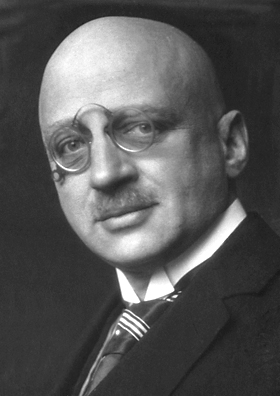
Fritz Haber demonstrated catalytic ammonia synthesis from nitrogen and hydrogen; Carl Bosch scaled it industrially, transforming fertilizer production and chemical synthesis worldwide. Source — Wikipedia:
Chemist Fritz Haber By The Nobel Foundation - http://nobelprize.org/chemistry/laureates/1918/index.html, Public domain, https://commons.wikimedia.org/w/index.php?curid=365964The End of Haber Bosch
1928 CE
Diels–Alder reaction discovered
Otto Diels and Kurt Alder discovered the [4+2] cycloaddition between dienes and dienophiles, providing a powerful ring-forming reaction central to organic synthesis. Source — Wikipedia:
Chemical diagram showing the Diels-Alder reaction of 1,3-butadiene and ethylene to give cyclohexene By User:Innerstream - Own work, Public domain, https://commons.wikimedia.org/w/index.php?curid=122283758
1951 CE
Ferrocene structure elucidated
Geoffrey Wilkinson and Ernst Otto Fischer determined the sandwich structure of ferrocene, launching modern metallocene and organometallic chemistry. Source — Wikipedia:
1953 CE
Ziegler–Natta catalysts for polymer synthesis
Karl Ziegler and Giulio Natta developed organotitanium catalysts for stereoregular polymerization of olefins, revolutionizing industrial polymer synthesis. Source — Wikipedia:
1965 CE
Woodward–Hoffmann rules published
Robert Burns Woodward and Roald Hoffmann formulated orbital symmetry rules governing pericyclic reactions, providing a theoretical framework for planning organic syntheses. Source — Wikipedia:
Stereospecificity of 4e electrocyclic ring opening reaction. By Ivogt - Own work, CC BY-SA 3.0, https://commons.wikimedia.org/w/index.php?curid=23034878
Geoffrey Wilkinson developed RhCl(PPh3)3, a homogeneous catalyst for selective hydrogenation of alkenes, widely used in both academic and pharmaceutical synthesis. Source — Wikipedia:
Wilkinson catalyst enables homogeneous hydrogenation By Benjah-bmm27 - Own work, Public domain, https://commons.wikimedia.org/w/index.php?curid=2164431
1979 CE
Palladium cross-coupling foundations laid
Akira Suzuki, Ei-ichi Negishi, and Richard Heck developed palladium-catalyzed cross-coupling reactions, enabling efficient carbon–carbon bond formation central to pharmaceutical and materials synthesis. Source — Wikipedia:
1990 CE
Corey formalizes retrosynthetic analysis
Elias James Corey systematized retrosynthetic analysis as a logic-based approach to designing multi-step organic syntheses, transforming how chemists plan complex molecule construction. Source — Wikipedia:
2001 CE
Asymmetric catalysis recognized with Nobel Prize
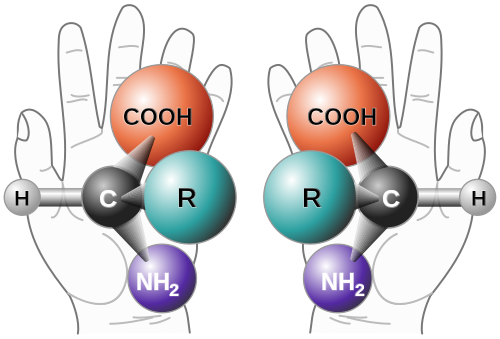
William Knowles, Ryoji Noyori, and Barry Sharpless were awarded the Nobel Prize for chirally catalyzed hydrogenation and oxidation reactions, enabling enantioselective synthesis of pharmaceuticals. Source — Wikipedia:
Amino Acid Chirality chirality with hands from http://www.nai.arc.nasa.gov/ A "chiral" molecule is one that is not superposable with its mirror image. Like left and right hands that have a thumb, fingers in the same order, but are mirror images and not the same, chiral molecules have the same things attached in the same order, but are mirror images and not the same. Although most amino acids can exist in both left and right handed forms, Life on Earth is made of left handed amino acids, almost exclusively. No one knows why this is the case. However, Drs. John Cronin and Sandra Pizzarello have shown that some of the amino acids that fall to earth from space are more left than right. Thus, the fact that we are made of L amino acids may be because of amino acids from space. Why do amino acids in space favor L? No one really knows, but it is known that radiation can also exist in left and right handed forms. So, there is a theory called the Bonner hypothesis, that proposes that left handed radiation in space (from a rotating neutron star for example) could lead to left handed amino acids in space, which would explain the left handed amino acids in meteorites. This is still speculative but our paper makes it much more plausible. In fact, this observations was one of the main reasons why we pursued this research. Although there were theories about how the amino acids could form in space in the ice, no one had shown that it was viable to make amino acids this way, until now. By Original: Unknown Vector: -- πϵρήλιο - Chirality with hands.jpg, Public domain, https://commons.wikimedia.org/w/index.php?curid=17071045
2010 CE
Palladium cross-coupling wins Nobel Prize
Richard Heck, Ei-ichi Negishi, and Akira Suzuki received the Nobel Prize for palladium-catalyzed cross-coupling, cementing organometallic catalysis as a cornerstone of modern synthetic chemistry. Source — Wikipedia:
2024 CE
AI-driven retrosynthesis and automated synthesis
Machine-learning models and automated synthesis platforms increasingly plan and execute multi-step organic syntheses, accelerating drug discovery and expanding the frontier of synthetical chemistry. Source — Wikipedia:


![Ball-and-stick model of the [(η2-C2H4)PtCl3]−] anion, as found in the crystal structure of Zeise's salt. X-ray crystallographic data from Acta Cryst. (1971). B27, 366-372. Model constructed in CrystalMaker 8.1. Image generated in Accelrys DS Visualizer.](https://upload.wikimedia.org/wikipedia/commons/thumb/c/c7/Zeise%27s-salt-anion-from-xtal-3D-balls.png/500px-Zeise%27s-salt-anion-from-xtal-3D-balls.png)