Egyptian artisans produced colored glass and synthetic pigments such as Egyptian blue, demonstrating early understanding of material composition and chemical transformation. Source — Wikipedia:
Egyptian Blue By FK1954 - Own work, Public domain, https://commons.wikimedia.org/w/index.php?curid=9814827
300 BCE
Indian wootz steel production
Indian metallurgists in the Tamil region developed wootz (crucible) steel, a high-carbon alloy whose crystalline structure produced superior blades and was later traded across Eurasia. Source — Wikipedia:
Watered pattern on iranian sword blade. By Rahil Alipour Ata Abadi - Transferred from en.wikipedia to Commons., GFDL, https://commons.wikimedia.org/w/index.php?curid=50800188
300 CE
Ge Hong's alchemy and elixir studies
Chinese Taoist alchemist Ge Hong documented chemical processes and substances including gunpowder ingredients in his work Baopuzi, laying foundations for systematic chemical investigation in China. · Wikipedia: https://en.wikipedia.org/wiki/Ge_Hong
One of a series of woodcuts of illustrious physicians and legendary founders of Chinese medicine from an edition of Bencao mengquan (Introduction to the Pharmacopoeia), engraved in the Wanli reign period of the Ming dynasty (1573-1620) -- Volume preface, 'Lidai mingyi hua xingshi' (Portraits and names of famous doctors through history). The images are attributed to a Tang (618-907) creator, Gan Bozong. The account in 'Portraits and Names of Famous Doctors through History' states: Ge Hong, a native of Danyang, lived under the Eastern Jin dynasty (317-420). His style-name was Zhichuan, and he also called himself Bao Pu Zi (The one who embraces simplicity). He held the office of magistrate of Gaolou (present-day Beiliu in Guangxi province). He was expert at curing illnesses and well-versed in the classics. A Daoist adept, he knew how to make pills of immortality. He lived as a hermit in Luofu Mountain (a Daoist holy place), where he made pills of immortality and became an Immortal, after which he was known as Ge Xianweng (Ge the Immortal Sage). Ge Hong spent many years in retreat, wandering in the mountains, cultivating himself and writing. He is the author of Bao Pu Zi and Zhouhou jiuzu fang (Book of Remedies in Extremis to be Kept up one's Sleeve) in three volumes.Woodcut By: Gan Bozong (Tang period, 618-907) By Gan Bozong (Tang period, 618-907) - https://wellcomeimages.org/indexplus/obf_images/5f/87/4e750c334bb041db425934535c34.jpg (hi-res image) Gallery: https://wellcomeimages.org/indexplus/image/L0039323.html Wellcome Collection gallery (2018-03-28): https://wellcomecollection.org/works/f65bzfbc CC-BY-4.0, CC BY 4.0, https://commons.wikimedia.org/w/index.php?curid=33926771
800 CE
Jabir ibn Hayyan systematizes chemistry
Persian-born alchemist Jabir ibn Hayyan introduced systematic experimental methods, distillation techniques, and classification of substances, founding early chemistry in the Islamic world. · Wikipedia: https://en.wikipedia.org/wiki/Jabir_ibn_Hayyan
15th-century artistic impression of Jabir ibn Hayyan (Geber) from Codici Ashburnhamiani 1166, Biblioteca Medicea Laurenziana, Florence fol 12r By Unknown author - https://cdn.britannica.com/10/132710-050-CECF006B/illustration-manuscript-Abu-Musa-Jabir-ibn-Hayyan.jpg, Public domain, https://commons.wikimedia.org/w/index.php?curid=166835469
850 CE
Al-Razi classifies chemical substances
Persian alchemist and physician al-Razi classified substances into spirits, metals, and stones and described distillation, sublimation, and calcination in his chemical treatises. · Wikipedia: https://en.wikipedia.org/wiki/Al-Razi
900 CE
Gunpowder formula in Wujing Zongyao
The Chinese military manual Wujing Zongyao recorded the first written gunpowder formula, a structural combination of saltpeter, sulfur, and charcoal that transformed warfare and chemistry. · Wikipedia: https://en.wikipedia.org/wiki/Wujing_Zongyao
The earliest known written description of the formula for gunpowder, from the Chinese Wujing Zongyao military manuscript that was compiled by 1044 during the Song Dynasty of China. It was written and compiled by the 11th century Song scholars Zeng Gongliang (曾公亮), Ding Du (丁度), and Yang Weide (楊惟德). The entry for this specific page is headed with the title "method for making the fire-chemical" ("huo yao fa"). This picture can also be found on page 119 of Joseph Needham's book Science and Civilization in China: Volume 5, Part 7. By PericlesofAthens - Own work (My book), Public domain, https://commons.wikimedia.org/w/index.php?curid=2549290
1100 CE
Zinc smelting at Zawar, India
Indian metallurgists at Zawar developed industrial-scale zinc smelting using retort distillation, the earliest documented production of metallic zinc, requiring precise control of chemical reduction. · Wikipedia: https://en.wikipedia.org/wiki/Zawar
1669 CE
Steno's law of crystal angles
Danish naturalist Nicolaus Steno observed that quartz crystals preserve constant interfacial angles regardless of size, founding the principle of crystallographic constancy of angles. · Wikipedia: https://en.wikipedia.org/wiki/Nicolas_Steno
Niels Steensen (da) - Nicholas Steno (1638 - 1686) var en pioner både indenfor anatomi og geologi. - Danish Scientist By Niels_stensen.jpg: J. P. Trap 1868 derivative work: nagualdesign (talk) - Niels_stensen.jpg, Public domain, https://commons.wikimedia.org/w/index.php?curid=18005089
1781 CE
Haüy's crystal structure theory
French mineralogist René Just Haüy proposed that crystals are built from regularly stacked molecular units, establishing the concept of crystal lattice structure. · Wikipedia: https://en.wikipedia.org/wiki/Ren%C3%A9_Just_Ha%C3%BCy
René Just Haüy (1743-1822) By Ambroise Tardieu (1788-1841) - http://digitalgallery.nypl.org/nypldigital/dgkeysearchdetail.cfm?trg=1&strucID=1762983&imageID=1624797&total=6&num=0&word=Tardieu%2C%20Ambroise&s=3¬word=&d=&c=&f=4&k=0&lWord=&lField=&sScope=&sLevel=&sLabel=&imgs=20&pos=5&e=w, Public domain, https://commons.wikimedia.org/w/index.php?curid=6739765
1808 CE
Dalton's atomic theory published
English chemist John Dalton published his atomic theory proposing that elements consist of indivisible atoms with characteristic masses, providing the theoretical basis for understanding molecular structure. · Wikipedia: https://en.wikipedia.org/wiki/John_Dalton
John Dalton oil on canvasmedium QS:P186,Q296955;P186,Q12321255,P518,Q861259 height: 91.4 cm (35.9 in); width: 71.4 cm (28.1 in)dimensions QS:P2048,91.4U174728dimensions QS:P2049,71.4U174728 By Thomas Phillips - National Portrait Gallery, London, Public domain, https://commons.wikimedia.org/w/index.php?curid=11727058
1850 CE
Pasteur discovers molecular chirality
French chemist Louis Pasteur separated tartaric acid crystals into left- and right-handed forms, discovering molecular chirality and establishing the importance of three-dimensional molecular structure. · Wikipedia: https://en.wikipedia.org/wiki/Louis_Pasteur
Studio portrait of Louis Pasteur, restored (removed dust, scratches, and what looked to be a water stain) By Paul Nadar - File:Louis Pasteur, foto av Paul Nadar.jpg, Public domain, https://commons.wikimedia.org/w/index.php?curid=28039885
1858 CE
Kekulé's structural theory of molecules
German chemist August Kekulé proposed that carbon is tetravalent and can form chain structures, founding structural organic chemistry and enabling the prediction of molecular architectures. · Wikipedia: https://en.wikipedia.org/wiki/August_Kekul%C3%A9
Friedrich August Kekulé von Stradonitz, german chemist By Unknown author - https://www.gettyimages.ie/detail/news-photo/german-organic-chemist-friedrich-august-kekule-von-news-photo/72242781, Public domain, https://commons.wikimedia.org/w/index.php?curid=167877
1874 CE
Van't Hoff and Le Bel propose tetrahedral carbon
Jacobus van't Hoff and Joseph Le Bel independently proposed that carbon atoms have a tetrahedral geometry, explaining optical activity and founding stereochemistry. · Wikipedia: https://en.wikipedia.org/wiki/Jacobus_Henricus_van_'t_Hoff
Portrait of Jacobus Henricus van 't Hoff, seated, looking into camera. By Nicola Perscheid - one or more third parties have made copyright claims against Wikimedia Commons in relation to the work from which this is sourced or a purely mechanical reproduction thereof. This may be due to recognition of the "sweat of the brow" doctrine, allowing works to be eligible for protection through skill and labour, and not purely by originality as is the case in the United States (where this website is hosted). These claims may or may not be valid in all jurisdictions. As such, use of this image in the jurisdiction of the claimant or other countries may be regarded as copyright infringement. Please see Commons:When to use the PD-Art tag for more information., Public domain, https://commons.wikimedia.org/w/index.php?curid=44101635
Nov 8, 1895 CE
Röntgen discovers X-rays
German physicist Wilhelm Röntgen discovered X-rays, providing the electromagnetic radiation that would become the primary tool for determining crystal and molecular structures. · Wikipedia: https://en.wikipedia.org/wiki/Wilhelm_R%C3%B6ntgen
Portrait of Wilhelm Conrad Röntgen between 1888 and 1900. By Erwin Hanfstaengl - https://global.museum-digital.org/singleimage?imagenr=2399678, Public domain, https://commons.wikimedia.org/w/index.php?curid=182243188Wilhelm Röntgen: X-rays | Heroes of Progress | Ep. 26
1912 CE
Von Laue's X-ray diffraction in crystals
Max von Laue demonstrated that X-rays diffract through copper sulfate crystals, proving both the wave nature of X-rays and the periodic lattice structure of crystals. Source — Wikipedia:
Max von Laue By Nobel foundation - http://nobelprize.org/nobel_prizes/physics/laureates/1914/laue-bio.html, Public domain, https://commons.wikimedia.org/w/index.php?curid=6201194
1913 CE
Bragg law and first crystal structure
William Henry and William Lawrence Bragg derived Bragg's law relating X-ray diffraction angles to crystal lattice spacing and solved the structure of sodium chloride, founding X-ray crystallography. · Wikipedia: https://en.wikipedia.org/wiki/Bragg's_law
1929 CE
Raman effect discovered
Indian physicist C. V. Raman discovered the inelastic scattering of light by molecules, providing a spectroscopic method to probe molecular vibrational structure and chemical bonds. · Wikipedia: https://en.wikipedia.org/wiki/C._V._Raman
Dr. Chandrasekhara Venkata Raman By Nobel Foundation - From Nobel Lectures, Physics 1922-1941, Elsevier Publishing Company, Amsterdam, 1965, Public domain, https://commons.wikimedia.org/w/index.php?curid=4213636
1930 CE
Linus Pauling's chemical bond theory
Linus Pauling published rules governing crystal structures and principles of chemical bonding, establishing how atomic properties determine molecular and crystal architecture. · Wikipedia: https://en.wikipedia.org/wiki/Linus_Pauling
Linus Pauling in the 1940s By Unknown author - Oregon State University [1], CC BY-SA 2.0, https://commons.wikimedia.org/w/index.php?curid=144490366
1936 CE
Debye Nobel Prize for molecular structure
Peter Debye received the Nobel Prize for studies of dipole moments and X-ray diffraction, methods central to determining molecular geometry and intermolecular forces. · Wikipedia: https://en.wikipedia.org/wiki/Peter_Debye
Petrus Josephus Wilhelmus Debije (1884-1966) By Unknown author - http://chem.ch.huji.ac.il/~eugeniik/history/debye.html, Public domain, https://commons.wikimedia.org/w/index.php?curid=1083819
1953 CE
Watson and Crick DNA double helix
James Watson and Francis Crick used Rosalind Franklin's X-ray diffraction data to determine the double-helix structure of DNA, a landmark of structural chemistry in biology. · Wikipedia: https://en.wikipedia.org/wiki/Nucleic_acid_double_helix
Static thumb frame of Animation of the structure of a section of DNA. The bases lie horizontally between the two spiraling strands. By 84user adapting file originally uploaded by Richard Wheeler (Zephyris) at en.wikipedia - Derived from File:DNA orbit animated.gif originally from here., CC BY-SA 3.0, https://commons.wikimedia.org/w/index.php?curid=6285050DNA double helix: how James Watson and Francis Crick cracked the secret of life
1957 CE
Kendrew solves first protein structure
John Kendrew determined the three-dimensional structure of myoglobin using X-ray crystallography, the first protein structure solved at atomic resolution. · Wikipedia: https://en.wikipedia.org/wiki/John_Kendrew
John Cowdery Kendrew (24 March 1917 – 23 August 1997) By Unknown author - http://www.nobelprize.org/nobel_prizes/chemistry/laureates/1962/, Public domain, https://commons.wikimedia.org/w/index.php?curid=18334629
1965 CE
Hoffmann and Woodward orbital symmetry rules
Roald Hoffmann and Robert Woodward published rules relating molecular orbital symmetry to chemical reactivity, linking electronic structure to reaction outcomes. · Wikipedia: https://en.wikipedia.org/wiki/Woodward%E2%80%93Hoffmann_rules
Stereospecificity of 4e electrocyclic ring opening reaction. By Ivogt - Own work, CC BY-SA 3.0, https://commons.wikimedia.org/w/index.php?curid=23034878
1971 CE
Pople develops computational chemistry methods
John Pople developed the GAUSSIAN program for ab initio quantum chemical calculations, making computational determination of molecular structures and properties practical. · Wikipedia: https://en.wikipedia.org/wiki/John_Pople
Sir John Anthony Pople w czasie spotkania z prezydentem Billem Clintonem w Białym Domu (1998) By The White House - https://pl.wikipedia.org/wiki/Plik:Clinton%261998NobelLaureates.jpg, Public domain, https://commons.wikimedia.org/w/index.php?curid=32833562
1981 CE
Binnig and Rohrer invent STM
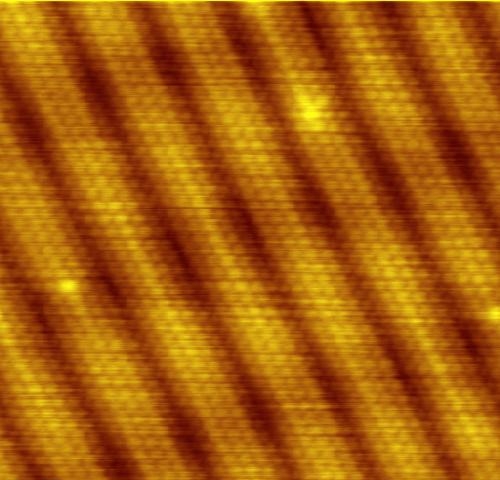
Gerd Binnig and Heinrich Rohrer invented the scanning tunneling microscope, enabling direct imaging of individual atoms on surfaces and structural chemistry at the single-atom scale. Source — Wikipedia:
Image of surface reconstruction on a clean Gold (Au(100)) surface, as visualized using scanning tunneling microscopy. The individual atoms composing the material are visible. Surface reconstruction causes the surface atoms to deviate from the bulk crystal structure, and arrange in columns several atoms wide with regularly spaced pits between them. Technical details: Atomically resolved STM image of clean Au(100). This image is made with hjjnh GBhh an Omicron Low Temperature STM and RHK Technology electronics by Erwin Rossen, Eindhoven University of Technology, 2006. Parameters: p<1e-11 mbar, T is 77 K, I_setpoint is 6 nA, V_bias is 1 mV, Au(100) surface is Ar sputtered (1,5 kV, 2uA, 30 minutes) and annealed (500°C, 30 minutes). By Erwinrossen - en:File:Atomic_resolution_Au100.JPG, see upload log, Public domain, https://commons.wikimedia.org/w/index.php?curid=17901421986 Nobel Prize lecture by Gerd Binnig and Heinrich Rohrer: SCANNING TUNNELING MICROSCOPY - FROM...
1985 CE
Discovery of buckminsterfullerene
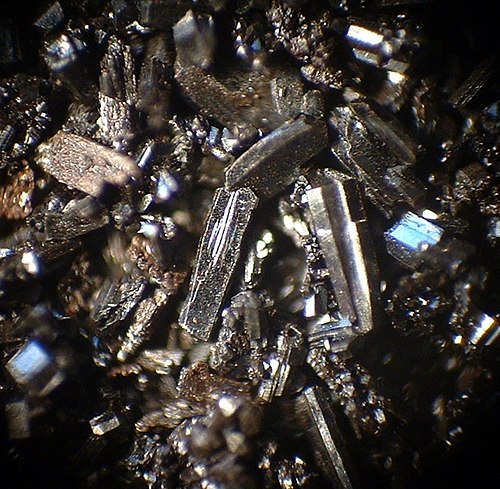
Harry Kroto, Richard Smalley, and Robert Curl discovered C60 buckminsterfullerene, a spherical carbon molecule whose structure was confirmed by spectroscopy, opening the field of nanostructural chemistry. · Wikipedia: https://en.wikipedia.org/wiki/Buckminsterfullerene
C60 Buckminsterfullerene, crystallized. From the Leopold-Franzens-Universität Innsbruck. By Fotograf: Jochen Gschnaller - German Wikipedia, original upload Dez 2004 by Moebius1 (selfmade), CC BY-SA 3.0, https://commons.wikimedia.org/w/index.php?curid=350278C60: Buckminsterfullerene, Not Just a Pretty Molecule
1998 CE
Nobel Prize for computational chemistry
Walter Kohn and John Pople received the Nobel Prize for density functional theory and computational methods, establishing computational chemistry as essential for predicting molecular structures. · Wikipedia: https://en.wikipedia.org/wiki/Density_functional_theory
2000 CE
Protein Data Bank reaches structural milestone
The Protein Data Bank surpassed 10,000 atomic-resolution structures, consolidating X-ray crystallography and NMR spectroscopy data as a global resource for structural chemistry and biology. · Wikipedia: https://en.wikipedia.org/wiki/Protein_Data_Bank
2013 CE
Nobel Prize for multiscale computational modeling
Martin Karplus, Michael Levitt, and Arieh Warshel received the Nobel Prize for developing multiscale computational models combining classical and quantum mechanics to simulate molecular structures and reactions. · Wikipedia: https://en.wikipedia.org/wiki/Martin_Karplus
Nobel Laureates 2013 press conference at the Royal Swedish Academy of Sciences in December 2013 By Bengt Nyman - Flickr: IMG_7546, CC BY 2.0, https://commons.wikimedia.org/w/index.php?curid=30047229
2020 CE
AlphaFold predicts protein structures
DeepMind's AlphaFold 2 demonstrated near-experimental accuracy in predicting protein three-dimensional structures from amino acid sequences, transforming structural chemistry through machine learning. · Wikipedia: https://en.wikipedia.org/wiki/AlphaFold
AlphaFold's predicted structure of T1044 (PDB 6VR4), an RNA polymerase of crAss-like phage phi14:2 By Kathryn Tunyasuvunakool, Jonas Adler, Zachary Wu, Tim Green, Michal Zielinski, Augustin Žídek, Alex Bridgland, Andrew Cowie, Clemens Meyer, Agata Laydon, Sameer Velanka *, Gerard J Kleywegt *, Alex Bateman *, Richard Evans, Alexander Pritzel, Michael Figurnov, Olaf Ronneberger, Russ Bates, Simon A. A. Kohl, Anna Potapenko, Andrew J Ballard, Bernardino Romera-Paredes, Stanislav Nikolov, Rishub Jain, Ellen Clancy, David Reiman, Stig Petersen, Andrew Senior, Koray Kavukcuoglu, Ewan Birney *, Pushmeet Kohli, John Jumper, Demis Hassabis - https://deepmind.google/blog/enabling-high-accuracy-protein-structure-prediction-at-the-proteome-scale/, CC BY 4.0, https://commons.wikimedia.org/w/index.php?curid=188769148AlphaFold: The making of a scientific breakthrough