Encyclopedia/3. History, Societies & Civilizations/09. Modern Nations/05. Europe • Curated by Admin Timeline.sg
History of Finland, sourced from Wikipedia's "Timeline of Finnish history".
Chronological Storyline (83 Milestones)
3500 BCE
Giant's Church
Giant's Church was constructed. <!-- WP:RS needed; removed link to WP--> Source — Wikipedia, "Timeline of Finnish history" (BC):
Kastelli Giant's church, a rectangular neolithic stone wall located in Raahe, Finland. Structure is photographed from its southeast corner towards the northwest corner. By Xanara - Own work, CC BY-SA 4.0, https://commons.wikimedia.org/w/index.php?curid=41388172
2000 BCE
Kiukainen culture
Beginning of the Kiukainen culture. Source — Wikipedia, "Timeline of Finnish history" (BC):
1500 BCE
Bronze Age
Beginning of the Bronze Age. Source — Wikipedia, "Timeline of Finnish history" (BC):
Map of the diffusion of metallurgy. By User:Want - File:Diffusion métallurgie.png: After M. Otte (2007) Vers la Préhistoire, de Boeck, Bruxelles, CC BY-SA 3.0 cz, https://commons.wikimedia.org/w/index.php?curid=41316620
500 BCE
Iron Age
Beginning of the Iron Age. Source — Wikipedia, "Timeline of Finnish history" (BC):
Weapons and fibulae from a warrior's grave, c. 350 BC. Grave no. 91, Celtic burial site, "Rain", Münsingen, Switzerland. By Unknown author - Own photograph by Sandstein, CC BY 3.0, https://commons.wikimedia.org/w/index.php?curid=8656346
9 BCE
Homo sapiens
Finland was inhabited by modern humans. Source — Wikipedia, "Timeline of Finnish history" (BC):
Akha couple in northern Thailand. The husband is carrying the stem of a banana-plant, which will be fed to their pigs. By Weltenbummler84 - This image has been extracted from another file, CC BY-SA 2.0 de, https://commons.wikimedia.org/w/index.php?curid=11183014
9 BCE
End of the last ice age
End of the last ice age in Finland. Source — Wikipedia, "Timeline of Finnish history" (BC):
6 BCE
First pottery in Finland.
First pottery in Finland. Source — Wikipedia, "Timeline of Finnish history" (BC):
0 CE
Roman period
Beginning of the Roman period. Source — Wikipedia, "Timeline of Finnish history" (1st millennium):
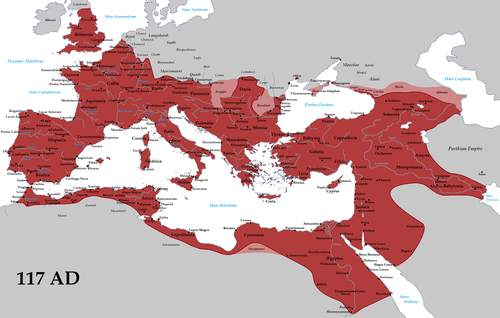
The Roman Empire (red) and its clients (pink) in 117 AD during the reign of emperor Trajan. By Tataryn - Own work, CC BY-SA 3.0, https://commons.wikimedia.org/w/index.php?curid=19625326
400 CE
Migration period
Beginning of the Migration period. Source — Wikipedia, "Timeline of Finnish history" (1st millennium):
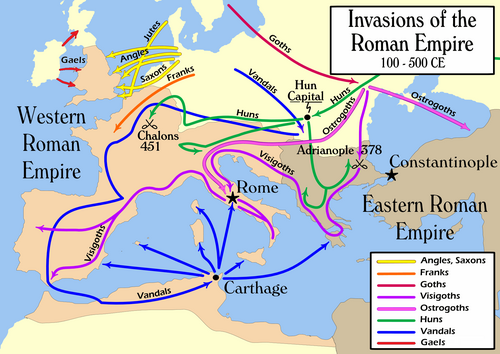
Map of the "barbarian" invasions by the Angles, Saxons, Jutes, Franks, Goths, Visigoths, Ostrogoths, Huns and Vandals of the Roman Empire showing the major incursions from 100 to 500 CE. References Cornell, Tim; Matthews, John (1982), Atlas of the Roman World, Facts on File, NY, ISBN: 0871966522. Ermatinger, James W; (2004) Decline and Fall of the Roman Empire, Greenwood Pub Group, NY, ISBN: 0313326924. Various, Historical Atlas of the World, 1970, Barnes & Noble, NY. Ancona, Francis ; Atlas Of The World, 1999, Barnes & Noble, NY. By User:MapMaster - Own work, CC BY-SA 2.5, https://commons.wikimedia.org/w/index.php?curid=1234669
575 CE
Merovingian period
Beginning of the Merovingian period. Source — Wikipedia, "Timeline of Finnish history" (1st millennium):
The Merovingian kingdoms at their height By Rudric - File:Merovingian_dynasty.jpg, CC BY-SA 3.0, https://commons.wikimedia.org/w/index.php?curid=153687911
800 CE
Merovingian period
End of the Merovingian period. Source — Wikipedia, "Timeline of Finnish history" (1st millennium):
The Merovingian kingdoms at their height By Rudric - File:Merovingian_dynasty.jpg, CC BY-SA 3.0, https://commons.wikimedia.org/w/index.php?curid=153687911
1239 CE
Second Swedish Crusade
The Second Swedish Crusade took place. Source — Wikipedia, "Timeline of Finnish history" (13th century):
Sort of an imagery collage of Birger Jarl conquering Häme and the construction of Häme Castle. On the left there is a Christian Bishop. By Joseph Alanen - Milla Bergström https://www.skhs.fi/viela-ehdit-taidetta-tampereella/ (cropped), Public domain, https://commons.wikimedia.org/w/index.php?curid=92531946
1278 CE
Karelia
Karelia was controlled by Novgorod. Source — Wikipedia, "Timeline of Finnish history" (13th century):
A map of the traditional Karelian regions. Note that Ingria is not considered part of Karelia. By User:Jniemenmaa - Transferred from English Wikipedia (File:Many_Karelias.png); see original upload log Data source: Karjala: Karjala-nimistä. Kotimaisten kielten tutkimuskeskuksen julkaisuja 129., CC BY-SA 3.0, https://commons.wikimedia.org/w/index.php?curid=72911
1293 CE
Third Swedish Crusade
The Third Swedish Crusade took place. Source — Wikipedia, "Timeline of Finnish history" (13th century):
A map of the growing Swedish dominion over what is today Finland in the late 13th century. Presupposing a passively annexed power base in Finland Proper, this map illustrates the direction of what has been numericalized as the latter two Swedish crusades against Tavastians, Karelians, and the princes of Novgorod; the veracity of the first one is disputed. Several notable castles of the time are also shown, as well as an interpretation of the border established by the Treaty of Nöteborg References Line, P. (2016). Sweden's Conquest of Finland: A Clash of Cultures? In A. V. Murray (Editor), The Clash of Cultures on the Medieval Baltic Frontier (p. 73–99). University of Leeds. Lavery J. (2006). The History of Finland. p. 33. Greenwood Press. By Cattette - Own work, CC BY 4.0, https://commons.wikimedia.org/w/index.php?curid=147207171
Aug 12, 1323 CE
Treaty of Nöteborg
The Treaty of Nöteborg was signed. Source — Wikipedia, "Timeline of Finnish history" (14th century):
Map of the two-branch borders set in the treaty of Nöteborg in 1323. By Velivieras - Own work, CC BY-SA 4.0, https://commons.wikimedia.org/w/index.php?curid=65457820
1348 CE
Magnus IV of Sweden
Magnus IV of Sweden led a crusade against the Orthodox, but they failed. Source — Wikipedia, "Timeline of Finnish history" (14th century):
King Magnus Eriksson IV of Sweden, VII of Norway, on the title page of his Swedish national law (Magnus Erikssons landslag) By Unknown author - Magnus Erikssons landslag, Codex B 68, 1430 (56 years after Magnus's death), Public domain, https://commons.wikimedia.org/w/index.php?curid=20996785
1397 CE
Kalmar Union
The Kalmar Union was established. Source — Wikipedia, "Timeline of Finnish history" (14th century):
This is merely a recreation of what the flag is thought to have looked like. There are no surviving flags or pictorial evidence as to its appearance. See article at Flags of the World. By ThrashedParanoid - Own work Original PNG made by E70., Public domain, https://commons.wikimedia.org/w/index.php?curid=556733
1403 CE
Eric of Pomerania
Eric of Pomerania arrived in Finland. Source — Wikipedia, "Timeline of Finnish history" (15th century):
Eric of Pomerania By Unknown author - Nationalmuseum, Public domain, https://commons.wikimedia.org/w/index.php?curid=52134081
1407 CE
Eric of Pomerania
Eric of Pomerania arrived in Finland again. Source — Wikipedia, "Timeline of Finnish history" (15th century):
Eric of Pomerania By Unknown author - Nationalmuseum, Public domain, https://commons.wikimedia.org/w/index.php?curid=52134081
1495 CE
Russo-Swedish War
Russo-Swedish War (1495–97): The war began. Source — Wikipedia, "Timeline of Finnish history" (15th century):
Russo-Swedish War By Unknown author, Public domain, https://commons.wikimedia.org/w/index.php?curid=1962950
1497 CE
Russo-Swedish War
Russo-Swedish War (1495–97): The war ended. Source — Wikipedia, "Timeline of Finnish history" (15th century):
Russo-Swedish War By Unknown author, Public domain, https://commons.wikimedia.org/w/index.php?curid=1962950
1521 CE
The Kalmar Union was disestablished.
The Kalmar Union was disestablished. Source — Wikipedia, "Timeline of Finnish history" (16th century):
1550 CE
Helsinki
Founding of Helsinki. Source — Wikipedia, "Timeline of Finnish history" (16th century):
Suomenlinna, a fortress near Helsinki, Finland. Picture taken from a ferry. By Michal Pise, Michal.Pise - Own work, CC BY 2.0, https://commons.wikimedia.org/w/index.php?curid=98183601
1610 CE
Ingrian War
Ingrian War: The war began. Source — Wikipedia, "Timeline of Finnish history" (17th century):
Ingrian War By Johan Hammer - Nationalmuseum, Public domain, https://commons.wikimedia.org/w/index.php?curid=52113043
1611 CE
Gustavus Adolphus
Gustavus Adolphus became king of Sweden. Source — Wikipedia, "Timeline of Finnish history" (17th century):
Gustavus Adolphus By Presumably Jacob Hoefnagel - Google Arts & Culture: Home page - Image, Public domain, https://commons.wikimedia.org/w/index.php?curid=21785153
1617 CE
Ingrian War
Ingrian War: The war ended. Source — Wikipedia, "Timeline of Finnish history" (17th century):
Ingrian War By Johan Hammer - Nationalmuseum, Public domain, https://commons.wikimedia.org/w/index.php?curid=52113043
1655 CE
Second Northern War
Second Northern War: The war began. Source — Wikipedia, "Timeline of Finnish history" (17th century):
Second Northern War Collage: Battle of Warka 1656; the first major Polish victory over the Swedes in the war Battle of Warsaw 1656; the largest battle of the war Unknown battle in the Second Northern War, between Poles and Swedes Swedish March Across the Belts 1658, resulting in a crushing Danish–Norwegian defeat Battle of the Sound 1658; the Dutch breaks through the Swedish blockade of Copenhagen Assault on Copenhagen 1659; the Swedes suffers heavy losses as they attempt to take Copenhagen by storm By Imonoz - Own work, CC BY-SA 4.0, https://commons.wikimedia.org/w/index.php?curid=124880008
1660 CE
Second Northern War
Second Northern War: The war ended. Source — Wikipedia, "Timeline of Finnish history" (17th century):
Second Northern War Collage: Battle of Warka 1656; the first major Polish victory over the Swedes in the war Battle of Warsaw 1656; the largest battle of the war Unknown battle in the Second Northern War, between Poles and Swedes Swedish March Across the Belts 1658, resulting in a crushing Danish–Norwegian defeat Battle of the Sound 1658; the Dutch breaks through the Swedish blockade of Copenhagen Assault on Copenhagen 1659; the Swedes suffers heavy losses as they attempt to take Copenhagen by storm By Imonoz - Own work, CC BY-SA 4.0, https://commons.wikimedia.org/w/index.php?curid=124880008
1661 CE
Treaty of Cardis
The Treaty of Cardis was signed with the Russian Empire. Source — Wikipedia, "Timeline of Finnish history" (17th century):
Kärde rahumajake By Metsavend - Own work by the original uploader, CC BY-SA 3.0, https://commons.wikimedia.org/w/index.php?curid=15755356
1695 CE
Great Famine of 1695–1697
The Great Famine of 1695–1697 began. Source — Wikipedia, "Timeline of Finnish history" (17th century):
1697 CE
Great Famine of 1695–1697
The Great Famine of 1695–1697 ended with one-third of the population dead. Source — Wikipedia, "Timeline of Finnish history" (17th century):
1700 CE
Great Northern War
Great Northern War: The war began. Source — Wikipedia, "Timeline of Finnish history" (17th century):
Great Northern War Collage: Battle of Narva 1700; the first major battle of the war, resulting in a complete Russian withdrawal out of Swedish Ingria which allowed Charles XII of Sweden to turn his forces against Augustus the Strong of Poland and Saxony. Crossing of the Düna 1701; Charles XII defeats the Saxons on the opposite bank of the river Düna, after which he conquers Courland and prepares for an invasion of Poland. Battle of Poltava 1709; after having forced Augustus to surrender following the invasions of Poland and Saxony, Charles XII launches an invasion of Russia to deal with his last enemy, Peter the Great. After more than a year of campaigning, the two rulers met at Poltava where Charles XII suffered a disastrous defeat which turned the tide of the war. Battle of Gadebusch 1712; following the Battle of Poltava, both Denmark–Norway and Saxony reentered the war. The Swedish German dominions were soon attacked, urging Sweden proper to send a relief army. At Gadebusch 1712, the Danes and Saxons suffered a heavy blow but the Swedish army was subsequently trapped and destroyed at Tönning the following year. "Bringing Home the Body of King Charles XII" 1718; Swedish Finland fell to the Russians in 1714, while the last Swedish continental stronghold surrendered in 1716. To regain the initiative, Charles XII launched an invasion of Norway in 1718. The king was shot dead during the Siege of Fredriksten and his body was carried back home to Sweden. After his death, Sweden lost all initiative in the war, which ended with the Treaty of Nystad in 1721. By Imonoz - Own work, CC BY-SA 4.0, https://commons.wikimedia.org/w/index.php?curid=124808488
1703 CE
Saint Petersburg
Saint Petersburg was founded. Source — Wikipedia, "Timeline of Finnish history" (18th century):
Aerial photo of St. Michael Castle in Saint Petersburg, Russia. By A.Savin - This image has been extracted from another file, FAL, https://commons.wikimedia.org/w/index.php?curid=182383586
Feb 27, 1710 CE
Battle of Helsingborg
The Battle of Helsingborg began. Source — Wikipedia, "Timeline of Finnish history" (18th century):
Print of the Battle of Helsingborg between Swedish and Danish troops in 1710 By Unknown author - Scanned from the book Svenska slagfält, Wahlström & Widstrand, 2003, ISBN 91-46-21087-3. Originally, the print is a part of the collections of The Military Archives of Sweden, Public domain, https://commons.wikimedia.org/w/index.php?curid=763993
1718 CE
Charles XII
Charles XII was killed. Source — Wikipedia, "Timeline of Finnish history" (18th century):
Karl XII var berömd i hela Europa. Alla ville ha hans porträtt. Det här har tillkommit i den franske hovmålaren Rigauds ateljé. I skinande rustning och med fladdrande mantel står kungen uppställd som på en teaterscen – kriget i bakgrunden liknar mest en kuliss. Det korta håret hade blivit hans signum, en symbol för soldatkungen. 1715, när porträttet målades, var den svenska stormakten på väg att falla samman. Verkliga krig, mycket blodigare än målningens teaterkrig, rasade på alla håll. Tre år senare var kungen död. By Workshop of Hyacinthe Rigaud - NM 883, Public domain, https://commons.wikimedia.org/w/index.php?curid=77134106
Aug 30, 1721 CE
Treaty of Nystad
The Treaty of Nystad was signed. Source — Wikipedia, "Timeline of Finnish history" (18th century):
Treaty of Nystad By Mix321 at Polish Wikipedia - Atlas historyczny dla liceum, wyd. PWN. Transferred from pl.wikipedia to Commons by Piotrus using CommonsHelper., CC BY-SA 3.0, https://commons.wikimedia.org/w/index.php?curid=8774859
Gustav III started a coup d'état. Source — Wikipedia, "Timeline of Finnish history" (18th century):
Gustav III of Sweden By Alexander Roslin - Cropped from this image. See also Nationalmuseum., Public domain, https://commons.wikimedia.org/w/index.php?curid=80450534
Jun 1, 1788 CE
Gustav III of Sweden
Gustav III started a war against Russia. Source — Wikipedia, "Timeline of Finnish history" (18th century):
Gustav III of Sweden By Alexander Roslin - Cropped from this image. See also Nationalmuseum., Public domain, https://commons.wikimedia.org/w/index.php?curid=80450534
Aug 1, 1790 CE
Russo-Swedish War
Russo-Swedish War (1788–1790): The war ended. Source — Wikipedia, "Timeline of Finnish history" (18th century):
Russo-Swedish War 1788–1790 Collage: Battle of Hogland 1788 Battle of Uttismalm 1789 Battle of Vyborg Bay 1790 Battle of Svensksund 1790 By Imonoz - Own work, CC BY-SA 4.0, https://commons.wikimedia.org/w/index.php?curid=124868528
Feb 21, 1808 CE
Finnish War
Finnish War: The war began. Source — Wikipedia, "Timeline of Finnish history" (19th century):
Finnish War Collage: Siege of Sveaborg 1808 Battle of Revolax 1808 Battle of Oravais 1808 Sven Dufva at Koljonvirta 1808 Battle of Ratan 1809 By Imonoz - Own work, CC BY-SA 4.0, https://commons.wikimedia.org/w/index.php?curid=125229753
Mar 29, 1809 CE
Diet of Finland
Diet of Finland was formed. Source — Wikipedia, "Timeline of Finnish history" (19th century):
The throne used by Emperor Alexander I in the Porvoo Parliament in 1809. The seat was commissioned by Emperor Paul I in St. Petersburg in 1797. The throne has been part of the collections of the National Museum of Finland since 1919. By Ohto Kokko - Own work, CC BY-SA 3.0, https://commons.wikimedia.org/w/index.php?curid=769184
1818 CE
House of Bernadotte
The House of Bernadotte was established. Source — Wikipedia, "Timeline of Finnish history" (19th century):
House of Bernadotte Shield. By arcjgh - Created by user:arcjgh in inkscape, using Image:Sweden_greater_arms.png as a guide and many other arms as templates., CC BY-SA 3.0, https://commons.wikimedia.org/w/index.php?curid=1356744
1869 CE
Ecclesiastical Law of 1869
The Ecclesiastical Law of 1869 was passed. Source — Wikipedia, "Timeline of Finnish history" (19th century):
1889 CE
Dissenter Law of 1889
The Dissenter Law of 1889 was passed. Source — Wikipedia, "Timeline of Finnish history" (19th century):
1892 CE
Finnish language
Finnish became an official language of Finland. Source — Wikipedia, "Timeline of Finnish history" (19th century):
Fixed an error of sight References: File:Languages of Finnish municipalities (2016).svg https://www.isof.se/nationella-minoritetssprak/meankieli/lar-dig-mer-om-meankieli https://www.kvenskinstitutt.no/sprak/kvenske-dialekter/ By ValtteriLahti12 - Own work, CC BY-SA 4.0, https://commons.wikimedia.org/w/index.php?curid=153307764
1899 CE
Russification of Finland
The Russification of Finland took place. Source — Wikipedia, "Timeline of Finnish history" (19th century):
The Attack (Hyökkäys), an 1899 oil painting by Edvard Isto, depicting the Russification of Finland as a double-headed eagle. By fi:User:MPorciusCato, edited by fi:User:Tungsten - This file was derived from: Hyökkäys by Eetu Isto, 1905.jpg, Public domain, https://commons.wikimedia.org/w/index.php?curid=11753927
Jul 26, 1919 CE
Kaarlo Juho Ståhlberg
Kaarlo Juho Ståhlberg became the 1st president of Finland. Source — Wikipedia, "Timeline of Finnish history" (20th century):
Kaarlo Juho Ståhlberg By Unknown author - Suomen tasavallan presidentti: Edelliset presidentit, Public domain, https://commons.wikimedia.org/w/index.php?curid=165026054
Oct 14, 1920 CE
Treaty of Tartu
Treaty of Tartu was signed to improve relations with the Soviet Union. Source — Wikipedia, "Timeline of Finnish history" (20th century):
Treaty of Tartu By Unknown author, CC BY-SA 3.0, https://commons.wikimedia.org/w/index.php?curid=1503879
Mar 2, 1925 CE
Lauri Kristian Relander
Lauri Kristian Relander became president of Finland. Source — Wikipedia, "Timeline of Finnish history" (20th century):
The second president of Finland (1925–1931), Lauri Kristian Relander (1883–1942). By AnonymousUnknown author - https://www.finna.fi/Cover/Show?id=nurmes.knp-1644&index=0&size=large&source=SolrImage record page in Finna: nurmes.knp-1644, CC BY 4.0, https://commons.wikimedia.org/w/index.php?curid=5847805
Mar 2, 1931 CE
Pehr Evind Svinhufvud
Pehr Evind Svinhufvud became president of Finland. Source — Wikipedia, "Timeline of Finnish history" (20th century):
This image has been extracted from another file By Unknown author - http://muistot.hs.fi/uploads/assets/obituary/4240_Pehr_Evind_Svinhufvud.jpg, Public domain, https://commons.wikimedia.org/w/index.php?curid=37266132
1932 CE
Mäntsälä rebellion
Mäntsälä rebellion took place. Source — Wikipedia, "Timeline of Finnish history" (20th century):
The Mäntsälä rebellion. March 7th, 1932. Six machine guns of the rebels. By Unknown author - Lehtikuva, Public domain, https://commons.wikimedia.org/w/index.php?curid=20713195
Mar 1, 1937 CE
Kyösti Kallio
Kyösti Kallio became president of Finland. Source — Wikipedia, "Timeline of Finnish history" (20th century):
Президент Финляндии Кюёсти Каллио. By Unknown author - presidentti.fi, Public domain, https://commons.wikimedia.org/w/index.php?curid=108402634
Nov 30, 1939 CE
Winter War
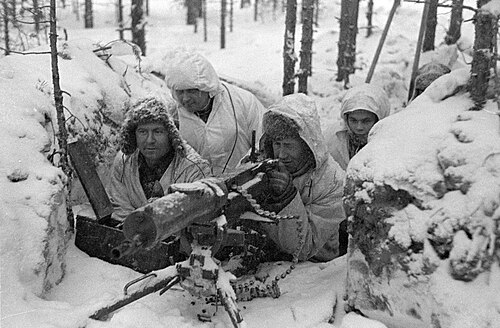
Winter War: The war began. Source — Wikipedia, "Timeline of Finnish history" (20th century):
Konekivääripesäke 100 m ryssistä n. 5 km Lemetistä pohjoiseen. Kuvan ampuja puolankalainen Antti Väisänen. Vasemmalla puolella todennäköisesti Onni Valkonen. By Unknown author. - finna.fi, Public domain, https://commons.wikimedia.org/w/index.php?curid=549346
Mar 13, 1940 CE
Winter War
Winter War: The war ended. Source — Wikipedia, "Timeline of Finnish history" (20th century):
Konekivääripesäke 100 m ryssistä n. 5 km Lemetistä pohjoiseen. Kuvan ampuja puolankalainen Antti Väisänen. Vasemmalla puolella todennäköisesti Onni Valkonen. By Unknown author. - finna.fi, Public domain, https://commons.wikimedia.org/w/index.php?curid=549346
Jun 25, 1941 CE
Continuation War
Continuation War: The war began against Soviet Union. Source — Wikipedia, "Timeline of Finnish history" (20th century):
Finnish soldiers in a shelter on the VT-line during an alert By Sot.virk. Uuno Laukka - https://finna.fi/Record/sa-kuva.sa-kuva-143060?lng=en-gb, Military Museum, Public domain, https://commons.wikimedia.org/w/index.php?curid=30652283
Aug 4, 1944 CE
Carl Gustaf Emil Mannerheim
Carl Gustaf Emil Mannerheim became president of Finland. Source — Wikipedia, "Timeline of Finnish history" (20th century):
Field Marshal C.G.E. Mannerheim By sa-kuva - http://sa-kuva.fi/neo#, Public domain, https://commons.wikimedia.org/w/index.php?curid=25766502
Apr 27, 1945 CE
Lapland War
Lapland War: The last of the German troops left the country and thus, ending the war in Finland. Source — Wikipedia, "Timeline of Finnish history" (20th century):
Picture of a sign the Germans left in Muonio, Lapland: "As a thanks for not demonstrating brotherhood in arms" By Sot.virk. A.Viitasalo - sa-kuva.sa-kuva-148587, Military Museum, Public domain, https://commons.wikimedia.org/w/index.php?curid=6416869
Mar 11, 1946 CE
Juho Kusti Paasikivi
Juho Kusti Paasikivi became president of Finland. Source — Wikipedia, "Timeline of Finnish history" (20th century):
Photograph of the Finnish politician Juho Kusti Paasikivi (1870–1956) in 1945. By F.E Fremling - https://museovirasto.finna.fi/Record/museovirasto.E2E5B0A9F1A5899634CF34941F42D5AD, CC BY 4.0, https://commons.wikimedia.org/w/index.php?curid=126675987
Feb 10, 1947 CE
Paris Peace Treaties, 1947
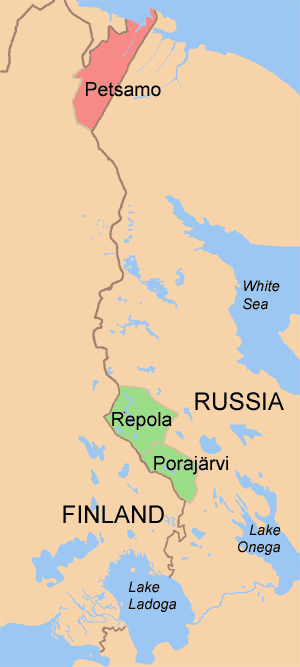
The Paris Peace Treaties were signed and restored borders from 1 January 1941. Source — Wikipedia, "Timeline of Finnish history" (20th century):
Rt. Hon. W.L. Mackenzie King and colleagues at the Paris Peace Conference, Palais du Luxembourg. (L.-r.:) Norman Robertson, Rt. Hon. W.L. Mackenzie King, Hon. Brooke Claxton, Arnold Heeney. By Unknown author - Library and Archives Canada does not allow free use of its copyrighted works. See Category:Images from Library and Archives Canada., Public domain, https://commons.wikimedia.org/w/index.php?curid=3351138
1952 CE
Finland entered into a passport union.
Finland entered into a passport union. Source — Wikipedia, "Timeline of Finnish history" (20th century):
Mar 1, 1956 CE
Urho Kekkonen
Urho Kekkonen became president of Finland. Source — Wikipedia, "Timeline of Finnish history" (20th century):
Portrait photograph of the President of Finland, Urho Kekkonen (1900–1986). By AnonymousUnknown author / Kuvasiskot studio - https://finna.fi/Record/musketti.M012:HK7155:544-75-31http://www.finna.fi/Cover/Show?id=musketti.M012%3AHK7155%3A544-75-31&index=0&size=large&w=1200&h=1200, CC BY 4.0, https://commons.wikimedia.org/w/index.php?curid=121867609
1961 CE
European Free Trade Association
Finland requested membership for the European Free Trade Association. Source — Wikipedia, "Timeline of Finnish history" (20th century):
European Free Trade Association insignia. By EFTA - https://www.efta.int/themes/custom/storyworx/logo.svg archive copy at the Wayback Machine, Public domain, https://commons.wikimedia.org/w/index.php?curid=22015081
1975 CE
Helsinki Accords
Finland signed the Helsinki Accords. Source — Wikipedia, "Timeline of Finnish history" (20th century):
The Helsinki Accords, the final act of the Conference on Security and Co-operation in Europe, which was signed in Helsinki in 1975 by the US, Canada and 33 European countries. Exhibited in the House of History in Bonn. By Rabax63 - Own work, CC BY-SA 4.0, https://commons.wikimedia.org/w/index.php?curid=72549056
Jan 27, 1982 CE
Mauno Koivisto
Mauno Koivisto became president of Finland. Source — Wikipedia, "Timeline of Finnish history" (20th century):
Jacques Delors, President of the CEC, and Frans Andriessen, Vice-President of the CEC in charge of External Relations and Trade Policy and Cooperation with other European Countries, received Mauno Koivisto, President of Finland, and Erkki Liikanen, Head of the Mission of Finland to the EC.. By European Communities, 1991 / EC - Audiovisual Service - Visit of Mauno Koivisto, President of Finland, to the CEC, CC BY 4.0, https://commons.wikimedia.org/w/index.php?curid=144781147
1982 CE
Keke Rosberg
Keke Rosberg wins the 1982 Formula One Championship, marking him the first Finnish Formula One driver to win a Championship. Source — Wikipedia, "Timeline of Finnish history" (20th century):
Keke Rosberg in a black and white photographic portait taken at the 1982 Dutch Grand Prix By Hans van Dijk for Anefo Minor restoration by Adam Cuerden: No need to credit me. - Gahetna in het nationaal archief, CC0, https://commons.wikimedia.org/w/index.php?curid=95953751
1986 CE
European Free Trade Association
Finland became a member of the European Free Trade Association. Source — Wikipedia, "Timeline of Finnish history" (20th century):
European Free Trade Association insignia. By EFTA - https://www.efta.int/themes/custom/storyworx/logo.svg archive copy at the Wayback Machine, Public domain, https://commons.wikimedia.org/w/index.php?curid=22015081
1991 CE
overheating
A depression took place after an overheating of the economy. Source — Wikipedia, "Timeline of Finnish history" (20th century):
Mar 1, 1994 CE
Martti Ahtisaari
Martti Ahtisaari became president of Finland. Source — Wikipedia, "Timeline of Finnish history" (20th century):
Photograph of the Finnish president Martti Ahtisaari (1937–2023) in 1994. By Markku Niskanen - https://www.finna.fi/Record/museovirasto.addec770-2f20-4b5b-80f0-4a0bd52d6b5a?sid=3608416163, CC BY 4.0, https://commons.wikimedia.org/w/index.php?curid=143143336
1995 CE
European Union
Finland joined the European Union. Source — Wikipedia, "Timeline of Finnish history" (20th century):
The Flag of Europe is the flag and emblem of the European Union (EU) and Council of Europe (CoE). It consists of a circle of 12 golden (yellow) stars on a blue background. It was created in 1955 by the CoE and adopted by the EU, then the European Communities, in the 1980s. The CoE and EU are distinct in membership and nature. The CoE is an international organisation with 46 members, dealing with human rights and rule of law, while the EU is a quasi-federal union of 27 states, focused on economic integration and political cooperation. Today, the flag is mostly associated with the latter. It was the intention of the CoE that the flag should come to represent Europe as a whole, and since its adoption the membership of the CoE covers nearly the entire Europe by the number of states involved, although only a little over half of the European continent by territory. This is why the EU adopted the same flag. The flag has been used to represent Europe in sporting events and as a pro-democracy banner outside the European Union. By User:Verdy p, User:-xfi-, User:Paddu, User:Nightstallion, User:Funakoshi, User:Jeltz, User:Dbenbenn, User:Zscout370 - File created by various Wikimedia users (see "Author"). File based on the specification given at [1]., Public domain, https://commons.wikimedia.org/w/index.php?curid=2615952
Nov 1, 1998 CE
Mika Häkkinen
Mika Häkkinen wins the Championship against Michael Schumacher, in Japan. Source — Wikipedia, "Timeline of Finnish history" (20th century):
during football match between Nowitzki All Stars and Nazionale Piloti in honor of Michael Schumacher at Opel Arena, Mainz, Rheinland Pfalz, Germany on 2016-07-27, Photo: Sven Mandel By Sven Mandel - Own work, CC BY-SA 4.0, https://commons.wikimedia.org/w/index.php?curid=50418145
1999 CE
Eurozone
Finland joined the Eurozone. Source — Wikipedia, "Timeline of Finnish history" (20th century):
SVG of File:Eurozone Internal.png By JLogan - Own work, Public domain, https://commons.wikimedia.org/w/index.php?curid=65038012
Mar 1, 2000 CE
Tarja Halonen
Tarja Halonen became president of Finland. Source — Wikipedia, "Timeline of Finnish history" (20th century):
Tarja Halonen By Tarja_Halonen_1c389_8827.jpg: Janwikifoto derivative work: Bff (talk) - Tarja_Halonen_1c389_8827.jpg, CC BY-SA 3.0, https://commons.wikimedia.org/w/index.php?curid=15607340
Jan 15, 2006 CE
2006 Finnish presidential election
A presidential election took place. Source — Wikipedia, "Timeline of Finnish history" (21st century):
2006 Finnish presidential election first round by province Halonen: 40–45% 45–50% 50–55% 55–60% 65–70% Vanhanen: 35–40% 40–45% By Petermgrund - Statistics Finland, CC BY-SA 4.0, https://commons.wikimedia.org/w/index.php?curid=144695704
Oct 21, 2007 CE
Kimi Räikkönen
Kimi Raikkonen wins the Championship against both Fernando Alonso and Lewis Hamilton, in Brazil. Source — Wikipedia, "Timeline of Finnish history" (21st century):
Formula 1 2019 / Schloss Gabelhofen By XaviYuahanda - Own work, CC BY-SA 4.0, https://commons.wikimedia.org/w/index.php?curid=81660514
Dec 31, 2009 CE
Sello mall shooting
The Sello mall shooting occurred. Source — Wikipedia, "Timeline of Finnish history" (21st century):
Ambulances and a police car outside the Sello shopping mall after the mall shooting, in Espoo, Finland. By Heksa - Own work, CC BY-SA 3.0, https://commons.wikimedia.org/w/index.php?curid=8893714
Feb 12, 2010 CE
2010 Winter Olympics
In the 2010 Winter Olympics, 95 athletes competed. Source — Wikipedia, "Timeline of Finnish history" (21st century):
Apr 17, 2011 CE
Finnish parliamentary election,2011
The Finnish parliamentary election was held. Source — Wikipedia, "Timeline of Finnish history" (21st century):
Mar 1, 2012 CE
Sauli Niinistö
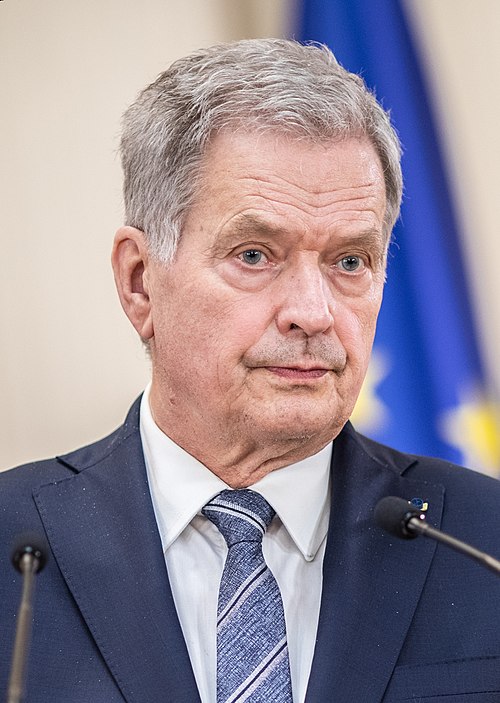
Sauli Niinistö became president of Finland. Source — Wikipedia, "Timeline of Finnish history" (21st century):
The Jyväskylä library stabbing occurred. Source — Wikipedia, "Timeline of Finnish history" (21st century):
Jyväskylä City Library, address: Vapaudenkatu 39–41, FI-40100 JYVÄSKYLÄ, Finland. Built in 1977–1980. By Zache - Own work, CC BY-SA 3.0, https://commons.wikimedia.org/w/index.php?curid=4231254
Jun 9, 2014 CE
Vladimir Putin
Vladimir Putin said Finland could join NATO but Russia would have to react. Source — Wikipedia, "Timeline of Finnish history" (21st century):
Russian President Vladimir Putin makes a video address to congratulate Russia's women on International Women's Day in Moscow, Russia. By Пресс-служба Президента РФ - https://www.thetimes.com/world/europe/article/emmanuel-macron-rebrands-himself-as-anti-russia-hawk-to-german-fury-dlplhbbzs (indirectly, this is identical in framing, slightly different color, higher res), CC BY 4.0, https://commons.wikimedia.org/w/index.php?curid=188977570
Jan 28, 2018 CE
2018 Finnish presidential election
A presidential election was held. Source — Wikipedia, "Timeline of Finnish history" (21st century):
Finnish MP Laura Huhtasaari at SuomiAreena in Pori, Finland, 2016. By Soppakanuuna - Own work, CC BY-SA 4.0, https://commons.wikimedia.org/w/index.php?curid=146915023
Apr 4, 2023 CE
NATO
Finland joins NATO. Source — Wikipedia, "Timeline of Finnish history" (21st century):
NATO/OTAN Logo. Source converted by Imalipusram By Unknown author - Rotated version of File:NATO_OTAN_portrait_logo.svg, Public domain, https://commons.wikimedia.org/w/index.php?curid=18466386