Encyclopedia/3. History, Societies & Civilizations/09. Modern Nations/01. Africa • Curated by Admin Timeline.sg
History of Egypt (AI-generated, sourced to Wikipedia).
Chronological Storyline (36 Milestones)
3100 BCE
Unification of Upper and Lower Egypt
King Narmer unified Upper and Lower Egypt into a single kingdom, establishing the First Dynasty and founding one of the world's earliest nation-states with Memphis as its capital. Source — Wikipedia, "Egypt":
Narmer palette (obverse) By Unknown author - This image has been extracted from another file, Public domain, https://commons.wikimedia.org/w/index.php?curid=181920722
2670 BCE
Step Pyramid of Djoser built
Architect Imhotep designed the Step Pyramid at Saqqara for Pharaoh Djoser, creating Egypt's first monumental stone structure and revolutionizing funerary architecture. Source — Wikipedia, "Egypt":
Step pyramid of Pharaoh Djoser from the 3rd Dynasty of the Old Kingdom in Egypt (around 2670 BC) By Olaf Tausch - Own work, CC BY 3.0, https://commons.wikimedia.org/w/index.php?curid=6871914
2560 BCE
Great Pyramid of Giza completed
The Great Pyramid, built for Pharaoh Khufu, was completed at Giza. At 146.6 meters, it remained the tallest man-made structure for over 3,800 years. Source — Wikipedia, "Egypt":
Pyramid of Khufu - May 2023 By Douwe C. van der Zee - Own work, CC BY-SA 4.0, https://commons.wikimedia.org/w/index.php?curid=138278511
1353 BCE
Akhenaten introduces Atenism
Pharaoh Akhenaten abolished traditional polytheism and established worship of the sun disc Aten, briefly relocating the capital to Amarna in one of history's earliest recorded monotheistic shifts. Source — Wikipedia, "Egypt":
Akhenaten introduces Atenism By Unknown author, CC BY-SA 2.5, https://commons.wikimedia.org/w/index.php?curid=505800
1323 BCE
Tutankhamun buried in Valley of Kings
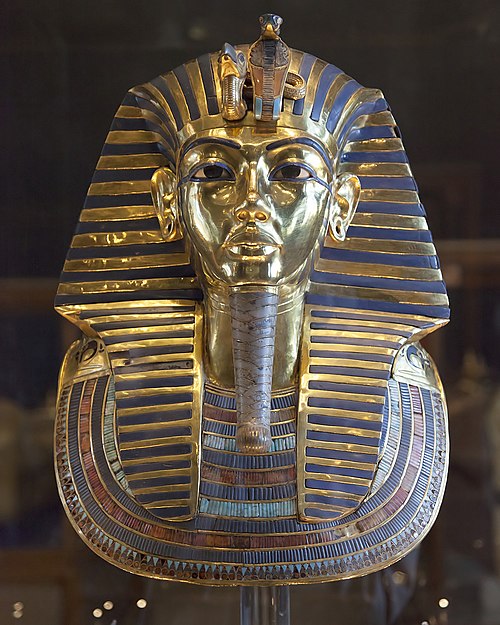
The boy-king Tutankhamun was interred in a modest tomb in the Valley of the Kings. His tomb's 1922 discovery would become the most celebrated archaeological find in history. Source — Wikipedia, "Egypt":
Since January 1, 2016 it is possible again to take photographs in the Egyptian Museum in Cairo. The funerary mask of Tutankhamun is certainly the most demanded exhibit. By Roland Unger - Own work, Public domain, https://commons.wikimedia.org/w/index.php?curid=48168958
May 1, 1274 BCE
Battle of Kadesh fought
Pharaoh Ramesses II clashed with the Hittite Empire at Kadesh in one of the largest chariot battles ever fought, eventually leading to the world's earliest recorded peace treaty. Source — Wikipedia, "Egypt":
Battle of Kadesh fought By Unknown author, CC BY-SA 3.0, https://commons.wikimedia.org/w/index.php?curid=581507
664 BCE
Assyrians sack Thebes
Assyrian forces under Ashurbanipal sacked and looted Thebes, marking the decline of Egyptian independence and the beginning of foreign domination that would last for centuries. Source — Wikipedia, "Egypt":
Neo-Assyrian map 824-671 BC By Nigyou - http://www.ancient.eu/Neo-Assyrian_Empire/, CC BY-SA 3.0, https://commons.wikimedia.org/w/index.php?curid=48002349
525 BCE
Persia conquers Egypt
Cambyses II of the Achaemenid Empire defeated Pharaoh Psamtik III at Pelusium, incorporating Egypt as a Persian satrapy and ending the last native dynasty for over a century. Source — Wikipedia, "Egypt":
Nov 1, 332 BCE
Alexander the Great enters Egypt
Alexander the Great conquered Egypt without resistance, ending Persian rule. He was welcomed as a liberator and founded the city of Alexandria, which became a major cultural center. Source — Wikipedia, "Egypt":
Alexander Mosaic (detail), House of the Faun, Pompeii By Unknown author - This image has been extracted from another file, Public domain, https://commons.wikimedia.org/w/index.php?curid=182741814
305 BCE
Ptolemaic Dynasty established
Ptolemy I Soter, one of Alexander's generals, declared himself pharaoh and founded the Ptolemaic Dynasty, initiating nearly three centuries of Macedonian Greek rule over Egypt. Source — Wikipedia, "Egypt":
Ptolemaic Kingdom in the 3rd–2nd centuries BCE By Ptolemaic Kingdom III-II century BC - ru.svg: Kaidor (talk · contribs) derivative work: rowanwindwhistler (talk) derivative work: Amphipolis - Ptolemaic Kingdom III-II century BC - es.svgevhiyggggg in JB is, CC BY-SA 4.0, https://commons.wikimedia.org/w/index.php?curid=101631116
196 BCE
Rosetta Stone inscribed
Priests issued a decree honoring Ptolemy V, inscribed in three scripts—hieroglyphic, demotic, and Greek—on the Rosetta Stone, which later became the key to deciphering Egyptian hieroglyphs. Source — Wikipedia, "Egypt":
The Rosetta Stone in the British Museum. By Hans Hillewaert - Own work, CC BY-SA 4.0, https://commons.wikimedia.org/w/index.php?curid=3153928
48 BCE
Library of Alexandria partially destroyed
Fire spread during Julius Caesar's siege of Alexandria, damaging the famous Library, one of antiquity's greatest repositories of knowledge, though it continued to function for centuries afterward. Source — Wikipedia, "Egypt":
Artistic Rendering of the Library of Alexandria, based on some archaeological evidence. By O. Von Corven - Tolzmann, Don Heinrich; Alfred Hessel and Reuben Peiss. The Memory of Mankind. New Castle, DE: Oak Knoll Press, 2001, Public domain, https://commons.wikimedia.org/w/index.php?curid=2307486
Aug 12, 30 BCE
Cleopatra VII dies, Rome annexes Egypt
Following Cleopatra VII's suicide after the Battle of Actium, Octavian annexed Egypt as a Roman province, ending the Ptolemaic Dynasty and 3,000 years of pharaonic rule. Source — Wikipedia, "Egypt":
Marble bust of Cleopatra VII of Egypt from ca. 40-30 BC. An ancient Roman bust of Ptolemaic ruler Cleopatra VII of Egypt wearing a royal diadem band over her hair; dated to the mid-1st century BC (i.e. around the time of her visit to Rome), it was discovered in a villa along the Via Appia. It is now located in the Altes Museum, Berlin, in the Antikensammlung Berlin collection. العربية: تمثال لرأس الملكة كليوبترا معروض في متحف ألتيس في برلين Sources: Raia, Ann R.; Sebesta, Judith Lynn. (September 2017). "The World of State". College of New Rochelle. Accessed 6 March 2018. "Cat. 22 Tetradrachm Portraying Queen Cleopatra VII". Art Institute of Chicago. Accessed 6 March 2018. Grout, James. (April 1, 2017). "Was Cleopatra Beautiful?". Encyclopaedia Romana. University of Chicago. Accessed 6 March 2018. By Louis le Grand - own work / Altes Museum Berlin (Berliner Museumsinsel), Public domain, https://commons.wikimedia.org/w/index.php?curid=2597825
Jul 1, 642 CE
Arab conquest of Egypt completed
Arab forces under Amr ibn al-As captured Alexandria, completing the Muslim conquest of Egypt and beginning the gradual Islamization and Arabization of the country. Source — Wikipedia, "Egypt":
Arab conquest of Egypt completed By Mohammad Adil (talk) - I created this work entirely by myself.Transferred from en.wikipedia, CC BY-SA 3.0, https://commons.wikimedia.org/w/index.php?curid=17974954
Aug 1, 969 CE
Cairo founded by Fatimids
The Fatimid general Jawhar al-Siqilli founded the city of Cairo (al-Qahira) as the new capital of the Fatimid Caliphate, establishing what would become one of the Islamic world's greatest cities. Source — Wikipedia, "Egypt":
Zamalek (Egyptian Arabic: الزمالك pronounced [ez.zæˈmæːlek]) is an affluent district of western Cairo encompassing the northern portion of Gezira Island in the Nile River. The island is connected with the river banks through three bridges each on the east and west sides of the island, including the Qasr al-Nil Bridge and 6th October Bridge. It has witnessed many phases of growth affected by many economic and political currents which has led to a crowding of parts of the island including great reductions in the Zamalek district's open green areas, but with a large greenbelt across the island's middle defining the two districts [Wikipedia.org] By Jorge Láscar from Melbourne, Australia - Cairo Opera House, Al Hurriyah Park and the Nile river, CC BY 2.0, https://commons.wikimedia.org/w/index.php?curid=66239095
1171 CE
Saladin founds Ayyubid dynasty
Saladin (Salah al-Din) abolished the Fatimid caliphate and established the Ayyubid dynasty, unifying Egypt and Syria and launching the campaign to retake Jerusalem from the Crusaders. Source — Wikipedia, "Egypt":
1250 CE
Mamluk Sultanate established
Mamluk soldiers seized power in Egypt, founding the Mamluk Sultanate, which would rule for over 250 years and become the dominant power in the eastern Mediterranean. Source — Wikipedia, "Egypt":
Map of the Mamluk sultanate during the third reign of al-Nasir Muhammad, 1317 AD, showing its political subdivisions and cities. Borders are approximate only. The primary resource used is the Encyclopedia of Islam, New Edition; see the articles regarding the various places, dynasties and individuals featured in the map. The articles on Diyar Mudar, al-Sa'id and Nuba were also referenced. Works cited: The Encyclopaedia of Islam. New Ed. 12 vols. with supplement and indices. Leiden: E.J. Brill, 1960-2005. "Europe in the Year 1300." Euratlas. Accessed 27 January 2016. Fakhry, Ahmed. The Oases of Egypt, Volume I: Siwa Oasis. Cairo: The American University at Cairo Press, 1973, pp. 96-97 (on the history of the Siwa Oasis). Holt, P.M. The Age of the Crusades: The Near East from the eleventh century to 1517. London: Routledge, 2013. ISBN 978-0-582-49302-5, pp. 133-36 (on Mamluk intervention in Makuria, along with the 1317 expedition to 'Aydab and Suakin). Holt, P.M. Early Mamluk Diplomacy (1260-1290): Treaties of Baybars & Qalawun with Christian Rulers. Leiden: E.J. Brill, 1995. ISBN 90-04-10246-9, pp. 74-78, 97-98 (copies of treaties which include lists of Mamluk territorial possessions). Al-Khazraji, 'Ali ibn al-Hasan. The Pearl-Strings; A History of the Resuliyy Dynasty of Yemen, Volume I. Trans. J.W. Redhouse. Ed. E.G. Browne, R.A. Nicholson and A. Rogers. Leyden: E.J. Brill, 1906 (on the history of the Yemen and Mecca). Nicolle, David. Mamluk 'Askari 1250-1517. Illus. Peter Dennis. Great Britain: Osprey Publishing, 2014. ISBN 978-1-4728-0352-8, p. 4 (containing map of the Mamluk sultanate). Peters, F.E. Mecca: A Literary History of the Muslim Holy Land. Princeton: Princeton University Press, 1994. ISBN 0-691-03267-X, pp. 148 ff. (on Mamluk activities in Mecca). Porter, Venetia Ann. The history and monuments of the Tahirid Dynasty of Yemen 858-923/1454-1517. PhD Thesis, Durham University, 1992, pp. 119 ff. (on the Mamluk intervention in the Yemen). Sinclair, T.A. Eastern Turkey: An Architectural and Archaeological Survey, Vol. IV. London: The Pindar Press, 1990, pp. 218-19 (on the status of Mamluk Jazira). Tsugitaka, Sato. State and Rural Society in Medieval Islam: Sultans, Muqta's and Fallahun. Leiden: E.J. Brill, 1997. ISBN 90-04-10649-9, pp. 135 ff. (regarding the rawk al-Nasiri; p. 138 contains the subdivisions of Egypt at this time); pp. 67-68 (on the oases of Egypt). Wiet, G. E.J. Brill's First Encyclopaedia of Islam, 1913-1936, Volume IV, 'Itk-Kwatta. Leiden: E.J. Brill, 1993. ISBN 90-04-09790-2, p. 904 (on the political status of the Wahat). Ziadeh, Nicola A. Urban life in Syria under the early Mamluks. Westport: Greenwood Press, 1953, pp 11-12 (on the administrative divisions of Syria). By Ro4444 - Own work, CC BY-SA 4.0, https://commons.wikimedia.org/w/index.php?curid=46642565
Jan 1, 1517 CE
Ottoman Empire conquers Egypt
Ottoman forces under Selim I defeated the Mamluks at the Battle of Ridaniya, incorporating Egypt into the Ottoman Empire, where it remained for nearly four centuries. Source — Wikipedia, "Egypt":
Jul 1, 1798 CE
Napoleon invades Egypt
Napoleon Bonaparte landed at Alexandria with 35,000 troops, aiming to disrupt British access to India. The campaign introduced modern European scholarship to Egypt's ancient civilization. Source — Wikipedia, "Egypt":
This collage was derived from: File:The Battle of the Pyramids 21 July 1798 by Louis-François, Baron Lejeune.jpg, File:The Battle of the Nile.jpg, File:Girodet.jpg, File:Antoine-Jean Gros - Bataille d'Aboukir, 25 juillet 1799 - Google Art Project.jpg, File:The landing of British troops at Aboukir, 8 March 1801.jpg, Battle of Alexandria (1801) By Ruedi33a - Own work, CC BY-SA 4.0, https://commons.wikimedia.org/w/index.php?curid=118078293
Jul 15, 1799 CE
Rosetta Stone discovered
French soldiers discovered the Rosetta Stone near the town of Rosetta (Rashid), providing the trilingual text that Jean-François Champollion later used to decipher hieroglyphs in 1822. Source — Wikipedia, "Egypt":
The Rosetta Stone in the British Museum. By Hans Hillewaert - Own work, CC BY-SA 4.0, https://commons.wikimedia.org/w/index.php?curid=3153928
1805 CE
Muhammad Ali becomes ruler
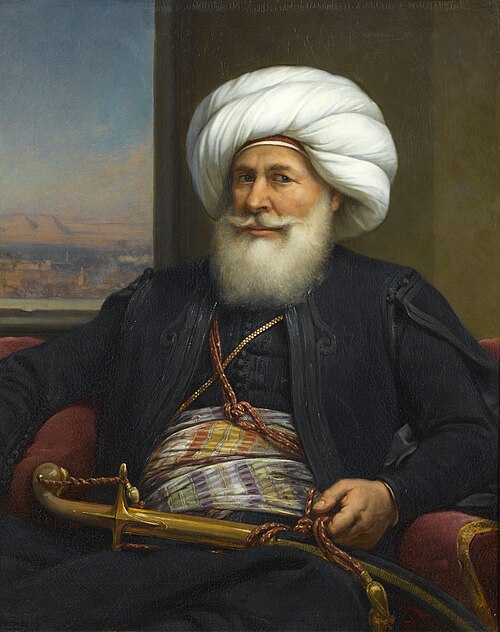
Muhammad Ali Pasha, an Ottoman commander, seized control of Egypt and founded a dynasty that ruled until 1952. He modernized the army, economy, and infrastructure, earning the title 'founder of modern Egypt.' Source — Wikipedia, "Egypt":
Mısır Valisi, Kavalalı Mehmet Ali Paşa . By Auguste Couder - This image comes from the Bibliotheca Alexandrina's Memory of Modern Egypt Digital Archive. Click here to view its thumbnail. Its description page can be located in the archive by copying the Arabic-language description above and pasting it into the search box situated in the upper-left corner of this page.This tag does not indicate the copyright status of the attached work. A valid copyright tag is still required., Public domain, https://commons.wikimedia.org/w/index.php?curid=6356895
Nov 17, 1869 CE
Suez Canal inaugurated
The Suez Canal opened to international shipping after a decade of construction, connecting the Mediterranean and Red Seas and becoming one of the world's most strategic waterways. Source — Wikipedia, "Egypt":
Jul 1, 1882 CE
British occupation begins
British forces bombarded Alexandria and defeated the Egyptian army at Tel el-Kebir, beginning a military occupation that lasted until 1954 and made Egypt a de facto British colony. Source — Wikipedia, "Egypt":
Anglo-Egyptian War By The Illustrated London News - Transferred from en.wikipedia to Commons.; The Illustrated London News, No.2256—Vol. LXXXI, Saturday, July 29, 1882, p.102, Public domain, https://commons.wikimedia.org/w/index.php?curid=36702105
Mar 1, 1919 CE
1919 Egyptian Revolution erupts
Following Britain's exile of nationalist leaders, mass protests and civil disobedience swept Egypt, led by Saad Zaghlul and the Wafd Party, eventually forcing Britain to grant limited independence. Source — Wikipedia, "Egypt":
Nationalists demonstrating in Cairo. The protesters holding the Egyptian flag with Crescent, the Cross and Star of David on it By Unknown author - http://p.twimg.com/AclP_jVCQAE7l9Y.jpg, Public domain, https://commons.wikimedia.org/w/index.php?curid=17117372
Feb 28, 1922 CE
Egypt gains nominal independence
Britain unilaterally declared Egypt an independent sovereign state under King Fuad I, though Britain retained control of defense, imperial communications, and the Sudan. Source — Wikipedia, "Egypt":
Nov 4, 1922 CE
Tutankhamun's tomb discovered
Howard Carter discovered the nearly intact tomb of Tutankhamun in the Valley of the Kings, sparking worldwide fascination with ancient Egypt and yielding over 5,000 artifacts. Source — Wikipedia, "Egypt":
Inside Pharaoh Tutankhamun's tomb, 18th dynasty By EditorfromMars - Own work, CC BY-SA 4.0, https://commons.wikimedia.org/w/index.php?curid=93287618
Jul 23, 1952 CE
Free Officers overthrow monarchy
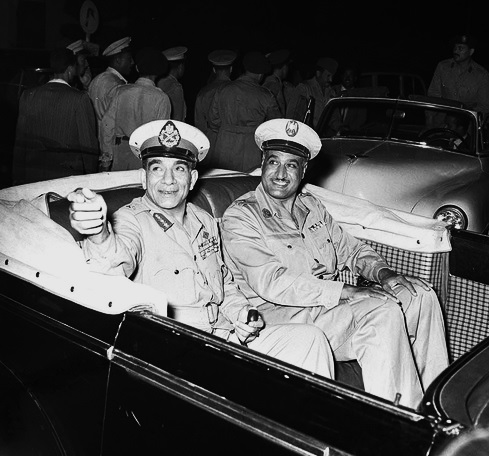
A group of nationalist military officers led by Gamal Abdel Nasser and Muhammad Naguib staged a coup, overthrowing King Farouk and ending the Muhammad Ali dynasty. Source — Wikipedia, "Egypt":
Prime Minister Gamal Abdel Nasser (right) and President Muhammad Naguib (left) in an open-top automobile during celebrations marking the second anniversary of the Egyptian Revolution of 1952 By Not credited - [1] at Bibliotheca Alexandrina, Public domain, https://commons.wikimedia.org/w/index.php?curid=27448940
Jul 26, 1956 CE
Nasser nationalizes Suez Canal
President Nasser nationalized the Suez Canal Company, prompting a military intervention by Britain, France, and Israel. The resulting Suez Crisis marked the end of British and French imperial influence in the region. Source — Wikipedia, "Egypt":
Smoke rises from oil tanks beside the Suez Canal hit during the initial Anglo-French assault on Port Said, 5 November 1956. By Fleet Air Arm official photographer - This photograph MH 23509 comes from the collections of the Imperial War Museums., Public domain, https://commons.wikimedia.org/w/index.php?curid=14863796
Jun 5, 1967 CE
Six-Day War devastates Egyptian military
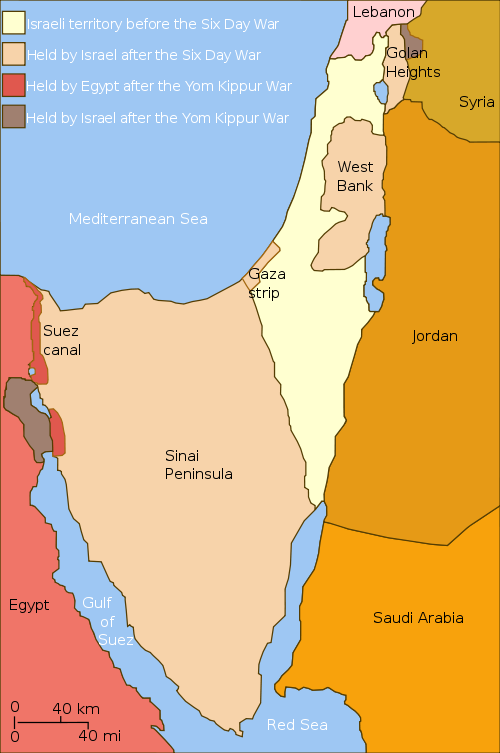
Israel launched preemptive strikes destroying most of Egypt's air force and captured the Sinai Peninsula, dealing a devastating blow to Nasser's prestige and military power. Source — Wikipedia, "Egypt":
Arab territories gained by Israel in the aftermath of the Six-Day War. By Zvikorn - Own work, CC BY-SA 4.0, https://commons.wikimedia.org/w/index.php?curid=85363862
Jul 21, 1970 CE
Aswan High Dam completed
The Aswan High Dam was formally inaugurated after a decade of construction with Soviet support, ending the Nile's annual floods and providing hydroelectric power but also causing significant ecological changes. Source — Wikipedia, "Egypt":
NASA satellite image of the Nile, Aswan High Dam, and Lake Nasser - southern Egypt. The Aswan High Dam was completed in 1970 and is one of the largest earthen embankment dams in the world. It is 364 feet (111 m) tall, 12 565 feet (3830 m) long and nearly 3281 feet (1000 m) wide. When it was built the new reservoir required relocation of nearly 100 000 residents and some archaeological sites. Although the reservoir has benefited Egypt by providing power and controlling floods, it has also had detrimental effects on the Nile system. Before the dam, an estimated 110 million tons of silt was deposited by the annual flood of the Nile, enriching agricultural lands and maintaining the land of the Nile delta. Now this sediment is trapped behind the dam, requiring artificial fertilization of agricultural lands and leading to erosion and saltwater intrusion where the Nile river meets the Mediterranean Sea. By NASA - http://earth.jsc.nasa.gov/sseop/EFS/lores.pl?PHOTO=STS102-303-17, Public domain, https://commons.wikimedia.org/w/index.php?curid=90994
Oct 6, 1973 CE
October War launched
Egypt and Syria launched a surprise attack on Israeli forces on Yom Kippur, crossing the Suez Canal and initially achieving success before Israel counterattacked, eventually leading to peace negotiations. Source — Wikipedia, "Egypt":
Self-made line drawing of a map of Israel's territories before and after the Yom Kippur War. By Raul654 - Source of line drawing: Now-deleted image Jom kippur war.jpg which was originally uploaded to the polish Wikipedia at Jom kippur war.jpg -- Ministerstwo Spraw Zagranicznych Izraela, za zgodÄ… Ambasady Izraela w Polsce. -- Ministry of Foreign Affairs of Israel, with the permission of Israel Embassy in Poland, CC BY-SA 2.5, https://commons.wikimedia.org/w/index.php?curid=2848963
Mar 26, 1979 CE
Egypt-Israel peace treaty signed
President Anwar Sadat and Israeli Prime Minister Menachem Begin signed the Camp David Accords peace treaty, making Egypt the first Arab state to recognize Israel. Sadat was later assassinated for this in 1981. Source — Wikipedia, "Egypt":
THE TRIPLE HANDSHAKE IN THE PEACE TREATY SIGNING BETWEEN ISRAEL AND EGYPT ON THE WHITE HOUSE LAWN. R. TO L: P.M. MENAHEM BEGIN, PRES. JIMMY CARTER AND A. SADAT. . לחיצת יד משולשת בבית הלבן, בטקס חתימת חוזה השלום בון ישראל למצרים בוושינגטון. בצילום מימין לשמאל - ראש הממשלה מנחם בגין, נשיא ארהב ג'ימי קארטר ונשיא מצרים אנואר סאדת. By Yaakov Saar - This is available from National Photo Collection of Israel, Photography dept. Government Press Office (link), under the digital ID D173-109.This tag does not indicate the copyright status of the attached work. A normal copyright tag is still required. See Commons:Licensing for more information., CC BY-SA 3.0, https://commons.wikimedia.org/w/index.php?curid=22808151
Oct 6, 1981 CE
Sadat assassinated
President Anwar Sadat was assassinated by Islamic extremists during a military parade commemorating the October War. Vice President Hosni Mubarak succeeded him and ruled for nearly 30 years. Source — Wikipedia, "Egypt":
Tomb of the unknown Soldier, and Tomb of Anwar as-Sadat, in Nasr City, Greater Cairo. By Einsamer Schütze - Own work, CC BY-SA 3.0, https://commons.wikimedia.org/w/index.php?curid=7280515
Oct 1, 1988 CE
Naguib Mahfouz wins Nobel Prize
Egyptian novelist Naguib Mahfouz was awarded the Nobel Prize in Literature, becoming the first Arabic-language writer to receive the honor and bringing global attention to modern Arabic literature. Source — Wikipedia, "Egypt":
Nagib mahfouz By The original uploader was Producer at Arabic Wikipedia. - Transferred from ar.wikipedia to Commons., Public domain, https://commons.wikimedia.org/w/index.php?curid=65466571
Jan 25, 2011 CE
Egyptian Revolution topples Mubarak
Massive popular protests in Cairo's Tahrir Square and across Egypt forced President Hosni Mubarak to resign after 30 years in power, as part of the broader Arab Spring uprisings. Source — Wikipedia, "Egypt":
Tahrir Square during 8 February 2011 By Mona - Feb8-3:34pm, CC BY 2.0, https://commons.wikimedia.org/w/index.php?curid=13249742
Jul 3, 2013 CE
Morsi ousted by military
Following mass protests against President Mohamed Morsi, the military led by General Abdel Fattah el-Sisi removed Egypt's first democratically elected president, suspending the constitution and establishing an interim government. Source — Wikipedia, "Egypt":
Original description: "The area around the Rabaa Adiweya mosque has been packed with Muslim Brotherhood supporters sleeping in tents for over a month. Families bring children to protect them from the police forcibly dismantling the sit-in. (H. Elrasam for VOA)" By H. Elrasam for VOA - http://gdb.voanews.com/1E9C9911-22F9-412A-8DBD-0D8D7548C184_mw1228_mh548_s.jpg, Public domain, https://commons.wikimedia.org/w/index.php?curid=30111989




![Zamalek (Egyptian Arabic: الزمالك pronounced [ez.zæˈmæːlek]) is an affluent district of western Cairo encompassing the northern portion of Gezira Island in the Nile River. The island is connected with the river banks through three bridges each on the east and west sides of the island, including the Qasr al-Nil Bridge and 6th October Bridge. It has witnessed many phases of growth affected by many economic and political currents which has led to a crowding of parts of the island including great reductions in the Zamalek district's open green areas, but with a large greenbelt across the island's middle defining the two districts [Wikipedia.org]](https://upload.wikimedia.org/wikipedia/commons/thumb/7/72/Cairo_Opera_House%2C_Al_Hurriyah_Park_and_the_Nile_river_%2814797782354%29.jpg/500px-Cairo_Opera_House%2C_Al_Hurriyah_Park_and_the_Nile_river_%2814797782354%29.jpg)