Encyclopedia/3. History, Societies & Civilizations/09. Modern Nations/02. Americas • Curated by Admin Timeline.sg
History of Dominican Republic (AI-generated, sourced to Wikipedia).
Chronological Storyline (33 Milestones)
Dec 5, 1492 CE
Columbus arrives on Hispaniola
Christopher Columbus first landed on the island of Hispaniola during his first voyage, claiming it for Spain. Source — Wikipedia, "Dominican Republic":
Columbus arrives on Hispaniola By Sebastiano del Piombo - This file was donated to Wikimedia Commons as part of a project by the Metropolitan Museum of Art. See the Image and Data Resources Open Access Policy, Public domain, https://commons.wikimedia.org/w/index.php?curid=27554267Video
1493 CE
First Spanish colony established
Columbus returned and founded La Navidad, the first European settlement in the Americas, on Hispaniola's northern coast. Source — Wikipedia, "Dominican Republic":
The flag of the Dominican Republic has a centered white cross that extends to the edges. This emblem is similar to the flag design and shows a bible, a cross of gold and 6 Dominican flags. There are branches of olive and palm around the shield and above on the ribbon is the motto "Dios,Patria!, Libertad" ("God, Country, Freedom") and to amiable freedom. The blue is said to stand for liberty, red for the fire and blood of the independence struggle and the white cross symbolized that God has not forgotten his people. "Republica Dominicana". The Dominican flag was designed by Juan Pablo Duarte, father of the national Independence of Dominican Republic. The first dominican flag was sewn by a young lady named Concepción Bona, who lived across the street of El Baluarte, monument where the patriots gathered to fight for the independence, the night of February 27th, 1844. Concepción Bona was helped by her first cousin María de Jesús Pina. By Juan Pablo Duarte - CONSTRUCTION SHEET: Vexilla Mundi.Further informations: Flags of the World. See also: Presidencia de la República Dominicana: Bandera Nacional., Public domain, https://commons.wikimedia.org/w/index.php?curid=433155
1496 CE
Santo Domingo founded
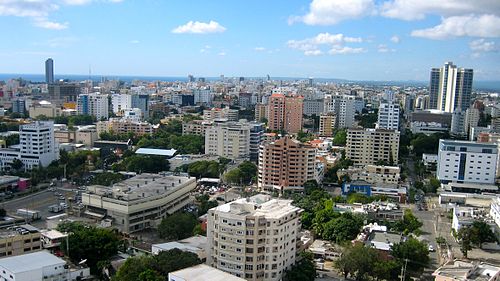
Bartholomew Columbus founded Santo Domingo, the oldest continuously inhabited European city in the Americas. Source — Wikipedia, "Dominican Republic":
SantoDomingo2 By Jose Juan C - File:SantoDomingo.JPG, Public domain, https://commons.wikimedia.org/w/index.php?curid=32858479
1503 CE
Casa de Contratación established
Spain established a system to regulate trade and commerce with its New World colonies, centered through Santo Domingo. Source — Wikipedia, "Dominican Republic":
Real Alcázar de Sevilla, Sevilla By FlyingCrimsonPig - Real Alcázar de Sevilla, Sevilla, CC BY 2.0, https://commons.wikimedia.org/w/index.php?curid=116701540
1508 CE
First bishopric in the Americas
Pope Julius II established the Roman Catholic Archdiocese of Santo Domingo, the first in the New World. Source — Wikipedia, "Dominican Republic":
First bishopric in the Americas By Unknown author, CC BY-SA 3.0, https://commons.wikimedia.org/w/index.php?curid=357730
1521 CE
First major slave rebellion
Enslaved Africans led by Sebastian Lemba launched one of the earliest recorded slave uprisings on Hispaniola. Source — Wikipedia, "Dominican Republic":
The flag of the Dominican Republic has a centered white cross that extends to the edges. This emblem is similar to the flag design and shows a bible, a cross of gold and 6 Dominican flags. There are branches of olive and palm around the shield and above on the ribbon is the motto "Dios,Patria!, Libertad" ("God, Country, Freedom") and to amiable freedom. The blue is said to stand for liberty, red for the fire and blood of the independence struggle and the white cross symbolized that God has not forgotten his people. "Republica Dominicana". The Dominican flag was designed by Juan Pablo Duarte, father of the national Independence of Dominican Republic. The first dominican flag was sewn by a young lady named Concepción Bona, who lived across the street of El Baluarte, monument where the patriots gathered to fight for the independence, the night of February 27th, 1844. Concepción Bona was helped by her first cousin María de Jesús Pina. By Juan Pablo Duarte - CONSTRUCTION SHEET: Vexilla Mundi.Further informations: Flags of the World. See also: Presidencia de la República Dominicana: Bandera Nacional., Public domain, https://commons.wikimedia.org/w/index.php?curid=433155
1605 CE
Devastations of Osorio
Spain ordered the depopulation of the island's northern and western regions to stop contraband trade, devastating the colony. Source — Wikipedia, "Dominican Republic":
Situation of the Island of Hispaniola During the devastations of Osorio, 1605-1606 By Cheposo - Own work, CC BY-SA 4.0, https://commons.wikimedia.org/w/index.php?curid=121284787
1697 CE
Treaty of Ryswick divides island
Spain formally ceded the western third of Hispaniola to France, creating the division between Saint-Domingue and Santo Domingo. Source — Wikipedia, "Dominican Republic":
Huis ter Nieuwburg in Rijswijk waar 1697 de Vrede van Rijswijk werd getekend By engraver is Jan van Vianen, whose name appears in the lower left corner - Catena: Digital Archive of Historic Gardens and Landscapes, Public domain, https://commons.wikimedia.org/w/index.php?curid=2568820
1795 CE
Treaty of Basel transfers colony
Spain ceded Santo Domingo to France under the Treaty of Basel, though French control was not fully established until 1801. Source — Wikipedia, "Dominican Republic":
The flag of the Dominican Republic has a centered white cross that extends to the edges. This emblem is similar to the flag design and shows a bible, a cross of gold and 6 Dominican flags. There are branches of olive and palm around the shield and above on the ribbon is the motto "Dios,Patria!, Libertad" ("God, Country, Freedom") and to amiable freedom. The blue is said to stand for liberty, red for the fire and blood of the independence struggle and the white cross symbolized that God has not forgotten his people. "Republica Dominicana". The Dominican flag was designed by Juan Pablo Duarte, father of the national Independence of Dominican Republic. The first dominican flag was sewn by a young lady named Concepción Bona, who lived across the street of El Baluarte, monument where the patriots gathered to fight for the independence, the night of February 27th, 1844. Concepción Bona was helped by her first cousin María de Jesús Pina. By Juan Pablo Duarte - CONSTRUCTION SHEET: Vexilla Mundi.Further informations: Flags of the World. See also: Presidencia de la República Dominicana: Bandera Nacional., Public domain, https://commons.wikimedia.org/w/index.php?curid=433155
1801 CE
Toussaint Louverture occupies Santo Domingo
Haitian revolutionary leader Toussaint Louverture took control of Santo Domingo, abolishing slavery in the eastern part of the island. Source — Wikipedia, "Dominican Republic":
A portrait of Toussaint Louverture Oil on Canvas, 65.1 x 54.3 cm. (25.6 x 21.4 in.) bostonhaitian.com By Alexandre-François-Louis, comte de Girardin - allposters.com, Public domain, https://commons.wikimedia.org/w/index.php?curid=46545226
1809 CE
Spain regains Santo Domingo
Following Napoleon's invasion of Spain, Dominican forces aided by Britain restored Spanish rule over Santo Domingo. Source — Wikipedia, "Dominican Republic":
The flag of the Dominican Republic has a centered white cross that extends to the edges. This emblem is similar to the flag design and shows a bible, a cross of gold and 6 Dominican flags. There are branches of olive and palm around the shield and above on the ribbon is the motto "Dios,Patria!, Libertad" ("God, Country, Freedom") and to amiable freedom. The blue is said to stand for liberty, red for the fire and blood of the independence struggle and the white cross symbolized that God has not forgotten his people. "Republica Dominicana". The Dominican flag was designed by Juan Pablo Duarte, father of the national Independence of Dominican Republic. The first dominican flag was sewn by a young lady named Concepción Bona, who lived across the street of El Baluarte, monument where the patriots gathered to fight for the independence, the night of February 27th, 1844. Concepción Bona was helped by her first cousin María de Jesús Pina. By Juan Pablo Duarte - CONSTRUCTION SHEET: Vexilla Mundi.Further informations: Flags of the World. See also: Presidencia de la República Dominicana: Bandera Nacional., Public domain, https://commons.wikimedia.org/w/index.php?curid=433155
Nov 30, 1821 CE
Brief independence under Núñez de Cáceres
José Núñez de Cáceres declared independence from Spain, creating the short-lived Republic of Spanish Haiti before Haitian annexation. Source — Wikipedia, "Dominican Republic":
José Núñez de Cáceres By Unknown/Desconocido - Biografías y Vidas - José Núñez de Cáceres, CC0, https://commons.wikimedia.org/w/index.php?curid=7290173
Feb 9, 1822 CE
Haiti annexes Santo Domingo
Haitian president Jean-Pierre Boyer unified the entire island under Haitian rule, abolishing slavery in the eastern territory. Source — Wikipedia, "Dominican Republic":
Portrait of President Jean-Pierre of Haiti and of the entire island of Hispaniola during his regime at the height of his career wearing a epaulette on his military attire signifying an elite rank By B.C. (Name unknown, beyond these initials) - http://www.williamreesecompany.com/shop/reeseco/WRCAM47136.html, Public domain, https://commons.wikimedia.org/w/index.php?curid=36927382
Feb 27, 1844 CE
Dominican independence declared
Led by Juan Pablo Duarte, the Trinitaria movement declared independence from Haiti, establishing the Dominican Republic. Source — Wikipedia, "Dominican Republic":
la batalla de Las Carreras By Mariano Torrente - http://pares.mcu.es/ParesBusquedas20/catalogo/show/7281066, CC0, https://commons.wikimedia.org/w/index.php?curid=114446819Video
Nov 6, 1844 CE
First constitution adopted
The first Dominican Constitution was promulgated in San Cristóbal, establishing a republican form of government. Source — Wikipedia, "Dominican Republic":
Coat of arms of the Dominican Republic By See File history below for details. - Own work, Public domain, https://commons.wikimedia.org/w/index.php?curid=917077
Mar 18, 1861 CE
Santana annexes DR to Spain
President Pedro Santana annexed the Dominican Republic back to Spain, making it a Spanish colony again. Source — Wikipedia, "Dominican Republic":
The flag of the Dominican Republic has a centered white cross that extends to the edges. This emblem is similar to the flag design and shows a bible, a cross of gold and 6 Dominican flags. There are branches of olive and palm around the shield and above on the ribbon is the motto "Dios,Patria!, Libertad" ("God, Country, Freedom") and to amiable freedom. The blue is said to stand for liberty, red for the fire and blood of the independence struggle and the white cross symbolized that God has not forgotten his people. "Republica Dominicana". The Dominican flag was designed by Juan Pablo Duarte, father of the national Independence of Dominican Republic. The first dominican flag was sewn by a young lady named Concepción Bona, who lived across the street of El Baluarte, monument where the patriots gathered to fight for the independence, the night of February 27th, 1844. Concepción Bona was helped by her first cousin María de Jesús Pina. By Juan Pablo Duarte - CONSTRUCTION SHEET: Vexilla Mundi.Further informations: Flags of the World. See also: Presidencia de la República Dominicana: Bandera Nacional., Public domain, https://commons.wikimedia.org/w/index.php?curid=433155
Aug 16, 1863 CE
War of Restoration begins
Dominican patriots launched a guerrilla war against Spanish colonial rule, beginning the War of Restoration. Source — Wikipedia, "Dominican Republic":
War of Restoration begins By Unknown author - This file is from the Mechanical Curator collection, a set of over 1 million images scanned from out-of-copyright books and released to Flickr Commons by the British Library. View image on Flickr View all images from book View catalogue entry for book., Public domain, https://commons.wikimedia.org/w/index.php?curid=31251448
Mar 3, 1865 CE
Spain withdraws from DR
Spain abandoned its attempt to reconquer the Dominican Republic, restoring independence under the restored republic. Source — Wikipedia, "Dominican Republic":
Spain withdraws from DR By Unknown author - This file is from the Mechanical Curator collection, a set of over 1 million images scanned from out-of-copyright books and released to Flickr Commons by the British Library. View image on Flickr View all images from book View catalogue entry for book., Public domain, https://commons.wikimedia.org/w/index.php?curid=31251448
1882 CE
Lilís becomes president
Ulises Heureaux, known as Lilís, consolidated power and began a long authoritarian rule marked by modernization and heavy debt. Source — Wikipedia, "Dominican Republic":
Ulises Heureaux (Lilis), president of the Dominican Republic in 1893 By Unknown author - https://www.flickr.com/photos/195632742@N06/52071150777/, Public domain, https://commons.wikimedia.org/w/index.php?curid=118923968
Nov 29, 1916 CE
US Marines occupy Dominican Republic
The United States military occupied the Dominican Republic, citing political instability and debt concerns, lasting until 1924. Source — Wikipedia, "Dominican Republic":
US Flag with 48 stars. In use for 47 years from July 4, 1912, to July 3, 1959. By Created by jacobolus using Adobe Illustrator. - Own work based on PD info, Public domain, https://commons.wikimedia.org/w/index.php?curid=733572
Aug 16, 1930 CE
Trujillo seizes power
Rafael Trujillo, commander of the army, became president through a rigged election, beginning a brutal 31-year dictatorship. Source — Wikipedia, "Dominican Republic":
Rafael Leónidas Trujillo Molina en la silla presidencial. By Unknown author. - Archivo General de la Nación, Public domain, https://commons.wikimedia.org/w/index.php?curid=126390760Video
Oct 1, 1937 CE
Parsley Massacre
Trujillo ordered the killing of thousands of Haitians and Haitian-Dominicans along the border, known as the Parsley Massacre. Source — Wikipedia, "Dominican Republic":
The flag of the Dominican Republic has a centered white cross that extends to the edges. This emblem is similar to the flag design and shows a bible, a cross of gold and 6 Dominican flags. There are branches of olive and palm around the shield and above on the ribbon is the motto "Dios,Patria!, Libertad" ("God, Country, Freedom") and to amiable freedom. The blue is said to stand for liberty, red for the fire and blood of the independence struggle and the white cross symbolized that God has not forgotten his people. "Republica Dominicana". The Dominican flag was designed by Juan Pablo Duarte, father of the national Independence of Dominican Republic. The first dominican flag was sewn by a young lady named Concepción Bona, who lived across the street of El Baluarte, monument where the patriots gathered to fight for the independence, the night of February 27th, 1844. Concepción Bona was helped by her first cousin María de Jesús Pina. By Juan Pablo Duarte - CONSTRUCTION SHEET: Vexilla Mundi.Further informations: Flags of the World. See also: Presidencia de la República Dominicana: Bandera Nacional., Public domain, https://commons.wikimedia.org/w/index.php?curid=433155
May 30, 1961 CE
Trujillo assassinated
Rafael Trujillo was assassinated by conspirators, ending his three-decade dictatorship and opening a period of political turmoil. Source — Wikipedia, "Dominican Republic":
Rafael Leónidas Trujillo Molina en la silla presidencial. By Unknown author. - Archivo General de la Nación, Public domain, https://commons.wikimedia.org/w/index.php?curid=126390760
1962 CE
First democratic elections held
Juan Bosch of the Dominican Revolutionary Party won the first democratic elections after Trujillo's era. Source — Wikipedia, "Dominican Republic":
The flag of the Dominican Republic has a centered white cross that extends to the edges. This emblem is similar to the flag design and shows a bible, a cross of gold and 6 Dominican flags. There are branches of olive and palm around the shield and above on the ribbon is the motto "Dios,Patria!, Libertad" ("God, Country, Freedom") and to amiable freedom. The blue is said to stand for liberty, red for the fire and blood of the independence struggle and the white cross symbolized that God has not forgotten his people. "Republica Dominicana". The Dominican flag was designed by Juan Pablo Duarte, father of the national Independence of Dominican Republic. The first dominican flag was sewn by a young lady named Concepción Bona, who lived across the street of El Baluarte, monument where the patriots gathered to fight for the independence, the night of February 27th, 1844. Concepción Bona was helped by her first cousin María de Jesús Pina. By Juan Pablo Duarte - CONSTRUCTION SHEET: Vexilla Mundi.Further informations: Flags of the World. See also: Presidencia de la República Dominicana: Bandera Nacional., Public domain, https://commons.wikimedia.org/w/index.php?curid=433155
Apr 1, 1963 CE
Bosch overthrown by coup
President Juan Bosch was overthrown in a military coup after just seven months in office, replaced by a civilian-military junta. Source — Wikipedia, "Dominican Republic":
The flag of the Dominican Republic has a centered white cross that extends to the edges. This emblem is similar to the flag design and shows a bible, a cross of gold and 6 Dominican flags. There are branches of olive and palm around the shield and above on the ribbon is the motto "Dios,Patria!, Libertad" ("God, Country, Freedom") and to amiable freedom. The blue is said to stand for liberty, red for the fire and blood of the independence struggle and the white cross symbolized that God has not forgotten his people. "Republica Dominicana". The Dominican flag was designed by Juan Pablo Duarte, father of the national Independence of Dominican Republic. The first dominican flag was sewn by a young lady named Concepción Bona, who lived across the street of El Baluarte, monument where the patriots gathered to fight for the independence, the night of February 27th, 1844. Concepción Bona was helped by her first cousin María de Jesús Pina. By Juan Pablo Duarte - CONSTRUCTION SHEET: Vexilla Mundi.Further informations: Flags of the World. See also: Presidencia de la República Dominicana: Bandera Nacional., Public domain, https://commons.wikimedia.org/w/index.php?curid=433155
Apr 24, 1965 CE
Dominican Civil War erupts
Constitutionalist forces seeking Bosch's restoration rebelled against the ruling junta, triggering a civil war. Source — Wikipedia, "Dominican Republic":
General notes: Use War and Conflict Number 378 when ordering a reproduction or requesting information about this image. By Unknown authorUnknown author or not provided - U.S. National Archives and Records Administration, Public domain, https://commons.wikimedia.org/w/index.php?curid=125640845
Apr 28, 1965 CE
Second US intervention begins
President Lyndon Johnson ordered US Marines to intervene in the Dominican Civil War, occupying the country until 1966. Source — Wikipedia, "Dominican Republic":
General notes: Use War and Conflict Number 378 when ordering a reproduction or requesting information about this image. By Unknown authorUnknown author or not provided - U.S. National Archives and Records Administration, Public domain, https://commons.wikimedia.org/w/index.php?curid=125640845
Jun 1, 1966 CE
Balaguer elected president
Joaquín Balaguer, Trujillo's former protégé, won the presidency in elections organized under US occupation, beginning a 12-year rule. Source — Wikipedia, "Dominican Republic":
Balaguer elected president By Unknown author, Public domain, https://commons.wikimedia.org/w/index.php?curid=552579
1978 CE
Guzmán wins, peaceful transfer
Antonio Guzmán of the PRD won the presidency, marking the first peaceful transfer of power between rival parties in Dominican history. Source — Wikipedia, "Dominican Republic":
Fotografía oficial del presidente don Silvestre Antonio Guzmán Fernández. By Unknown author - Archivo General de la Nación, Public domain, https://commons.wikimedia.org/w/index.php?curid=126378448
1986 CE
Balaguer returns to power
Joaquín Balaguer won the presidency again, serving until 1996 in a period marked by economic difficulties and political tension. Source — Wikipedia, "Dominican Republic":
Balaguer returns to power By Unknown author, Public domain, https://commons.wikimedia.org/w/index.php?curid=552579
1996 CE
Fernández first presidency
Leonel Fernández of the Dominican Liberation Party won the presidency, ushering in a period of economic growth and modernization. Source — Wikipedia, "Dominican Republic":
Quito, 23 jun (Andes).- Los ex-presidentes Leonel Fernández, de República Dominicana, Ernesto Samper de Colombia y Martín Torrijos de Panamá mantuvieron una reunión con el presidente de la República Rafael Correa para hablar acerca de la situación actual por la que atraviesa Venezuela. ANDES/Micaela Ayala V. By Agencia de Noticias ANDES - REUNION DE EX-PRESIDENTES, CC BY-SA 2.0, https://commons.wikimedia.org/w/index.php?curid=119375826
Jan 12, 2010 CE
Devastating earthquake strikes Haiti
A catastrophic earthquake devastated neighboring Haiti, and the Dominican Republic became a major hub for international relief efforts. Source — Wikipedia, "Dominican Republic":
In January 2010 a massive earthquake struck Haiti, killing over 300,000 people and making 1.5 million people homeless. The disaster was the worst in the history of a country that has been ravaged by conflict and crisis. Two years after the earthquake struck, the ruins of the Cathedral in the centre of Port au Prince offered a reminder of the tragedy of that fateful morning. (Eoghan Rice / Trocaire) By Trocaire from Ireland - DSC_1200 Uploaded by victorgrigas, CC BY 2.0, https://commons.wikimedia.org/w/index.php?curid=25580984
Jul 5, 2020 CE
Abinader elected amid pandemic
Luis Abinader of the Modern Revolutionary Party won the presidency as the country dealt with the COVID-19 pandemic and economic crisis. Source — Wikipedia, "Dominican Republic":
President of the Dominican Republic Luis Abinader on 25 April 2024 By Chairman of the Joint Chiefs of Staff - https://www.flickr.com/photos/42310076@N04/53739400963/, Public domain, https://commons.wikimedia.org/w/index.php?curid=148905918