Encyclopedia/3. History, Societies & Civilizations/01. East Asian Civilizations/01. Chinese Dynasties • Curated by Admin Timeline.sg
The Ming dynasty ruled China for 276 years, marking an era of cultural brilliance, maritime expansion, and eventual decline through corruption, rebellion, and Manchu invasion.
Chronological Storyline (30 Milestones)
Jan 23, 1368 CE
Hongwu Founding of Ming (朱元璋)
Zhu Yuanzhang (朱元璋, Zhū Yuánzhāng) proclaimed himself Emperor Hongwu (洪武帝, Hóngwǔ Dì), establishing the Ming dynasty after overthrowing the Mongol Yuan dynasty. He made Nanjing (南京, Nánjīng) his capital and implemented radical land reforms. #politics #founding #governance
Hongwu Founding of Ming (朱元璋) By Unknown author - Digitized by NPM; image is directly from Shuge, Public domain, https://commons.wikimedia.org/w/index.php?curid=122470843
1370 CE
Imperial Examination Restoration (科举)
Hongwu restored the civil service examination system (科举, kējǔ), selecting officials based on Confucian classics rather than aristocratic birth. This created a meritocratic bureaucracy that defined Ming governance. #education #governance #philosophy
Excerpt from the handscroll Viewing the Pass List. Imperial examination candidates gather around the wall where results had been posted. Traditionally attributed to Qiu Ying, but now suspected to be the work of a late-Ming painter with Qiu Ling's name added. By Qiu Ying (仇英) (attributed) - In the collection of the National Palace Museum, Public domain, https://commons.wikimedia.org/w/index.php?curid=598340
1380 CE
Abolition of Chancellor Post (废丞相)
Hongwu abolished the chancellor (丞相, chéngxiàng) position, concentrating all executive power in the emperor's hands. He personally handled immense workloads, establishing the autocratic pattern of Ming rule. #governance #politics
1399 CE
Jingnan Campaign Begins (靖难之役)
Zhu Di (朱棣, Zhū Dì), the Prince of Yan, launched a civil war against his nephew, the Jianwen Emperor (建文帝, Jiànwén Dì), claiming the throne. This four-year conflict devastated northern China. #war #politics #dynastic
Map of the Jingnan Campaign or Jingnan Rebellion (1399-1402) — a civil war in the early years of the Ming Dynasty in China. By 玖巧仔, translated to English by Alex Shih - 地形圖數據:ETOPO1 海岸線(即陸地輪廓):GSHHS 地名標注:zh:谷歌地球 古地名:zh:中国历史地图集明朝地图 黄河走势:zh:中国历史地图集明朝地图 河流、湖泊:[1], CC BY-SA 3.0, https://commons.wikimedia.org/w/index.php?curid=27673257
1402 CE
Yongle Emperor Seizes Throne (永乐帝)
Zhu Di captured Nanjing and became the Yongle Emperor (永乐帝, Yǒnglè Dì). He reversed many of Hongwu's policies, expanded Beijing, and launched ambitious foreign expeditions. #politics #war #founding
Seated portrait of Emperor Ming Chengzu By Unknown author - Digitized by NPM; image is directly from Shuge, Public domain, https://commons.wikimedia.org/w/index.php?curid=112316499
1405 CE
Zheng He's First Voyage (郑和下西洋)
Admiral Zheng He (郑和, Zhèng Hé), a Muslim eunuch, led the first of seven massive maritime expeditions with hundreds of ships and thousands of sailors, reaching Southeast Asia, India, Arabia, and East Africa. #exploration #maritime #commerce
This is a photo of a monument in Malaysia, identified by ID By Marcin Konsek - Own work, CC BY-SA 4.0, https://commons.wikimedia.org/w/index.php?curid=51927875
1420 CE
Forbidden City Completed (紫禁城)
The Forbidden City (紫禁城, Zǐjìnchéng) in Beijing was completed as the imperial palace. This vast complex became the symbolic center of Chinese power for five centuries. #architecture #culture #art
A (HDR-) photograph shot from the Jingshan Park (aka Coal Hill or Prospect Hill). By Pixelflake - Own work, CC BY-SA 3.0, https://commons.wikimedia.org/w/index.php?curid=19989908
1421 CE
Capital Moved to Beijing (迁都北京)
Yongle officially moved the primary capital from Nanjing to Beijing (北京, Běijīng), fortifying the northern frontier against Mongol threats. The Grand Canal was expanded to supply the new capital. #governance #infrastructure #politics
B-5906 was flying CA112 (from Hong Kong) at that time. By N509FZ - Own work, CC BY 4.0, https://commons.wikimedia.org/w/index.php?curid=159610992
1449 CE
Tumu Crisis (土木之变)
The Zhengtong Emperor (正统帝, Zhèngtǒng Dì) was captured by Oirat Mongols at the Battle of Tumu (土木堡, Tǔmùbǎo). This humiliating defeat led to a defensive turn in Ming military policy and the rise of wall-building. #war #disaster #defence
Tumu Fortress Crisis of Ming Dynasty By SY - Own work. Based on: Twitchett, Denis C; Grimm, Tilemann (1988). "The Cheng-t'ung, Ching-t'ai, and T'ien-shun reigns, 1436—1464". In Mote, Frederick W.; Twitchett, Denis C (eds.). The Cambridge History of China Volume 7: The Ming Dynasty, 1368–1644, Part 1. Cambridge: Cambridge University Press. ISBN 0521243327. p. 323. Kierman, Frank A.; Fairbank, John King (2013). Chinese Ways in Warfare. Harvard University Press. ISBN 9780674182042. p. 257., CC BY-SA 4.0, https://commons.wikimedia.org/w/index.php?curid=62675501
1470 CE
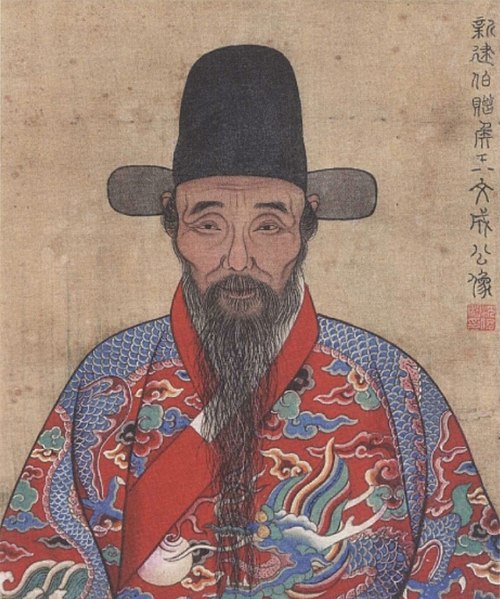
Wang Yangming Born (王阳明)
The philosopher Wang Yangming (王阳明, Wáng Yángmíng) was born. He later developed the influential school of mind (心学, xīnxué), emphasizing intuitive moral knowledge and the unity of knowledge and action. #philosophy #Confucianism #culture
Wang Shou Ren, Chinese idealist Neo-Confucian philosopher, official, educationist, calligraphist and general during the Ming dynasty. By Shen Junhui (沈俊繪) - Create a new portrait of Marquis Wang Wencheng : 新建伯贈侯王文成公像, Public domain, https://commons.wikimedia.org/w/index.php?curid=80389785
1506 CE
Zhengde Emperor's Reign Begins (正德帝)
The Zhengde Emperor (正德帝, Zhèngdé Dì), known for his erratic behavior and defiance of Confucian norms, began his reign. He favored military affairs, built a pleasure palace, and reportedly died from a boating accident. #politics #culture #scandal
Zhengde Emperor's Reign Begins (正德帝) By Unknown author - Digitized by NPM; image is directly from Shuge, Public domain, https://commons.wikimedia.org/w/index.php?curid=89369502
1510 CE
Liu Jin's Corruption Exposed (刘瑾)
The powerful eunuch Liu Jin (刘瑾, Liú Jǐn) was executed for extreme corruption. He had controlled government affairs, sold offices, and amassed enormous wealth, exemplifying eunuch dominance in late Ming politics. #politics #corruption #governance
1521 CE
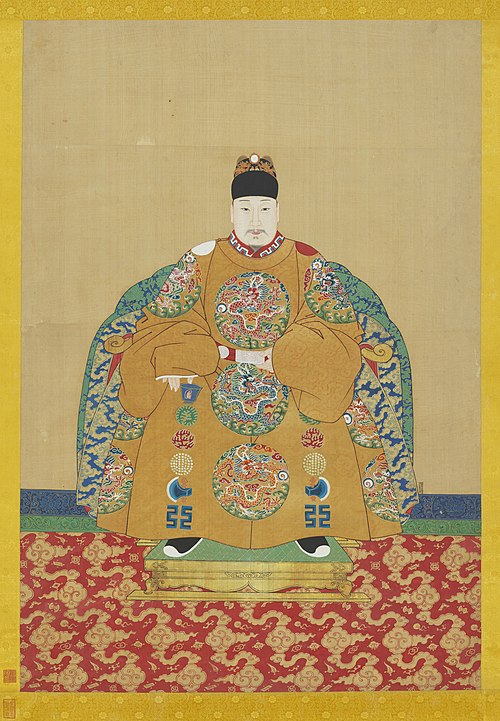
Jiajing Emperor Ascends (嘉靖帝)
The Jiajing Emperor (嘉靖帝, Jiājìng Dì) began his 45-year reign, the second-longest in Ming history. His obsession with Daoist alchemy and elixirs, and withdrawal from court, allowed eunuchs and officials to wield power. #politics #religion #Daoism
Portrait assis de l'empereur Jiajing (1507-1567) vêtu d'une robe décorée de douze dragons. Le motif du dragon (à cinq griffes), symbole du pouvoir impérial, est réservé à l'empereur et à sa famille. Le soleil et la lune dessinés sur les épaules composent le caractère « ming » (lumineux), nom de la dynastie. By Unknown author - Digitized by NPM; image is directly from Shuge, Public domain, https://commons.wikimedia.org/w/index.php?curid=85266114
1550 CE
Altan Khan Reaches Beijing (庚戌之变)
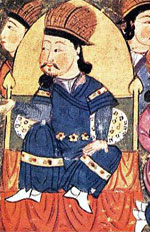
Mongol leader Altan Khan (阿勒坦汗, Ālètǎn Hàn) breached Ming defenses and raided suburbs of Beijing. This crisis exposed military weakness and led to eventual trade agreements with the Mongols. #war #defence #foreign
Depicted person: Altan Khan – leader of the Tümed Mongols By Unknown author - https://web.archive.org/web/20061211080736/http://etudiant.univ-mlv.fr/~ehureaux/images/Altan_Khan.jpg, Public domain, https://commons.wikimedia.org/w/index.php?curid=5371738
1552 CE
Wokou Piracy Crisis Peaks (倭寇)
Japanese and Chinese pirates known as wokou (倭寇, wōkòu) ravaged China's southeastern coast. Qi Jiguang (戚继光, Qī Jìguāng) later developed effective tactics and the Mandarin Duck formation to defeat them. #war #defence #piracy
Wokou Piracy Crisis Peaks (倭寇) By AnonymousUnknown author - Een zeeslag tussen Japanse zeerovers en Chinezen, anonymous, 1700 - 1800. Amsterdam: Rijksmuseum., Public domain, https://commons.wikimedia.org/w/index.php?curid=65985777
1566 CE
Hai Rui's Memorial (海瑞骂嘉靖)
The upright official Hai Rui (海瑞, Hǎi Ruì) submitted a scathing memorial criticizing the Jiajing Emperor's governance. He was imprisoned but became a symbol of moral courage against imperial excess. #politics #governance #reform
海青天像 By Unknown author - 《歷代名臣像解》, CC BY-SA 3.0, https://commons.wikimedia.org/w/index.php?curid=4902385
1572 CE
Wanli Emperor Begins Reign (万历帝)
The Wanli Emperor (万历帝, Wànlì Dì) ascended the throne as a child, with Zhang Juzheng (张居正, Zhāng Jūzhèng) as regent. This reign would become the longest in Ming history but ended in paralysis and decline. #politics #governance
Wanli Emperor Begins Reign (万历帝) By Unknown author - Digitized by NPM; image is directly from Shuge, Public domain, https://commons.wikimedia.org/w/index.php?curid=83365624
1578 CE
Single Whip Reform (一条鞭法)
Zhang Juzheng implemented the Single Whip reform (一条鞭法, yītiáo biān fǎ), converting labor service and grain taxes to silver payments. This streamlined taxation but increased peasant burdens as silver prices fluctuated. #economy #reform #agriculture
1582 CE
Zhang Juzheng Dies (张居正)
Zhang Juzheng (张居正, Zhāng Jūzhèng), the powerful grand secretary who had revitalized Ming finances and administration, died. The Wanli Emperor later reversed many reforms and turned against Zhang's family. #politics #governance #death
Zhang Wenzhong's portrait of a python. By Rongshi - Own work, Public domain, https://commons.wikimedia.org/w/index.php?curid=73533485
1592 CE
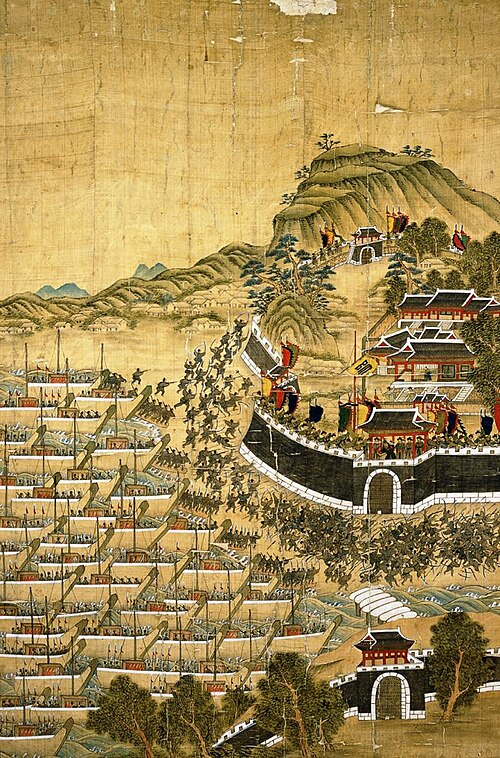
Japanese Invasion of Korea (万历朝鲜之役)
Toyotomi Hideyoshi invaded Korea; Ming China sent massive armies to aid its tributary state in the Imjin War (壬辰倭乱, Rénchén Wōluàn). The seven-year conflict strained Ming finances and military strength. #war #foreign #defence
Japanese Siege of Busanjin (1592) By Unknown author - http://www.cha.go.kr/unisearch/Culresult_Db_View.jsp?VdkVgwKey=12,03910000,11, Public domain, https://commons.wikimedia.org/w/index.php?curid=752659
1601 CE
Matteo Ricci Reaches Beijing (利玛窦)
The Italian Jesuit Matteo Ricci (利玛窦, Lìmǎdòu) arrived in Beijing, bringing Western astronomy, mathematics, and cartography. He became the first foreigner allowed to reside permanently in the capital. #science #religion #foreign
Matteo Ricci Reaches Beijing (利玛窦) By Chinese brother Emmanuel Pereira (born Yu Wen-hui 游文辉) - Unknown source, Public domain, https://commons.wikimedia.org/w/index.php?curid=85942
1615 CE
Donglin Academy Purge (东林党争)
The Donglin faction (东林党, Dōnglíndǎng) of moralistic officials was suppressed by the eunuch Wei Zhongxian (魏忠贤, Wèi Zhōngxián). This factional struggle paralyzed government and exemplified late Ming political decay. #politics #corruption #governance
1616 CE
Nurhaci Declares Khanate (努尔哈赤)
Nurhaci (努尔哈赤, Nǔ'ěrhāchì), a Jurchen leader, proclaimed himself Khan of the Later Jin dynasty, openly challenging Ming authority in Manchuria. He had unified Jurchen tribes and created the Eight Banners system. #war #founding #politics
Qing Dynasty Anonymous "Statue of the Emperor's Destiny of the Qing Dynasty" By Unknown author - Palace Museum, Beijing (故宫博物院), Public domain, https://commons.wikimedia.org/w/index.php?curid=181159761
1619 CE
Battle of Sarhu (萨尔浒之战)
Nurhaci decisively defeated a massive Ming expeditionary force at Sarhu (萨尔浒, Sà'ěrhǔ). This catastrophic loss shifted the military balance in Manchuria and exposed Ming military incompetence. #war #defence #disaster
An illustration of Nurhaci's biography depicting the battle of Sarhu (1619) By Unknown author - http://www.lasalle.edu/~mcinneshin/356/wk04/images/1619JurchenvsMinginfantry.jpg, Public domain, https://commons.wikimedia.org/w/index.php?curid=12042157
1626 CE
Yuan Chonghuan Defends Ningyuan (袁崇焕)
Ming general Yuan Chonghuan (袁崇焕, Yuán Chónghuàn) used Portuguese cannons to repel Nurhaci at the Battle of Ningyuan (宁远, Níngyuǎn), the first major Manchu defeat. Nurhaci died from wounds or illness soon after. #war #defence #technology
Yuan Chonghuan By Unknown author - http://cathay.ce.cn/history/200805/28/W020080528351052020929.jpg, Public domain, https://commons.wikimedia.org/w/index.php?curid=8955395
1628 CE
Chongzhen Emperor Ascends (崇祯帝)
The Chongzhen Emperor (崇祯帝, Chóngzhēn Dì), the last Ming emperor, began his reign. He executed the powerful eunuch Wei Zhongxian but faced mounting crises: rebellion, famine, and Manchu invasion. #politics #governance #decline
1630 CE
Yuan Chonghuan Executed (袁崇焕之死)
The Ming general Yuan Chonghuan was executed by lingchi (凌迟, língchí, death by a thousand cuts) on false charges of treason. The Chongzhen Emperor's suspicion destroyed his most capable military commander. #war #politics #tragedy
1636 CE
Qing Dynasty Proclaimed (皇太极)
Hong Taiji (皇太极, Hóng Tàijí), Nurhaci's son, changed the Jurchen name to Manchu and proclaimed the Qing dynasty (清, Qīng), claiming universal emperorship and positioning himself as Ming's successor. #politics #founding #foreign
清人画皇太极朝服像轴 2418 x 3564 By Anonymous Qing Dynasty Court Painter - https://digicol.dpm.org.cn/cultural/detail?id=46a323c4237f4d12863b49a421fcffd7, Public domain, https://commons.wikimedia.org/w/index.php?curid=181160214
1642 CE
Plague Devastates North China (明末大疫)
A devastating epidemic, possibly bubonic plague, struck northern China, killing hundreds of thousands in Beijing alone. This compounded famine from the Little Ice Age and severely weakened Ming defenses. #disaster #disease #agriculture
Apr 25, 1644 CE
Chongzhen Suicide, Ming Falls (崇祯自缢)
Li Zicheng (李自成, Lǐ Zìchéng) captured Beijing; the Chongzhen Emperor hanged himself on Meishan (煤山, Méishān) in the imperial garden. The Ming dynasty collapsed, though loyalist regimes continued in the south. #war #disaster #politics