Encyclopedia/1. The Cosmos & The Natural World/1. Mathematics & Formal Systems/12. Foundational & General Mathematics • Curated by Admin Timeline.sg
Number theory · Group theory · Cryptography
Chronological Storyline (25 Milestones)
1800 BCE
Babylonian Plimpton 322 tablet
Babylonian scribes compiled Plimpton 322, a table of Pythagorean triples demonstrating sophisticated understanding of number-theoretic relationships in a base-60 system. · Wikipedia: https://en.wikipedia.org/wiki/Plimpton_322
w:Plimpton 322, Babylonian tablet listing pythagorean triples By photo author unknown - image copied from http://www.math.ubc.ca/~cass/courses/m446-03/pl322/pl322.html, Public domain, https://commons.wikimedia.org/w/index.php?curid=1170904
1650 BCE
Rhind Mathematical Papyrus
Ancient Egyptian scribe Ahmes copied the Rhind papyrus, containing arithmetic, algebraic problems, and fraction methods used in Egyptian mathematics. · Wikipedia: https://en.wikipedia.org/wiki/Rhind_Mathematical_Papyrus
Rhind Mathematical Papyrus : detail (recto, left part of the first section British Museum Department of Ancient Egypt and Sudan, EA10057) Acquired by the Scottish lawyer A.H. Rhind during his sojourn in Thebes in the 1850s. length: 295.5 cm, width: 32 cm (whole section EA10057) A second section is kept in the British Museum (EA 10058 length: 199.5 cm, same width) Fragments of a small intermediate section (18 cm length) are kept in the Brooklyn Museum. It dates to the reign of the Hyksos kings Apepi or Apophis and possibly his successor Khamudi. By unknown (c. 2000 B.C) - Ahmes (scribe), http://www.archaeowiki.org/Image:Rhind_Mathematical_Papyrus.jpg (https://www.britishmuseum.org/, British Museum), Public domain, https://commons.wikimedia.org/w/index.php?curid=6943889
200 BCE
The Nine Chapters on the Mathematical Art
This foundational Chinese mathematical text compiled methods for solving linear equations, computing areas, and arithmetic with negative numbers, influencing East Asian mathematics for centuries. #ancient #science
263 CE
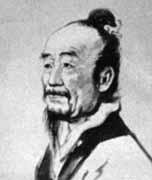
Liu Hui's commentary on Nine Chapters
Mathematician Liu Hui completed his commentary on the Nine Chapters, providing rigorous proofs and calculating π ≈ 3.1416 using polygonal approximation methods. Source — Wikipedia:
Lui Hui By Unknown - "Liu Hui (220 - 280) - Biography - MacTutor History of Mathematics" https://mathshistory.st-andrews.ac.uk/Biographies/Liu_Hui/, CC BY-SA 4.0, https://commons.wikimedia.org/w/index.php?curid=130481910
499 CE
Aryabhata's Aryabhatiya
Indian mathematician Aryabhata composed the Aryabhatiya, covering arithmetic, algebra, and trigonometry, including methods for solving quadratic equations and computing π. Source — Wikipedia:
Aryabhatta. By Cpjha13 - Own work, CC BY-SA 4.0, https://commons.wikimedia.org/w/index.php?curid=49883192
628 CE
Brahmagupta formalizes zero
Brahmagupta's Brahmasphutasiddhanta introduced rules for arithmetic with zero and negative numbers, and methods for solving quadratic equations, foundational to algebra. Source — Wikipedia:
820 CE
Al-Khwarizmi founds algebra
Al-Khwarizmi wrote Al-Jabr, systematically solving linear and quadratic equations, giving algebra its name and introducing the word 'algorithm' into European mathematics. Source — Wikipedia:
1070 CE
Omar Khayyam solves cubics geometrically
Persian polymath Omar Khayyam classified cubic equations and provided geometric solutions using intersections of conic sections, advancing algebraic technique. Source — Wikipedia:
Hakim Omar Khayam By Alireza Javaheri - https://web.archive.org/web/20161024154356/http://www.panoramio.com/photo/85093358, CC BY 3.0, https://commons.wikimedia.org/w/index.php?curid=55909539
1150 CE
Bhaskara II's Lilavati
Bhaskara II wrote the Lilavati and Bijaganita, covering arithmetic and algebra including solutions to indeterminate equations and early forms of the Pell equation. Source — Wikipedia:
भास्कराचार्य By Unknown author - Own work, Public domain, https://commons.wikimedia.org/w/index.php?curid=150275955
1247 CE
Qin Jiushao's Mathematical Treatise
Chinese mathematician Qin Jiushao published Shushu Jiuzhang, containing the earliest known method for solving simultaneous congruences, now called the Chinese Remainder Theorem. Source — Wikipedia:
Third order equation 宜稼堂 《数书九章》正负开赛乘方图 By Qin Jiushao 秦九韶 - 1842 printing Shu Shu Jiu Zhang, Public domain, https://commons.wikimedia.org/w/index.php?curid=3414657
1261 CE
Yang Hui's arithmetic triangle
Chinese mathematician Yang Hui documented the binomial coefficient triangle (Pascal's triangle) in his mathematical works, predating Pascal's publication by nearly 400 years. Source — Wikipedia:
Drawing of Pascal's Triangle published in C.E.1303 by Zhu Shijie (C.E.1260-1320), in his Si Yuan Yu Jian. It was called Jia Xian triangle or Yanghui Triangle by the Chinese, after the mathematician Jia Xian & Yang Hui. By Yáng Huī (楊輝), ca. 1238–1298) - w:en:Image:Yanghui_triangle.gif, Public domain, https://commons.wikimedia.org/w/index.php?curid=1189650
1350 CE
Madhava's infinite series
Madhava of the Kerala school discovered infinite series expansions for π and trigonometric functions, predating Newton and Leibniz by over three centuries. Source — Wikipedia:
1545 CE
Cardano's Ars Magna
Italian mathematician Gerolamo Cardano published Ars Magna, presenting general solutions to cubic and quartic equations, marking a major advance in European algebra. Source — Wikipedia: )
Title page of Ars Magna by Gerolamo Cardano By JCSantos - Own work, Public domain, https://commons.wikimedia.org/w/index.php?curid=3810175
1770 CE
Lagrange's theorem on permutations
Joseph-Louis Lagrange published Réflexions sur la résolution algébrique des équations, analyzing permutations of roots and laying groundwork for group theory. Source — Wikipedia:
Joseph Louis Lagrange Mathematics Timeline Card By Unknown author - File:Joseph_Louis_Lagrange.jpg, CC0, https://commons.wikimedia.org/w/index.php?curid=155608232
1801 CE
Gauss's Disquisitiones Arithmeticae
Carl Friedrich Gauss published Disquisitiones Arithmeticae, systematizing number theory and introducing modular arithmetic, foundational to modern algebra and cryptography. Source — Wikipedia:
Gauss's Disquisitiones Arithmeticae By Unknown author, Public domain, https://commons.wikimedia.org/w/index.php?curid=641724
1832 CE
Galois founds Galois theory
Évariste Galois developed the theory of groups to characterize solvability of polynomial equations, founding Galois theory and modern abstract algebra before his death at 20. Source — Wikipedia:
Portrait of Évariste Galois, young man in front of bust coating a redingote. By Unknown author - Iyanaga, Shokichi, "ガロアの時代 ガロアの数学 第一部 時代篇" , Springer-Verlag Tokyo, 1999 http://www.win.tue.nl/~aeb/at/GaloisCorrespondence.html, Public domain, https://commons.wikimedia.org/w/index.php?curid=103351
1854 CE
Cayley defines abstract group
Arthur Cayley published 'On the theory of groups,' giving the first abstract definition of a finite group, independent of any specific permutation context. Source — Wikipedia:
Arthur Cayley Portrait By Herbert Beraud (1845–1896) - http://www-groups.dcs.st-and.ac.uk/~history/PictDisplay/Cayley.html, Public domain, https://commons.wikimedia.org/w/index.php?curid=904674
1870 CE
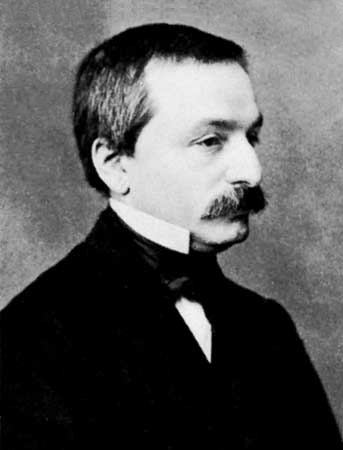
Kronecker defines abstract structures
Leopold Kronecker gave an abstract definition of fields and rings, helping shift algebra from operations on numbers to the study of abstract algebraic structures. Source — Wikipedia:
Leopold Kronecker By Unknown author - http://www.britannica.com/EBchecked/media/28346/Kronecker-1865, Public domain, https://commons.wikimedia.org/w/index.php?curid=33753789
1926 CE
Noether's Ideal Theory
Emmy Noether published 'Idealtheorie in Ringbereichen,' establishing the abstract theory of ideals in commutative rings, foundational to modern algebraic structures. · Wikipedia: https://en.wikipedia.org/wiki/Emmy_Noether
Portrait of Emmy Noether, around 1900 By Unknown authorUnknown author Publisher: Mathematical Association of America [3], Brooklyn Museum [4], Agnes Scott College [5], [6] - Emmy Noether (1882-1935), Archived, Public domain, https://commons.wikimedia.org/w/index.php?curid=158126186
1931 CE
Gödel's incompleteness theorems
Kurt Gödel published his incompleteness theorems, proving that any consistent formal system containing arithmetic has undecidable statements, profoundly impacting number theory and logic. · Wikipedia: https://en.wikipedia.org/wiki/G%C3%B6del's_incompleteness_theorems
Gödel's Incompleteness Theorem - Numberphile
1976 CE
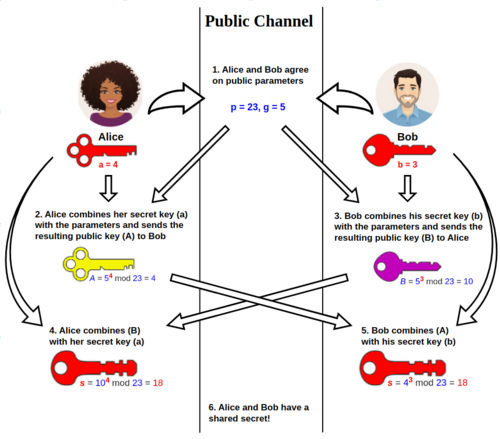
Diffie-Hellman key exchange
Whitfield Diffie and Martin Hellman published the first practical public-key cryptosystem, using the discrete logarithm problem in finite cyclic groups. · Wikipedia: https://en.wikipedia.org/wiki/Diffie%E2%80%93Hellman_key_exchange
Diffie-Hellman key exchange algorithm described in visual form. By Epachamo - Own work, CC BY-SA 4.0, https://commons.wikimedia.org/w/index.php?curid=142206661Secret Key Exchange (Diffie-Hellman) - Computerphile
1977 CE
RSA cryptosystem invented
Ron Rivest, Adi Shamir, and Leonard Adleman published the RSA cryptosystem, whose security relies on the difficulty of factoring large integers, linking number theory to cryptography. · Wikipedia: https://en.wikipedia.org/wiki/RSA_(cryptosystem)
Prime Numbers & RSA Encryption Algorithm - Computerphile
1985 CE
Elliptic curve cryptography introduced
Neal Koblitz and Victor Miller independently proposed elliptic curve cryptography, using the group structure of elliptic curves over finite fields for cryptographic applications. · Wikipedia: https://en.wikipedia.org/wiki/Elliptic-curve_cryptography
1994 CE
Shor's algorithm published
Peter Shor published a quantum algorithm for integer factorization, demonstrating that sufficiently powerful quantum computers could break RSA and reshaping cryptographic research. · Wikipedia: https://en.wikipedia.org/wiki/Shor's_algorithm
Shor's Algorithm: The algorithm that changed everything
2016 CE
NIST post-quantum cryptography project
NIST launched a process to standardize post-quantum cryptographic algorithms resistant to quantum attacks, evaluating lattice-based and other algebraic-structure-based schemes. · Wikipedia: https://en.wikipedia.org/wiki/Post-quantum_cryptography