Encyclopedia/3. History, Societies & Civilizations/09. Modern Nations/05. Europe • Curated by Admin Timeline.sg
History of Czechia (AI-generated, sourced to Wikipedia).
Chronological Storyline (31 Milestones)
400 BCE
Celtic Boii settle region
The Celtic Boii tribe settled in the region that would later be named Bohemia after them, establishing oppida and trading networks across Central Europe. Source — Wikipedia, "Czechia":
Flag of the Czech Republic By Jaroslav Kursa - Appendix No. 3 of Czech Legal Act 3/1993, Public domain, https://commons.wikimedia.org/w/index.php?curid=432452
550 CE
Slavs arrive in Bohemia
Slavic peoples migrated into Bohemia and Moravia during the Migration Period, gradually displacing or assimilating the remaining Germanic and Celtic populations. Source — Wikipedia, "Czechia":
Slavs arrive in Bohemia By Viktor Vasnetsov - http://art.1september.ru/articlef.php?ID=200702110, Public domain, https://commons.wikimedia.org/w/index.php?curid=430556
Jan 1, 623 CE
Samo's Empire founded
Frankish merchant Samo unified Slavic tribes against Avar raids, creating the first known Slavic political entity in Central Europe. Source — Wikipedia, "Czechia":
Milotice, Hodonín District, Czechia. Náklo hill. By Palickap - Own work, CC BY-SA 4.0, https://commons.wikimedia.org/w/index.php?curid=130582992
833 CE
Great Moravia established
Mojmir I unified Moravian and Nitravian principalities into Great Moravia, the first major West Slavic state, which became a cultural and religious center. Source — Wikipedia, "Czechia":
Great Moravia at its greatest extent during the reign of Svatopluk I with marked probable approximate location of its capital city (red dot) By Great_moravia_svatopluk.png: Tankred derivative work: Millenium187 (talk) - Great_moravia_svatopluk.png, Public domain, https://commons.wikimedia.org/w/index.php?curid=16071345
863 CE
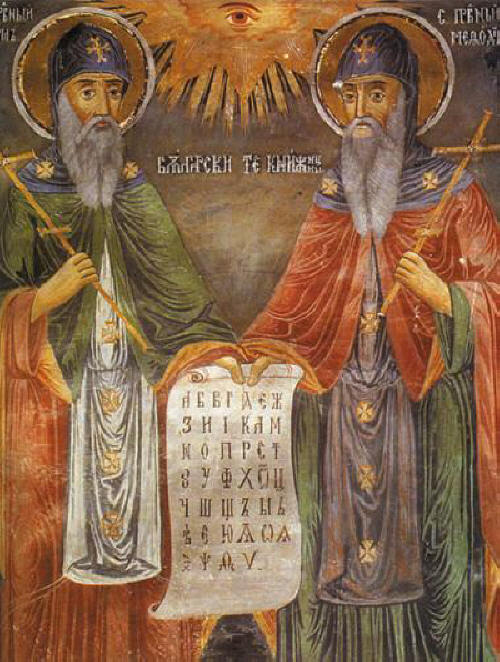
Cyril and Methodius mission
Byzantine missionaries Saints Cyril and Methodius arrived in Great Moravia, creating the Glagolitic alphabet and translating Christian texts into Old Church Slavonic. Source — Wikipedia, "Czechia":
Saints Cyril and Methodius - fresco in Troyan Monastery By painted by Zahari Zograf (Захарий Христович Димитров) - http://www.pravoslavieto.com/art/shkoli/samokovska/1810-1853_Zaharij_Zograf.htm, Public domain, https://commons.wikimedia.org/w/index.php?curid=4140266
870 CE
Duchy of Bohemia founded
Bořivoj I became the first historically documented ruler of the Přemyslid dynasty, establishing the Duchy of Bohemia and adopting Christianity. Source — Wikipedia, "Czechia":
Coat of arms of the Premyslid dynasty. By Wereszczyński - Own work, elements from Wikimedia Commons by Sodacan and Regicollis., CC BY-SA 4.0, https://commons.wikimedia.org/w/index.php?curid=102253388
Sep 28, 935 CE
Murder of Duke Wenceslas
Duke Wenceslas I was assassinated by his brother Boleslav, later becoming the patron saint of Bohemia and a symbol of Czech statehood. Source — Wikipedia, "Czechia":
Iluminace z Wolfenbüttelského rukopisu Gumpoldovy legendy o sv. Václavu. By Unknown author - Herzog August Bibliothek. Manuscript 11-2 Aug 4f. Accessed October 2, 2024. http://diglib.hab.de/mss/11-2-aug-4f/start.htm?image=00038, Public domain, https://commons.wikimedia.org/w/index.php?curid=153475226
Jun 1, 1085 CE
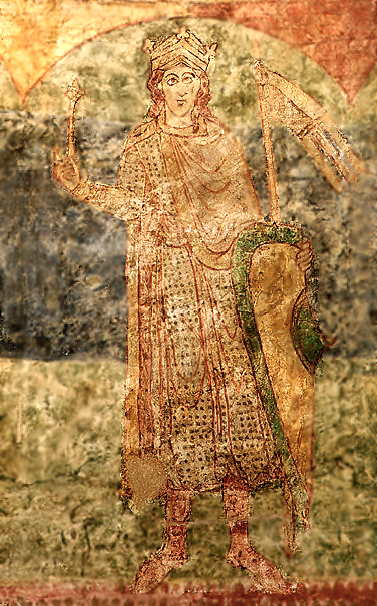
First King of Bohemia
Vratislav II was crowned the first King of Bohemia, elevating the realm from a duchy to a kingdom within the Holy Roman Empire. Source — Wikipedia, "Czechia":
Vratislav II King of Bohemia By anonymous fresco in Znojmo (CZ) - web, Public domain, https://commons.wikimedia.org/w/index.php?curid=2801131
Sep 1, 1212 CE
Golden Bull of Sicily
Emperor Frederick II issued the Golden Bull of Sicily, formally recognizing Bohemia as a kingdom and granting hereditary royal title to Přemyslid rulers. Source — Wikipedia, "Czechia":
Golden Bull of Sicily By emperor Frederick II Original uploader was Pastorius at cs.wikipedia - Original source: Archiv České koruny 1158-1935, inv. č. 2, 1212, 26. září, Basilej (http://www.mvcr.cz/archivnictvi/nkp/ack.html) Transferred from cs.wikipedia; Transfer was stated to be made by User:sevela.p., Public domain, https://commons.wikimedia.org/w/index.php?curid=3613431
Apr 7, 1348 CE
Charles University founded
Charles IV established Charles University in Prague, the first university in Central Europe and one of the oldest in the world. Source — Wikipedia, "Czechia":
Seal of the Charles University in Prague. Faithful reproduction via vectorization of the logo with InkScape. By WikiWriter123 - Own work, Public domain, https://commons.wikimedia.org/w/index.php?curid=80905850
Apr 5, 1355 CE
Charles IV crowned Emperor
Charles IV was crowned Holy Roman Emperor in Rome, making Prague the imperial capital and a major European political and cultural center. Source — Wikipedia, "Czechia":
Charles IV crowned Emperor By Circle of Theodoric of Prague - 1./2. Self-scanned from: Bohemian art of the gothic and early renaissance periods, Press Foto, Olomouc3. detail from: File:Anonym - Votive Painting of Archbishop Jan Očko of Vlašim.jpg, Public domain, https://commons.wikimedia.org/w/index.php?curid=1755205
Jul 6, 1415 CE
Jan Hus burned at stake
Religious reformer Jan Hus was executed for heresy at the Council of Constance, sparking the Hussite movement and decades of religious conflict. Source — Wikipedia, "Czechia":
Christoph Murer, Jan Hus, probably historicizing representation. Woodcut from Nicolaus Reusner: Icones sive Imagines virorum literis illustrium By Christoph Murer 1587 - Selbstgefertigter Scan eines Holzschnitts aus eigenem Bildarchiv, Public domain, https://commons.wikimedia.org/w/index.php?curid=32617482
Jul 30, 1419 CE
First Defenestration of Prague
Hussite radicals threw Catholic town councillors from Prague's New Town Hall windows, triggering the Hussite Wars that engulfed Bohemia for fifteen years. Source — Wikipedia, "Czechia":
Der Prager Fenstersturz auf einem zeitgenössischen Flugblatt By Unknown author - Peter Milger: Der Dreißigjährige Krieg. Gegen Land und Leute. Niedernhausen 2001, ISBN 3-572-01270-8, Public domain, https://commons.wikimedia.org/w/index.php?curid=1719982
May 30, 1434 CE
Battle of Lipany
Moderate Hussite forces defeated the radical Taborites at Lipany, effectively ending the Hussite Wars and opening the path to a compromise peace. Source — Wikipedia, "Czechia":
Battle of Lipan: A group of camp and orphan warlords. Shown here are Prokop Holý, Prokop Malý, Jan Roháč of Dubá & the armed men of Jan of Bergov. A scene from Marold's panorama of the Battle of Lipan, which was taken for the Exhibition of Architecture and Engineering, which took place at the Exhibition Center in Prague Holešovice in C.E.1898. By Luděk Marold - Publikace: Maroldovo panorama bitvy u Lipan, Public domain, https://commons.wikimedia.org/w/index.php?curid=19033594
Oct 23, 1526 CE
Habsburg rule begins
Ferdinand I of Habsburg was elected King of Bohemia after the Battle of Mohács, beginning nearly four centuries of Habsburg domination over Czech lands. Source — Wikipedia, "Czechia":
Cropped portrait of HRE Ferdinand I By Hans Bocksberger the Elder - File:Hans_Bocksberger_der_Aeltere_001.jpg, Public domain, https://commons.wikimedia.org/w/index.php?curid=189829840
May 23, 1618 CE
Second Defenestration of Prague
Protestant Bohemian nobles threw Catholic imperial governors from Prague Castle windows, sparking the Bohemian Revolt and the Thirty Years' War. Source — Wikipedia, "Czechia":
Der Prager Fenstersturz auf einem zeitgenössischen Flugblatt By Unknown author - Peter Milger: Der Dreißigjährige Krieg. Gegen Land und Leute. Niedernhausen 2001, ISBN 3-572-01270-8, Public domain, https://commons.wikimedia.org/w/index.php?curid=1719982
Nov 8, 1620 CE
Battle of White Mountain
Bohemian Protestant forces were decisively defeated by the Catholic Habsburg army, ending Czech independence and initiating forced re-Catholicization. Source — Wikipedia, "Czechia":
Battle of White Mountain By Peter Snayers - [1], Public domain, https://commons.wikimedia.org/w/index.php?curid=103889005
Oct 13, 1781 CE
Patent of Toleration
Emperor Joseph II issued the Patent of Toleration, granting limited religious freedom to non-Catholic Christians in Habsburg lands including Bohemia. Source — Wikipedia, "Czechia":
Patent of Toleration, front page top: Patent, Wegen der den augsburgisch und helvetischen Religionsverwandten, dann den nicht unirten Griechen zu gestattenden christlichen Toleranz und ihres privat excertii Religionis. ["Patent aimed at the members of the Lutheran and Calvinist confession, as well as orthodox Greeks, which tolerates their religion, and gives them the right to privately exercise it.] By Joseph II, Holy Roman Emperor - Archives of the Republic of Slovenia, Public domain, https://commons.wikimedia.org/w/index.php?curid=17212262
Jun 12, 1848 CE
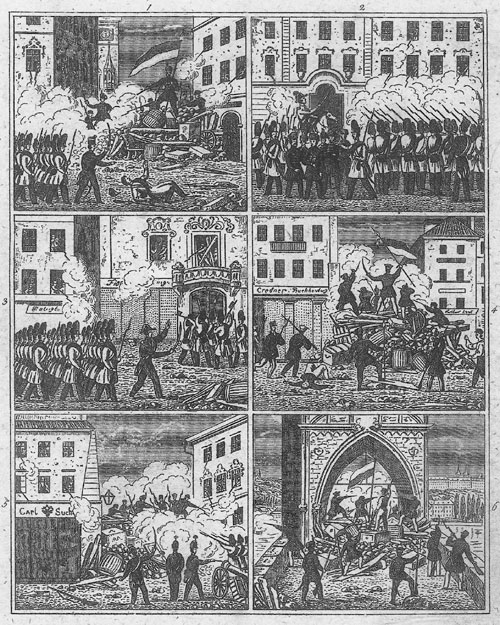
Prague uprising crushed
Czech nationalists staged a popular uprising in Prague during the Spring of Nations, but it was suppressed by Austrian military force under Prince Windischgrätz. Source — Wikipedia, "Czechia":
Prague uprising crushed By Unknown author, Public domain, https://commons.wikimedia.org/w/index.php?curid=665402
Feb 8, 1865 CE
Mendel presents genetics laws
Augustinian friar Gregor Mendel presented his experiments on pea plant hybridization in Brno, establishing the fundamental laws of genetic inheritance. Source — Wikipedia, "Czechia":
Gregor Mendel By Unknown author - http://0.tqn.com/d/biology/1/0/l/e/3244238.jpg, Public domain, https://commons.wikimedia.org/w/index.php?curid=33347279
Oct 28, 1918 CE
Czechoslovakia founded
The independent state of Czechoslovakia was proclaimed in Prague following the collapse of Austria-Hungary, uniting Czech and Slovak lands under Tomáš Masaryk. Source — Wikipedia, "Czechia":
Flag of the Czech Republic By Jaroslav Kursa - Appendix No. 3 of Czech Legal Act 3/1993, Public domain, https://commons.wikimedia.org/w/index.php?curid=432452
Sep 30, 1938 CE
Munich Agreement signed
Britain, France, Italy, and Germany agreed to cede Czechoslovak borderlands to Nazi Germany without Czechoslovak participation, leading to territorial dismemberment. Source — Wikipedia, "Czechia":
For documentary purposes the German Federal Archive often retained the original image captions, which may be erroneous, biased, obsolete or politically extreme. Münchener Abkommen, Staatschefs Zentralbild Das Münchner Abkommen vom 29.9.1938. Das am 29.9.1938 in München zwischen dem britischen Ministerpräsidenten Neville Chamberlain, dem französischen Ministerpräsidenten Edouard Daladier, dem italienischen Staatschef Benito Mussolini und Adolf Hitler geschlossene Abkommen ermächtigte das faschistische Deutschland zur Annexion tschechoslowakischen Gebietes. UBz: von links: Chamberlain, Daladier, Hitler, Mussolini, und der italienische Außenminister Graf Galeazzo Ciano. Im Hintergrund v.l.n.r. Unbekannter (wahrscheinlich ein brite Diplomat), Fromageot, Ribbentrop, Weizsäcker, Leger alias Saint-John Perse. 12 766-38 [Scherl Bilderdienst] Abgebildete Personen: Neville Chamberlain, Premierminister, Großbritannien Édouard Daladier, Ministerpräsident, Vorsitzender Sozialistische Partei, Frankreich Adolf Hitler, Reichskanzler, Deutschland Benito Mussolini, Ministerpräsident, Regierungschef, Chef des Faschistischen Großrates, Italien Graf Galeazzo Ciano, Außenminister, Italien (GND 119178362) Joachim von Ribbentrop, deutscher Außenminister Henri Fromageot, Diplomat, Frankreich Freiherr Ernst von Weizsäcker, Diplomat, Staatssekretär im Auswärtigen Amt, SS-Führer, Deutschland Alexis Leger alias Saint-John Perse, Generalsekretär des Aussenministeriums, auch Dichter, Schriftsteller und Nobelpreisträger für Literatur, Frankreich By Unknown author - This image was provided to Wikimedia Commons by the German Federal Archive (Deutsches Bundesarchiv) as part of a cooperation project. The German Federal Archive guarantees an authentic representation only using the originals (negative and/or positive), resp. the digitalization of the originals as provided by the Digital Image Archive., CC BY-SA 3.0 de, https://commons.wikimedia.org/w/index.php?curid=172648767
Mar 15, 1939 CE
Nazi occupation of Bohemia
German troops occupied the Czech lands, establishing the Protectorate of Bohemia and Moravia and ending Czechoslovak independence for six years. Source — Wikipedia, "Czechia":
National flag and merchant ensign of Germany from 1935 to 1945. By German government - RGBl. I (1935) No. 122, Public domain, https://commons.wikimedia.org/w/index.php?curid=4713270
May 27, 1942 CE
Heydrich assassinated in Prague
Czechoslovak paratroopers carried out Operation Anthropoid, fatally wounding SS-Obergruppenführer Reinhard Heydrich in Prague, triggering brutal Nazi reprisals. Source — Wikipedia, "Czechia":
Reinhard Heydrich's car (a Mercedes-Benz 320 Convertible B) after the 1942 assassination attempt in Prague. Heydrich later died of his injuries. By Unknown author - This image was provided to Wikimedia Commons by the German Federal Archive (Deutsches Bundesarchiv) as part of a cooperation project. The German Federal Archive guarantees an authentic representation only using the originals (negative and/or positive), resp. the digitalization of the originals as provided by the Digital Image Archive., Public domain, https://commons.wikimedia.org/w/index.php?curid=5418925
Feb 25, 1948 CE
Communist coup d'état
The Communist Party of Czechoslovakia seized complete power, ending democracy and installing a Soviet-backed totalitarian regime for over four decades. Source — Wikipedia, "Czechia":
Flag of the Czech Republic By Jaroslav Kursa - Appendix No. 3 of Czech Legal Act 3/1993, Public domain, https://commons.wikimedia.org/w/index.php?curid=432452
Aug 21, 1968 CE
Warsaw Pact invasion
Soviet-led Warsaw Pact troops invaded Czechoslovakia to crush the Prague Spring reforms, ending Alexander Dubček's attempt to create socialism with a human face. Source — Wikipedia, "Czechia":
Invasion of Czechoslovakia collage: Student protesters passing by a burning Soviet tank in Prague Hippies' inscriptions made on a Soviet military vehicle in Prague A crowd of protesters around a Soviet tank in Prague, at Balbinova and Vinohradská streets crossing A crowd of protesters around a Soviet BTR-60 armored vehicle in Ostrava Funeral of Jan Palach A refugee camp in Vienna, Austria, near Reichsbrücke bridge Street scene in Prague. A protester in front of burning Soviet tanks A streetfight in progress, with Soviet armor and civilian transport on fire, and people running in the center A graffiti comparing Soviets to Nazis, with USSR abbreviation written using ᛋᛋ (Schutzstaffel) runic symbol, painted at Husova street, Prague By Главцентроархив - Own work, CC0, https://commons.wikimedia.org/w/index.php?curid=174232098
Jan 16, 1969 CE
Jan Palach self-immolates
Student Jan Palach set himself on fire in Prague to protest the Soviet occupation and public apathy, becoming a powerful symbol of resistance. Source — Wikipedia, "Czechia":
Výkaz o studiu na Vysoké škole. Průkaz patřil Janu Palachovi. By Úřady - File:Výkaz_o_studiu_Jana_Palacha.jpg, Public domain, https://commons.wikimedia.org/w/index.php?curid=20314218
Nov 17, 1989 CE
Velvet Revolution begins
Student demonstrations in Prague sparked the Velvet Revolution, a peaceful mass protest movement that toppled communist rule within weeks. Source — Wikipedia, "Czechia":
Prague during the Velvet Revolution. By ŠJů (cs:ŠJů) - This file is an electronic scan of a film (photochemical) photograph made by ŠJů. film No.: 159, picture No.: 30 camera: Vilia , film type: Foto 64 (Svema), scanner: scanned from a negative by Foto-graf, CC BY-SA 3.0, https://commons.wikimedia.org/w/index.php?curid=14684941
Jan 1, 1993 CE
Czech Republic established
Czechoslovakia peacefully split into the Czech Republic and Slovakia, ending 74 years of common statehood in the so-called Velvet Divorce. Source — Wikipedia, "Czechia":
Map of Czechoslovakia in 1969-1990 By PANONIAN - Own work, Public domain, https://commons.wikimedia.org/w/index.php?curid=1449893
Mar 12, 1999 CE
Czechia joins NATO
The Czech Republic became a member of NATO alongside Poland and Hungary, anchoring itself in Western security structures after the Cold War. Source — Wikipedia, "Czechia":
Map of NATO historic enlargement in Europe. By Patrickneil - Own work based on: Blank map of Europe (with disputed regions).svg by Tintazul and Maix, CC BY-SA 3.0, https://commons.wikimedia.org/w/index.php?curid=146152344
May 1, 2004 CE
Czechia joins EU
The Czech Republic acceded to the European Union in the largest single enlargement, completing its reintegration into Western political and economic structures. Source — Wikipedia, "Czechia":
European Union Die alten Mitgliedsländer Die zehn neuen Mitgliedsländer By Europe_countries.svg: Júlio Reis derivative work: Kolja21 (talk) - EU25-2004_European_Union_map.svg, CC BY-SA 2.5, https://commons.wikimedia.org/w/index.php?curid=6814207






![Patent of Toleration, front page top: Patent, Wegen der den augsburgisch und helvetischen Religionsverwandten, dann den nicht unirten Griechen zu gestattenden christlichen Toleranz und ihres privat excertii Religionis. ["Patent aimed at the members of the Lutheran and Calvinist confession, as well as orthodox Greeks, which tolerates their religion, and gives them the right to privately exercise it.]](https://upload.wikimedia.org/wikipedia/commons/thumb/a/a8/Patent_of_Tolerance_13.10.1781_p1.jpg/500px-Patent_of_Tolerance_13.10.1781_p1.jpg)

![For documentary purposes the German Federal Archive often retained the original image captions, which may be erroneous, biased, obsolete or politically extreme. Münchener Abkommen, Staatschefs Zentralbild Das Münchner Abkommen vom 29.9.1938. Das am 29.9.1938 in München zwischen dem britischen Ministerpräsidenten Neville Chamberlain, dem französischen Ministerpräsidenten Edouard Daladier, dem italienischen Staatschef Benito Mussolini und Adolf Hitler geschlossene Abkommen ermächtigte das faschistische Deutschland zur Annexion tschechoslowakischen Gebietes. UBz: von links: Chamberlain, Daladier, Hitler, Mussolini, und der italienische Außenminister Graf Galeazzo Ciano. Im Hintergrund v.l.n.r. Unbekannter (wahrscheinlich ein brite Diplomat), Fromageot, Ribbentrop, Weizsäcker, Leger alias Saint-John Perse. 12 766-38 [Scherl Bilderdienst] Abgebildete Personen: Neville Chamberlain, Premierminister, Großbritannien Édouard Daladier, Ministerpräsident, Vorsitzender Sozialistische Partei, Frankreich Adolf Hitler, Reichskanzler, Deutschland Benito Mussolini, Ministerpräsident, Regierungschef, Chef des Faschistischen Großrates, Italien Graf Galeazzo Ciano, Außenminister, Italien (GND 119178362) Joachim von Ribbentrop, deutscher Außenminister Henri Fromageot, Diplomat, Frankreich Freiherr Ernst von Weizsäcker, Diplomat, Staatssekretär im Auswärtigen Amt, SS-Führer, Deutschland Alexis Leger alias Saint-John Perse, Generalsekretär des Aussenministeriums, auch Dichter, Schriftsteller und Nobelpreisträger für Literatur, Frankreich](https://upload.wikimedia.org/wikipedia/commons/thumb/7/76/Munich_Agreement_Bundesarchiv_Bild_183-R69173.jpg/500px-Munich_Agreement_Bundesarchiv_Bild_183-R69173.jpg)


