Encyclopedia/3. History, Societies & Civilizations/09. Modern Nations/05. Europe • Curated by Admin Timeline.sg
History of Cyprus, sourced from Wikipedia's "Timeline of Cypriot history".
Chronological Storyline (125 Milestones)
9500 BCE
Pre-Pottery Neolithic
The first permanent settlements are formed in Asprokremnos, Klimonas and Roudias, founded by Pre-Pottery Neolithic populations who also introduced dog, sheep, goats, cattle, pigs, foxes, and deer to the island. Klimonas is to date the oldest known farming village in the world. Source — Wikipedia, "Timeline of Cypriot history" (Epipaleolithic and Neolithic periods (up to ''circa'' 3,800 BCE)): )
Map of Southwest Asia showing the main archaeological sites of the Pre-Pottery Neolithic period, BCE c. 7500, in the "Fertile Crescent". Black squares indicate pre-agricultural sites. By Bjoertvedt, Lars A - Own work based on: 1, 2 and 3, CC BY-SA 4.0, https://commons.wikimedia.org/w/index.php?curid=172419255
8700 BCE
Shillourokambos
A second phase of early migration is thought to have occurred between 8700 and 7000 BCE, with settlements at Akanthou, Mylouthkia, Shillourokambos, and Tenta. DNA data obtained from three individuals whose fragmentary remains were found in a Neolithic disused and filled-in water well at Kissonerga-Mylouthkia, revealed high Anatolian-related ancestry. Source — Wikipedia, "Timeline of Cypriot history" (Epipaleolithic and Neolithic periods (up to ''circa'' 3,800 BCE)): )
die Kamera lügt nicht .... wenn man sich der Ausgrabungsstätte bei Kalavasos auf Zypern nähert fällt von weitem das eindrucksvolle Zeltdach in´s Auge - und daneben im Hintergrund die Raffinerie von Zygi. Ich hatte das Glück, dass eine Schafherde meinen Weg kreuzte- so entstand ein schöner Kontrast bzw. eine interessante Komposition. Je nch Standort erhält das Bild dann eine sehr unterschiedliche Aussage - mal mit Raffinerie, mal ohne - Mehr zu der Neolithischen Fundstätte unter: <a href="https://de.wikipedia.org/wiki/Tenta" rel="nofollow">de.wikipedia.org/wiki/Tenta</a> By Rolf Dietrich Brecher from Germany - different points of view, CC BY 2.0, https://commons.wikimedia.org/w/index.php?curid=120825102
7000 BCE
Khirokitia
The Neolithic village of Khirokitia (a UNESCO World Heritage Site) is founded. Source — Wikipedia, "Timeline of Cypriot history" (Epipaleolithic and Neolithic periods (up to ''circa'' 3,800 BCE)): )
Neolithic Archaeological Site of Khirokitia near Larnaca, Cyprus By A.Savin - Own work, FAL, https://commons.wikimedia.org/w/index.php?curid=55242593
6000 BCE
Khirokitia
The village of Khirokitia is suddenly abandoned for unknown reasons. The island appears to have remained uninhabited for about 1500 years, until the next phase of settlement that gave rise to the Sotira culture. Source — Wikipedia, "Timeline of Cypriot history" (Epipaleolithic and Neolithic periods (up to ''circa'' 3,800 BCE)): )
Neolithic Archaeological Site of Khirokitia near Larnaca, Cyprus By A.Savin - Own work, FAL, https://commons.wikimedia.org/w/index.php?curid=55242593
4600 BCE
Khirokitia
Second phase of Khirokitia settlement by Pottery Neolithic farmers from Anatolia or the Levant. Source — Wikipedia, "Timeline of Cypriot history" (Epipaleolithic and Neolithic periods (up to ''circa'' 3,800 BCE)): )
Neolithic Archaeological Site of Khirokitia near Larnaca, Cyprus By A.Savin - Own work, FAL, https://commons.wikimedia.org/w/index.php?curid=55242593
3800 BCE
Neolithic
Large earthquake hits Cyprus and heralds the end of the Neolithic culture on the island. Source — Wikipedia, "Timeline of Cypriot history" (Epipaleolithic and Neolithic periods (up to ''circa'' 3,800 BCE)): )
6176 By Sarah Murray from Palo Alto, CA - 6176 Uploaded by stegop, CC BY-SA 2.0, https://commons.wikimedia.org/w/index.php?curid=12606879
3600 BCE
chalcolithic
Socio-cultural continuity with the previous period and increase of settlements on the island. The chalcolithic population of Cyprus continues to use stone, but now in combination with copper for objects like chisels, hooks and jewellery. Female fertility and cruciform figurines, as well as Red-on-White pottery, predominate. Source — Wikipedia, "Timeline of Cypriot history" (37th–26th centuries BCE):
Diffusion periods: oldest, 7500, 7000, 6500, 5500, 4300 BC By Hamelin de Guettelet - Own work, Public domain, https://commons.wikimedia.org/w/index.php?curid=4176978
3500 BCE
Chalcolithic
First signs of metalwork on the island marking the beginning of the Chalcolithic period. Source — Wikipedia, "Timeline of Cypriot history" (36th century BCE):
Diffusion periods: oldest, 7500, 7000, 6500, 5500, 4300 BC By Hamelin de Guettelet - Own work, Public domain, https://commons.wikimedia.org/w/index.php?curid=4176978
2450 BCE
Chalcolithic
Transition from the Chalcolithic to the Bronze Age and emergence of the Philia culture following further migrations from Anatolia. Metallurgy, cattle, donkey and woolly sheep are introduced on the island. A new form of distinctive pottery, Red Polished Ware, and other intrusive elements appear in archaeological data and material culture. Source — Wikipedia, "Timeline of Cypriot history" (25th century BCE):
Diffusion periods: oldest, 7500, 7000, 6500, 5500, 4300 BC By Hamelin de Guettelet - Own work, Public domain, https://commons.wikimedia.org/w/index.php?curid=4176978
2250 BCE
Philia culture
Continuity with Philia characterised mostly by peaceful development. Bidirectional trading contacts with Minoan Crete and the Levant develop. Source — Wikipedia, "Timeline of Cypriot history" (23rd–17th centuries BCE):
Schaffhausen, Museum zu Allerheiligen, Sammlung Ebnöther, (Abteilung "Idole") Brettidol, Zypern, frühe Bronze Zeit (2100–2000 v. Chr.), Ton (modelliert und geritzt); Höhe 27 cm By User:Helvetiker - Own work, Public domain, https://commons.wikimedia.org/w/index.php?curid=12649748
1600 BCE
Mining industry of Cyprus
Exploitation of copper, urbanization and foundation of Enkomi, the first industrial centre in Cyprus. Source — Wikipedia, "Timeline of Cypriot history" (16th century BCE):
Skouriotissa Mine - open pit mining. A copper mine on Cyprus. By User:MeanStreets - Own work, Public domain, https://commons.wikimedia.org/w/index.php?curid=28422211
1550 BCE
Cypro-Minoan syllabary
Literacy is introduced on the island with the Cypro-Minoan syllabary, first attested in Enkomi. Source — Wikipedia, "Timeline of Cypriot history" (16th century BCE):
1446 BCE
Thutmose III
Thutmose III extends his influence over Cyprus under the name of "Isy" or "Irs" (probably referring to Alasiya), which is reported offering minerals and timber as a tribute to the Pharaoh. Source — Wikipedia, "Timeline of Cypriot history" (15th century BCE):
Ancient Orient around 1400 BCE: Amarna period: Hittites, Mittani, Kashites, Elam, 18th dynasty of New Kingdom Mycenaean replaces Minoan culture in Crete (?) More information about maps in this series By Enyavar - Own work, CC BY-SA 4.0, https://commons.wikimedia.org/w/index.php?curid=102936018
1300 BCE
Aegean civilization
Close trading contacts between Cyprus and the Aegean develop, attested by the import of luxury Aegean items and "Aegeanization" of Cypriote craftmanship. Mycenaean traders start visiting the island and establishing stations for the exportation of copper. Source — Wikipedia, "Timeline of Cypriot history" (14th century BCE):
Greece, Archipelago and part of Anadoli. Published for Willm. Faden, Geographer to the King. W. Palmer sculp. . Scale: 1,350,000 By Louis Stanislas d'Arcy Delarochette - http://www.davidrumsey.com/luna/servlet/detail/RUMSEY~8~1~24845~960053?trs=120&mi=23&qvq=mgid%3A2728#, Public domain, https://commons.wikimedia.org/w/index.php?curid=48557075
1220 BCE
Tudhaliya IV
Tudhaliya IV annexes Cyprus (disputed). Source — Wikipedia, "Timeline of Cypriot history" (13th century BCE):
Rotsreliëf van de Hettitische god Sharruma en koning Tudhaliya, gedateerd op 1250 - 1220 voor Christus. Het reliëf bevindt zich in Yazilikaya, het heiligdom van Hattusa, de hoofdstad van het Hettitische Rijk. Gefotografeerd door w:en:User:AtilimGunesBaydin op 8 november 2004 tijdens een excursie met de METU Archaeological Society. By w:en:User:AtilimGunesBaydin - w:en:Image:YazilikayaSharrumaAndKingTudhaliya8November2004.JPG, Public domain, https://commons.wikimedia.org/w/index.php?curid=2177335
1210 BCE
Hittites
The last king of the Hittites, Šuppiluliuma II, wins a decisive naval battle against Alashiya (Cypriots) off the coast of Cyprus, in the first recorded naval battle in history. Source — Wikipedia, "Timeline of Cypriot history" (13th century BCE):
Map showing the expanse of Hittite Empire with its vassals around the year 1300 BC. By Ennomus - Own work, CC BY-SA 4.0, https://commons.wikimedia.org/w/index.php?curid=139305272
1200 BCE
Aetokremnos
The earliest site of putative human activity on Cyprus is Aetokremnos, situated on the south coast. Fossilised animal remains and lithic tools indicate that seasonal hunter-gatherers were active on the island from around 12,000 BC. Source — Wikipedia, "Timeline of Cypriot history" (Epipaleolithic and Neolithic periods (up to ''circa'' 3,800 BCE)): )
Aetokremnos site, Akrotiri, Cyprus- taken on discovering the site in 1960 - photographer's brother as scale- fossil bones in foreground. Excavated from 1987. By D Nixon - Self-photographed, CC BY 3.0, https://commons.wikimedia.org/w/index.php?curid=14524668
1200 BCE
Ugarit
The first documented name of a Cypriote king, Kushmeshusha, is attested in letters sent to Ugarit from Alasiya (Cyprus) sometime in the 13th c. BCE. Source — Wikipedia, "Timeline of Cypriot history" (13th century BCE):
Ancient Orient around 1400 BCE: Amarna period: Hittites, Mittani, Kashites, Elam, 18th dynasty of New Kingdom Mycenaean replaces Minoan culture in Crete (?) More information about maps in this series By Enyavar - Own work, CC BY-SA 4.0, https://commons.wikimedia.org/w/index.php?curid=102936018
1190 BCE
Sea Peoples
Invasion by the Sea Peoples. Source — Wikipedia, "Timeline of Cypriot history" (12th century BCE):
Resignature of the "war of sea peoples" on the northeast wall of the temple of the dead Ramses III in Medinet Habu, Egypt By Unknown artistUnknown artist in pay of Ramesses III - Gray, Dorothea (1974) "chapter G" in (in German) Seewesen, Archaeologia Homerica, I, Göttingen, pp. 166−167, Public domain, https://commons.wikimedia.org/w/index.php?curid=45247426
1179 BCE
Aegean civilization
Migrations of Aegean populations to Cyprus attested by abundant locally produced Mycenaean-style (IIIC:1b) pottery and other Aegean/European features. The Hellenization process of the island begins. Source — Wikipedia, "Timeline of Cypriot history" (12th century BCE):
Greece, Archipelago and part of Anadoli. Published for Willm. Faden, Geographer to the King. W. Palmer sculp. . Scale: 1,350,000 By Louis Stanislas d'Arcy Delarochette - http://www.davidrumsey.com/luna/servlet/detail/RUMSEY~8~1~24845~960053?trs=120&mi=23&qvq=mgid%3A2728#, Public domain, https://commons.wikimedia.org/w/index.php?curid=48557075
1150 BCE
Bronze Age collapse
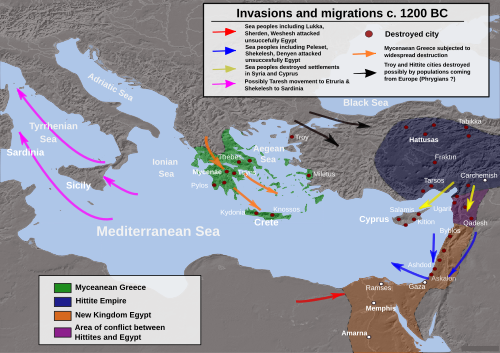
A second, major wave of Greek settlements takes place following the Bronze Age collapse of Mycenaean Greece, accompanied by the appearance of further Aegean features including long dromoi graves and the introduction of the Greek language. Source — Wikipedia, "Timeline of Cypriot history" (11th century BCE):
Migrations, invasions and destructions during the end of the Bronze Age (c. 1200 BC), Topography taken from DEMIS Mapserver, which are public domain, other wise self-made. By Alexikoua - Own work, CC BY-SA 3.0, https://commons.wikimedia.org/w/index.php?curid=30160275
1100 BCE
Cypriot syllabary
Appearance of the Cypriot syllabary, used both for Arcadocypriot Greek and Eteocypriot. The script, which had evolved from the pre-existing Cypro-Minoan syllabary, lasted until the end of the 3rd Century BCE when it was eventually replaced by the Greek alphabet. Source — Wikipedia, "Timeline of Cypriot history" (11th century BCE):
Bronze tablet inscribed with signs of the Cypriot syllabary By O. Masson / Schreiber - Olivier Masson: Les Inscriptions chypriotes syllabiques. Recueil critique et commenté (Études Chypriotes I) Boccard, Paris 1961, Plate XXXVI,1, Public domain, https://commons.wikimedia.org/w/index.php?curid=1640687
1050 BCE
Amathus
Foundation of the city-kingdom of Amathus, the last autochthonous urban centre in Iron Age Cyprus where the Eteocypriot language survived until about 400 BCE. Source — Wikipedia, "Timeline of Cypriot history" (11th century BCE):
Blick vom Hügel auf Amathous By Hermann Junghans - Own workOriginal text: eigenes Werk, CC BY-SA 3.0 de, https://commons.wikimedia.org/w/index.php?curid=50017852
1000 BCE
Phoenicia
Literary evidence of Phoenician presence at Kition under Tyrian rule. Source — Wikipedia, "Timeline of Cypriot history" (10th century BCE):
"map of Phoenicia", apparently intended to give a rough idea of the part of the Levant known as "Phoenicia", it does not correspond to any historical empire or polity. The cities indicated are the ancient Phoenician city states, perhaps in the Late Bronze Age (?) By Kordas, based on Alvaro's work - This map, CC BY 3.0, https://commons.wikimedia.org/w/index.php?curid=4083286
850 BCE
The royal tombs in the city
The royal tombs in the city of Salamis are built. Source — Wikipedia, "Timeline of Cypriot history" (9th century BCE):
800 BCE
Phoenicia
Phoenician merchants settle in Kition. Source — Wikipedia, "Timeline of Cypriot history" (9th century BCE):
"map of Phoenicia", apparently intended to give a rough idea of the part of the Levant known as "Phoenicia", it does not correspond to any historical empire or polity. The cities indicated are the ancient Phoenician city states, perhaps in the Late Bronze Age (?) By Kordas, based on Alvaro's work - This map, CC BY 3.0, https://commons.wikimedia.org/w/index.php?curid=4083286
709 BCE
Neo-Assyrian Empire
The kingdoms of Cyprus are subjugated by the Neo-Assyrian Empire, although no evidence of occupation is apparent in archaeological data and material culture; rather, the kingdoms seem to have "offered their submission to Sargon II" and had a client-state relationship. Source — Wikipedia, "Timeline of Cypriot history" (8th century BC):
Map of the Assyrian Empire By Ningyou - Own work data from Based on a map in 'Atlas of the Bible Lands', C S Hammond & Co (1959), ISBN 9780843709414., Public domain, https://commons.wikimedia.org/w/index.php?curid=600659
631 BCE
Cyprus is no longer mentioned in
Cyprus is no longer mentioned in Assyrian records after the death of King Ashurbanipal of Assyria. Source — Wikipedia, "Timeline of Cypriot history" (7th century BCE):
570 BCE
Ancient Egypt
Cyprus is conquered by the Egyptians under Amasis II. Source — Wikipedia, "Timeline of Cypriot history" (6th century BCE):
Map of Ancient Egypt, showing the Nile up to the fifth cataract, and major cities and sites of the Dynastic period (c. 3150 BC to 30 BC). Cairo and Jerusalem are shown as reference cities. By Jeff Dahl - Own work using: Shaw, Ian, ed. (2003) The Oxford History of Ancient Egypt, Oxford University Press ISBN: 0-19-280293-3. Dr. Peter Der Manuelian, ed. (1998) Egypt: The World of the Pharaohs, Bonner Straße, Köln (Deutschland): Könemann Verlagsgesellschaft mbH ISBN: 3-89508-913-3. Digital Egypt - maps. Retrieved on 2007-11-25. NASA PIA04957. Retrieved on 2007-11-25. NASA PIA02647. Retrieved on 2007-11-25. NASA PIA04965. Retrieved on 2007-11-25. Coordinates: Sais 30°57′53″N, 30°46′6″E Buto 31°11′47″N, 30°44′41″E Alexandria 31°11′53″N 29°55′09″E Naukratis 30°54' N 30°35'E coordinates here Tanis 30°58′37″N, 31°52′48″E Avaris 30°47′N, 31°50′E Busiris 30°54′40″N, 31°14′40″E Image renamed from File:Ancient Egypt map.svg (see #Original upload log)., CC BY-SA 4.0, https://commons.wikimedia.org/w/index.php?curid=5818406
545 BCE
Cyprus pledged allegiance to the Achaemenid
Cyprus pledged allegiance to the Achaemenid Empire. Source — Wikipedia, "Timeline of Cypriot history" (6th century BCE):
526 BCE
Amasis II
Amasis II dies. His son Psammetichus III succeeds him as pharaoh. Source — Wikipedia, "Timeline of Cypriot history" (6th century BCE):
Head of Amasis II. Saite period, 26th Dynasty, c. 550 BCE. From Egypt. Neues Museum, Berlin, Germany. Greywacke, ÄM 11864. By Osama Shukir Muhammed Amin FRCP(Glasg) - Own work, CC BY-SA 4.0, https://commons.wikimedia.org/w/index.php?curid=92683103
525 BCE
Cambyses II of Persia
The kingdoms of Cyprus gave naval support to Cambyses II of the Achaemenid Persian Empire in anticipation of his invasion of Egypt. Source — Wikipedia, "Timeline of Cypriot history" (6th century BCE):
Apis stele dated to the regnal year 6 of Cambyses (524 BCE), and depicting the king (kneeling, left) as an Egyptian pharaoh, while worshiping a dead Apis bull (right).[1] Later Greek traditions depicted Cambyses as the slayer of this Apis bull. By Jona Lendering - http://www.livius.org, Public domain, https://commons.wikimedia.org/w/index.php?curid=78408401
499 BCE
Ionian Revolt
Ionian Revolt: Aristagoras, the appointed tyrant of Miletus, rebells against Persian rule. Source — Wikipedia, "Timeline of Cypriot history" (5th century BCE):
Map in English of the military operations during the Ionian Revolt which will lead to the Greco–Persian Wars.Notes: *The background map is a raster image embedded in the SVG file. *The routes shown are hypothetical, based on Herodotus's descriptions. By Ionian_Revolt_Campaign_Map-fr.svg: Eric Gaba (Sting - fr:Sting) derivative work: MinisterForBadTimes (talk) - Ionian_Revolt_Campaign_Map-fr.svg Background map: File:Aegean_Sea_map_bathymetry-fr.svg (modified) created by Eric Gaba (Sting - fr:Sting) Based on an original idea by user:MinisterForBadTimes (see File:Ionian_Revolt_Campaign_Map.png) Compass rose: File:Brújula.svg (modified) created by user:Serg!o under GFDL, CC BY-SA 3.0, https://commons.wikimedia.org/w/index.php?curid=8991667
498 BCE
Ionian Revolt: The kingdoms of Cyprus
Ionian Revolt: The kingdoms of Cyprus joined the revolt except the Kingdom of Amathus. Source — Wikipedia, "Timeline of Cypriot history" (5th century BCE):
497 BCE
Ionian Revolt: The Cypriot rebels besieged
Ionian Revolt: The Cypriot rebels besieged the pro-Persian Kingdom of Amathus. Source — Wikipedia, "Timeline of Cypriot history" (5th century BCE):
451 BCE
The Athenian expedition in Cyprus under
The Athenian expedition in Cyprus under the command of Cimon besieged the city of Kition, but later retreated to Salamis. Source — Wikipedia, "Timeline of Cypriot history" (5th century BCE):
450 BCE
The Athenians in Salamis defeated an
The Athenians in Salamis defeated an attacking Persian forces and retreated from Cyprus. Source — Wikipedia, "Timeline of Cypriot history" (5th century BCE):
411 BCE
Evagoras I
The Teucrid Evagoras I regains the throne of Salamis. Source — Wikipedia, "Timeline of Cypriot history" (5th century BCE):
Salamis, Gymnasion und Therme aus Südwest By Gerhard Haubold - Own work, CC BY-SA 3.0, https://commons.wikimedia.org/w/index.php?curid=6858749
391 BCE
Athens
Evagoras attempts to establish himself as an independent ruler on Cyprus with Athenian help. Source — Wikipedia, "Timeline of Cypriot history" (4th century BCE):
Monastiraki Square and Acropolis in Athens By dronepicr - Monastiraki Square and Acropolis in Athens, CC BY 2.0, https://commons.wikimedia.org/w/index.php?curid=75612185
386 BCE
Persian Empire
Under the Treaty of Antakidas, Persian rule over Cyprus is accepted by Athens. Source — Wikipedia, "Timeline of Cypriot history" (4th century BCE):
Achaemenid Empire 500 BCE By Cattette - This image has been extracted from another file, CC BY 4.0, https://commons.wikimedia.org/w/index.php?curid=113179532
376 BCE
Cyprus became a de facto Persian
Cyprus became a de facto Persian vassal after a peace treaty was concluded between King Evagoras I of Cyprus and Persia. Source — Wikipedia, "Timeline of Cypriot history" (4th century BCE):
350 BCE
A Cypriot rebellion begins.
A Cypriot rebellion begins. Source — Wikipedia, "Timeline of Cypriot history" (4th century BCE):
344 BCE
Artaxerxes III
The Cypriot rebellion is crushed by Artaxerxes III. Source — Wikipedia, "Timeline of Cypriot history" (4th century BCE):
Rock relief of Artaxerxes III in Persepolis By AR VLD - Own work, CC BY-SA 4.0, https://commons.wikimedia.org/w/index.php?curid=136535586
333 BCE
Alexander the Great
The island is finally liberated from Persian rule by Alexander the Great. Source — Wikipedia, "Timeline of Cypriot history" (4th century BCE):
Alexander Mosaic (detail), House of the Faun, Pompeii By Unknown author - This image has been extracted from another file, Public domain, https://commons.wikimedia.org/w/index.php?curid=182741814
332 BCE
Alexander The Great
Pythagoras of Salamis and other Cypriot kings plea to Alexander The Great during the beginning of the siege of Tyre. Source — Wikipedia, "Timeline of Cypriot history" (4th century BCE):
Alexander Mosaic (detail), House of the Faun, Pompeii By Unknown author - This image has been extracted from another file, Public domain, https://commons.wikimedia.org/w/index.php?curid=182741814
331 BCE
Nicocreon
The rule of Nicocreon begins. Source — Wikipedia, "Timeline of Cypriot history" (4th century BCE):
CYPRUS, Salamis. Nikokreon. Circa 331-311/10 BC. AV Stater (8.29 gm). Persic standard. Draped bust of Aphrodite left, hair rolled above forehead and falling in long wavy strands to front and back of shoulder, wearing beaded necklace, triple-drop earring, and turreted crown, NI behind / Draped bust of Aphrodite left, hair in tight ringlets falling before ear and down back of neck, wearing torque (open end at front of her neck), beaded hoop earring, fillet, and crown decorated with semicircular plates; BA behind. McGregor 804 = Traité II 1188, pl. 129, 10, (same dies). EF. (See color enlargement on plate 1.) ($10,000) By User:LouisAragon (uploader) - https://www.cngcoins.com/Coin.aspx?CoinID=27555#, CC BY-SA 2.5, https://commons.wikimedia.org/w/index.php?curid=79494208
325 BCE
The Archaic and Classical Period ends.
The Archaic and Classical Period ends. Source — Wikipedia, "Timeline of Cypriot history" (4th century BCE):
310 BCE
Nicocreon
The rule of Nicocreon ends. Source — Wikipedia, "Timeline of Cypriot history" (4th century BCE):
CYPRUS, Salamis. Nikokreon. Circa 331-311/10 BC. AV Stater (8.29 gm). Persic standard. Draped bust of Aphrodite left, hair rolled above forehead and falling in long wavy strands to front and back of shoulder, wearing beaded necklace, triple-drop earring, and turreted crown, NI behind / Draped bust of Aphrodite left, hair in tight ringlets falling before ear and down back of neck, wearing torque (open end at front of her neck), beaded hoop earring, fillet, and crown decorated with semicircular plates; BA behind. McGregor 804 = Traité II 1188, pl. 129, 10, (same dies). EF. (See color enlargement on plate 1.) ($10,000) By User:LouisAragon (uploader) - https://www.cngcoins.com/Coin.aspx?CoinID=27555#, CC BY-SA 2.5, https://commons.wikimedia.org/w/index.php?curid=79494208
306 BCE
The reign of Menelaos ends.
The reign of Menelaos ends. Source — Wikipedia, "Timeline of Cypriot history" (4th century BCE):
301 BCE
The reign of Antigonus ends.
The reign of Antigonus ends. Source — Wikipedia, "Timeline of Cypriot history" (4th century BCE):
300 BCE
Zeno of Citium
The prominent Cypriot philosopher, Zenon of Kitium, becomes the founder of the Stoic school of philosophy in Athens in the early 3rd century BCE. Source — Wikipedia, "Timeline of Cypriot history" (3rd century BCE):
Napoli. Museo Nazionale. Busti filosofi. Servizio fotografico: Napoli, 1969 / Paolo Monti. - Strisce: 7, Fotogrammi complessivi: 36: Negativo b/n, gelatina bromuro d'argento/pellicola; 35 mm. - I fotogrammi hanno una doppia numerazione. - Sul portanegativi: Nikon FP4. - All'interno e sul dorso del portanegativi Monti specifica: "Tucidide. Erodoto. Zenone. Antistene. Esiodo. Euripide. Garzanti". - Occasione: Pubblicazione, Enciclopedia dell'Arte, ed. Garzanti 1973. - Fonte: Agenda di Paolo Monti: Monti - Agenda 1969 (1969), presso Archivio Paolo Monti. By Paolo Monti - Available in the BEIC digital library and uploaded in partnership with BEIC Foundation. The image comes from the Fondo Paolo Monti, owned by BEIC and located in the Civico Archivio Fotografico of Milan., CC BY-SA 4.0, https://commons.wikimedia.org/w/index.php?curid=48067347
245 BCE
Ptolemaic dynasty
Kingdoms are abolished under the Ptolemaic rule. Greek alphabet and koine Greek are established as the official administrative tools. Both the Eteocypriot and Phoenician languages become extinct and the island is thereafter fully Hellenised. Source — Wikipedia, "Timeline of Cypriot history" (3rd century BCE):
Eagle of Zeus standing on a thunderbolt, traditional symbol of Ptolemaic Egypt often found on coins. By Unknown, CC BY-SA 4.0, https://commons.wikimedia.org/w/index.php?curid=137076867
116 BCE
Cleopatra III
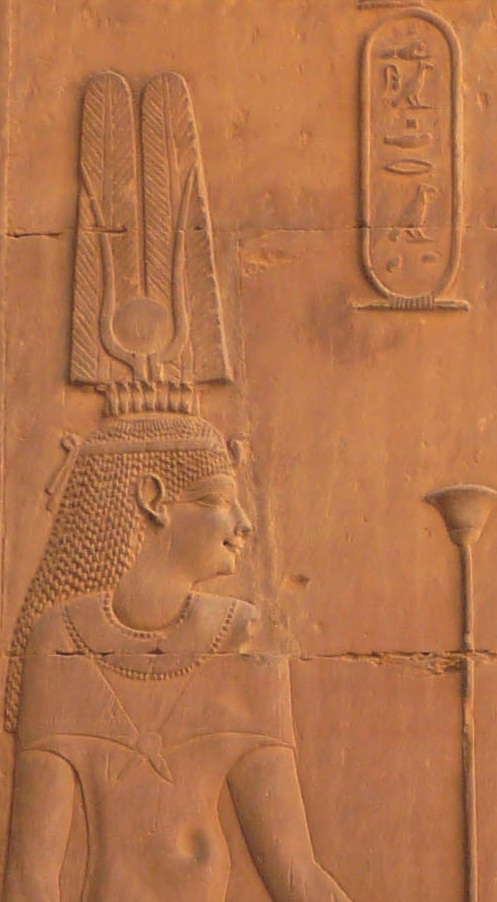
Cleopatra sends her son Ptolemy Philometor to Cyprus. Source — Wikipedia, "Timeline of Cypriot history" (2nd century BCE):
Cleopatra II and Cleopatra III (right to left), Kom Ombo Temple, Egypt By Cleopatra_II_and_III_Kom_Ombo_Temple.jpg: *Cleopatra_Kom_Ombo.JPG: Rémih derivative work: ISa1 (talk) derivative work: AnnekeBart (talk) - Cleopatra_II_and_III_Kom_Ombo_Temple.jpg, CC BY-SA 3.0, https://commons.wikimedia.org/w/index.php?curid=11242805
109 BCE
Cleopatra III
Cleopatra sends Alexander, her son and the brother of Ptolemy IX Lathyros, to Cyprus. Source — Wikipedia, "Timeline of Cypriot history" (2nd century BCE):
Cleopatra II and Cleopatra III (right to left), Kom Ombo Temple, Egypt By Cleopatra_II_and_III_Kom_Ombo_Temple.jpg: *Cleopatra_Kom_Ombo.JPG: Rémih derivative work: ISa1 (talk) derivative work: AnnekeBart (talk) - Cleopatra_II_and_III_Kom_Ombo_Temple.jpg, CC BY-SA 3.0, https://commons.wikimedia.org/w/index.php?curid=11242805
107 BCE
Ptolemy X Alexander I
Alexander returns from Cyprus and becomes king of Egypt. Ptolemy campaigns in Palestine. Source — Wikipedia, "Timeline of Cypriot history" (2nd century BCE):
Ptolemy X Alexander I as a pharaoh wearing the uraeus. Diorite, 1st century BC. Found in Rome, in the area of the Forum (?). By Unknown author - Jastrow (2006), Public domain, https://commons.wikimedia.org/w/index.php?curid=1537512
58 BCE
Roman Cyprus
Cyprus becomes a Roman province. Source — Wikipedia, "Timeline of Cypriot history" (1st century BCE):
Locator map of the Cyprus province in the Roman Empire (125). Extracted from File:Roman Empire 125 political map.svg By Milenioscuro - Own work, CC BY-SA 4.0, https://commons.wikimedia.org/w/index.php?curid=45059711
43 BCE
Cleopatra
Cyprus is placed under the rule of Cleopatra VII, with its governor being Serapion. However, Serapion defected against Cleopatra. Source — Wikipedia, "Timeline of Cypriot history" (1st century BCE):
Marble bust of Cleopatra VII of Egypt from ca. 40-30 BC. An ancient Roman bust of Ptolemaic ruler Cleopatra VII of Egypt wearing a royal diadem band over her hair; dated to the mid-1st century BC (i.e. around the time of her visit to Rome), it was discovered in a villa along the Via Appia. It is now located in the Altes Museum, Berlin, in the Antikensammlung Berlin collection. العربية: تمثال لرأس الملكة كليوبترا معروض في متحف ألتيس في برلين Sources: Raia, Ann R.; Sebesta, Judith Lynn. (September 2017). "The World of State". College of New Rochelle. Accessed 6 March 2018. "Cat. 22 Tetradrachm Portraying Queen Cleopatra VII". Art Institute of Chicago. Accessed 6 March 2018. Grout, James. (April 1, 2017). "Was Cleopatra Beautiful?". Encyclopaedia Romana. University of Chicago. Accessed 6 March 2018. By Louis le Grand - own work / Altes Museum Berlin (Berliner Museumsinsel), Public domain, https://commons.wikimedia.org/w/index.php?curid=2597825
41 BCE
Ptolemaic rule in Cyprus was restored
Ptolemaic rule in Cyprus was restored after Serapion was captured and executed under orders from Cleopatra VII. Source — Wikipedia, "Timeline of Cypriot history" (1st century BCE):
30 BCE
Ptolemaic Dynastys
The Ptolemaic Lagid Dynasty ends and Cyprus returns to Roman rule. Source — Wikipedia, "Timeline of Cypriot history" (1st century BCE):
Ptolemaic Kingdom in the 3rd–2nd centuries BCE By Ptolemaic Kingdom III-II century BC - ru.svg: Kaidor (talk · contribs) derivative work: rowanwindwhistler (talk) derivative work: Amphipolis - Ptolemaic Kingdom III-II century BC - es.svgevhiyggggg in JB is, CC BY-SA 4.0, https://commons.wikimedia.org/w/index.php?curid=101631116
45 CE
Paul the Apostle
Apostle Paul, St. Barnabas and St. Mark introduced Christianity in Cyprus and converted the Roman governor Sergius Paulus. Source — Wikipedia, "Timeline of Cypriot history" (1st century):
Fresco of Saint Paul at the cave of Saint Paul at Ephesus By Unknown author - Credited to: Ephesus Foundation USA Immediate source: https://aleteia.org/slideshow/slideshow-5-christian-sites-in-the-ancient-city-of-ephesus/7/, Public domain, https://commons.wikimedia.org/w/index.php?curid=168558938
115 CE
Kitos War
Kitos War: A messianic Jewish revolt begins, which results in the massacre of 240,000 Greeks in Cyprus. Trajan intervenes to restore the peace and expels the Jews from Cyprus. Source — Wikipedia, "Timeline of Cypriot history" (2nd century):
Locator map of the Iudaea province in the Roman Empire (125). Extracted from File:Roman Empire 125 political map.svg By Milenioscuro - Own work, CC BY-SA 4.0, https://commons.wikimedia.org/w/index.php?curid=45059722
116 CE
Kitos War: The revolt ends.
Kitos War: The revolt ends. Source — Wikipedia, "Timeline of Cypriot history" (2nd century):
335 CE
Calocaerus
The revolt of the usurper Calocaerus is suppressed by Flavius Dalmatius. Source — Wikipedia, "Timeline of Cypriot history" (4th century):
350 CE
Constantius II
Salamis is rebuilt by Constantius II, the son of Constantine, after being destroyed by earthquakes and renamed Constantia. Source — Wikipedia, "Timeline of Cypriot history" (4th century):
A bust of the Roman Emperor Constantius II from Syria. This object is today located in the collection of the University of Pennsylvania's Museum of Archaeology. Constantius II was the second of Constantine I's three sons and ruled the Roman Empire, sometimes in co-rulership with his 2 brothers, between 337 and 361 AD. By Mary Harrsch - https://www.flickr.com/photos/44124324682@N01/58193791/in/set-31666/, CC BY-SA 2.0, https://commons.wikimedia.org/w/index.php?curid=5715964
395 CE
Byzantine Empire
Cyprus becomes part of the Byzantine Empire. Source — Wikipedia, "Timeline of Cypriot history" (4th century):
Vector map showing the Eastern Roman Empire (or Byzantine Empire) at the end of Justinian's reign in 565 By Mnohohrishnyi - Own work, based mainly on "The New Roman Empire: A History of Byzantium" by Anthony Kaldellis, CC0, https://commons.wikimedia.org/w/index.php?curid=190907815
431 CE
Church of Cyprus
The Church of Cyprus achieves its independence from the Patriarch of Antioch at the First Council of Ephesus. Source — Wikipedia, "Timeline of Cypriot history" (5th century):
Herb Kościoła Cypru By Zografos 07 - Own work, CC BY-SA 4.0, https://commons.wikimedia.org/w/index.php?curid=44247426
649 CE
Arabs
The Arabs under Mu'awiya invade and occupy Cyprus. Source — Wikipedia, "Timeline of Cypriot history" (7th century):
Map of the Arab people around the world. (The map might include people with Arab ancestry or citizenship) Arab world + 5,000,000 + 1,000,000 + 100,000 By Allice Hunter - Empty map: File:World map (Miller cylindrical projection, blank).svg Sources available on page Arabs, Arab diaspora and its linked pages on the English Wikipedia Data for Paraguay: Más de 10 millones de libaneses empujan el crecimiento social y económico de América Latina (European Spanish). Infobae. Retrieved on 2021-12-01., CC BY-SA 4.0, https://commons.wikimedia.org/w/index.php?curid=92714838
683 CE
Constantine IV
The Arab garrison is withdrawn after its defeat at the hands of Constantine IV. Source — Wikipedia, "Timeline of Cypriot history" (7th century):
Basilica di Sant'Apollinare in Classe By Sailko - Own work, CC BY-SA 4.0, https://commons.wikimedia.org/w/index.php?curid=86096455
688 CE
Justinian II
Emperor Justinian II and Caliph Abd al-Malik ibn Marwan sign a treaty under whose terms no garrisons are to be stationed on the island, and all taxes collected are to be divided between the Arabs and the Emperor. Source — Wikipedia, "Timeline of Cypriot history" (7th century):
Justinian II, mosaic in Sant'Apollinare in Classe By Marvelfannumber1 - Own work, CC BY-SA 4.0, https://commons.wikimedia.org/w/index.php?curid=94456018
965 CE
Nikephoros II Phokas
Byzantine rule is restored on the island by Nicepheros Phokas. Source — Wikipedia, "Timeline of Cypriot history" (10th century):
Miniature of Emperor Nikephoros II (r. 963–969) from a 15th-century manuscript; Venice, Biblioteca Marciana, Marc. Lat. 342 (X 158, coll. 3749), fol.1r: Valentinelli 1868–1873, 6.305. For a discussion of the portrait, see Burke, John (2014) Inventing and re-inventing Byzantium: Nikephoros Phokas, Byzantine Studies in Greece, and 'New Rome', pp. 5−10 By Unknown Byzantine artist - Meisterdrucke, Public domain, https://commons.wikimedia.org/w/index.php?curid=120420584
1185 CE
Isaac Komnenos of Cyprus
Cyprus becomes an independent Empire under the reign of Isaak Comnenus. Source — Wikipedia, "Timeline of Cypriot history" (12th century):
Isaac Comnenus. Usurper in Cyprus, 1185-1191. Æ Tetarteron (20mm, 3.02 g, 6h). Primary mint (Nicosia?). Struck 1187-1191(?). Facing bust of Christ Pantokrator / Crowned facing bust of Isaac, holding cruciform scepter and akakia. By UnknownUnknown / Photography: CNG coins - http://cngcoins.com/Coin.aspx?CoinID=244740, CC BY-SA 3.0, https://commons.wikimedia.org/w/index.php?curid=56490810
1192 CE
Siege of Acre
The reign of Isaac Komnenos comes to an end after the island's ruler refuses to release prisoners and treasure captured from three English ship wrecks on their way to Acre, and Richard I conquers Cyprus. The island is then sold to the Templar Order, who in turn sell it to Guy of Lusignan of the House of Lusignan. Source — Wikipedia, "Timeline of Cypriot history" (12th century):
Effigy of Richard I of England in the church of Fontevraud Abbey By Adam Bishop - Own work, CC BY-SA 3.0, https://commons.wikimedia.org/w/index.php?curid=17048652
1193 CE
Altheides
Altheides of Cyprus, the traveling philosopher, is born. Source — Wikipedia, "Timeline of Cypriot history" (12th century):
1347 CE
Black Death
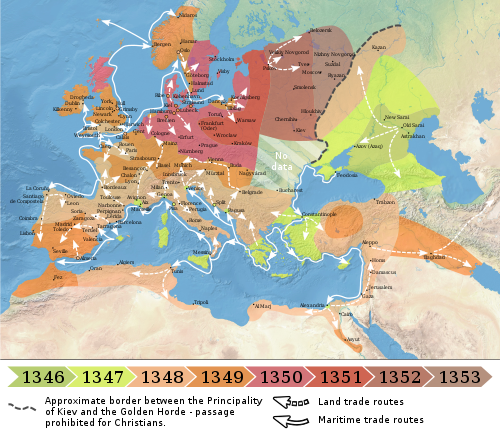
Black Death hits Cyprus and wipes out one fifth to one third of its population. Source — Wikipedia, "Timeline of Cypriot history" (14th century):
Map showing the spread of the Black Death in Europe between 1346 and 1353. By Flappiefh - Own work from: Natural Earth ; Cesana, D.; Benedictow O.J., Bianucci R. (2017). "The origin and early spread of the Black Death in Italy: first evidence of plague victims from 14th-century Liguria (northern Italy)". Anthropological Science 125 (1): 15–24. DOI:10.1537/ase.161011. ISSN 0918-7960. (page 17), CC BY-SA 4.0, https://commons.wikimedia.org/w/index.php?curid=66468361
1361 CE
Antalya
Antalya and Corycus in Anatolia are briefly annexed by the Kingdom of Cyprus. Source — Wikipedia, "Timeline of Cypriot history" (14th century):
A view taken from the cliffs towards Antalya Konyaaltı Beach in February 2018. The snowy part in the middle is the Bey Mountains and the snowy mountain in the right is Tunç Mountain. The photo is in the west direction. The sea on the left is the Mediterranean. By Esginmurat - Own work, CC BY-SA 4.0, https://commons.wikimedia.org/w/index.php?curid=98376445
1474 CE
Catherine Cornaro
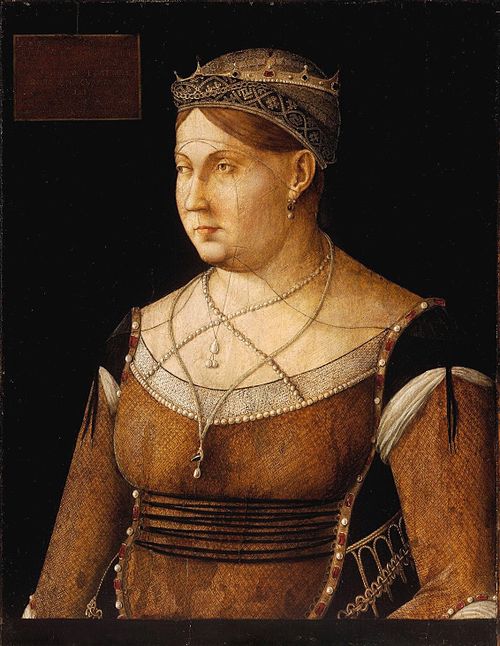
Catherine Cornaro becomes the last monarch of the Kingdom of Cyprus, succeeding James II. Source — Wikipedia, "Timeline of Cypriot history" (15th century):
Catherine Cornaro By Gentile Bellini - The Yorck Project (2002) 10.000 Meisterwerke der Malerei (DVD-ROM), distributed by DIRECTMEDIA Publishing GmbH. ISBN: 3936122202., Public domain, https://commons.wikimedia.org/w/index.php?curid=147844
Feb 1, 1489 CE
Guy of Lusignan
The Venetian government forces Catherine to cede her rights over Cyprus because she had no heir. The rule of the Lusignan dynasty comes to an end after nearly three centuries. Source — Wikipedia, "Timeline of Cypriot history" (15th century):
High-rise buildings in Limassol By Στέφανος Νικολάου - Own work, CC BY-SA 4.0, https://commons.wikimedia.org/w/index.php?curid=144588240
Jul 1, 1570 CE
Ottoman Turks invade Cyprus with 80,000
Ottoman Turks invade Cyprus with 80,000 men. Source — Wikipedia, "Timeline of Cypriot history" (16th century):
1571 CE
Siege of Famagusta
Having been under siege since the previous year, Famagusta also falls to the Ottomans marking the end of the Venetian rule. Most Christians still remaining in the city are massacred and the Venetian commander Marco Antonio Bragadin is tortured, mutilated and flayed alive. Source — Wikipedia, "Timeline of Cypriot history" (16th century):
Wallanlagen: v. l.: San Luca-Bastion, Karmeliter-Kirche (aus Süd) By Original uploader was Gerhard Haubold at de.wikipedia - Self-photographed, CC BY-SA 3.0, https://commons.wikimedia.org/w/index.php?curid=7725771
1572 CE
A period of Ottoman occupation of
A period of Ottoman occupation of the island begins, during which twenty-eight bloody uprisings will occur. Source — Wikipedia, "Timeline of Cypriot history" (16th century):
1788 CE
Constantinople
The Chronological History of the island of Cyprus, later described as "the only scholarly monograph of modern Greek literature since the fall of Constantinople", is published by Kyprianos Kouriokourineos, one of the most prominent Greek-Cypriot intellectuals and clerics of the 18th century. Source — Wikipedia, "Timeline of Cypriot history" (18th century):
Topographical map of Constantinople during the Byzantine period. By Cplakidas - Own work using: Main map source: R. Janin, Constantinople Byzantine. Developpement urbain et repertoire topographique Road network and some other details based on Dumbarton Oaks Papers 54 Data on many churches, especially unidentified ones, taken from the New York University's The Byzantine Churches of Istanbul project Other published maps and accounts of the city have been used for corroboration., CC BY-SA 3.0, https://commons.wikimedia.org/w/index.php?curid=5084599
Mar 25, 1821 CE
Christians
The Cypriots sided with Greece in a revolt against Ottoman rule. The island's leading churchmen and notables were executed as punishment. 20,000 Christians fled the island. Source — Wikipedia, "Timeline of Cypriot history" (19th century):
Miraculous catch of fish By Raphael - ywH0tF2CcmYUxA at Google Cultural Institute maximum zoom level, Public domain, https://commons.wikimedia.org/w/index.php?curid=22127049
1869 CE
Suez Canal
The Suez Canal opened. Source — Wikipedia, "Timeline of Cypriot history" (19th century):
Jul 12, 1878 CE
India
British occupation began. The British took over the administration of the island, by mutual agreement, in order to protect their sea route to India via the Suez Canal. In exchange, Britain agreed to help Ottoman against future Russian attacks. Source — Wikipedia, "Timeline of Cypriot history" (19th century):
The Flag of India. The colours are saffron, white and green. The navy blue wheel in the center of the flag has a diameter approximately the width of the white band and is called Ashoka's Dharma Chakra, with 24 spokes (after Ashoka, the Great). Each spoke depicts one hour of the day, portraying the prevalence of righteousness all 24 hours of it. By Government of India - Own work, based on Flag Code of India (2002) Specification for the National Flag of India (Cotton Khadi) (amended in 1979) CONSTRUCTION SHEET: Flag of India* country India used by India current since 15 August 1947 created by Pingali Venkayya format 2:3 shape rectangular FIAV ↑ colours orange, white, green, blue orange rendered as RGB 255 103 031 white rendered as RGB 255 255 255 green rendered as RGB 004 106 056 blue rendered as RGB 006 003 141 other characteristics flag has 3 horizontal stripes flag contains symbol: Dharma-chakra, Public domain, https://commons.wikimedia.org/w/index.php?curid=343608
1879 CE
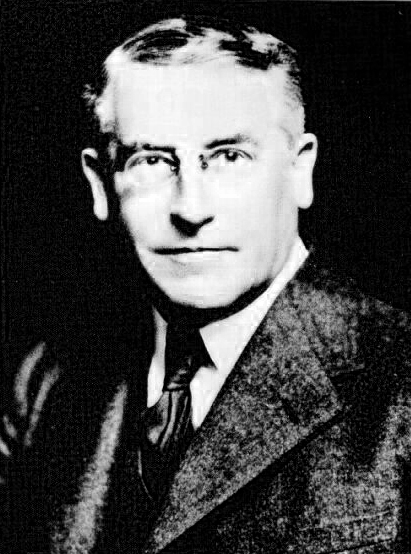
Robert Biddulph
Sir Robert Biddulph became Crown commissioner. Source — Wikipedia, "Timeline of Cypriot history" (19th century):
General Sir Robert Biddulph (1835-1918), photographed 12 June 1906 By Lafayette photography studio - Victoria and Albert Museum, Lafayette archive, CC BY-SA 4.0, https://commons.wikimedia.org/w/index.php?curid=68155839
1886 CE
Henry Ernest Gascoyne Bulwer
Sir Henry Ernest Bulwer became Crown commissioner. Source — Wikipedia, "Timeline of Cypriot history" (19th century):
1892 CE
Walter Joseph Sendall
Sir Walter Sendall became Crown commissioner. Source — Wikipedia, "Timeline of Cypriot history" (19th century):
Сэр Вальтер Сендалл, губернатор Кипра в 1892–1898 годах. By Sculpture and photography: en:Edouard Lanteri (1848-1917) - The Art Journal, 1903, p. 242, Public domain, https://commons.wikimedia.org/w/index.php?curid=29955317
1898 CE
William Haynes-Smith
Sir William Frederick Haynes-Smith became Crown commissioner. Source — Wikipedia, "Timeline of Cypriot history" (19th century):
1904 CE
Charles King-Harman
Sir Charles King-Harman became Crown commissioner. Source — Wikipedia, "Timeline of Cypriot history" (20th century):
Sir Charles Anthony King Harman, Governor of Sierra Leone By Henry Van der Weyde - The Sierra Leone Web. Artifacts, Public domain, https://commons.wikimedia.org/w/index.php?curid=88367244
1911 CE
Hamilton Goold-Adams
Sir Hamilton Goold-Adams became Crown commissioner. Source — Wikipedia, "Timeline of Cypriot history" (20th century):
Sir Hamilton John Goold-Adams, Irish soldier and Governor of Queensland By Unknown author - Handle identifier: 10462/deriv/1991, Public domain, https://commons.wikimedia.org/w/index.php?curid=3230245
1914 CE
United Kingdom of Great Britain and Ireland
Britain annexed Cyprus in response to Turkey's alliance with Germany and Austro-Hungary in World War I. Source — Wikipedia, "Timeline of Cypriot history" (20th century):
Flag of the United Kingdom, Union Jack or Union Flag in a 1:2 ratio (typical on British warships and also the rank flag of an admiral of the fleet). By Original: Acts of Union 1800 Vector: Zscout370 - Own work based on: United Kingdom at Flag of the World United Kingdom Flag at the Flag Institute, Public domain, https://commons.wikimedia.org/w/index.php?curid=347935
1915 CE
John Clauson
Sir John Eugene Clauson became Crown commissioner. Source — Wikipedia, "Timeline of Cypriot history" (20th century):
1920 CE
Malcolm Stevenson
Sir Malcolm Stevenson became Crown commissioner. Source — Wikipedia, "Timeline of Cypriot history" (20th century):
1925 CE
British Crown Colony
Cyprus became a British Crown Colony. Sir Malcolm Stevenson was made governor. Source — Wikipedia, "Timeline of Cypriot history" (20th century):
Coat of Arms of the Kingdom of England from 1603 to 1649 used by King James I and Charles I By Sodacan - Own work, CC BY-SA 3.0, https://commons.wikimedia.org/w/index.php?curid=10952428
1926 CE
Sir Ronald Storrs
Sir Ronald Storrs became governor. Source — Wikipedia, "Timeline of Cypriot history" (20th century):
Title: Sir Ronald Storrs Abstract/medium: 1 negative : glass ; 5 x 7 in. or smaller. By Bain News Service, publisher - Library of Congress Catalog: https://lccn.loc.gov/2014717333 Image download: https://cdn.loc.gov/service/pnp/ggbain/37100/37185v.jpg Original url: https://www.loc.gov/pictures/item/2014717333/, Public domain, https://commons.wikimedia.org/w/index.php?curid=74066354
1931 CE
Greek Cypriot
Greek Cypriots demanding Enosis, the union with Greece, instigated their first serious riots. The government-house in Nicosia was burned down; martial law was declared afterwards and the legislative council was abolished. The Greek National Anthem and the display of the Greek flag were banned. The British invented the terms "Greek Cypriot" and "Turkish Cypriot" and used the latter against the "Greek Cypriots" so as to cease Enosis demands. Source — Wikipedia, "Timeline of Cypriot history" (20th century):
Homer's Iliad, Book II, lines 681–685. From the Codex Marcianus Graecus 454 (now 822) also known as Venetus A. By Homer - https://www.internetculturale.it/jmms/iccuviewer/iccu.jsp?id=oai%3A193.206.197.121%3A18%3AVE0049%3ACSTOR.240.10164, Public domain, https://commons.wikimedia.org/w/index.php?curid=164466555
1932 CE
Reginald Edward Stubbs
Sir Reginald Edward Stubbs became governor. Source — Wikipedia, "Timeline of Cypriot history" (20th century):
Sir Reginald Edward Stubbs (1876—1947), the 16th Governor of Hong Kong. His term started in September 1919 and ended in March 1925. By The original uploader was Clithering at Chinese Wikipedia. - Government Public Record Office, Public domain, https://commons.wikimedia.org/w/index.php?curid=2595251
1933 CE
Richmond Palmer
Sir Herbert Richmond Palmer became governor. Source — Wikipedia, "Timeline of Cypriot history" (20th century):
Sir w:Herbert Richmond Palmer from family archives By Huguº - Own work and reproduced by the family, CC BY-SA 3.0, https://commons.wikimedia.org/w/index.php?curid=17181875
1939 CE
Demographics of Cyprus
Cypriots fought with the British in World War II, Greek Cypriots demanding Enosis at war's end. The Turkish Cypriots wanted British rule to continue. Source — Wikipedia, "Timeline of Cypriot history" (20th century):
Generated from US Census Bureau International Data Base using Excel 2019 By Sdgedfegw - Own work, CC BY-SA 4.0, https://commons.wikimedia.org/w/index.php?curid=99604989
1941 CE
Charles Woolley
Sir Charles Campbell Woolley became governor. Source — Wikipedia, "Timeline of Cypriot history" (20th century):
1946 CE
Jews in British camps on Cyprus
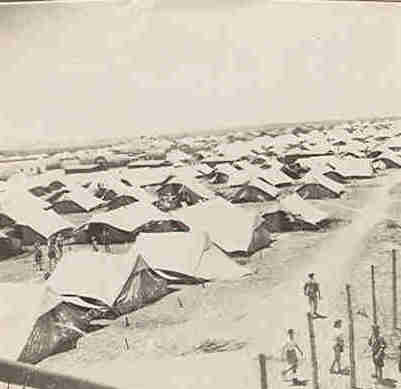
The British Government began to imprison thousands of displaced Jews in camps on Cyprus. Source — Wikipedia, "Timeline of Cypriot history" (20th century):
The tents in the deportation Summer camps at Cyprus. By אין מידע - The Atlit Illegal Detention Camp Site via the PikiWiki - Israel free image collection project, Public domain, https://commons.wikimedia.org/w/index.php?curid=9752762
1949 CE
The British Government finished imprisoning displa
The British Government finished imprisoning displaced Jews. Source — Wikipedia, "Timeline of Cypriot history" (20th century):
1950 CE
Archbishop Makarios
Archbishop Makarios III was elected the political and spiritual leader of Cyprus, the head of the autocephalous Cypriot Orthodox Church and leader of the campaign for Enosis with the support of Greece. Source — Wikipedia, "Timeline of Cypriot history" (20th century):
Archbishop Makarios of Cyprus. Mayor Wagner greets Archbishop Makarios at City Hall / World Telegram & Sun photo by O. Fernandez. By New York World-Telegram and the Sun staff photographer: Fernandez, Orlando, photographer. Cropped by Badseed using The GIMP. - Cropped from public domain image Image:Makarios III and Robert F. Wagner NYWTS.jpg whose source is Library of Congress Prints and Photographs Division. New York World-Telegram and the Sun Newspaper Photograph Collection. http://hdl.loc.gov/loc.pnp/cph.3c28910, Public domain, https://commons.wikimedia.org/w/index.php?curid=1646557
1954 CE
Robert Perceval Armitage
Sir Robert Perceval Armitage became governor. Source — Wikipedia, "Timeline of Cypriot history" (20th century):
1955 CE
John Harding, 1st Baron Harding of Petherton
Sir John Harding became governor. Source — Wikipedia, "Timeline of Cypriot history" (20th century):
John Harding, 1st Baron Harding of Petherton. By . The original uploader was RossLoudon at English Wikipedia. - Transferred from en.wikipedia to Commons by Henning M., Public domain, https://commons.wikimedia.org/w/index.php?curid=7515435
1956 CE
Seychelles
Britain deported Makarios to the Seychelles in an attempt to quell the revolt. Source — Wikipedia, "Timeline of Cypriot history" (20th century):
Flag of Seychelles By User:Vxb83 - http://www.statehouse.gov.sc/pages/natsym.aspx, for the RGB approximations http://www.vexilla-mundi.com/seychelles_flag.html, Public domain, https://commons.wikimedia.org/w/index.php?curid=433061
1957 CE
John Harding, 1st Baron Harding of Petherton
Field Marshal Sir John Harding was replaced by the civilian governor Sir Hugh Foot in a conciliatory move. Source — Wikipedia, "Timeline of Cypriot history" (20th century):
John Harding, 1st Baron Harding of Petherton. By . The original uploader was RossLoudon at English Wikipedia. - Transferred from en.wikipedia to Commons by Henning M., Public domain, https://commons.wikimedia.org/w/index.php?curid=7515435
Jan 27, 1958 CE
First of 2 days of serious
First of 2 days of serious rioting by Turkish Cypriots. Seven were killed by British security forces. Source — Wikipedia, "Timeline of Cypriot history" (20th century):
Feb 11, 1959 CE
London and Zürich Agreements
London and Zürich Agreements started with an agreement on 19 February 1959 in Lancaster House, London, between Turkey, Greece, the United Kingdom and Cypriot community leaders. On that basis, a constitution was drafted and agreed together with two prior Treaties of Alliance and Guarantee in Zürich on 11 February 1959. Source — Wikipedia, "Timeline of Cypriot history" (20th century):
Cyprus conference between Greece and Turkey in Zurich (from left to right): Greek Prime Minister Konstantinos Karamanlis, Turkish Foreign Minister Fatin Rüştü Zorlu, Turkish Prime Minister Adnan Menderes and Greek Foreign Minister Evangelos Averoff. By Behrens, Herbert / Anefo - Fotocollectie Anefo. Nationaal Archief, Den Haag, nummertoegang 2.24.01.09, bestanddeelnummer 910-1498., CC BY 4.0, https://commons.wikimedia.org/w/index.php?curid=46342221
1960 CE
British occupation ended.
British occupation ended. Source — Wikipedia, "Timeline of Cypriot history" (20th century):
1963 CE
United Nations Peacekeeping Force in Cyprus
Greek Cypriots began to view the constitution as unworkable and proposed changes abolishing all veto rights and many ethnic clauses; these proposals were rejected by Turkish Cypriots and the Turkish government. Inter-communal fighting erupted. Tylliria was bombarded with napalm bombs. A UN Peace Keeping Force was sent in, but soon proved powerless to prevent incidents. Thousands of Turkish Cypriots retreated into enclaves where they were embargoed by the Greek Cypriots. The UN attempted to supply them with food and medicine. Akritas plan Source — Wikipedia, "Timeline of Cypriot history" (20th century):
Photo: UNFICYP/Ľuboš Podhorský By Thaizacastilho - Own work, CC BY-SA 4.0, https://commons.wikimedia.org/w/index.php?curid=108107627
1964 CE
Battle of Tylliria
The Battle of Tylliria takes place. Greek-Cypriot forces storm the Turkish-held Kokkina enclave, prompting a Turkish military intervention and airstrikes on the Greek forces. However, Soviet pressure prevented the Turks from going any further, and when the battle ended after four days of fierce fighting, the Kokkina enclave had been reduced to 50-40% of its original size. Source — Wikipedia, "Timeline of Cypriot history" (20th century):
1971 CE
EOKA B' is being created
EOKA B' is being created Source — Wikipedia, "Timeline of Cypriot history" (20th century):
1973 CE
The Turks emerged from their enclaves.
The Turks emerged from their enclaves. Source — Wikipedia, "Timeline of Cypriot history" (20th century):
1974 CE
see Timeline of events in Cyprus,
see Timeline of events in Cyprus, 1974 Source — Wikipedia, "Timeline of Cypriot history" (20th century):
1975 CE
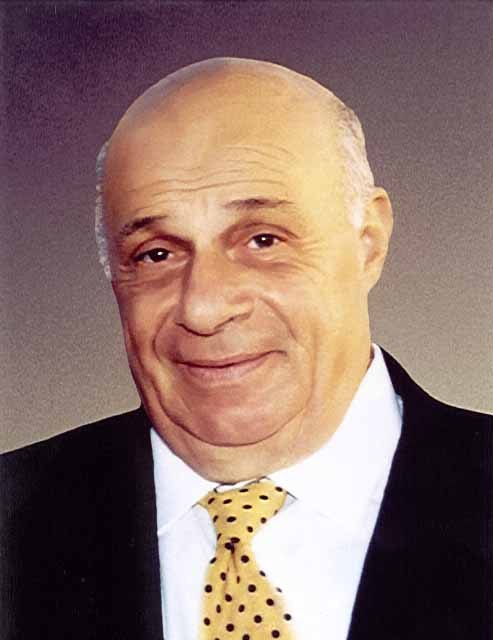
Rauf Dentash
Turks announced a Federate State in the north, with Rauf Denktaş as leader. UN Forces remained as buffer between the two zones. Source — Wikipedia, "Timeline of Cypriot history" (20th century):
Rauf Dentash By Unknown author, CC BY-SA 3.0, https://commons.wikimedia.org/w/index.php?curid=112926
1977 CE
Spyros Kyprianou
Makarios died. He was succeeded by Spyros Kyprianou. Source — Wikipedia, "Timeline of Cypriot history" (20th century):
titled: Spyros Kyprianou, President of Cyprus, at the United Nations, New York By Bernard Gotfryd - https://www.loc.gov/item/2020735976/, Public domain, https://commons.wikimedia.org/w/index.php?curid=115907163
1983 CE
The Turkish Federated State declared itself
The Turkish Federated State declared itself the independent Turkish Republic of Northern Cyprus (TRNC), with Denktaş as president. The new state was not recognised by any country except Turkey and was officially boycotted. Source — Wikipedia, "Timeline of Cypriot history" (20th century):
1992 CE
UN sponsored talks began between the
UN sponsored talks began between the two sides. Source — Wikipedia, "Timeline of Cypriot history" (20th century):
1995 CE
The UN talks ran into the
The UN talks ran into the sand, but with a commitment to resume. Source — Wikipedia, "Timeline of Cypriot history" (20th century):
2001 CE
European Court of Human Rights
The European Court of Human Rights found Turkey guilty of continuing human rights violations against the Greek Cypriots. Source — Wikipedia, "Timeline of Cypriot history" (21st century):
European Court of Human Rights (Strasbourg) By CherryX - Own work, CC-BY-SA-3.0, https://en.wikipedia.org/w/index.php?curid=38007603
2003 CE
Enlargement of the EU
Cyprus was set to join the European Union in May 2004. Renewed negotiations about the status of the island took place. Source — Wikipedia, "Timeline of Cypriot history" (21st century):
Enlargement of the European Union (animation) European Community European Union By Kolja21 - Own work, Public domain, https://commons.wikimedia.org/w/index.php?curid=6884395
Apr 24, 2004 CE
2004 Annan Plan Referendum
2004 Annan Plan Referendum: The Annan Plan was accepted by the majority of Turkish Cypriots but overwhelmingly rejected by the Greek Cypriots. Source — Wikipedia, "Timeline of Cypriot history" (21st century):
Coat of arms of Cyprus since 2006 By Borb, modified by User:Di (they-them) - File:Lesser coat of arms of Cyprus.svg, CC BY-SA 4.0, https://commons.wikimedia.org/w/index.php?curid=85729305
2008 CE
Demetris Christofias
Demetris Christofias replaced Tassos Papadopoulos as president of the Republic of Cyprus. It was the first time that a leader of the Greek Cypriot communist party, AKEL, had entered the presidential race. He was at the time the only communist leader in the European Union. Source — Wikipedia, "Timeline of Cypriot history" (21st century):
Την Δευτέρα 14 και Τρίτη 15 Φεβρουαρίου 2011, ο Υπουργός Εξωτερικών Δημήτρης Δρούτσας επισκέφθηκε την Κύπρο όπου παρακάθισε σε δείπνο εργασίας που παρέθεσε προς τιμήν του ο Πρόεδρος της Κυπριακής Δημοκρατίας κ. Χριστόφιας. Επίσης, ο κ. Δρούτσας συναντήθηκε με τον Υπουργό Εξωτερικών κ. Μάρκο Κυπριανού, με τον Πρόεδρο της Βουλής των Αντιπροσώπων κ. Μάριο Καρογιάν καθώς και με τους επικεφαλής των κομμάτων. On 14 and 15 February, Foreign Minister Dimitris Droutsas visited Nicosia, where will attended a working dinner held in his honor by the President of the Republic of Cyprus, Mr. Christofias. Mr. Droutsas also met with Cypriot Foreign Minister Kyprianou, the President of the House of Representatives, Mr. Garoyian, and with the heads of the political parties. By Υπουργείο Εξωτερικών - Επίσκεψη ΥΠΕΞ Δ. Δρούτσα σε Κύπρο - Visit of FM D. Droutsas to Cyprus, CC BY-SA 2.0, https://commons.wikimedia.org/w/index.php?curid=101144090




![Apis stele dated to the regnal year 6 of Cambyses (524 BCE), and depicting the king (kneeling, left) as an Egyptian pharaoh, while worshiping a dead Apis bull (right).[1] Later Greek traditions depicted Cambyses as the slayer of this Apis bull.](https://upload.wikimedia.org/wikipedia/commons/1/18/Stela_Cambyses_Apis_closeup.jpg)