Encyclopedia/3. History, Societies & Civilizations/09. Modern Nations/07. Eastern Europe & Caucasus • Curated by Admin Timeline.sg
History of Ukraine (AI-generated, sourced to Wikipedia).
Chronological Storyline (28 Milestones)
4000 BCE
Trypillian culture flourishes
Advanced Neolithic agrarian society known for distinctive painted ceramics and large settlements emerges in the lands of modern Ukraine. Source — Wikipedia, "Ukraine":
Cucuteni Pottery W By CristianChirita - Own work, CC BY-SA 3.0, https://commons.wikimedia.org/w/index.php?curid=7992331
700 BCE
Scythian kingdom established
Nomadic Scythian tribes dominate the Pontic steppe, establishing a powerful kingdom centered in what is now Ukraine and building trade ties with Greek colonies. Source — Wikipedia, "Ukraine":
Extent of the Scythian kingdom in Western Asia and Europe By Antiquistik - Own work based on: Barnett, R. D. (1991) "Urartu" in The Cambridge Ancient History, 3.1, Cambridge: Cambridge University Press, pp. 314–371 ISBN: 978-1-139-05428-7. Batty, Roger (2007) Rome and the Nomads: The Pontic-Danubian Realm in Antiquity, Oxford: Oxford University Press, pp. 204−214 ISBN: 978-0-198-14936-1. Brinkman (1991) "Babylonia in the Shadow of Assyria" in The Cambridge Ancient History, 3.2, Cambridge: Cambridge University Press, pp. 1−70 ISBN: 978-1-139-05429-4. Diakonoff, I. M. (1985) "Media" in The Cambridge History of Iran: Volume, 2, Cambridge: Cambridge University Press ISBN: 978-0-521-20091-2. Grayson, A. K. (1991) "Assyria: Sennacherib and Esarhaddon" in The Cambridge Ancient History, 3.2, Cambridge: Cambridge University Press, pp. 103–141 ISBN: 978-1-139-05429-4. Grousset, René (1970) The Empire of the Steppes, Rutgers University Press ISBN: 0-8135-1304-9. Harmatta, János (1996) "The Scythians" in History of Humanity: From the seventh century B.C. to the seventh century A.D., 3, UNESCO, pp. 181–182 ISBN: 923102812X. Hawkins, J. D. (1991) "The Neo-Hittite States in Syria and Anatolia" in The Cambridge Ancient History, 3, Cambridge: Cambridge University Press, pp. 372−441 ISBN: 978-1-139-05428-7. Ivantchik, Askold (1993) (in French) Les Cimmériens au Proche-Orient, Fribourg, Switzerland; Göttingen, Germany: Editions Universitaires (Switzerland); Vandenhoeck & Ruprecht (Germany) ISBN: 978-3-727-80876-0. Ivantchik, Askold (2018). Scythians. Encyclopædia Iranica. Loehr, Max (1955). "The Stag Image in Scythia and the Far East". Archives of the Chinese Art Society of America 9: 63-76. Chinese Art Society of America. Olbrycht, Marek Jan (2000) "Remarks on the Presence of Iranian Peoples in Europe and Their Asiatic Relations" in Collectanea Celto-Asiatica Cracoviensia, Kraków: Księgarnia Akademicka, pp. 101–140 ISBN: 978-8-371-88337-8. Olbrycht, Marek Jan (2000) "The Cimmerian Problem Re-Examined: the Evidence of the Classical Sources" in Collectanea Celto-Asiatica Cracoviensia, Kraków: Księgarnia Akademicka, pp. 71−99 ISBN: 978-8-371-88337-8. Phillips, E. D. (1972). "The Scythian Domination in Western Asia: Its Record in History, Scripture and Archaeology". World Archaeology 4 (2): 129–138. DOI:10.1080/00438243.1972.9979527. Spalinger, Anthony J. (1978). "The Date of the Death of Gyges and Its Historical Implications". Journal of the American Oriental Society 98 (4): 400–409. DOI:10.2307/599752. Spalinger, Anthony (1978). "Psammetichus, King of Egypt: II". Journal of the American Research Center in Egypt 15: 49–57. DOI:10.2307/40000130. Sulimirski, T. (1954). "Scythian Antiquities in Western Asia". Artibus Asiae 17 (3): 282-318. Ascona, Switzerland: Artibus Asiae Publishers. ; Tadeusz Sulimirski, T. F. Taylor (1991) "The Scythians" in The Cambridge Ancient History, 3.2, Cambridge: Cambridge University Press, pp. 547–590 ISBN: 978-1-139-05429-4. Tokhtas’ev, Sergei R. (1991). Cimmerians. Encyclopædia Iranica. Vaggione, Richard P. (1973). "Over All Asia? The Extent of the Scythian Domination in Herodotus". Journal of Biblical Literature 92 (4): 523-530. DOI:10.2307/3263121. Young, T. Cuyler (1988) "The early history of the Medes and the Persians and the Achaemenid empire to the death of Cambyses" in The Cambridge Ancient History, 4, Cambridge: Cambridge University Press, pp. 1–52 ISBN: 978-0-521-22804-6. Background from [1], CC BY-SA 4.0, https://commons.wikimedia.org/w/index.php?curid=122424291
Nov 1, 882 CE
Kyivan Rus' founded
Prince Oleg of Novgorod captures Kyiv and unites it with Novgorod, establishing the medieval state of Kyivan Rus', a precursor to modern Ukraine, Russia, and Belarus. Source — Wikipedia, "Ukraine":
Map of later Kyivan Rus (after the death of Yaroslav I in 1054). By Vitaliyf261 - Own work. Compare: Plokhy, Serhii (2006) The Origins of the Slavic Nations: Premodern Identities in Russia, Ukraine, and Belarus, Category:New York: Cambridge University Press, p. xiv ISBN: 978-0-521-86403-9., CC BY-SA 4.0, https://commons.wikimedia.org/w/index.php?curid=93773078
Aug 1, 988 CE
Christianization of Kyivan Rus'
Prince Vladimir the Great adopts Orthodox Christianity, baptizing his subjects in the Dnipro River and aligning Kyivan Rus' with Byzantine civilization. Source — Wikipedia, "Ukraine":
Christianization of Kyivan Rus' By Klavdy Lebedev - [1], Public domain, https://commons.wikimedia.org/w/index.php?curid=3055858
1054 CE
Death of Yaroslav the Wise
Under Yaroslav the Wise, Kyivan Rus' reaches its cultural and political zenith with the first written legal code, the Russkaya Pravda, and ties to European royalty. Source — Wikipedia, "Ukraine":
The most probable (live) picture of the Yaroslav the Wise is his seal. By Unknown author - [1] (Ukranian) Transferred from en.wikipedia to Commons by User:Logan using CommonsHelper последняя версия - "Ярослав Мудрый", ЖЗЛ, Public domain, https://commons.wikimedia.org/w/index.php?curid=14993588
1199 CE
Galicia-Volhynia united
Prince Roman Mstislavich unites the principalities of Halych and Volhynia, creating a powerful western Ukrainian state that endures after Kyivan Rus' declines. Source — Wikipedia, "Ukraine":
Flag of the Halych-Volhynia (1119-1349) By Alex Tora or Alex K in Ukranian and Japanese wiki - Own work, Public domain, https://commons.wikimedia.org/w/index.php?curid=2556607
Dec 6, 1240 CE
Mongols destroy Kyiv
Batu Khan's Golden Horde sacks Kyiv, ending Kyivan Rus' as a major power and ushering in centuries of Mongol overlordship over much of Ukraine. Source — Wikipedia, "Ukraine":
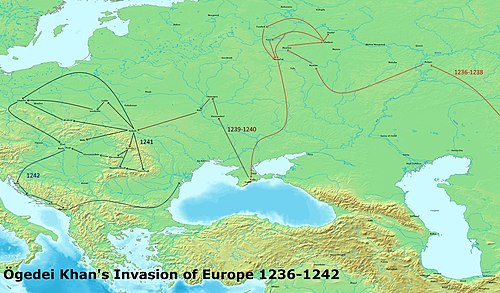
1236-1242 Mongol invasions of Europe By Qiushufang - Own work, CC BY-SA 4.0, https://commons.wikimedia.org/w/index.php?curid=87503541
Dec 1, 1253 CE
Daniel crowned King of Rus'
Daniel of Galicia is crowned by a papal legate in Drohiczyn, becoming the only ruler of a Rus' state to receive a royal crown from the Pope. Source — Wikipedia, "Ukraine":
Boyars swear allegiance to Daniel Galitsky after the death of his father By Anonymous Russian manuscript illuminators, 1560-1570s Facial Chronicle (Illustrated Chronicle of Ivan the Terrible) (in 10 volumes: pdf, pdf with translation)Public domain image - https://runivers.ru/bookreader/book594201/#page/145/mode/1up, Public domain, https://commons.wikimedia.org/w/index.php?curid=160686930
Jul 1, 1569 CE
Union of Lublin
The Polish-Lithuanian Commonwealth is formed, transferring most Ukrainian lands from Lithuania to Poland and intensifying Polish noble influence and Catholicization efforts. Source — Wikipedia, "Ukraine":
Głównym dziełem sejmu radomskiego 1505 r. miało być trwałe zjednoczenie z Polską Litwy oraz Prus. Zarówno konstytucje wydane na tym sejmie, jak i opublikowanie zbioru praw miały na celu między innymi ukazanie Korony jako Rzeczypospolitej praworządnej i sprawiedliwej, w której los poddanych nie jest zależny od samowoli władcy, lecz chroniony jest przez rozumne prawo i sprawiedliwość. Miał to być sygnał wysłany sąsiednim krajom, połączonym już wieloma węzłami z Polską, który miał wzbudzić ich zaufanie, co do ściślejszego z nią zespolenia aż do całkowitej unifikacji. Jak pisał Michał Bobrzyński, niezwykle uroczyście na zjeździe panów litewskich w Brześciu 25 lutego 1505 wystąpił kanclerz Jan Łaski. W imieniu polskiego senatu przedstawił on zagadnienia istotne z punktu widzenia unii, takie jak wspólna elekcja władcy, zapewnienie mu dochodów z dóbr stołowych takich, ażeby wystarczały nie tylko na utrzymanie dworu, lecz także na obronę państwa, organizacja dworu królewskiego. Pojawiła się tu także propozycja ustanowienia jednej stolicy w centrum połączonych krajów (prawdopodobnie miał nią być królewski Radom, do którego zwołano sejm walny, rozpoczęty 30 marca). Istotne były kwestie formy rządów i obrony państwa, rozstrzygania sporów, wspólnej dyplomacji oraz sejmów. Wzywając zaś panów litewskich do przybycia na sejm radomski, zwołany bez wątpienia głównie celem ostatecznego przypieczętowania integracji państw jagiellońskich, przemówić miał Łaski w te słowa: "Wiecie, jak sławna, jak straszna była potęga królów polskich, kiedy Korona razem z Wielkim Księstwem występowała i wojny połączonemi siłami toczyła, wiecie, jak bogaty był wówczas nasz wspólny monarcha, a teraz jak upadła powaga imienia królewskiego i potęga obojga rzeczy pospolitych, naszej i waszej". Była to zatem druga próba wcielenia w życie projektu wielkiego dzieła, który po raz pierwszy ujawniono w akcie tzw. unii piotrkowsko-mielnickiej. Jej artykuł pierwszy przewidywał, iż Regnum Poloniae et Magnus Ducatus Lithwaniae uniantur et conglutinentur in unum et indivisum ac indifferens corpus, ut sit una gens, unus populus, una fraternitas et communia consilia eidemque corpori perpetuo unum caput, unus rex unusque dominus in loco et tempore assignatis per praesentes et ad electionem convenientes votis communibus eligatur quodque absentium obstantia electio non impediatur et decretum electionis in Regno semper sit iuxta consuetudines circa illud ex antiquo servatas. Tym razem sprawy te miały zostać uregulowane już ostatecznie i nieodwołalnie podlegać realizacji. Był to jednak program jedynie panów koronnych; program, którego nie można było jeszcze zrealizować w początku XVI w. Członkowie rady wielkoksiążęcej, którzy zjechali do Radomia w maju 1505 nie dysponowali żadnymi pełnomocnictwami w tym zakresie, strona litewska nie wystawiła także rewersałów unii z roku 1501. Takim obrotem sprawy nie była zainteresowana także dynastia Jagiellonów, która w ten sposób utraciłaby swe dziedziczne prawa na Litwie. Szczególnie doniosłe znaczenie przyznać należy dziełu podjętemu w roku 1505. Podjęta została wówczas niezwykle ważna próba przebudowy całego systemu państwowego i politycznego. Nie mogła ona zakończyć się stuprocentowym powodzeniem, nie była, bowiem jeszcze możliwa w tym czasie ścisła integracja z Koroną wszystkich ziem z nią w jakiś sposób związanych. Udało się jednak dokonać na gruncie prawnym zmian ustrojowych w systemie władzy państwowej, a ponadto położyć fundament, na którym z czasem wzniesiono gmach Rzeczypospolitej Wielu Narodów, czego najdonioślejszym akcentem był prezentowany tutaj akt Unii Lubelskiej 1569 roku. By Unknown author - This file was provided to Wikimedia Commons by the Polish Central Archives of Historical Records as part of a cooperation project with Association "Archivum Patriae" and Wikimedia Polska., Public domain, https://commons.wikimedia.org/w/index.php?curid=33701093
Jan 1, 1648 CE
Khmelnytsky Uprising begins
Bohdan Khmelnytsky leads a massive Cossack rebellion against Polish-Lithuanian rule, founding the Cossack Hetmanate and reshaping Eastern European politics. Source — Wikipedia, "Ukraine":
Khmelnytsky Uprising begins By Mykola Ivasiuk - Козаччина зимова. Тріумфальний в’ізд Богдана Хмельницького до Києва. Картина та подія // Громадська організація «Департамент воєнно-культурної антропології», Public domain, https://commons.wikimedia.org/w/index.php?curid=5325997
Jan 18, 1654 CE
Treaty of Pereyaslav
Cossack Hetmanate pledges allegiance to the Russian Tsar in exchange for military protection, beginning a long and contested relationship between Ukraine and Russia. Source — Wikipedia, "Ukraine":
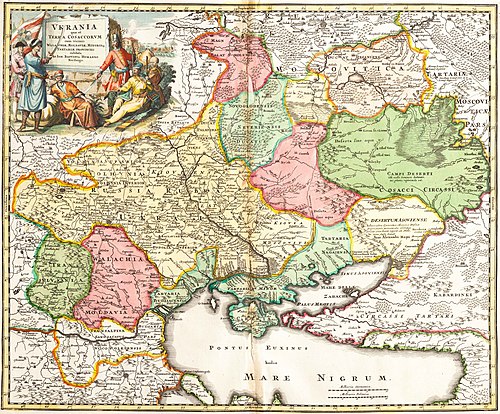
Ukrania quae et Terra Cosaccorum cum vicinis Walachiae, Moldoviae, Johann Baptiste Homann (Nuremberg, 1720) «Україна або козацька земля з прилеглими провінціями Валахії, Молдавії і Малої Татарії, зображена Йоганом-Баптистом Гоманном». Відома за скороченою назвою «Terra Cosaccorum». Йоган Баптист Гоманн акумулював усі відомі на початок 1700-х років досягнення науковців, географів, знання істориків і дані про поточну ситуацію в Україні, щоб зробити цю карту. На мапі позначене місце Полтавської битви 1709 року; землі Задунайської Січі, які у 1711 році були передані Туреччині, позначені у складі Кримського ханства; вказане будівництво Перекопського валу тощо. В картуші території названо на латинський манер Vkraina, а вже на самій карті позначено Ukraina. It is known by the abbreviated name "Terra Cosaccorum". Johann Baptist Hohmann accumulated all the achievements of scientists, geographers, historians and data about the current situation in Ukraine known at the beginning of the 1700s to make this map. The site of the Battle of Poltava in 1709 is marked on the map; the lands of Transdanubian Sich, which were transferred to Turkey in 1711, are marked as part of the Crimean Khanate; the specified construction of the Perekop Wall, etc. In the cartouche, the territory is named Vkraina in the Latin manner, and already on the map itself it is marked as Ukraina. By Johann Homann - Vkraina, Public domain, https://commons.wikimedia.org/w/index.php?curid=33040544
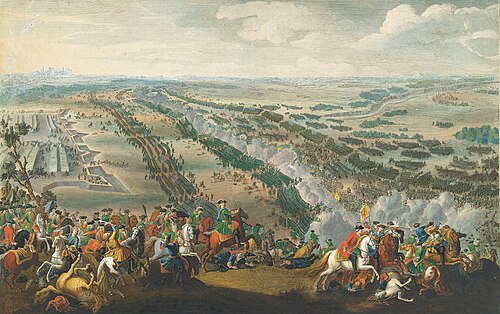
Jul 8, 1709 CE
Battle of Poltava
Peter I of Russia defeats Swedish and Cossack forces under Ivan Mazepa, ending Ukraine's bid for independence and consolidating Russian control over the Hetmanate. Source — Wikipedia, "Ukraine":
Battle of Poltava By Pierre-Denis Martin - museum.ru Catherine Palace, Public domain, https://commons.wikimedia.org/w/index.php?curid=76504
Apr 5, 1710 CE
Constitution of Pylyp Orlyk
Hetman Pylyp Orlyk adopts one of Europe's first written constitutions, establishing democratic Cossack governance and limiting executive power while in exile. Source — Wikipedia, "Ukraine":
Constitution of Pylyp Orlyk, Latin version, page 1 By National Archives of Sweden, Public domain, https://commons.wikimedia.org/w/index.php?curid=110618829
Jun 1, 1775 CE
Zaporozhian Sich destroyed
Catherine the Great orders the destruction of the Zaporozhian Sich, the autonomous Cossack fortress, ending centuries of Cossack self-governance in southern Ukraine. Source — Wikipedia, "Ukraine":
Flag of the Zaporizhian Sich. By Germenfer - Own work, CC BY-SA 3.0, https://commons.wikimedia.org/w/index.php?curid=105764926
1840 CE
Kobzar published
Taras Shevchenko's poetry collection 'Kobzar' is published, becoming a foundational text of Ukrainian national identity and literary language. Source — Wikipedia, "Ukraine":
Kobzar published By Andrey Denyer - twitter.com, Public domain, https://commons.wikimedia.org/w/index.php?curid=88012388
Jul 1, 1863 CE
Valuev Circular issued
Russian Interior Minister Pyotr Valuev bans publication in Ukrainian, part of systematic Tsarist efforts to suppress Ukrainian language and culture. Source — Wikipedia, "Ukraine":
Валуєвський циркуляр. By Петро Валуєв. - Мирослав Попович. Культура: ілюстрована енциклопедія України. Київ: Балтія-Друк, 2009. ISBN 978-966-8137-61-7, Public domain, https://commons.wikimedia.org/w/index.php?curid=27323016
Jan 22, 1918 CE
Ukrainian independence declared
The Central Rada in Kyiv proclaims the independence of the Ukrainian People's Republic, marking the first modern attempt at Ukrainian statehood. Source — Wikipedia, "Ukraine":
Flag of Ukrainian People Republic (1917—1921) and Ukrainian State (1918) By Original: Unknown author Vector: Ιγκόρ - Own work Ukrainian independence poster (1917).jpg Ukraine Solidarity Vigil (51916566465).jpg, Public domain, https://commons.wikimedia.org/w/index.php?curid=87095134
Dec 30, 1922 CE
Ukrainian SSR joins USSR
The Ukrainian Soviet Socialist Republic becomes a founding member of the Soviet Union, remaining under Moscow's control for nearly seven decades. Source — Wikipedia, "Ukraine":
Flag of the Ukrainian SSR (1949–1991) By Zscout370 and others. All authors are listed in the "File versions" section below., Public domain, https://commons.wikimedia.org/w/index.php?curid=478337
Nov 1, 1932 CE
Holodomor begins
Stalin's forced collectivization and grain requisition policies cause a catastrophic man-made famine that kills millions of Ukrainians, now recognized as genocide. Source — Wikipedia, "Ukraine":
Starved peasants on a street in Kharkiv, 1933, victims of Holodomor, photographed by Alexander Wienerberger. In Famine in the Soviet Ukraine, 1932–1933: a memorial exhibition, Widener Library, Harvard University. Cambridge, Mass.: Harvard College Library: Distributed by Harvard University Press, 1986. Procyk, Oksana. Heretz, Leonid. Mace, James E. (James Earnest). ISBN: 0674294262. Page 35. Initially published in Muss Russland Hungern? [Must Russia Starve?], published by Wilhelm Braumüller, Wien [Vienna] 1935. By Alexander Wienerberger - Diocesan Archive of Vienna (Diözesanarchiv Wien)/BA Innitzer, Public domain, https://commons.wikimedia.org/w/index.php?curid=3120021
Sep 29, 1941 CE
Babi Yar massacre
Nazi forces murder over 33,000 Jews at Babi Yar ravine in Kyiv in one of the largest single massacres of the Holocaust, beginning two years of German occupation. Source — Wikipedia, "Ukraine":
Soviet POWs covering a mass grave after the Babi Yar massacre, October 1, 1941. By Johannes Hähle - http://history.kby.kiev.ua/publication/illu_b15.html, Public domain, https://commons.wikimedia.org/w/index.php?curid=107741041
Oct 24, 1945 CE
Ukraine joins United Nations
The Ukrainian SSR becomes a founding member of the United Nations, gaining international diplomatic presence despite lacking true sovereignty as a Soviet republic. Source — Wikipedia, "Ukraine":
Flag of the United Nations By See File history below for details. Denelson83, Zscout370 ve Madden - Flag of the United Nations from the Open Clip Art website. Modifications by Denelson83, Zscout370 and Madden. Official construction sheet here.(1946-present United Nations) The United Nations flag code and regulations, as amended November 11, 1952, New York. Archived from the original on 13 September 2001. Retrieved on 2 December 2023. OCLC: 7548838., Public domain, https://commons.wikimedia.org/w/index.php?curid=437460
Apr 26, 1986 CE
Chornobyl disaster
Reactor No. 4 at the Chornobyl Nuclear Power Plant explodes, causing the world's worst nuclear accident and profoundly impacting Ukrainian society and the Soviet system. Source — Wikipedia, "Ukraine":
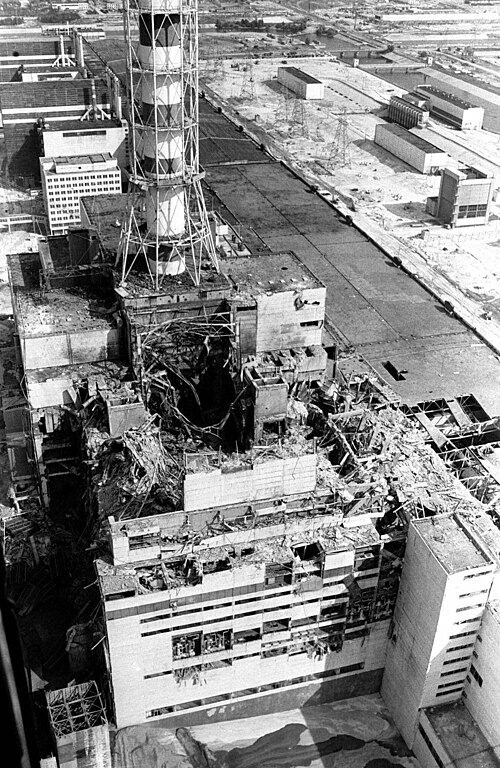
Historical collections of the Chernobyl accident from the Ukrainian Society for Friendship and Cultural Relations with Foreign Countries (USFCRFC). April 26, 1986, signified the boundary between life and death. A new reckoning of time began. This photo was taken from a helicopter several months after the explosion. The destroyed Chernobyl reactor, one of four units operating at the site in Ukraine in 1986. No units operate today. (Chernobyl, Ukraine, 1986) Copyright: IAEA Imagebank Photo Credit: USFCRFC By IAEA Imagebank - 02790015, CC BY-SA 2.0, https://commons.wikimedia.org/w/index.php?curid=63251598
Aug 24, 1991 CE
Ukraine declares independence
Following the failed Soviet coup, Ukraine's parliament declares independence, confirmed by a December referendum where over 90% voted for sovereignty. Source — Wikipedia, "Ukraine":
The Act of Declaration of Independence of Ukraine, 1991 By Верховна Рада УРСР - Central State Archives of Higher Authorities and Governance of Ukraine, Public domain, https://commons.wikimedia.org/w/index.php?curid=109231361
Nov 1, 2004 CE
Orange Revolution begins
Mass protests against electoral fraud bring Viktor Yushchenko to power after a fraudulent runoff, signaling Ukraine's democratic aspirations and westward orientation. Source — Wikipedia, "Ukraine":
Morning first day of Orange Revolution By Serhiy - Own work, CC BY-SA 3.0, https://commons.wikimedia.org/w/index.php?curid=779303
Feb 1, 2014 CE
Euromaidan Revolution
Months of pro-European protests culminate in the deaths of over 100 demonstrators and the flight of President Yanukovych, dramatically reshaping Ukraine's political trajectory. Source — Wikipedia, "Ukraine":
Euromaidan collage. Clockwise from top left: A large EU flag is waved across Maidan on 27 November 2013, opposition activist popular singer Ruslana addresses the crowds on Maidan on 29 November 2013, Pro EU rally on Maidan, Euromaidan on European Square on 1 December, tree decorated with flags and posters, crowds direct hose at militsiya, plinth of the toppled Lenin statue By Lystopad - Composed by Lystopad. The photos made:File:Euroaidan 2013 Mstyslav Chernov-11.jpg by Mstyslav ChernovFile:Ruslana reading out an official resolution of Euromaidan.jpg by Ivan BanduraFile:Euromaidan 03.JPG by Feldsparta4File:Euromaidan Kyiv 1-12-13 by Gnatoush 009.jpg by Nessa GnatoushFile:Євромайдан, Київ (72).JPG by SergentoFile:Cityhallhose.JPG by Smerus]File:Euromaidan in Kyiv early evening 2013-12-10 (020).JPG by BaseSat, CC BY-SA 3.0, https://commons.wikimedia.org/w/index.php?curid=30112065
Mar 18, 2014 CE
Russia annexes Crimea
Russian forces seize Crimea and Russia formally annexes the peninsula, the first such territorial seizure in Europe since World War II, drawing international condemnation. Source — Wikipedia, "Ukraine":
Крым, Варламов, март 2014 By Ilya Varlamov - varlamov.ru, CC BY-SA 4.0, https://commons.wikimedia.org/w/index.php?curid=82208359
Apr 1, 2014 CE
War in Donbas begins
Russian-backed separatists declare people's republics in Donetsk and Luhansk, launching an armed conflict that kills over 14,000 people before escalating into full-scale war. Source — Wikipedia, "Ukraine":
A Russia-backed rebel armored fighting vehicles convoy near Donetsk, Eastern Ukraine, May 30, 2015. A stencil on the front armor panel reads "С нами Бог" - "God is with us" By Mstyslav Chernov - Own work, CC BY-SA 4.0, https://commons.wikimedia.org/w/index.php?curid=41733044
Feb 24, 2022 CE
Russia invades Ukraine
Russia launches a full-scale invasion of Ukraine from multiple fronts, triggering Europe's largest war since 1945 and a devastating ongoing conflict with global consequences. Source — Wikipedia, "Ukraine":
Bucha after Russian invasion of Ukraine, President Zelensky By Oleksandr Ratushniak - https://en.wikipedia.org/wiki/File:Bucha_after_Russian_invasion_of_Ukraine,_President_Zelensky_2.jpg, CC BY 4.0, https://commons.wikimedia.org/w/index.php?curid=193573733






![Starved peasants on a street in Kharkiv, 1933, victims of Holodomor, photographed by Alexander Wienerberger. In Famine in the Soviet Ukraine, 1932–1933: a memorial exhibition, Widener Library, Harvard University. Cambridge, Mass.: Harvard College Library: Distributed by Harvard University Press, 1986. Procyk, Oksana. Heretz, Leonid. Mace, James E. (James Earnest). ISBN: 0674294262. Page 35. Initially published in Muss Russland Hungern? [Must Russia Starve?], published by Wilhelm Braumüller, Wien [Vienna] 1935.](https://upload.wikimedia.org/wikipedia/commons/thumb/2/27/HolodomorKharkiv_1933_Wienerberger.jpg/500px-HolodomorKharkiv_1933_Wienerberger.jpg)