Encyclopedia/3. History, Societies & Civilizations/09. Modern Nations/10. Middle East & North Africa • Curated by Admin Timeline.sg
History of Lebanon, sourced from Wikipedia's "Timeline of Lebanese history".
Chronological Storyline (84 Milestones)
1400 BCE
Ugarit
The height of the Canaanite town of Ugarit. Source — Wikipedia, "Timeline of Lebanese history" (14th Century BC):
Flag of Lebanon. By Henri Pharaon - Traced based on the CIA World Factbook with some modification done to the colours based on information at Vexilla mundi., Public domain, https://commons.wikimedia.org/w/index.php?curid=433207
1200 BCE
Phoenician alphabet
Phoenicians invent the alphabet and the Tyrian Purple which was a major component in their trade. Source — Wikipedia, "Timeline of Lebanese history" (12th century BC):
purple dyed fabric with their corresponding sea snail Bolinus brandaris Hexaplex trunculus Stramonita haemastoma (Thais haemastoma) Exhibit of the Museum of Natural History in Vienna By Photograph: U.Name.Me Derivative work: TeKaBe - This file was derived from: Purple Purpur.jpg:, CC BY-SA 4.0, https://commons.wikimedia.org/w/index.php?curid=94992996
840 BCE
Shalmaneser III
Shalmaneser III devastates the territory of Damascus; Palestine and the Phoenician cities send tribute. Source — Wikipedia, "Timeline of Lebanese history" (9th century BC):
Shalmaneser III (relief detail) By Osama Shukir Muhammed Amin FRCP(Glasg) - This image has been extracted from another file, CC BY 4.0, https://commons.wikimedia.org/w/index.php?curid=88267550
810 BCE
Carthage
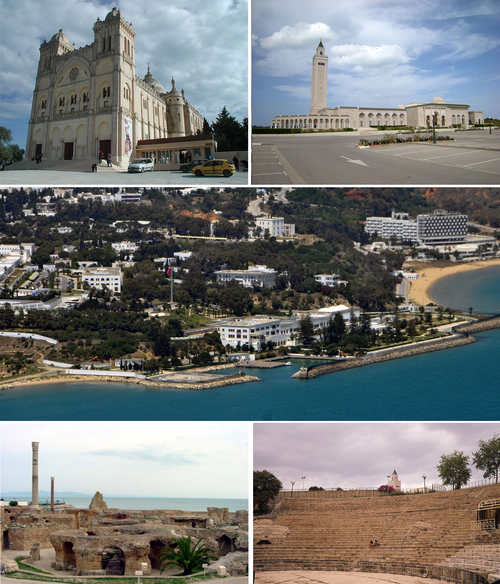
Carthage is founded by Phoenicians. Source — Wikipedia, "Timeline of Lebanese history" (9th century BC):
Montage de photos de la ville de Carthage By ELEL09, montage - Author: Citizen59 Author: Issam Barhoumi Author: Leandro Neumann Ciuffo Author: Patrick Verdier Author: nonanet, CC BY-SA 3.0, https://commons.wikimedia.org/w/index.php?curid=30698442
770 BCE
Pygmalion of Tyre
The reign of king Pygmalion of Tyre ends. Source — Wikipedia, "Timeline of Lebanese history" (8th century BC):
730 BCE
Mattan II
Mattan II succeeds Hiram II as king. Source — Wikipedia, "Timeline of Lebanese history" (8th century BC):
730 BCE
Hiram II
Hiram II becomes king of Tyre. Source — Wikipedia, "Timeline of Lebanese history" (8th century BC):
720 BCE
Assyria
The Assyrians under king Shalmaneser V start a four-year siege of Tyre that ends in 720 BC. Source — Wikipedia, "Timeline of Lebanese history" (8th century BC):
Emblem of the god Ashur, from an ancient Assyrian relief in Nimrud By Austen Henry Layard (1817–1894) - Austen Henry Layard (1867) Nineveh and its Remains, Public domain, https://commons.wikimedia.org/w/index.php?curid=113673445
710 BCE
Kingdom of Judah
Judah, Tyre and Sidon revolt against Assyria. Source — Wikipedia, "Timeline of Lebanese history" (8th century BC):
Map showing the Kingdoms of Israel and Judah during the 8th century BCE By Tobias Schäfer 87 - Own work. This file was derived from: Southern Levant blank topographic map.svg: Sources of data: Topography and bathymetry: GEBCO 2023. Coastline, rivers and water bodies: GSHHG. Hillshade: NASA SRTM GL3. Borders and cities: Finkelstein, Israel (2013) The Forgotten Kingdom: The Archaeology and History of Northern Israel, Society of Biblical Literature, p. 2 ISBN: 978-1-58983-910-6., CC BY 4.0, https://commons.wikimedia.org/w/index.php?curid=185542969
700 BCE
Sennacherib
The Assyrian siege of Tyre by king Sennacherib. Source — Wikipedia, "Timeline of Lebanese history" (8th century BC):
Cast of a rock relief of Sennacherib from the foot of Cudi Dağı, near Cizre. The cast is exhibited in Landshut, Germany (src). By Timo Roller - Own work, CC BY 3.0, https://commons.wikimedia.org/w/index.php?curid=39985581
663 BCE
Ashurbanipal
The Assyrian siege of Tyre by king Ashurbanipal. Source — Wikipedia, "Timeline of Lebanese history" (7th century BC):
Ashurbanipal hunting lion By KeyolTranslater - Own work, CC BY-SA 4.0, https://commons.wikimedia.org/w/index.php?curid=176766633
587 BCE
Jerusalem
The region is annexed to the Babylonian empire, while Jerusalem fell into their hands. Source — Wikipedia, "Timeline of Lebanese history" (6th century BC):
586 BCE
Babylonia
The Babylonians under king Nebuchadnezzar II sieged Tyre for thirteen years without success. Later a compromise peace was made in which Tyre had to pay tribute to the Babylonians. (to 573 <small>BC</small>) Source — Wikipedia, "Timeline of Lebanese history" (6th century BC):
A locator map of Hammurabi's Babylonia, showing the Babylonian territory upon his ascension in 1792 BC and upon his death in 1750 BC. The river courses and coastline are those of that time period -- in general, they are not the modern rivers or coastlines. This is a Mercator projection, with north in its usual position. There is some question to what degree the cities of Nineveh, Tuttul, and Assur were under Babylonian authority. While in his introduction to his code of laws, Hammurabi claims lordship over these cities, Roaf does not include any of these in his map, upon which this map is based, and Chevalas states that "Assur and Nineveh were held for a very few years" (p. 155). Therefore, I have not included them as under Hammurabi's control in 1750 BC. References Bjorklund, Oddvar; Holmboe, Haakon; Rohr, Anders (1970) (in English) Historical Atlas of the World, NY: Barnes & Noble ISBN: 389-00253-4. Chavalas, Mark W. (2003) (in English) Mesopotamia and the Bible, Continuum International Publishing Group ISBN: 978-0567082312. (in English) (2007) Historical World Atlas, Hammond World Atlas Corporation ISBN: 9-780843-71391-6. Roaf, M. (1990) (in English) Cultural Atlas of Mesopotamia and the ancient Near East, Oxford: Facts on File "In general, the basis for the ancient river courses and ancient coastline" Van De Mieroop, Marc (2005) (in English) King Hammurabi of Babylon: A Biography, Blackwell Publishing ISBN: 1405126604. By MapMaster - Own work, CC BY-SA 4.0, https://commons.wikimedia.org/w/index.php?curid=3578442
530 BCE
Cyrus the Great
Cyrus the Great conquered Phoenicia. Source — Wikipedia, "Timeline of Lebanese history" (6th century BC):
Winged genius relief in Pasargadae By Surenae - Own work, CC BY-SA 4.0, https://commons.wikimedia.org/w/index.php?curid=162225973
350 BCE
Sidon
A rebellion in Sidon led by Tennes was crushed by Artaxerxes III, and its destruction was dramatically described by Diodorus Siculus. (to 345 <small>BC</small>) Source — Wikipedia, "Timeline of Lebanese history" (4th century BC):
Sidon's Sea Castle (1228). Sidon, Saida, Lebanon. This ancient Phoenician city is said to be inhabited since 4000 B.C. By Vyacheslav Argenberg - Own work, CC BY 4.0, https://commons.wikimedia.org/w/index.php?curid=92766880
332 BCE
Alexander the Great
Alexander the Great took Tyre following the city's siege. After Alexander's death Phoenicia witnessed a succession of Hellenistic rulers: Laomedon (323 BC), Ptolemy I (320 BC), Antigonus II (315 BC), Demetrius (301 BC), and Seleucus (296 BC). Source — Wikipedia, "Timeline of Lebanese history" (4th century BC):
Alexander Mosaic (detail), House of the Faun, Pompeii By Unknown author - This image has been extracted from another file, Public domain, https://commons.wikimedia.org/w/index.php?curid=182741814
315 BCE
Alexander's former general Antigonus begins his
Alexander's former general Antigonus begins his own siege of Tyre, taking the city a year later. Source — Wikipedia, "Timeline of Lebanese history" (4th century BC):
286 BCE
Arwad
Phoenicia (except for Aradus) fell to the Ptolemies of Egypt. Source — Wikipedia, "Timeline of Lebanese history" (3rd century BC):
Island of Arwad (formerly Aradus), Syria By NASA, Public domain, https://commons.wikimedia.org/w/index.php?curid=2050373
197 BCE
Seleucids
Phoenicia along with Syria reverted to the Seleucids, and the region became increasingly Hellenized, although Tyre actually became autonomous in 126 BC, followed by Sidon in 111 BC. Source — Wikipedia, "Timeline of Lebanese history" (2nd century BC):
Berlin Pergamon Museum, Tetradrachme Seleukos' I, Silver, Pergamon, 281-280 BC. By Hartmann Linge - Own work, CC BY-SA 4.0, https://commons.wikimedia.org/w/index.php?curid=21343017
140 BCE
Beirut
Beirut was taken and destroyed by Diodotus Tryphon in his contest with Antiochus VII Sidetes for the throne of the Seleucid monarchy. It was later named Laodicea in Phoenicia ( ). Source — Wikipedia, "Timeline of Lebanese history" (2nd century BC):
Areal view of Beirut. In the foreground, the al Amin Mosque and St Georges Cathedral, Beirut's historic city centre and Place de l'Étoile. In the background, the skyscrapers of Minet el Hosn. By SCHW - Own work, CC BY-SA 4.0, https://commons.wikimedia.org/w/index.php?curid=90176651
82 BCE
Tigranes the Great
Syria, including Phoenicia, were seized by king Tigranes the Great who was later defeated by Lucullus. (to 69 <small>BC</small>) Source — Wikipedia, "Timeline of Lebanese history" (1st century BC):
Coin of Tigranes II the Great, Antioch mint. By Classical Numismatic Group; [1] - https://www.cngcoins.com/Coin.aspx?CoinID=175452, CC BY-SA 3.0, https://commons.wikimedia.org/w/index.php?curid=83404979
65 BCE
Pompey
Pompey finally incorporated Phoenicia as part of the Roman province of Syria. Source — Wikipedia, "Timeline of Lebanese history" (1st century BC):
Locator map of the Syria province in the Roman Empire (125). Extracted from File:Roman Empire 125 political map.svg By Milenioscuro - Own work, CC BY-SA 4.0, https://commons.wikimedia.org/w/index.php?curid=45059738
64 BCE
Marcus Vipsanius Agrippa
Beirut was conquered by Agrippa and the city was renamed in honour of the emperor's daughter, Julia; its full name became Colonia Julia Augusta Felix Berytus. Source — Wikipedia, "Timeline of Lebanese history" (1st century BC):
Portrait of M. Vipsanius Agrippa of the Gabii type. Marble, ca. 25–24 BC. From Gabii. By Unknown author - Marie-Lan Nguyen (User:Jastrow), 2009, CC BY 2.5, https://commons.wikimedia.org/w/index.php?curid=7472755
27 BCE
Pax Romana
the Pax Romana period, inhabitants of the principal Phoenician cities of Byblos, Sidon, and Tyre were granted Roman citizenship, while economic and intellectual activities flourished. (to <small>AD</small> 180) Source — Wikipedia, "Timeline of Lebanese history" (1st century BC):
SPQR banner, emblem of the Roman Republic. By Ssolbergj - Own work, CC BY 3.0, https://commons.wikimedia.org/w/index.php?curid=2992630
20 CE
Papinian
Beirut's school of law was founded, it later became widely known in the surrounding region. Two of Rome's most famous jurists, Papinian and Ulpian (both natives of Phoenicia), were taught at the law school under the Severan emperors. Source — Wikipedia, "Timeline of Lebanese history" (1st century):
Statue of Aemilius Paulus Papinianus at the entrance to the Palace of Justice in Rome By Rabax63 - Own work, CC BY-SA 4.0, https://commons.wikimedia.org/w/index.php?curid=64568301
50 CE
Paul of Tarsus
Saint Paul of Tarsus begins his third mission and preaches in Tyre. Source — Wikipedia, "Timeline of Lebanese history" (1st century):
Fresco of Saint Paul at the cave of Saint Paul at Ephesus By Unknown author - Credited to: Ephesus Foundation USA Immediate source: https://aleteia.org/slideshow/slideshow-5-christian-sites-in-the-ancient-city-of-ephesus/7/, Public domain, https://commons.wikimedia.org/w/index.php?curid=168558938
451 CE
Maronite Church
The Maronites, a Christian community named after Saint Maron sought refuge in the mountains of Lebanon. Source — Wikipedia, "Timeline of Lebanese history" (5th century):
Bkerke - Maronite Patriarchate By J.Hassoun - Own work, CC BY-SA 3.0, https://commons.wikimedia.org/w/index.php?curid=14628282
551 CE
551 Beirut earthquake
Beirut is destroyed by an earthquake and tsunami. About 30,000 were killed in the city alone and, along the Phoenician coast, total casualties were close to 250,000. Source — Wikipedia, "Timeline of Lebanese history" (6th century):
Map of the the main tectonic features in the coastal part of Lebanon, modified after Elias et al. 2007 Base map screenshot from NASA World Wind software. [1] By Mikenorton - Own work, CC BY-SA 3.0, https://commons.wikimedia.org/w/index.php?curid=14332283
630 CE
Maronite
The Marada, a group of autonomous Maronite communities, settled in Mount Lebanon and the surrounding highlands following the conquest of Syria by the Arab caliphate. Source — Wikipedia, "Timeline of Lebanese history" (7th century):
A flag with a cedar tree with green leaves and a brown trunk on a white field. By Afever - Own work, Public domain, https://commons.wikimedia.org/w/index.php?curid=161022348
632 CE
jihad
Calling for a jihad against non-Muslims, Muhammad's successor, Caliph Abu Bakr, brought Islam to the area surrounding Lebanon. (to 634) Source — Wikipedia, "Timeline of Lebanese history" (7th century):
al-fiqh, 'Islamic jurisprudence' By Mdktb - Own work, Public domain, https://commons.wikimedia.org/w/index.php?curid=79788545
661 CE
Battle of Yarmuk
After the Battle of Yarmuk, Caliph Umar appointed the Arab Muawiyah I, founder of the Umayyad dynasty, as governor of Syria, an area that included present-day Lebanon. Source — Wikipedia, "Timeline of Lebanese history" (7th century):
Illustration of the Battle of Yarmouk (636) at the bottom of the page of BNF Nouvelle acquisition française 886 fol. 9v (early 14th century). The Saracens are shown with a star and crescent banner, the Byzantines (anachronistically in Crusader era armour) with a star banner. Note that the banner designs are not attributed to factions with any consistency by this illustrator: The star and crescent is also shown as carried by the Mongols in foll. 22r, 32v, 34r, 35v). For a later (mid 14th-century) copy with more developed heraldry, see Vienna ÖNB Cod. 2623[1] fol. 15r. Hayton's (Faulcon's) text reads: Lors manda l'empereour Eracles grant secors de genz pour defendre la cité d'Antioche. Qant les genz de l'empereour Eracles furent parvenuz jusques à une plainure qui est nomée Possent (var.: Posserit), les Sarazins vindrent à l'encontre; e là fu comencée molt grant bataille que longuement dura; mès, à la fin, les Sarazins en orent la victoire, e tant gent furent ocis en cele bataille que encores y perent les ossements des seignors en celui champ. Dont il avint que les Grex, qui tenoient la cité d'Antioche, furent molt espoentés, e rendirent la terre as Sarazins par convenances. (La Flor des Estories de la Terre d'Orient II.1, ed. Dardel 1906, p. 137.) By anonymous Catalonian illustrator - BNF Nouvelle acquisition française 886 fol. 9v (manuscriptminiatures.com, gallica.bnf.fr, nossldemo.logilab.fr), Public domain, https://commons.wikimedia.org/w/index.php?curid=51788912
667 CE
Constantine IV
Muawiyah negotiated an agreement with Constantine IV, the Byzantine emperor, whereby he agreed to pay Constantine an annual tribute in return for the cessation of Marada incursions. Source — Wikipedia, "Timeline of Lebanese history" (7th century):
Basilica di Sant'Apollinare in Classe By Sailko - Own work, CC BY-SA 4.0, https://commons.wikimedia.org/w/index.php?curid=86096455
670 CE
Callinicus of Heliopolis
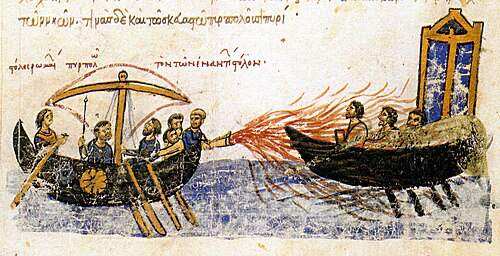
Callinicus of Heliopolis, a Byzantine chemist from Heliopolis, invents the Greek fire in Constantinople. Source — Wikipedia, "Timeline of Lebanese history" (7th century):
Image from an illuminated manuscript, the Madrid Skylitzes, showing Greek fire in use against the fleet of the rebel Thomas the Slav. By Unknown author - Codex Skylitzes Matritensis, Bibliteca Nacional de Madrid, Vitr. 26-2, Bild-Nr. 77, f 34 v. b. (taken from Pászthory, p. 31), Public domain, https://commons.wikimedia.org/w/index.php?curid=302463
759 CE
An abortive rebellion of Lebanese mountaineers
An abortive rebellion of Lebanese mountaineers against the Abbasid rule after the harsh treatment of people living in the Lebanese-Syrian region. Source — Wikipedia, "Timeline of Lebanese history" (8th century):
878 CE
Jordan Rift Valley
The Jordan valley is occupied by the Tulunids, extending in the north to the outposts in the Anti-Lebanon mountains on the Byzantine border, enabling them to defend Egypt against Abbasid attack. Source — Wikipedia, "Timeline of Lebanese history" (9th century):
The Jordan River http://www.pbase.com/beivushtang By Beivushtang at English Wikipedia - Transferred from en.wikipedia to Commons., CC BY-SA 3.0, https://commons.wikimedia.org/w/index.php?curid=3485696
960 CE
Tyre, Lebanon
Prince 'Allaqa of Tyre proclaimed his independence from the Abbasids and coined money in his own name. Source — Wikipedia, "Timeline of Lebanese history" (10th century):
970 CE
Egypt
The Fatimides settled in Egypt and extended their authority to the coastal region of Bilad al-Sham and Damascus. Source — Wikipedia, "Timeline of Lebanese history" (10th century):
Map of Islamic Syria and its provinces (ajnad, sing. jund, of Qinnasrin, Palestine (Filastin), Jordan (al-Urdunn), Damascus (Dimashq), Hims, al-'Awasim) under the Abbasid Caliphate in the 9th century Note that borders varied somewhat over time (e.g. sometimes Amman was part of Jund Filastin, etc.)... By Constantine Plakidas - This vector image includes elements that have been taken or adapted from this file:, CC BY-SA 3.0, https://commons.wikimedia.org/w/index.php?curid=30352850
986 CE
Al-Hakim bi-Amr Allah
Under the Fatimid Caliph Al-Hakim bi-Amr Allah, a new religion was born and spread by a man called Ad-Darazi. This was the beginning of the Druze religion and its expansion in several Lebanese regions. Source — Wikipedia, "Timeline of Lebanese history" (10th century):
Dinar de ouro do califa fatímida Aláqueme Bimar Alá By Unknown author - CNG Coins, CC BY-SA 2.5, https://commons.wikimedia.org/w/index.php?curid=48113950
1110 CE
Beirut
Beirut and Sidon are captured. Source — Wikipedia, "Timeline of Lebanese history" (12th century):
Areal view of Beirut. In the foreground, the al Amin Mosque and St Georges Cathedral, Beirut's historic city centre and Place de l'Étoile. In the background, the skyscrapers of Minet el Hosn. By SCHW - Own work, CC BY-SA 4.0, https://commons.wikimedia.org/w/index.php?curid=90176651
1124 CE
Tyre resisted the raids but finally
Tyre resisted the raids but finally capitulated after a long siege. Source — Wikipedia, "Timeline of Lebanese history" (12th century):
1179 CE
Battle of Marj Ayyun
The Battle of Marj Ayyun took place on 10 June, where an Ayyubid army commanded by Saladin defeated a Crusader army led by King Baldwin IV of Jerusalem. Source — Wikipedia, "Timeline of Lebanese history" (12th century):
Saladin By Gustave Doré - http://pages.usherbrooke.ca/croisades/big_images/_images_en.htm, Public domain, https://commons.wikimedia.org/w/index.php?curid=4645401
1182 CE
Battle of Belvoir Castle
The Battle of Belvoir Castle in which a Crusader force led by King Baldwin IV of Jerusalem sparred inconclusively with an Ayyubid army from Egypt commanded by Saladin. The theatre of operations included Eilat, the Transjordan, Galilee and Beirut (which witnessed a siege by Saladin that ended in August of the same year). Source — Wikipedia, "Timeline of Lebanese history" (12th century):
The crusader castle of Belvoir, Israel By אסף.צ at Hebrew Wikipedia - Transferred from he.wikipedia to Commons by teqoah., Public domain, https://commons.wikimedia.org/w/index.php?curid=3516504
1187 CE
Conrad of Montferrat
Saladin conquers virtually all of the Kingdom of Jerusalem with the exception of Tyre, which held out under Conrad of Montferrat. Source — Wikipedia, "Timeline of Lebanese history" (12th century):
Mariage de Conrad de Montferrat et d'Isabelle de Jérusalem By AnonymousUnknown author - BNF, Français 2824, Public domain, https://commons.wikimedia.org/w/index.php?curid=9503532
1192 CE
Richard I of England
Richard the Lionheart signed a treaty with Saladin, restoring the Kingdom of Jerusalem to a coastal strip between Jaffa and Beirut. Source — Wikipedia, "Timeline of Lebanese history" (12th century):
Effigy of Richard I of England in the church of Fontevraud Abbey By Adam Bishop - Own work, CC BY-SA 3.0, https://commons.wikimedia.org/w/index.php?curid=17048652
1260 CE
Mongol Empire
The county of Tripoli becomes a vassal state of the Mongol Empire. Source — Wikipedia, "Timeline of Lebanese history" (13th century):
Map of the Mongol Empire's territorial expansion in 1206-1294. Shows the territory of the Mongol Empire when Genghis Khan unified the tribes, mainly on the Mongolian plateau, including the regions of the Kereit, Naiman and Merkit. By DannamEmpire - Own work, CC BY 4.0, https://commons.wikimedia.org/w/index.php?curid=162865370
1289 CE
Fall of Tripoli
The county of Tripoli falls into the hands of the Mamluks after the attack of Egyptian Sultan Qalawun in March. Source — Wikipedia, "Timeline of Lebanese history" (13th century):
The fall of Tripoli to the Mamluks, April 1289. This was a battle towards the end of the Crusades, in what is modern-day Lebanon. By Not listed - Painting reproduced as Plate #26 in Christopher Tyerman's God's War. Credited as "British Library, London [Ms Add 27695 Fol. 5]" (Tyerman, p. vii), Public domain, https://commons.wikimedia.org/w/index.php?curid=3230496
1291 CE
Shia Islam
The Shia Muslims and Druze, in Lebanon, rebelled against the Mamluks who were busy fighting the European Crusaders and Mongols. Source — Wikipedia, "Timeline of Lebanese history" (13th century):
Nabi Shu'ayb By Dr. Avishai Teicher - Dr. Avishai Teicher via the PikiWiki - Israel free image collection project, CC BY 2.5, https://commons.wikimedia.org/w/index.php?curid=44124824
1308 CE
The rebellion was crushed by the
The rebellion was crushed by the Mamluks. Source — Wikipedia, "Timeline of Lebanese history" (14th century):
1516 CE
Selim I
The Ottoman Sultan Selim I grants Emir Fakhr ad-Din I a semi-autonomous reign in Lebanon. Source — Wikipedia, "Timeline of Lebanese history" (16th century):
Selim I., osmanische Miniatur, gemalt von Nakkaş Osman. By Naḳḳāş ʿOs̠mān - Seyyid Loḳmān Çelebi: Ḳıyāfetü l-İnsānīye fī Şemāʾili l-ʿOsmānīye (Şemāʾil-nāme). Library of the Topkapi Palace Museum, Hazine, Nr. 1562., Public domain, https://commons.wikimedia.org/w/index.php?curid=18289553
1570 CE
Fakhr ad-Din II
The Maanid period reaches its peak with the reign of Fakhr ad-Din II. (to 1635) Source — Wikipedia, "Timeline of Lebanese history" (16th century):
Cropped engraving portrait of Fakhr al-Din Ma'n by Giovanni Mariti, found as the frontispiece of his 1787 biography of Fakhr al-Din. It is generally believed by historians that the engraving by Mariti was a copy of the painting of Fakhr al-Din requested from the Grand Duke of Tuscany, Ferdinando II, by Abu Nawfal al-Khazen on behalf of Fakhr al-Din's nephews in 1659. It is not evident that the painting was transferred and there is no information about the original's whereabouts. Mariti likely had access to either the original or a copy.(Source: Chehab, Hafez. 1994: "Reconstructing the Medici Portrait of Fakhr al-Din al-Maʿani" in Muqarnas, II, pp. 117, 121-22) By Giovanni Mariti - Mariti, Giovanni (Livorno: 1787) Istoria de Faccardino, frontispiece, Public domain, https://commons.wikimedia.org/w/index.php?curid=94067628
1613 CE
Tuscany
Fakhr ad-Din II is exiled to Tuscany after his inability to defeat the army of Ahmad al Hafiz, the governor of Damascus. Source — Wikipedia, "Timeline of Lebanese history" (17th century):
Location of region xy (see filename) in Italy. By TUBS - This SVG map includes elements that have been taken or adapted from this map:, CC BY-SA 3.0, https://commons.wikimedia.org/w/index.php?curid=14512942
1618 CE
Muhammad Pasha
Fakhr ad-Din II returns to Lebanon with the beginning of Muhammad Pasha's reign as the new governor of Damascus. Source — Wikipedia, "Timeline of Lebanese history" (17th century):
1622 CE
Battle of Anjar
The Battle of Anjar took place on 31 October, near Majdal Anjar between the army of Fakhr ad-Din II and an Ottoman army led by the governor of Damascus Mustafa Pasha. Source — Wikipedia, "Timeline of Lebanese history" (17th century):
. By César Gemayel - Kadmous, Public domain, https://commons.wikimedia.org/w/index.php?curid=45654095
1635 CE
Murad IV
By the orders of Murad IV, Kutshuk, the governor of Damascus, defeats Fakhr ad-Din who was later executed in Constantinople. Source — Wikipedia, "Timeline of Lebanese history" (17th century):
Sultan Murat IV on his way to the Baghdad campaign, dressed in the armour of an Arab. Topkapı Sarayı Müzesi, Istanbul (Inv. H 2134, Fol 1r) By Ottoman miniature painting - Badisches Landesmuseum, Public domain, https://commons.wikimedia.org/w/index.php?curid=2724924
1736 CE
Lebanese Council of 1736
The Lebanese Council of 1736 takes place in which the Maronite Church reforms itself significantly and elaborates rules and canons for the Maronite Church. Source — Wikipedia, "Timeline of Lebanese history" (18th century):
1799 CE
Bashir Shihab II
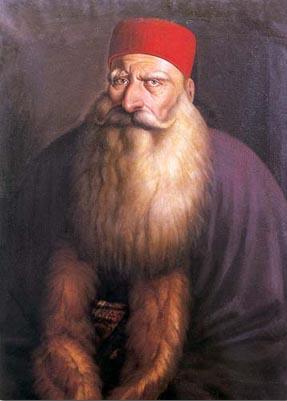
Bashir II declines to assist the siege of Acre by Napoleon and Jezzar Pasha. Unable to conquer Acre, Napoleon returned to Egypt, and the death of Jezzar Pasha in 1804 removed Bashir's principal opponent in the area. Source — Wikipedia, "Timeline of Lebanese history" (18th century):
Bashir Chehab - Lebanon's Prince By Daoud Corm d. 1930 - http://www.onefineart.com/en/artists/daoudcorm/page5.shtml The photo is copyrighted onefineart.com I took the photo myself (editorial@onefineart.com) Plz add the copyright, Public domain, https://commons.wikimedia.org/w/index.php?curid=5702321
1831 CE
Muhammad Ali of Egypt
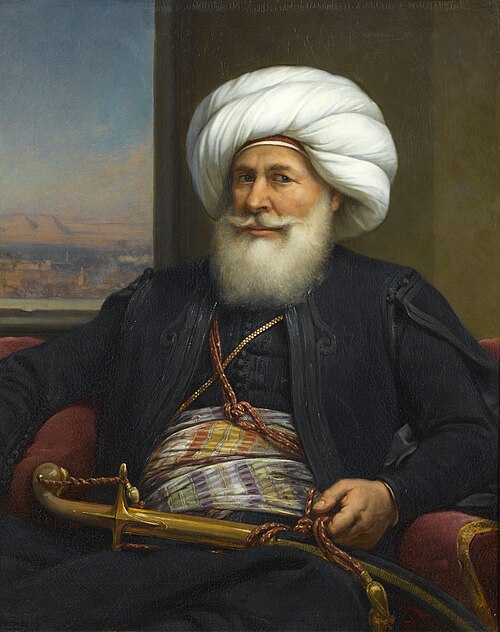
Bashir II breaks away from the Ottoman Empire, allies with Muhammad Ali of Egypt and assists Muhammad Ali's son, Ibrahim Pasha, in another siege of Acre. This siege lasted seven months, the city falling on 27 May 1832. The Egyptian army, with assistance from Bashir's troops, also attacked and conquered Damascus on 14 June 1832. Source — Wikipedia, "Timeline of Lebanese history" (19th century):
Mısır Valisi, Kavalalı Mehmet Ali Paşa . By Auguste Couder - This image comes from the Bibliotheca Alexandrina's Memory of Modern Egypt Digital Archive. Click here to view its thumbnail. Its description page can be located in the archive by copying the Arabic-language description above and pasting it into the search box situated in the upper-left corner of this page.This tag does not indicate the copyright status of the attached work. A valid copyright tag is still required., Public domain, https://commons.wikimedia.org/w/index.php?curid=6356895
1840 CE
After Muhammad Ali's rejection of the
After Muhammad Ali's rejection of the requests of the London treaty signed on 15 June 1840, Ottoman and British troops landed on the Lebanese coast on 10 September 1840. Faced with this combined force, Muhammad Ali retreated, and on 14 October 1840, Bashir II surrendered to the British and went into exile. Source — Wikipedia, "Timeline of Lebanese history" (19th century):
1841 CE
Druze
Conflicts between the Druze and the Maronite Christians exploded. A Maronite revolt against the Feudal class erupted, and lasted until 1858. Source — Wikipedia, "Timeline of Lebanese history" (19th century):
Nabi Shu'ayb By Dr. Avishai Teicher - Dr. Avishai Teicher via the PikiWiki - Israel free image collection project, CC BY 2.5, https://commons.wikimedia.org/w/index.php?curid=44124824
1860 CE
Napoleon III of France
A full-scale war erupted between Maronites and Druze. Napoleon III of France sent 7,000 troops to Beirut and helped impose a partition: The Druze control of the territory was recognised as the fact on the ground, and the Maronites were forced into an enclave, arrangements ratified by the concert of Europe in 1861. Source — Wikipedia, "Timeline of Lebanese history" (19th century):
The life-size state portrait was completed by Alexandre Cabanel at the behest of the emperor himself. Napoleon III is seen standing, wearing haute couture instead of a military uniform: a black dinner jacket with a white shirt, black short trousers with black stockings and fitting leather shoes. This suit was fashionable at that time. His only decoration is the medal of the Legion of Honour on his left and the red sash across his right shoulder. His right hand rest comfortably on his right hip, giving an air of confidence. The only indication of his imperial status is the long red mantle with hermine and the golden imperial crown and sceptre resting on the table, on which Napoleon III is resting his left hand on. The gilded room is presumable one of the Tuileries Palace. At the time of completion, Cabanel was heavily criticised by many for depicting the emperor not grand enough, making him look rather short and stout. Since Napoleon III is also not wearing uniform, which would have lent him an air of grandeur, some even mocked Cabanel of painting a waiter, ready to serve supper. Nevertheless the painting was well received within the imperial family. Apparently the artist was able to capture the emperor so well, it was greatly appreciated by the Empress Eugenie, who hung the portrait in the private chambers of the Tuileries Palace. After the end of the Second Empire, she took the painting with her into exile, despite its large size. It is speculated why the emperor chose to depict himself in civilian rather than military dress. Napoleon III wanted to move away from a strict imperial rule more towards a more bourgeois, democratic society. The attempt to downplay the imperial aspect could also be in reaction to the fact that the Bonaparte family originally came from rather humble origins, compared to other, centuries-old European royal dynasties. The fact that he has his back turned to the imperial regalia and stands in civilian dress can be interpreted as a move forward into the future, almost as if stepping out of something. Speculations aside, it is not a coincidence that Napoleon III wanted to be painted without imperial military uniform but depicted more as a civilian statesman or a gentleman. By Alexandre Cabanel - compiegne-peintures.fr, Public domain, https://commons.wikimedia.org/w/index.php?curid=14666815
1890 CE
The "silk crisis" took place. Cheaper
The "silk crisis" took place. Cheaper and better quality Chinese silk and silk products flooded Lebanese silk's main market: Europe. The crisis was especially hard considering many had taken on large debt to expand their lands and plant mulberry trees -which leaves were used to feed the worm. Source — Wikipedia, "Timeline of Lebanese history" (19th century):
1914 CE
Jamal Pasha
After the abolishment of Lebanon's semiautonomous status, Jamal Pasha militarily occupies Lebanon. Source — Wikipedia, "Timeline of Lebanese history" (20th century):
Djemal Pasha By Unknown author - Archibald Forder: In Brigand's Hands and Turkish Prisons 1914-1918. London et. al. 1920., Public domain, https://commons.wikimedia.org/w/index.php?curid=37817560
1915 CE
Mediterranean Sea
Jamal Pasha initiates a blockade of the entire eastern Mediterranean coast. Lebanon witnessed thousands of deaths from widespread famine and plagues. (Great Famine of Mount Lebanon) Source — Wikipedia, "Timeline of Lebanese history" (20th century):
Satellite caption of the Mediterranean Sea. By of the modification : Eric Gaba (Sting) - Screenshot from NASA World Wind (retouched), Public domain, https://commons.wikimedia.org/w/index.php?curid=150902
1916 CE
Turkey
Turkish authorities publicly executed 21 Syrians and Lebanese in Damascus and Beirut, respectively, for alleged anti-Turkish activities. Source — Wikipedia, "Timeline of Lebanese history" (20th century):
National Flag of Turkey By David Benbennick (original author) - Turkish Flag Law (Türk Bayrağı Kanunu), Law nr. 2893 of 22 September 1983. Text (in Turkish) at the website of the Turkish Historical Society (Türk Tarih Kurumu), Public domain, https://commons.wikimedia.org/w/index.php?curid=348909
1918 CE
Edmund Allenby, 1st Viscount Allenby
British general Edmund Allenby and Faysal I, son of Sharif Hussein of Mecca, moved into Palestine with British and Arab forces, thus opening the way for the occupation of Lebanon. Source — Wikipedia, "Timeline of Lebanese history" (20th century):
Field Marshal Viscount Edmund Allenby after Jerusalem conquer By Unknown author - This photograph Q 82969 comes from the collections of the Imperial War Museums., Public domain, https://commons.wikimedia.org/w/index.php?curid=46519465
1920 CE
San Remo conference
France takes control over Lebanese territory after the San Remo conference. Source — Wikipedia, "Timeline of Lebanese history" (20th century):
Delegates to the San Remo conference in Italy, 25 April 1920 By Unknown author - eipa.eu.com, Public domain, https://commons.wikimedia.org/w/index.php?curid=46364985
1935 CE
1935 Lebanon tobacco protests
France establishes a tobacco monopoly, followed by the 1935 Lebanon tobacco protests. Source — Wikipedia, "Timeline of Lebanese history" (20th century):
Nov 22, 1943 CE
Lebanese Independence Day
On 22 November, Lebanon gains its independence after national and international pressure following the imprisonment of president Bechara El Khoury and other parliament members by the French. Source — Wikipedia, "Timeline of Lebanese history" (20th century):
Flag of Lebanon. By Henri Pharaon - Traced based on the CIA World Factbook with some modification done to the colours based on information at Vexilla mundi., Public domain, https://commons.wikimedia.org/w/index.php?curid=433207
1948 CE
1948 Arab–Israeli War
The 1948 Arab–Israeli War; Palestinian refugees begin arriving in Lebanon. Source — Wikipedia, "Timeline of Lebanese history" (20th century):
Tel Aviv-Yafo (Israel) Photographs;התחנה המרכזית (תל אביב) Photographs By Benno Rothenberg - This image is available from National Library of Israel under the digital ID: 997008136796005171, CC BY 4.0, https://commons.wikimedia.org/w/index.php?curid=113320395
1958 CE
United States Marine Corps
A civil war erupts but short lived after the intervention of 5,000 US Marines ordered by President Eisenhower upon the request of the Lebanese president Camille Chamoun. Source — Wikipedia, "Timeline of Lebanese history" (20th century):
Emblem of the United States Marine Corps. This differs from the official seal in the inscription. By U.S. Government - Extracted from the cover of the PDF version of the March 2008 The Navy Reservist (direct PDF URL [1])., Public domain, https://commons.wikimedia.org/w/index.php?curid=4011106
1975 CE
Kataeb Party
Gunmen from the Phalanges, a Lebanese Christian group, ambush a bus in Beirut, killing 27 of its mainly Palestinian Muslim passengers, initiating the Lebanese Civil War, mainly between Christians (with Israeli support) and Muslims. Source — Wikipedia, "Timeline of Lebanese history" (20th century):
Flag of the Lebanese Phalanges Party. By MrPenguin20 - Own work, Public domain, https://commons.wikimedia.org/w/index.php?curid=29461280
1982 CE
Kataeb Party
Israel launches a full-scale invasion of Lebanon. The south of Lebanon, all the way to Beirut, is occupied by Israel. Pro-Israeli president-elect Bachir Gemayel is assassinated. With Israeli support, the Phalangist militia kills thousands of Palestinians in the Sabra and Shatila massacre. Bachir's elder brother Amine Gemayel is elected president. Hezbollah is founded in Lebanon in opposition to the Israeli occupation of Southern Lebanon. Source — Wikipedia, "Timeline of Lebanese history" (20th century):
Flag of the Lebanese Phalanges Party. By MrPenguin20 - Own work, Public domain, https://commons.wikimedia.org/w/index.php?curid=29461280
1988 CE
Outgoing President Amine Gemayel appoints an
Outgoing President Amine Gemayel appoints an unelected military government under Christian Commander-in-Chief Michel Aoun. Source — Wikipedia, "Timeline of Lebanese history" (20th century):
1990 CE
Michel Aoun flees the country as
Michel Aoun flees the country as Syrian troops enter Lebanon. End of the Lebanese civil war. Source — Wikipedia, "Timeline of Lebanese history" (20th century):
1992 CE
Rafic Hariri
Wealthy businessman Rafic Hariri, a Muslim moderate, is elected prime minister. Source — Wikipedia, "Timeline of Lebanese history" (20th century):
M. Barroso reçoit le PM libanais, M. Rafiq Hariri By European Commission - Christian Lambiotte - https://audiovisual.ec.europa.eu/en/photo-details/P-010848~2F00-2, CC BY 4.0, https://commons.wikimedia.org/w/index.php?curid=144930593
May 1, 2000 CE
South Lebanon conflict
Israeli withdrawal from southern Lebanon, putting an end to 18 years of Israeli occupation. Source — Wikipedia, "Timeline of Lebanese history" (21st century):
מבצע ליטני (15/3-21/3 1978). טור נגמ"שים M113 בתנועה בשטח הררי בדרום לבנון. ברקע כפר לבנוני. By Michael Zarfati - This file was derived from: רצועת הביטחון 40.jpg: רצועת הביטחון 7.jpg: רצועת הביטחון 33.jpg: רצועת הביטחון 26.jpg: רצועת הביטחון 1.jpg: רצועת הביטחון 43.jpg:, CC BY-SA 3.0, https://commons.wikimedia.org/w/index.php?curid=90387068
Feb 1, 2005 CE
assassination of Rafic Hariri
Following the assassination of Rafic Hariri, who opposed Syrian presence in Lebanon, the Cedar Revolution took place: following massive, peaceful demonstrations, the Syrian troops completely withdrew from Lebanon on 27 April 2005. Source — Wikipedia, "Timeline of Lebanese history" (21st century):
This Ministry of the Interior soldier was guarding the site of the attack that killed former Prime Minister Hariri and started turmoil in Lebanon.Guarding Ground Zero By Petteri Sulonen from Helsinki, Finland - Flickr, CC BY 2.0, https://commons.wikimedia.org/w/index.php?curid=1129161
Jul 1, 2006 CE
2006 Lebanon War
The July War takes place between Hezbollah and Israel. The conflict ends with the acceptance of the United Nations Security Council Resolution 1701 by both Israel and Lebanon. Source — Wikipedia, "Timeline of Lebanese history" (21st century):
Dust rises after the impact of two 500lb (230kg) laser guided bombs dropped during an IAF airstrike on Tyre, Lebanon. By Masser - https://www.flickr.com/photos/masser/198909816/, CC BY-SA 2.0, https://commons.wikimedia.org/w/index.php?curid=1071277
May 1, 2007 CE
2007 Lebanon conflict
2007 Lebanon conflict: fighting between Fatah al-Islam, an Islamist militant organization, and the Lebanese Armed Forces (LAF) on May 20, 2007, in Nahr al-Bared, an UNRWA Palestinian refugee camp near Tripoli. Source — Wikipedia, "Timeline of Lebanese history" (21st century):
Smoke over Nahr al Bared during the fighting in 2007 By Eternalsleeper - Cropped from PD Image:Nahralbaredbomb.JPG, Public domain, https://commons.wikimedia.org/w/index.php?curid=3592870
May 1, 2008 CE
2008 Lebanon conflict
2008 Lebanon conflict: Hezbollah-led opposition fighters seized control of several West Beirut neighborhoods from Future Movement militiamen loyal to the government, in street battles that left 11 dead and 30 wounded. The opposition-seized areas were then handed over to the Lebanese Army. Source — Wikipedia, "Timeline of Lebanese history" (21st century):
The Future TV building was setted in fire during the crisis in May 2008. By Lannie Naas - originally posted to Flickr as War in Beirut-Lebanon, CC BY-SA 2.0, https://commons.wikimedia.org/w/index.php?curid=4041189
Jan 1, 2011 CE
2011 Lebanese protests
2011 Lebanese protests - part of the Arab Spring. Source — Wikipedia, "Timeline of Lebanese history" (21st century):
(ar) الموقع الجغرافي للبنان (en) Geographical location of Lebanon (fr) Situation géographique du Liban By By Rei-artur pt en Rei-artur blog - Original by User:Vardion, Image:A large blank world map with oceans marked in blue.svg, CC BY-SA 3.0, https://commons.wikimedia.org/w/index.php?curid=1446489
Jun 1, 2011 CE
Syrian civil war spillover in Lebanon
Syrian Civil War spillover in Lebanon - Between 2011 and 2017, fighting from the Syrian Civil War spilled over into Lebanon as opponents and supporters of the Syrian Arab Republic traveled to Lebanon to fight and attack each other on Lebanese soil. The Syrian conflict stoked a resurgence of sectarian violence in Lebanon. Source — Wikipedia, "Timeline of Lebanese history" (21st century):
Lebanese army vehicle and soldier on Syria Street, guarding the road between Bab al-Tabbaneh and Jabal Mohsen. By FunkMonk - Own work, CC BY-SA 3.0, https://commons.wikimedia.org/w/index.php?curid=18556568
Oct 1, 2019 CE
2019–2020 Lebanese protests
2019–2020 Lebanese protests - part of the 2018–2020 Arab protests. Source — Wikipedia, "Timeline of Lebanese history" (21st century):
Beirut Protests 2019 By Shahen Araboghlian - Own work, CC BY-SA 4.0, https://commons.wikimedia.org/w/index.php?curid=83214286
Aug 1, 2020 CE
2020 Beirut explosion
On August 4, 2020, a massive explosion occurred at the Port of Beirut, Lebanon, resulting in at least 218 deaths, over 7,000 injuries. The explosion was one of the most powerful non-nuclear blasts recorded and the cause is still unknown.2020 Beirut explosion Source — Wikipedia, "Timeline of Lebanese history" (21st century):
Damage after the Beirut explosion By Mahdi Shojaeian - http://mehrnews.com/xSsTy, CC BY 4.0, https://commons.wikimedia.org/w/index.php?curid=92996957




![Map of the the main tectonic features in the coastal part of Lebanon, modified after Elias et al. 2007 Base map screenshot from NASA World Wind software. [1]](https://upload.wikimedia.org/wikipedia/commons/thumb/7/76/Lebanon_tectonics.png/500px-Lebanon_tectonics.png)


![Illustration of the Battle of Yarmouk (636) at the bottom of the page of BNF Nouvelle acquisition française 886 fol. 9v (early 14th century). The Saracens are shown with a star and crescent banner, the Byzantines (anachronistically in Crusader era armour) with a star banner. Note that the banner designs are not attributed to factions with any consistency by this illustrator: The star and crescent is also shown as carried by the Mongols in foll. 22r, 32v, 34r, 35v). For a later (mid 14th-century) copy with more developed heraldry, see Vienna ÖNB Cod. 2623[1] fol. 15r. Hayton's (Faulcon's) text reads: Lors manda l'empereour Eracles grant secors de genz pour defendre la cité d'Antioche. Qant les genz de l'empereour Eracles furent parvenuz jusques à une plainure qui est nomée Possent (var.: Posserit), les Sarazins vindrent à l'encontre; e là fu comencée molt grant bataille que longuement dura; mès, à la fin, les Sarazins en orent la victoire, e tant gent furent ocis en cele bataille que encores y perent les ossements des seignors en celui champ. Dont il avint que les Grex, qui tenoient la cité d'Antioche, furent molt espoentés, e rendirent la terre as Sarazins par convenances. (La Flor des Estories de la Terre d'Orient II.1, ed. Dardel 1906, p. 137.)](https://upload.wikimedia.org/wikipedia/commons/thumb/d/d1/Hayton_BNF886_9v.jpg/500px-Hayton_BNF886_9v.jpg)