Encyclopedia/3. History, Societies & Civilizations/09. Modern Nations/02. Americas • Curated by Admin Timeline.sg
History of Canada, sourced from Wikipedia's "Timeline of Canadian history".
Chronological Storyline (129 Milestones)
14 BCE
Wisconsin glaciation
Glaciers that covered Canada began melting, allowing Paleo-Indians to move south and east into Canada and beyond. Source — Wikipedia, "Timeline of Canadian history" (Prehistory):
Maximum glaciation of the northern hemisphere (black) during the Quaternary climatic cycles Ice coverage: J. Ehlers & P.L. Gibbard: The extent and chronology of Cenozoic global glaciation. Quaternary International, 164-165, 6-20, 2007 doi:10.1016/j.quaint.2006.10.008 Topography: U.S. Department of Commerce, National Oceanic and Atmospheric Administration, National Geophysical Data Center (NOAA/NGDC), 2-minute Gridded Global Relief Data (ETOPO2) 2006 Map software: Schlitzer, R., Ocean Data View, http://odv.awi.de, 2007 By Hannes Grobe/AWI - Own work, CC BY 3.0, https://commons.wikimedia.org/w/index.php?curid=5565604
14 BCE
Paleo-Indians
At some unknown time prior to this date, Paleo-Indians moved across the Beringia land bridge from eastern Siberia into northwest North America, settling in some areas of Alaska and the Yukon, but are blocked from further travel south into the continent by extensive glaciation. Source — Wikipedia, "Timeline of Canadian history" (Prehistory):
Glyptodon. By Heinrich Harder (1858-1935) - The Wonderful Paleo Art of Heinrich Harder, Public domain, https://commons.wikimedia.org/w/index.php?curid=1143767
3 BCE
Paleo-Eskimos
Paleo-Eskimos begin to settle the Arctic regions of North America from Siberia. Source — Wikipedia, "Timeline of Canadian history" (Prehistory):
Archaeological site of a hunting ground of the Saqqaq culture near Sermermiut on the Disco Bay, Greenland By Makemake 09:28, 28. Nov. 2006 (CET) - Self-photographed, CC BY-SA 3.0, https://commons.wikimedia.org/w/index.php?curid=32846366
3 BCE
Indigenous peoples of the Northeastern Woodlands
The Indigenous peoples of the Northeastern Woodlands begin to cultivate different types of squash. Source — Wikipedia, "Timeline of Canadian history" (Prehistory):
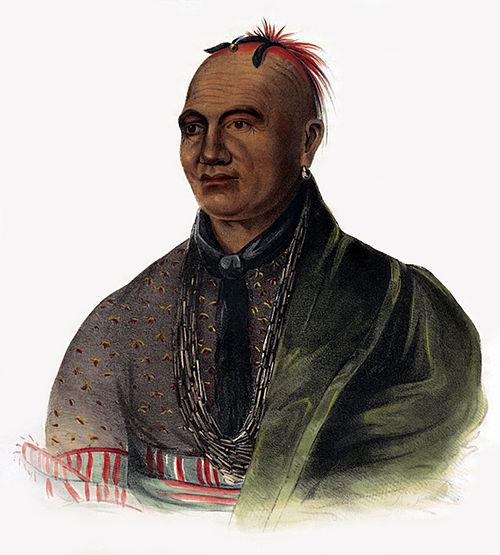
Illustration "Joseph Brant (Mohawk)" By Charles Bird King - Thomas Loraine McKenney and James Hall. History of the Indian tribes of North America. Philadelphia: E. C. Biddle, 1836-1844. via Cornell University Native American Collection, Public domain, https://commons.wikimedia.org/w/index.php?curid=900906
796 CE
Council of Three Fires
Council of Three Fires (also known as the Three Fires Confederacy) was formed. Source — Wikipedia, "Timeline of Canadian history" (8th century):
1000 CE
Norse colonization of North America
A short-lived Norse settlement is founded at L'Anse aux Meadows on the northern tip of Newfoundland. It is possibly connected with the attempted colony of Vinland, established by Leif Erikson around the same period or, more broadly, with Norse colonization of North America. Source — Wikipedia, "Timeline of Canadian history" (10th century):
Norse silhouette sculpture above L'Anse aux Meadows National Historic Site, Newfoundland Canada on August 27, 2022. This sculpture commemorates the arrival of the Vikings in approximately 1021 and was designed by New Brunswick artist, Karen Van Niekerk. It is made of corten steel, 10 millimeters thick and approximately 2.4 meters high, Most of the Norse figures look southeast to symbolize their intent to use L’Anse aux Meadows as a base camp to explore further southward from Newfoundland's Great Northern Peninsula. One looks back to southern Greenland from whence they came. There is a woman figure indicative of families that came during the period that L'Anse aux Meadows was used as a base camp. By Gordon Leggett - Own work, CC BY-SA 4.0, https://commons.wikimedia.org/w/index.php?curid=154758645
Aug 31, 1142 CE
Iroquois
The Iroquois Confederacy (also known as the League of Peace and Power) is formed. Source — Wikipedia, "Timeline of Canadian history" (12th century):
Flag of the Iroquois Confederacy, Hiawatha Belt By Rick Hill, Harold Johnson, and Tim Johnson - Approximate color shade from [1], Public domain, https://commons.wikimedia.org/w/index.php?curid=997266
Jun 24, 1497 CE
Genoa
Genoese navigator John Cabot lands the Matthew of Bristol somewhere on the northern Atlantic coast of North America, claiming the land for England by the Doctrine of discovery. The precise location of Cabot's landing is widely debated but generally believed to be on Newfoundland, already inhabited by the Beothuk people. Source — Wikipedia, "Timeline of Canadian history" (15th century):
Piazza de Ferrari, Genoa, Italy By Julian Lupyan - Own work, CC0, https://commons.wikimedia.org/w/index.php?curid=175883898
1498 CE
Portugal
Portuguese explorer João Fernandes Lavrador first sights and sails along the coasts of the Labrador Peninsula. Source — Wikipedia, "Timeline of Canadian history" (15th century):
Flag of Portugal, created by Columbano Bordalo Pinheiro (1857-1929), officially adopted by Portuguese government in June 30, 1911 (in use since about November 1910). By Original: Columbano Bordalo Pinheiro Vector: Vítor Luís Rodrigues, António Martins-Tuválkin - Símbolos Nacionais, Public domain, https://commons.wikimedia.org/w/index.php?curid=92861585
Jul 24, 1534 CE
Jacques Cartier
Explorer Jacques Cartier claims the Gaspé Peninsula, already inhabited by Indigenous St. Lawrence Iroquoians, for France under the Doctrine of Discovery. He returns to France with two Iroquois captives. Source — Wikipedia, "Timeline of Canadian history" (16th century):
A painting representing a side picture of explorer Jacques Cartier, produced by the painter Theophile Hamel (1844). There are no known paintings of Cartier that were created during his lifetime. By Théophile Hamel / After François Nicholas Riss, CC BY-SA 4.0, https://commons.wikimedia.org/w/index.php?curid=75675451
1583 CE
Humphrey Gilbert
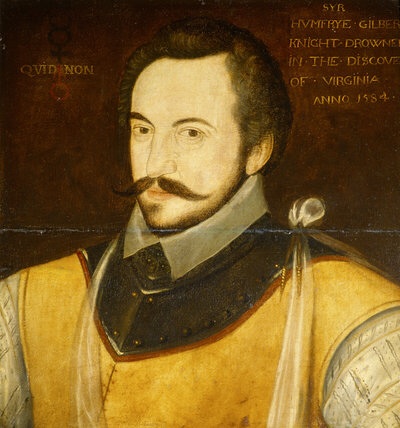
Explorer Humphrey Gilbert lands in present-day St. John's and lays claim to the island of Newfoundland for the Kingdom of England under the Doctrine of Discovery. He dies at sea and permanent settlement by the British had to await better planned attempts. Source — Wikipedia, "Timeline of Canadian history" (16th century):
Portrait of explorer Sir Humphrey Gilbert. By Unknown author - http://strangeandfarre.weebly.com/arming-garments.html, Public domain, https://commons.wikimedia.org/w/index.php?curid=33219862
1605 CE
Samuel de Champlain
French colonists under Samuel de Champlain establish the first permanent European settlement in the future Canada at Port-Royal, founding the colony that would become known as Acadia. Source — Wikipedia, "Timeline of Canadian history" (17th century):
Detail from "Deffaite des Yroquois au Lac de Champlain." Drawn by Samuel de Champlain for his "Voyages" (1613) By Samuel de Champlain - http://jcb.lunaimaging.com/luna/servlet/detail/JCB~1~1~250~115900740?qvq=q%3Asource_creator%3D%22Champlain%2C%2BSamuel%2Bde%2C%2B1567-1635%22%3Bsort%3ARecord_number%2CTitle%2CCreators%2CNormalized_date%3Blc%3AJCB~1~1%2CJCBBOOKS~1~1%2CJCBMAPS~1~1%2CJCBMAPS~2~2%2CJCBMAPS~3~3&mi=15&trs=23, Public domain, https://commons.wikimedia.org/w/index.php?curid=7665017
Jul 3, 1608 CE
Quebec City
Quebec City founded by Champlain, becoming the capital of New France. Source — Wikipedia, "Timeline of Canadian history" (17th century):
The skyline of Quebec City, Quebec, in winter 2025. By Quintin Soloviev - Own work, CC BY 4.0, https://commons.wikimedia.org/w/index.php?curid=191431827
Jul 4, 1634 CE
Trois-Rivières
Trois-Rivières founded, becoming the second permanent settlement in New France. Source — Wikipedia, "Timeline of Canadian history" (17th century):
Skyline of downtown Trois-Rivières, Quebec, Canada. By Quintin Soloviev - Own work, CC BY 4.0, https://commons.wikimedia.org/w/index.php?curid=184064671
May 17, 1642 CE
Fort Ville-Marie
Fort Ville-Marie (Old Montreal) founded with the majority of immigrants coming directly from France led by Paul de Chomedey and Jeanne Mance, a lay woman. Source — Wikipedia, "Timeline of Canadian history" (17th century):
Fort of Ville-Marie (Montreal) 1645 By Pierre-Louis Morin - Le Vieux-Montréal, 1611-1803, dessins de Pierre-Louis Morin, Montréal, Honoré Beaugrand, La Patrie, 1884 / repris dans : Histoire du Montréal, François Dollier de Casson, Nouvelle édition critique par Marcel Trudel et Marie Baboyant, Cahiers du Québec, Hurtubise HMS, 1992, p. 106, Public domain, https://commons.wikimedia.org/w/index.php?curid=8557069
1666 CE
1666 census of New France
First census of North America released. Source — Wikipedia, "Timeline of Canadian history" (17th century):
May 2, 1670 CE
Hudson's Bay Company
Hudson's Bay Company formed. It has an exclusive charter for trade in the Hudson Bay watershed region known as Rupert's Land. The company administers the new colony on behalf of the King. Source — Wikipedia, "Timeline of Canadian history" (17th century):
Logo von Hudsons Bay Company By Unknown author - Hudson's Bay Company Official Logo 2013.svg, Public domain, https://commons.wikimedia.org/w/index.php?curid=32332525
Oct 16, 1690 CE
Battle of Quebec
The Battle of Québec was fought between the colonies of New France and Massachusetts Bay, then ruled by the kingdoms of France and England, respectively. It was the first time Québec's defenses were tested, with the New Englanders hoping to seize Québec, then the capital of New France. They failed to take the city. Source — Wikipedia, "Timeline of Canadian history" (17th century):
la défense de Québec en 1690 par Frontenac durant la guerre de la Ligue d'Augsbourg By Charles Van Tenac - gallica.fr, Public domain, https://commons.wikimedia.org/w/index.php?curid=28439836
Aug 4, 1701 CE
Great Peace of Montreal
The Great Peace of Montreal, between New France and 39 First Nations, is finalized. Source — Wikipedia, "Timeline of Canadian history" (18th century):
Copie du traité de paix de 1701. (Le document original du traité de paix de 1701 semble avoir disparu.) Pictogrammes des nations signataires : 1. Ouentsiouan représente la nation iroquoise des Onontagués et signe un échassier. 2. Pour les Tsonnontouan, c'est Tourengouenon qui appose la signature de la tortue. 3. Pour les Onneeiouts, la signature représente une fourche au milieu de laquelle se trouve une pierre. 4. Chez les Goyogouins (« peuple de la grande pipe », le dessin d'une pipe va de soi! 5. La marque de Kondiaronk, dit le Rat (un rat musqué), figure sur le traité de 1701. Un autre chef huron a pu apposer cette marque au nom de ce grand chef, mort deux jours avant la signature du traité. 6. L'ours, la signature du chef Kinongé, dit le Brochet, pour les Outaouais du Sable. 7. La marque des Abénaquis de l'Acadie, par le chef Mescouadoué. 8. L'ours, la marque des Outaouais Sinagos. 9. Pour les Gens du Sault, l'ours également, signature apposée par Haronhiateka. 10. La signature du chef des Gens de la Montagne est un chevreuil. 11. Le chef Kileouiskingié signe d'un poisson pour les Outaouais Kiskarons. 12. La fourche représente le lieu où vivent les Outaouais de la Fourche, à la confluence de trois rivières. 13. Représentés par Onanguicé, chef pouteouatami, les Mississagués (nation ojibwée) signent d'un oiseau-tonnerre. 14. Les Amikoués apposent la marque du castor. 15. Pour les Sauteux (Ojibwés), le chef Ouabangué appose la marque d'une grue. 16. Chez les Algonquins, on trouve deux signatures : un échassier ou une grue et, à côté, un être humain. 17. Une perche surmontée d'un scalp sert de signature pour le village des Pangichéas (Piankashaws). 18. La marque de Chichicatalo, chef très respecté chez les Miamis, regroupe deux symboles, dont une grue. 19. La marque du chef Outilirine pourrait représenter les Cris. En langue Crie, le suffixe -irin signie « homme ». 20. Représentés par Onanguicé, les Koueras Koueatenons (groupe illinois) signent d'un arc et d'une flèche. 21. La marque du village des Peorias (nation illinoise) est une tortue à longue queue. 22. L'emblème des Tapouaroas (groupe illinois). 23. L'emblème des Monisgouenars (nation illinoise), établi à la rivière des Moines. 24. Le village des Marouas (groupe illinois), signe d'une grenouille. 25. Pour les Pouteouatamis, la marque d'un chicot et trois racines. 26. Pour les Kaskaskias (nation illinoise), une plume encochée. 27. La marque du village des Ouiatanons (nation miamie) est une carrière. 28. L'esturgeon est la marque des Sakis (Sauks). 29. Chez les Outagamis, ou Renards, la signature est celle du... renard. 30. L'oiseau-tonnerre représente le symbole clanique des Puants. 31. La marque des Malominis (Folles Avoines) est celle d'un oiseau-tonnerre tenant une tige de folle avoine. 32. Le chevalier de Callière, Brochart de Champigny, et autres. (Notes tirées de : Alain Beaulieu et Roland Viau, La Grande Paix, Chronique d'une saga diplomatique, Montréal, Éditions Libre Expression, 2001, pp. 109-111.) By Secrétaire de Callière et autre main (pour les pictogrammes) - Numérisation et collage de 3 pages du livre : La Grande Paix, Chronique d'une saga diplomatique, Alain Beaulieu, Montréal, éditions Libre Expression, 2001., Public domain, https://commons.wikimedia.org/w/index.php?curid=5026409
Oct 1, 1710 CE
Siege of Port Royal
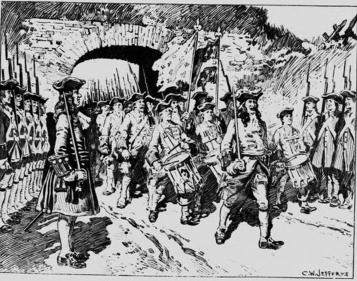
In the Siege of Port Royal, the capital of Acadia falls to the British, defeating the French garrison and their Wabanaki Confederacy Indigenous allies. This begins an expansion into present-day Nova Scotia by the British. Source — Wikipedia, "Timeline of Canadian history" (18th century):
Evacution Of Port Royal 1710 by CW Jefferys By Charles William Jefferys - Picture Gallery of Canadian History (3 vols, 1942-50), Public domain, https://commons.wikimedia.org/w/index.php?curid=31189776
Apr 11, 1713 CE
War of the Spanish Succession
The War of the Spanish Succession is ended by the Treaty of Utrecht. France cedes the territory of Acadia to Great Britain and renounces claims to some British territories in Canada, as well as its claim to a monopoly of trade with the Indigenous population, but retains control of Île Royale colony (present-day Cape Breton Island and Prince Edward Island). Source — Wikipedia, "Timeline of Canadian history" (18th century):
Final War of the Spanish Succession Collage By DavidDijkgraaf - Own work, CC0, https://commons.wikimedia.org/w/index.php?curid=123648712
1717 CE
Kanesatake
The Indigenous settlement of Kanesatake is founded at the confluence of the St. Lawrence and Ottawa rivers. It is founded by the Sulpician Order under a royal charter as a home for Catholic converts of the Indigenous peoples of the region, including the Mohawk. The lands' ownership becomes disputed between the Order and the Indigenous residents over the original land grant and title. The settlement would later be the location of the Oka Crisis. The land remains disputed. Source — Wikipedia, "Timeline of Canadian history" (18th century):
Location of Kanesatake, Quebec within Deux-Montagnes Regional County Municipality. By Gordalmighty - Own work, CC BY-SA 3.0, https://commons.wikimedia.org/w/index.php?curid=25017556
Jun 21, 1749 CE
Halifax, Nova Scotia
Halifax is founded and settled by the British, marking the first time that public rather than private capital was used to settle a British colony in the Americas. The Indigenous Mi'kmaq consider Britain's unilateral action as a violation of treaties signed after Father Rale's War in 1726, starting Father Le Loutre's War. British colonists would drive French and Mi'kmaq inhabitants from peninsular Nova Scotia but are repelled from Acadian settlements further north (present-day New Brunswick). Source — Wikipedia, "Timeline of Canadian history" (18th century):
Halifax, Nova Scotia, Canada By Tony Webster from Minneapolis, Minnesota - Halifax Harbour Sunset Skyline, CC BY-SA 2.0, https://commons.wikimedia.org/w/index.php?curid=46589733
Aug 11, 1755 CE
Charles Lawrence
British Brigadier-General Charles Lawrence orders the Expulsion of the Acadians. Over the next decade an estimated 11,400 French Catholics are deported to the Thirteen Colonies and Europe. Many settle in Louisiana. Source — Wikipedia, "Timeline of Canadian history" (18th century):
Governor of Nova Scotia Charles Lawrence By Unknown author - Collections of the Nova Scotia Historical Society.Vol. 16. 1912. p. 11, Public domain, https://commons.wikimedia.org/w/index.php?curid=21080496
Jun 8, 1758 CE
Fortress of Louisbourg
The French naval fortress at Louisbourg is sieged for a second time by the British, having been returned to the French after a previous occupation in 1745. After being used to stage attacks on French Canada the following year, British soldiers reduce the fortress to rubble to prevent its return to the French a second time. Source — Wikipedia, "Timeline of Canadian history" (18th century):
Louisbourg en 1758 By Charny - Own work, CC BY-SA 3.0, https://commons.wikimedia.org/w/index.php?curid=17554633
Sep 13, 1759 CE
Quebec City
A three-month British siege of Quebec City culminates in the pivotal Battle of the Plains of Abraham just outside the city's walls. Both the British commander and the French commander are killed in the battle. The British army secures a decisive victory, and French forces leave the city. Source — Wikipedia, "Timeline of Canadian history" (18th century):
The skyline of Quebec City, Quebec, in winter 2025. By Quintin Soloviev - Own work, CC BY 4.0, https://commons.wikimedia.org/w/index.php?curid=191431827
Mar 10, 1760 CE
Halifax Treaties
The Halifax Treaties are signed between the Wabanaki Confederacy and the British Crown to end warring between the Indigenous peoples of the Maritimes and the British. One by one, various First Nations signed treaties to pledge "peace and friendship" with the British. The issue of aboriginal title is not covered in the treaties. Source — Wikipedia, "Timeline of Canadian history" (18th century):
A portrait of Nova Scotia jurist and governor Jonathan Belcher, based on a 1741 mezzotint by John Faber. By John Singleton Copley - Original painting hangs in Court room #4, Nova Scotia Supreme Court, Halifax, Nova Scotia; American Furniture magazine: https://www.chipstone.org/publications/2004AF/Prown/2004Prownindex.html, Public domain, https://commons.wikimedia.org/w/index.php?curid=14673564
Feb 10, 1763 CE
Seven Years' War
The Seven Years' War is ended by the Treaty of Paris. France cedes New France to Great Britain, its colony Canada becoming the British Province of Quebec, and its remaining maritime colonies annexed by Nova Scotia. Source — Wikipedia, "Timeline of Canadian history" (18th century):
Seven Years' War Collage based on these files: Lord Clive meeting with Mir Jafar after the Battle of Plassey, 23 June 1757 The Victory of Montcalm's Troops at Carillon, 6-8 July 1758 Frederick the Great at the battle of Zorndorf, 25 August 1758 General von Laudon at the battle of Kunersdorf, 12 August 1759 By Blaue Max - Own work, CC BY-SA 4.0, https://commons.wikimedia.org/w/index.php?curid=43179570
Aug 1, 1764 CE
Treaty of Fort Niagara
The Treaty of Fort Niagara is agreed to by the British Crown and 24 First Nations. It is the first treaty after the 1763 Proclamation, recognizing aboriginal title, and Indigenous recognition of the Proclamation. A strip of land along the Niagara River is transferred to Britain by the Seneca to provide a portage around Niagara Falls. The treaty created a new Covenant Chain, or friendship treaty, between Britain and the First Nations of the western Great Lakes. It is recorded in wampum. To the Indigenous peoples, it is a symbol of friendship and the recognition of sovereignty to their First Nations. Source — Wikipedia, "Timeline of Canadian history" (18th century):
Transparent inukshuk Canada icon By Moxy - Own work, CC BY-SA 4.0, https://commons.wikimedia.org/w/index.php?curid=101303412
Jul 14, 1769 CE
Prince Edward Island
St. John's Island is partitioned from Nova Scotia, becoming a separate colony from the mainland. The colony is renamed Prince Edward Island in 1798. Source — Wikipedia, "Timeline of Canadian history" (18th century):
Flag of Prince Edward Island. By E Pluribus Anthony - Government of Prince Edward Island, InfoPEI: Provincial Symbols. Adapted by E Pluribus Anthony., Public domain, https://commons.wikimedia.org/w/index.php?curid=361809
1774 CE
Quebec Act
Quebec Act of 1774 is passed by the Parliament of Great Britain outlining how the Province of Quebec would be governed as colony, in an attempt to address damage to the economy/society of Quebec. Old boundaries were restored, free practice of Catholicism was guaranteed, and property and civil laws were to be decided according to traditional Canadian laws (thus preserving the Seigneurial system of New France for land ownership), with other matters of law left to English Common Law. The province was left to be governed by a legislative council, with no provision for an elected assembly. Source — Wikipedia, "Timeline of Canadian history" (18th century):
Coat of Arms of Great Britain from 1714 to 1801 used by King George I, George II and George III “ Quarterly, First quarter, Per pale, dexter, Gules three lions passant guardant in pale Or armed and langued Azure (for England), sinister, Or a lion rampant within a double tressure flory counter-flory Gules (for Scotland), Second quarter Azure three fleurs de lys Or (For France), Third quarter Azure a harp Or stringed Argent (for Ireland), Fourth quarter, Tierced per pale and per chevron, First Gules two lions passant guardant Or (for Brunswick), Second Or semée of hearts Gules a lion rampant Azure (For Luneburg), Third Gules a horse courant Argent (For Hanover), an inescutcheon over all three, Gules the Crown of Charlemagne Proper (As Archtreasurer of the Holy Roman Empire), the whole surrounded by the Garter; for a Crest, upon the Royal helm the imperial crown Proper, thereon a lion statant guardant Or imperially crowned Proper; Mantling Or and ermine; for Supporters, dexter a lion rampant guardant Or crowned as the Crest, sinister a unicorn Argent armed, crined and unguled Proper, gorged with a coronet Or composed of crosses patée and fleurs de lys a chain affixed thereto passing between the forelegs and reflexed over the back also Or; Motto 'Dieu et mon Droit' in the compartment below the shield, with the Union rose, shamrock and thistle engrafted on the same stem. ” PINCHES, J.H & R.V., The Royal Heraldry of England, 1974, Heraldry Today. By Sodacan - Own work, CC BY-SA 3.0, https://commons.wikimedia.org/w/index.php?curid=10952376
1775 CE
Invasion of Quebec
The Invasion of Quebec and the Battle of Quebec take place, during the American Revolutionary War against Great Britain. These became a failed attempt at seizing military control of the British Province of Quebec and convince the French-speaking Canadiens to join the revolution on the side of the Thirteen Colonies. Source — Wikipedia, "Timeline of Canadian history" (18th century):
The The Death of General Montgomery in the Attack on Quebec, December 31, 1775 is an 1786 oil painting by John Trumbull. It depicts the tragic death of the American General Richard Montgomery at the Battle of Quebec on December 31, 1775, during the Invasion of Quebec, a major military operation by the Continental Army in the American Revolutionary War. By John Trumbull - Yale University Art Gallery, Public domain, https://commons.wikimedia.org/w/index.php?curid=14619271
1780 CE
Underground railroad
An Underground railroad, a series of houses where aid and shelter was available, assisted escaped slaves from slave states to the northern U.S. and for some the journey continued into Canada. Slavery was outlawed in Canada with the passage of the British Slavery Abolition Act 1833. That made entry into Canada even more attractive to escaped slaves, and an estimated 30,00 to 40,000 blacks came to Canada along the Underground Railroad before the end of slavery in the United States in 1865. Source — Wikipedia, "Timeline of Canadian history" (18th century):
"Routes of the Underground Railroad." Whole map of the underground railroad. The Underground Railroad was not an actual railroad, but a network of secret routes and safe houses used by black slaves in the United States to escape to free states and Canada. By https://lccn.loc.gov/68003375 Siebert, Wilbur Henry, 1866-1961. The underground railroad from slavery to freedom. With an introd. by Albert Bushnell Hart. Gloucester, Mass., P. Smith, 1968 [c1898] xxvi, 478 p. illus., facsim., fold. map, ports. 21 cm. E450 .S57 1968 - http://history.sandiego.edu/gen/CWPics/86139.jpg. Compiled from "The Underground Railroad from Slavery to Freedom" by Wilbur H. Siebert, The Macmillan Company, 1898.[1], Public domain, https://commons.wikimedia.org/w/index.php?curid=405624
1782 CE
Kingdom of Great Britain
A preliminary peace treaty between Great Britain and the United States of America is signed. Citing one of the clauses, General George Washington insisted on the return of any present or former slaves. As part of documenting and evacuation of former slaves to British North America, the Book of Negroes was compiled in New York City. Enslaved Africans in America who escaped to the British during the American Revolutionary War became the first settlement of Black Nova Scotians and Black Canadians. Source — Wikipedia, "Timeline of Canadian history" (18th century):
The pre-1801 Union Flag (of w:United Kingdom of Great Britain). By Hoshie - Made by Hoshie Sodipodi flag collection (original file) Dead link as of: 4FEB2009 Colours: vexilla mundi Dead link as of: 12DEC2007 (Archived from 12MAR2007) Proportions: Zscout370 and Madden, Public domain, https://commons.wikimedia.org/w/index.php?curid=365635
Sep 3, 1783 CE
Treaty of Paris
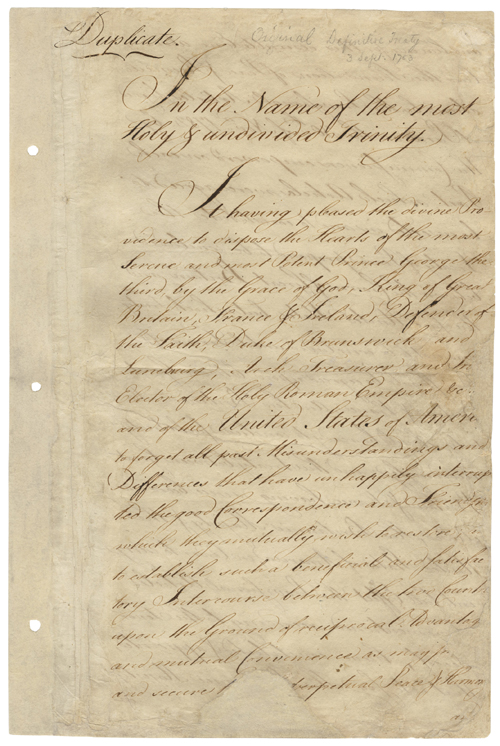
The Treaty of Paris (1783) was signed by representatives of King George III of Great Britain and representatives of the United States of America, officially ending the American Revolutionary War. The treaty set the boundaries between the British Empire in North America and the United States of America. Details included fishing rights and restoration of property and prisoners of war. Source — Wikipedia, "Timeline of Canadian history" (18th century):
First page of the Treaty of Paris in 1783, which forced Britain to recognise the United States as a country. By iDK - This tag does not indicate the copyright status of the attached work. A normal copyright tag is still required. See Commons:Licensing., Public domain, https://commons.wikimedia.org/w/index.php?curid=115507932
May 22, 1784 CE
Mississaugas of the Credit First Nation
Over of land is purchased by the British Crown from the Mississaugas of the Credit First Nation in present-day Ontario for £1,180. Source — Wikipedia, "Timeline of Canadian history" (18th century):
1790 CE
North West Company
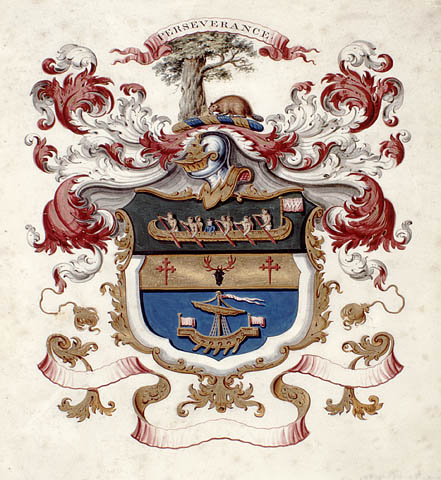
Hudson's Bay Company and North West Company build fur trading posts on upper Saskatchewan River. These include Fort Edmonton and forts at Rocky Mountain House. Source — Wikipedia, "Timeline of Canadian history" (18th century):
North West Company coat of arms, ca. 1800-1820 By Unknown author - Library and Archives Canada does not allow free use of its copyrighted works. See Category:Images from Library and Archives Canada., Public domain, https://commons.wikimedia.org/w/index.php?curid=5650567
Jun 10, 1791 CE
Constitutional Act 1791
The Constitutional Act 1791 divides the Province of Quebec into Upper and Lower Canada (modern-day Ontario and Quebec). Elections held in 1792 in those two colonies. Source — Wikipedia, "Timeline of Canadian history" (18th century):
Coat of Arms of Great Britain from 1714 to 1801 used by King George I, George II and George III “ Quarterly, First quarter, Per pale, dexter, Gules three lions passant guardant in pale Or armed and langued Azure (for England), sinister, Or a lion rampant within a double tressure flory counter-flory Gules (for Scotland), Second quarter Azure three fleurs de lys Or (For France), Third quarter Azure a harp Or stringed Argent (for Ireland), Fourth quarter, Tierced per pale and per chevron, First Gules two lions passant guardant Or (for Brunswick), Second Or semée of hearts Gules a lion rampant Azure (For Luneburg), Third Gules a horse courant Argent (For Hanover), an inescutcheon over all three, Gules the Crown of Charlemagne Proper (As Archtreasurer of the Holy Roman Empire), the whole surrounded by the Garter; for a Crest, upon the Royal helm the imperial crown Proper, thereon a lion statant guardant Or imperially crowned Proper; Mantling Or and ermine; for Supporters, dexter a lion rampant guardant Or crowned as the Crest, sinister a unicorn Argent armed, crined and unguled Proper, gorged with a coronet Or composed of crosses patée and fleurs de lys a chain affixed thereto passing between the forelegs and reflexed over the back also Or; Motto 'Dieu et mon Droit' in the compartment below the shield, with the Union rose, shamrock and thistle engrafted on the same stem. ” PINCHES, J.H & R.V., The Royal Heraldry of England, 1974, Heraldry Today. By Sodacan - Own work, CC BY-SA 3.0, https://commons.wikimedia.org/w/index.php?curid=10952376
1793 CE
Alexander Mackenzie
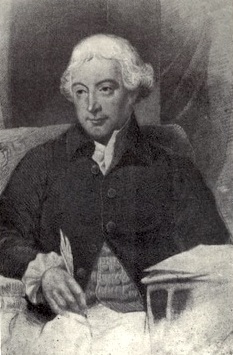
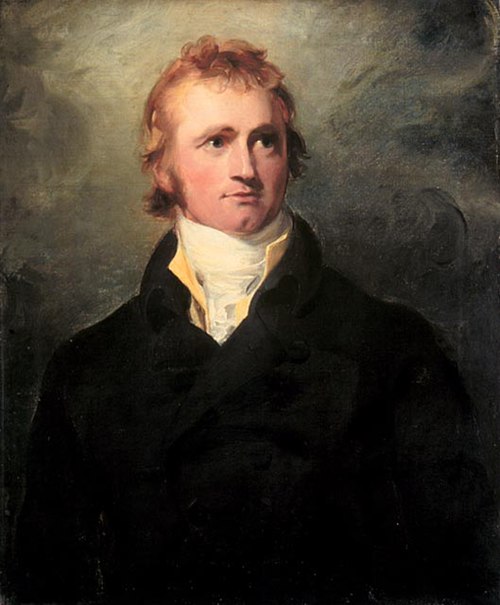
Alexander Mackenzie arrives at Bella Coola on the west coast, being the first person known to cross the North American continent. Source — Wikipedia, "Timeline of Canadian history" (18th century):
Alexander Mackenzie By Thomas Lawrence - National Gallery of Canada (no. 8000), Public domain, https://commons.wikimedia.org/w/index.php?curid=270925
Aug 1, 1805 CE
Toronto Purchase
The treaty of the Toronto Purchase is made for the lands of present-day Toronto north to Lake Simcoe between the Crown and the Mississauga. It was found that the original 1787 agreement only provided a land deed and no description of the lands involved. The treaty would be disputed and settled in 2010. Source — Wikipedia, "Timeline of Canadian history" (19th century):
A map of the Toronto purchase. By Unknown author - This image is available from the City of Toronto Archives, listed under the archival citation Fonds 1231, Item 174. This tag does not indicate the copyright status of the attached work. A normal copyright tag is still required. See Commons:Licensing for more information., Public domain, https://commons.wikimedia.org/w/index.php?curid=6706688
1811 CE
Red River Colony
Settlement began of the Red River Colony. 300,000 square kilometres (120,000 sq mi) in size; 5 times that of Scotland. Founded by Thomas Douglas, 5th Earl of Selkirk via a land grant from the Hudson's Bay Company, of which he was part-owner. The territory later became part of Manitoba and the Missouri Territory, with the location of colony's main centre becoming the site of Winnipeg. Source — Wikipedia, "Timeline of Canadian history" (19th century):
Red Ensign, Civil Ensign of the United Kingdom By Unknown author - Move and edit from Image:British-Merchant-Navy-Ensign.svg. Rewritten using Image:Flag of the United Kingdom.svg by User:Pumbaa80., Public domain, https://commons.wikimedia.org/w/index.php?curid=764649
1812 CE
Pemmican War
Pemmican War, the last outburst of long-standing friction between the HBC and rival fur trading companies. The Red River Colony was the scene of a series of violent encounters, blockades, sieges, attacks and kidnappings. The war includes the NWC capture and partial destruction of Fort Douglas and Fort Gibraltar and the Battle of Seven Oaks in 1816. Source — Wikipedia, "Timeline of Canadian history" (19th century):
The Fight at Seven Oaks, 1816 By Charles William Jefferys - Library and Archives Canada does not allow free use of its copyrighted works. See Category:Images from Library and Archives Canada., Public domain, https://commons.wikimedia.org/w/index.php?curid=3501573
Apr 27, 1813 CE
Battle of York
Battle of York. A U.S. military force attacks the garrison at York, Upper Canada, the capital of Upper Canada. The British and Canadian defenders are defeated. As they retreat, they blow up their magazine and kill hundreds of U.S. soldiers. Surviving U.S. soldiers retaliate by looting and burning down the town. Source — Wikipedia, "Timeline of Canadian history" (19th century):
Town of York (now Toronto), looking east along Palace Street (now Front Street East), from today's Jarvis Street at left, to the town's blockhouse, with flag, at right. Arthur Cox painted this view of York from pencil sketches presumed to be based on a watercolour of York painted by Surgeon and Lieutenant Edward Walsh (1756-1832 or 1834) in 1803. Walsh served with 49th Regiment in Canada from 1803 to 1807. The Walsh painting is now in the William L. Clements Library, University of Michigan. By Arthur Cox (1840 - 1917), after Edward Walsh (1766/7 - 1832) - This image is available from the Toronto Public Library under the reference number TRL, X 4-1, Public domain, https://commons.wikimedia.org/w/index.php?curid=6034112
Jun 21, 1813 CE
War of 1812
During the War of 1812, Laura Secord overhears U.S. officers planning a surprise attack on a British force and walks 30 kms (20 miles) to warn them. The British force successfully repels the U.S. invaders at the Battle of Beaver Dams on 24 June. War ends with Canada still independent from the U.S. Source — Wikipedia, "Timeline of Canadian history" (19th century):
Montage of images relevant to the War of 1812. Clockwise, from top: Damage to the US Capitol building after the Burning of Washington. The mortally wounded Isaac Brock spurs his troops on at the Battle of Queenston Heights. USS Constitution vs HMS Guerriere. The death of Tecumseh at the Battle of the Thames. Andrew Jackson leads the defence at the Battle of New Orleans. By Clockwise, from top: George Munger, John David Kelly, Anton Otto Fischer, William Emmons, Edward Percy Moran - See images below., Public domain, https://commons.wikimedia.org/w/index.php?curid=19406500
Oct 20, 1818 CE
Treaty of 1818
The London Convention is signed. It sets the boundary between British North America and the U.S., running at the 49th parallel from the Northwest Angle in Minnesota, east of Manitoba, west to the continental divide of the Rocky Mountains, and establishing joint control of the Oregon Country. Source — Wikipedia, "Timeline of Canadian history" (19th century):
en:Oregon Country and the border dispute between the U.S. and Britain, 1818-1846. By Kmusser - Own work, CC BY-SA 2.5, https://commons.wikimedia.org/w/index.php?curid=684354
1821 CE
North West Company
Merger of Hudson's Bay Company and the North West Company ending the Pemmican War of 1812-1821. As part of the merger, the monopoly of HBC is extended north to the Arctic Ocean and west to the Pacific Ocean. Source — Wikipedia, "Timeline of Canadian history" (19th century):
North West Company coat of arms, ca. 1800-1820 By Unknown author - Library and Archives Canada does not allow free use of its copyrighted works. See Category:Images from Library and Archives Canada., Public domain, https://commons.wikimedia.org/w/index.php?curid=5650567
1823 CE
Robert Wilmot-Horton
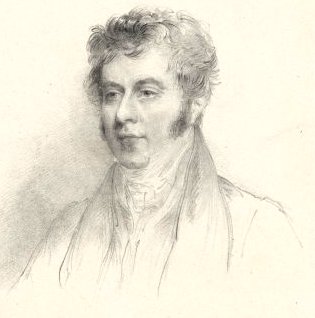
Robert Wilmot-Horton secures two parliamentary grants to fund an experiment where poor Irish families settled in Canada. The plans are dropped after Wilmot-Horton leaves the Colonial Office in 1827. Source — Wikipedia, "Timeline of Canadian history" (19th century):
Sir Robert Wilmot Horton - Sir Robert John Wilmot-Horton, 3rd Baronet, GCH (21 December 1784 – 31 May 1841) was a British politician during the first third of the 19th century. He was a member of the Canningite faction of the Tory party and served as Member of Parliament for Newcastle-under-Lyme from 1818 until 1830. By Richard James Lane - http://nla.gov.au/nla.pic-an9918213, Public domain, https://commons.wikimedia.org/w/index.php?curid=5514042
Jun 6, 1829 CE
Shanawdithit
Shanawdithit, the last known full-blooded member of the Beothuks of Newfoundland, dies at the age of 29. Source — Wikipedia, "Timeline of Canadian history" (19th century):
distribution of Beothuk language By en:User:ish ishwar - Map redrawn and modified from two maps by cartographer Roberta Bloom appearing in Mithun (1999:xviii-xxi). Additional references include Mithun (1999:606-616), Goddard (1996) (contains a very nice color map), Sturtevant (1978-present), Campbell (1997:353-376)., CC BY 2.0, https://commons.wikimedia.org/w/index.php?curid=85131765
1837 CE
Patriot War
Patriot War. Members of the Hunters' Lodges make armed incursions into the Canadas. The incursions are met by British regulars and Canadian militia units. Almost a hundred U.S. invaders and 58 Patriot fighters from Lower Canada are transported to Australian prison colonies. Source — Wikipedia, "Timeline of Canadian history" (19th century):
View of the Battle of Windmill Point, below Prescott, Upper Canada, (from the Ogdensburg side of the St. Lawrence). Woodcut By Adrian Sharp (unverified) - Library and Archives Canada does not allow free use of its copyrighted works. See Category:Images from Library and Archives Canada., Public domain, https://commons.wikimedia.org/w/index.php?curid=3681772
1837 CE
Rebellions of 1837–1838
Rebellions of 1837–1838 break out in both Upper and Lower Canada, inspired by republican ideals, against the domination by the Château Clique and the Family Compact, corruption-riddled combinations of large business interests and public officials. The rebellions are led by William Lyon Mackenzie and Louis Joseph Papineau. Some of the captured are hanged; a hundred captured Canadian rebels and U.S. sympathizers are sentenced to life in Australian prison colonies. The rebellions inspire the Durham Report and subsequent reforms. Source — Wikipedia, "Timeline of Canadian history" (19th century):
Estampe. Vue arrière de l'église Saint-Eustache et dispersion des insurgés. Encre et aquarelle sur papier - Lithographie (26.5 x 36.6 cm). Bataille de Saint-Eustache, 14 décembre 1837 lors de la rébellion des Patriotes à Saint-Eustache, ville du Québec qui se situe au confluent de la rivière du Chêne et de la rivière des Mille-Îles, dans la MRC de Deux-Montagnes et les Basses-Laurentides à 30 km à l'ouest de Montréal au Canada. By Lord Charles Beauclerk (1813—1842) - Unknown source, Public domain, https://commons.wikimedia.org/w/index.php?curid=7782195
Feb 10, 1841 CE
Act of Union 1840
Under the terms of the Act of Union 1840, the British colonies of Lower Canada and Upper Canada are merged into the single Province of Canada. Representation by population, to give fairness between former Upper and Lower Canada, is enshrined. Source — Wikipedia, "Timeline of Canadian history" (19th century):
Coat of Arms of the United Kingdom 1837 These arms were the first UK coat of arms to not include an inescutcheon of the arms of Hanover, as Queen Victoria could not also inherit the throne of Hannover under Salic law as she was a woman. “ Quarterly, First and Fourth Gules three lions passant guardant in pale Or armed and langued Azure (for England), Second quarter Or a lion rampant within a double tressure flory counter-flory Gules (for Scotland), Third quarter Azure a harp Or stringed Argent (for Ireland), the whole surrounded by the Garter; for a Crest, upon the Royal helm the imperial crown Proper, thereon a lion statant guardant Or imperially crowned Proper; Mantling Or and ermine; for Supporters, dexter a lion rampant guardant Or crowned as the Crest, sinister a unicorn Argent armed, crined and unguled Proper, gorged with a coronet Or composed of crosses patée and fleurs de lys a chain affixed thereto passing between the forelegs and reflexed over the back also Or; Motto 'Dieu et mon Droit' in the compartment below the shield, with the Union rose, shamrock and thistle engrafted on the same stem. ” PINCHES, J.H & R.V., The Royal Heraldry of England, 1974, Heraldry Today.}} By Sodacan (ed. Safes007) - This vector image includes elements that have been taken or adapted from this file:, CC BY-SA 4.0, https://commons.wikimedia.org/w/index.php?curid=148095264
Jun 15, 1846 CE
Oregon boundary dispute
The Oregon boundary dispute is settled with the signing of the Oregon Treaty, extending the boundary between British North America and the United States along the 49th parallel from the Rocky Mountains to the Juan de Fuca Strait, and defining the maritime boundary to the Pacific Ocean. Source — Wikipedia, "Timeline of Canadian history" (19th century):
en:Oregon Country and the border dispute between the U.S. and Britain, 1818-1846. By Kmusser - Own work, CC BY-SA 2.5, https://commons.wikimedia.org/w/index.php?curid=684354
Sep 7, 1850 CE
Robinson Treaties
The Robinson Treaties are signed between Ojibwa leaders and the British Crown, surrendering the northern shores of Lake Superior and Lake Huron for £2,160 and an annual payment of £600. Source — Wikipedia, "Timeline of Canadian history" (19th century):
Transparent inukshuk Canada icon By Moxy - Own work, CC BY-SA 4.0, https://commons.wikimedia.org/w/index.php?curid=101303412
1860 CE
American Civil War
The outbreak of the U.S. Civil War caused issues in Canada. The fear of the large armies encouraged moves towards Confederation as a defence strategy; the activities of Confederate spies in Canada and other issues caused problems with the U.S. government. The end of slavery in the United States in 1865 ended the operation of the Underground Railroad, which had helped 30,00 to 40,000 blacks escape to freedom in Canada. Source — Wikipedia, "Timeline of Canadian history" (19th century):
The battle of Gettysburg, Pa. July 3d. 1863, depicting the Battle of Gettysburg, fought July 1–3, 1863. The battle was part of the American Civil War and was won by the North. Hand-colored lithograph by Currier and Ives. By Nathaniel Currier and James Merritt Ives - This image is available from the United States Library of Congress's Prints and Photographs division under the digital ID cph.3g02088.This tag does not indicate the copyright status of the attached work. A normal copyright tag is still required. See Commons:Licensing., Public domain, https://commons.wikimedia.org/w/index.php?curid=49350
Mar 18, 1862 CE
1862 Pacific Northwest smallpox epidemic
1862 Pacific Northwest smallpox epidemic starts with the first reported case of smallpox in Victoria, BC. Smallpox spreads amongst Indigenous populations, and kills an estimated 20,000, two-thirds of the Indigenous population. Source — Wikipedia, "Timeline of Canadian history" (19th century):
Jun 1, 1864 CE
Grand Trunk Railway
The Beloeil train disaster - a Grand Trunk Railway train carrying hundreds of recently arrived immigrants from Montreal to Quebec City did not stop at an opened swing bridge over the Richelieu River, at the present-day town of Beloeil, Quebec. 99 killed and more than 100 injured. The worst railway accident in Canadian history. Source — Wikipedia, "Timeline of Canadian history" (19th century):
An 1896 logo of the Grand Trunk Railway System. By Canadian National Railway Company - http://railpast.com/CRO/PDF/CNlogos.pdf, Public domain, https://commons.wikimedia.org/w/index.php?curid=181934508
Sep 1, 1864 CE
Charlottetown Conference
The Charlottetown Conference, the first of several meetings to discuss a Maritime Union and Canadian Confederation, is held in Charlottetown. Source — Wikipedia, "Timeline of Canadian history" (19th century):
Convention at Charlottetown, P.E.I., of Delegates from the Legislatures of Canada, New Brunswick, Nova Scotia, and Prince Edward Island to take into consideration the Union of the British North American Colonies. Delegates: Col. Hon. John Hamilton Gray, M.P.P. P.E.I. (Chairman of Convention) Hon. John A. Macdonald, M.P.P. Attorney General, Canada West Hon. George E. Cartier, M.P.P. Min. of Agriculture Hon. Thomas D'Arcy McGee, M.P.P., Min. of Agriculture Hon. Wm. A. Henry, M.P.P., Attorney General, N.S. Hon. Wm. H. Steeves, M.E.C., N.B. Hon. John M. Johnson, M.P.P. Attorney General, N.B. Hon. Samuel Leonard Tilley, M.P.P., Prov. Secretary, N.B. Hon. R. Dickey, M.L.C. N.S. Lt. Col. Hon. J.H. Gray, M.P.P., N.B. Hon. E. Palmer, M.L.C. Attorney General, P.E.I. Hon. E. Botsford Chandler, M.L.C., N.B. Hon. H.L. Langevin, M.P.P., Solicitor General, Canada East Hon. Charles Tupper, M.P.P., Provincial Secretary, N.S. Hon. A.T. Galt, M.P.P., Finance Minister Hon. Adams G. Archibald, M.P.P., N.S. Hon. A.A. Macdonald, M.L.C., P.E.I. Hon. Abt. Campbell, M.L.C. Commissioner of Crown Land Hon. Wm. McDougall, M.P.P., Provincial Secretary Hon. Wm. H. Pope, M.P.P. Colonial Secretary, P.E.I. Hon. J. McCully, M.L.C., N.S. Hon. G. Coles, M.P.P., P.E.I. Hon. G. Brown, M.P.P., President Executive Council Maj. Hewitt Bernard, Secretary to the Attorney General Mr. Charles Drinkwater, Private Secretary to the Attorney General, Canada West William H. Lee, Clerk Executive Council. By George P. Roberts - Library and Archives Canada does not allow free use of its copyrighted works. See Category:Images from Library and Archives Canada., Public domain, https://commons.wikimedia.org/w/index.php?curid=4674739
1866 CE
Fenian raids
Fenian raids into New Brunswick, Quebec, Ontario, and Manitoba caused more than a hundred Canadian deaths. Source — Wikipedia, "Timeline of Canadian history" (19th century):
The charge of the Fenians (wearing green uniforms) under Colonel John O'Neill at the Battle of Ridgeway, near Niagara, Canada West, on June 2, 1866. In reality, the Fenians had their own green flags but wore a very mixed bag of Union and Confederate uniforms (if they still had them, or parts of them left over from the Civil War), or civilian garb, with strips of green as arm or hat bands to distinguish themselves. (library and archives canada, c-18737) By The Sage, Sons & Co. Lithographer - Library and Archives Canada, CC BY-SA 4.0, https://commons.wikimedia.org/w/index.php?curid=68164955
Jul 1, 1867 CE
Constitution Act, 1867
Confederation -- The British North America Act, 1867, divides the Province of Canada into Ontario and Quebec and joins them with New Brunswick and Nova Scotia into the new confederated state of Canada. Source — Wikipedia, "Timeline of Canadian history" (19th century):
Coat of Arms of the United Kingdom 1837 These arms were the first UK coat of arms to not include an inescutcheon of the arms of Hanover, as Queen Victoria could not also inherit the throne of Hannover under Salic law as she was a woman. “ Quarterly, First and Fourth Gules three lions passant guardant in pale Or armed and langued Azure (for England), Second quarter Or a lion rampant within a double tressure flory counter-flory Gules (for Scotland), Third quarter Azure a harp Or stringed Argent (for Ireland), the whole surrounded by the Garter; for a Crest, upon the Royal helm the imperial crown Proper, thereon a lion statant guardant Or imperially crowned Proper; Mantling Or and ermine; for Supporters, dexter a lion rampant guardant Or crowned as the Crest, sinister a unicorn Argent armed, crined and unguled Proper, gorged with a coronet Or composed of crosses patée and fleurs de lys a chain affixed thereto passing between the forelegs and reflexed over the back also Or; Motto 'Dieu et mon Droit' in the compartment below the shield, with the Union rose, shamrock and thistle engrafted on the same stem. ” PINCHES, J.H & R.V., The Royal Heraldry of England, 1974, Heraldry Today.}} By Sodacan (ed. Safes007) - This vector image includes elements that have been taken or adapted from this file:, CC BY-SA 4.0, https://commons.wikimedia.org/w/index.php?curid=148095264
May 11, 1869 CE
Métis
A group of Métis led by Louis Riel mount the Red River Rebellion against Canadian intrusion in the Red River Colony. The Canadian government regains control after a military expedition and accedes to many of Riel's demands. He flees into exile in the United States after the government refuses to grant him amnesty and a bounty is offered for his capture. Source — Wikipedia, "Timeline of Canadian history" (19th century):
SVG version of Metis Blue.png: By Unknown Métis resistance fighters, made official by Métis National Council - Originally from en.wikipedia. Original uploader was Enjoyhats at en.wikipedia, Public domain, https://commons.wikimedia.org/w/index.php?curid=1849386
Jul 20, 1871 CE
Colony of British Columbia
The colonies of British Columbia and Vancouver Island amalgamate and then enter Confederation as the Province of British Columbia, Canada's sixth province. Except for individual treaties for small portions of the territory, the agreement annexes a large area of land into Canada without treaties with the First Nations. Source — Wikipedia, "Timeline of Canadian history" (19th century):
The flag of the United Kingdom using a 3:5 ratio. This flag is the Union Flag in the 3:5 ratio exclusively used on land. At sea, the correct ratio is 1:2. By Original: Acts of Union 1800 Vector: Yaddah - Design data from http://fotw.vexillum.com/flags/gb.html; original code is from Image:Flag of the United Kingdom (1-2).svg, Public domain, https://commons.wikimedia.org/w/index.php?curid=127049491
May 23, 1873 CE
North-West Mounted Police
The North-West Mounted Police is established to enforce Canadian sovereignty in the North-West Territories and to stamp out the whisky trade. In 1874, the Force accomplished Great March West westward to southern Alberta and to Fort Edmonton. Source — Wikipedia, "Timeline of Canadian history" (19th century):
Badge of the NWMP used from c. 1876 - 1903 By ConfidentBobcat - This work is a slightly modified version of an image that was once under Canadian Crown Copyright, which has since expired Modified from Illegitimate Barrister's svg rendering of https://commons.wikimedia.org/wiki/File:Coat_of_arms_of_the_Royal_Canadian_Mounted_Police.svg used under CC0 license, Public domain, https://commons.wikimedia.org/w/index.php?curid=178933169
Sep 15, 1874 CE
Treaty 4
Treaty 4 is signed between many Cree First Nations and the Crown of Canada, surrendering lands in present-day Saskatchewan, Alberta and Manitoba in exchange for treaty obligations agreed to by Canada. Source — Wikipedia, "Timeline of Canadian history" (19th century):
This pictograph is unique in being the only one of its kind in Canada with respect to treaties between the Crown and First Nations. By Chief Paskwa (died in 1889) - I photographed this facsimile of Chief Paskwa's pictogram at the Royal Saskatchewan Museum., Public domain, https://commons.wikimedia.org/w/index.php?curid=54910401
Sep 20, 1875 CE
Treaty 5
Treaty 5 is signed between Saulteaux and Swampy Cree First Nations and the Canadian Crown, surrendering lands in Manitoba, Saskatchewan and Ontario, in exchange for treaty obligations agreed to by Canada. Source — Wikipedia, "Timeline of Canadian history" (19th century):
Transparent inukshuk Canada icon By Moxy - Own work, CC BY-SA 4.0, https://commons.wikimedia.org/w/index.php?curid=101303412
Apr 12, 1876 CE
Indian Act
The Indian Act is passed. The Act updates previous legislation of the Province of Canada addressing the relationship between the Government of Canada and officially recognized First Nations. It establishes official definitions of "Indian status" and defines Indigenous government. Source — Wikipedia, "Timeline of Canadian history" (19th century):
Original Parliament buildings before the 1916 fire in Ottawa, Canada By Unknown author - Library and Archives Canada does not allow free use of its copyrighted works. See Category:Images from Library and Archives Canada., Public domain, https://commons.wikimedia.org/w/index.php?curid=502081
Sep 22, 1877 CE
Treaty 7
Treaty 7 is signed by Nakoda and Blackfoot First Nations and the Canadian Crown, surrendering lands in southern present-day Alberta in exchange for treaty obligations agreed to by Canada. Source — Wikipedia, "Timeline of Canadian history" (19th century):
Map of Numbered Treaties of Canada. Borders are approximated. By Canada location map.svg: derivative work: Yug (talk) Canada (geolocalisation).svg: STyx derivative work: Themightyquill (talk) - Canada location map.svg, CC BY-SA 3.0, https://commons.wikimedia.org/w/index.php?curid=14706244
Sep 1, 1880 CE
British Arctic Territories
The British Arctic Territories are ceded to Canada, becoming part of the North-West Territories. Source — Wikipedia, "Timeline of Canadian history" (19th century):
The flag of the United Kingdom using a 3:5 ratio. This flag is the Union Flag in the 3:5 ratio exclusively used on land. At sea, the correct ratio is 1:2. By Original: Acts of Union 1800 Vector: Yaddah - Design data from http://fotw.vexillum.com/flags/gb.html; original code is from Image:Flag of the United Kingdom (1-2).svg, Public domain, https://commons.wikimedia.org/w/index.php?curid=127049491
Mar 26, 1885 CE
Louis Riel
Several hundred Catholic Francophone Métis led by Louis Riel and supported by Cree fighters mount the North-West Rebellion. They establish the Provisional Government of Saskatchewan. Riel is captured after the Battle of Batoche (9–12 May), tried for treason, and hanged on 16 November 1885. Many Francophones denounce the sentence, and Canada is split along ethno-religious lines. Six First Nations convicted murderers also hanged in 1885, the largest mass-hanging in Canadian history. Source — Wikipedia, "Timeline of Canadian history" (19th century):
Louis Riel, after a carte de visite from 1884. By Photographer: I. Bennetto & Co. (Israel Bennetto, 1860-1946[2])(possibly) Engraver: Octave-Henri Julien (1852-1908) - Immediate image source for this post-processed version was probably [1]. See File:LouisRiel1870.jpg for the original. The University of Manitoba states that engraver Octave-Henri Julien (1852-1908) was believed to have used the carte de visite for an engraving published in The Canadian Illustrated News, so possibly this digital image was derived from that newspaper publication., Public domain, https://commons.wikimedia.org/w/index.php?curid=95920
1889 CE
Peasant Farm Policy
The Peasant Farm Policy is brought into force. The Policy restricted Indigenous farmers agricultural practices. Indigenous farmers are allowed only to use hand tools, both in the seeding, harvesting and milling. Indigenous farmers were only allowed small plots and not sell produce in competition with settlers. It is discontinued in 1897. Source — Wikipedia, "Timeline of Canadian history" (19th century):
1890 CE
Calgary and Edmonton Railway
Calgary & Edmonton Railway built from the CPR station at Calgary to the Edmonton area, spawning the later City of Strathcona. Source — Wikipedia, "Timeline of Canadian history" (19th century):
Aug 16, 1896 CE
Klondike, Yukon
Gold is discovered in the Klondike region of the Yukon Territory, sparking the Klondike Gold Rush. Tens of thousands flood into the Klondike region in 1897 and 1898, through Edmonton and the northern Prairies, or through BC and Alaska seaports. Source — Wikipedia, "Timeline of Canadian history" (19th century):
Jul 8, 1899 CE
Treaty 8
Treaty 8 is signed by Cree, Beaver, Chipewyan First Nations and the Canadian Crown, surrendering of lands in present-day British Columbia, Alberta and Saskatchewan, in exchange for treaty obligations agreed to by Canada. Source — Wikipedia, "Timeline of Canadian history" (19th century):
1903 CE
Alaska boundary dispute
The United Kingdom and the United States settle the Alaska boundary dispute on the border with British Columbia. Canadians are bitterly disappointed by British betrayal of Canadian interests in order to curry favour from Washington. Source — Wikipedia, "Timeline of Canadian history" (20th century):
Sep 1, 1905 CE
Alberta
Alberta and Saskatchewan are partitioned out of the North-West Territories to become the eighth and ninth provinces of Canada. Source — Wikipedia, "Timeline of Canadian history" (20th century):
Aug 28, 1906 CE
Treaty 10
Treaty 10 is signed between several First Nations, including the Cree and Chipewyan, and the Crown, surrendering in northern Saskatchewan and Alberta. Additional nations signed on later in 1906 and 1907. Source — Wikipedia, "Timeline of Canadian history" (20th century):
Feb 23, 1909 CE
Bras d'Or Lake
The first powered heavier-than-air flight in Canada occurred on Bras d'Or Lake at Baddeck, Nova Scotia, when John Alexander Douglas McCurdy piloted the AEA Silver Dart over a flight of less than 1 kilometer. Source — Wikipedia, "Timeline of Canadian history" (20th century):
May 4, 1910 CE
Royal Canadian Navy
Royal Canadian Navy is established. Source — Wikipedia, "Timeline of Canadian history" (20th century):
Nov 1, 1913 CE
The Great Lakes Storm of 1913
The Great Lakes Storm of 1913 killed at least 250 in Ontario. Source — Wikipedia, "Timeline of Canadian history" (20th century):
May 29, 1914 CE
RMS Empress of Ireland
RMS Empress of Ireland and Norwegian collier SS Storstad collide in Saint Lawrence River in Quebec. Death toll was at least 1012. Source — Wikipedia, "Timeline of Canadian history" (20th century):
Jun 19, 1914 CE
Hillcrest mine disaster
Hillcrest mine disaster, at Hillcrest, Alberta. At least 189 coalminers died. Source — Wikipedia, "Timeline of Canadian history" (20th century):
Aug 4, 1914 CE
Declarations of war by Great Britain and the Unite
Great Britain declares war on Germany, bringing Canada into the First World War. Seventy-three Canadians were awarded the Victoria Cross during WWI. Source — Wikipedia, "Timeline of Canadian history" (20th century):
Jun 27, 1916 CE
HMHS Llandovery Castle
A German U-Boat torpedoes and sinks HMHS Llandovery Castle, a Canadian hospital ship, off coast of Ireland, killing at least 234 crew, medical officers and other ranks, and nursing sisters. Worst Canadian maritime disaster of WWI. Source — Wikipedia, "Timeline of Canadian history" (20th century):
Apr 9, 1917 CE
Canadian Expeditionary Force
The four divisions of the Canadian Expeditionary Force fight together for the first time in the Battle of Vimy Ridge, which becomes celebrated as a national symbol of achievement and sacrifice and a formative milestone in the development of Canada's national identity. Source — Wikipedia, "Timeline of Canadian history" (20th century):
Dec 6, 1917 CE
Halifax Explosion
| Halifax Explosion -- Accidental collision between two merchant ships, one filled with explosives for the war, occurs in Halifax Harbour. The subsequent explosion caused 2000 people dead and 9000 injured. Source — Wikipedia, "Timeline of Canadian history" (20th century):
Apr 1, 1918 CE
Prohibition in Canada
Prohibition in Canada enacted federally by an Order in Council. Source — Wikipedia, "Timeline of Canadian history" (20th century):
May 15, 1919 CE
Winnipeg general strike
The largest strike in Canadian history; the Winnipeg general strike occurs. Soldiers returning from WW1 & over 30,000 workers walk off their jobs; shutting down the majority of the city's privately owned factories, shops and trains. Public employees joined them in solidarity. These included police, firemen, postal workers, telephone and telegraph operators & utilities workers. Special constables were hired and laws were passed to immediately deport, without trial, anyone who was not born in Canada that was caught striking. events of this day led to the creation of the "One Big Union". Source — Wikipedia, "Timeline of Canadian history" (20th century):
1919 CE
Treaty of Versailles
Canada sends a delegation to the Paris Peace Talks, the conference resolving war issues. Canada signs the Versailles treaty as part of the British Empire, with parliament's approval. Source — Wikipedia, "Timeline of Canadian history" (20th century):
Jan 1, 1920 CE
League of Nations
Canada is admitted as a full member of the League of Nations, independently of Britain. It joins the League Council (governing board) in 1927. Canada plays a minor role and opposes sanctions or military action by the League. Source — Wikipedia, "Timeline of Canadian history" (20th century):
Jun 27, 1921 CE
Treaty 11
Treaty 11, the last of the Numbered Treaties, is signed by the Slavey, Dogrib, Loucheux, Hare First Nations and the Canadian Crown. It covers a region within the Northwest Territories. Source — Wikipedia, "Timeline of Canadian history" (20th century):
Jun 25, 1926 CE
constitutional crisis
A constitutional crisis, known as the King–Byng affair, is precipitated when Governor General Byng refused Prime Minister King's request to dissolve parliament and call an election, instead asking opposition leader Meighen to form a government, which in turn was quickly defeated. King framed the dispute as one of Britain, represented by the Governor General, interfering with Canadian affairs. Consequently, the affair played a role in the Balfour Declaration of 1926, in which each Dominion of the British Empire was declared to be of equal status with Britain. Source — Wikipedia, "Timeline of Canadian history" (20th century):
The pre-1801 Union Flag (of w:United Kingdom of Great Britain). By Hoshie - Made by Hoshie Sodipodi flag collection (original file) Dead link as of: 4FEB2009 Colours: vexilla mundi Dead link as of: 12DEC2007 (Archived from 12MAR2007) Proportions: Zscout370 and Madden, Public domain, https://commons.wikimedia.org/w/index.php?curid=365635
Nov 25, 1927 CE
Vincent Massey
Canada appoints Vincent Massey as its first fully accredited envoy to a foreign capital. Source — Wikipedia, "Timeline of Canadian history" (20th century):
1929 CE
Great Depression in Canada
Great Depression in Canada begins, resulting in widespread poverty, unemployment, & violent labour protests for the next decade. Source — Wikipedia, "Timeline of Canadian history" (20th century):
Jan 1, 1930 CE
Workers' Unity League
The Workers' Unity League (WUL) is created. The WUL paralleled similar alternative trade union structures elsewhere: the Trade Union Unity League in the US, and the National Minority Movement in the UK. Some of the unions affiliated with the WUL include the Mine Workers' Union of Canada, Lumber Workers Industrial Union of Canada and the Relief Camp Workers' Union. Unlike both the Trades and Labor Congress of Canada (TLC) and the All-Canadian Congress of Labour (ACCL), the WUL organized the unemployed as well. Source — Wikipedia, "Timeline of Canadian history" (20th century):
Sep 7, 1931 CE
Estevan riot
Estevan riot was a confrontation between members of the Royal Canadian Mounted Police and striking coal miners from nearby Bienfait, Saskatchewan, The Mine Workers' Union of Canada in Bienfait, established by the national "Workers' Unity League" demanded a wage increase, an end to the company store monopoly, better living conditions, and improved workplace safety. Miners assembled in Beinfait with their families to parade to Estevan in order to draw attention to their demands. As they walked from Beinfait to Estevan, they were met with lines of police officers. RCMP fired on the protesters, killing four. Source — Wikipedia, "Timeline of Canadian history" (20th century):
Sep 15, 1933 CE
Stratford General Strike of 1933
The Stratford General Strike of 1933 begins with strikes in several local furniture-making factories that the Workers' Unity League had recently unionized, & Swift's Meat Packing Plant, a poultry company, who had unionized as the Food Workers' Industrial Union. At its height more than 2,000 strikers were involved. The army along with several Carden Loyd tankettes were sent to quell the violence. Controversy over the use of armoured military vehicles in a management-labour dispute resulted in victory for the strikers. One strike leader, Oliver Kerr, was elected mayor the following year. Source — Wikipedia, "Timeline of Canadian history" (20th century):
Apr 4, 1935 CE
Arthur "Slim" Evans
Over 1000 workers under the guidance of Arthur "Slim" Evans join the Relief Camp Workers' Union and begin the On-to-Ottawa Trek in protest of the conditions & wages of then prime minister R. B. Bennett's Government relief work camps. After arriving in Regina, Saskatchewan, the trekkers agreed to send only 8 delegates to Ottawa to represent their cause, with the rest remaining at the Regina Exhibition grounds with support provided by private citizens & government of Regina. After discussion between the delegations and the government in Ottawa broke down, RCMP officers hidden in boxtrucks ambush the Trekkers. The police fire pistols and automatic gun into and above the group, causing two deaths and several hundred wounds. Saskatchewan Premier James Garfield Gardiner accuses the RCMP of "precipitating a riot". Source — Wikipedia, "Timeline of Canadian history" (20th century):
Jun 19, 1938 CE
Bloody Sunday
Bloody Sunday was the conclusion of a month-long "sitdowners' strike" by The Relief Project Workers' Union (an extension of the Relief Camp Workers' Union) in Vancouver. 1,200 men split themselves between the post office, the Vancouver Art Gallery & The Georgia Hotel. At 5 o'clock on the morning of 19 June, City Police & RCMP entered the buildings and forcibly ejected the men, Of the 42 hospitalized, only 5 were police and all of those were Vancouver police constables. Later that afternoon, 10,000 to 15,000 turned out to a protest at the Powell Street Grounds against the "police terror" of Bloody Sunday. Source — Wikipedia, "Timeline of Canadian history" (20th century):
Sep 10, 1939 CE
Second World War
Canada, with its parliament's support, enters the Second World War by declaring war on Germany. The Dominion of Newfoundland had entered the war as a British colony upon the United Kingdom's declaration of war a week earlier. Source — Wikipedia, "Timeline of Canadian history" (20th century):
1939 CE
Home front during World War II
During the war, the government mobilizes Canadian money, supplies, and volunteers to support Britain while boosting the economy and maintaining home front morale. Canada plays a military role protecting convoys against German submarines and fighting the German Army in Italy and France, and helping to liberate the Netherlands. Canada expands its small navy into the third largest in the world, after the U.S. and U.K. It had 363 ships (although few battleships and other capital ships) and 100,000 sailors (of whom 6700 were women). Source — Wikipedia, "Timeline of Canadian history" (20th century):
Nov 9, 1945 CE
Canada and the United Nations
Canada joins the United Nations, seeking to play a world role as a "middle power", with interest in the UN Charter and in relief agencies. Source — Wikipedia, "Timeline of Canadian history" (20th century):
Jan 1, 1947 CE
Canadian Citizenship Act, 1946
The Canadian Citizenship Act, 1946 comes into force creating a new, separate, Canadian legal citizenship for all British subjects born, raised, or resident in Canada and automatic citizenship for all those born in Canada after this date. Source — Wikipedia, "Timeline of Canadian history" (20th century):
Mar 31, 1949 CE
Newfoundland and Labrador
Newfoundland, the last British colony in North America, enters Confederation as the tenth province following a pair of contentious referendums on whether the island should remain a British Crown Colony, become fully independent, or join Canada. Source — Wikipedia, "Timeline of Canadian history" (20th century):
Jun 27, 1959 CE
St. Lawrence Seaway
The St. Lawrence Seaway, a joint project between Canada and the United States, is officially opened. Source — Wikipedia, "Timeline of Canadian history" (20th century):
Jul 1, 1960 CE
List of electoral firsts in Canada
First Nations people are granted the right to vote in federal elections without having to give up their status and treaty rights. Source — Wikipedia, "Timeline of Canadian history" (20th century):
Feb 15, 1965 CE
maple leaf
Canada adopts the maple leaf for the national flag. Source — Wikipedia, "Timeline of Canadian history" (20th century):
Apr 27, 1967 CE
Expo 67
Expo 67 opens in Montreal. Source — Wikipedia, "Timeline of Canadian history" (20th century):
Oct 5, 1970 CE
War Measures Act
The government invokes the War Measures Act to apprehend the Front de libération du Québec (FLQ), a separatist paramilitary group in Quebec that was responsible for over 160 violent incidents that killed 8 people and in October 1970 had kidnapped a British official (later released) and Quebec labour minister Pierre Laporte, who they killed. The FLQ collapses in 1971. Source — Wikipedia, "Timeline of Canadian history" (20th century):
Jan 31, 1973 CE
Calder v British Columbia
The Supreme Court of Canada rules in the Calder v British Columbia (AG) case that aboriginal title existed prior to the existence of the colonial government and was not a matter of Canadian law alone. The case recognized Nisga'a Nation aboriginal title. The ruling would lead the Government of Canada to update its land claims negotiation process. Source — Wikipedia, "Timeline of Canadian history" (20th century):
May 20, 1980 CE
1980 Quebec referendum
A referendum on Quebec independence is held, resulting in a majority (59.56%) of the province voting to remain in Canada. Source — Wikipedia, "Timeline of Canadian history" (20th century):
1981 CE
BC Tel
Workers for British Columbia Telephone take over all of the province's telephone exchanges and run them for 5 days. Source — Wikipedia, "Timeline of Canadian history" (20th century):
Apr 17, 1982 CE
Constitution Act, 1982
The enactment of the Constitution Act, 1982, by royal proclamation. Canada achieves total independence from Great Britain through Patriation of its Constitution. The Constitution includes the Canadian Charter of Rights and Freedoms, guaranteeing individual human rights. The Act also guarantees all treaty rights of Indigenous peoples in Canada. The Government of Quebec refuses to sign the deal and attempts to veto the Act; the Supreme Court of Canada rules that Quebec's assent is not required. Source — Wikipedia, "Timeline of Canadian history" (20th century):
Jun 3, 1987 CE
Meech Lake Accord
The Meech Lake Accord is signed by all ten provincial premiers and Prime Minister Brian Mulroney. The accord is intended to grant further powers to all provinces and grant distinct society status to Quebec, which had opposed the repatriation of the Canadian Constitution. The Accord is not ratified by all provincial parliaments within the required 3 years, heightening national unity tensions. Source — Wikipedia, "Timeline of Canadian history" (20th century):
Jan 1, 1989 CE
Canada–United States Free Trade Agreement
The Canada–United States Free Trade Agreement comes into force. Under the agreement, the countries start to reduce or eliminate trade barriers between the two countries. Source — Wikipedia, "Timeline of Canadian history" (20th century):
Jul 11, 1990 CE
Oka Crisis
The Oka Crisis occurs as Indigenous Mohawk activists protest the construction of a golf course on a burial ground, barricading roads and the Mercier Bridge. In August, after a series of violent standoffs between protesters and the Sûreté du Québec (SQ, Quebec's provincial police) which led to the death of one officer, Premier Robert Bourassa requests aid from the Canadian Armed Forces. In September, facing military invasion of their community, the protesters surrender and many leaders are arrested. Construction of the golf course is later cancelled. Source — Wikipedia, "Timeline of Canadian history" (20th century):
Quelques soldats des forces canadiennes et deux policiers de la sureté du Québec lors de la crise d'Oka. À l'arrière, un AVGP Cougar (Armoured Vehicle General Purpose) By SamuelFreli - Own work, CC BY-SA 3.0, https://commons.wikimedia.org/w/index.php?curid=20518567
Aug 28, 1992 CE
Charlottetown Accord
The Charlottetown Accord, a second attempt to settle constitutional grievances, is agreed to by leaders of all provincial governments and the federal government and Indigenous groups. However, a 26 October national referendum on the accord is defeated. Source — Wikipedia, "Timeline of Canadian history" (20th century):
Jan 1, 1994 CE
North American Free Trade Agreement
The North American Free Trade Agreement came into force, creating a free trade zone between Canada, Mexico and the United States, superseding the 1988 Canada-US Agreement. Source — Wikipedia, "Timeline of Canadian history" (20th century):
Aug 18, 1995 CE
Secwépemc
Indigenous Shuswap and non-Indigenous supporters exchange fire with Royal Canadian Mounted Police officers after a British Columbia rancher attempts to evict them from land being used for a traditional ceremony, beginning the Gustafsen Lake standoff. After the largest and costliest paramilitary operation in the province's history, the Ts'peten Defenders surrender to police. Source — Wikipedia, "Timeline of Canadian history" (20th century):
Dec 11, 1997 CE
Delgamuukw v British Columbia
The Delgamuukw v British Columbia decision is rendered by the Supreme Court of Canada, determining that aboriginal title had not been distinguished in British Columbia. This ended the decades-long refusal of the BC government to participate in land claims to settle with First Nations, claiming that aboriginal title had been extinguished. Source — Wikipedia, "Timeline of Canadian history" (20th century):
Apr 1, 1999 CE
Nunavut
Nunavut is partitioned from the Northwest Territories to become Canada's third territory, following a series of plebiscites in 1982 and 1992, and establishment of the Nunavut Land Claims Agreement in 1993. Source — Wikipedia, "Timeline of Canadian history" (20th century):
Oct 7, 2001 CE
War in Afghanistan
|Canada joins the War in Afghanistan. Source — Wikipedia, "Timeline of Canadian history" (21st century):
Dec 7, 2003 CE
Canadian Alliance
The Canadian Alliance and PC Party merged into the Conservative Party of Canada. Source — Wikipedia, "Timeline of Canadian history" (21st century):
Jul 20, 2005 CE
Civil Marriage Act
The Civil Marriage Act legalizes same-sex marriage throughout Canada. Source — Wikipedia, "Timeline of Canadian history" (21st century):
Jun 1, 2008 CE
Indian Residential Schools Settlement Agreement
As part of the Indian Residential Schools Settlement Agreement, the Truth and Reconciliation Commission (TRC) is established to document the history and lasting impacts of the Canadian Indian residential school system on Indigenous persons and their families. Source — Wikipedia, "Timeline of Canadian history" (21st century):
Jun 3, 2010 CE
Haida Gwaii
The Haida Gwaii Reconciliation Act establishes in Canadian law the name of Haida Gwaii over the archipelago formerly known as the Queen Charlotte Islands. Further agreements would re-establish the sovereignty of over 200 islands to the Council of the Haida Nation. Source — Wikipedia, "Timeline of Canadian history" (21st century):
Feb 13, 2012 CE
2012 Quebec student protests
Students in Quebec protest and stop proposed increases in university tuition. Source — Wikipedia, "Timeline of Canadian history" (21st century):
Mar 12, 2014 CE
War in Afghanistan
|Canada withdraws from the War in Afghanistan at the end of the first phase. Source — Wikipedia, "Timeline of Canadian history" (21st century):
Oct 17, 2018 CE
Cannabis Act
The Cannabis Act becomes law, making recreational cannabis use legal throughout the country. Canada is the second country (after Uruguay in 2013) to legalize recreational cannabis use nationwide. Source — Wikipedia, "Timeline of Canadian history" (21st century):
Jan 7, 2020 CE
2020 Canadian pipeline and railway protests
Widespread popular protests occur across Canada after the RCMP forcibly remove peaceful protesters blocking construction of the Coastal GasLink pipeline on Wetʼsuwetʼen territory in British Columbia. The protests block several rail lines, forcing the shutdown of much of the Canadian rail network. Source — Wikipedia, "Timeline of Canadian history" (21st century):
Jan 1, 2022 CE
Canada convoy protest
Right-wing protesters protesting vaccine mandates converge in Ottawa, overwhelming local police forces and disrupting residents in an occupation of downtown. After several weeks, the Canada convoy protest group is cleared after the Government of Canada invokes the Emergencies Act. Several police forces participate in a joint effort that forcibly removes the group. Similar groups block Canada-US border crossings in Windsor, Ontario and Coutts, Alberta for days before also being cleared forcibly by police. Source — Wikipedia, "Timeline of Canadian history" (21st century):