Encyclopedia/3. History, Societies & Civilizations/09. Modern Nations/05. Europe • Curated by Admin Timeline.sg
History of Bulgaria, sourced from Wikipedia's "Timeline of Bulgarian history".
Chronological Storyline (139 Milestones)
6000 BCE
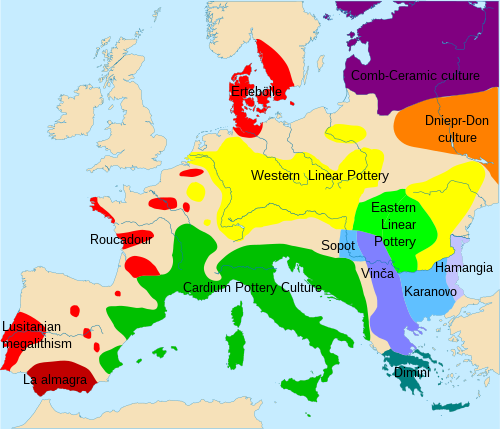
Karanovo culture
The Karanovo culture appeared. Source — Wikipedia, "Timeline of Bulgarian history" (Prior to 1st century):
Karanovo culture By Original: w:Sugaar (talk | contribs);w:Clarifer (talk | contribs) Vector: Joostik - Own work by Joostik; This file was derived from: European Middle Neolithic.gif:, CC BY-SA 3.0, https://commons.wikimedia.org/w/index.php?curid=23059624
5000 BCE
Plovdiv
The Thracian village of Nebet Tepe is established on the site of modern Plovdiv. Source — Wikipedia, "Timeline of Bulgarian history" (Prior to 1st century):
Панорамна снимка на град Пловдив By Община Пловдив - Own work, CC BY-SA 4.0, https://commons.wikimedia.org/w/index.php?curid=114869518
4600 BCE
Oldest gold artifacts were created.
Oldest gold artifacts were created. Source — Wikipedia, "Timeline of Bulgarian history" (Prior to 1st century):
4000 BCE
Black Sea
Proto-Thracians settled near the Black Sea. Source — Wikipedia, "Timeline of Bulgarian history" (Prior to 1st century):
This cloud-free Sea-viewing Wide Field-of-view Sensor (SeaWiFS) view of the Black Sea reveals the colourful interplay of currents on the lake’s surface. The green crescent shaped pattern in the north-western corner of the Black Sea is due to the nutrient-rich, sediment-laden discharge of the Danube River stimulating biological activity. The brighter, more turquoise patterns on the lake to the south and east are probably blooms of another type of phytoplankton. By The SeaWiFS Project - NASA Earth Observatory, Public domain, https://commons.wikimedia.org/w/index.php?curid=10072688
2100 BCE
Dabene Treasure of 15,000 small Thracian
Dabene Treasure of 15,000 small Thracian gold rings created (approximate date). Source — Wikipedia, "Timeline of Bulgarian history" (Prior to 1st century):
512 BCE
Amyntas I
Macedonian king Amyntas I surrendered to the Thracians. Source — Wikipedia, "Timeline of Bulgarian history" (Prior to 1st century):
MACEDON, Aegae. Circa 510-480 BC By CNG - CNG Coins Coin from CNG coins. Used with permission (CNG coin [1]). Coin [2], CC BY-SA 3.0, https://commons.wikimedia.org/w/index.php?curid=75054144
429 BCE
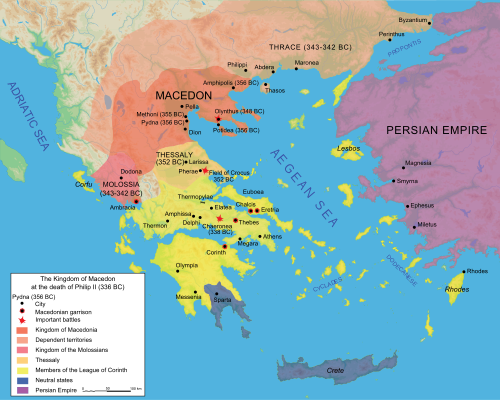
Macedon
Sitalces invaded Macedon. Source — Wikipedia, "Timeline of Bulgarian history" (Prior to 1st century):
Map of the Kingdom of Macedon at the death of Philip II in 336 BC. By Map_Macedonia_336_BC-es.svg: Marsyas (French original); Kordas (Spanish translation) derivative work: MinisterForBadTimes (talk) - Translation of Map_Macedonia_336_BC-es.svg (data from R. Ginouvès and al., La Macédoine, Paris, 1992), CC BY-SA 3.0, https://commons.wikimedia.org/w/index.php?curid=7398609
342 BCE
Plovdiv
Thracian settlement of modern Plovdiv renamed to "Philippopolis". Source — Wikipedia, "Timeline of Bulgarian history" (Prior to 1st century):
Панорамна снимка на град Пловдив By Община Пловдив - Own work, CC BY-SA 4.0, https://commons.wikimedia.org/w/index.php?curid=114869518
298 BCE
Celts
Arrival of the Celtic tribes. Source — Wikipedia, "Timeline of Bulgarian history" (Prior to 1st century):
Celts in Europe the core Hallstatt territory, expansion before 500 BC maximum Celtic expansion by the 270s BC Lusitanian, Autrigones, Varduli and Caristi areas of Iberia, "Celticity" uncertain the boundaries of the six commonly-recognized 'Celtic nations', which remained Celtic speaking throughout the Middle Ages (viz. Brittany, Wales, Cornwall, Isle of Man, Ireland, Scotland) areas that remain Celtic-speaking today By QuartierLatin1968,The Ogre,Dbachmann - Atlas of the Celtic World, by John Haywood; London Thames & Hudson Ltd., 2001, pp.30-37 and other sources (see talkpage for details)., CC BY-SA 3.0, https://commons.wikimedia.org/w/index.php?curid=638312
212 BCE
Tylis
Abandonment of Tylis. Source — Wikipedia, "Timeline of Bulgarian history" (Prior to 1st century):
Tribes in Thrace pre-Roman conquest Own work data from The Thracians 700 BC-AD 46 (Men-at-Arms) by Christopher Webber and Angus McBride,ISBN-10: 1841763292,2001, The Odrysian Kingdom of Thrace: Orpheus Unmasked (Oxford Monographs on Classical Archaeology) by Z. H. Archibald,1998,ISBN-10-0198150474, Dacia: Landscape, Colonization and Romanization by Ioana A Oltean, ISBN 0415412528, 2007, Blank map is a part of Blank_map_of_South_Europe_and_North_Africa.svg By Megistias - Own work, Public domain, https://commons.wikimedia.org/w/index.php?curid=7801310
188 BCE
Thrace
Thrace invaded by the Romans Source — Wikipedia, "Timeline of Bulgarian history" (Prior to 1st century):
The Thrace region By Factuarius - Own work based upon two maps already uploaded in Wikimedia. File:Balkan topo en.jpg by User:Captain Blood, File:Europe topography map en.png by: User:San Jose, Public domain, https://commons.wikimedia.org/w/index.php?curid=9396023
46 CE
Thrace
Thrace was conquered by Rome. Source — Wikipedia, "Timeline of Bulgarian history" (1st–6th centuries):
The Thrace region By Factuarius - Own work based upon two maps already uploaded in Wikimedia. File:Balkan topo en.jpg by User:Captain Blood, File:Europe topography map en.png by: User:San Jose, Public domain, https://commons.wikimedia.org/w/index.php?curid=9396023
117 CE
The Trimontium amphitheater was created.
The Trimontium amphitheater was created. Source — Wikipedia, "Timeline of Bulgarian history" (1st–6th centuries):
268 CE
Goths
The Goths raided Serdica. Source — Wikipedia, "Timeline of Bulgarian history" (1st–6th centuries):
Goths By Unknown author, CC BY-SA 3.0, https://commons.wikimedia.org/w/index.php?curid=422085
343 CE
Council of Serdica
The Council of Serdica takes place. Source — Wikipedia, "Timeline of Bulgarian history" (1st–6th centuries):
447 CE
Huns
Huns start a fire in Sofia. Source — Wikipedia, "Timeline of Bulgarian history" (1st–6th centuries):
Extent of Attila's Empire. Based on Map 10 Empires and Barbarians. The Fall of Rome and the Birth of Europe. Peter Heather. Oxford University Press, 2010. Map template adapted from user Andrei Nicu By Slovenski Volk - Own work, CC BY-SA 3.0, https://commons.wikimedia.org/w/index.php?curid=17966815
632 CE
Great Bulgaria
Great Bulgaria was formed after the unification of the tribes of Kutrigurs, Utigurs, and Onogurs (Onodonduri). Source — Wikipedia, "Timeline of Bulgarian history" (7th century):
Map of Old Great Bulgaria, c. 650Карта на Велика България, ок. 650 годинаBased on: Рашев, Рашо (2005). „Прабългарите през V-VII век“, Трето издание, София: Орбел. ISBN 954-496-073-2. By Nk - Own work, Public domain, https://commons.wikimedia.org/w/index.php?curid=3334815
635 CE
Kubrat
A peace treaty was signed by Kubrat with the Byzantine Empire. Source — Wikipedia, "Timeline of Bulgarian history" (7th century):
A 1926 painting by bulgarian artist Dimitar Gyudjenov By Dimitar Atanasov Gyudjenov (1891 - 1979) - https://bghistorypictures.wordpress.com/601-700/#jp-carousel-134, Public domain, https://commons.wikimedia.org/w/index.php?curid=149851808
668 CE
Khazars
Khazar's pressure caused Great Bulgaria to decline. Volga Bulgaria (7th century–1240s) is formed. Source — Wikipedia, "Timeline of Bulgarian history" (7th century):
Khazars By Unknown author, CC BY-SA 3.0, https://commons.wikimedia.org/w/index.php?curid=1320122
680 CE
First Bulgarian Empire
First Bulgarian Empire (Danubian Bulgaria) was formed. Source — Wikipedia, "Timeline of Bulgarian history" (7th century):
Southeastern Europe in the Late 9th Century By Ádám Kolláth - Own work, CC BY-SA 4.0, https://commons.wikimedia.org/w/index.php?curid=118846577
701 CE
Asparukh
Asparukh died in a battle. He was succeeded by Tervel. Source — Wikipedia, "Timeline of Bulgarian history" (8th century):
Паметника на кан Аспарух в Стрелча. By Иван - Own work, CC BY-SA 3.0, https://commons.wikimedia.org/w/index.php?curid=18614034
705 CE
Tervel of Bulgaria
Tervel received title as Caesar in 705 after recovering the throne of Justinian II. Source — Wikipedia, "Timeline of Bulgarian history" (8th century):
Portrait of Julius Caesar By Ángel M. Felicísimo from Mérida, España - Retrato de Julio César, Public domain, https://commons.wikimedia.org/w/index.php?curid=91281949
721 CE
Tervel of Bulgaria
Tervel died. He was succeeded by Kormesiy. Source — Wikipedia, "Timeline of Bulgarian history" (8th century):
738 CE
Sevar of Bulgaria
Kormesiy ended his rule. He was succeeded by Sevar. Source — Wikipedia, "Timeline of Bulgarian history" (8th century):
753 CE
Sevar of Bulgaria
Sevar died. He was succeeded by Kormisosh. Source — Wikipedia, "Timeline of Bulgarian history" (8th century):
756 CE
Kormisosh of Bulgaria
Kormisosh was disposed. He was succeeded by Vinekh. Source — Wikipedia, "Timeline of Bulgarian history" (8th century):
762 CE
Vinekh of Bulgaria
Vinekh was assassinated. He was succeeded by Telets. Source — Wikipedia, "Timeline of Bulgarian history" (8th century):
765 CE
Telets of Bulgaria
Telets was assassinated. He was succeeded by Sabin. Source — Wikipedia, "Timeline of Bulgarian history" (8th century):
766 CE
Sabin of Bulgaria
Sabin was disposed. He was succeeded by Umor. Source — Wikipedia, "Timeline of Bulgarian history" (8th century):
767 CE
Toktu of Bulgaria
Toktu was killed. He was succeeded by Pagan. Source — Wikipedia, "Timeline of Bulgarian history" (8th century):
768 CE
Pagan of Bulgaria
Pagan was killed by their servants. He was succeeded by Telerig. Source — Wikipedia, "Timeline of Bulgarian history" (8th century):
Seal (state seal) of bulgarian kan Telerig. By Unknown author - bg Wiki, Public domain, https://commons.wikimedia.org/w/index.php?curid=5573399
777 CE
Telerig of Bulgaria
Telerig was baptized after flying to Constantinople. He was succeeded by Kardam. Source — Wikipedia, "Timeline of Bulgarian history" (8th century):
Seal (state seal) of bulgarian kan Telerig. By Unknown author - bg Wiki, Public domain, https://commons.wikimedia.org/w/index.php?curid=5573399
803 CE
Kardam of Bulgaria
Kardam was baptized after fleeing to Constantinople. He was succeeded by Krum. Source — Wikipedia, "Timeline of Bulgarian history" (9th century):
Khan Krum (detail) By Manasias - http://bgsoldier.eamci.bg/Scripts/isapiVWB.dll/theme?THEMEID=87232, Public domain, https://commons.wikimedia.org/w/index.php?curid=10714578
809 CE
Sofia was renamed to "Sredetz" after
Sofia was renamed to "Sredetz" after becoming part of the Bulgarian Empire. Source — Wikipedia, "Timeline of Bulgarian history" (9th century):
Jul 26, 811 CE
Nicephorus I
Byzantine Emperor Nicephorus I was killed after being involved in the Battle of Pliska. Source — Wikipedia, "Timeline of Bulgarian history" (9th century):
Солид. Никифор I и его сын Ставракий. Ок. 803—811 гг. (аверс). Бюст Никифора I, в фас; на голове корона с крестом. В руках крест и акакия. By АНО "Международный нумизматический клуб", CC BY-SA 4.0, https://commons.wikimedia.org/w/index.php?curid=67977120
Apr 13, 814 CE
Krum
Krum died. He was succeeded by Omurtag. Source — Wikipedia, "Timeline of Bulgarian history" (9th century):
Khan Krum (detail) By Manasias - http://bgsoldier.eamci.bg/Scripts/isapiVWB.dll/theme?THEMEID=87232, Public domain, https://commons.wikimedia.org/w/index.php?curid=10714578
831 CE
Omurtag of Bulgaria
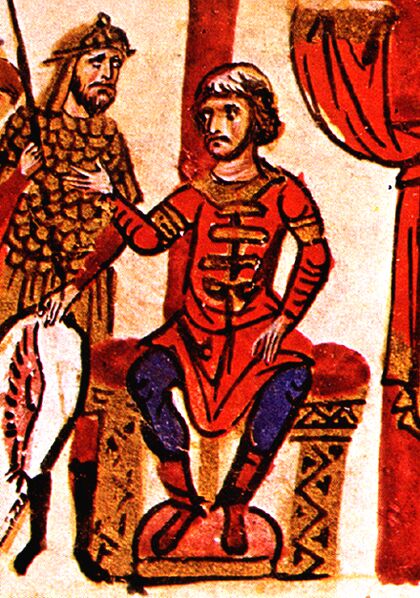
Omurtag died. He was succeeded by Malamir. Source — Wikipedia, "Timeline of Bulgarian history" (9th century):
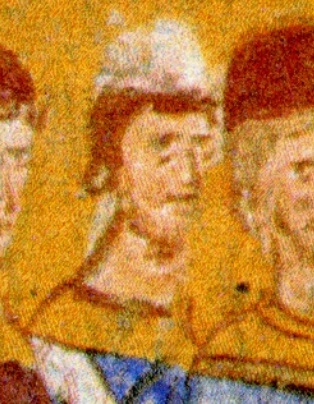
Khan Omurtag of Bulgaria, from the Chronicle of John Skylitzes By Unknown author - protobulgarians.com, Public domain, https://commons.wikimedia.org/w/index.php?curid=2720148
836 CE
Malamir of Bulgaria
Malamir died. He was succeeded by Presian I. Source — Wikipedia, "Timeline of Bulgarian history" (9th century):
The Presian Inscription or Philippi Inscription is a medieval Greek text inscribed upon a stone in Basilica B during the reign of the Bulgarian ruler Presian I (r. 836–852). By Anton Lefterov - Own work, Public domain, https://commons.wikimedia.org/w/index.php?curid=4410619
852 CE
Presian I of Bulgaria
Presian died. He was succeeded by Boris I. Source — Wikipedia, "Timeline of Bulgarian history" (9th century):
The Presian Inscription or Philippi Inscription is a medieval Greek text inscribed upon a stone in Basilica B during the reign of the Bulgarian ruler Presian I (r. 836–852). By Anton Lefterov - Own work, Public domain, https://commons.wikimedia.org/w/index.php?curid=4410619
883 CE
Boris I of Bulgaria
Boris I abdicated. Source — Wikipedia, "Timeline of Bulgarian history" (9th century):
Boris I of Bulgaria By Unknown author - http://archaeologyinbulgaria.com/2015/05/02/bulgaria-celebrates-1150-years-since-adoption-of-christianity-under-st-knyaz-boris-i-mihail-during-first-bulgarian-empire/ direct link, Public domain, https://commons.wikimedia.org/w/index.php?curid=1232733
886 CE
Glagolitic alphabet
The Glagolitic alphabet was adopted. Source — Wikipedia, "Timeline of Bulgarian history" (9th century):
Above: example fragment from “Kiev leaflets” (11th-century Bulgarian), written with a round Glagolitic alphabet. Below: example fragment from the “Rhyming gospel” (South Slavic), written with an angular Glagolitic alphabet. By Лобачев Владимир - Own work, CC0, https://commons.wikimedia.org/w/index.php?curid=101745681
889 CE
Boris I of Bulgaria
Boris I ended his rule. He was succeeded by Vladimir. Source — Wikipedia, "Timeline of Bulgarian history" (9th century):
Boris I of Bulgaria By Unknown author - http://archaeologyinbulgaria.com/2015/05/02/bulgaria-celebrates-1150-years-since-adoption-of-christianity-under-st-knyaz-boris-i-mihail-during-first-bulgarian-empire/ direct link, Public domain, https://commons.wikimedia.org/w/index.php?curid=1232733
893 CE
Vladimir of Bulgaria
Vladimir was disposed and blinded. He was succeeded by Simeon I. Source — Wikipedia, "Timeline of Bulgarian history" (9th century):
Saint Demetrius Church in Teshovo Enthronement of Simeon and Punishment of Vladimir Fresco 2 By Mino, Marko and Teofil Minovi - http://www.atlasproject.eu/asset_demo/icons/teshovo/bg/teshovo.html, Public domain, https://commons.wikimedia.org/w/index.php?curid=50157053
902 CE
Boris I of Bulgaria
Boris I died. Source — Wikipedia, "Timeline of Bulgarian history" (10th century):
Boris I of Bulgaria By Unknown author - http://archaeologyinbulgaria.com/2015/05/02/bulgaria-celebrates-1150-years-since-adoption-of-christianity-under-st-knyaz-boris-i-mihail-during-first-bulgarian-empire/ direct link, Public domain, https://commons.wikimedia.org/w/index.php?curid=1232733
May 27, 927 CE
Simeon I of Bulgaria
Simeon I died. He was succeeded by Peter I. Source — Wikipedia, "Timeline of Bulgarian history" (10th century):
Видин, май 2013 By Nikolai Karaneschev - https://web.archive.org/web/20161030080830/http://www.panoramio.com/photo/91783803, CC BY 3.0, https://commons.wikimedia.org/w/index.php?curid=56508158
969 CE
Peter I of Bulgaria
Peter I abdicated. Source — Wikipedia, "Timeline of Bulgarian history" (10th century):
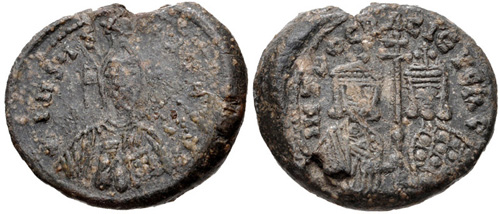
BULGARIA, First Empire. Petr I, with Irina (Maria Lakapena). 927-969. PB Seal (20mm, 7.36 g, 12h). Facing bust of Christ Pantokrator / Half-length facing busts of Petr and Irina, holding patriarchal cross between them. Iordanov Type III.3Ав, 95; Youroukova & Penchev 10. VF. By User:Cplakidas (uploader) - CNG, CC BY-SA 2.5, https://commons.wikimedia.org/w/index.php?curid=20466216
Jan 30, 970 CE
Peter I of Bulgaria
Peter I died. He was succeeded by Boris II. Source — Wikipedia, "Timeline of Bulgarian history" (10th century):
BULGARIA, First Empire. Petr I, with Irina (Maria Lakapena). 927-969. PB Seal (20mm, 7.36 g, 12h). Facing bust of Christ Pantokrator / Half-length facing busts of Petr and Irina, holding patriarchal cross between them. Iordanov Type III.3Ав, 95; Youroukova & Penchev 10. VF. By User:Cplakidas (uploader) - CNG, CC BY-SA 2.5, https://commons.wikimedia.org/w/index.php?curid=20466216
971 CE
Boris II of Bulgaria
The Byzantine Empire dethroned Boris II. Source — Wikipedia, "Timeline of Bulgarian history" (10th century):
Boris II By John Skylitzes - Madrid Skylitzes, Public domain, https://commons.wikimedia.org/w/index.php?curid=10648079
977 CE
Boris II of Bulgaria
Boris II was killed by Bulgarian border guards after returning to Bulgaria. He was succeeded by Samuel. Source — Wikipedia, "Timeline of Bulgarian history" (10th century):
Boris II By John Skylitzes - Madrid Skylitzes, Public domain, https://commons.wikimedia.org/w/index.php?curid=10648079
991 CE
Roman of Bulgaria
The Byzantine Empire captured Roman. Source — Wikipedia, "Timeline of Bulgarian history" (10th century):
997 CE
Roman of Bulgaria
Roman died in a Constantinople prison. He was succeeded by Boris II. Source — Wikipedia, "Timeline of Bulgarian history" (10th century):
Boris II By John Skylitzes - Madrid Skylitzes, Public domain, https://commons.wikimedia.org/w/index.php?curid=10648079
Oct 6, 1014 CE
Samuel of Bulgaria
Samuel died. He was succeeded by Gavril Radomir. Source — Wikipedia, "Timeline of Bulgarian history" (11th century):
Samuil of Bulgaria, Forensic facial reconstruction. d.1014. Was buried near Prest (Greece), basilica of St.Achilles By Shakko - Own work, CC BY-SA 3.0, https://commons.wikimedia.org/w/index.php?curid=9494027
1015 CE
Gavril Radomir of Bulgaria
Gavril Radomir died. He was succeeded by Ivan Vladislav. Source — Wikipedia, "Timeline of Bulgarian history" (11th century):
Miniatura de Gabriel Radomir By Juan Skylitzes - Madrid Skylitzes, Public domain, https://commons.wikimedia.org/w/index.php?curid=45094712
1018 CE
Basil II
The Byzantine Emperor Basil II annexed Bulgaria after the death of Ivan Vladislav. Source — Wikipedia, "Timeline of Bulgarian history" (11th century):
Replica of a miniature of Emperor Basil II in triumphal garb, exemplifying the Imperial Crown handed down by Angels. Replica of the Psalter of Basil II (Psalter of Venice), BNM, Ms. gr. 17, fol. 3r By from the Middle Ages, unknown - English Wikipedia, original upload 24 August 2005 by Brastite. Original source: http://www.culture.gr/4/42/421/42103/42103e/e42103e3.html (archive link), Public domain, https://commons.wikimedia.org/w/index.php?curid=564187
1040 CE
Peter Delyan
Peter Delyan organized a rebellion, but he failed to recreate the Bulgarian empire. Source — Wikipedia, "Timeline of Bulgarian history" (11th century):
Peter II of Bulgaria. By John Skylitzes - Cropped from File:DeljanTihomirAndBulgarians.jpg, Public domain, https://commons.wikimedia.org/w/index.php?curid=29137788
1041 CE
Peter Delyan
Peter Delyan died. Source — Wikipedia, "Timeline of Bulgarian history" (11th century):
Peter II of Bulgaria. By John Skylitzes - Cropped from File:DeljanTihomirAndBulgarians.jpg, Public domain, https://commons.wikimedia.org/w/index.php?curid=29137788
1072 CE
Constantine Bodin
Constantine Bodin ruled the annexed Bulgaria under Byzantine rule. Source — Wikipedia, "Timeline of Bulgarian history" (11th century):
1185 CE
Second Bulgarian Empire
Second Bulgarian Empire was formed. Source — Wikipedia, "Timeline of Bulgarian history" (12th century):
Flag of the Second Bulgarian Empire based on Angelino Dulcert's map from 1325 By Samhanin - Redraw: Samhanin, PNG author: Iamnhaz / source: 1325 Dalorto Shishman Flag Simplecolor.png, CC BY-SA 4.0, https://commons.wikimedia.org/w/index.php?curid=83077628
1190 CE
Peter II of Bulgaria
Peter II donated his throne to his brother Ivan Asen I. Source — Wikipedia, "Timeline of Bulgarian history" (12th century):
Coin of Bulgarian emperor Peter II (also numbered Peter IV). Peter IV standing facing on daïs, holding patriarchal cross. By CNG Coins - https://www.cngcoins.com/Coin.aspx?CoinID=358303#, CC BY-SA 2.5, https://commons.wikimedia.org/w/index.php?curid=130332999
1196 CE
Byzantine Empire
The Byzantine Empire created a large force after merging the eastern and western armies, but the large army was defeated at the Battle of Arcadiopolis. Source — Wikipedia, "Timeline of Bulgarian history" (12th century):
Vector map showing the Eastern Roman Empire (or Byzantine Empire) at the end of Justinian's reign in 565 By Mnohohrishnyi - Own work, based mainly on "The New Roman Empire: A History of Byzantium" by Anthony Kaldellis, CC0, https://commons.wikimedia.org/w/index.php?curid=190907815
1197 CE
Peter II of Bulgaria
Peter II was murdered. He was succeeded by Kaloyan. Source — Wikipedia, "Timeline of Bulgarian history" (12th century):
Coin of Bulgarian emperor Peter II (also numbered Peter IV). Peter IV standing facing on daïs, holding patriarchal cross. By CNG Coins - https://www.cngcoins.com/Coin.aspx?CoinID=358303#, CC BY-SA 2.5, https://commons.wikimedia.org/w/index.php?curid=130332999
Mar 21, 1201 CE
Siege of Varna
Siege of Varna (1201): The Bulgarian Empire and the Byzantine Empire compete for the city of Varna. Source — Wikipedia, "Timeline of Bulgarian history" (13th century):
Vector map showing the Eastern Roman Empire (or Byzantine Empire) at the end of Justinian's reign in 565 By Mnohohrishnyi - Own work, based mainly on "The New Roman Empire: A History of Byzantium" by Anthony Kaldellis, CC0, https://commons.wikimedia.org/w/index.php?curid=190907815
1205 CE
Latin empire
Forces of the Latin empire were defeated by Kaloyan at the Battle of Adrianople. Source — Wikipedia, "Timeline of Bulgarian history" (13th century):
The Latin Empire and the Partition of the Byzantine Empire after the 4th crusade, c. 1204; borders are approximate. By LatinEmpire - own work; based on File:LatinEmpire.png by Varana Bibliography Angold, Michael (2009) "After the Fourth Crusade: the Greek Rump States and the Recovery of Byzantium" in Shepard, Jonathan, ed. The Cambridge History of the Byzantine Empire c. 500–1492, Cambridge: Cambridge University Press ISBN: 978-0-5117-5670-2. Kaldellis, Anthony (2023) The New Roman Empire: A History of Byzantium, New York City: Oxford University Press ISBN: 978-0197549322. Laiou, Angeliki (2008) "Political-Historical Survey, 1204–1453" in Cormack, Robin, ed. The Oxford Handbook of Byzantine Studies, Oxford: Oxford University Press, pp. 280–294 (on page 280) ISBN: 978-0-1917-4352-8. Reinert, Stephen W. (2002) "Fragmentation (1204–1453)" in Mango, Cyril A., ed. The Oxford History of Byzantium, Oxford and New York: Oxford University Press, pp. 248–283 (on pages 250–253) ISBN: 978-0-19-814098-6. OCLC: ocm50270189., CC BY-SA 3.0, https://commons.wikimedia.org/w/index.php?curid=1470982
1207 CE
Kaloyan of Bulgaria
Kaloyan was murdered. He was succeeded by Boril. Source — Wikipedia, "Timeline of Bulgarian history" (13th century):
Seal (state seal) of bulgarian tsar Boril. By Unknown author - bg Wiki, Public domain, https://commons.wikimedia.org/w/index.php?curid=5573280
1218 CE
Boril of Bulgaria
Boril was disposed. He was succeeded by Ivan Asen II. Source — Wikipedia, "Timeline of Bulgarian history" (13th century):
Seal (state seal) of bulgarian tsar Boril. By Unknown author - bg Wiki, Public domain, https://commons.wikimedia.org/w/index.php?curid=5573280
1235 CE
Patriarchate
Recreation of the Bulgarian Orthodox Patriarchate. Source — Wikipedia, "Timeline of Bulgarian history" (13th century):
Map of the 4 Eastern Churches in the Pentarchy, circa 500CE By 1800_Wilkinson_Map_of_the_4_Eastern_Churches.jpg: Robert Wilkinson (mapmaker). The original uploader was Fredrick Wilhelm at English Wikipedia. derivative work: MichaelBueker (talk) - 1800_Wilkinson_Map_of_the_4_Eastern_Churches.jpg, Public domain, https://commons.wikimedia.org/w/index.php?curid=15085770
Jun 24, 1241 CE
Ivan Asen II of Bulgaria
Boril died. He was succeeded by Kaliman Asen I. Source — Wikipedia, "Timeline of Bulgarian history" (13th century):
Coin of Bulgarian emperor Ivan Asen II. Thessalonica mint. Ivan Asen II and St. Dimitrii standing facing, holding star-tipped staff between them. By CNG Coins - https://www.cngcoins.com/Coin.aspx?CoinID=358304#, CC BY-SA 2.5, https://commons.wikimedia.org/w/index.php?curid=130318884
1246 CE
Kaliman Asen I of Bulgaria
Kaliman Asen I died. He was succeeded by Michael II Asen. Source — Wikipedia, "Timeline of Bulgarian history" (13th century):
Portrait of tsar Michael Asen I of Bulgaria (1246 - 1256), from the church Agii Taxiarhes Mitropiliteos in Kastoria, Greece. By Unknown author - [1], Public domain, https://commons.wikimedia.org/w/index.php?curid=5519654
1256 CE
Michael II Asen of Bulgaria
Michael II Asen was killed. He was succeeded by Kaliman Asen II. Source — Wikipedia, "Timeline of Bulgarian history" (13th century):
Portrait of tsar Michael Asen I of Bulgaria (1246 - 1256), from the church Agii Taxiarhes Mitropiliteos in Kastoria, Greece. By Unknown author - [1], Public domain, https://commons.wikimedia.org/w/index.php?curid=5519654
1257 CE
Mitso Asen of Bulgaria
Mitso Asen ended his rule. He was succeeded by Constantine I. Source — Wikipedia, "Timeline of Bulgarian history" (13th century):
Coin of Bulgarian emperor Mitso Asen. Half-length facing bust of Mico Asen, holding scepter and cross; monograms across field. By CNG Coins - https://cngcoins.com/Coin.aspx?CoinID=172073#, CC BY-SA 2.5, https://commons.wikimedia.org/w/index.php?curid=130333000
1277 CE
Constantine I Asen of Bulgaria
Constantine I was killed in a battle. Source — Wikipedia, "Timeline of Bulgarian history" (13th century):
1280 CE
Ivaylo of Bulgaria
Ivaylo was killed by the Mongols after arriving at the Golden Horde. Source — Wikipedia, "Timeline of Bulgarian history" (13th century):
6570 Ivaylovgrad, Bulgaria By Красимир Косев - https://web.archive.org/web/20161103102101/http://www.panoramio.com/photo/131587043, CC BY 3.0, https://commons.wikimedia.org/w/index.php?curid=61010048
1292 CE
George I of Bulgaria
George I went to the Byzantine Empire. Source — Wikipedia, "Timeline of Bulgarian history" (13th century):
Coin of Bulgarian emperor George Terter I. Imitating a Venetian grosso of Giovanni Dandolo (1280-1289). Uncertain mint. Giovanni and St. Mark standing facing, holding banner between them. By CNG Coins - https://www.cngcoins.com/Coin.aspx?CoinID=341614#, CC BY-SA 2.5, https://commons.wikimedia.org/w/index.php?curid=130318768
1323 CE
Michael Shishman of Bulgaria
Michael Shishman Bolyar of Vidin. Source — Wikipedia, "Timeline of Bulgarian history" (14th century):
Coin of Bulgarian emperor Michael Shishman (Michael Asen III). Michael and St. George standing facing, holding banner between them. By CNG Coins - https://www.cngcoins.com/Coin.aspx?CoinID=172084#, CC BY-SA 2.5, https://commons.wikimedia.org/w/index.php?curid=130318770
Jul 28, 1330 CE
Battle of Velbuzhd
Battle of Velbuzhd: the Serbians won the battle and the Serbians after the battle dominated Bulgaria. Source — Wikipedia, "Timeline of Bulgarian history" (14th century):
Душан убија бугарског краља Михаила (битка код Велбужда), Дечани, детаљ иконе Стефана Дечанског са житијем, крај XVI века. By late 16th-century fresco painter of Visoki Dečani - Serbian Medieval art., Public domain, https://commons.wikimedia.org/w/index.php?curid=37952687
1331 CE
Ivan Stephen of Bulgaria
Ivan Stephen was disposed and went to Serbia. Source — Wikipedia, "Timeline of Bulgarian history" (14th century):
John Stephen, King of Bulgaria and Duke of Durazzo, painting by anonymous author, late 19th century, Sofia Art Gallery. By Anonymous author - Sofia Art Gallery, Public domain, https://commons.wikimedia.org/w/index.php?curid=92066599
Feb 17, 1371 CE
Ivan Alexander of Bulgaria
Ivan Alexander died. Source — Wikipedia, "Timeline of Bulgarian history" (14th century):
Ivan Alexander form the Gospels of Ivan Alexander By Asenovec1186 - Own work, CC BY-SA 4.0, https://commons.wikimedia.org/w/index.php?curid=192648028
1393 CE
Second Bulgarian Empire
The capital of the Second Bulgarian Empire, Tarnovo, was captured by the Ottoman Empire. Source — Wikipedia, "Timeline of Bulgarian history" (14th century):
Flag of the Second Bulgarian Empire based on Angelino Dulcert's map from 1325 By Samhanin - Redraw: Samhanin, PNG author: Iamnhaz / source: 1325 Dalorto Shishman Flag Simplecolor.png, CC BY-SA 4.0, https://commons.wikimedia.org/w/index.php?curid=83077628
1396 CE
Bulgaria was invaded and conquered by
Bulgaria was invaded and conquered by the Turks. Source — Wikipedia, "Timeline of Bulgarian history" (14th century):
1422 CE
Vidin Tsardom
The Vidin Tsardom, the last Bulgarian state, collapsed. Source — Wikipedia, "Timeline of Bulgarian history" (15th century):
Flag of Bulgaria (i.e Vidin), used in the 14th century. By TRAJAN 117 This W3C-unspecified vector image was created with Inkscape . - Own work, based upon [1], CC BY-SA 3.0, https://commons.wikimedia.org/w/index.php?curid=29341316
1443 CE
Sofia
Sofia was occupied by the Hungarian forces. Source — Wikipedia, "Timeline of Bulgarian history" (15th century):
Russian church By Deensel - Russian church, CC BY 2.0, https://commons.wikimedia.org/w/index.php?curid=63589191
1493 CE
Kremikovtsi Monastery
Kremikovtsi Monastery was reconstructed. Source — Wikipedia, "Timeline of Bulgarian history" (15th century):
Кремиковски манастир край София, България. Kremikovski monastery, near Sofia, Bulgaria. By Vassia Atanassova - Spiritia - Own work, Public domain, https://commons.wikimedia.org/w/index.php?curid=1590557
1494 CE
Buyuk Mosque
Buyuk Mosque was constructed. Source — Wikipedia, "Timeline of Bulgarian history" (15th century):
1528 CE
Sveti Sedmochislenitsi Church
The Sveti Sedmochislenitsi Church was constructed. Source — Wikipedia, "Timeline of Bulgarian history" (16th century):
Sveti Sedmochislenitsi church, Sofia (The Seven Saints). Built (1901-1902) over an old building. Inaugurated 1903. By Plamen Agov (Пламен Агов) - Own work, CC BY-SA 3.0, https://commons.wikimedia.org/w/index.php?curid=11516682
1576 CE
Banya Bashi Mosque was constructed.
Banya Bashi Mosque was constructed. Source — Wikipedia, "Timeline of Bulgarian history" (16th century):
1598 CE
First Tarnovo uprising
The First Tarnovo uprising took place. Source — Wikipedia, "Timeline of Bulgarian history" (16th century):
First Tarnovo Uprising By Kandi - Own work, Public domain, https://commons.wikimedia.org/w/index.php?curid=5785949
1606 CE
Varna, Bulgaria
Cossacks sacked Varna. Source — Wikipedia, "Timeline of Bulgarian history" (17th century):
Collage of the landmarks of Varna, Bulgaria By Collage by Todor Bozhinov. Photograph authors and links (from top to bottom, left to right): Asparuhov most at night: File:Asparuhov most.jpg, Abator, cc-by-2.5 View of Varna from the beach: File:Varna Plage.JPG, Harrieta171, miltilicense Euxinograd Palace: File:Euxinograd Palace - view 1.jpg, Dimcho Panayotov (Benkovski), copyrighted free use Varna Archaeological Museum: File:Euxinograd Palace - view 1.jpg, Extrawurst, multilicense Varna Dramatic Theatre detail: File:Theater Varna.jpg, Nikola Gruev, GFDL Varna Cathedral: File:Varno katedralo.jpg, Umberto, multilicense Drazki torpedo boat displayed at the National Naval Museum: File:Drazki-VNmuseum.jpg, Kosi Gramatikoff, PD-self Navy Club: File:Navy Club in Varna.jpg, Dian Dimitrov, GFDL Palace of Sports and Culture: File:Sport Palace Varna.JPG, Svilen Enev, GFDL & cc-by-sa-3.0 Roman public baths: File:VarnaRoman.JPG, Extrawurst, multilicense Ethnographic Museum: File:Etnografisch Museum.jpg, Ilonamay, multilicense - Own work, CC BY-SA 4.0, https://commons.wikimedia.org/w/index.php?curid=11727988
1640 CE
Petar Bogdan
The first Bulgarian history was written by Petar Bogdan. Source — Wikipedia, "Timeline of Bulgarian history" (17th century):
Coat of Arms of Bulgaria from a map printed in Venice in 1692, according to Ivan Voinikov, "History of the Bulgarian State Symbols", 2005, Part I Bulgarian Coat of Arms, section III Bulgarian Coat of Arms in the period 15th century - 1878, chapter 2 Bulgarian Coat of Arms in the Illyrian Rolls of Arms (in Bulgarian). By Petar Bogdan Bakshev (1601-1674). - Bozhidar Dimitrov, "Petar Bogdan Bakshev. A Bulgarian Politician and Historian from XVII century", Sofia, 1985 (in Bulgarian, online publication here)., Public domain, https://commons.wikimedia.org/w/index.php?curid=5790063
1686 CE
Second Tarnovo uprising
The Second Tarnovo uprising took place. Source — Wikipedia, "Timeline of Bulgarian history" (17th century):
Bulgarian uprisings against Ottoman rule in the second half of the 17th century. By Kandi - Own work, CC BY-SA 3.0, https://commons.wikimedia.org/w/index.php?curid=26553356
1688 CE
Chiprovtsi uprising
Chiprovtsi uprising against Ottoman rule. Source — Wikipedia, "Timeline of Bulgarian history" (17th century):
The coat of arms of Bulgarian Roman Catholic bishop and diplomat Petar Parchevich (1612-1674). From the Bulgarian Wikipedia. Created in the 17th century, public domain due to age. By Unknown author, Public domain, https://commons.wikimedia.org/w/index.php?curid=12066580
Oct 1, 1689 CE
Karposh's rebellion
Karposh's rebellion against Ottoman rule: Strahil Vojvoda captured Kriva Palanka. Source — Wikipedia, "Timeline of Bulgarian history" (17th century):
Kriva Reka river flowing through town of Kriva palanka By Man33m - Own work, CC BY-SA 3.0, https://commons.wikimedia.org/w/index.php?curid=9099470
1737 CE
Samokov
Uprising against Ottoman rule in Sofia, Samokov and Western Bulgaria Source — Wikipedia, "Timeline of Bulgarian history" (18th century):
Samokov History Museum and the statue of Zahari Zograf By Vassia Atanassova - Spiritia - Own work, Public domain, https://commons.wikimedia.org/w/index.php?curid=7525125
1738 CE
Great Plague of 1738
Great Plague of 1738: The plague affects Bulgaria. Source — Wikipedia, "Timeline of Bulgarian history" (18th century):
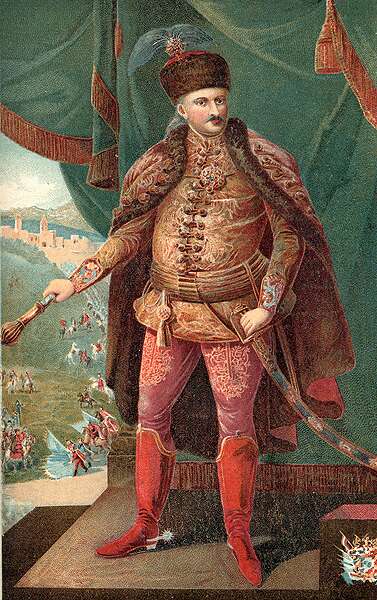
Gróf Károlyi Sándor - olajfestmény By Unknown author - Marczali Henrik: Magyarország története III. Károlytól a bécsi congresszusig 1711-1815 A magyar nemzet története. Szerkesztette: Szilágyi Sándor. Athéneum, Budapest, 1898, VIII. kötet, 88. oldal utáni tábla. [1], Public domain, https://commons.wikimedia.org/w/index.php?curid=11107888
1739 CE
Treaty of Belgrade
The Treaty of Belgrade was signed and Habsburg monarchy/Austrian Empire was no longer active against the Ottoman Empire for around a century. Source — Wikipedia, "Timeline of Bulgarian history" (18th century):
Signing of Treaty of Belgrade, 1739 By Unknown author - P. Marković - "Zemun od najstariji vremena pa do danas", 1896; reprint 2004. ISBN 86-84149-08-4, Public domain, https://commons.wikimedia.org/w/index.php?curid=7918664
1762 CE
Istoriya Slavyanobolgarskaya
Istoriya Slavyanobolgarskaya, one of the first ones and the most important early book about Bulgarian History written by Saint Paisius of Hilendar. Source — Wikipedia, "Timeline of Bulgarian history" (18th century):
A photo of the first page of the original draft of Istoriya Slavyanobolgarskaya by Paisius of Hilendar. By I. Stankov - Own work, CC BY-SA 3.0, https://commons.wikimedia.org/w/index.php?curid=21069657
1768 CE
Russo-Turkish War
Russo-Turkish War (1768-1774) Source — Wikipedia, "Timeline of Bulgarian history" (18th century):
Картина представляет собой эффектное живописное зрелище. В ней соединены изображения конкретных исторических лиц и вольная фантазия художника, условность колорита, декоративность композиции и документально точные детали. Полотно было призвано прославить победы русского оружия в первой русско-турецкой войне (1768–1774). В триумфальной колеснице, окруженная аллегорическими изображениями благодарных народов, населявших южные рубежи Российской империи, восседает Екатерина II в виде богини Минервы. Парящие в небесах крылатые создания трубят ей славу и венчают лавровым венком. Екатерину сопровождают воины –ближайшие сподвижники, первые кавалеры ордена Св. Георгия: П.А.Румянцев, А.Г.Орлов, П.И.Панин, В.М.Долгорукий, Н.В.Репнин и Ф.Г.Орлов. Возглавляет шествие Г.Г.Орлов – фаворит императрицы. Он изображен перед колесницей Екатерины с бриллиантовым портретом государыни на груди. By Stefano Torelli - former image source [1]; current image source [2], Public domain, https://commons.wikimedia.org/w/index.php?curid=980558
Jun 20, 1774 CE
Battle of Kozludzha
Battle of Kozludzha: The battle took place near Kozludzha, Bulgaria. Source — Wikipedia, "Timeline of Bulgarian history" (18th century):
Сражение при Козлуджи By Антинг И. Ф. Жизнь и военные деяния генералиссимуса, князя Италийского графа Суворова-Рымникского : С виньетками и планами : Ч. 1-3. - СПб., 1799-1800. - http://elib.shpl.ru/ru/nodes/15204-anting-i-f-zhizn-i-voennye-deyaniya-generalissimusa-knyazya-italiyskogo-grafa-suvorova-rymnikskogo-s-vinietkami-i-planami-ch-1-3-spb-1799-1800, Public domain, https://commons.wikimedia.org/w/index.php?curid=104934797
1774 CE
Treaty of Küçük Kaynarca
The Treaty of Küçük Kaynarca gave Russia the right to interfere in Ottoman affairs to protect the Sultan's Christian subjects, including the Bulgarians. Source — Wikipedia, "Timeline of Bulgarian history" (18th century):
Map of the Bulgarian people around the world. (The map might include people with Bulgarian ancestry or citizenship) Bulgaria + 100,000 + 10,000 + 1,000 By Allice Hunter - Empty map: File:World map (Miller cylindrical projection, blank without Antarctica).svg Information available on the page Bulgarians and Bulgarian diaspora on the English Wikipedia Number of Bulgarians living abroad per country: NW, 1615 L. St. Global Migration Map: Origins and Destinations, 1990-2017 (American English). Pew Research Center's Global Attitudes Project. Retrieved on 2024-02-07. Immigrant and Emigrant Populations: Immigrant and Emigrant Populations by Country of Origin and Destination (English). migrationpolicy.org (2024-02-07)., CC BY-SA 4.0, https://commons.wikimedia.org/w/index.php?curid=92679916
1792 CE
history of Bulgaria
An important book was written about the history of Bulgaria (История во кратце о болгарском народе словенском) by Spiridon Gabrovski . Source — Wikipedia, "Timeline of Bulgarian history" (18th century):
1818 CE
An earthquakes shakes up Sofia.
An earthquakes shakes up Sofia. Source — Wikipedia, "Timeline of Bulgarian history" (19th century):
1821 CE
A revolt began with the Greeks
A revolt began with the Greeks against the Ottomans. Source — Wikipedia, "Timeline of Bulgarian history" (19th century):
1829 CE
Forces owned by Russia occupy Sofia.
Forces owned by Russia occupy Sofia. Source — Wikipedia, "Timeline of Bulgarian history" (19th century):
1834 CE
The first Bulgarian factory opened.
The first Bulgarian factory opened. Source — Wikipedia, "Timeline of Bulgarian history" (19th century):
1839 CE
Tanzimat
Ottoman Tanzimat reforms Source — Wikipedia, "Timeline of Bulgarian history" (19th century):
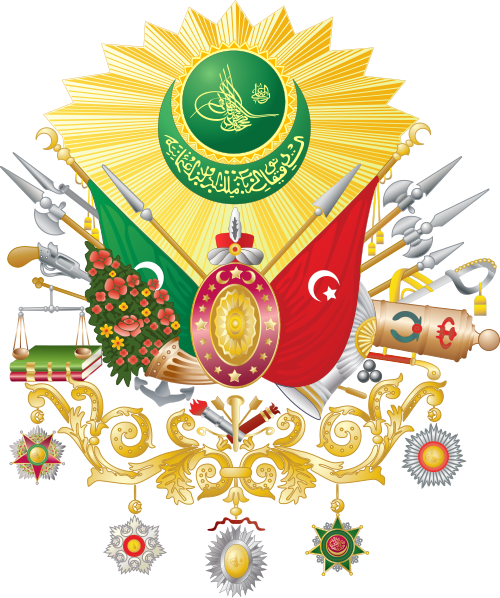
Every sultan of the Ottoman Empire had his own monogram, called the tughra, which served as a royal symbol. A coat of arms in the European heraldic sense was created in the late 19th century. Hampton Court requested from the Ottoman Empire a coat of arms to be included in their collection. As the coat of arms had not been previously used in the Ottoman Empire, it was designed after this request, and the final design was adopted by Sultan Abdul Hamid II on 17 April 1882. By Juris Tiltins - Own work based on Derivative works of this file: Enver bey and Niyazi bey postcard 1908.jpg, Public domain, https://commons.wikimedia.org/w/index.php?curid=3423102
1853 CE
Crimean War
Crimean War: British and French troops arrive in Bulgaria. Source — Wikipedia, "Timeline of Bulgarian history" (19th century):
The Attack on the Malakoff by w:William Simpson. Print shows the French assault on the Malakoff, the main Russian fortification before Sevastopolʹ, on 7 September 1855. French soldiers advance from the left, Zouaves from the left foreground, crossing the ditch and engaging Russian soldiers in hand-to-hand combat on the right. This was published on 22 October 1855, less than two months after the battle, which is about as contemporary to the event as mass-reproduced colour images got at the time. Français L'attaque de Malakoff par w:William Simpson. La gravure montre l'assaut sur Malakoff, la plus importante fortification russe devant Sébastopol, le 7 septembre 1855, au cours de la guerre de Crimée. Soldats français et Zouaves s'avancent, traversent le fossé, et engagent les soldats russes dans un combat au corps à corps. Ce document fut publié le 22 octobre 1855, moins de deux mois après l'événement, ce qui peut être considéré à l'époque comme contemporain pour ce type de reproduction de masse en couleurs. By William Simpson, artist (1823-1899) E[dmond]. Morin, lithographer (1824 - 1882), working for "Day & Son, lithrs. to the Queen" Published by: Paul & Dominic Colnaghi & Co., 13 & 14 Pall Mall East, publishers to Her Majesty Paris : Goupil & Cie. Leipzig: Otto Weigel - This image is available from the United States Library of Congress's Prints and Photographs division under the digital ID pga.03644.This tag does not indicate the copyright status of the attached work. A normal copyright tag is still required. See Commons:Licensing., Public domain, https://commons.wikimedia.org/w/index.php?curid=11245546
1870 CE
Bulgarian Exarchate
A Bulgarian Exarchate is established. Source — Wikipedia, "Timeline of Bulgarian history" (19th century):
The Bulgarian St Stephen Church in Constantinople (now Istanbul). By Unknown author - Scanned early 20th century Ottoman postcard., Public domain, https://commons.wikimedia.org/w/index.php?curid=1439504
1876 CE
April Uprising of 1876
The major April Uprising is brutally suppressed, resulting in a public outcry in Europe. Source — Wikipedia, "Timeline of Bulgarian history" (19th century):
Bulgarische Aufständische im Kampf mit einer türkischen Schar (im Jahre 1876) By V. Antonoff - "Bulgarien vom Beginn seines staatlichen Bestandes bis auf unsere Tage", 1917, Public domain, https://commons.wikimedia.org/w/index.php?curid=3089626
Mar 1, 1878 CE
Treaty of San Stefano
Russia and Turkey signed the Treaty of San Stefano. Source — Wikipedia, "Timeline of Bulgarian history" (19th century):
The Treaty of San Stefano. Oil on canvas by Joseph Holdforth. Completed in 1879. Depiction of officials deliberating the Treaty of San Stefano (signed 3 March 1878). Private collection By Joseph Holdforth - Permission from private collection, Public domain, https://commons.wikimedia.org/w/index.php?curid=181799213
1885 CE
Principality of Bulgaria
The Principality of Bulgaria and Eastern Rumelia became united formalized with the Tophane Agreement. Source — Wikipedia, "Timeline of Bulgarian history" (19th century):
Flag of Bulgaria By SKopp - The flag of Bulgaria. The colors are specified at http://www.government.bg/cgi-bin/e-cms/vis/vis.pl?s=001&p=0034&n=000005&g= as: White: Pantone Safe Green: 17-5936 (Green TC) [textile color] [1] Red: 18-1664 (Fiery Red TC) [2], Public domain, https://commons.wikimedia.org/w/index.php?curid=342993
1888 CE
University of Sofia
The University of Sofia was established (bears that name from 1904). Source — Wikipedia, "Timeline of Bulgarian history" (19th century):
София, декември 2014 ("St. Kliment Ohridski" University of Sofia) By Nikolai Karaneschev - https://web.archive.org/web/20161102025904/http://www.panoramio.com/photo/115157325, CC BY 3.0, https://commons.wikimedia.org/w/index.php?curid=58956240
Jun 1, 1913 CE
Greece and Serbia established a relationship
Greece and Serbia established a relationship with each other against Bulgaria. Source — Wikipedia, "Timeline of Bulgarian history" (20th century):
Oct 14, 1915 CE
World War I
Bulgaria joined World War I and teamed up with Germany. Source — Wikipedia, "Timeline of Bulgarian history" (20th century):
French soldiers moving into attack from their trench during the Battle of Verdun, 1916. By Collection DocAnciens/docpix.fr - www.docpix.fr, Public domain, https://commons.wikimedia.org/w/index.php?curid=45603415
Sep 30, 1918 CE
Bulgaria surrendered in World War I.
Bulgaria surrendered in World War I. Source — Wikipedia, "Timeline of Bulgarian history" (20th century):
Nov 27, 1919 CE
Treaty of Neuilly-sur-Seine
Treaty of Neuilly-sur-Seine: After it was signed at Neuilly-sur-Seine, France, Bulgaria gave away some of their territories Source — Wikipedia, "Timeline of Bulgarian history" (20th century):
Ratification of the Treaty of Neuilly-sur-Seine. By Unknown author - This file was provided to Wikimedia Commons by the Bulgarian Archives State Agency as part of a cooperation project. The Bulgarian Archives State Agency provides images, which are public domain. For attribution/citation of the source, Bulgarian Archives State Agency, please use the identification numbers of the document's fonds, inventory, archival unit and sheet., Public domain, https://commons.wikimedia.org/w/index.php?curid=45281575
Mar 28, 1920 CE
1920 Bulgarian parliamentary election
An election took place. Source — Wikipedia, "Timeline of Bulgarian history" (20th century):
Results of the April 1920 Bulgarian legislative election for XIX Ordinary National Assembly. Data is taken from the National Statistical Institute By Nikolay4101 - Own work, CC BY 4.0, https://commons.wikimedia.org/w/index.php?curid=175310788
Jun 9, 1923 CE
Bulgarian coup d'état of 1923
A coup d'état took place that resulted in the assassination of Aleksandar Stamboliyski. Source — Wikipedia, "Timeline of Bulgarian history" (20th century):
Ръководителите на Деветоюнския преврат в дома на Иван Русев (по-късна възстановка). От ляво надясно: Димо Казасов, Кимон Георгиев, Никола Рачев, Янаки Моллов, Иван Вълков, Александър Цанков, Христо Калфов, Иван Русев, Петър Тодоров, Цвятко Бобошевски By Unknown author - НБКМ-БИА // Аврамов, Румен. Комуналният капитализъм: Т.II. София, Фондация Българска наука и култура / Център за либерални стратегии, 2007. ISBN 978-954-90758-8-5. с. 283., Public domain, https://commons.wikimedia.org/w/index.php?curid=9821217
Oct 18, 1925 CE
War of the stray dog
War of the stray dog: The war began with Greece. Source — Wikipedia, "Timeline of Bulgarian history" (20th century):
This is a photo of a natural heritage site in Bulgaria, id: By Спасимир - Own work, CC BY-SA 4.0, https://commons.wikimedia.org/w/index.php?curid=40762021
1939 CE
World War II
Bulgaria declared war on Britain, Yugoslavia, Greece, and the USA. Bulgaria left the war after the Soviet Union declared war on Bulgaria. Source — Wikipedia, "Timeline of Bulgarian history" (20th century):
For documentary purposes the German Federal Archive often retained the original image captions, which may be erroneous, biased, obsolete or politically extreme. German Stuka dive bombers over the Eastern Front, World War II. A destroyed city is seen in the foreground (below the Junkers Ju 87s) By Richard Opitz - This image was provided to Wikimedia Commons by the German Federal Archive (Deutsches Bundesarchiv) as part of a cooperation project. The German Federal Archive guarantees an authentic representation only using the originals (negative and/or positive), resp. the digitalization of the originals as provided by the Digital Image Archive., CC BY-SA 3.0 de, https://commons.wikimedia.org/w/index.php?curid=5477308
1944 CE
Women earned the right to vote.
Women earned the right to vote. Source — Wikipedia, "Timeline of Bulgarian history" (20th century):
1947 CE
Soviet Union
Bulgaria and the Soviet Union signed a peace treaty. Source — Wikipedia, "Timeline of Bulgarian history" (20th century):
Dec 27, 1948 CE
Georgi Dimitrov
Georgi Dimitrov became the leader of the communist party. Source — Wikipedia, "Timeline of Bulgarian history" (20th century):
The death of Sm. Georg Mikhailovich Dimitrov. Bust portrait of Dimitrov. By TASS - https://www.muis.ee/museaalview/2474113, Public domain, https://commons.wikimedia.org/w/index.php?curid=187053295
Jul 2, 1949 CE
Georgi Dimitrov
Georgi Dimitrov died and Valko Chervenkov became the new leader of the communist party. Source — Wikipedia, "Timeline of Bulgarian history" (20th century):
The death of Sm. Georg Mikhailovich Dimitrov. Bust portrait of Dimitrov. By TASS - https://www.muis.ee/museaalview/2474113, Public domain, https://commons.wikimedia.org/w/index.php?curid=187053295
Mar 4, 1954 CE
Todor Zhivkov
Todor Zhivkov became the leader of the communist party. Source — Wikipedia, "Timeline of Bulgarian history" (20th century):
Todor Zhivkov Portrait By Extracted by Fredy.00 - This image has been extracted from another file, CC BY-SA 3.0 cz, https://commons.wikimedia.org/w/index.php?curid=34230662
May 14, 1955 CE
Warsaw Pact
The Warsaw Pact was signed. Source — Wikipedia, "Timeline of Bulgarian history" (20th century):
Warsaw Pact in 1990. Member states (dark green) and Albania which left in 1968 (light green). By Rob984 - Derived from Union of Soviet Socialist Republics (orthographic projection).svg, CC BY-SA 4.0, https://commons.wikimedia.org/w/index.php?curid=53195631
1962 CE
Yugov
Yugov retired from the communist party. Source — Wikipedia, "Timeline of Bulgarian history" (20th century):
Стефан Богданов, началник на Втори отдел на Държавна сигурност и Антон Югов, министър на вътрешните работи, през 1947 година By Unknown author - Методиев, Момчил. Държавна сигурност: предимство по наследство. София, Институт за изследване на близкото минало, 2015. ISBN 978-954-28-1937-0., Public domain, https://commons.wikimedia.org/w/index.php?curid=139952807
1963 CE
Pirin Macedonia
Pirin Macedonia was declared by Zhivkov as a part of Bulgaria. Source — Wikipedia, "Timeline of Bulgarian history" (20th century):
Pirin Macedonia By Unknown author, CC BY-SA 2.5, https://commons.wikimedia.org/w/index.php?curid=745861
1968 CE
Zhivkov
Zhivkov's loyalty was demonstrated to the Soviet Union. Source — Wikipedia, "Timeline of Bulgarian history" (20th century):
Todor Zhivkov Portrait By Extracted by Fredy.00 - This image has been extracted from another file, CC BY-SA 3.0 cz, https://commons.wikimedia.org/w/index.php?curid=34230662
Aug 1, 1975 CE
Helsinki Accords
The Helsinki Accords was signed by Bulgaria, giving citizens more freedom. Source — Wikipedia, "Timeline of Bulgarian history" (20th century):
The Helsinki Accords, the final act of the Conference on Security and Co-operation in Europe, which was signed in Helsinki in 1975 by the US, Canada and 33 European countries. Exhibited in the House of History in Bonn. By Rabax63 - Own work, CC BY-SA 4.0, https://commons.wikimedia.org/w/index.php?curid=72549056
Nov 10, 1989 CE
Communists in the government are replaced
Communists in the government are replaced by democracy supporters. Source — Wikipedia, "Timeline of Bulgarian history" (20th century):
Apr 3, 1990 CE
Bulgarian Communist Party
Bulgaria is no longer a communist state and was renamed to the Republic of Bulgaria. Source — Wikipedia, "Timeline of Bulgarian history" (20th century):
The logo of Bulgarian Communist Party – political party in Bulgaria between 1919 and 1990 By Respublika Narodnaya - Own work based on: Bouzloudja02.jpg, Public domain, https://commons.wikimedia.org/w/index.php?curid=68664163
1995 CE
Zhan Videnov took office after the
Zhan Videnov took office after the angry reactions against a reform on the economy. Source — Wikipedia, "Timeline of Bulgarian history" (20th century):
1997 CE
After the BSP government in Bulgaria
After the BSP government in Bulgaria fell, the UDF took its place. Source — Wikipedia, "Timeline of Bulgarian history" (20th century):
Jun 17, 2001 CE
Simeon Saxe-Coburg-Gotha
Simeon II won in parliamentary elections. Source — Wikipedia, "Timeline of Bulgarian history" (21st century):
Simeon II / Simeon Borissow Sakskoburggotski By Grey Geezer - Own work, CC BY-SA 4.0, https://commons.wikimedia.org/w/index.php?curid=192398974
Mar 29, 2004 CE
NATO
Bulgaria joins NATO. Source — Wikipedia, "Timeline of Bulgarian history" (21st century):
NATO/OTAN Logo. Source converted by Imalipusram By Unknown author - Rotated version of File:NATO_OTAN_portrait_logo.svg, Public domain, https://commons.wikimedia.org/w/index.php?curid=18466386
Jan 1, 2007 CE
European Union
Bulgaria joins in the European Union. Source — Wikipedia, "Timeline of Bulgarian history" (21st century):
The Flag of Europe is the flag and emblem of the European Union (EU) and Council of Europe (CoE). It consists of a circle of 12 golden (yellow) stars on a blue background. It was created in 1955 by the CoE and adopted by the EU, then the European Communities, in the 1980s. The CoE and EU are distinct in membership and nature. The CoE is an international organisation with 46 members, dealing with human rights and rule of law, while the EU is a quasi-federal union of 27 states, focused on economic integration and political cooperation. Today, the flag is mostly associated with the latter. It was the intention of the CoE that the flag should come to represent Europe as a whole, and since its adoption the membership of the CoE covers nearly the entire Europe by the number of states involved, although only a little over half of the European continent by territory. This is why the EU adopted the same flag. The flag has been used to represent Europe in sporting events and as a pro-democracy banner outside the European Union. By User:Verdy p, User:-xfi-, User:Paddu, User:Nightstallion, User:Funakoshi, User:Jeltz, User:Dbenbenn, User:Zscout370 - File created by various Wikimedia users (see "Author"). File based on the specification given at [1]., Public domain, https://commons.wikimedia.org/w/index.php?curid=2615952
2009 CE
Recession of 2009 occurred.
Recession of 2009 occurred. Source — Wikipedia, "Timeline of Bulgarian history" (21st century):
2010 CE
Bulgaria started to export goods to
Bulgaria started to export goods to nations that didn't join the European Union. Source — Wikipedia, "Timeline of Bulgarian history" (21st century):
Jan 19, 2013 CE
Oktay Enimehmedov
Oktay Enimehmedov attempted to launch a gas pistol at Ahmed Dogan who was the leader of the Turkish political party. After the gun wasn't successful at releasing a bullet, Enimehmedov was beaten up. Source — Wikipedia, "Timeline of Bulgarian history" (21st century):
Bulgarian politician Ahmed Dogan during a 2009 post-election conference By Vladimir Petkov - Гушнал букета, CC BY-SA 2.0, https://commons.wikimedia.org/w/index.php?curid=7270119
Jan 1, 2014 CE
European Union
Romanians and Bulgarians can work in the 28 European Union member states after the European Commission announced it. Source — Wikipedia, "Timeline of Bulgarian history" (21st century):
The Flag of Europe is the flag and emblem of the European Union (EU) and Council of Europe (CoE). It consists of a circle of 12 golden (yellow) stars on a blue background. It was created in 1955 by the CoE and adopted by the EU, then the European Communities, in the 1980s. The CoE and EU are distinct in membership and nature. The CoE is an international organisation with 46 members, dealing with human rights and rule of law, while the EU is a quasi-federal union of 27 states, focused on economic integration and political cooperation. Today, the flag is mostly associated with the latter. It was the intention of the CoE that the flag should come to represent Europe as a whole, and since its adoption the membership of the CoE covers nearly the entire Europe by the number of states involved, although only a little over half of the European continent by territory. This is why the EU adopted the same flag. The flag has been used to represent Europe in sporting events and as a pro-democracy banner outside the European Union. By User:Verdy p, User:-xfi-, User:Paddu, User:Nightstallion, User:Funakoshi, User:Jeltz, User:Dbenbenn, User:Zscout370 - File created by various Wikimedia users (see "Author"). File based on the specification given at [1]., Public domain, https://commons.wikimedia.org/w/index.php?curid=2615952