Encyclopedia/3. History, Societies & Civilizations/09. Modern Nations/03. Central Asia • Curated by Admin Timeline.sg
History of Uzbekistan (AI-generated, sourced to Wikipedia).
Chronological Storyline (31 Milestones)
700 BCE
Sogdian city-states flourish
Sogdiana emerges as a network of prosperous city-states and trading hubs across the Zarafshan and Kashka Darya valleys, becoming key intermediaries on ancient trade routes. Source — Wikipedia, "Uzbekistan":
Map of Sogdia By DEMIS Mapserver, पाटलिपुत्र - This image has been extracted from another file, CC BY-SA 3.0, https://commons.wikimedia.org/w/index.php?curid=128206875
329 BCE
Alexander conquers Sogdiana
Alexander the Great captures Sogdian Rock and subdues the region after fierce resistance from local rulers such as Spitamenes, integrating it into his empire. Source — Wikipedia, "Uzbekistan":
Map of Sogdia By DEMIS Mapserver, पाटलिपुत्र - This image has been extracted from another file, CC BY-SA 3.0, https://commons.wikimedia.org/w/index.php?curid=128206875
138 BCE
Zhang Qian opens Silk Road
The Han dynasty envoy Zhang Qian reaches Central Asia, paving the way for regular Silk Road commerce that enriches Sogdian cities for centuries. Source — Wikipedia, "Uzbekistan":
Zhang Qian leaving emperor Han Wudi around 130 BCE, for his expedition to Central Asia. Mural in Cave 323, Mogao Caves, high Tang Dynasty, circa 8th century CE. Rong Xinjiang (2013). Eighteen Lectures on Dunhuang, translated by Imre Galambos, BRILL, ISBN 978-90-04-25233-2, p. 52. By PHG - copied from en wp, Public domain, https://commons.wikimedia.org/w/index.php?curid=721599
100 BCE
Kushan Empire rises
The Kushan Empire extends its authority over southern Central Asia, fostering Buddhist culture and trade links from Bactria deep into Sogdiana. Source — Wikipedia, "Uzbekistan":
Map of the Kushan Empire By Map created from DEMIS Mapserver, which are public domain. Koba-chan. Reference: Schwartzberg Atlas, v. , p. 145. Map g - This image has been extracted from another file, CC BY-SA 3.0, https://commons.wikimedia.org/w/index.php?curid=115482936
500 CE
Hephthalites dominate region
The Hephthalites, or White Huns, establish control over Sogdiana and surrounding territories, ruling until their defeat by the Göktürks and Sassanids. Source — Wikipedia, "Uzbekistan":
Flag of Uzbekistan By Farhod Yoʻldoshev - Oʻzbekiston Respublikasining Davlat bayrogʻi to‘g‘risida, Public domain, https://commons.wikimedia.org/w/index.php?curid=344734
710 CE
Arab conquest brings Islam
Arab forces under Qutayba ibn Muslim capture Samarkand, beginning the Islamization of Transoxiana and ending local Zoroastrian and Buddhist dominance. Source — Wikipedia, "Uzbekistan":
Arabs besieging the city of Samarkand, captured in 722 CE, Palace of Devastich (706-722), Penjikent mural By Photographer: The State Hermitage Museum - [1] 8th century CE mural PD-Art: Non-creative photograph of a two-dimensional work of art in the Public Domain (8th century CE), Public domain, https://commons.wikimedia.org/w/index.php?curid=95370445
Jul 1, 751 CE
Battle of Talas fought
Abbasid and Karluk forces defeat Tang Chinese troops at the Talas River, halting westward Chinese expansion and solidifying Islamic influence in Central Asia. Source — Wikipedia, "Uzbekistan":
Battle of Talas By SY - Own work, CC BY-SA 4.0, https://commons.wikimedia.org/w/index.php?curid=61320148
819 CE
Samanid dynasty founded
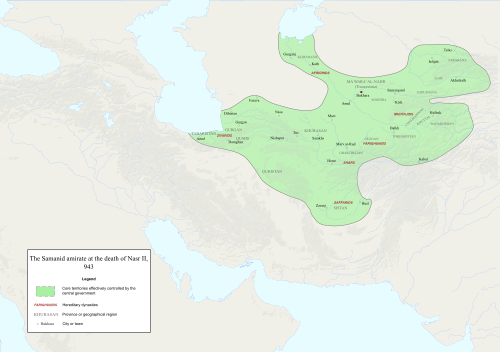
The Samanid dynasty establishes itself in Transoxiana, making Bukhara a premier center of Islamic learning, science, and Persianate culture. Source — Wikipedia, "Uzbekistan":
Map of the Samanid amirate at the death of Nasr II. By Original file by Ro4444, edited by me - Map is mainly based on two maps of mid 10th-century Central Asia under the Samanids in the pages 23 and 25 of An Historical Atlas of Central Asia, written by Yuri Bregel and published by Brill, supplied by NAṢR (I) B. AḤMAD (I) B. ESMĀʿIL [1] and Frye, R. N. (1975). "The Sāmānids". In Frye, Richard N. (ed.). The Cambridge History of Iran, Volume 4: From the Arab Invasion to the Saljuqs. Cambridge: Cambridge University Press. pp. 136–161. Since the maps in the source "only" showed Central Asia, I was missing very few parts of the southern border of the Samanids, which I used the following sources to construct; Frye, R. N. (1975). "The Sāmānids". In Frye, Richard N. (ed.). The Cambridge History of Iran, Volume 4: From the Arab Invasion to the Saljuqs. Cambridge: Cambridge University Press. Page 139. ISBN 0-521-20093-8. O'Neal, Michael (2015). "Ghūrids". In Fleet, Kate; Krämer, Gudrun; Matringe, Denis; Nawas, John; Rowson, Everett (eds.). Encyclopaedia of Islam, THREE. Brill Online. ISSN 1873-9830 SISTĀN ii. In the Islamic period [2] SAFFARIDS [3] NAṢR (I) B. AḤMAD (I) B. ESMĀʿIL [4], CC BY-SA 4.0, https://commons.wikimedia.org/w/index.php?curid=94665967
999 CE
Karakhanids take Transoxiana
The Turkic Karakhanid dynasty overthrows the Samanids, ushering in Turkic-Islamic rule and accelerating the Turkicization of the region. Source — Wikipedia, "Uzbekistan":
Flag of Uzbekistan By Farhod Yoʻldoshev - Oʻzbekiston Respublikasining Davlat bayrogʻi to‘g‘risida, Public domain, https://commons.wikimedia.org/w/index.php?curid=344734
Sep 1, 1219 CE
Genghis Khan invades
Mongol armies under Genghis Khan devastate Transoxiana, destroying Samarkand and Bukhara and ending centuries of flourishing urban civilization. Source — Wikipedia, "Uzbekistan":
Flag of Uzbekistan By Farhod Yoʻldoshev - Oʻzbekiston Respublikasining Davlat bayrogʻi to‘g‘risida, Public domain, https://commons.wikimedia.org/w/index.php?curid=344734
1370 CE
Timur founds empire
Timur, known in the West as Tamerlane, establishes his capital at Samarkand and builds a vast Central Asian empire through conquests across Eurasia. Source — Wikipedia, "Uzbekistan":
File:Amir Timur (9333672292).jpg "Timur was a typical Mongoloid. His grandsons Ulugh-Beg and Mohammed Sultan were "hybrids" and in type closely ressembled the present-day town-dwelling Uzbeks. The sons Shah-Rukh and Miran-Shah possessed unmistakable features of a Tadjik type (Europoid of central Asia). Despite all these differences, aal five of these men belonged through blood-relationship to one family. This fact is undoubted." in Gerasimov, M. M. (Mikhail Mikhaĭlovich) (1971) The face finder, Philadelphia, J. B. Lippincott, p. 116 By user:shakko - Own work, CC BY-SA 3.0, https://commons.wikimedia.org/w/index.php?curid=9494028
1429 CE
Ulugh Beg Observatory built
The astronomer-prince Ulugh Beg constructs a great observatory in Samarkand, producing star catalogues that rank among the finest pre-telescopic astronomical works. Source — Wikipedia, "Uzbekistan":
Ulugh Beg Observatory, Samarkand, Uzbekistan By Bgag - Own work, CC0, https://commons.wikimedia.org/w/index.php?curid=142098469
1500 CE
Shaybanids conquer Transoxiana
Muhammad Shaybani captures Samarkand and Bukhara, establishing Uzbek dynastic rule and shifting the political center to the Shaybanid Khanate. Source — Wikipedia, "Uzbekistan":
The trellis-walled yurt of Shaybani Khan, probably at Samarkand By Unknown - Shaybani namee zamfer, PD, https://en.wikipedia.org/w/index.php?curid=25367003
1598 CE
Bukhara Khanate established
The Janid (Ashtarkhanid) dynasty takes power in Bukhara, ruling a khanate that remains a major Central Asian state through the seventeenth century. Source — Wikipedia, "Uzbekistan":
Flag of Uzbekistan By Farhod Yoʻldoshev - Oʻzbekiston Respublikasining Davlat bayrogʻi to‘g‘risida, Public domain, https://commons.wikimedia.org/w/index.php?curid=344734
1709 CE
Khanate of Kokand founded
Shahrukh Bey establishes the Khanate of Kokand in the Fergana Valley, which grows into a powerful state contesting trade and territory with Bukhara. Source — Wikipedia, "Uzbekistan":
The banner of the Kokand khans was white (aq-yalaw or just yalaw), symbolising the Chingissid tradition of khan authority. By Incall - Own work; Timur, Beysembiev (2009) (in Russian) Kokand historiography: a study on the source study of Central Asia in the XVIII-XIX centuries, Print-S, p. 161 ISBN: 978-9965-482-84-7. Tursunov, Buston (2014) (in Russian) Military state of the Russian Empire and the Kokand Khanate in the conquest of Central Asia (conquest plans, armament, numerical composition of the army of the parties in the mid-19th century), p. 223, Public domain, https://commons.wikimedia.org/w/index.php?curid=153788004
1785 CE
Manghit Emirate of Bukhara
The Manghit dynasty transforms the Khanate of Bukhara into an emirate, ruling until the Russian conquest and promoting Islamic scholarship. Source — Wikipedia, "Uzbekistan":
Flag of Emirate of Bukhara. Source for design: (in French) (1929) La voix de la Boukharie opprimée, Paris: Librairie Orientale et Américaine MAISONNEUVE, p. 8 "Drapeau National Boukhare (Bukhara National Flag)" By CentralAsianEditor - Own work, CC BY 4.0, https://commons.wikimedia.org/w/index.php?curid=146121590
Jun 1, 1865 CE
Russia captures Tashkent
Russian imperial troops under General Chernyayev seize Tashkent, marking the start of direct Russian colonial administration in Central Asia. Source — Wikipedia, "Uzbekistan":
Набег казаков на поселение туземцев By Nikolay Karazin - https://art.mirtesen.ru/blog/43646912712/Hudozhnik-Nikolay-Nikolayevich-Karazin.?utm_referrer=mirtesen.ru, Public domain, https://commons.wikimedia.org/w/index.php?curid=90982513
Jun 1, 1868 CE
Bukhara becomes protectorate
After military defeat, the Emirate of Bukhara accepts Russian protectorate status, losing sovereignty in foreign affairs while retaining internal autonomy. Source — Wikipedia, "Uzbekistan":
Flag of Emirate of Bukhara. Source for design: (in French) (1929) La voix de la Boukharie opprimée, Paris: Librairie Orientale et Américaine MAISONNEUVE, p. 8 "Drapeau National Boukhare (Bukhara National Flag)" By CentralAsianEditor - Own work, CC BY 4.0, https://commons.wikimedia.org/w/index.php?curid=146121590
1873 CE
Khiva becomes protectorate
The Khanate of Khiva capitulates to Russian forces and becomes a Russian protectorate, completing the subjugation of the major Uzbek-ruled states. Source — Wikipedia, "Uzbekistan":
Flag of the Khanate of Khiva, "The museum of Khiva displays (vertically) the flag used by the khanate of Khiva during the civil war (1917-1922). The khanate, which had been annexed by Russia in 1873, proclaimed independence on 13 February 1917. In 1918, the khan was overthrown by a Turkmen chief. Then began a period of anarchy. The protectorate of Khiva was suppressed on 9 April 1919 and Khiva was included in the new Republic of Khorezm, created by the Soviets on 26 April 1920." By Samhanin - Own work, source: The museum of Khiva displays (vertically) the flag used by the khanate of Khiva during the civil war (1917-1922)., CC0, https://commons.wikimedia.org/w/index.php?curid=95906633
Feb 1, 1876 CE
Kokand Khanate abolished
Russia dissolves the Khanate of Kokand and incorporates its territory into the Fergana Oblast of Russian Turkestan, ending local khanate rule. Source — Wikipedia, "Uzbekistan":
The banner of the Kokand khans was white (aq-yalaw or just yalaw), symbolising the Chingissid tradition of khan authority. By Incall - Own work; Timur, Beysembiev (2009) (in Russian) Kokand historiography: a study on the source study of Central Asia in the XVIII-XIX centuries, Print-S, p. 161 ISBN: 978-9965-482-84-7. Tursunov, Buston (2014) (in Russian) Military state of the Russian Empire and the Kokand Khanate in the conquest of Central Asia (conquest plans, armament, numerical composition of the army of the parties in the mid-19th century), p. 223, Public domain, https://commons.wikimedia.org/w/index.php?curid=153788004
Apr 1, 1918 CE
Turkestan ASSR created
Bolshevik authorities establish the Turkestan Autonomous Soviet Socialist Republic within the RSFSR, encompassing most of former Russian Turkestan including Uzbek lands. Source — Wikipedia, "Uzbekistan":
Turkestan Autonomous SSR Flag By ЦИК ТССР - Туркестан, Public domain, https://commons.wikimedia.org/w/index.php?curid=115637086
Oct 1, 1920 CE
Bukhara People's Republic
Red Army-backed revolutionaries overthrow the Emir of Bukhara and proclaim the Bukhara People's Soviet Republic, ending centuries of dynastic rule. Source — Wikipedia, "Uzbekistan":
Flag of the Bukharan People's Soviet Republic 1921–1923. By Mysid - Self-drawn in CorelDraw, based on a FOTW flag ([1]), Public domain, https://commons.wikimedia.org/w/index.php?curid=719161
Oct 1, 1924 CE
Uzbek SSR established
Soviet national-territorial delimitation creates the Uzbek Soviet Socialist Republic, formally recognizing Uzbeks as a distinct nation within the USSR. Source — Wikipedia, "Uzbekistan":
Flag of Uzbek Soviet Socialist Republic, based on Image:Flag of the Soviet Union.svg and information at Flags of the World. By Denelson83, Urmas, Nokka - https://www.fotw.info/flags/su-uz.html, Public domain, https://commons.wikimedia.org/w/index.php?curid=601124
1937 CE
Great Purge devastates elite
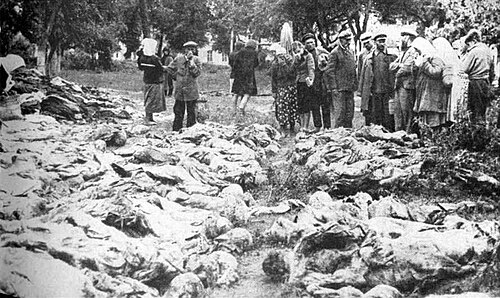
Stalin's Great Purge sweeps through Uzbekistan, executing thousands of party officials, intellectuals, and cultural figures including the writer Abdulla Qodiriy. Source — Wikipedia, "Uzbekistan":
People looking for relatives among repressed in Vinnytsia By Ukrainian American Youth Association - Crime of Moscow in Vynnytsia. Ukrainian Publication of the Ukrainian American Youth Association, Inc. New York. 1951, Public domain, https://commons.wikimedia.org/w/index.php?curid=3119574
Apr 26, 1966 CE
Tashkent earthquake
A devastating 5.1 magnitude earthquake destroys much of central Tashkent, leaving over 300,000 homeless and prompting a massive Soviet-wide reconstruction effort. Source — Wikipedia, "Uzbekistan":
Map Of Tashkent in 1967 and following years showing the earthquake area and subsequent Soviet developments (5 of 7) By Guy Cosnahan - Self generated by author based on the Geographical Atlas of Tashkent (Ташкент Географический Атлас, Москва 1984), CC BY-SA 4.0, https://commons.wikimedia.org/w/index.php?curid=5154520
Jun 1, 1989 CE
Karimov leads Uzbekistan
Islam Karimov becomes First Secretary of the Communist Party of Uzbekistan, consolidating power that he will carry into the independence era. Source — Wikipedia, "Uzbekistan":
Uzbekistan President Islam Karimov meets with Secretary of Defense Donald H. Rumsfeld in the Pentagon on March 13, 2002. Karimov and Rumsfeld are meeting to discuss the war on terrorism and regional security issues. By Helene C. Stikkel - This image was released by the United States Department of Defense with the ID 020313-D-2987S-123 (next). This tag does not indicate the copyright status of the attached work. A normal copyright tag is still required. See Commons:Licensing. العربية ∙ বাংলা ∙ Bahaso Jambi ∙ Deutsch ∙ Deutsch (Sie-Form) ∙ English ∙ español ∙ euskara ∙ فارسی ∙ français ∙ italiano ∙ 日本語 ∙ 한국어 ∙ македонски ∙ മലയാളം ∙ Plattdüütsch ∙ Nederlands ∙ polski ∙ پښتو ∙ português ∙ русский ∙ slovenščina ∙ svenska ∙ Türkçe ∙ українська ∙ 简体中文 ∙ 繁體中文 ∙ +/−, Public domain, https://commons.wikimedia.org/w/index.php?curid=141898
Aug 31, 1991 CE
Uzbekistan declares independence
Following the failed Moscow coup, the Supreme Soviet of Uzbekistan declares independence from the USSR, with Islam Karimov soon elected president. Source — Wikipedia, "Uzbekistan":
Flag of Uzbekistan By Farhod Yoʻldoshev - Oʻzbekiston Respublikasining Davlat bayrogʻi to‘g‘risida, Public domain, https://commons.wikimedia.org/w/index.php?curid=344734
Mar 1, 1992 CE
Uzbekistan joins United Nations
Uzbekistan is admitted to the United Nations, formalizing its status as a sovereign state in the international community. Source — Wikipedia, "Uzbekistan":
Flag of Uzbekistan By Farhod Yoʻldoshev - Oʻzbekiston Respublikasining Davlat bayrogʻi to‘g‘risida, Public domain, https://commons.wikimedia.org/w/index.php?curid=344734
2001 CE
US base at Karshi-Khanabad
Uzbekistan allows the United States to use Karshi-Khanabad airbase for operations in Afghanistan, aligning briefly with Washington after 9/11. Source — Wikipedia, "Uzbekistan":
Welcome to K2 sign at Karshi-Khanabad By 1st Sgt. Meyer - 210 RQS, Public domain, https://commons.wikimedia.org/w/index.php?curid=90896383
May 13, 2005 CE
Andijan massacre
Government troops fire on protesters in Andijan, killing hundreds according to human rights groups, drawing international condemnation and straining US-Uzbek ties. Source — Wikipedia, "Uzbekistan":
Flag of Uzbekistan By Farhod Yoʻldoshev - Oʻzbekiston Respublikasining Davlat bayrogʻi to‘g‘risida, Public domain, https://commons.wikimedia.org/w/index.php?curid=344734
Sep 1, 2016 CE
Mirziyoyev becomes president
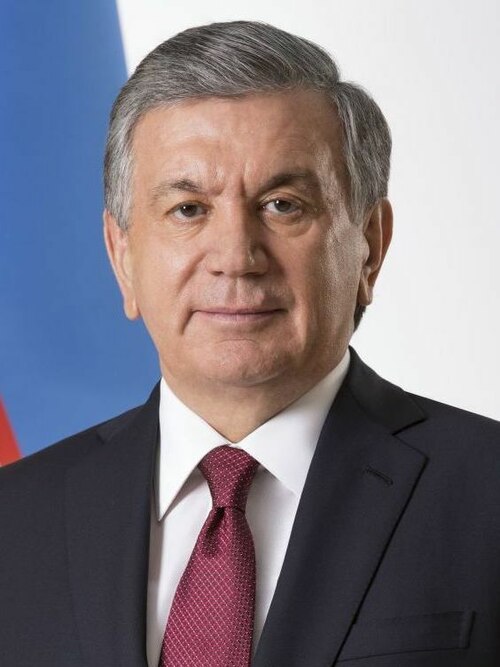
Following the death of Islam Karimov, Prime Minister Shavkat Mirziyoyev is elected president and initiates gradual economic and political reforms. Source — Wikipedia, "Uzbekistan":
Official portrait of the second President of Uzbekistan en:Shavkat Mirziyoyev, taken on his 61st birthday By Press Service of the President of the Republic of Uzbekistan - Source confirming the publication: Official Facebook page of the President Shavkat MirziyoyevSupporting source: Official biography page of the President, CC BY-SA 4.0, https://commons.wikimedia.org/w/index.php?curid=108332053