Encyclopedia/3. History, Societies & Civilizations/09. Modern Nations/04. East Asia • Curated by Admin Timeline.sg
History of South Korea (AI-generated, sourced to Wikipedia).
Chronological Storyline (30 Milestones)
2333 BCE
Legendary founding of Gojoseon
According to Korean mythology, Dangun Wanggeom established Gojoseon, the first Korean kingdom, marking the legendary beginning of Korean civilization. Source — Wikipedia, "South Korea":
Map of Old Chosŏn By Asieon - Own work, CC0, https://commons.wikimedia.org/w/index.php?curid=191841772
57 BCE
Silla kingdom founded
Silla, one of the Three Kingdoms of Korea, was founded in the southeastern part of the peninsula, eventually becoming a dominant regional power. Source — Wikipedia, "South Korea":
6th century Silla By Asieon - Own work, CC0, https://commons.wikimedia.org/w/index.php?curid=192466722
37 BCE
Goguryeo kingdom founded
Goguryeo was established in the northern Korean peninsula and southern Manchuria, becoming the largest of the Three Kingdoms of Korea. Source — Wikipedia, "South Korea":
5th century Goguryeo By Asieon - Own work, CC0, https://commons.wikimedia.org/w/index.php?curid=192465789
18 BCE
Baekje kingdom founded
Baekje was founded in the southwestern Korean peninsula, emerging as a major cultural and political power that traded extensively with Japan and China. Source — Wikipedia, "South Korea":
4th century Paekche By Asieon - Own work, CC0, https://commons.wikimedia.org/w/index.php?curid=192466581
668 CE
Silla unifies the peninsula
Silla, allied with Tang China, conquered Goguryeo and Baekje, unifying the Korean peninsula under a single state for the first time. Source — Wikipedia, "South Korea":
The territory of Balhae, In 830s during the reign of king Seon of Balhae. Territory of Balhae in 830.. By KJS615 - Own work, CC BY-SA 3.0, https://commons.wikimedia.org/w/index.php?curid=30571234
918 CE
Goryeo dynasty founded
Wang Geon established the Goryeo dynasty, from which the modern name 'Korea' derives, ushering in a period of Buddhist cultural flourishing. Source — Wikipedia, "South Korea":
Royal Flag of the Goryeo dynasty. Flag's name is "Phoenix flag" ( hanja: 鳳旗, 봉기, Bong-gi). This flag is in the War Memorial of Korea. By Samhanin - Own work, referenced the flag in the War memorial of Korea., Public domain, https://commons.wikimedia.org/w/index.php?curid=46722914
1232 CE
Tripitaka Koreana carving begins
The carving of the Tripitaka Koreana, a comprehensive collection of Buddhist scriptures, began during the Mongol invasions as a spiritual defense of the nation. Source — Wikipedia, "South Korea":
Tripitaka Koreana at Haeinsa Temple, South Korea By Bernard Gagnon - Own work, CC0, https://commons.wikimedia.org/w/index.php?curid=145076861
1392 CE
Joseon dynasty founded
Yi Seong-gye overthrew Goryeo and established the Joseon dynasty, which would rule Korea for over five centuries and adopt Neo-Confucianism as state ideology. Source — Wikipedia, "South Korea":
1882 version of the flag of Korea, based on the earliest surviving depiction of the flag, published in a U.S. Navy book Flags of Maritime Nations in July 1, 1882. By Daniil Ivanov - [1], Public domain, https://commons.wikimedia.org/w/index.php?curid=1762046
Dec 1, 1443 CE
Hangul alphabet created
King Sejong the Great promulgated Hangul, a scientifically designed phonetic alphabet, to improve literacy among commoners who struggled with Chinese characters. Source — Wikipedia, "South Korea":
<The Korean text> "Joseongeul" and "Hangeul," written in Hangul, the native Korean script. By metalslick - Own work, CC BY-SA 4.0, https://commons.wikimedia.org/w/index.php?curid=63996191
May 23, 1592 CE
Japanese invasions of Korea begin
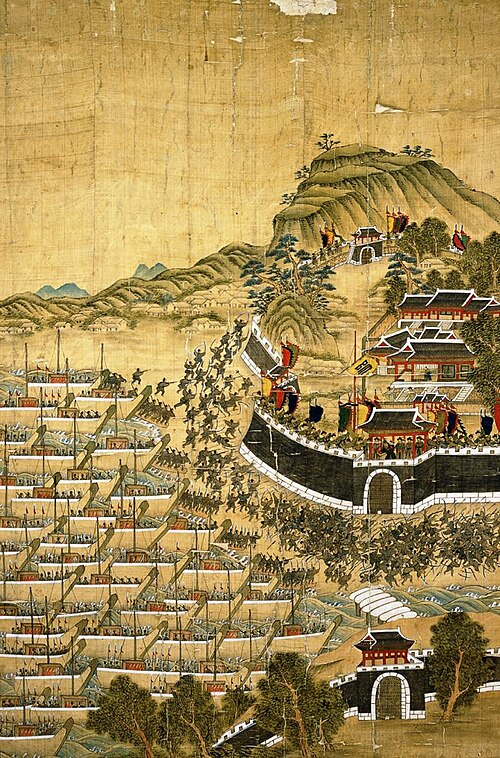
Toyotomi Hideyoshi's forces invaded Korea, triggering the Imjin War, a devastating six-year conflict in which Korean admiral Yi Sun-sin achieved legendary naval victories. Source — Wikipedia, "South Korea":
Japanese Siege of Busanjin (1592) By Unknown author - http://www.cha.go.kr/unisearch/Culresult_Db_View.jsp?VdkVgwKey=12,03910000,11, Public domain, https://commons.wikimedia.org/w/index.php?curid=752659
Oct 12, 1897 CE
Korean Empire declared
King Gojong declared the Korean Empire in an attempt to assert Korea's independence and modernize the state amid growing imperial pressures from neighboring powers. Source — Wikipedia, "South Korea":
Flag of Korea (1899) By Lumia1234 - [1], File:Flags of Maritime Nations (1899).djvu, Public domain, https://commons.wikimedia.org/w/index.php?curid=46374231
Aug 22, 1910 CE
Japan annexes Korea
Japan formally annexed Korea through the Japan-Korea Annexation Treaty, beginning 35 years of colonial rule marked by exploitation and cultural suppression. Source — Wikipedia, "South Korea":
General power of attorney to Lee Wan-Yong signed and sealed by the last emperor, Sunjong of the Korean Empire (Yi Cheok, 이척 李坧) on August 22, 1910. The last emperor's first name '坧' used as signature. By Sunjong of Korean Empire - "서울대이태진교수의동경대생들에게들려준한국사 : 메이지일본의한국침략사", Yi Tae-jin (2005) p. 211. ISBN 89-7626-999-3, Public domain, https://commons.wikimedia.org/w/index.php?curid=2294468
Mar 1, 1919 CE
March 1st Movement
Millions of Koreans participated in peaceful pro-independence demonstrations against Japanese colonial rule, sparking a nationwide movement that was brutally suppressed. Source — Wikipedia, "South Korea":
Peaceful demonstration in Seoul, in March 1919 By Bureau d'information coréen - L'indépendance de la Corée et la paix [1], Public domain, https://commons.wikimedia.org/w/index.php?curid=60559405
Aug 15, 1945 CE
Liberation from Japan
Korea was liberated from Japanese colonial rule following Japan's surrender in World War II, leading to the division of the peninsula along the 38th parallel. Source — Wikipedia, "South Korea":
Korean Volunteers By Unknown author - http://www.hddy.or.kr/, Public domain, https://commons.wikimedia.org/w/index.php?curid=31000412
Aug 15, 1948 CE
Republic of Korea established
Syngman Rhee was inaugurated as the first president of the Republic of Korea in the south, while the Democratic People's Republic of Korea was established in the north. Source — Wikipedia, "South Korea":
Flag of South Korea (1949-1984) By Xfigpower - Derived from File:Flag of South Korea (1949–1984).png문교부 고시 제2호, Public domain, https://commons.wikimedia.org/w/index.php?curid=75217531
Jun 25, 1950 CE
Korean War begins
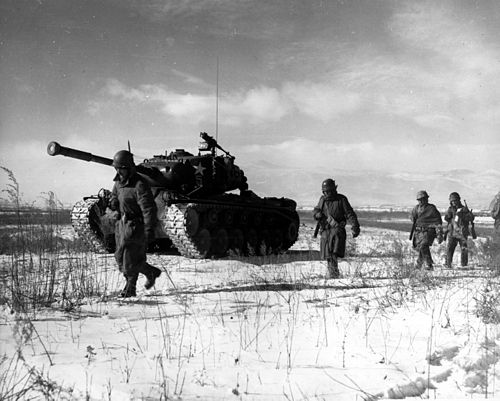
North Korean forces invaded South Korea, launching the Korean War, a major Cold War conflict that drew in the United Nations and China and devastated the peninsula. Source — Wikipedia, "South Korea":
A column of troops and armor of the 1st Marine Division move through communist Chinese lines during their successful breakout from the Chosin Reservoir in North Korea. The Marines were besieged when the Chinese entered the Korean War November 27, 1950, by sending 200,000 shock troops against Allied forces. By Photo by Corporal Peter McDonald, USMC - [1] (originally uploaded to en.wiki by Raul654), Public domain, https://commons.wikimedia.org/w/index.php?curid=403277
Jul 27, 1953 CE
Korean War armistice signed
An armistice agreement was signed at Panmunjom, ending active hostilities without a formal peace treaty and establishing the Demilitarized Zone along the 38th parallel. Source — Wikipedia, "South Korea":
UN delegate Lieut. Gen. William K. Harrison, Jr. (seated left), and Korean People’s Army and Chinese People’s Volunteers delegate Gen. Nam Il (seated right) signing the Korean War armistice agreement at P’anmunjŏm, Korea, July 27, 1953. By U.S. Department of Defense (F. Kazukaitis. U.S. Navy) - http://www.britannica.com/media/full/160426 (a crop of NARA FILE #: 080-G-625728, WAR & CONFLICT BOOK #: 1517), Public domain, https://commons.wikimedia.org/w/index.php?curid=24854727
Apr 19, 1960 CE
April 19 Revolution
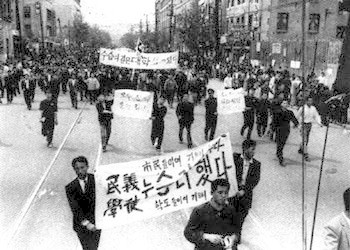
Massive student-led protests against electoral fraud and corruption toppled the authoritarian government of Syngman Rhee, leading to his resignation and a brief democratic opening. Source — Wikipedia, "South Korea":
1960년 4.19 혁명. By Unknown author - http://news.khan.co.kr/kh_news/khan_art_view.html?artid=200808181834035&code=210000, Public domain, https://commons.wikimedia.org/w/index.php?curid=11560641
May 16, 1961 CE
Park Chung-hee military coup
Major General Park Chung-hee seized power in a military coup, beginning an 18-year authoritarian rule that prioritized rapid economic development and industrialization. Source — Wikipedia, "South Korea":
1961.5.16 Park Jung Hee By Unknown author - http://www.newshankuk.com/news/news_view.asp?articleno=p2009110616374357365, Public domain, https://commons.wikimedia.org/w/index.php?curid=15304611
May 18, 1980 CE
Gwangju Democratization Uprising
Citizens of Gwangju rose up against military dictatorship, and the government's brutal suppression of the uprising became a pivotal moment in South Korea's democratization movement. Source — Wikipedia, "South Korea":
Fotos der Opfer des Gwangju-Massakers By Schlarpi - Own work, CC BY-SA 3.0, https://commons.wikimedia.org/w/index.php?curid=34594987
Jun 1, 1987 CE
Democratic transition begins
Massive pro-democracy protests known as the June Struggle forced the government to accept direct presidential elections, marking South Korea's transition to democracy. Source — Wikipedia, "South Korea":
고 이한열을 추모하기 위한 군중들이 시청앞 광장과 소공로, 서소문 일대를 가득 메운 모습이다. 학원민주화 요구에서 비롯된 학생운동은 1980년대 중반 사회 민주화운동을 확산시키는데 중요한 역할을 하였다. 1987년 초 정부는 '4.13 호헌 조치'를 발표하였다. 이 선언을 계기로 학생과 시민은 직선제 개헌을 더욱 강력히 요구하였다. 같은해 6월 10일 민주헌법쟁취국민운동본부는 '박종철군 고문치사 조작은폐 규탄 및 호헌철폐 국민대회'를 개최하였다. 한달만에 전국적으로 연인원 500만명이 참가한 '6월 항쟁'이 시작되었다.(1987.07.09) By 서울특별시청 - 서울역사아카이브 > 서울시정사진 > 촬영연도별 > 1984-1988 > 고 이한열 추모 군중, KOGL Type 1, https://commons.wikimedia.org/w/index.php?curid=116039803
Sep 17, 1988 CE
Seoul Olympics held
South Korea hosted the Summer Olympic Games in Seoul, a landmark event showcasing the country's economic rise and diplomatic engagement with the world. Source — Wikipedia, "South Korea":
Flag of the Republic of Korea (South Korea) By Original: Government of the Republic of Korea Vector: Great Brightstar and others - Ordinance Act of the Law concerning the National Flag of the Republic of Korea, Construction and color guidelines (Russian/English)File:Flag of South Korea (construction sheet).svg, Public domain, https://commons.wikimedia.org/w/index.php?curid=343752
Aug 24, 1992 CE
Diplomatic ties with China
South Korea and China established formal diplomatic relations, ending decades of Cold War hostility and opening a major new economic and diplomatic partnership. Source — Wikipedia, "South Korea":
China South Korea locator By The Account 2 - Own work, CC BY-SA 4.0, https://commons.wikimedia.org/w/index.php?curid=178631607
Nov 21, 1997 CE
Asian Financial Crisis hits Korea
South Korea sought a $58 billion IMF bailout during the Asian Financial Crisis, leading to painful reforms but ultimately strengthening the economy's resilience. Source — Wikipedia, "South Korea":
1997 Asian financial crisis By Max Roser - Our World in Data: https://ourworldindata.org/grapher/gdp-per-capita-growth?tab=chart&time=1995..2000&country=THA~KOR~PHL~MYS~SGP~IDN, CC BY 4.0, https://commons.wikimedia.org/w/index.php?curid=115387150
Jun 13, 2000 CE
First inter-Korean summit
President Kim Dae-jung met North Korean leader Kim Jong-il in Pyongyang, a historic summit that earned Kim Dae-jung the Nobel Peace Prize for his Sunshine Policy. Source — Wikipedia, "South Korea":
Seen at Unification Observatory in Paju. From 13 through 15 June 2000, President Kim Dae-jung visited Pyongyang, holding the first-ever inter-Korean summit. These are the first and the last pages of the joint declaration issued at the end of the 3-day summit, signed by Kim Dae-jung and Kim Jong-il. (In typeface and style, this is the South Korean version.) The two Koreas symbolically agreed to take a number of steps to improve inter-Korean relations and work toward peaceful co-existence. Kim Dae-jung had to fly in a South Korean military transport plane to get to Pyongyang, but as a result of these talks, road and rail links between the two Koreas were restored, and by the time the second inter-Korean summit happened, Kim's successor Roh Moo-hyun could simply drive to Pyongyang. Also notable is the understanding that Kim Jong-il would visit Seoul "at an appropriate time in the future," but between Kim's paranoia and failing health, the promise was never kept. Also, for the northern propaganda machine, it's far more convenient if the southern President comes in to Pyongyang to pay respects to the Dear Leader, rather than the Dear Leader having to stoop to the southern President in "American imperialist" territory. Kim Dae-jung eventually won the Nobel Peace Prize for this achievement, though the large amounts of aid payments made to the North proved more than controversial. The Sunshine Policy, a conciliatory policy toward the North with emphasis on humanitarian aid, is considered to be a failure as it failed to change North Korea's attitude long-term. However, the massive aid sent to the North did buy a huge amount of influence for South Korea, and a peek into the secretive northern society for the rest of the world. North Korea eventually became very dependent on South Korean aid. By the time South Korea turned right-wing and cut off the aid, it did limit North Korea's options as well; as much as it could shout "Military First," in the absence of South Korean aid there was very little to channel into the military, at least not without causing severe pains (and a near-rebellion) for the civilians. Additionally, continuing the Sunshine Policy in some form would've allowed South Korea to have other forms of leverage in North Korea, an influence squandered by the far-right government. By InSapphoWeTrust - Flickr: June 15th Joint Declaration 6.15 공동선언, CC BY-SA 2.0, https://commons.wikimedia.org/w/index.php?curid=31405203
Jun 1, 2002 CE
FIFA World Cup co-hosted
South Korea co-hosted the FIFA World Cup with Japan, with the national team's run to the semifinals sparking nationwide euphoria and boosting global cultural visibility. Source — Wikipedia, "South Korea":
Flag of the Republic of Korea (South Korea) By Original: Government of the Republic of Korea Vector: Great Brightstar and others - Ordinance Act of the Law concerning the National Flag of the Republic of Korea, Construction and color guidelines (Russian/English)File:Flag of South Korea (construction sheet).svg, Public domain, https://commons.wikimedia.org/w/index.php?curid=343752
Jul 15, 2012 CE
Gangnam Style goes viral
PSY's 'Gangnam Style' became a global viral phenomenon, the first YouTube video to surpass one billion views, signaling the global reach of Korean popular culture. Source — Wikipedia, "South Korea":
Flag of the Republic of Korea (South Korea) By Original: Government of the Republic of Korea Vector: Great Brightstar and others - Ordinance Act of the Law concerning the National Flag of the Republic of Korea, Construction and color guidelines (Russian/English)File:Flag of South Korea (construction sheet).svg, Public domain, https://commons.wikimedia.org/w/index.php?curid=343752
Feb 9, 2018 CE
PyeongChang Winter Olympics
South Korea hosted the Winter Olympics in PyeongChang, with athletes from North and South Korea marching together under a unified flag in a moment of diplomatic thaw. Source — Wikipedia, "South Korea":
PyeongChang Winter Olympics logo By The original uploader was AxG at English Wikipedia. - Own work based on: Pyeongchang 2018 Olympic official emblem.gif by Gitbi, Public domain, https://commons.wikimedia.org/w/index.php?curid=26185107
Jan 20, 2020 CE
COVID-19 pandemic response
South Korea's aggressive testing, contact tracing, and transparent communication made it an early global model for pandemic response without imposing lockdowns. Source — Wikipedia, "South Korea":
Map of regions with confirmed or suspected coronavirus cases (as of 5 March) Confirmed 1~9,999 Confirmed 10,000~99,999 Confirmed ≥100,000 By 아드리앵 and Nguyen QuocTrung - Own work, data from KCDC, Seoul, Busan, Daegu, Incheon, Daejeon, Gwangju, Ulsan, Sejong, Gyeonggi, Gangwon, North Gyeongsang, South Gyeongsang, North Chungcheong, South Chungcheong, North Jeolla, South Jeolla and Jeju official homepage., CC BY-SA 4.0, https://commons.wikimedia.org/w/index.php?curid=87465075
May 10, 2022 CE
Yoon Suk-yeol inaugurated
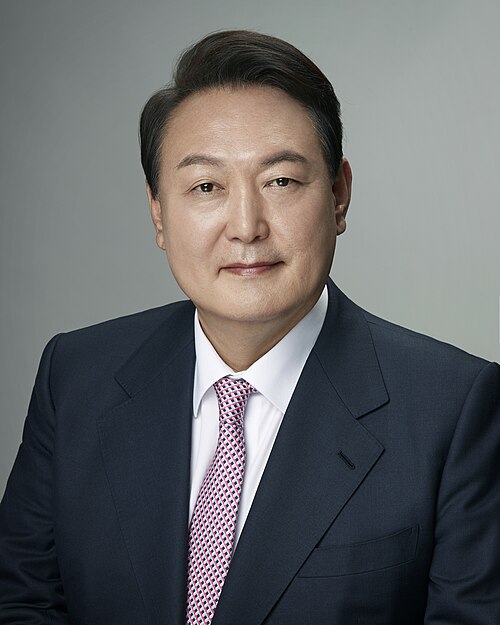
Conservative prosecutor-turned-politician Yoon Suk-yeol was inaugurated as president, pledging a tougher stance on North Korea and stronger ties with the United States. Source — Wikipedia, "South Korea":
South Korea President Yoon Suk-yeol official portrait By Office of the President of South Korea - 대한민국 대통령실, CC BY-SA 3.0, https://commons.wikimedia.org/w/index.php?curid=120880689