Encyclopedia/3. History, Societies & Civilizations/09. Modern Nations/03. Central Asia • Curated by Admin Timeline.sg
History of Turkmenistan (AI-generated, sourced to Wikipedia).
Chronological Storyline (28 Milestones)
2500 BCE
Oxus Civilization Flourishes
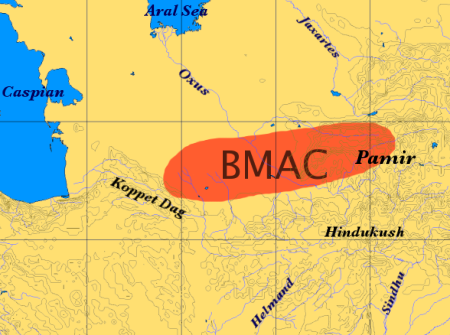
The Bronze Age Bactria-Margiana Archaeological Complex, centered at Gonur Depe in the Murgab River delta, represents one of Central Asia's earliest urban civilizations with advanced irrigation and monumental architecture. Source — Wikipedia, "Turkmenistan":
Oxus Civilization Flourishes By Unknown author, CC BY-SA 3.0, https://commons.wikimedia.org/w/index.php?curid=286126
550 BCE
Achaemenid Persia Conquers Region
The Achaemenid Empire under Cyrus the Great incorporates the territory of modern Turkmenistan, including Margiana and Parthia, into its vast administrative system. Source — Wikipedia, "Turkmenistan":
Achaemenid Empire 500 BCE By Cattette - This image has been extracted from another file, CC BY 4.0, https://commons.wikimedia.org/w/index.php?curid=113179532
330 BCE
Alexander the Great Arrives
Alexander the Great conquers the region during his campaign against the Achaemenid Empire, founding or refounding several cities including Alexandria in Margiana near modern Merv. Source — Wikipedia, "Turkmenistan":
Alexander Mosaic (detail), House of the Faun, Pompeii By Unknown author - The Guardian (DEA/G Nimatallah/De Agostini/Getty Images), Public domain, https://commons.wikimedia.org/w/index.php?curid=35067658
247 BCE
Parthian Empire Established
The Arsacid dynasty founds the Parthian Empire with its early capital at Nisa near modern Ashgabat, creating a major power that will rival Rome for centuries. Source — Wikipedia, "Turkmenistan":
Parthian Empire Established By Unknown author, Public domain, https://commons.wikimedia.org/w/index.php?curid=433223
224 CE
Sasanian Persia Takes Control
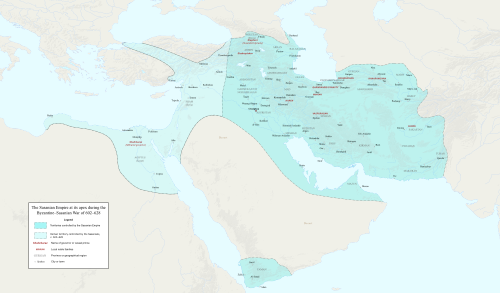
The Sasanian Empire under Ardashir I overthrows the Parthians and brings Turkmenistan's territory under Persian rule, with Merv becoming an important provincial center. Source — Wikipedia, "Turkmenistan":
Map of the Sasanian Empire at its apex under Khosrow II. By Original file by Ro4444, edited by me - Based on several sources, including the Middle Persian geographical text Šahrestānīhā ī Ērānšahr, CC BY 4.0, https://commons.wikimedia.org/w/index.php?curid=94837349
651 CE
Arab Conquest Reaches Merv
Arab Muslim forces capture Merv, bringing Islam to the region and ending Sasanian rule; Merv becomes a major center of Islamic learning and culture. Source — Wikipedia, "Turkmenistan":
Map of the Sassanid, Byzantine and Muslim borders. By Javierfv1212 and edited by HistoryofIran. - File:Pre_Islamic_Arabia.PNG, Public domain, https://commons.wikimedia.org/w/index.php?curid=26144272
May 23, 1040 CE
Seljuk Empire Founded
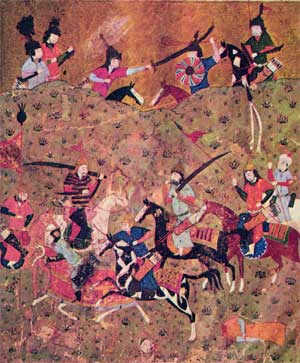
The Seljuk Turks defeat the Ghaznavids at the Battle of Dandanaqan near Merv, establishing a Turkic empire that will stretch from Central Asia to the Mediterranean. Source — Wikipedia, "Turkmenistan":
Battle of Dandanaqan fought between Ghaznavids and Seljuks in 1040. By Unknown author, Public domain, https://commons.wikimedia.org/w/index.php?curid=1400089
1221 CE
Mongols Destroy Merv
Genghis Khan's armies sack and nearly annihilate Merv, one of the great cities of the Islamic world, killing most of its inhabitants and ending its golden age. Source — Wikipedia, "Turkmenistan":
Mongols Destroy Merv By Unknown author, Public domain, https://commons.wikimedia.org/w/index.php?curid=433223
1380 CE
Timurid Conquest
Timur (Tamerlane) incorporates the region into his empire; Merv is partially rebuilt but never regains its former prominence as a major Silk Road metropolis. Source — Wikipedia, "Turkmenistan":
Timur's empire at his death, vasals aren't shown. By Stuntelaar - Own work, CC BY-SA 3.0, https://commons.wikimedia.org/w/index.php?curid=5206128
1511 CE
Khiva Khanate Established
The Khanate of Khiva emerges as an independent state encompassing much of western Turkmenistan, becoming a center of trade and Islamic scholarship in Central Asia. Source — Wikipedia, "Turkmenistan":
Flag of the Khanate of Khiva, "The museum of Khiva displays (vertically) the flag used by the khanate of Khiva during the civil war (1917-1922). The khanate, which had been annexed by Russia in 1873, proclaimed independence on 13 February 1917. In 1918, the khan was overthrown by a Turkmen chief. Then began a period of anarchy. The protectorate of Khiva was suppressed on 9 April 1919 and Khiva was included in the new Republic of Khorezm, created by the Soviets on 26 April 1920." By Samhanin - Own work, source: The museum of Khiva displays (vertically) the flag used by the khanate of Khiva during the civil war (1917-1922)., CC0, https://commons.wikimedia.org/w/index.php?curid=95906633
1869 CE
Russia Founding Krasnovodsk
The Russian Empire establishes the fortress and port of Krasnovodsk (now Türkmenbaşy) on the Caspian Sea, beginning its systematic expansion into Turkmen territory. Source — Wikipedia, "Turkmenistan":
offsilkroadin.com Turkmenbashi By Peretz Partensky from San Francisco, USA - The oil-soaked jewel of the Caspian - Turkmenbashi., CC BY-SA 2.0, https://commons.wikimedia.org/w/index.php?curid=24570352
1873 CE
Russian Conquest of Khiva
Russian forces under General Kaufman conquer the Khanate of Khiva, forcing it to become a Russian protectorate and bringing northern Turkmen lands under imperial control. Source — Wikipedia, "Turkmenistan":
Russian Troops entering the City of Khiva at the Hazar-Asp Gate. Illustration for The Illustrated London News, 22 November 1873. Engraved from the The Illustrated London News that shows Russian soldiers in Khiva By Nikolay Karazin - https://runivers.ru/gal/gallery-all.php?SECTION_ID=7093&ELEMENT_ID=605365, Public domain, https://commons.wikimedia.org/w/index.php?curid=79748880
Jan 24, 1881 CE
Battle of Geok Tepe
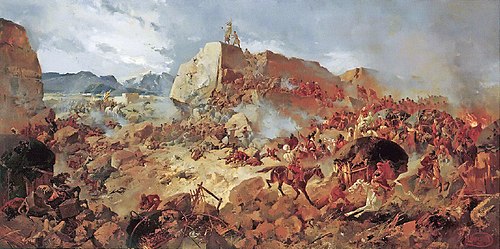
Russian forces storm the Turkmen fortress at Geok Tepe after a lengthy siege, decisively defeating the Tekke Turkmen and completing the Russian conquest of the region. Source — Wikipedia, "Turkmenistan":
Oil painting depicting a Russian assault on the fortress of Geok Tepe during the siege of 1880-81 By Nikolay Karazin - [1], Public domain, https://commons.wikimedia.org/w/index.php?curid=17195147
1885 CE
Trans-Caspian Railway Reaches Merv
The Trans-Caspian Railway is extended to Merv, integrating Turkmenistan into the Russian imperial economy and facilitating cotton production and military control. Source — Wikipedia, "Turkmenistan":
Map of the main road of the Trans-Caspian railway By Peter Christener - Map was created using Open Street Map Data, CC BY-SA 3.0, https://commons.wikimedia.org/w/index.php?curid=42880057
Dec 1, 1917 CE
Soviet Power Established
Following the October Revolution, Soviet power is established in the Trans-Caspian region, though anti-Bolshevik resistance and British intervention complicate the transition. Source — Wikipedia, "Turkmenistan":
Clockwise from top: Soldiers of the Don Army in 1919; a White Russian infantry division in March 1920; soldiers of the 1st Cavalry Army; Leon Trotsky in 1918; hanging of workers in Yekaterinoslav by Austro-Hungarian troops, April 1918. By User:Yanachka - Own work, Public domain, https://commons.wikimedia.org/w/index.php?curid=3158815
Oct 27, 1924 CE
Turkmen SSR Created
The Turkmen Soviet Socialist Republic is established as a union republic of the USSR, giving the Turkmen people their own formal national territory for the first time. Source — Wikipedia, "Turkmenistan":
Flag of the Turkmen Soviet Socialist Republic (1974–1991) and Turkmenistan (1991–1992). By Denelson83, Urmas, Nokka - Own work, based on Image:Flag of the Soviet Union.svg, Image:Flag-turkmen-ssr.png and information at Flags of the World., Public domain, https://commons.wikimedia.org/w/index.php?curid=600173
Oct 6, 1948 CE
Ashgabat Earthquake
A devastating 7.3 magnitude earthquake destroys Ashgabat, killing an estimated 110,000 people and nearly leveling the capital city entirely. Source — Wikipedia, "Turkmenistan":
Ashgabat Earthquake By Unknown author, Public domain, https://commons.wikimedia.org/w/index.php?curid=433223
1962 CE
Karakum Canal Construction
Construction of the Karakum Canal, one of the world's largest irrigation projects, begins diverting Amu Darya water across the desert, enabling agriculture but contributing to the Aral Sea crisis. Source — Wikipedia, "Turkmenistan":
Karakum-Kanal By Ziegler175 - Own work, CC BY-SA 4.0, https://commons.wikimedia.org/w/index.php?curid=35670272
Aug 22, 1990 CE
Sovereignty Declared
The Turkmen Supreme Soviet declares state sovereignty, marking the first formal step toward independence from the dissolving Soviet Union. Source — Wikipedia, "Turkmenistan":
Sovereignty Declared By Unknown author, Public domain, https://commons.wikimedia.org/w/index.php?curid=433223
Oct 27, 1991 CE
Independence Declared
Turkmenistan declares independence from the Soviet Union following a national referendum, becoming a sovereign state with Saparmurat Niyazov as its first president. Source — Wikipedia, "Turkmenistan":
Independence Declared By Unknown author, Public domain, https://commons.wikimedia.org/w/index.php?curid=433223
Nov 1, 1993 CE
Manat Currency Introduced
Turkmenistan introduces the manat as its national currency, replacing the Soviet ruble and asserting economic independence from the former Soviet monetary system. Source — Wikipedia, "Turkmenistan":
100 manats of Turkmenistan (2014) By Central Bank of Turkmenistan - own scan, Public domain, https://commons.wikimedia.org/w/index.php?curid=36605630
Dec 12, 1995 CE
Permanent Neutrality Declared
The United Nations General Assembly unanimously recognizes Turkmenistan's status as a permanently neutral state, a cornerstone of its foreign policy. Source — Wikipedia, "Turkmenistan":
Permanent Neutrality Declared By Unknown author, Public domain, https://commons.wikimedia.org/w/index.php?curid=433223
Dec 1, 1999 CE
Niyazov President for Life
The People's Council declares Saparmurat Niyazov President for Life, consolidating his authoritarian rule and the cult of personality centered on his self-authored Ruhnama. Source — Wikipedia, "Turkmenistan":
Saparmurad Niyazov By Danny Gys - https://audiovisual.ec.europa.eu/en/photo/P-002187~2F01-2A, CC BY 4.0, https://commons.wikimedia.org/w/index.php?curid=148575630
Aug 26, 2005 CE
Withdrawal from CIS
Turkmenistan downgrades its membership in the Commonwealth of Independent States to associate member, reflecting its policy of isolation and neutrality. Source — Wikipedia, "Turkmenistan":
Flag of the Commonwealth of Independent States. By The original uploader was Denelson83 at Wikimedia Commons. Redrawn from scratch by MapGrid in 2021. - Geometry and dimensions of most recent version from Flag of the CIS technical details.png., Public domain, https://commons.wikimedia.org/w/index.php?curid=576287
Dec 21, 2006 CE
Niyazov Dies
President Saparmurat Niyazov dies suddenly of cardiac arrest, ending his 21-year rule and triggering a managed succession to his deputy Gurbanguly Berdimuhamedow. Source — Wikipedia, "Turkmenistan":
Niyazov Dies By Unknown author, Public domain, https://commons.wikimedia.org/w/index.php?curid=433223
Feb 14, 2007 CE
Berdimuhamedow Elected
Gurbanguly Berdimuhamedow wins a presidential election with over 89% of the vote, beginning a period of gradual reform and continued authoritarian governance. Source — Wikipedia, "Turkmenistan":
Рабочий визит Раиса Республики Татарстан Р. Н. Минниханова в Туркменистан. By Пресс-служба Президента Республики Татарстан - Рабочий визит Раиса Республики Татарстан Р.Н. Минниханова в Туркменистан, CC BY 4.0, https://commons.wikimedia.org/w/index.php?curid=191939765
Sep 17, 2017 CE
Asian Indoor Games Held
Ashgabat hosts the 5th Asian Indoor and Martial Arts Games in a massive new Olympic complex, showcasing the country's investment in international sporting events. Source — Wikipedia, "Turkmenistan":
Asian Indoor Games Held By Unknown author, Public domain, https://commons.wikimedia.org/w/index.php?curid=433223
Mar 19, 2022 CE
Son Succeeds Father
Serdar Berdimuhamedow, son of the outgoing president, wins the presidential election, establishing Central Asia's first political dynasty of the post-Soviet era. Source — Wikipedia, "Turkmenistan":
Serdar Berdimuhamedov, President of Turkmenistan, meets with Sanae Takaichi, Prime Minister of Japan, at the Prime Minister's Official Residence on December 20, 2025. By Cabinet Public Relations Office of the Cabinet Secretariat - Summit Meetings with Leaders of Countries Participating in the Summit of the "Central Asia plus Japan" Dialogue (CA+JAD) (2) (The Prime Minister in Action) | Prime Minister's Office of Japan, CC BY 4.0, https://commons.wikimedia.org/w/index.php?curid=183958201