Encyclopedia/3. History, Societies & Civilizations/09. Modern Nations/06. Oceania • Curated by Admin Timeline.sg
History of Papua New Guinea (AI-generated, sourced to Wikipedia).
Chronological Storyline (39 Milestones)
60000 BCE
First human settlement
Humans first arrive in the New Guinea landmass via the Sahul shelf, establishing some of the earliest evidence of human habitation outside Africa. Source — Wikipedia, "Papua New Guinea":
National Emblem of Papua New Guinea (Adopted on 1 July 1971) “ DESCRIPTION OF THE NATIONAL EMBLEM (National Identity Act 1971) The Papua New Guinea National Emblem is a partiaIIy-stylized representation of the widespread Bird of Paradise Genus paradisaea in display, head turned to its left, seated on the upturned grip of a horizontal Kundu drum with the drum-head to the right side of the bird, from behind which a horizontal ceremonial spear projects with the head to the left of the bird. If coloured proper, the following colours should be used -- BIRD OF PARADISE Head Yellow Bill Grey-Blue Neck Black Breast Green with yellow band Abdomen Light brown, darkening to vent Wings and long tail feathers Brown (reddish) Display plumes Deep red (slightly brownish) SPEAR Black, with white highlights. KUNDU DRUM Drum head …. …. …. …. …. White Body …. …. …. …. …. Black, with white ornamentations Grip …. …. …. …. …. Black, with white highlights. ” By Sodacan - Own work, CC BY-SA 4.0, https://commons.wikimedia.org/w/index.php?curid=61071416
9000 BCE
Independent agriculture emerges
Archaeological evidence at Kuk Swamp in the Wahgi Valley shows early independent development of agriculture, including banana and taro cultivation. Source — Wikipedia, "Papua New Guinea":
The Kuk Early Agricultural Site consists of 116 ha of swamps in the western highlands of New Guinea 1,500 meters above sea-level. Archaeological excavation has revealed the landscape to be one of wetland reclamation worked almost continuously for 7,000, and possibly for 10,000 years. The area was declared a UNESCO World Heritage Site in 2008. The image was acquired May 7, 2002, covers an area of 31.6 x 40 km, and is located at 5.8° S, 144.3° E. By NASA: JPL - http://photojournal.jpl.nasa.gov/catalog/PIA13090, Public domain, https://commons.wikimedia.org/w/index.php?curid=10379239
5000 BCE
Highland settlements established
Permanent settlements in the highland valleys expand, supporting dense populations through sophisticated farming and irrigation systems. Source — Wikipedia, "Papua New Guinea":
Flag of Papua New GuineaColours: Pantone 186 C for red and 116 C for yellow By User:Nightstallion - Own work, FOTW, Public domain, https://commons.wikimedia.org/w/index.php?curid=433185
Aug 1, 1526 CE
Portuguese sight New Guinea
Portuguese explorer Jorge de Meneses reaches the western part of New Guinea and names it 'Ilhas dos Papuas,' marking the first European contact. Source — Wikipedia, "Papua New Guinea":
Flag of Papua New GuineaColours: Pantone 186 C for red and 116 C for yellow By User:Nightstallion - Own work, FOTW, Public domain, https://commons.wikimedia.org/w/index.php?curid=433185
1545 CE
Spanish name 'New Guinea'
Spanish navigator Íñigo Ortíz de Retez coins the name 'Nueva Guinea' because the inhabitants reminded him of those on the African Guinea coast. Source — Wikipedia, "Papua New Guinea":
Flag of Papua New GuineaColours: Pantone 186 C for red and 116 C for yellow By User:Nightstallion - Own work, FOTW, Public domain, https://commons.wikimedia.org/w/index.php?curid=433185
1660 CE
Dutch claim western half
The Dutch East India Company asserts sovereignty over the western half of New Guinea as part of the Dutch East Indies. Source — Wikipedia, "Papua New Guinea":
Flag of the Netherlands By Zscout370 - Own work, Public domain, https://commons.wikimedia.org/w/index.php?curid=363168
Nov 1, 1884 CE
Germany claims northeast
Germany raises its flag over the northeastern part of New Guinea, establishing German New Guinea (Kaiser-Wilhelmsland) under the New Guinea Company. Source — Wikipedia, "Papua New Guinea":
Inoffizielle Variante der Kaiserreichsflagge mit Hoheitszeichen, Deutsches Reich, 1871–1918 By Original: Imperial Colonial Office of the German Empire Vector: David Liuzzo - Own work, based on various photographs of physical flags such as the one depicted in File:Reichskolonialflagge WWI Imperial German colonial flag 1884–1918 Photo JC PLE 2022. Warriors Gate M.O.T.H. Museum of Militaria, Durban, South Africa.jpg – (Flickr source), Public domain, https://commons.wikimedia.org/w/index.php?curid=4481199
Nov 1, 1884 CE
Britain claims southeast
Britain declares a protectorate over the southeastern coast of New Guinea, establishing British New Guinea to preempt German or French expansion. Source — Wikipedia, "Papua New Guinea":
Flag of the Territory of Papua between September 1, 1906 - July 1, 1971. By Thommy - Own work, based on Flags of the World - Territory of Papua (1906-1949) and Couronne royale.svg (British Tudor Crown)., Public domain, https://commons.wikimedia.org/w/index.php?curid=4651764
Sep 1, 1888 CE
British annexation formalized
Britain formally annexes its portion of New Guinea, transitioning from a protectorate to a crown colony administered from Port Moresby. Source — Wikipedia, "Papua New Guinea":
Flag of the British New Guinea from 1888 - 1906 By vectored by FOX 52 - Based off this image, CC BY-SA 4.0, https://commons.wikimedia.org/w/index.php?curid=68294555
1899 CE
German administration shifts
The German government takes over administration of German New Guinea from the New Guinea Company due to financial difficulties and colonial mismanagement. Source — Wikipedia, "Papua New Guinea":
It is easy to put a border around this flag image By Samhanin - Own work, sources: #1, #2, Public domain, https://commons.wikimedia.org/w/index.php?curid=155195032
1902 CE
Papua transferred to Australia
The British government agrees to transfer administration of British New Guinea to Australia, formalized by the Papua Act of 1905. Source — Wikipedia, "Papua New Guinea":
Commonwealth Coat of Arms of Australia granted by Royal Warrant signed by King George V on 19 September 1912. IMPORTANT:This image is an artist's interpretation of the original (1912) official version of the Commonwealth Coat of Arms shown in Commons on the Australian coat of arms page. A variant of the original, with a transparent background, is shown on this page. “ Quarterly of six, the first quarter Argent a Cross Gules charged with a Lion passant guardant between on each limb a Mullet of eight points Or; the second Azure five Mullets, one of eight, two of seven, one of six and one of five points of the first (representing the Constellation of the Southern Cross) ensigned with an Imperial Crown proper; the third of the first a Maltese Cross of the fourth, surmounted by a like Imperial Crown; the fourth of the third, on a Perch wreathed Vert and Gules an Australian Piping Shrike displayed also proper; the fifth also Or a Swan naiant to the sinister Sable; the last of the first, a Lion passant of the second, the whole within a Bordure Ermine; for the Crest on a Wreath Or and Azure A Seven-pointed Star Or, and for Supporters dexter a Kangaroo, sinister an Emu, both proper. ” By Sodacan - Own work; Based on the painting at the National Archives of Australia -- item barcode 98430, Public domain, https://commons.wikimedia.org/w/index.php?curid=32871765
1906 CE
Australia administers Papua
Australia officially assumes administrative control of British New Guinea, renaming it the Territory of Papua, with Hubert Murray as Lieutenant-Governor. Source — Wikipedia, "Papua New Guinea":
Australian colonial administrator Hubert Murray By John Hubert Newman - National Library of Australia, Public domain, https://commons.wikimedia.org/w/index.php?curid=181325643
Sep 1, 1914 CE
Australia captures German New Guinea
Australian forces seize German New Guinea shortly after the outbreak of World War I, occupying Rabaul and other German colonial possessions. Source — Wikipedia, "Papua New Guinea":
AWM Caption: THE FLEET, HEADED BY THE FLAGSHIP HMAS "AUSTRALIA", ENTERING RABAUL ON 1914-09-12. By photographer not identified - This tag does not indicate the copyright status of the attached work. A normal copyright tag is still required. See Commons:Licensing for more information., Public domain, https://commons.wikimedia.org/w/index.php?curid=5063189
Dec 1, 1920 CE
League of Nations mandate
The League of Nations grants Australia a mandate over former German New Guinea, creating the Territory of New Guinea, administered separately from Papua. Source — Wikipedia, "Papua New Guinea":
Flag of the Australian Territory of New Guinea. By Orange Tuesday - Own work, Public domain, https://commons.wikimedia.org/w/index.php?curid=7181287
1920 CE
Gold rush at Wau
Major gold discoveries near Wau and Bulolo spark a gold rush, bringing significant economic activity and European settlement to the Morobe highlands. Source — Wikipedia, "Papua New Guinea":
A mine in Papua New Guinea as imaged by NASA. World Wind image of Wau By U.S. NASA - World Wind image, Public domain, https://commons.wikimedia.org/w/index.php?curid=32204614
1933 CE
Highland peoples 'discovered'
Australian explorers Mick and Dan Leahy encounter dense, previously uncontacted highland populations in the Wahgi Valley, stunning the outside world. Source — Wikipedia, "Papua New Guinea":
Highland peoples 'discovered' By Dióscoro Puebla - Colección, Museo del Prado., Public domain, https://commons.wikimedia.org/w/index.php?curid=6944341
Mar 1, 1942 CE
Japanese invade New Guinea
Japanese forces land at Rabaul and Lae, beginning a brutal military occupation that draws New Guinea into the Pacific theater of World War II. Source — Wikipedia, "Papua New Guinea":
1943-01-07. PAPUA, GIROPA POINT. MEMBERS OF 2/12TH INFANTRY BATTALION ADVANCE AS GENERAL STUART M3 LIGHT TANKS MANNED BY B SQUADRON, 2/6TH ARMOURED REGIMENT, BLAST JAPANESE PILLBOXES IN THE FINAL ASSAULT ON BUNA. NOTE MACHINE GUN ON TANK CLEARING TREETOPS OF SNIPERS BY SYSTEMATIC SPRAYING OF TREES AS THE INFANTRY MOVES FORWARD. THIS TANK, IN ONE MORNING'S FIGHTING, FIRED 10,000 ROUNDS OF MACHINE GUN AMMUNITION. THE PHOTOGRAPH WAS TAKEN DURING ACTUAL FIGHTING. NEAREST THE TANK IS CORPORAL G. G. FLETCHER, AND NEXT TO THE TREE (CENTRE) CORPORAL M. D. CROKER. (NEGATIVE BY GEORGE SILK). By George Silk - This tag does not indicate the copyright status of the attached work. A normal copyright tag is still required. See Commons:Licensing for more information., Public domain, https://commons.wikimedia.org/w/index.php?curid=11400559
Jul 1, 1942 CE
Kokoda Track campaign begins
Australian and Papuan forces engage Japanese troops along the Kokoda Track in a grueling series of battles across the Owen Stanley Range. Source — Wikipedia, "Papua New Guinea":
Sourced from: http://www.awm.gov.au/database/collection.asp Copyright: The AWM record for this photo states that the copyright status is 'clear'. The photo was taken in 1942. AWM Caption: MEMBERS OF THE 39TH BATTALION, AMF, PARADE AFTER WEEKS OF FIGHTING IN DENSE JUNGLE DURING THE KOKODA CAMPAIGN. THE OFFICER IN FRONT IS LIEUTENANT JOHNSON. THE MEN STANDING BEHIND HIM, FROM THE LEFT, ARE: ARNIE WALLACE, BILL SANDERS, HARRY HODGE, KEVIN SURTEES, GEORGE CUDMORE, GEORGE PUXLEY, KEVIN WHELAN, LEN MURRELL, DICK SECKER, NEIL GRAHAM, CLIVE GALE AND JACK BOLAND. THEIR BEDRAGGLED DRESS REFLECTS THE HARD FIGHTING OF PAST WEEKS. Copyright: The AWM record for this photo states that the copyright status is 'clear'. The photo was taken in 1942. By Parer, Damien Peter - This tag does not indicate the copyright status of the attached work. A normal copyright tag is still required. See Commons:Licensing for more information., Public domain, https://commons.wikimedia.org/w/index.php?curid=10477670Video
Sep 1, 1943 CE
Allies secure New Guinea
Allied forces defeat Japanese troops at Lae and Salamaua, gradually pushing Japanese forces back and securing the New Guinea mainland. Source — Wikipedia, "Papua New Guinea":
B-24 bomber over Salamaua By Taken by Lt. Sidney Seff 6th Photo Tech Sq. US Army - http://ftp.ibiblio.org/hyperwar//AAF/IV/img/AAF-IV-p174a.jpg, Public domain, https://commons.wikimedia.org/w/index.php?curid=19405535
1949 CE
Papua and New Guinea merged
Australia administratively unites the Territory of Papua and the Territory of New Guinea into the Territory of Papua and New Guinea, though legal distinctions remain. Source — Wikipedia, "Papua New Guinea":
National Emblem of Papua New Guinea (Adopted on 1 July 1971) “ DESCRIPTION OF THE NATIONAL EMBLEM (National Identity Act 1971) The Papua New Guinea National Emblem is a partiaIIy-stylized representation of the widespread Bird of Paradise Genus paradisaea in display, head turned to its left, seated on the upturned grip of a horizontal Kundu drum with the drum-head to the right side of the bird, from behind which a horizontal ceremonial spear projects with the head to the left of the bird. If coloured proper, the following colours should be used -- BIRD OF PARADISE Head Yellow Bill Grey-Blue Neck Black Breast Green with yellow band Abdomen Light brown, darkening to vent Wings and long tail feathers Brown (reddish) Display plumes Deep red (slightly brownish) SPEAR Black, with white highlights. KUNDU DRUM Drum head …. …. …. …. …. White Body …. …. …. …. …. Black, with white ornamentations Grip …. …. …. …. …. Black, with white highlights. ” By Sodacan - Own work, CC BY-SA 4.0, https://commons.wikimedia.org/w/index.php?curid=61071416
Jun 1, 1964 CE
First House of Assembly
The first House of Assembly of Papua and New Guinea opens, introducing limited representative government with both elected and appointed members. Source — Wikipedia, "Papua New Guinea":
Flag of Papua New GuineaColours: Pantone 186 C for red and 116 C for yellow By User:Nightstallion - Own work, FOTW, Public domain, https://commons.wikimedia.org/w/index.php?curid=433185
1971 CE
New flag and emblem adopted
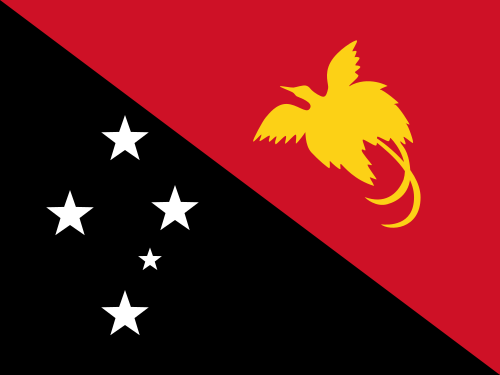
Papua New Guinea adopts its national flag featuring the Southern Cross and a bird of paradise, along with a national emblem, ahead of self-governance. Source — Wikipedia, "Papua New Guinea":
Flag of Papua New GuineaColours: Pantone 186 C for red and 116 C for yellow By User:Nightstallion - Own work, FOTW, Public domain, https://commons.wikimedia.org/w/index.php?curid=433185
Dec 1, 1973 CE
Self-government achieved
Papua New Guinea gains self-government, with Michael Somare becoming Chief Minister, marking the final step before full independence. Source — Wikipedia, "Papua New Guinea":
Michael Somare, 1973 By Unknown, CC0, https://commons.wikimedia.org/w/index.php?curid=133290776
Sep 16, 1975 CE
Independence declared
Papua New Guinea becomes an independent nation, with Michael Somare as its first Prime Minister and Queen Elizabeth II as head of state. Source — Wikipedia, "Papua New Guinea":
Flag of Papua New GuineaColours: Pantone 186 C for red and 116 C for yellow By User:Nightstallion - Own work, FOTW, Public domain, https://commons.wikimedia.org/w/index.php?curid=433185Video
Sep 1, 1975 CE
Bougainville secession attempt
Bougainville unilaterally declares independence as the Republic of the North Solomons, but the move is not recognized and the crisis is temporarily defused. Source — Wikipedia, "Papua New Guinea":
Flag of Bougainville By Aliasd - Own work, Public domain, https://commons.wikimedia.org/w/index.php?curid=1809357
1988 CE
Bougainville conflict erupts
Disputes over the Panguna copper mine escalate into a decade-long armed separatist conflict on Bougainville, causing thousands of deaths. Source — Wikipedia, "Papua New Guinea":
District map of Bougainville Province, Papua New Guinea By Isaac Sutcliffe - Own work, Public domain, https://commons.wikimedia.org/w/index.php?curid=2382955
May 1, 1989 CE
State of emergency declared
The PNG government declares a state of emergency on Bougainville and deploys security forces to suppress the Bougainville Revolutionary Army. Source — Wikipedia, "Papua New Guinea":
Flag of Papua New GuineaColours: Pantone 186 C for red and 116 C for yellow By User:Nightstallion - Own work, FOTW, Public domain, https://commons.wikimedia.org/w/index.php?curid=433185
Mar 1, 1997 CE
Sandline affair erupts
The disclosure that the government hired mercenaries from Sandline International to fight in Bougainville triggers a political crisis and the resignation of Prime Minister Sir Julius Chan. Source — Wikipedia, "Papua New Guinea":
Flag of Papua New GuineaColours: Pantone 186 C for red and 116 C for yellow By User:Nightstallion - Own work, FOTW, Public domain, https://commons.wikimedia.org/w/index.php?curid=433185
Oct 1, 1997 CE
Bougainville truce signed
Warring parties sign the Burnham Truce in New Zealand, paving the way for a permanent ceasefire and eventual peace process on Bougainville. Source — Wikipedia, "Papua New Guinea":
Flag of Papua New GuineaColours: Pantone 186 C for red and 116 C for yellow By User:Nightstallion - Own work, FOTW, Public domain, https://commons.wikimedia.org/w/index.php?curid=433185
Aug 1, 2001 CE
Bougainville peace agreement
The Bougainville Peace Agreement is signed, granting autonomy to Bougainville and promising a future referendum on independence. Source — Wikipedia, "Papua New Guinea":
Flag of Papua New GuineaColours: Pantone 186 C for red and 116 C for yellow By User:Nightstallion - Own work, FOTW, Public domain, https://commons.wikimedia.org/w/index.php?curid=433185
Aug 1, 2002 CE
Somare returns as PM
Sir Michael Somare is elected Prime Minister again, leading a coalition government and stabilizing the country after a period of political turbulence. Source — Wikipedia, "Papua New Guinea":
Michael Somare, 1973 By Unknown, CC0, https://commons.wikimedia.org/w/index.php?curid=133290776
Apr 1, 2009 CE
Pandemic influenza outbreak
A novel influenza A (H1N1) pandemic reaches Papua New Guinea, prompting a public health response in a country with limited healthcare infrastructure. Source — Wikipedia, "Papua New Guinea":
50 000+ confirmed cases 5 000+ confirmed cases 500+ confirmed cases 50+ confirmed cases 5+ confirmed cases 1+ confirmed cases By HotWikiBR - Own work (derivated)., Public domain, https://commons.wikimedia.org/w/index.php?curid=6747576
Dec 1, 2011 CE
Constitutional crisis
A standoff between Peter O'Neill and Sir Michael Somare over the prime ministership triggers a constitutional crisis lasting months before O'Neill prevails. Source — Wikipedia, "Papua New Guinea":
Flag of Papua New GuineaColours: Pantone 186 C for red and 116 C for yellow By User:Nightstallion - Own work, FOTW, Public domain, https://commons.wikimedia.org/w/index.php?curid=433185
May 1, 2014 CE
ExxonMobil LNG project
The PNG LNG project, operated by ExxonMobil, begins commercial exports of liquefied natural gas, becoming the country's largest resource project. Source — Wikipedia, "Papua New Guinea":
Flag of Papua New GuineaColours: Pantone 186 C for red and 116 C for yellow By User:Nightstallion - Own work, FOTW, Public domain, https://commons.wikimedia.org/w/index.php?curid=433185
Feb 1, 2018 CE
Highlands earthquake strikes
A devastating 7.5 magnitude earthquake hits the Southern Highlands, killing over 100 people and causing major damage to LNG infrastructure. Source — Wikipedia, "Papua New Guinea":
Version 4 of the shake map for the 2018 Papua New Guinea earthquake By United States Geological Survey - https://earthquake.usgs.gov/earthquakes/eventpage/us2000d7q6#shakemap, Public domain, https://commons.wikimedia.org/w/index.php?curid=66991233
Nov 1, 2018 CE
APEC summit hosted
Papua New Guinea hosts the APEC summit in Port Moresby, showcasing its growing international profile despite domestic criticism of costs. Source — Wikipedia, "Papua New Guinea":
Flag of Papua New GuineaColours: Pantone 186 C for red and 116 C for yellow By User:Nightstallion - Own work, FOTW, Public domain, https://commons.wikimedia.org/w/index.php?curid=433185
May 1, 2019 CE
Marape becomes PM
James Marape becomes Prime Minister after Peter O'Neill resigns amid mounting political pressure and economic challenges. Source — Wikipedia, "Papua New Guinea":
Secretary of Defense Lloyd J. Austin III greets Papua New Guinea Prime Minister James Marape in Port Moresby, Papua New Guinea, July 27, 2023. Austin is the first ever sitting U.S. Secretary of Defense to visit the South Pacific island to discuss next steps following the recent signature of the U.S.-Papua New Guinea Defense Cooperation Agreement (DCA), which reflects the partnership and shared values as Pacific countries, the importance of ensuring the security and prosperity of the region, and our shared commitment to a free and open Indo-Pacific.(DoD photo by Chad J. McNeeley) By U.S. Secretary of Defense - https://www.flickr.com/photos/68842444@N03/53073814062/, CC BY 2.0, https://commons.wikimedia.org/w/index.php?curid=135109238
Nov 1, 2019 CE
Bougainville independence vote
Bougainville holds a non-binding referendum on independence, with over 97% voting in favor of separation from Papua New Guinea. Source — Wikipedia, "Papua New Guinea":
Flag of Bougainville By Aliasd - Own work, Public domain, https://commons.wikimedia.org/w/index.php?curid=1809357
Aug 1, 2022 CE
Marape re-elected
James Marape is re-elected as Prime Minister following national elections, forming a coalition government despite a contentious vote marred by irregularities. Source — Wikipedia, "Papua New Guinea":
Results of the 2022 Papua New Guinean general election by district seats By Wowzers122 - Modified version of a map from the Humanitarian Data Exchange Election data compiled using the profile pages on the National Parliament website, CC BY-SA 4.0, https://commons.wikimedia.org/w/index.php?curid=137759746