Encyclopedia/3. History, Societies & Civilizations/09. Modern Nations/09. Southeast Asia • Curated by Admin Timeline.sg
History of Laos (AI-generated, sourced to Wikipedia).
Chronological Storyline (29 Milestones)
500 BCE
Early Bronze Age settlements
Archaeological evidence shows early metal-using communities in the Mekong River valley, with jar burial sites and bronze artifacts appearing across what is now Laos. Source — Wikipedia, "Laos":
Pha That Luang, Vientiane, Laos By Aaron Smith from London, United Kingdom - Vientiane, CC BY 2.0, https://commons.wikimedia.org/w/index.php?curid=4103730
100 CE
Kingdom of Funan rises
The Indianized kingdom of Funan dominates the Mekong Delta region, influencing early trade and cultural development in southern Laos. Source — Wikipedia, "Laos":
Map of indianized kingdoms of Indochina (1st to IXth centuries AC). By Emmanuel de Chambost (France) - Own work, Public domain, https://commons.wikimedia.org/w/index.php?curid=875291
500 CE
Chenla succeeds Funan
The successor state of Chenla expands influence over the Mekong region, spreading Hindu-Buddhist cultural traditions into Laotian territories. Source — Wikipedia, "Laos":
Mainland Southeast Asia in 700 CE By Tanakorn Srichaisuphakit - Own work, CC BY-SA 4.0, https://commons.wikimedia.org/w/index.php?curid=107964666
700 CE
Mon-Khmer principalities form
Various Mon and Khmer principalities and city-states emerge across the Laotian plateau, laying foundations for later Lao political identity. Source — Wikipedia, "Laos":
Pha That Luang, Vientiane, Laos By Aaron Smith from London, United Kingdom - Vientiane, CC BY 2.0, https://commons.wikimedia.org/w/index.php?curid=4103730
Apr 23, 1353 CE
Founding of Lan Xang
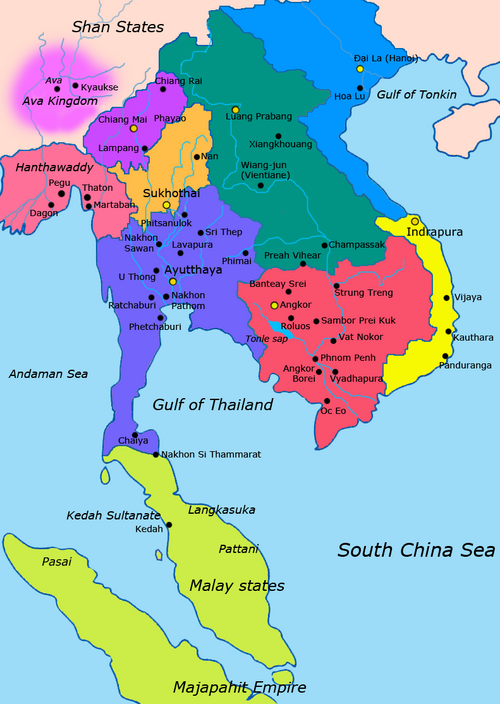
Fa Ngum unites Lao principalities and founds the Kingdom of Lan Xang (Million Elephants), establishing a powerful Buddhist state centered at Luang Prabang. Source — Wikipedia, "Laos":
Map of Southeast Asia circa 1400 CE, showing Khmer Empire in red, Ayutthaya Kingdom in violet, Lan Xang kingdom in teal, Sukhothai kingdom in orange, Champa in yellow, Kingdom of Lanna in purple, Dai Viet in blue and surrounding states. By Javierfv1212 - http://ecaimaps.berkeley.edu/animations/2003_03_khmer_animation.swf http://www.britannica.com/EBchecked/media/3395/Khmer-empire-1200 Atlas of world history, Patrick Karl O'brien. Societies, Networks, and Transitions: A Global History, Volume B. Craig A.Lockard http://upload.wikimedia.org/wikipedia/commons/thumb/4/45/Srivijaya_Empire.svg/2000px-Srivijaya_Empire.svg.png File:DvaravatiMapThailand.png http://upload.wikimedia.org/wikipedia/commons/e/eb/Thailand_2002_CIA_map.jpg, CC0, https://commons.wikimedia.org/w/index.php?curid=14719762
1373 CE
Fa Ngum exiled
King Fa Ngum is deposed and exiled by his own court due to his harsh rule, replaced by his son Un Heuan who reigns as Samsenthai. Source — Wikipedia, "Laos":
Idealised image of Fā Ngum, founder of the Kingdom of Lān Xāng (National History Museum, Vientiane) By en:User:Adam Carr - en:File:Fangum.JPG, Public domain, https://commons.wikimedia.org/w/index.php?curid=12901519
1520 CE
Photisarath ascends throne
King Photisarath promotes Theravada Buddhism and moves the capital from Luang Prabang to Vientiane, strengthening Lan Xang's central administration. Source — Wikipedia, "Laos":
This is a photo of a monument in Thailand identified by the ID By Kittipong khunnen - Own work, CC BY-SA 3.0, https://commons.wikimedia.org/w/index.php?curid=28171417
1574 CE
Burmese invasion devastates Lan Xang
Burmese forces under Bayinnaung invade and sack Lan Xang, forcing King Setthathirath to flee and plunging the kingdom into decades of instability. Source — Wikipedia, "Laos":
Vientiane : monument au roi Setthathirat, devant le Pha That Luang By Alcyon - Own work, CC BY-SA 3.0, https://commons.wikimedia.org/w/index.php?curid=3220644
1637 CE
Sourigna Vongsa reigns
King Sourigna Vongsa begins a long and peaceful reign considered the golden age of Lan Xang, with cultural flourishing and diplomatic ties established. Source — Wikipedia, "Laos":
ພະເຈົ້າ ສຸລິຍະວົງສາໄຊຍະເສດຖາທຳມິກະຣາດ (ເຈົ້າອົງຫລວງ) By Vila Phounvongsa - Own work, CC BY-SA 4.0, https://commons.wikimedia.org/w/index.php?curid=89200902
1707 CE
Lan Xang splits into three
Following succession disputes, Lan Xang fragments into the kingdoms of Luang Prabang, Vientiane, and Champasak, weakening Lao political unity. Source — Wikipedia, "Laos":
Pha That Luang, Vientiane, Laos By Aaron Smith from London, United Kingdom - Vientiane, CC BY 2.0, https://commons.wikimedia.org/w/index.php?curid=4103730
1779 CE
Siamese conquest of Lao kingdoms
Siam under King Taksin conquers Vientiane and other Lao kingdoms, reducing them to vassal states and beginning centuries of Siamese influence. Source — Wikipedia, "Laos":
Pha That Luang, Vientiane, Laos By Aaron Smith from London, United Kingdom - Vientiane, CC BY 2.0, https://commons.wikimedia.org/w/index.php?curid=4103730
Jan 1, 1827 CE
Anouvong rebellion crushed
King Anouvong of Vientiane rebels against Siamese domination but is defeated; Vientiane is sacked and largely destroyed, and Anouvong is executed. Source — Wikipedia, "Laos":
SAMSUNG DIGITAL CAMERA By User: Chaoborus - Wikimedia Commons., CC BY 3.0, https://commons.wikimedia.org/w/index.php?curid=180251399
1867 CE
French explorers reach Mekong
The French Mekong Expedition led by Ernest Doudart de Lagrée and Francis Garnier reaches Laos, mapping the river and assessing colonial potential. Source — Wikipedia, "Laos":
Flag of Laos By SKopp - Own work, Public domain, https://commons.wikimedia.org/w/index.php?curid=343627
Oct 3, 1893 CE
Laos becomes French protectorate
After the Franco-Siamese crisis, Siam cedes territories east of the Mekong to France, establishing Laos as part of French Indochina. Source — Wikipedia, "Laos":
The Franco-Siamese Frontier Dispute, the French forcing the Menam. Illustration for The Graphic, 26 August 1893. French ships Inconstant and Comète under fire in the Paknam incident, 13 July 1893. By Joseph Nash - https://romanceofthegrandtour.files.wordpress.com/2015/06/french-ships-on-the-maenam.jpg, Public domain, https://commons.wikimedia.org/w/index.php?curid=140210385
1941 CE
Japanese occupation begins
Japanese forces occupy Laos during World War II, while France's colonial authority is effectively undermined by the Vichy regime's collaboration. Source — Wikipedia, "Laos":
Japanese Imperial Army soldiers advance to Lang Son, in September 1940 in French Indochina. By Unknown author - https://saigoneer.com/old-saigon/old-saigon-categories/2073-when-the-japanese-occupied-vietnam-part-ii, Public domain, https://commons.wikimedia.org/w/index.php?curid=61574194
Oct 12, 1945 CE
Independence declared
King Sisavang Vong declares Lao independence under Japanese pressure, but the move is short-lived as France seeks to reassert colonial control. Source — Wikipedia, "Laos":
Pha That Luang, Vientiane, Laos By Aaron Smith from London, United Kingdom - Vientiane, CC BY 2.0, https://commons.wikimedia.org/w/index.php?curid=4103730
Jul 19, 1949 CE
Laos gains limited autonomy
France grants Laos limited self-government within the French Union, but full independence and political stability remain elusive. Source — Wikipedia, "Laos":
Flag of France By Original: Unknown Vector: SKopp - This SVG flag includes elements that have been taken or adapted from this flag:, Public domain, https://commons.wikimedia.org/w/index.php?curid=60739584
Oct 22, 1953 CE
Full independence achieved
Laos gains full independence from France through the Franco-Lao Treaty, becoming a constitutional monarchy under King Sisavang Vong. Source — Wikipedia, "Laos":
Clockwise from top: After the fall of Dien Bien Phu supporting laotian troops fall back across the Mekong River into Laos; French Marine commandos wade ashore off the Annam coast in July 1950; M24 Chaffee American light tank used by French in Vietnam; Geneva Conference in 21 July 1954; A Grumman F6F-5 Hellcat from Escadrille 1F prepares to land on the French carrier Arromanches (R95) operating in the Gulf of Tonkin. By Mohamed Ajjani - Own work, CC BY 3.0, https://commons.wikimedia.org/w/index.php?curid=54782594
Jul 21, 1954 CE
Geneva Accords signed
The Geneva Conference ends the First Indochina War, recognizing Laos's independence and neutrality while failing to resolve internal political divisions. Source — Wikipedia, "Laos":
http://en.wikipedia.org/wiki/Geneva_Conference_(1954) By US Army Photograph - http://en.wikipedia.org/wiki/File:Gen.jpg (George Esper, The Eyewitness History of the Vietnam War, Associated Press 1983), Public domain, https://commons.wikimedia.org/w/index.php?curid=7523599
Aug 9, 1960 CE
Kong Le coup in Vientiane
Paratrooper Captain Kong Le seizes Vientiane in a neutralist coup, deepening the civil war between royalist, neutralist, and communist factions. Source — Wikipedia, "Laos":
Situation in Laos in February 1973 according to the CIA By CIA - UNDERCOVER ARMIES, page 23, Public domain, https://commons.wikimedia.org/w/index.php?curid=168195825
1964 CE
Secret War intensifies
The CIA-backed covert war in Laos escalates, with Hmong guerrillas fighting Pathet Lao and North Vietnamese forces in what becomes the most heavily bombed country per capita in history. Source — Wikipedia, "Laos":
Situation in Laos in February 1973 according to the CIA By CIA - UNDERCOVER ARMIES, page 23, Public domain, https://commons.wikimedia.org/w/index.php?curid=168195825
Feb 21, 1973 CE
Vientiane Agreement signed
A ceasefire agreement is signed between the Royal Lao Government and the Pathet Lao, formally ending the Laotian Civil War and establishing a coalition government. Source — Wikipedia, "Laos":
Flag of Laos By SKopp - Own work, Public domain, https://commons.wikimedia.org/w/index.php?curid=343627
Dec 2, 1975 CE
Lao People's Republic declared
The Pathet Lao abolishes the monarchy and establishes the Lao People's Democratic Republic, ending 600 years of Lao kingship and aligning with the Soviet bloc. Source — Wikipedia, "Laos":
Flag of Laos By SKopp - Own work, Public domain, https://commons.wikimedia.org/w/index.php?curid=343627
1979 CE
Collectivization and hardship
The new government implements agricultural collectivization and political re-education camps, causing tens of thousands to flee as refugees to Thailand and beyond. Source — Wikipedia, "Laos":
Pha That Luang, Vientiane, Laos By Aaron Smith from London, United Kingdom - Vientiane, CC BY 2.0, https://commons.wikimedia.org/w/index.php?curid=4103730
1986 CE
New Economic Mechanism launched
Laos begins market-oriented economic reforms under the New Economic Mechanism, gradually liberalizing trade and investment while maintaining one-party rule. Source — Wikipedia, "Laos":
Khu trung tâm thành phố Hồ Chí Minh, nhìn từ phía quận 2 By Tokeisan at Vietnamese Wikipedia - Transferred from vi.wikipedia to Commons., CC BY-SA 3.0, https://commons.wikimedia.org/w/index.php?curid=44998436
1991 CE
New constitution adopted
Laos adopts a revised constitution formalizing single-party socialist rule under the Lao People's Revolutionary Party while permitting limited market activity. Source — Wikipedia, "Laos":
Emblem of Laos since 1991. This is/was a work-in-progress of the English Wikipedia Graphics Lab. By DTR - Own work, Public domain, https://commons.wikimedia.org/w/index.php?curid=5300762
Jul 23, 1997 CE
Laos joins ASEAN
Laos becomes a member of the Association of Southeast Asian Nations, marking a significant step toward regional integration and diplomatic engagement. Source — Wikipedia, "Laos":
Flag of Laos By SKopp - Own work, Public domain, https://commons.wikimedia.org/w/index.php?curid=343627
Feb 2, 2013 CE
WTO membership achieved
Laos officially joins the World Trade Organization after years of negotiations, opening its economy further to global trade and investment. Source — Wikipedia, "Laos":
Flag of Laos By SKopp - Own work, Public domain, https://commons.wikimedia.org/w/index.php?curid=343627
Jan 22, 2016 CE
Bounnhang Vorachith becomes leader
Bounnhang Vorachith is appointed Secretary-General of the Lao People's Revolutionary Party and President, continuing the tradition of consensus-based leadership transitions. Source — Wikipedia, "Laos":
President Rodrigo Roa Duterte and Laotian President Bounnhang Vorachith pose for a photograph during a courtesy visit at the Presidential Palace in Vientiane, Laos on September 7. TOTO LOZANO/PPD By Presidential Communications Operations Office - Presidential Communications Operations Office (Immediate: [1]), Public domain, https://commons.wikimedia.org/w/index.php?curid=51233642