Encyclopedia/3. History, Societies & Civilizations/09. Modern Nations/07. Eastern Europe & Caucasus • Curated by Admin Timeline.sg
History of Georgia, sourced from Wikipedia's "Timeline of Georgian history".
Chronological Storyline (56 Milestones)
8 CE
Paul I of Russia
Tsar Paul I of Russia signs a decree on incorporating Kartli-Kakheti into Russia, confirmed by Alexander I on 12 September the same year. Source — Wikipedia, "Timeline of Georgian history" (19th century):
Emperor Paul I of Russia by Vladimir Borovikovsky By Vladimir Borovikovsky - https://www.gettyimages.com/detail/news-photo/portrait-of-the-emperor-paul-i-of-russia-1799-1800-news-photo/464427333, Public domain, https://commons.wikimedia.org/w/index.php?curid=86714941
9 CE
Soviet Army
Soviet forces disperse demonstrations in Tbilisi, leaving 21 civilians killed. Source — Wikipedia, "Timeline of Georgian history" (20th century):
A red star and a hammer and sickle with golden border and red rims. By Mikelelgediento - File:Red star with hammer and sickle.svg, Public domain, https://commons.wikimedia.org/w/index.php?curid=61930902
9 CE
David Gurieli
David Gurieli was proclaimed deposed by the Russian authorities and Principality of Guria was directly annexed by Russian Empire. Source — Wikipedia, "Timeline of Georgian history" (19th century):
Banner of Guria By ArnoldPlaton - Vectorization: Own work, based on this flag, CC BY-SA 3.0, https://commons.wikimedia.org/w/index.php?curid=22742118
9 CE
Georgia
Georgia declares independence from the Soviet Union, finalized on 25 December the same year. Source — Wikipedia, "Timeline of Georgian history" (20th century):
flag of Georgia By Last update by MapGrid SKopp - Own work. This vector image was generated programmatically from geometry defined in File:Flag of Georgia (construction sheet).svg, which is in turn based off of Organic Law of Georgia on State Symbols — November 14, 2018., Public domain, https://commons.wikimedia.org/w/index.php?curid=343067
13 CE
Treaty of Berlin
Treaty of Berlin was signed in the aftermath of the Russo-Turkish War. The Ottomans were forced to cede Adjara to the expanding Russian Empire. Source — Wikipedia, "Timeline of Georgian history" (19th century):
Balkán v roce 1878 po vzniku Bulharska a Východní Rumélie a poté, co Osmanská říše ztratila Bosnu By J.G. Bartholomew, Decius (some minor corrections since the Treaty of Berlin - 1878) - J. G. Bartholomew: A literary & historical atlas of Europe /, Public domain, https://commons.wikimedia.org/w/index.php?curid=3372945
18 CE
Georgian Orthodox Church
Autocephaly of Georgian Orthodox Church was quashed on order of the Tsar. Source — Wikipedia, "Timeline of Georgian history" (19th century):
Svetitskhoveli Cathedral (Georgian: სვეტიცხოვლის საკათედრო ტაძარი, svet'icxovlis sak'atedro t'adzari; literally the Cathedral of the Living Pillar) is an Orthodox Christian cathedral located in the historic town of Mtskheta, Georgia. By This Photo was taken by Supanut Arunoprayote. Feel free to use any of my images, but please mention me as the author and may send me a message. (สามารถใช้ภาพได้อิสระ แต่กรุณาใส่เครดิตผู้ถ่ายและอาจส่งข้อความบอกกล่าวด้วย) Please do not upload an updated image here without consultation with the Author. The author would like to make corrections only at his own source. This ensures that the changes are preserved.Please if you think that any changes should be required, please inform the author.Otherwise you can upload a new image with a new name. Please use one of the templates derivative or extract. - Own work, CC BY 4.0, https://commons.wikimedia.org/w/index.php?curid=138048532
24 CE
Treaty of Gulistan
Treaty of Gulistan signed between Qajar Iran and the Russian Empire, ending the Russo-Iranian War of 1804–1813. Eastern Georgia officially ceded by the Iranians to Russia. Source — Wikipedia, "Timeline of Georgian history" (19th century):
Treaty of Gulistan By en:User:Siamax Original uploader was Kaveh at fa.wikipedia - Map collection of the Perry-Castañeda Library (PCL) Originally from * Farsi Wikipedia, Public domain, https://commons.wikimedia.org/w/index.php?curid=2218013
24 CE
Treaty of Georgievsk
the Treaty of Georgievsk is signed between the Kingdom of Kartli-Kakheti and the Russian Empire, making Kartli-Kakheti a protectorate of Russia. Source — Wikipedia, "Timeline of Georgian history" (18th century):
The Treaty of Georgievsk of 1783, ratified by Erekle II of Georgia. An illustration from Letopis' Gruzii, edited by B. Esadze, 1913. By Unknown author - Эсадзе Б. С. Летопись Грузии (Выпуск 1). тип. Канцелярии Наместника Е.И.В. на Кавказе. 1913, Public domain, https://commons.wikimedia.org/w/index.php?curid=20524621
30 CE
Pharnabazid dynasty
Pharnabazid dynasty is restored to the Iberian throne. Source — Wikipedia, "Timeline of Georgian history" (1st century):
State Museum of History of Georgia (Tbilisi Archaeological Museum) By Julianna Lees - State Museum of History of Georgia (Tbilisi Archaeological Museum), CC BY-SA 2.0, https://commons.wikimedia.org/w/index.php?curid=33455658
117 CE
Caucasian Iberia
Kingdom of Iberia reaches its peak with the reign of King Pharasmanes II of Iberia, who manages to install his brother Mithridates on the Armenian throne, who is later deposed and replaced by his nephew Rhadamistus. The possibility of uniting the two kingdoms is finally shattered by Parthian invasion and Rhadamistus is overthrown. Source — Wikipedia, "Timeline of Georgian history" (2nd century):
Ancient Georgian (Iberian) Flag during King Gorgasali reign in 5c. AD. The flag was also used by the Principality of Iberia (lately Tao-Klarjeti) and its legal successor the Kingdom of The Georgians By Ec.Domnowall (vectorisation SVG) - crwflags.com, CC BY-SA 3.0, https://commons.wikimedia.org/w/index.php?curid=19195948
189 CE
Arsacid dynasty of Iberia
Arsacid dynasty of Iberia succeeds the Pharnabazids. Source — Wikipedia, "Timeline of Georgian history" (2nd century):
State Museum of History of Georgia (Tbilisi Archaeological Museum) By Julianna Lees - State Museum of History of Georgia (Tbilisi Archaeological Museum), CC BY-SA 2.0, https://commons.wikimedia.org/w/index.php?curid=33455658
270 CE
Colchis
Anti-Roman uprising in Colchis. Source — Wikipedia, "Timeline of Georgian history" (3rd century):
The kingdoms of Colchis and Iberia By Deu, basiert auf Andrew Anderson's File:Earlycaucasus655.jpg und Don-Kun's File:Caucasus 300 map alt de.png - Own work, CC BY-SA 3.0, https://commons.wikimedia.org/w/index.php?curid=18306371
284 CE
Chosroid dynasty
Chosroid dynasty, a branch of the House of Mihran, begins reigning over the Kingdom of Iberia. Source — Wikipedia, "Timeline of Georgian history" (3rd century):
319 CE
Mirian III of Iberia
King Mirian III of Iberia declares Christianity in Caucasian Iberia (eastern Georgia) as an official religion. Source — Wikipedia, "Timeline of Georgian history" (4th century):
King Mirian, a 17th-century fresco from Svetitskhoveli Cathedral (Mtskheta, Georgia) By Kober - Own work, Public domain, https://commons.wikimedia.org/w/index.php?curid=182010590
482 CE
Sassanid Empire
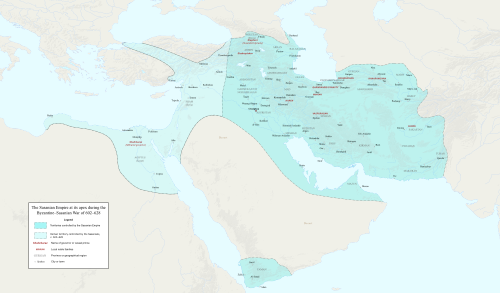
Vakhtang I of Iberia fights against growing Persian domination and renewed attempts of forcible conversion of Iberia, Armenia and Albania to Zoroastrianism. Source — Wikipedia, "Timeline of Georgian history" (5th century):
Map of the Sasanian Empire at its apex under Khosrow II. By Original file by Ro4444, edited by me - Based on several sources, including the Middle Persian geographical text Šahrestānīhā ī Ērānšahr, CC BY 4.0, https://commons.wikimedia.org/w/index.php?curid=94837349
526 CE
Iberian War
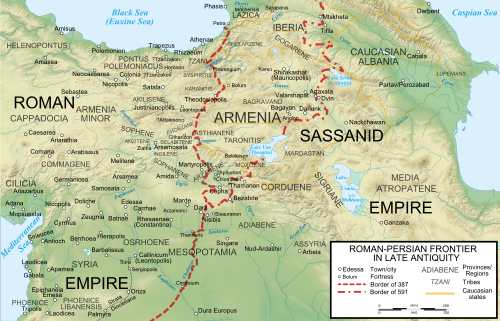
Iberian War Source — Wikipedia, "Timeline of Georgian history" (6th century):
The frontier between the Roman/Byzantine and Sassanid Persian empires in Late Antiquity (4th-7th centuries). Basemap taken from Image:Arshakuni Armenia 150-en.svg. Sources: G. Greatrex & S.N.C. Lieu: The Roman Eastern Frontier and the Persian Wars (Part II, 363–630 AD). Routledge 2002, ISBN 0-415-14687-9, pp. xxix–xxxii; R.W. Thomson, J. Howard-Johnston & T. Greenwood: The Armenian history attributed to Sebeos Liverpool University Press 1999, ISBN 0-85323-564-3, pp. 360–363; Map of the cities listed in Hierocles' Synecdemus after Ernest Honigmann, Le Synecdèmos d'Hiéroclès et l'opuscule géographique de Georges de Chypre, Brussels 1939 By Cplakidas - Own work, CC BY-SA 3.0, https://commons.wikimedia.org/w/index.php?curid=12023564
541 CE
Lazic War
Lazic War Source — Wikipedia, "Timeline of Georgian history" (6th century):
560 CE
Khosrow I
Khosrow I abolishes the king as a title of the Iberian ruler and incorporates Iberia into his Empire. Iberia becomes a mere province. Source — Wikipedia, "Timeline of Georgian history" (5th century):
Plate of the Sasanian king Khosrow I Anushirvan. By Unknown author - Own work, CC BY-SA 4.0, https://commons.wikimedia.org/w/index.php?curid=81374656
580 CE
Bacurius III of Iberia
Death of Bacurius, the last Chosroid ruler of Iberia and subsequent abolition of Iberian monarchy by Persians. Source — Wikipedia, "Timeline of Georgian history" (5th century):
Ancient Georgian (Iberian) Flag during King Gorgasali reign in 5c. AD. The flag was also used by the Principality of Iberia (lately Tao-Klarjeti) and its legal successor the Kingdom of The Georgians By Ec.Domnowall (vectorisation SVG) - crwflags.com, CC BY-SA 3.0, https://commons.wikimedia.org/w/index.php?curid=19195948
588 CE
Sassanid Empire
After the abolition of the monarchy by Sassanid Empire, Principate of Iberia is established with Guaram I of Iberia as its first ruler. Source — Wikipedia, "Timeline of Georgian history" (5th century):
Map of the Sasanian Empire at its apex under Khosrow II. By Original file by Ro4444, edited by me - Based on several sources, including the Middle Persian geographical text Šahrestānīhā ī Ērānšahr, CC BY 4.0, https://commons.wikimedia.org/w/index.php?curid=94837349
627 CE
Third Perso-Turkic War
Third Perso-Turkic War - Tbilisi, capital of the Principate of Iberia, whose ruler Stephen I of Iberia is an ally of the Khosrau II, is sacked by the combined forces of Turks and Byzantines. Source — Wikipedia, "Timeline of Georgian history" (7th century):
View of Tbilisi from Tabori Church By Alexey Komarov - Own work, CC BY-SA 4.0, https://commons.wikimedia.org/w/index.php?curid=138679634
654 CE
Arab rule in Georgia
First entry of Arabs into Georgian lands. Principate of Iberia, unable to resist the invaders on its own, surrenders and accepts the terms of vassalage. Source — Wikipedia, "Timeline of Georgian history" (7th century):
735 CE
Marwan ibn Muhammad's invasion of Georgia
Marwan ibn Muhammad's invasion of Georgia Source — Wikipedia, "Timeline of Georgian history" (8th century):
Political map of the Caucasus, c. 740 CE, following the end of the Arab-Khazar conflict and the consolidation of Umayyad power in Transcaucasia. Sources: Inspired by File:Kaukasus 750n de.svg, as an attempt to improve it and correct some errors and omissions. Background map taken from File:Caucasus_topographic_map-fr.svg. Literature and maps consulted: Khalid Yahya Blankinship (1994). The End of the Jihâd State: The Reign of Hishām ibn ʻAbd al-Malik and the Collapse of the Umayyads. Albany, NY: State University of New York Press. ISBN 978-0-7914-1827-7 William C. Brice (1981). An Historical Atlas of Islam. Leiden: E. J. Brill. ISBN 90-04-06116-9, p. 44 "Caucasus (Al-Qabq) in the Early Middle Ages" M. I. Artamonov (1962). История хазар. Издательство Государственного Эрмитажа, p. 200 Map 'The Caucasus in the 7th-8th centuries' Map "Armenia, 654-750 A.D." from armenica.org. Any errors are mine, and any suggestions for improvement and corrections are welcome. By Constantine Plakidas - Own work, CC BY-SA 4.0, https://commons.wikimedia.org/w/index.php?curid=70521469
1000 CE
Bagrat III of Georgia
Bagrat III of Georgia founds Kingdom of Georgia Source — Wikipedia, "Timeline of Georgian history" (10th century):
Bagrat III of Georgia, mural from Bedia Cathedral By Unknown author - Unknown source, Public domain, https://commons.wikimedia.org/w/index.php?curid=4548416
1040 CE
Seljuk Turks
Seljuk Turks invade Georgia. Source — Wikipedia, "Timeline of Georgian history" (11th century):
A double-headed eagle relief, 13th-century (Seljuk/Ayyubid period) architectural fragment found at Konya (now in Ince Minare Museum). It has also been suggested that the double-headed eagle may have been used as "personal insignia" by sultan Kayqubad I (r. 1220–1237).[1] This particular design has come to be seen as "symbol of Konya"[2] and is closlely associated with Konya's role as historical Seljuq capital. "The double eagle in the city's coat of arms is a symbol of the Seljuk reign a period crucial for Konya's self-perception until today."[3] A re-drawing of the same design is used as an official emblem by the municipality[4] An independent redrawing is used in the logo of Selçuk University, Konya, Turkey. By Fabienkhan modified by Ewan ar Born - Own work, CC BY-SA 2.5, https://commons.wikimedia.org/w/index.php?curid=4528575
1071 CE
Seljuk Turks
Byzantine-Georgian armies are defeated by Seljuk Turks at the Battle of Manzikert. Source — Wikipedia, "Timeline of Georgian history" (11th century):
A double-headed eagle relief, 13th-century (Seljuk/Ayyubid period) architectural fragment found at Konya (now in Ince Minare Museum). It has also been suggested that the double-headed eagle may have been used as "personal insignia" by sultan Kayqubad I (r. 1220–1237).[1] This particular design has come to be seen as "symbol of Konya"[2] and is closlely associated with Konya's role as historical Seljuq capital. "The double eagle in the city's coat of arms is a symbol of the Seljuk reign a period crucial for Konya's self-perception until today."[3] A re-drawing of the same design is used as an official emblem by the municipality[4] An independent redrawing is used in the logo of Selçuk University, Konya, Turkey. By Fabienkhan modified by Ewan ar Born - Own work, CC BY-SA 2.5, https://commons.wikimedia.org/w/index.php?curid=4528575
1089 CE
David IV of Georgia
At the age 16 King David IV of Georgia inherits the throne and organizes the army to combat the Seljuk invaders. Source — Wikipedia, "Timeline of Georgian history" (11th century):
David IV, detail from icon, St. Catherine Monastery. The Greek inscription reads: ΠΙΣΤΟ[Σ] ΒΑΣΙΛ[ΕΥΣ] ΠΑΣ[ΗΣ] ΑΝΑΤΟΛ[ΗΣ] Ὁ ΠΑΓΚΡΑΤΟΝΙΑΝΟΣ meaning “Pious Basileus (emperor) of all the East, Bagratonianos”. By Certain types of Egyptian works (official documents, stamps, works of national folklore) should use specific license tags instead of this generic tag. - David IV, Public domain, https://commons.wikimedia.org/w/index.php?curid=141561731
1121 CE
Battle of Didgori
At the Battle of Didgori Seljuks are defeated by the Georgians. Tbilisi and other Georgian lands go back to Georgia. Source — Wikipedia, "Timeline of Georgian history" (12th century):
_DSC1276 Georgia- Kutaisi- Gelati Monastery- Copy By John Wagner - _DSC1276 Georgia- Kutaisi- Gelati Monastery- Copy, CC BY-SA 2.0, https://commons.wikimedia.org/w/index.php?curid=52587361
1204 CE
Tamar of Georgia
Queen Tamar of Georgia conquers Black Sea coast of Byzantine Empire and Empire of Trebizond is created. She puts there as emperor her own relative Prince Alexios Komnenos. Source — Wikipedia, "Timeline of Georgian history" (13th century):
Betania Monastery, Tamar By 13th century painter - [1], Public domain, https://commons.wikimedia.org/w/index.php?curid=154004279
1400 CE
Timur
Timur invades Georgia, destroying most of the towns in western Georgia. Around 60,000 survivors were taken back to the Timurid Empire as slaves. Source — Wikipedia, "Timeline of Georgian history" (15th century):
File:Amir Timur (9333672292).jpg "Timur was a typical Mongoloid. His grandsons Ulugh-Beg and Mohammed Sultan were "hybrids" and in type closely ressembled the present-day town-dwelling Uzbeks. The sons Shah-Rukh and Miran-Shah possessed unmistakable features of a Tadjik type (Europoid of central Asia). Despite all these differences, aal five of these men belonged through blood-relationship to one family. This fact is undoubted." in Gerasimov, M. M. (Mikhail Mikhaĭlovich) (1971) The face finder, Philadelphia, J. B. Lippincott, p. 116 By user:shakko - Own work, CC BY-SA 3.0, https://commons.wikimedia.org/w/index.php?curid=9494028
1463 CE
Kingdom of Imereti
Self-declared King of Imereti Bagrat VI defeats George VIII forces in the Battle of Chikhori and ensures his power. Source — Wikipedia, "Timeline of Georgian history" (15th century):
Map of Caucasus Region 1490 By Goran tek-en - Own work Based on; Caucasus 1490 map de alt.svg, CC BY-SA 4.0, https://commons.wikimedia.org/w/index.php?curid=30891767
1483 CE
Atabeg
Self-declared Atabeg of Samtskhe Qvarqvare II Jaqeli assaults royal forces and defeats them in the Battle of Aradeti, therefore ensuring his power. Kingdom of Georgia finally collapses. Source — Wikipedia, "Timeline of Georgian history" (15th century):
Kitāb al-aghānī (“The Book of Songs”) by Abū al-Faraj al-Iṣbahānī By 13th century CE author (Abū al-Faraj al-Iṣbahānī) - [1], Public domain, https://commons.wikimedia.org/w/index.php?curid=143915569
1490 CE
Kingdom of Kartli
Governors of Kartli finally recognizes dissolution of Kingdom of Georgia. Source — Wikipedia, "Timeline of Georgian history" (15th century):
Georgian Kingdom of Kakheti, 1490 AD By Goran tek-en - This image has been extracted from another file, CC BY-SA 4.0, https://commons.wikimedia.org/w/index.php?curid=179524102
1795 CE
Agha Mohammed Khan
Agha Mohammed Khan invades Georgia, capturing and sacking Tbilisi. Eastern Georgia briefly re-occupied by the Iranians. Source — Wikipedia, "Timeline of Georgian history" (18th century):
A portrait of Agha Muhammad Khan, Persia, Qajar, dated 1795 painting: 17.5 by 11.5cm. gouache heightened with gold on paper, inscribed at the upper left, laid down on an album page, framed inscription: ‘al-Sultan Aqa Muhammad Khan Qajar 1210 (1795-6 AD)’ Agha Muhammad Khan was the founder of Qajar dynasty. By Sotheby's - https://www.sothebys.com/en/auctions/ecatalogue/2017/arts-of-the-islamic-world-l17223/lot.95.html, Public domain, https://commons.wikimedia.org/w/index.php?curid=110370550
1798 CE
Kartli-Kakheti
Civil war breaks out within Kartli following the death of Erekle II over the succession to the throne of Kartli, eventually taken by George XII. Source — Wikipedia, "Timeline of Georgian history" (18th century):
Kingdom of Kartli-Kakheti, 18th century AD By ArnoldPlaton, based on Georgia map 1762.svg - Own work, CC BY-SA 3.0, https://commons.wikimedia.org/w/index.php?curid=19166484
1799 CE
Russian Empire
Russians enter Tbilisi. Source — Wikipedia, "Timeline of Georgian history" (18th century):
Flag of Russia By Peter the Great - Государственный флаг Российской Федерации. Цвета флага: (Blue - Pantone 286 C, Red - Pantone 485 C) взяты из [1][2][3][4], Public domain, https://commons.wikimedia.org/w/index.php?curid=9450374
1810 CE
Imperial Russian Army
Russian Army invades and annexes Kingdom of Imereti. Source — Wikipedia, "Timeline of Georgian history" (19th century):
Emblem of the Ministry of the Interior of the Russian Empire By w:Ministry of the Interior of the Russian Empire Ралиф Мухаматнуров - Логотипы CorelDRAW скачать бесплатно Геральдика, Public domain, https://commons.wikimedia.org/w/index.php?curid=91420246
1858 CE
Principality of Svaneti
Principality of Svaneti was abolished by the Russian authorities and was converted into a district of Russian Empire. Source — Wikipedia, "Timeline of Georgian history" (19th century):
Made using the Vakhushti Bagrationi "Description of the Kingdom of Georgia, the habits and canons of Georgia" work. Coloring according to Map of Georgia by Prince Vakhushti Bagrationi.27.jpg By Athoremmes - Own work, CC0, https://commons.wikimedia.org/w/index.php?curid=153383268
1864 CE
Principality of Abkhazia
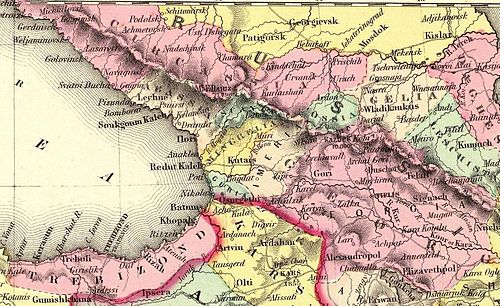
Principality of Abkhazia was abolished and incorporated in the Russian Empire, whereas Prince Mikhail Shervashidze was forced to reject his rights and resettle in Voronezh. Source — Wikipedia, "Timeline of Georgian history" (19th century):
Turkey In Asia And The Caucasian Provinces Of Russia. Published By J.H. Colton & Co. No. 172 William St. New York. Entered ... 1855 by J.H. Colton & Co. ... New York. No. 25 By George Woolworth Colton - This image has an extracted file: Colton, G.W. Turkey In Asia And The Caucasian Provinces Of Russia. 1856.jpg. * Original from: www.davidrumsey.com, Public domain, https://commons.wikimedia.org/w/index.php?curid=11293780
1867 CE
Niko I Dadiani
Niko Dadiani was deposed and Principality of Mingrelia was abolished and incorporated in the Russian Empire. Source — Wikipedia, "Timeline of Georgian history" (19th century):
Niko Dadiani, last Prince of Mingrelia; 1847-1903 By unknown painter (неизвестный художник) - Zugdidi Dadiani Palace, Public domain, https://commons.wikimedia.org/w/index.php?curid=10588620
Apr 22, 1918 CE
Transcaucasian Democratic Federative Republic
Transcaucasian Democratic Federative Republic established. Source — Wikipedia, "Timeline of Georgian history" (20th century):
1918 map of the Caucasus by the British Army, with 1919 borders drawn in. By Great Britain. Army. Royal Engineers. Field Survey Co., 8th - https://collections.lib.uwm.edu/digital/collection/agdm/id/1715, Public domain, https://commons.wikimedia.org/w/index.php?curid=77194713
May 26, 1918 CE
Democratic Republic of Georgia
Democratic Republic of Georgia established. Source — Wikipedia, "Timeline of Georgian history" (20th century):
Flag of Georgia (1918-1921; 1990–2004), as per the legal code (actual flags often differed from this) By Vector version: Giorgi Balakhadze. Original: Iakob Nikoladze - Own work, CC BY-SA 4.0, https://commons.wikimedia.org/w/index.php?curid=69423969
Transcaucasian Democratic Federative Republic disestablished. Source — Wikipedia, "Timeline of Georgian history" (20th century):
Feb 25, 1921 CE
Democratic Republic of Georgia
Democratic Republic of Georgia annexed by the Bolshevik forces of the Soviet Union, following an invasion which begin 14 days earlier on the 11th. Source — Wikipedia, "Timeline of Georgian history" (20th century):
Flag of Georgia (1918-1921; 1990–2004), as per the legal code (actual flags often differed from this) By Vector version: Giorgi Balakhadze. Original: Iakob Nikoladze - Own work, CC BY-SA 4.0, https://commons.wikimedia.org/w/index.php?curid=69423969
Apr 14, 1978 CE
1978 Georgian demonstrations
A wave of demonstrations were held in Tbilisi to protest adopting a new constitution of the Soviet Georgia, no longer declaring Georgian to be the sole state language. Protests resulted in retaining the previous status of the Georgian language. Source — Wikipedia, "Timeline of Georgian history" (20th century):
Distribution of the Kartvelian (South Caucasian) languages. By ArnoldPlaton, based on File:Early Georgian States Colchis And Iberia.svg and this map - Own work, CC BY-SA 3.0, https://commons.wikimedia.org/w/index.php?curid=18373890
1991 CE
1991–1992 South Ossetia War
South Ossetia War. Source — Wikipedia, "Timeline of Georgian history" (20th century):
Map of location and division in South Ossetia until 2008 Russo-Georgian War By Nahabino - This vector image includes elements that have been taken or adapted from this file:, CC BY-SA 4.0, https://commons.wikimedia.org/w/index.php?curid=133268025
1991 CE
Zviad Gamsakhurdia elected as the first
Zviad Gamsakhurdia elected as the first President of Georgia. Source — Wikipedia, "Timeline of Georgian history" (20th century):
1991 CE
Georgian civil war of 1991–1993
Georgian Civil War Source — Wikipedia, "Timeline of Georgian history" (20th century):
Georgian Civil War July-October By Kami888 - Own work by uploader, based on ArdadN's 2008 South Ossetia map derived from Wikipedia and the CIA regional map of 1994., Public domain, https://commons.wikimedia.org/w/index.php?curid=5178613
1991 CE
Zviad Gamsakhurdia
Zviad Gamsakhurdia overthrowed by the military junta. Source — Wikipedia, "Timeline of Georgian history" (20th century):
Leader of Georgian independence movement in late 80s, Zviad Gamsakhurdia. This photo taken in 1989 in Tbilisi during pro-independence rallies By George barateli by George Barateli in 1989 - This image has been extracted from another file, Public domain, https://commons.wikimedia.org/w/index.php?curid=12866929
1992 CE
War in Abkhazia
War in Abkhazia. Source — Wikipedia, "Timeline of Georgian history" (20th century):
Бійці УНА-УНСО в Грузії By Unknown author - Надано Історичною правдою для публікації на Вікіпедії, GFDL, https://commons.wikimedia.org/w/index.php?curid=118629880
1995 CE
Eduard Shevardnadze
Eduard Shevardnadze elected as the President of Georgia. Source — Wikipedia, "Timeline of Georgian history" (20th century):
President Eduard Shevardnadze of Georgia photographed during a meeting with Secretary of Defense William Cohen at the Pentagon on July 17, 1997 By Robert D. Ward - This tag does not indicate the copyright status of the attached work. A normal copyright tag is still required. See Commons:Licensing., Public domain, https://commons.wikimedia.org/w/index.php?curid=154420078
2003 CE
Rose Revolution
The Rose Revolution resulted in overthrow of incumbent President Eduard Shevardnadze. Source — Wikipedia, "Timeline of Georgian history" (21st century):
Tbilisi, Rose Revolution 2003. By Zaraza, CC BY-SA 3.0, https://commons.wikimedia.org/w/index.php?curid=1668494
2004 CE
Mikheil Saakashvili
Mikheil Saakashvili elected as the new President of Georgia. Source — Wikipedia, "Timeline of Georgian history" (21st century):
Бывший президент Грузии Михаил Саакашвили. By Виталий Носач / РБК-Украина - Украинский консул посетил Саакашвили в грузинской тюрьме, - МИД, CC BY 4.0, https://commons.wikimedia.org/w/index.php?curid=178892206
2004 CE
2004 Adjara crisis
The Adjara Revolution restored semi-independent region under control of the central government of Georgia. Source — Wikipedia, "Timeline of Georgian history" (21st century):
The location of Adjara region in Georgia. By This work is created by George Melashvili. You can redistribute it or modify it under the terms of the terms of Cc-by-sa-3.0 (See below) - Own work, CC BY-SA 3.0, https://commons.wikimedia.org/w/index.php?curid=10455622
2008 CE
Russo-Georgian War
Russo-Georgian War. Source — Wikipedia, "Timeline of Georgian history" (21st century):
Ruins of a burnt apartment building where sixteen people were killed and thirteen others injured are observed by members of U.S. European Command’s Joint Assessment team in Gori, Republic of Georgia, Aug. 25, 2008. Residents of Gori begin to return home and start to clean up their city following the recent conflict between Russia and Georgia. The Assessment team and officials from the government of Georgia tour the embattled city to assess the level of damage, status of relief efforts, and the return of displaced persons. By Lt. Jim Hoeft, U.S. Navy - http://www.defenseimagery.mil/; VIRIN: 080825-N-0629H-017, Public domain, https://commons.wikimedia.org/w/index.php?curid=4705253
2012 CE
Georgian Dream
Georgian Dream defeats the United National Movement party of incumbent President Mikheil Saakashvili in the parliamentary election. Source — Wikipedia, "Timeline of Georgian history" (21st century):
Logo of the Georgian Dream By Georgian Dream - Own work using: http://gd.ge/, Public domain, https://commons.wikimedia.org/w/index.php?curid=107426763




![A double-headed eagle relief, 13th-century (Seljuk/Ayyubid period) architectural fragment found at Konya (now in Ince Minare Museum). It has also been suggested that the double-headed eagle may have been used as "personal insignia" by sultan Kayqubad I (r. 1220–1237).[1] This particular design has come to be seen as "symbol of Konya"[2] and is closlely associated with Konya's role as historical Seljuq capital. "The double eagle in the city's coat of arms is a symbol of the Seljuk reign a period crucial for Konya's self-perception until today."[3] A re-drawing of the same design is used as an official emblem by the municipality[4] An independent redrawing is used in the logo of Selçuk University, Konya, Turkey.](https://upload.wikimedia.org/wikipedia/commons/thumb/3/31/Ince_minare_sculpture_1.jpg/500px-Ince_minare_sculpture_1.jpg)
![David IV, detail from icon, St. Catherine Monastery. The Greek inscription reads: ΠΙΣΤΟ[Σ] ΒΑΣΙΛ[ΕΥΣ] ΠΑΣ[ΗΣ] ΑΝΑΤΟΛ[ΗΣ] Ὁ ΠΑΓΚΡΑΤΟΝΙΑΝΟΣ meaning “Pious Basileus (emperor) of all the East, Bagratonianos”.](https://upload.wikimedia.org/wikipedia/commons/thumb/2/2a/David_IV%2C_detail_from_icon%2C_St._Catherine_Monastery.jpg/500px-David_IV%2C_detail_from_icon%2C_St._Catherine_Monastery.jpg)