Encyclopedia/3. History, Societies & Civilizations/09. Modern Nations/01. Africa • Curated by Admin Timeline.sg
History of Botswana (AI-generated, sourced to Wikipedia).
Chronological Storyline (29 Milestones)
70000 BCE
Stone Age inhabitants
Middle Stone Age tools found at sites like the Tsodilo Hills indicate early human habitation in what is now Botswana by San hunter-gatherer populations. Source — Wikipedia, "Botswana":
Tsodilo rock paintings, Botswana By cj Huo - cropped version of [1], CC BY-SA 1.0, https://commons.wikimedia.org/w/index.php?curid=3827662
500 CE
Bantu migration arrives
Bantu-speaking agro-pastoralists migrate into the region, introducing ironworking, agriculture, and cattle-keeping, gradually displacing or absorbing indigenous Khoisan peoples. Source — Wikipedia, "Botswana":
Spread of the "Early Iron Age" in Eastern, Central and Southern Africa, a proxy for the Bantu migrations. Based on K. Shillington, History of Africa (3rd ed. 2005), p. 63. Urewe (Lake Victoria) 250 BCE, Kwale 200 CE, Kisale 300 CE, , Kalundu/Dambwa 100 CE , Kalambo 300 CE, Nkope 300 CE, Gokmere-Ziwa/Bambata 300 CE, presence in South Africa (Kei river) by 400 CE. By Unknown author - East&southern africa early iron age.gif, Public domain, https://commons.wikimedia.org/w/index.php?curid=5444722
1500 CE
Tswana chiefdoms form
Distinct Tswana-speaking chiefdoms such as the Bakwena, Bangwaketse, and Bangwato consolidate in the eastern hardveld, establishing the political structures that define the region. Source — Wikipedia, "Botswana":
Bella, from the book Seven Years in South Africa, volume 2, page 454 By Unknown author - File:Seven Years in South Africa v2.pdf, Public domain, https://commons.wikimedia.org/w/index.php?curid=90742694
1700 CE
Bangwato kingdom rises
The Bangwato kingdom under Kgosi Mathiba emerges as a major power in northeastern Botswana, controlling vast territories and trade routes. Source — Wikipedia, "Botswana":
Flag of Botswana By SKopp, Gabbe, Madden - Drawn by User:SKopp, rewritten by Gabbe, Madden. Based on this construction sheet:, Public domain, https://commons.wikimedia.org/w/index.php?curid=342990
1823 CE
Difaqane upheavals
The Mfecane/Difaqane, triggered by Zulu expansion under Shaka, sends displaced groups such as the Kololo and Ndebele through Botswana, causing widespread disruption and population movement. Source — Wikipedia, "Botswana":
Difaqane upheavals By Unknown author, Public domain, https://commons.wikimedia.org/w/index.php?curid=6309730
1841 CE
Livingstone arrives
Scottish missionary David Livingstone begins work among the Bakwena at Kolobeng, introducing Christianity and literacy while forging close ties with Kgosi Sechele I. Source — Wikipedia, "Botswana":
"David Livingstone, 1813 - 1873. Missionary and explorer", a carbon print of a photograph by Thomas Annan, 36.90 x 30.20 cm. Gift to the National Galleries of Scotland by T & R Annan and Sons, 1930 Restoration notes This was an interesting one. Quality was absolutely superb; detail's incredible. Printing technology is often what holds back image detail in this period, and the paper texture is really pretty much unnoticable at this scale. In any case, this is excellent work. This does show up some flaws. One knee is pretty badly out of focus. The edges had some pretty major damage, lower right hand corner was probably the worst. The background was very dirty - probably because people selectively handled it - but since that's just a smooth bokeh it's not that big of a deal; any minor variance from the original is not meaningful. Some noticable damage around the edges of a sharp transition from light to dark ; that might be some chemical thing, like dye leeching, might just be particularly noticable since it's more precise work; in any case, I fixed it. By Thomas Annan / Adam Cuerden - National Galleries of Scotland Accession number: PGP 74.2, Public domain, https://commons.wikimedia.org/w/index.php?curid=6887585
1852 CE
Battle of Dimawe
A coalition of Tswana merafe led by Sechele I repels Boer commandos at Dimawe, resisting Transvaal encroachment and asserting Tswana sovereignty. Source — Wikipedia, "Botswana":
Sechele, chief of the Kwena tribe of Botswana and early Christian missionary. According to Keith Dietrich and Andrew Bank in An eloquent picture gallery : the South African portrait photographs of Gustav Theodor Fritsch, 1863 - 1865 (2008): "Sechele was happy to be photographed and dressed himself for the occasion in a black ‘dress’ with a colourful silk cravat, ‘fez’, ‘mackintosh’ and riding boots, which, Fritsch noted, he wore on Sundays when he preached. Fritsch gave Sechele an albumen print of his portrait that included the fez, though the photograph used for his book excluded this. Fritsch also recalled that Sechele was very disappointed that the photograph did not include his boots". By Gustav Theodor Fritsch (1838–1927) - According to Dietrich and Bank (2008), the original is at the Ethnologisches Museum, Staatliche Museen zu Berlin, Stiftung Preußischer Kulturbesitz but the scanned file was taken from SUNScholar Research Repository at Stellenbosch University, Public domain, https://commons.wikimedia.org/w/index.php?curid=25182581
1875 CE
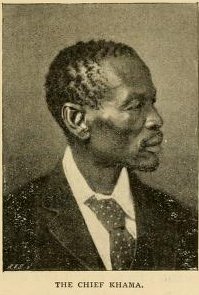
Khama III enacts reforms
Kgosi Khama III of the Bangwato implements Christian-inspired reforms, banning alcohol and promoting education and modern governance within his kingdom. Source — Wikipedia, "Botswana":
Photograph of Chief Khama III ("Khama the Good") By Photograph by S.B. Bernard, Cape Town - Twenty years in Khama's country, and, pioneering among the Batauana of Lake Ngami; (1896) - Page 15, Public domain, https://commons.wikimedia.org/w/index.php?curid=30584611
Mar 31, 1885 CE
Bechuanaland Protectorate
Britain declares the Bechuanaland Protectorate, partly at the request of Tswana chiefs seeking protection against Boer and German expansion in the region. Source — Wikipedia, "Botswana":
Flag of the United Kingdom, Union Jack or Union Flag in a 1:2 ratio (typical on British warships and also the rank flag of an admiral of the fleet). By Original: Acts of Union 1800 Vector: Zscout370 - Own work based on: United Kingdom at Flag of the World United Kingdom Flag at the Flag Institute, Public domain, https://commons.wikimedia.org/w/index.php?curid=347935
Sep 11, 1895 CE
Three Dikgosi visit Britain
Chiefs Khama III, Bathoen I, and Sebele I travel to London to successfully persuade the British government not to transfer their lands to the British South Africa Company. Source — Wikipedia, "Botswana":
Flag of Botswana By SKopp, Gabbe, Madden - Drawn by User:SKopp, rewritten by Gabbe, Madden. Based on this construction sheet:, Public domain, https://commons.wikimedia.org/w/index.php?curid=342990
Oct 11, 1899 CE
Anglo-Boer War begins
The Second Anglo-Boer War erupts, with Bechuanaland serving as a strategic corridor for British forces and some Batswana serving as scouts and auxiliaries. Source — Wikipedia, "Botswana":
A Collage of Major Battles and Events during the Second Boer War Clockwise from left: Boers in action at the Battle of Colenso, the 17th Lancers holding of an attack at Modderfontein, General Redvers Buller entering Ladysmith on 27 Feb 1900, Boers at the besieged city of Mafeking, Canadian Troops during the Battle of Paardeberg, and Boers before action at Spion Kop. By The British Army and The Illustrated London News, Public domain, https://commons.wikimedia.org/w/index.php?curid=140253010
May 31, 1910 CE
Union of South Africa
The Union of South Africa is formed; Bechuanaland remains a British High Commission Territory, narrowly avoiding incorporation into the new dominion. Source — Wikipedia, "Botswana":
Flag of the High Commissioner for Southern Africa between 1907–1931. By Great Brightstar - This vector image includes elements that have been taken or adapted from this file:, CC BY-SA 4.0, https://commons.wikimedia.org/w/index.php?curid=92573677
1920 CE
Advisory Council created
Britain establishes the African Advisory Council and European Advisory Council, giving Batswana limited formal representation in protectorate governance for the first time. Source — Wikipedia, "Botswana":
Flag of the United Kingdom, Union Jack or Union Flag in a 1:2 ratio (typical on British warships and also the rank flag of an admiral of the fleet). By Original: Acts of Union 1800 Vector: Zscout370 - Own work based on: United Kingdom at Flag of the World United Kingdom Flag at the Flag Institute, Public domain, https://commons.wikimedia.org/w/index.php?curid=347935
Oct 1, 1948 CE
Seretse Khama marries
Seretse Khama, heir to the Bangwato chieftainship, marries Englishwoman Ruth Williams in London, sparking a political crisis with Britain and South Africa's apartheid regime. Source — Wikipedia, "Botswana":
Seretse Khama, President of Botswana (1966-1980), visited the CEC and the EP. By European Communities Director: Allan Watson Architect: Jean Polak,Jean Gilson,Lucien De Vestel,André Polak - [1], CC BY 4.0, https://commons.wikimedia.org/w/index.php?curid=166419447
1950 CE
Seretse Khama exiled
Under pressure from South Africa, Britain exiles Seretse Khama from Bechuanaland, barring him from returning for six years and intensifying political consciousness among Batswana. Source — Wikipedia, "Botswana":
Seretse Khama, President of Botswana (1966-1980), visited the CEC and the EP. By European Communities Director: Allan Watson Architect: Jean Polak,Jean Gilson,Lucien De Vestel,André Polak - [1], CC BY 4.0, https://commons.wikimedia.org/w/index.php?curid=166419447
1956 CE
Khama returns home
Seretse Khama is allowed to return to Bechuanaland, renounces his claim to the Bangwato chieftainship, and begins organizing politically for self-government and decolonization. Source — Wikipedia, "Botswana":
Seretse Khama, President of Botswana (1966-1980), visited the CEC and the EP. By European Communities Director: Allan Watson Architect: Jean Polak,Jean Gilson,Lucien De Vestel,André Polak - [1], CC BY 4.0, https://commons.wikimedia.org/w/index.php?curid=166419447
1962 CE
BDP founded
Seretse Khama founds the Bechuanaland Democratic Party, uniting traditional leaders and modernists to campaign for independence through peaceful constitutional means. Source — Wikipedia, "Botswana":
Flag of the Botswana Democratic Party (BDP) By Mangwanani - Own work, Public domain, https://commons.wikimedia.org/w/index.php?curid=3779377
Mar 1, 1965 CE
Self-government achieved
Bechuanaland gains internal self-government following elections won by the BDP, and the administrative capital is moved from Mafikeng to the new town of Gaborone. Source — Wikipedia, "Botswana":
View from the top of the I-Tower (restaurant) southeast, with the centre of Gaborone and the Gaborone Dam in the background By CNJerem - Own work, CC BY 4.0, https://commons.wikimedia.org/w/index.php?curid=112099721
Sep 30, 1966 CE
Botswana gains independence
The Republic of Botswana becomes an independent sovereign nation within the Commonwealth, with Seretse Khama as its first president. Source — Wikipedia, "Botswana":
Flag of Botswana By SKopp, Gabbe, Madden - Drawn by User:SKopp, rewritten by Gabbe, Madden. Based on this construction sheet:, Public domain, https://commons.wikimedia.org/w/index.php?curid=342990
1967 CE
Orapa diamonds discovered
Geologists discover the Orapa diamond pipe, one of the world's largest, transforming Botswana's economic prospects and laying the foundation for future prosperity. Source — Wikipedia, "Botswana":
The Orapa diamond mine is the world's largest diamond mine by area. The mine is located in Botswana. It is the oldest of four mines operated by the same company, having begun operations in 1971. Orapa is an open pit style of mine, located on two kimberlite pipes. Currently, the Orapa mine annually produces approximately 11 million carats (2200 kg) of diamonds. The Letlhakane diamond mine is also an open pit construction. In 2003, the Letlhakane mine produced 1.06 million carats of diamonds. The Damtshaa diamond mine is the newest of four mines, located on top of four distinct kimberlite pipes of varying ore grade. The mine is forecast to produce about 5 million carats of diamond over the projected 31 year life of the mine. The image was acquired October 5, 2014, covers an area of 28 by 45 km, and is located at 21.3 degrees south, 25.4 degrees east. By NASA/METI/AIST/Japan Space Systems, and U.S./Japan ASTER Science Team - This image or video was catalogued by Jet Propulsion Laboratory of the United States National Aeronautics and Space Administration (NASA) under Photo ID: orapa., Public domain, https://commons.wikimedia.org/w/index.php?curid=133847400
Aug 23, 1976 CE
Pula currency introduced
Botswana launches its own currency, the pula, replacing the South African rand and symbolizing the young nation's economic sovereignty. Source — Wikipedia, "Botswana":
Flag of Botswana By SKopp, Gabbe, Madden - Drawn by User:SKopp, rewritten by Gabbe, Madden. Based on this construction sheet:, Public domain, https://commons.wikimedia.org/w/index.php?curid=342990
Jul 13, 1980 CE
Seretse Khama dies
Botswana's founding president Seretse Khama dies in office and is succeeded by his vice president Quett Masire, ensuring a smooth democratic transition. Source — Wikipedia, "Botswana":
Seretse Khama, President of Botswana (1966-1980), visited the CEC and the EP. By European Communities Director: Allan Watson Architect: Jean Polak,Jean Gilson,Lucien De Vestel,André Polak - [1], CC BY 4.0, https://commons.wikimedia.org/w/index.php?curid=166419447
Jun 14, 1985 CE
SADF raids Gaborone
South African Defence Force commandos raid Gaborone, killing 12 people in an attack on suspected ANC targets, drawing international condemnation. Source — Wikipedia, "Botswana":
Flag of Botswana By SKopp, Gabbe, Madden - Drawn by User:SKopp, rewritten by Gabbe, Madden. Based on this construction sheet:, Public domain, https://commons.wikimedia.org/w/index.php?curid=342990
Apr 1, 1998 CE
Mogae becomes president
Festus Mogae succeeds Quett Masire as president, continuing Botswana's tradition of democratic succession and overseeing economic diversification efforts. Source — Wikipedia, "Botswana":
Festus Mogae By Greenweek - Flickr: Festus Mogae, CC BY 2.0, https://commons.wikimedia.org/w/index.php?curid=56518622
2002 CE
National HIV treatment program
Botswana launches one of Africa's first national antiretroviral treatment programs, responding to one of the world's highest HIV prevalence rates with decisive public health action. Source — Wikipedia, "Botswana":
Flag of Botswana By SKopp, Gabbe, Madden - Drawn by User:SKopp, rewritten by Gabbe, Madden. Based on this construction sheet:, Public domain, https://commons.wikimedia.org/w/index.php?curid=342990
Apr 1, 2008 CE
Ian Khama becomes president
Ian Khama, son of Seretse Khama, becomes president after Festus Mogae's retirement, continuing the BDP's dominance while emphasizing discipline and conservation. Source — Wikipedia, "Botswana":
President Ian Khama of Botswana at the London Conference on The Illegal Wildlife Trade, 13 February 2014 By Foreign and Commonwealth Office - https://www.flickr.com/photos/foreignoffice/12498848125/, OGL v1.0, https://commons.wikimedia.org/w/index.php?curid=79907534
Jun 22, 2014 CE
Okavango Delta UNESCO site
The Okavango Delta is inscribed as a UNESCO World Heritage Site, recognizing its extraordinary biodiversity and reinforcing Botswana's commitment to conservation. Source — Wikipedia, "Botswana":
View on the Okavango Delta By Joachim Huber - originally posted to Flickr as Okavango Delta, Botswana, CC BY-SA 2.0, https://commons.wikimedia.org/w/index.php?curid=4728300
Apr 1, 2018 CE
Masisi becomes president
Mokgweetsi Masisi succeeds Ian Khama as president, but tensions between the two men soon reshape Botswana's political landscape. Source — Wikipedia, "Botswana":
On May 3, 2023, WIPO Director General Daren Tang (right) met with Dr. Mokgweetsi Masisi, President of Botswana, during an official visit of a Botswanan delegation to the WIPO Headquarters in Geneva. Director General Tang and President Masisi discussed synergies between Botswana’s “Vision 2036” and WIPO’s work to bring intellectual property (IP) to all, and agreed to explore new ways of working together to further strengthen Botswana’s IP ecosystem. Video: President of Botswana Visits WIPO Copyright: WIPO. Photo: Emmanuel Berrod. This work is licensed under a Creative Commons Attribution 4.0 International License. By World Intellectual Property Organization - https://www.flickr.com/photos/wipo/52867133962/, CC BY 2.0, https://commons.wikimedia.org/w/index.php?curid=132701175
Nov 1, 2024 CE
Duma Boko wins election
Opposition leader Duma Boko of the Umbrella for Democratic Change defeats the BDP, ending nearly 58 years of single-party dominance in a historic democratic transition. Source — Wikipedia, "Botswana":
Secretary Marco Rubio meets with Botswana President Duma Boko at the Department of State in Washington, D.C., March 7, 2025. (Official State Department photo by Freddie Everett) By U.S. Department of State - https://www.flickr.com/photos/9364837@N06/54371412631/, Public domain, https://commons.wikimedia.org/w/index.php?curid=161773884