Encyclopedia/3. History, Societies & Civilizations/09. Modern Nations/03. Central Asia • Curated by Admin Timeline.sg
History of Tajikistan (AI-generated, sourced to Wikipedia).
Chronological Storyline (38 Milestones)
1000 BCE
Early settlement in region
Indo-Iranian tribes inhabited the territory of present-day Tajikistan, establishing agricultural communities in river valleys. Source — Wikipedia, "Tajikistan":
Ismoili Somoni Statue Abū Ibrāhīm Ismā'īl ibn Aḥmad (Persian: ابو ابراهیم اسماعیل بن احمد سامانی; May 849 – November 907), better simply known as Isma'il ibn Ahmad (اسماعیل بن احمد), and also known as Ismail Samani (اسماعیل سامانی), was the Samanid emir of Transoxiana (892–907) and Khorasan (900–907). His reign saw the emergence of the Samanids as a powerful force. He was the son of Ahmad ibn Asad and a descendant of Saman Khuda, the eponymous ancestor of the Samanid dynasty who renounced Zoroastrianism and embraced Islam. Isma'il is known in history as a competent general and a strong ruler; many stories about him are written in Arabic and Persian sources. According to a Bukharian historian writing in 943 stated that Ismail: "Was indeed worthy and right for padishahship. He was intelligent, just, compassionate person, one possessing reason and prescience...he conducted affairs with justice and good ethics. Whoever tyrannize people he would punish...In affairs of state he was always impartial." The celebrated scholar Nizam al-Mulk, in his famous work, Siyasatnama, stated that Ismail: "Was extremely just, and his good qualities were many. He had pure faith in God (to Him be power and glory) and he was generous to the poor – to name only one of his notable virtues. With the end of Soviet Union dominion in Central Asia, Ismail's legacy was rediscovered and rehabilitated. The Somoni currency of Tajikistan is named after Ismail. Also, the highest mountain in Tajikistan (and in the former Soviet Union) is named after Ismail. The mountain was formerly known as "Stalin Peak" and "Communism Peak" but was subsequently changed to the Ismoil Somoni Peak. (Wikipedia) By Ninara from Helsinki, Finland - Modern Center of Dushanbe, Tajikistan, CC BY 2.0, https://commons.wikimedia.org/w/index.php?curid=74267899
546 BCE
Achaemenid conquest
Cyrus the Great incorporated Central Asian lands including Bactria and Sogdiana into the Achaemenid Empire. Source — Wikipedia, "Tajikistan":
Achaemenid Empire 500 BCE By Cattette - This image has been extracted from another file, CC BY 4.0, https://commons.wikimedia.org/w/index.php?curid=113179532
329 BCE
Alexander captures Sogdiana
Alexander the Great conquered Sogdiana and Bactria, facing fierce resistance including that of Spitamenes. Source — Wikipedia, "Tajikistan":
Alexander Mosaic (detail), House of the Faun, Pompeii By Unknown author - This image has been extracted from another file, Public domain, https://commons.wikimedia.org/w/index.php?curid=182741814
250 BCE
Greco-Bactrian Kingdom
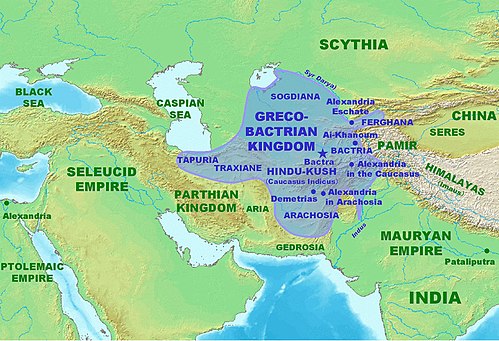
The Hellenistic Greco-Bactrian Kingdom emerged, blending Greek and local cultures across Bactria and Sogdiana. Source — Wikipedia, "Tajikistan":
Map of the Greco-Bactrian at its maximum extent, circa 180 BC. Personal creation. By No machine-readable author provided. World Imaging assumed (based on copyright claims). - Own work using: Martinez-Sève, Laurianne (2020) "Afghan Bactria" in Mairs, Rachel, ed. The Graeco-Bactrian and Indo-Greek World (1st ed.), London: Routledge, pp. 218–219 DOI: 10.4324/9781315108513-13. ISBN: 9781315108513., CC BY-SA 3.0, https://commons.wikimedia.org/w/index.php?curid=1603341
100 CE
Kushan Empire rises
The Kushan Empire controlled the region, fostering trade along the Silk Road and the spread of Buddhism. Source — Wikipedia, "Tajikistan":
Map of the Kushan Empire By Map created from DEMIS Mapserver, which are public domain. Koba-chan. Reference: Schwartzberg Atlas, v. , p. 145. Map g - This image has been extracted from another file, CC BY-SA 3.0, https://commons.wikimedia.org/w/index.php?curid=115482936
410 CE
Hephthalite domination
The Hephthalites (White Huns) conquered Central Asian territories, ruling over Sogdiana and Bactria. Source — Wikipedia, "Tajikistan":
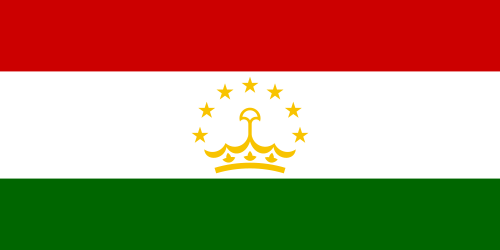
Flag of Tajikistan By Unknown author - Unknown sourceUnknown source. Construction sheet., Public domain, https://commons.wikimedia.org/w/index.php?curid=433200
710 CE
Arab conquest reaches region
Arab forces of the Umayyad Caliphate brought Islam to Central America, replacing Zoroastrian and Buddhist traditions. Source — Wikipedia, "Tajikistan":
Arabs besieging the city of Samarkand, captured in 722 CE, Palace of Devastich (706-722), Penjikent mural By Photographer: The State Hermitage Museum - [1] 8th century CE mural PD-Art: Non-creative photograph of a two-dimensional work of art in the Public Domain (8th century CE), Public domain, https://commons.wikimedia.org/w/index.php?curid=95370445
819 CE
Samanid dynasty founded
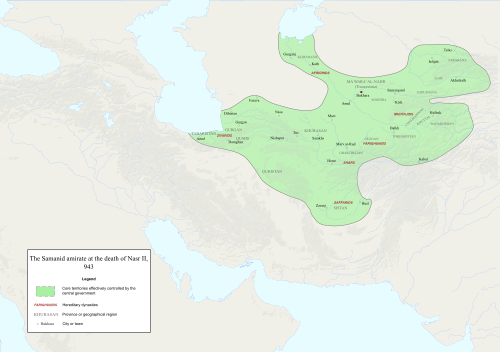
The Samanid dynasty established itself in Transoxiana, inaugurating a golden age of Persian culture and science. Source — Wikipedia, "Tajikistan":
Map of the Samanid amirate at the death of Nasr II. By Original file by Ro4444, edited by me - Map is mainly based on two maps of mid 10th-century Central Asia under the Samanids in the pages 23 and 25 of An Historical Atlas of Central Asia, written by Yuri Bregel and published by Brill, supplied by NAṢR (I) B. AḤMAD (I) B. ESMĀʿIL [1] and Frye, R. N. (1975). "The Sāmānids". In Frye, Richard N. (ed.). The Cambridge History of Iran, Volume 4: From the Arab Invasion to the Saljuqs. Cambridge: Cambridge University Press. pp. 136–161. Since the maps in the source "only" showed Central Asia, I was missing very few parts of the southern border of the Samanids, which I used the following sources to construct; Frye, R. N. (1975). "The Sāmānids". In Frye, Richard N. (ed.). The Cambridge History of Iran, Volume 4: From the Arab Invasion to the Saljuqs. Cambridge: Cambridge University Press. Page 139. ISBN 0-521-20093-8. O'Neal, Michael (2015). "Ghūrids". In Fleet, Kate; Krämer, Gudrun; Matringe, Denis; Nawas, John; Rowson, Everett (eds.). Encyclopaedia of Islam, THREE. Brill Online. ISSN 1873-9830 SISTĀN ii. In the Islamic period [2] SAFFARIDS [3] NAṢR (I) B. AḤMAD (I) B. ESMĀʿIL [4], CC BY-SA 4.0, https://commons.wikimedia.org/w/index.php?curid=94665967
892 CE
Isma'il Samani takes power
Isma'il Samani became the emir, uniting Transoxiana and Khorasan under Samanid rule from Bukhara. Source — Wikipedia, "Tajikistan":
Ismoili Somoni Statue Abū Ibrāhīm Ismā'īl ibn Aḥmad (Persian: ابو ابراهیم اسماعیل بن احمد سامانی; May 849 – November 907), better simply known as Isma'il ibn Ahmad (اسماعیل بن احمد), and also known as Ismail Samani (اسماعیل سامانی), was the Samanid emir of Transoxiana (892–907) and Khorasan (900–907). His reign saw the emergence of the Samanids as a powerful force. He was the son of Ahmad ibn Asad and a descendant of Saman Khuda, the eponymous ancestor of the Samanid dynasty who renounced Zoroastrianism and embraced Islam. Isma'il is known in history as a competent general and a strong ruler; many stories about him are written in Arabic and Persian sources. According to a Bukharian historian writing in 943 stated that Ismail: "Was indeed worthy and right for padishahship. He was intelligent, just, compassionate person, one possessing reason and prescience...he conducted affairs with justice and good ethics. Whoever tyrannize people he would punish...In affairs of state he was always impartial." The celebrated scholar Nizam al-Mulk, in his famous work, Siyasatnama, stated that Ismail: "Was extremely just, and his good qualities were many. He had pure faith in God (to Him be power and glory) and he was generous to the poor – to name only one of his notable virtues. With the end of Soviet Union dominion in Central Asia, Ismail's legacy was rediscovered and rehabilitated. The Somoni currency of Tajikistan is named after Ismail. Also, the highest mountain in Tajikistan (and in the former Soviet Union) is named after Ismail. The mountain was formerly known as "Stalin Peak" and "Communism Peak" but was subsequently changed to the Ismoil Somoni Peak. (Wikipedia) By Ninara from Helsinki, Finland - Modern Center of Dushanbe, Tajikistan, CC BY 2.0, https://commons.wikimedia.org/w/index.php?curid=74267899
999 CE
Karakhanids overthrow Samanids
The Turkic Karakhanid dynasty captured Bukhara, ending Samanid rule and shifting power to Turkic dynasties. Source — Wikipedia, "Tajikistan":
Flag of Tajikistan By Unknown author - Unknown sourceUnknown source. Construction sheet., Public domain, https://commons.wikimedia.org/w/index.php?curid=433200
1219 CE
Mongol invasion devastates region
Genghis Khan's armies swept through Central Asia, destroying cities like Balkh and Samarkand. Source — Wikipedia, "Tajikistan":
Flag of Tajikistan By Unknown author - Unknown sourceUnknown source. Construction sheet., Public domain, https://commons.wikimedia.org/w/index.php?curid=433200
1370 CE
Tamerlane establishes empire
Timur (Tamerlane) founded the Timurid Empire with its capital at Samarkand, reviving Central Asian prosperity. Source — Wikipedia, "Tajikistan":
File:Amir Timur (9333672292).jpg "Timur was a typical Mongoloid. His grandsons Ulugh-Beg and Mohammed Sultan were "hybrids" and in type closely ressembled the present-day town-dwelling Uzbeks. The sons Shah-Rukh and Miran-Shah possessed unmistakable features of a Tadjik type (Europoid of central Asia). Despite all these differences, aal five of these men belonged through blood-relationship to one family. This fact is undoubted." in Gerasimov, M. M. (Mikhail Mikhaĭlovich) (1971) The face finder, Philadelphia, J. B. Lippincott, p. 116 By user:shakko - Own work, CC BY-SA 3.0, https://commons.wikimedia.org/w/index.php?curid=9494028
1500 CE
Uzbek Shaybanids take over
The Shaybanid Uzbeks captured Samarkand and Bukhara, bringing Tajik-populated lands under Uzbek rule. Source — Wikipedia, "Tajikistan":
The trellis-walled yurt of Shaybani Khan, probably at Samarkand By Unknown - Shaybani namee zamfer, PD, https://en.wikipedia.org/w/index.php?curid=25367003
1747 CE
Afsharid and Manghit control
After Nadir Shah's death, the Manghit dynasty consolidated power in the Emirate of Bukhara over Tajik lands. Source — Wikipedia, "Tajikistan":
Flag of Emirate of Bukhara. Source for design: (in French) (1929) La voix de la Boukharie opprimée, Paris: Librairie Orientale et Américaine MAISONNEUVE, p. 8 "Drapeau National Boukhare (Bukhara National Flag)" By CentralAsianEditor - Own work, CC BY 4.0, https://commons.wikimedia.org/w/index.php?curid=146121590
1868 CE
Russian Empire advances
Russian forces conquered parts of Central Asia, incorporating Tajik territories into the Governorate-General of Turkestan. Source — Wikipedia, "Tajikistan":
Набег казаков на поселение туземцев By Nikolay Karazin - https://art.mirtesen.ru/blog/43646912712/Hudozhnik-Nikolay-Nikolayevich-Karazin.?utm_referrer=mirtesen.ru, Public domain, https://commons.wikimedia.org/w/index.php?curid=90982513
1917 CE
Russian Revolution reaches region
The Bolshevik Revolution disrupted imperial rule, sparking political upheaval across Russian Turkestan. Source — Wikipedia, "Tajikistan":
Saint Petersburg (Russia), Nevsky Prospekt. By unknown; photo retake by George Shuklin - Museum of Political History of Russia, Public domain, https://commons.wikimedia.org/w/index.php?curid=5828403
1918 CE
Basmachi resistance begins
Central Asian fighters known as Basmachi launched an armed resistance against Soviet rule. Source — Wikipedia, "Tajikistan":
Fires in Bukhara during time of storm of Red Army. A picture from an airplane, on September, 1st, 1920 By Артур Васильевич Гулян (Рильский) 1895—1927 год. - http://yustysya.livejournal.com/30958.html#cutid1, Public domain, https://commons.wikimedia.org/w/index.php?curid=8551088
1924 CE
Tajik ASSR established
The Soviet Union created the Tajik Autonomous Soviet Socialist Republic within the Uzbek SSR. Source — Wikipedia, "Tajikistan":
Flag of Tajik ASSR 23.02.1929-04.1929 By Transoxsiana - Own work, CC BY-SA 4.0, https://commons.wikimedia.org/w/index.php?curid=39255352
Oct 16, 1929 CE
Tajik SSR created
Tajikistan was separated from Uzbekistan and elevated to a full Union Republic of the USSR. Source — Wikipedia, "Tajikistan":
Парчам Республикаи Советии Социалистии Тоҷикистон, 1953-1992 By SVG by Pianist - Own work, Public domain, https://commons.wikimedia.org/w/index.php?curid=536865
1937 CE
Stalinist purges hit Tajikistan
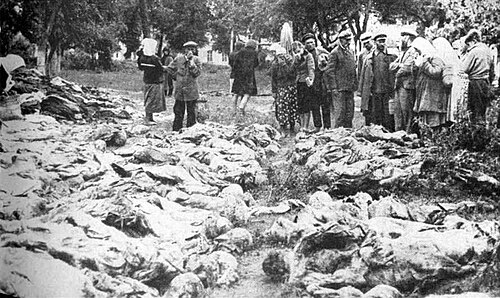
The Great Purge targeted Tajik intellectuals and party officials, including First Secretary Abdurahim Khodzhibaev. Source — Wikipedia, "Tajikistan":
People looking for relatives among repressed in Vinnytsia By Ukrainian American Youth Association - Crime of Moscow in Vynnytsia. Ukrainian Publication of the Ukrainian American Youth Association, Inc. New York. 1951, Public domain, https://commons.wikimedia.org/w/index.php?curid=3119574
1950 CE
Cotton monoculture expands
Soviet planners intensified cotton cultivation in Tajikistan, causing severe environmental and economic distortions. Source — Wikipedia, "Tajikistan":
Flag of Tajikistan By Unknown author - Unknown sourceUnknown source. Construction sheet., Public domain, https://commons.wikimedia.org/w/index.php?curid=433200
1979 CE
Tajiks in Soviet-Afghan War
Tajikistan became a staging ground for the Soviet invasion of neighboring Afghanistan, affecting cross-border Tajik communities. Source — Wikipedia, "Tajikistan":
Mujahideen in Kunar, Afghanistan By erwinlux - Private collection; apparently a crop of this image at Flickr, CC BY-SA 3.0, https://commons.wikimedia.org/w/index.php?curid=5310966
Feb 1, 1990 CE
Dushanbe riots erupt
Ethnic and political tensions exploded into riots in Dushanbe, foreshadowing later conflict. Source — Wikipedia, "Tajikistan":
“Dushanbe riots, February 1990”. Dushanbe riots, February 10-17, 1990. Martial law is imposed in the city. Tanks on Lenin Prospekt. By Vladimir Fedorenko / Владимир Федоренко - RIA Novosti archive, image #699865, http://visualrian.ru/ru/site/gallery/#699865 35 mm film / 35 мм негатив, CC BY-SA 3.0, https://commons.wikimedia.org/w/index.php?curid=17824601
Sep 9, 1991 CE
Independence declared
Tajikistan declared independence from the disintegrating Soviet Union following the failed August coup. Source — Wikipedia, "Tajikistan":
Flag of Tajikistan By Unknown author - Unknown sourceUnknown source. Construction sheet., Public domain, https://commons.wikimedia.org/w/index.php?curid=433200
May 1, 1992 CE
Civil war begins
Factional fighting between government forces, democratic and Islamist groups plunged Tajikistan into a devastating civil war. Source — Wikipedia, "Tajikistan":
15th Spetsnaz Bde troopers in Tajikistan, during the 1992 Tajik war. By Ussuriysk Military School (UsSVU)Dmitry Ivlyovthe copyright-holder+7(916)227-88-65 - Ussuriysk Military School (recently digitalized photos), CC BY-SA 3.0, https://commons.wikimedia.org/w/index.php?curid=23560162
Nov 19, 1992 CE
Rakhmonov takes power
Emomali Rakhmonov was elected chairman of the Supreme Soviet, becoming the dominant figure in Tajik politics. Source — Wikipedia, "Tajikistan":
Following Russian-Tajikistani talks, Vladimir Putin and Emomali Rahmon made statements for the press. By Kristina Kormilitsyna (”Rossiya Segodnya“) - http://en.kremlin.ru/events/president/news/76469/photos, CC BY 4.0, https://commons.wikimedia.org/w/index.php?curid=176792755
Nov 6, 1994 CE
New constitution adopted
A new constitution established a presidential republic, consolidating executive power under Rakhmonov. Source — Wikipedia, "Tajikistan":
New constitution adopted By Unknown author, Public domain, https://commons.wikimedia.org/w/index.php?curid=3051904
Jun 27, 1997 CE
Peace accord signed
The General Agreement on Peace and National Accord ended the civil war, integrating opposition forces into government. Source — Wikipedia, "Tajikistan":
Flag of Tajikistan By Unknown author - Unknown sourceUnknown source. Construction sheet., Public domain, https://commons.wikimedia.org/w/index.php?curid=433200
Sep 1, 1999 CE
Rakhmonov wins referendum
A constitutional referendum extended presidential terms, allowing Rakhmonov to consolidate authority. Source — Wikipedia, "Tajikistan":
Flag of Tajikistan By Unknown author - Unknown sourceUnknown source. Construction sheet., Public domain, https://commons.wikimedia.org/w/index.php?curid=433200
2001 CE
NATO logistics hub opens
Tajikistan became part of the Northern Distribution Network supplying NATO forces in Afghanistan after 9/11. Source — Wikipedia, "Tajikistan":
Parachutes begin to open on supply pallets being airdropped from a C-17 Globemaster III to servicemembers Jan. 2 at a remote camp in Afghanistan. By Senior Airman Ricky J. Best - defenselink.mil (search for "airdrop"), Public domain, https://commons.wikimedia.org/w/index.php?curid=1578871
2006 CE
Rogun Dam project revived
Plans to complete the massive Rogun hydroelectric dam were revived, becoming a national priority and source of disputes with Uzbekistan. Source — Wikipedia, "Tajikistan":
Rogun Dam By Sosh19632 - Own work, CC BY-SA 4.0, https://commons.wikimedia.org/w/index.php?curid=110540719
Sep 9, 2011 CE
Independence anniversary marked
Tajikistan celebrated 20 years of independence amid economic challenges and remittances from migrant workers in Russia. Source — Wikipedia, "Tajikistan":
Independence anniversary marked By Unknown author, Public domain, https://commons.wikimedia.org/w/index.php?curid=3051904
2012 CE
Khorog clashes occur
Government forces clashed with armed groups in Khorog, Gorno-Badakhshan, highlighting regional tensions. Source — Wikipedia, "Tajikistan":
View of Khorog from the Botanical Gardens By Zack Knowles - https://web.archive.org/web/20161014165820/http://www.panoramio.com/photo/31758478, CC BY-SA 3.0, https://commons.wikimedia.org/w/index.php?curid=10111892
2015 CE
IRPT banned
The Islamic Renaissance Party of Tajikistan was declared a terrorist organization and dissolved, ending formal opposition. Source — Wikipedia, "Tajikistan":
The flag of the Islamic Renaissance Party of Tajikistan, an Islamist political party in Tajikistan By MrPenguin20 - This vector image includes elements that have been taken or adapted from this file:, Public domain, https://commons.wikimedia.org/w/index.php?curid=33819655
May 1, 2016 CE
Rahmon titled Leader of Nation
A referendum granted President Rahmon lifelong immunity and the title 'Founder of Peace and National Unity — Leader of the Nation.' Source — Wikipedia, "Tajikistan":
Flag of Tajikistan By Unknown author - Unknown sourceUnknown source. Construction sheet., Public domain, https://commons.wikimedia.org/w/index.php?curid=433200
Oct 11, 2020 CE
Rahmon reelected again
Emomali Rahmon won another presidential term with over 90% of the vote amid criticism of democratic backsliding. Source — Wikipedia, "Tajikistan":
Flag of Tajikistan By Unknown author - Unknown sourceUnknown source. Construction sheet., Public domain, https://commons.wikimedia.org/w/index.php?curid=433200
2021 CE
Border clashes with Kyrgyzstan
Deadly clashes erupted along the Tajik-Kyrgyz border around Vorukh, reflecting long-standing territorial disputes. Source — Wikipedia, "Tajikistan":
Flag of Tajikistan By Unknown author - Unknown sourceUnknown source. Construction sheet., Public domain, https://commons.wikimedia.org/w/index.php?curid=433200
Sep 1, 2022 CE
Protests in Gorno-Badakhshan
Anti-government protests in the Pamir region were met with a security crackdown and reported casualties. Source — Wikipedia, "Tajikistan":
Flag of Tajikistan By Unknown author - Unknown sourceUnknown source. Construction sheet., Public domain, https://commons.wikimedia.org/w/index.php?curid=433200