Encyclopedia/3. History, Societies & Civilizations/09. Modern Nations/08. South Asia • Curated by Admin Timeline.sg
History of Bhutan, sourced from Wikipedia's "Timeline of Bhutanese history".
Chronological Storyline (87 Milestones)
627 CE
Songtsän Gampo
Tibetan ruler Songtsän Gampo (reigned 627–49) ordered the construction of many Buddhist temples, including two in Bhutan: Jambay Lhakhang at Bumthang in central Bhutan, and Kyichu Lhakhang on the Kyi River in the Paro Valley. The construction of these temples marked the arrival of Buddhism in Bhutan. (to 649) Source — Wikipedia, "Timeline of Bhutanese history" (7th century):
<a href="http://bighugelabs.com/onblack.php?id=6180857891&size=large" rel="nofollow">View On Black</a>Recently I have been to Songtsen Library(dehradun,India)..Saw this Statue of King Songtsen Gampo on horseback in front of the Library ...According to them this statue of King Songtsen Gampo (617 -650 AD) is believed to be an emanation of Avalokitesvara, the Buddha of Compassion. He is credited with bringing Buddhism to Tibet. The institution is named after the 33rd Tibetan King, Songtsen Gampo (617-650). The sculpture, executed by the Western nun Khenmo Drolma By Bhavna Sayana - Flickr: The King Songtsen Gampo, CC BY 2.0, https://commons.wikimedia.org/w/index.php?curid=19994124
747 CE
Padmasambhava
Buddhist saint Padmasambhava, known as "Guru Rimpoche", comes to Bhutan from India at the invitation of Sindhu Raja of the Kingdom of Bumthang, one of the numerous kingdoms predating modern Bhutan. Padmasambhava converts the king to Buddhism and then continues to Tibet. When he returns to Bhutan at the invitation of Trisong Detsen, he oversees the construction of new monasteries in the Paro Valley and sets up his headquarters in Jakar. According to tradition, Padmasambhava thus founds the Nyingma, or "Red Hat," sect of Vajrayana Buddhism. Padmasambhava plays a great historical and religious role as the national patron saint who revealed the tantras to Bhutan. He returned for a third visit during the reign of Murthi Tsenpo (764–817), son of Trisong Detsen. Source — Wikipedia, "Timeline of Bhutanese history" (8th century):
Rewalsar, Himachal Pradesh - Photo of statue in mist from across the lake By John Hill - Own work, CC BY-SA 3.0, https://commons.wikimedia.org/w/index.php?curid=11763754
807 CE
Alternate date for Padmasambhava's invitation to
Alternate date for Padmasambhava's invitation to Bhutan by Sindhu Raja. Naguchhi's sons spread the realm into parts of modern Sikkim and Tibet. Source — Wikipedia, "Timeline of Bhutanese history" (9th century):
809 CE
Padmasambhava comes again to Bhutan. Around
Padmasambhava comes again to Bhutan. Around the same time, independent monarchies develop. Source — Wikipedia, "Timeline of Bhutanese history" (9th century):
824 CE
Ralpacan
Tibetan King Ralpacan (reigned 816–836), grandson of Trisong Detsen, goes to war with an Indian people ruler in Bhutan, driving him out. Tibetan troops who remained in Bhutan were called Milog, meaning "those that will not return." The region they settle is referred to as Tshochhen Gyed. Its eight parts or divisions are Wang, Be, Med, Kawang, Chang, Thi, Thim, and Lar. Source — Wikipedia, "Timeline of Bhutanese history" (9th century):
Tibetian Dharma Wheel. By Emblem of Tibet.svg: Sodacan / derivative work: Sodacan - Emblem of Tibet.svg, CC BY-SA 3.0, https://commons.wikimedia.org/w/index.php?curid=9704069
836 CE
Ralpacan
Tibetan King Ralpacan is murdered by agents of his brother Langdarma. Tibetans seek refuge in Bhutan from ensuing political and religious upheaval during the reign of Langdarma (836–842). After Langdarma's assassination in 842, Tibetans continue to flee to western Bhutan, thus creating the homeland of the modern Ngalop people. The centuries that follow, known in Tibet as the Era of Fragmentation, are characterized by their lack of political cohesion. During much of this period, the dominant Bhutanese polity was the Kingdom of Bumthang. Source — Wikipedia, "Timeline of Bhutanese history" (9th century):
Tibetian Dharma Wheel. By Emblem of Tibet.svg: Sodacan / derivative work: Sodacan - Emblem of Tibet.svg, CC BY-SA 3.0, https://commons.wikimedia.org/w/index.php?curid=9704069
900 CE
In the late 9th century, ethnic
In the late 9th century, ethnic Tibetan forces expel Indian people princes from parts of modern Bhutan. Tibetans in this period and location develop the roots of Ngalong culture. Source — Wikipedia, "Timeline of Bhutanese history" (9th century):
1000 CE
Tibetan people
By the 11th century, Tibetan-Mongol forces occupy the whole of Tibet. More waves of Tibetans seek refuge in Bhutan from religious persecution. Charismatic lamas become the de facto leaders of regions in western Bhutan. Source — Wikipedia, "Timeline of Bhutanese history" (10th century):
This place in Yunnan province was formerly known as Zhongdian, but was renamed in 2001 after the fictional land of Shangri-La in the 1933 James Hilton novel Lost Horizon, in an effort to promote tourism in the area. A three day 'Horse Racing Festival' also known as 'Heavenly Steed Festival' is held some time in June, which involves dancing, singing and eating, in addition to the racing of horses. Horse traders and minorities assemble here in their finest attire of furs and silks. (From Wikipedia, en.wikipedia.org/wiki/Zhongdian, en.wikipedia.org/wiki/Gandan_Sumtseling_Monastery) By Arian Zwegers from Brussels, Belgium - Zhongdian festival, CC BY 2.0, https://commons.wikimedia.org/w/index.php?curid=27472089
1143 CE
1143
1143 Source — Wikipedia, "Timeline of Bhutanese history" (11th century):
1180 CE
Tsangpa Gyare
Tibetan lama Tsangpa Gyare (1161–1211) founds Ralung Monastery for the Drukpa Lineage of the Kagyu school, named after the thunder dragons (druk) he witnessed on his quest for an appropriate foundation site. With the proliferation of the Drukpa, the druk become synonymous with Bhutan and later its central national symbol. Source — Wikipedia, "Timeline of Bhutanese history" (12th century):
Tsangpa Gyare (b.1161 - d.1211)- 1st Drukchen By www.treasuryoflives.org - http://www.treasuryoflives.org/uploads/person/11865/65249%20Tsangpa%20Gyare.jpg, Public domain, https://commons.wikimedia.org/w/index.php?curid=32026506
1360 CE
Gelug
Gelug monks flee to Bhutan from Tibet.<!-- This cannot be the case for the founder of Gelug Je Tsongkhapa was born 3 years prior to this date. --> Source — Wikipedia, "Timeline of Bhutanese history" (14th century):
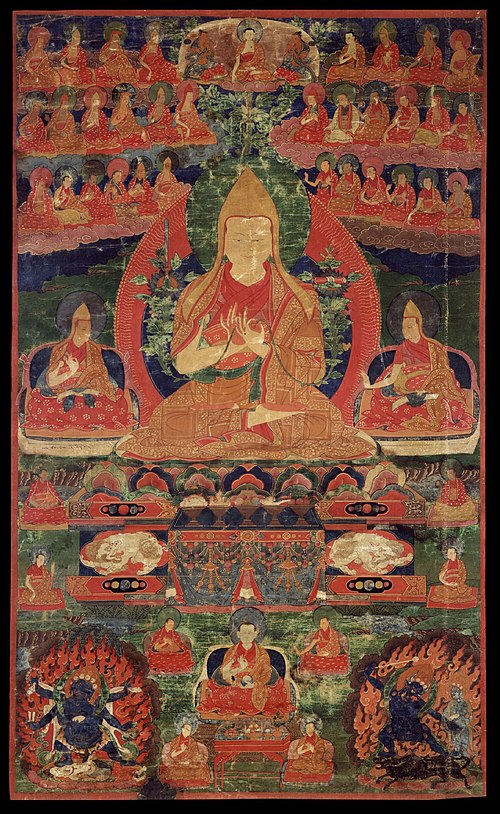
Tsonkapa, 16th century, Collection of Rubin Museum of Art By AnonymousUnknown author - Rubin Museum of Art, Public domain, https://commons.wikimedia.org/w/index.php?curid=27291997
1475 CE
Pema Lingpa
Pema Lingpa, a Bhutanese religious figure and tertön from Bumthang, discovered his first terma from Lake Membar near Bumthang. Source — Wikipedia, "Timeline of Bhutanese history" (15th century):
Statue of Terchen Pema Lingpa in a temple at Tsakaling, Mongar, Bhutan. By Christopher J. Fynn - Own work, CC BY-SA 3.0, https://commons.wikimedia.org/w/index.php?curid=18204411
1616 CE
Ngawang Namgyal
Ngawang Namgyal, 1st Zhabdrung Rinpoche, facing arrest and following visions in which it is said that the chief guardian deities of Bhutan offered him a home, leaves Tibet to establish a new base in western Bhutan, founding Chagri Monastery at the head of the Thimphu Valley. Source — Wikipedia, "Timeline of Bhutanese history" (17th century):
Center: Shabdrung Ngagwang Namgya. Above: primordial Buddha Vajradhara. Left: mahasiddha Tilopa with a fish. Seated right: Naropa. Sides: monks, lamas, and a yogi in a white robe. Ground Mineral Pigment on Cotton. Collection of Rubin Museum of Art. By Unknown author - http://www.himalayanart.org/image.cfm?icode=360, Public domain, https://commons.wikimedia.org/w/index.php?curid=6333246
1627 CE
Simtokha Dzong
Shabdrung Ngawang Namgyal builds Simtokha Dzong at the entrance to Thimphu valley. From this dzong, he exerts control over traffic between the powerful Paro Valley to the west and Trongsa Valley to the east. Source — Wikipedia, "Timeline of Bhutanese history" (17th century):
Simtokha Dzong, Bhutan By Bernard Gagnon - Own work, CC BY-SA 4.0, https://commons.wikimedia.org/w/index.php?curid=71645027
Ngawang Namgyal prevails in the Battle of Five Lamas over the Tibetan Empire and Bhutanese forces allied against him. The Zhabdrung is thus the first to unite Bhutan into a single country. The Zhabdrung establishes the Drukpa Lineage as the state religion under the dual system of government, and codifies the system of laws known as the Tsa Yig, based on Buddhist religious law (dharma). Source — Wikipedia, "Timeline of Bhutanese history" (17th century):
Simtoka Dzong, Thimphu By Christopher J. Fynn - Own work, CC BY-SA 3.0, https://commons.wikimedia.org/w/index.php?curid=4750449
A joint Mongol-Tibetan force sought to destroy Nyingma refugees who had fled to Bhutan, Sikkim, and Nepal. The Mongols had seized control of religious and civil power in Tibet in the 1630s and established the Gelug school as the state religion. Bhutanese rivals of Ngawang Namgyal encouraged the Mongol intrusion, but the Mongol force was easily defeated in the humid lowlands of southern Bhutan. Source — Wikipedia, "Timeline of Bhutanese history" (17th century):
Padmasambhava[note 1] (lit. "Lotus-Born"), also known as Guru Rinpoche, is a literary character of terma,[1] an emanation of Amitābha that is said to appear to tertöns in visionary encounters and a focus of Tibetan Buddhist practice, particulary in the Nyingma school. A statue of Padmasambhava in the form of Guru Nangsi Zilnoen is being built in Takela, Lhuntse in the eastern part of the Kingdom of Bhutan to bring peace and harmony to the world as prophesied by Lord Buddha and the Great Dzogchen masters. The statue will stand 148 feet tall including 30 foot high lion throne and 17 foot high lotus seat. By Vikramjit KAkati - Own work, CC BY-SA 4.0, https://commons.wikimedia.org/w/index.php?curid=41985018
Ngawang Namgyal dies; however, his death is kept a secret for fifty-four years in order to keep Bhutan from disintegrating. While the Zhabdrung was supposedly away on an extended religious retreat, his son reigned. Source — Wikipedia, "Timeline of Bhutanese history" (17th century):
1680 CE
Sikkim
Bhutan invades Sikkim. The same year, Ngawang Namgyal's son is succeeded by the Zhabdrung's stepbrother. Source — Wikipedia, "Timeline of Bhutanese history" (17th century):
Partially frozen Gurudongmar Lake, a high altitude glacial lake located in the northeast Indian state of Sikkim. Located at an altitude of over 5,150 metres (16,900 ft), the lake is located to the north of the Himalayas, and is fed by glaciers of the Khangchengyao massif. It forms the headwaters of the Teesta river and is considered sacred by Buddhists and Sikhs. By Original: Yoghya Derivative work: UnpetitproleX - This file was derived from: Gurudongmar Lake Sikkim, India.jpg, CC BY-SA 4.0, https://commons.wikimedia.org/w/index.php?curid=163256573
Tibetan forces, aided by the Mongols, invade Bhutan but fail to gain control. Source — Wikipedia, "Timeline of Bhutanese history" (18th century):
A map showing various claims of the extant of Tibet. By University of Texas Libraries - http://www.lib.utexas.edu/maps/middle_east_and_asia/asia_ref04.jpg, CC BY-SA 3.0, https://commons.wikimedia.org/w/index.php?curid=199677
1730 CE
Cooch Behar
Cooch Behar first requests Bhutanese assistance in repelling Mughal Empire encroachments, establishing a dependent relationship with Bhutan. Source — Wikipedia, "Timeline of Bhutanese history" (18th century):
A view of the Sagar Dighi, meaning an ocean-like pond, exaggerated in view of its great significance. As well as being popular with people, it also attracts migratory birds each winter. By Prasanta Kr Dutta - Own work, CC BY-SA 4.0, https://commons.wikimedia.org/w/index.php?curid=37091499
1770 CE
Cooch Behar
Bhutan invades Sikkim, supported by troops from Cooch Behar. Source — Wikipedia, "Timeline of Bhutanese history" (18th century):
A view of the Sagar Dighi, meaning an ocean-like pond, exaggerated in view of its great significance. As well as being popular with people, it also attracts migratory birds each winter. By Prasanta Kr Dutta - Own work, CC BY-SA 4.0, https://commons.wikimedia.org/w/index.php?curid=37091499
1772 CE
Cooch Behar
In a succession dispute in Cooch Behar, the Druk Desi's nominee for the throne was opposed by a rival who invited British troops; in effect, Cooch Behar became a dependency of the British East India Company. Source — Wikipedia, "Timeline of Bhutanese history" (18th century):
A view of the Sagar Dighi, meaning an ocean-like pond, exaggerated in view of its great significance. As well as being popular with people, it also attracts migratory birds each winter. By Prasanta Kr Dutta - Own work, CC BY-SA 4.0, https://commons.wikimedia.org/w/index.php?curid=37091499
Apr 25, 1774 CE
British East India Company
The Druk Desi signs a Treaty of Peace with the British East India Company. Under the treaty, Bhutan returns to its pre-1730 boundaries and allows the British to harvest timber in Bhutan. Source — Wikipedia, "Timeline of Bhutanese history" (18th century):
1784 CE
Bengal
British government turns over to Bhutan the Bengal Duars territory, where boundaries had been poorly defined. As in its other foreign territories, Bhutan left administration of the Bengal Duars territory to local officials and collected its revenues. Source — Wikipedia, "Timeline of Bhutanese history" (18th century):
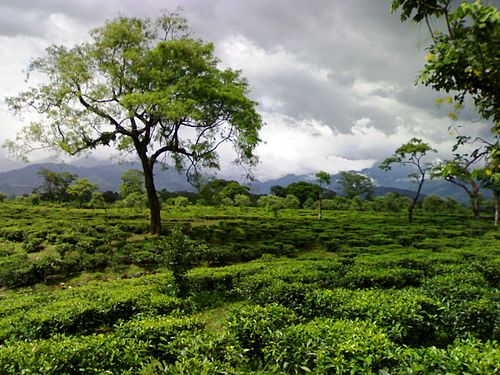
A tea estate in Dooars (West Bengal) at the foothills of the Himalayas. Hila Tea Estate, Jalpaiguri district, West Bengal, India. By Rajibnandi - Own work, CC BY-SA 3.0, https://commons.wikimedia.org/w/index.php?curid=5049235
1815 CE
British mission to Thimphu fails to
British mission to Thimphu fails to reach a conclusion amid increasing border tensions. Source — Wikipedia, "Timeline of Bhutanese history" (19th century):
1838 CE
Assam
British mission to Thimphu offers Bhutan a treaty providing for the extradition of Bhutanese officials responsible for incursions into Assam, free and unrestricted commerce between India and Bhutan, and settlement of Bhutan's debt to the British. In an attempt to protect its independence, Bhutan rejected the British offer. Source — Wikipedia, "Timeline of Bhutanese history" (19th century):
An adult male one horned rhino takes shelter on highland during flood at Kaziranga National Park in Bagori range of Nagaon district of Assam By Diganta Talukdar - Own work, CC BY-SA 4.0, https://commons.wikimedia.org/w/index.php?curid=60799652
1841 CE
Assam
British annex Bhutanese controlled Assam Duars, paying a compensation of 10,000 rupees a year to Bhutan. Source — Wikipedia, "Timeline of Bhutanese history" (19th century):
An adult male one horned rhino takes shelter on highland during flood at Kaziranga National Park in Bagori range of Nagaon district of Assam By Diganta Talukdar - Own work, CC BY-SA 4.0, https://commons.wikimedia.org/w/index.php?curid=60799652
1842 CE
Bengal
Bhutan cedes control of the troublesome Bengal Duars to Britain. Source — Wikipedia, "Timeline of Bhutanese history" (19th century):
A tea estate in Dooars (West Bengal) at the foothills of the Himalayas. Hila Tea Estate, Jalpaiguri district, West Bengal, India. By Rajibnandi - Own work, CC BY-SA 3.0, https://commons.wikimedia.org/w/index.php?curid=5049235
1862 CE
Bhutanese forces raid Sikkim and Cooch
Bhutanese forces raid Sikkim and Cooch Behar; the British respond by withholding all compensation payments and demanding release of all captives and return of stolen property. These demands went unheeded by the Druk Desi, as he was alleged to be unaware of frontier officials' raids. Source — Wikipedia, "Timeline of Bhutanese history" (19th century):
1864 CE
Britain sends a peace mission to
Britain sends a peace mission to Bhutan in the wake of a recent civil war, during a period when two rival claimants to the office of Druk Desi competed for power. Though the British attempt to deal with both Druk Desis, the peace mission is rejected by Bhutan. Source — Wikipedia, "Timeline of Bhutanese history" (19th century):
Nov 11, 1865 CE
Treaty of Sinchula
Bhutan signs the Treaty of Sinchula, ceding territories in the Assam Duars and Bengal Duars, as well as the eighty-three-square-kilometer territory of Dewangiri in southeastern Bhutan, in return for an annual subsidy of 50,000 rupees. Source — Wikipedia, "Timeline of Bhutanese history" (19th century):
Identifier: india00surr (find matches) Title: India; Year: 1909 (1900s) Authors: Surridge, Victor MacCormick, Arthur David, 1860- ill Subjects: India -- History India -- History British occupation, 1765-1947 Publisher: London, Edinburgh : T. C. & E. C. Jack Contributing Library: New York Public Library Digitizing Sponsor: MSN View Book Page: Book Viewer About This Book: Catalog Entry View All Images: All Images From Book Click here to view book online to see this illustration in context in a browseable online version of this book. Text Appearing Before Image: en wars; but they have been waged either beyondthe boundaries of India Proper, as in Afghanistanand Burma, or with small and unimportant frontiertribes. Nor must we forget that that frontier isnever stationary. As the years roll by, fresh tractsof land are being added to, fresh tribes of hillmenbrought under, the dominion of the British Crown.A picturesque example of such a conquest occurredin 1864, when an Englishman, Ashley Eden byname, set forth with a few white companions andan escort of one hundred Sepoys on a delicate andhazardous mission. His destination was the countryof Bhutdn, and his task was to bring the rulers ofthat wild and lawless district to reason. For theBhutanese had long been a thorn in the side of theIndian Government. They are of a race distinctfrom all others in Hindustan—a mixture of Chineseand Tartars—and, as yet, the tide of western civilisa-tion—or, indeed, of any civilisation at all worthy thename—had failed to reach their bleak and inaccessible296 Text Appearing After Image: Ashley Eden forced by tbe Bhutanese to sign a Treaty EPILOGUE land. The Eighth Commandment was by them morehonoured in the breach than in the observance;many villages had been despoiled of cattle andother property in the course of their freebootingraids; and it became necessary to impress uponthe populace the seemliness of restricting theirdepredations to districts outside the sphere ofBritish rule. The country of Bhutan lies to the north ofAssam and Bengal, shut in by the snow-peakedHimalayas. The Imperial Gazetteer of India describesit as a succession of lofty and rugged mountainsabounding in picturesque and sublime scenery. Theprospect between abrupt and lofty prominences isinconceivably grand; hills clothed to their verysummit with trees, dark and deep glens, and the hightops of the mountains lost in the clouds constitutealtogether a scene of extraordinary magnificence andsublimity. So it was not a very easy route that Ashley Edenhad to traverse. Nor was it rendered smoother bythe Note About Images Please note that these images are extracted from scanned page images that may have been digitally enhanced for readability - coloration and appearance of these illustrations may not perfectly resemble the original work. By Internet Archive Book Images - https://www.flickr.com/photos/internetarchivebookimages/14566720270/ Source book page: https://archive.org/stream/india00surr/india00surr#page/n334/mode/1up, No restrictions, https://commons.wikimedia.org/w/index.php?curid=44134915
1870 CE
penlop of Trongsa
In the 1870s and 1880s, renewed competition among regional rivals – primarily the pro-British penlop of Trongsa and the anti-British, pro-Tibetan penlop of Paro – resulted in the ascendancy of Ugyen Wangchuck, the penlop of Trongsa. (to 1880) Source — Wikipedia, "Timeline of Bhutanese history" (19th century):
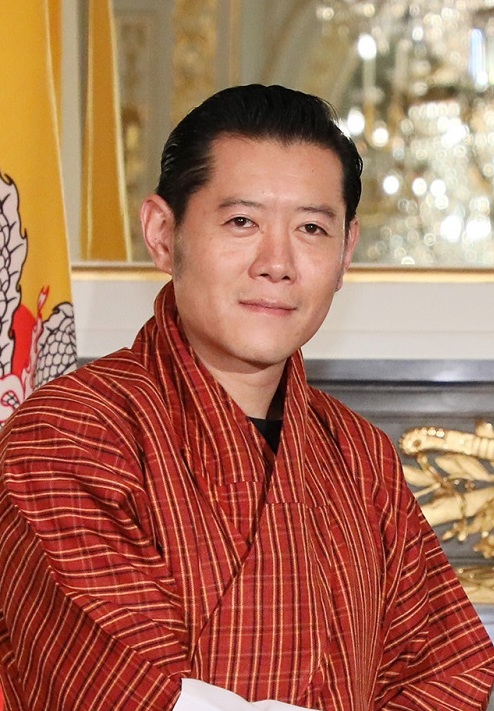
King Jigme Khesar Namgyel Wangchuck of Bhutan at his serene majesty's residence By Royal Family of Bhutan - Modified version of Image:King Jigme Khesar Namgyel Wangchuck.jpg., CC BY-SA 3.0, https://commons.wikimedia.org/w/index.php?curid=5151092
1885 CE
Ugyen Wangchuck
Ugyen Wangchuck, penlop (governor) of Trongsa, puts down civil unrest across Bhutan, consolidates power, and cultivates closer ties with British India. Source — Wikipedia, "Timeline of Bhutanese history" (19th century):
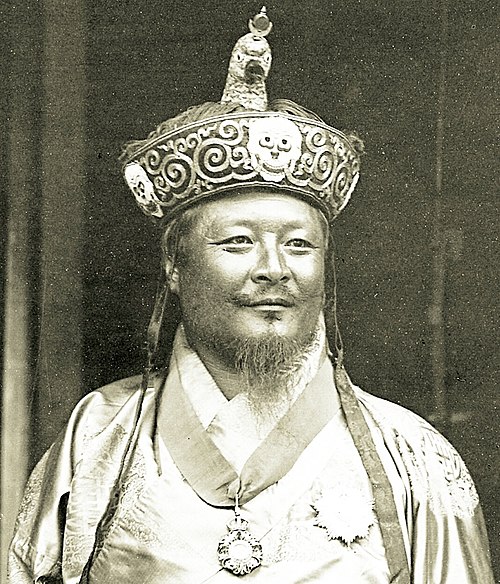
King Ugyen Wangchuck — in Punakha, the old capital of Bhutan, in 1905. Ugyen Wangchuck was the first King of Bhutan, from 1907 to 1926. By John Claude White - British Library, Public domain, https://commons.wikimedia.org/w/index.php?curid=76333697
1903 CE
Ugyen Wangchuck
The last reigning Shabdrung dies, and a successor is not found until 1906. In the meantime, the civil administration comes under the power of the Ugyen Wangchuck as Druk Desi. Source — Wikipedia, "Timeline of Bhutanese history" (20th century):
King Ugyen Wangchuck — in Punakha, the old capital of Bhutan, in 1905. Ugyen Wangchuck was the first King of Bhutan, from 1907 to 1926. By John Claude White - British Library, Public domain, https://commons.wikimedia.org/w/index.php?curid=76333697
Dec 17, 1907 CE
Druk Gyalpo
Ugyen Wangchuck is elected Bhutan's first hereditary ruler (Druk Gyalpo) after having politically unified the country. Source — Wikipedia, "Timeline of Bhutanese history" (20th century):
On October 21, 2019, Prime Minister Abe held a bilateral talk with the King of Bhutan Jigme Khesar Namgyel Wangchuck at the Guest House Akasaka Palace. By 首相官邸ホームページ - https://www.kantei.go.jp/jp/98_abe/actions/201910/22kaidan_04.html, CC BY 4.0, https://commons.wikimedia.org/w/index.php?curid=106664794
Jan 8, 1910 CE
Treaty of Punakha
The Treaty of Punakha amends two articles of the 1865 Treaty of Sinchula: the British agree to double the annual stipend to 100,000 rupees and "to exercise no interference in the internal administration of Bhutan." In turn, Bhutan agrees "to be guided by the advice of the British Government in regard to its external relations." Source — Wikipedia, "Timeline of Bhutanese history" (20th century):
Punakha Dzong, Bhutan. Photo taken April 22, 2002. Monks in foreground with the southern portion of the dzong visible across the Mo Chhu. Copyright (c) 2002 by William L. Devanney. By The original uploader was Technopilgrim at English Wikipedia. - Transferred from en.wikipedia to Commons., CC BY-SA 3.0, https://commons.wikimedia.org/w/index.php?curid=2526989
Aug 21, 1926 CE
Jigme Wangchuck
King Ugyen Wangchuck dies; his son Jigme Wangchuck begins to reign. Source — Wikipedia, "Timeline of Bhutanese history" (20th century):
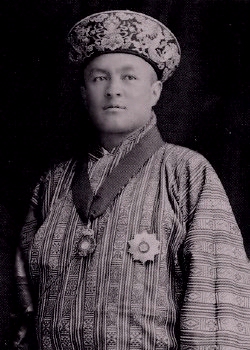
Jigme Wangchuck. By Unknown author - http://www.royalark.net/Bhutan/bhutan3.htm, Public domain, https://commons.wikimedia.org/w/index.php?curid=19038349
Mar 16, 1927 CE
Coronation of Jigme Wangchuck.
Coronation of Jigme Wangchuck. Source — Wikipedia, "Timeline of Bhutanese history" (20th century):
1931 CE
Zhabdrung Rinpoche
The 7th Shabdrung Jigme Dorji dies at Talo monastery. Jigme Dorji is the last Shabdrung recognized by the government of Bhutan, though subsequent claimants to the incarnation continue today. Source — Wikipedia, "Timeline of Bhutanese history" (20th century):
Depicted person: Shabdrung – title used when referring to or addressing great lamas in Tibet, particularly those who held a hereditary lineage By Unknown author - http://www.buddhistchannel.tv/picture/upload/shabdrung.jpg, Public domain, https://commons.wikimedia.org/w/index.php?curid=86441832
1947 CE
The British Empire leaves India, and
The British Empire leaves India, and direct political by the British ends. Bhutan remains relatively isolated from international affairs. Source — Wikipedia, "Timeline of Bhutanese history" (20th century):
Aug 8, 1949 CE
Treaty of Sinchula
India and Bhutan sign the Treaty of Peace and Friendship, which provided that India would not interfere in Bhutan's internal affairs but that Bhutan would be guided by India in its foreign policy. The same year, India cedes to Bhutan some territories lost to the British in the 1865 Treaty of Sinchula. Source — Wikipedia, "Timeline of Bhutanese history" (20th century):
Identifier: india00surr (find matches) Title: India; Year: 1909 (1900s) Authors: Surridge, Victor MacCormick, Arthur David, 1860- ill Subjects: India -- History India -- History British occupation, 1765-1947 Publisher: London, Edinburgh : T. C. & E. C. Jack Contributing Library: New York Public Library Digitizing Sponsor: MSN View Book Page: Book Viewer About This Book: Catalog Entry View All Images: All Images From Book Click here to view book online to see this illustration in context in a browseable online version of this book. Text Appearing Before Image: en wars; but they have been waged either beyondthe boundaries of India Proper, as in Afghanistanand Burma, or with small and unimportant frontiertribes. Nor must we forget that that frontier isnever stationary. As the years roll by, fresh tractsof land are being added to, fresh tribes of hillmenbrought under, the dominion of the British Crown.A picturesque example of such a conquest occurredin 1864, when an Englishman, Ashley Eden byname, set forth with a few white companions andan escort of one hundred Sepoys on a delicate andhazardous mission. His destination was the countryof Bhutdn, and his task was to bring the rulers ofthat wild and lawless district to reason. For theBhutanese had long been a thorn in the side of theIndian Government. They are of a race distinctfrom all others in Hindustan—a mixture of Chineseand Tartars—and, as yet, the tide of western civilisa-tion—or, indeed, of any civilisation at all worthy thename—had failed to reach their bleak and inaccessible296 Text Appearing After Image: Ashley Eden forced by tbe Bhutanese to sign a Treaty EPILOGUE land. The Eighth Commandment was by them morehonoured in the breach than in the observance;many villages had been despoiled of cattle andother property in the course of their freebootingraids; and it became necessary to impress uponthe populace the seemliness of restricting theirdepredations to districts outside the sphere ofBritish rule. The country of Bhutan lies to the north ofAssam and Bengal, shut in by the snow-peakedHimalayas. The Imperial Gazetteer of India describesit as a succession of lofty and rugged mountainsabounding in picturesque and sublime scenery. Theprospect between abrupt and lofty prominences isinconceivably grand; hills clothed to their verysummit with trees, dark and deep glens, and the hightops of the mountains lost in the clouds constitutealtogether a scene of extraordinary magnificence andsublimity. So it was not a very easy route that Ashley Edenhad to traverse. Nor was it rendered smoother bythe Note About Images Please note that these images are extracted from scanned page images that may have been digitally enhanced for readability - coloration and appearance of these illustrations may not perfectly resemble the original work. By Internet Archive Book Images - https://www.flickr.com/photos/internetarchivebookimages/14566720270/ Source book page: https://archive.org/stream/india00surr/india00surr#page/n334/mode/1up, No restrictions, https://commons.wikimedia.org/w/index.php?curid=44134915
Mar 24, 1952 CE
Jigme Dorji Wangchuck
King Jigme Wangchuck dies; his son Jigme Dorji Wangchuck begins to reign. Bhutan begins a program of planned development and democratization. The same year, the National Assembly is established, and the post of Chief Minister (Gongzim) is abolished. Source — Wikipedia, "Timeline of Bhutanese history" (20th century):
Picture of king Jigme Dorje Wangchuck in the waiting hall at Thimpu airport Bhutan By Benjamin Goetzinger - Own work, CC BY-SA 4.0, https://commons.wikimedia.org/w/index.php?curid=124404373
1957 CE
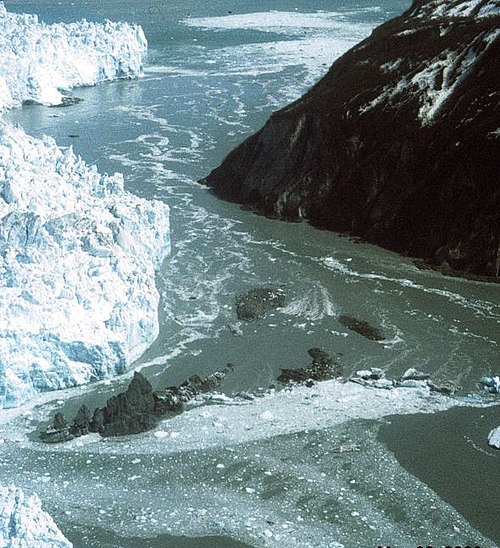
glacial lake outburst flood
Major glacial lake outburst flood from glacial lakes. Source — Wikipedia, "Timeline of Bhutanese history" (20th century):
glacial lake outburst flood By Unknown author, Public domain, https://commons.wikimedia.org/w/index.php?curid=676638
1958 CE
slavery in Bhutan
Slavery is abolished. Source — Wikipedia, "Timeline of Bhutanese history" (20th century):
1959 CE
Tibet
Bhutanese enclaves in western Tibet are seized by the Chinese. Source — Wikipedia, "Timeline of Bhutanese history" (20th century):
A map showing various claims of the extant of Tibet. By University of Texas Libraries - http://www.lib.utexas.edu/maps/middle_east_and_asia/asia_ref04.jpg, CC BY-SA 3.0, https://commons.wikimedia.org/w/index.php?curid=199677
1960 CE
glacial lake outburst flood
Major glacial lake outburst flood from glacial lakes. Source — Wikipedia, "Timeline of Bhutanese history" (20th century):
glacial lake outburst flood By Unknown author, Public domain, https://commons.wikimedia.org/w/index.php?curid=676638
1961 CE
Five-Year Plans of Bhutan
First Five-Year Plan is introduced. Source — Wikipedia, "Timeline of Bhutanese history" (20th century):
Apr 5, 1964 CE
Jigme Palden Dorji
Prime Minister Jigme Palden Dorji is assassinated in a dispute among competing political factions. The King's own uncle, a military cadre, was among those executed for their role in the attempted coup. After a brief tenure by acting Prime Minister Lhendup Dorji, the post of Prime Minister is abolished until 1998. Source — Wikipedia, "Timeline of Bhutanese history" (20th century):
1965 CE
Jigme Dorji Wangchuck
Unsuccessful attempt to assassinate King Jigme Dorji Wangchuck. Source — Wikipedia, "Timeline of Bhutanese history" (20th century):
Picture of king Jigme Dorje Wangchuck in the waiting hall at Thimpu airport Bhutan By Benjamin Goetzinger - Own work, CC BY-SA 4.0, https://commons.wikimedia.org/w/index.php?curid=124404373
1966 CE
Punakha
The capital is moved from Punakha to Thimphu through a transition period when Punakha was the winter capital and Thimphu the summer capital. Source — Wikipedia, "Timeline of Bhutanese history" (20th century):
Punakha Dzong, Bhutan. Photo taken April 22, 2002. Monks in foreground with the southern portion of the dzong visible across the Mo Chhu. Copyright (c) 2002 by William L. Devanney. By The original uploader was Technopilgrim at English Wikipedia. - Transferred from en.wikipedia to Commons., CC BY-SA 3.0, https://commons.wikimedia.org/w/index.php?curid=2526989
1968 CE
Lhengye Zhungtshog
King Jigme Dorji Wangchuck establishes the first Council of Ministers, or executive cabinet. At the same time, the king renounces his power of veto, which had never been used. The king also creates the High Court (the Thimkhang Gongma) and empowers it to review the king's decisions. The Bank of Bhutan is also founded as a central bank, charged with supervising the transition from a barter economy to a monetary economy. Source — Wikipedia, "Timeline of Bhutanese history" (20th century):
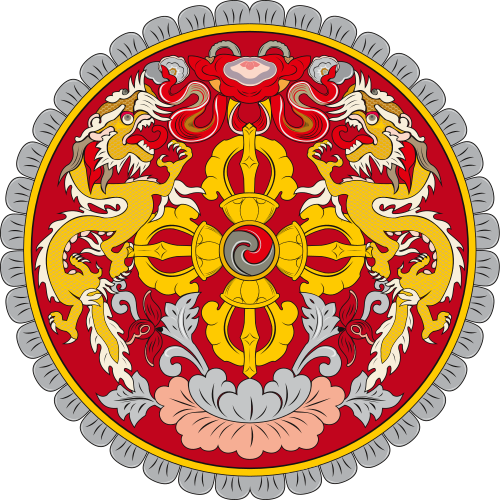
Emblem of Bhutan — used by the Parliament of Bhutan, first established in 2007. By Original Author: Vector-Images.com Converted to SVG by: Oren neu dag - Own work using: http://vector-images.com/image.php?epsid=6042, Public domain, https://commons.wikimedia.org/w/index.php?curid=4339176
1969 CE
Jigme Dorji Wangchuck
Jigme Dorji Wangchuck called for a triennial vote of confidence by the National Assembly to renew the Druk Gyalpo's mandate to rule. This vote was later abolished by his successor. Source — Wikipedia, "Timeline of Bhutanese history" (20th century):
Picture of king Jigme Dorje Wangchuck in the waiting hall at Thimpu airport Bhutan By Benjamin Goetzinger - Own work, CC BY-SA 4.0, https://commons.wikimedia.org/w/index.php?curid=124404373
1970 CE
Bhutan's population reaches an estimated 300,000.
Bhutan's population reaches an estimated 300,000. Source — Wikipedia, "Timeline of Bhutanese history" (20th century):
1971 CE
Bhutan joins the United Nations.
Bhutan joins the United Nations. Source — Wikipedia, "Timeline of Bhutanese history" (20th century):
Jul 21, 1972 CE
Jigme Singye Wangchuck
King Jigme Dorji Wangchuck dies; his son Jigme Singye Wangchuck begins to reign. Source — Wikipedia, "Timeline of Bhutanese history" (20th century):
His Majesty the Fourth Druk Gyalpo at Thimphu, in Bhutan on November 12, 2025. By Prime Minister's Office - This file or its source was published by Press Information Bureau on behalf of Prime Minister's Office, Government of India under the ID 195853. (direct link) This tag does not indicate the copyright status of the attached work. A normal copyright tag is still required. See Commons:Licensing. العربية ∙ বাংলা ∙ English ∙ हिन्दी ∙ 日本語 ∙ македонски ∙ മലയാളം ∙ polski ∙ தமிழ் ∙ ತುಳು ∙ 中文 ∙ 中文(简体) ∙ 中文(繁體) ∙ +/−, GODL-India, https://commons.wikimedia.org/w/index.php?curid=179899398
Mar 1, 1974 CE
Wangchuck
Strains between the Wangchucks and Dorjis were relieved with the return that year of the exiled members of the latter family. The reconciliation, however, was preceded by reports of a plot to assassinate the new Druk Gyalpo before his coronation could take place and to set fire to the Tashichho Dzong, the seat of government in Thimphu. Yangki, the Druk Gyalpo's Tibetan mistress, was the alleged force behind the plot. Thirty persons were arrested, including high government and police officials. (to April) Source — Wikipedia, "Timeline of Bhutanese history" (20th century):
Emblem of Bhutan — used by the Parliament of Bhutan, first established in 2007. By Original Author: Vector-Images.com Converted to SVG by: Oren neu dag - Own work using: http://vector-images.com/image.php?epsid=6042, Public domain, https://commons.wikimedia.org/w/index.php?curid=4339176
1978 CE
Bhutan's population reaches an estimated 400,000.
Bhutan's population reaches an estimated 400,000. Source — Wikipedia, "Timeline of Bhutanese history" (20th century):
1982 CE
Royal Monetary Authority of Bhutan
The Royal Government establishes the Royal Monetary Authority, the central bank of Bhutan. Source — Wikipedia, "Timeline of Bhutanese history" (20th century):
Royal Monetary Authority of Bhutan By Monkkko - Own work, CC BY-SA 4.0, https://commons.wikimedia.org/w/index.php?curid=163410991
Jun 10, 1985 CE
Bhutanese Citizenship Act 1985
The Bhutanese Citizenship Act 1985 is enacted. Source — Wikipedia, "Timeline of Bhutanese history" (20th century):
Emblem of Bhutan — used by the Parliament of Bhutan, first established in 2007. By Original Author: Vector-Images.com Converted to SVG by: Oren neu dag - Own work using: http://vector-images.com/image.php?epsid=6042, Public domain, https://commons.wikimedia.org/w/index.php?curid=4339176
1986 CE
Bhutan's population reaches an estimated 500,000.
Bhutan's population reaches an estimated 500,000. Source — Wikipedia, "Timeline of Bhutanese history" (20th century):
1987 CE
Gasa District
Gasa District is split up among Punakha and Thimphu Districts; Chhukha District is carved out from parts of Samtse, Paro, and Thimphu Districts. Source — Wikipedia, "Timeline of Bhutanese history" (20th century):
National Emblem of Bhutan in Color with with Black Dzongkha Text By PgyamtshoBT - Own work, CC0, https://commons.wikimedia.org/w/index.php?curid=191175705
1988 CE
Lhotshampa
Bhutan conducts its first census. As a result, many Lhotshampa (ethnic Nepalis) are branded as illegal immigrants. Source — Wikipedia, "Timeline of Bhutanese history" (20th century):
Lotshampa refugees in Beldangi Camp By Alemaugil - Own work, Public domain, https://commons.wikimedia.org/w/index.php?curid=2956803
1989 CE
driglam namzha
The driglam namzha, the official behaviour and dress code, is elevated from recommended to mandatory in public and educational settings. Nepali ceases to be a language of instruction in schools, escalating tensions between Ngalops and Lhotshampas. Source — Wikipedia, "Timeline of Bhutanese history" (20th century):
* Letterpress label measures 40 x 85 mm. By Scan by NYPL - https://digitalcollections.nypl.org/items/510d47dc-e7cb-a3d9-e040-e00a18064a99, Public domain, https://commons.wikimedia.org/w/index.php?curid=52278244
1990 CE
Bhutan Peoples' Party
Violent ethnic unrest and anti-government protests in southern Bhutan pressing for greater democracy and respect for minority rights. The Bhutan Peoples' Party, whose members are mostly Lhotshampa, begin a campaign of violence against the government. Pro-government citizen militias form in response to rising crime and violence including clashes between Lhotshampa demonstrators and the Royal Bhutan Army. The Bhutan Peoples' Party is subsequently banned. Source — Wikipedia, "Timeline of Bhutanese history" (20th century):
Flag of the Bhutan Peoples' Party flag By Bhutan's People Party - http://www.crwflags.com/fotw/flags/bt%7Dbpp.html, Public domain, https://commons.wikimedia.org/w/index.php?curid=29455865
1991 CE
Jigme Singye Wangchuck
Jigme Singye Wangchuck threatens to abdicate in face of hardline opposition in the National Assembly to his efforts to resolve ethnic unrest, leaving an international summit to attend to unrest. Source — Wikipedia, "Timeline of Bhutanese history" (20th century):
His Majesty the Fourth Druk Gyalpo at Thimphu, in Bhutan on November 12, 2025. By Prime Minister's Office - This file or its source was published by Press Information Bureau on behalf of Prime Minister's Office, Government of India under the ID 195853. (direct link) This tag does not indicate the copyright status of the attached work. A normal copyright tag is still required. See Commons:Licensing. العربية ∙ বাংলা ∙ English ∙ हिन्दी ∙ 日本語 ∙ македонски ∙ മലയാളം ∙ polski ∙ தமிழ் ∙ ತುಳು ∙ 中文 ∙ 中文(简体) ∙ 中文(繁體) ∙ +/−, GODL-India, https://commons.wikimedia.org/w/index.php?curid=179899398
1992 CE
Tek Nath Rizal
Tek Nath Rizal, leader of the illegal Bhutan Peoples' Party, is sentenced to life imprisonment. Source — Wikipedia, "Timeline of Bhutanese history" (20th century):
Flag of the Bhutan Peoples' Party flag By Bhutan's People Party - http://www.crwflags.com/fotw/flags/bt%7Dbpp.html, Public domain, https://commons.wikimedia.org/w/index.php?curid=29455865
1994 CE
glacial lake outburst flood
Major glacial lake outburst flood from glacial lakes, devastating Punakha. Source — Wikipedia, "Timeline of Bhutanese history" (20th century):
glacial lake outburst flood By Unknown author, Public domain, https://commons.wikimedia.org/w/index.php?curid=676638
1998 CE
Lhengye Zhungtshog
The Council of Ministers (Lhengye Zhungtshog) replaces the cabinet, and King Jigme Singye Wangchuck withdraws from his role in the decision-making of the cabinet. The post of Prime Minister (Lonchen) is restored. (to 1999) Source — Wikipedia, "Timeline of Bhutanese history" (20th century):
Emblem of Bhutan — used by the Parliament of Bhutan, first established in 2007. By Original Author: Vector-Images.com Converted to SVG by: Oren neu dag - Own work using: http://vector-images.com/image.php?epsid=6042, Public domain, https://commons.wikimedia.org/w/index.php?curid=4339176
1999 CE
Television is introduced.
Television is introduced. Source — Wikipedia, "Timeline of Bhutanese history" (20th century):
2000 CE
Bhutanese refugees
Bhutan and Nepal reach an agreement regarding the repatriation of certain classes of Bhutanese refugees living in camps in Nepal, subject to joint government verification. Points of contention included that some camp inhabitants were never citizens – or some even residents – of Bhutan before attaining refugee status. Also, the Bhutanese government regarded many political groups among the Nepalese Lhotshampa community, such as the Bhutan Peoples' Party (BPP) and Bhutan National Democratic Party (BNDP), as terrorist or anti-national groups. Source — Wikipedia, "Timeline of Bhutanese history" (20th century):
Lotshampa refugees in Beldangi Camp By Alemaugil - Own work, Public domain, https://commons.wikimedia.org/w/index.php?curid=2956803
Mar 1, 2001 CE
Bhutanese refugees
First verification of Bhutanese refugees eligible for repatriation commences in Nepalese refugee camps. Actual repatriation is estimated to occur one year out. As of 2011 over 200 refugees in the Khudunabari refugee camp alone had been certified, however no Bhutanese refugees had been repatriated. Source — Wikipedia, "Timeline of Bhutanese history" (21st century):
Lotshampa refugees in Beldangi Camp By Alemaugil - Own work, Public domain, https://commons.wikimedia.org/w/index.php?curid=2956803
2002 CE
Bhutan's population reaches an estimated 600,000.
Bhutan's population reaches an estimated 600,000. Source — Wikipedia, "Timeline of Bhutanese history" (21st century):
2003 CE
United Liberation Front of Assam
Several guerrilla groups seeking to establish an independent Assamese state in northeast India had set up guerrilla bases in the forests of southern Bhutan from which they launch cross-border attacks on targets in Assam. The largest guerrilla group was the United Liberation Front of Assam (ULFA). Negotiations aimed at removing them peacefully from these bases failed in the spring of 2003. Source — Wikipedia, "Timeline of Bhutanese history" (21st century):
Flag of United Liberation Front of Asom (ULFA). This SVG flag is created from the information found in here By Simbu123 - Own work, CC0, https://commons.wikimedia.org/w/index.php?curid=20200263
Mar 20, 2004 CE
Capital punishment in Bhutan
Capital punishment in Bhutan is abolished. Source — Wikipedia, "Timeline of Bhutanese history" (21st century):
Mar 26, 2005 CE
Proposed constitution is unveiled under which
Proposed constitution is unveiled under which Bhutan would transition from absolute monarchy to a constitutional monarchy and parliamentary democracy. Source — Wikipedia, "Timeline of Bhutanese history" (21st century):
Jan 1, 2006 CE
Nago
Authorities arrest two civil servants in the village of Nago in Paro District, accusing them of engaging in acts of proselytism under the false pretext of holding an official meeting, maligning the Spiritual Head of Bhutan (Je Khenpo), posing as officials on official business, and giving false information. In accordance with provisions in the Penal Code and the National Security Act, both men are found guilty in a district court. Christian groups maintain the men were arrested due to their religious beliefs since, according to these groups, the men were arrested while showing a Christian film in a Buddhist home. They are sentenced in early June 2006 in an open trial with a public hearing to three and a half years and three years in prison. They did not appeal the court judgment, although the right to appeal was provided for by law. On 28 July 2006, both men were released after payment of a fine. Source — Wikipedia, "Timeline of Bhutanese history" (21st century):
This image is montage of Nago, Okinawa prefecture, Japan upper left : The Busena Terrace upper right : Kouri Bridge middle left : The large tree of Ficus microcarpa called "Hinpun Gajumaru" middle right : Haneji Naikai (the sea around Okinawa island and Yagaji island) bottom : The cityscape of central Naha city By File:Busena Terrace01ssb3200.jpg by 663highland File:View of Kouri Ohashi from road.JPG by Captain76 File:Hinpun Gajumaru.jpg by Ray_go File:Yagajishima.JPG by Snap55 File:Nago cityscape.jpg by Kugel - File:Busena Terrace01ssb3200.jpg File:View of Kouri Ohashi from road.JPG File:Hinpun Gajumaru.jpg File:Yagajishima.JPG File:Nago cityscape.jpg, CC BY-SA 3.0, https://commons.wikimedia.org/w/index.php?curid=19048919
Jan 5, 2007 CE
Bhutanese Citizenship Act 1985
The Royal Government enacts the Immigration Act of 2007, amending the Bhutanese Citizenship Act 1985 and establishing the Department of Immigration under the Ministry of Home and Cultural Affairs to implement and administer immigration laws through immigration offices. The Act endowed officers of the Department of Immigration with broad police and prosecution powers: they may enter any private or official premises in order to search, arrest, seize, detain, interrogate or to demand forfeiture of any vehicles, trains, vessels, aircraft, or goods. Source — Wikipedia, "Timeline of Bhutanese history" (21st century):
Emblem of Bhutan — used by the Parliament of Bhutan, first established in 2007. By Original Author: Vector-Images.com Converted to SVG by: Oren neu dag - Own work using: http://vector-images.com/image.php?epsid=6042, Public domain, https://commons.wikimedia.org/w/index.php?curid=4339176
Jan 1, 2008 CE
Lhotshampa
A series of bombs blast the kingdom ahead of elections slated for 24 March. The attacks are blamed on armed Lhotshampa groups. (to February) Source — Wikipedia, "Timeline of Bhutanese history" (21st century):
Lotshampa refugees in Beldangi Camp By Alemaugil - Own work, Public domain, https://commons.wikimedia.org/w/index.php?curid=2956803
Apr 1, 2009 CE
Huanglongbing
Huanglongbing virus decimates Bhutan's orange crop, an important export for the kingdom. Source — Wikipedia, "Timeline of Bhutanese history" (21st century):
Huanglongbing on mandarin oranges By T.R. Gottwald and S.M. Garnsey - USDA APHIS, Public domain, https://commons.wikimedia.org/w/index.php?curid=16303555
Mar 1, 2010 CE
Dzongkhag Court
A district court interprets the constitutional clause regarding religious "coercion or inducement" to prohibit not only forced conversion but also proselytism in the case of a Christian missionary pastor who used a generator and a projector in a private home on 21 May 2009. The pastor received a sentence of three years imprisonment for infringing the Constitution. Source — Wikipedia, "Timeline of Bhutanese history" (21st century):
Emblem of Bhutan — used by the Parliament of Bhutan, first established in 2007. By Original Author: Vector-Images.com Converted to SVG by: Oren neu dag - Own work using: http://vector-images.com/image.php?epsid=6042, Public domain, https://commons.wikimedia.org/w/index.php?curid=4339176
Jan 24, 2011 CE
bhikkhu
Sonam Tshering, a 23-year-old ordained monk from Langpa in Haa, was caught with 480 grams of chewing tobacco (purchased for Nu.120) en route from Phuntsholing to Thimphu. This presented the first prosecution under the Tobacco Control Act of Bhutan 2010 and was the result of a private individual informing the police that Tshering possessed tobacco. Although Tshering revealed the source of his tobacco to mitigate and qualify his offense as a misdemeanor, he failed to identify the location and supplier of the tobacco, apparently somewhere in the border town of Jaigaon. He was thus convicted of a felony, and sentenced to the minimum imprisonment of three years. The conviction and especially the sentence have made the Tobacco Control Act of Bhutan 2010 controversial in urban Bhutan due to their severity. Although the Constitution of Bhutan guarantees all persons the right to be represented by a jabmi (attorney), the Thimphu Dzongkhag Court closed the case before any jabmi could offer services. Tshering has since appealed the Dzongkhag Court ruling to the High Court of Bhutan, for which has retained a private attorney. Source — Wikipedia, "Timeline of Bhutanese history" (21st century):
Buddha in Phutthamonthon (Buddhist park in the Phutthamonthon district, Nakhon Pathom Province of Thailand). By Tevaprapas ผู้สร้างสรรค์ผลงาน/ส่งข้อมูลเก็บในคลังข้อมูลเสรีวิกิมีเดียคอมมอนส์ - เทวประภาส มากคล้าย - Own work, CC BY-SA 2.5, https://commons.wikimedia.org/w/index.php?curid=1754601
Mar 8, 2013 CE
National Assembly
The Speaker of the National Assembly, Jigme Tshultim, sentenced to 2 years 6 months imprisonment for official misconduct, fraud, and deceptive practices; and the then Home Minister, Lyonpo Minjur Dorji, and 13 Plot Allotment committee members sentenced to a year imprisonment by the Mongar District Court for official misconduct in the Gyelpozhing land allotment case. On appeal, the convictions and sentences are upheld by the High Court of Bhutan on 16 May and by the Supreme Court on 17 July<sup>th.</sup> Source — Wikipedia, "Timeline of Bhutanese history" (21st century):
Emblema dell'Assemblea nazionale del Bhutan By Unknown author - http://www.nab.gov.bt/, Public domain, https://commons.wikimedia.org/w/index.php?curid=142149190




![Padmasambhava[note 1] (lit. "Lotus-Born"), also known as Guru Rinpoche, is a literary character of terma,[1] an emanation of Amitābha that is said to appear to tertöns in visionary encounters and a focus of Tibetan Buddhist practice, particulary in the Nyingma school. A statue of Padmasambhava in the form of Guru Nangsi Zilnoen is being built in Takela, Lhuntse in the eastern part of the Kingdom of Bhutan to bring peace and harmony to the world as prophesied by Lord Buddha and the Great Dzogchen masters. The statue will stand 148 feet tall including 30 foot high lion throne and 17 foot high lotus seat.](https://upload.wikimedia.org/wikipedia/commons/thumb/c/c2/GURU_PADMASAMBHAVA_Lhuntse%2C_Bhutan.jpg/500px-GURU_PADMASAMBHAVA_Lhuntse%2C_Bhutan.jpg)