Encyclopedia/3. History, Societies & Civilizations/09. Modern Nations/10. Middle East & North Africa • Curated by Admin Timeline.sg
History of Iran, sourced from Wikipedia's "Timeline of Iranian history".
Chronological Storyline (154 Milestones)
4300 BCE
Susa
Construction of the city of Susa in southwestern Iran. Source — Wikipedia, "Timeline of Iranian history" (44th century BC):
Apadana of Susa, reconstruction drawing, 1903 Identifier: cu31924091762140 (find matches) Title: History of Egypt, Chaldea, Syria, Babylonia and Assyria Year: 1903 (1900s) Authors: Maspero, G. (Gaston), 1846-1916 Sayce, A. H. (Archibald Henry), 1845-1933 Subjects: Civilization, Ancient History, Ancient Publisher: London : Grolier Society Contributing Library: Cornell University Library Digitizing Sponsor: MSN View Book Page: Book Viewer About This Book: Catalog Entry View All Images: All Images From Book Click here to view book online to see this illustration in context in a browseable online version of this book. Text Appearing Before Image: 270 THE LAST DAYS OP THE OLD EASTERN WORLD respect as in other Oriental nations was paid only to the gods: this was but natural, for was he not a despot, who with a word or gesture could abase the noblest of his subjects, and determine the well-being or misery of his people? His dress differed from that of his nobles only by the purple dye of its material and the richness of the gold embroideries with which it was adorned, but he was Text Appearing After Image: A VIEW OF THE APADANA OF SUSA, RESTORED.Drawn by Boudier, from the restoration by Marcel Dieulafoy. distinguished from all others by the peculiar felt cap, kidaris, which he wore, and the blue-and-white band which encircled it like a crown; the king is never represented without his long sceptre with pommelled handle, whether he be sitting or standing, and wherever he went he was attended by his umbrella- and fan-bearers. The prescriptions of court etiquette were such as to convince his subjects and persuade himself that he was sprung from a 271 THE ETIQUETTE OP THE PERSIAN COURT nobler race than that of any of his magnates, and that he was outside the pale of ordinary humanity. The greater part of his time was passed in privacy, where he was attended only by the eunuchs appointed to receive hisorders; and these orders, once issued, were irrevocable, as was also the kings word, however much he might desire to recall a promise once made. His meals were, as a rule, served to him alone; he might not Note About Images Please note that these images are extracted from scanned page images that may have been digitally enhanced for readability - coloration and appearance of these illustrations may not perfectly resemble the original work. By Internet Archive Book Images - https://www.flickr.com/photos/internetarchivebookimages/14584070300/ Source book page: https://archive.org/stream/cu31924091762140/cu31924091762140#page/n327/mode/1up, No restrictions, https://commons.wikimedia.org/w/index.php?curid=43219593
3200 BCE
Elam
The Elamite civilisation, one of the four oldest civilisations (along with Mesopotamia, the Indus Valley, and Egypt), begins in the far west and southwest of modern-day Iran. Source — Wikipedia, "Timeline of Iranian history" (33rd century BC):
English map of Elam By File:Near East topographic map-blank.svg: Sémhur File:Elam-map-PL.svg: Wkotwica derivative work: Morningstar1814 - File:Elam-map-PL.svg, CC BY-SA 3.0, https://commons.wikimedia.org/w/index.php?curid=61956849
2000 BCE
Aryans
Earliest date for the arrival of Aryans into Iran from Central Asia. The migrations into Iran may have been completed as late as 1000 BC. Source — Wikipedia, "Timeline of Iranian history" (21st century BC):
1500 BCE
Avestan period
Start of the Avestan period, which according to some scholars continued until the sixth century BC. The prophet Zoroaster lived at some point during this era, with any time between 1500 BC and 1000 BC being the most favoured date for his life by modern scholars. Source — Wikipedia, "Timeline of Iranian history" (16th century BC):
This figure shows the place names mentioned in the Avesta. It, therefore, demonstrates the geographical horizon of the early Zoroastrians during the Young Avestan period. By Kjansen86 - Own work, CC BY 4.0, https://commons.wikimedia.org/w/index.php?curid=141333081
1250 BCE
Untash-Napirisha
Untash-Napirisha, king of Elam, builds the Chogha Zanbil ziggurat complex in present-day Khuzestan province. Source — Wikipedia, "Timeline of Iranian history" (13th century BC):
Untash-Napirisha By Fabienkhan - Own work, CC BY-SA 2.5, https://commons.wikimedia.org/w/index.php?curid=2168908
1210 BCE
Elam
Elamite Empire reaches the height of its power. Source — Wikipedia, "Timeline of Iranian history" (13th century BC):
English map of Elam By File:Near East topographic map-blank.svg: Sémhur File:Elam-map-PL.svg: Wkotwica derivative work: Morningstar1814 - File:Elam-map-PL.svg, CC BY-SA 3.0, https://commons.wikimedia.org/w/index.php?curid=61956849
770 BCE
Persians
The Persians start driving the Elamites of Anshan towards Susa. Source — Wikipedia, "Timeline of Iranian history" (8th century BC):
English map of Elam By File:Near East topographic map-blank.svg: Sémhur File:Elam-map-PL.svg: Wkotwica derivative work: Morningstar1814 - File:Elam-map-PL.svg, CC BY-SA 3.0, https://commons.wikimedia.org/w/index.php?curid=61956849
720 BCE
Deioces
Deioces founds the Median government. Source — Wikipedia, "Timeline of Iranian history" (8th century BC):
Identifier: storyofgreatestn01elli (find matches) Title: The story of the greatest nations; a comprehensive history, extending from the earliest times to the present, founded on the most modern authorities, and including chronological summaries and pronouncing vocabularies for each nation; and the world's famous events, told in a series of brief sketches forming a single continuous story of history and illumined by a complete series of notable illustrations from the great historic paintings of all lands Year: 1913 (1910s) Authors: Ellis, Edward Sylvester, 1840-1916 Horne, Charles F. (Charles Francis), 1870-1942 Subjects: World history Publisher: New York : Niglutsch Contributing Library: University of California Libraries Digitizing Sponsor: MSN View Book Page: Book Viewer About This Book: Catalog Entry View All Images: All Images From Book Click here to view book online to see this illustration in context in a browseable online version of this book. Text Appearing Before Image: ' Text Appearing After Image: Persia—Cyrus the Great 8 r soldiers, Harpagus, to slay the child; but instead Harpagus had the boy broughtup in secret by a peasant. The strength and resolution of the lad Cyrus, no lessthan his kingl)- beauty, so distinguished him above all the other peasant lads thathis birth was suspected, and finally Harpagus confessed it. Astyages thenspared Cyrus at the entreaty of the boy s mother, but punished Harpagus byslaying the latters son under circumstances of revolting cruelty. Harpagus pretended a continued loyalty, but, being secretly determined onrevenge, constantly urged his foster-child Cyrus to revolt against Astyages.This Cyrus did after he had succeeded his father on the subordinate throne ofPersia. He summoned all the Persian men to meet him, bidding each bring ahatchet. When they were gathered in wonderment, he set them to a hard dayswork at chopping trees, offering them no refreshment through all their labor.The next day he invited them to a feast, and when this reached it Note About Images Please note that these images are extracted from scanned page images that may have been digitally enhanced for readability - coloration and appearance of these illustrations may not perfectly resemble the original work. By Internet Archive Book Images - https://www.flickr.com/photos/internetarchivebookimages/14780857854/ Source book page: https://archive.org/stream/storyofgreatestn01elli/storyofgreatestn01elli#page/n258/mode/1up, No restrictions, https://commons.wikimedia.org/w/index.php?curid=42034083
705 BCE
Achaemenes
Birth of Achaemenes (died ), the eponymous ancestor of the Achaemenid dynasty. Source — Wikipedia, "Timeline of Iranian history" (8th century BC):
Achaemenid lineage By Ekvcpa पाटलिपुत्र (talk) - This file was derived from: ACHAEMENES TREE.png, CC BY-SA 4.0, https://commons.wikimedia.org/w/index.php?curid=75842503
670 BCE
Phraortes
Phraortes founds the Median Empire. Source — Wikipedia, "Timeline of Iranian history" (7th century BC):
A map showing the ancient Median Empire highlighting their homeland and maximum extent. By Cattette - Own work, CC BY 4.0, https://commons.wikimedia.org/w/index.php?curid=123308592
655 BCE
Assyrian conquest of Elam
The Assyrian conquest of Elam occurs. The Neo-Assyrian Empire under Assurbanipal is victorious at the Battle of Susa in 647 BC, resulting in the looting and sack of Susa. Source — Wikipedia, "Timeline of Iranian history" (7th century BC):
Battle of Ulai, Elam, 653 BCE, British Museum By Carole Raddato from FRANKFURT, Germany - This image has been extracted from another file, CC BY-SA 2.0, https://commons.wikimedia.org/w/index.php?curid=91385337
633 BCE
Scythians
The Scythians invade Media. Source — Wikipedia, "Timeline of Iranian history" (7th century BC):
Extent of the Scythian kingdom in Western Asia and Europe By Antiquistik - Own work based on: Barnett, R. D. (1991) "Urartu" in The Cambridge Ancient History, 3.1, Cambridge: Cambridge University Press, pp. 314–371 ISBN: 978-1-139-05428-7. Batty, Roger (2007) Rome and the Nomads: The Pontic-Danubian Realm in Antiquity, Oxford: Oxford University Press, pp. 204−214 ISBN: 978-0-198-14936-1. Brinkman (1991) "Babylonia in the Shadow of Assyria" in The Cambridge Ancient History, 3.2, Cambridge: Cambridge University Press, pp. 1−70 ISBN: 978-1-139-05429-4. Diakonoff, I. M. (1985) "Media" in The Cambridge History of Iran: Volume, 2, Cambridge: Cambridge University Press ISBN: 978-0-521-20091-2. Grayson, A. K. (1991) "Assyria: Sennacherib and Esarhaddon" in The Cambridge Ancient History, 3.2, Cambridge: Cambridge University Press, pp. 103–141 ISBN: 978-1-139-05429-4. Grousset, René (1970) The Empire of the Steppes, Rutgers University Press ISBN: 0-8135-1304-9. Harmatta, János (1996) "The Scythians" in History of Humanity: From the seventh century B.C. to the seventh century A.D., 3, UNESCO, pp. 181–182 ISBN: 923102812X. Hawkins, J. D. (1991) "The Neo-Hittite States in Syria and Anatolia" in The Cambridge Ancient History, 3, Cambridge: Cambridge University Press, pp. 372−441 ISBN: 978-1-139-05428-7. Ivantchik, Askold (1993) (in French) Les Cimmériens au Proche-Orient, Fribourg, Switzerland; Göttingen, Germany: Editions Universitaires (Switzerland); Vandenhoeck & Ruprecht (Germany) ISBN: 978-3-727-80876-0. Ivantchik, Askold (2018). Scythians. Encyclopædia Iranica. Loehr, Max (1955). "The Stag Image in Scythia and the Far East". Archives of the Chinese Art Society of America 9: 63-76. Chinese Art Society of America. Olbrycht, Marek Jan (2000) "Remarks on the Presence of Iranian Peoples in Europe and Their Asiatic Relations" in Collectanea Celto-Asiatica Cracoviensia, Kraków: Księgarnia Akademicka, pp. 101–140 ISBN: 978-8-371-88337-8. Olbrycht, Marek Jan (2000) "The Cimmerian Problem Re-Examined: the Evidence of the Classical Sources" in Collectanea Celto-Asiatica Cracoviensia, Kraków: Księgarnia Akademicka, pp. 71−99 ISBN: 978-8-371-88337-8. Phillips, E. D. (1972). "The Scythian Domination in Western Asia: Its Record in History, Scripture and Archaeology". World Archaeology 4 (2): 129–138. DOI:10.1080/00438243.1972.9979527. Spalinger, Anthony J. (1978). "The Date of the Death of Gyges and Its Historical Implications". Journal of the American Oriental Society 98 (4): 400–409. DOI:10.2307/599752. Spalinger, Anthony (1978). "Psammetichus, King of Egypt: II". Journal of the American Research Center in Egypt 15: 49–57. DOI:10.2307/40000130. Sulimirski, T. (1954). "Scythian Antiquities in Western Asia". Artibus Asiae 17 (3): 282-318. Ascona, Switzerland: Artibus Asiae Publishers. ; Tadeusz Sulimirski, T. F. Taylor (1991) "The Scythians" in The Cambridge Ancient History, 3.2, Cambridge: Cambridge University Press, pp. 547–590 ISBN: 978-1-139-05429-4. Tokhtas’ev, Sergei R. (1991). Cimmerians. Encyclopædia Iranica. Vaggione, Richard P. (1973). "Over All Asia? The Extent of the Scythian Domination in Herodotus". Journal of Biblical Literature 92 (4): 523-530. DOI:10.2307/3263121. Young, T. Cuyler (1988) "The early history of the Medes and the Persians and the Achaemenid empire to the death of Cambyses" in The Cambridge Ancient History, 4, Cambridge: Cambridge University Press, pp. 1–52 ISBN: 978-0-521-22804-6. Background from [1], CC BY-SA 4.0, https://commons.wikimedia.org/w/index.php?curid=122424291
625 BCE
Cyaxares the Great
Cyaxares the Great becomes the king of the Medes after Phraortes dies fighting the Assyrians. Source — Wikipedia, "Timeline of Iranian history" (7th century BC):
Detail. The facade of the rock-cut tombs of Qizqapan, Sulaymaniyah Governorate, Iraqi Kurdistan. Probably Achaemenid (6th-5th century BCE) rather than Median. By Osama Shukir Muhammed Amin FRCP(Glasg) - Own work, CC BY-SA 4.0, https://commons.wikimedia.org/w/index.php?curid=110589783
624 BCE
The Medes under Cyaxares repel the
The Medes under Cyaxares repel the Scythians. Source — Wikipedia, "Timeline of Iranian history" (7th century BC):
612 BCE
Neo-Babylonian Empire
Together with the Neo-Babylonian Empire, Cyaxares the Great sacks the Assyrian capital Nineveh and destroys the Neo-Assyrian Empire. Source — Wikipedia, "Timeline of Iranian history" (7th century BC):
Map of the Neo-Babylonian Empire at its greatest territorial extent, under its final king Nabonidus. Follows the map of the Babylonian Empires produced by National Geographic (link), with the addition of the various cities conquered by Nabonidus in his Arabian Campaign, based on information in Paul-Alain Beaulieu's Reign of Nabonidus, King of Babylon (556-539 BC) (1989), p. 173 By IchthyovenatorSémhur (base map) - Own work, CC BY-SA 4.0, https://commons.wikimedia.org/w/index.php?curid=105149705
600 BCE
Cyrus I
Cyrus I becomes king of Persia. Source — Wikipedia, "Timeline of Iranian history" (7th century BC):
zoom in from seal By Unknown author - http://www.livius.org/pictures/a/iran/seal-of-cyrus-of-ansan/, CC BY-SA 4.0, https://commons.wikimedia.org/w/index.php?curid=42882171
580 BCE
Astyages
Cyaxares dies and is succeeded by his son Astyages. Source — Wikipedia, "Timeline of Iranian history" (6th century BC):
King Astyages submitting to Cyrus By Designed by Maximilien de Haese, Woven by Jac. van der Borght (1771-1775) - This image has been extracted from another file, Public domain, https://commons.wikimedia.org/w/index.php?curid=75008278
580 BCE
Cyrus I
Cyrus I dies and is succeeded by his son Cambyses I. Source — Wikipedia, "Timeline of Iranian history" (6th century BC):
zoom in from seal By Unknown author - http://www.livius.org/pictures/a/iran/seal-of-cyrus-of-ansan/, CC BY-SA 4.0, https://commons.wikimedia.org/w/index.php?curid=42882171
550 BCE
Achaemenid Empire
The Achaemenid Empire is founded by Cyrus the Great after he overthrows and conquers the Median Empire. Source — Wikipedia, "Timeline of Iranian history" (6th century BC):
Achaemenid Empire 500 BCE By Cattette - This image has been extracted from another file, CC BY 4.0, https://commons.wikimedia.org/w/index.php?curid=113179532
550 BCE
Cyrus II the Great
Cambyses I dies and is succeeded by Cyrus the Great as king of Persia. Source — Wikipedia, "Timeline of Iranian history" (6th century BC):
Winged genius relief in Pasargadae By Surenae - Own work, CC BY-SA 4.0, https://commons.wikimedia.org/w/index.php?curid=162225973
545 BCE
Bactria
Cyrus conquers Bactria, Arachosia, Sogdia, Sakastan, Chorasmia, and Margiana during his eastern campaign. Source — Wikipedia, "Timeline of Iranian history" (6th century BC):
Eastern Satrapies of the Achaemenid Empire By Mossmaps - This image has been extracted from another file, CC BY-SA 4.0, https://commons.wikimedia.org/w/index.php?curid=73498970
540 BCE
Lydian Empire
Cyrus conquers the Lydian Empire in western Asia Minor. Source — Wikipedia, "Timeline of Iranian history" (6th century BC):
Map showing the Kingdom of Lydia at its greatest extent during the late reign of Croesus. Approximate boundaries were determined mainly by using Herodotus' sources regarding the conquests of Lydian Kings and expanse of the realm, with River Halys separating the Lydian Kingdom from the Medians. By Ennomus - Own work, CC BY-SA 4.0, https://commons.wikimedia.org/w/index.php?curid=139257001
530 BCE
Neo-Babylonian Empire
Cyrus conquers the Neo-Babylonian Empire, frees thousands of slaves in Babylon and issues a declaration of human rights. This would later be inscribed into the Cyrus Cylinder. Source — Wikipedia, "Timeline of Iranian history" (6th century BC):
Map of the Neo-Babylonian Empire at its greatest territorial extent, under its final king Nabonidus. Follows the map of the Babylonian Empires produced by National Geographic (link), with the addition of the various cities conquered by Nabonidus in his Arabian Campaign, based on information in Paul-Alain Beaulieu's Reign of Nabonidus, King of Babylon (556-539 BC) (1989), p. 173 By IchthyovenatorSémhur (base map) - Own work, CC BY-SA 4.0, https://commons.wikimedia.org/w/index.php?curid=105149705
530 BCE
Cambyses II
Cyrus dies, and is succeeded by his son Cambyses II. Source — Wikipedia, "Timeline of Iranian history" (6th century BC):
Apis stele dated to the regnal year 6 of Cambyses (524 BCE), and depicting the king (kneeling, left) as an Egyptian pharaoh, while worshiping a dead Apis bull (right).[1] Later Greek traditions depicted Cambyses as the slayer of this Apis bull. By Jona Lendering - http://www.livius.org, Public domain, https://commons.wikimedia.org/w/index.php?curid=78408401
530 BCE
Achaemenid conquest of the Indus Valley
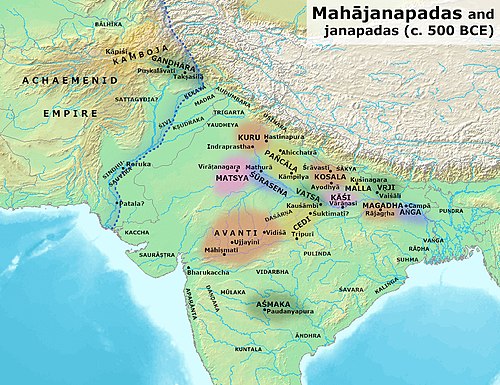
Cyrus commences the Achaemenid conquest of the Indus Valley. Source — Wikipedia, "Timeline of Iranian history" (6th century BC):
Eastern border of the Achaemenid Empire.India 500 BCE By Avantiputra7 - This image has been extracted from another file, CC BY-SA 3.0, https://commons.wikimedia.org/w/index.php?curid=73413965
520 BCE
Twenty-sixth dynasty of Egypt
Cambyses II conquers Egypt after the Battle of Pelusium. Cyprus is also conquered by Cambyses. Source — Wikipedia, "Timeline of Iranian history" (6th century BC):
Portrait of a Pharaoh of the Saite Dynasty By Jona Lendering - Livius .orgProvided under "Licence CC0 1.0 Universal" per notice under the photograph, CC0, https://commons.wikimedia.org/w/index.php?curid=91221690
520 BCE
Darius the Great
Cambyses dies and is succeeded by either his brother Bardiya or an impostor, Gaumata, pretending to be Bardiya. This individual dies months after becoming the King of Kings, and is succeeded by Darius the Great. Civil war breaks out as a result of the mysterious circumstances surrounding Darius' ascension, with Persis, Elam, Media, Assyria, Babylonia, Egypt, Parthia, Armenia, Margiana, Sattagydia, Sagartia, Hyrcania, and Scythia all revolting. Darius suppresses all the uprisings by 520 and restores order to the Achaemenid Empire. Source — Wikipedia, "Timeline of Iranian history" (6th century BC):
The face of Darius I on Mount Bistun in Iran By Rumlu - [1], Public domain, https://commons.wikimedia.org/w/index.php?curid=146053444
510 BCE
Scythian campaign of Darius I
Darius expands the Achaemenid Empire into Europe, conquering European Scythia, Thrace, Paeonia, and the coastal Greek cities. Source — Wikipedia, "Timeline of Iranian history" (6th century BC):
Correct version of fr.svg with the shorelines of the time and the correct location of the peoples mentioned. By Anton Gutsunaev - Version corrigée de fr.svg avec les lignes de rivage de l'époque et l'emplacement correct des peuples cités, Public domain, https://commons.wikimedia.org/w/index.php?curid=158449838
510 BCE
Darius completes the conquest of the
Darius completes the conquest of the Indus Valley. Source — Wikipedia, "Timeline of Iranian history" (6th century BC):
510 BCE
Macedon
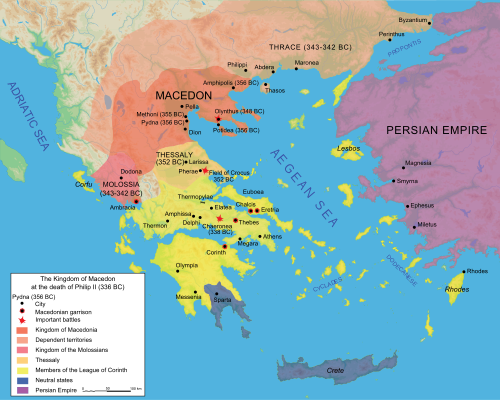
Macedon submits to Persia. Source — Wikipedia, "Timeline of Iranian history" (6th century BC):
Map of the Kingdom of Macedon at the death of Philip II in 336 BC. By Map_Macedonia_336_BC-es.svg: Marsyas (French original); Kordas (Spanish translation) derivative work: MinisterForBadTimes (talk) - Translation of Map_Macedonia_336_BC-es.svg (data from R. Ginouvès and al., La Macédoine, Paris, 1992), CC BY-SA 3.0, https://commons.wikimedia.org/w/index.php?curid=7398609
Aug 1, 490 BCE
Battle of Marathon
Battle of Marathon, Persian Empire is defeated by Greek states. Source — Wikipedia, "Timeline of Iranian history" (5th century BC):
Scene of the Battle of Marathon By John Steeple Davis - The story of the greatest nations, from the dawn of history to the twentieth century (published in 1900), Public domain, https://commons.wikimedia.org/w/index.php?curid=75078967
486 BCE
Xerxes I the Great
Darius the Great dies; Xerxes I the Great succeeds him as King of Kings. Source — Wikipedia, "Timeline of Iranian history" (5th century BC):
National Museum of Iran By Darafsh - Own work, CC BY 3.0, https://commons.wikimedia.org/w/index.php?curid=41965467
484 BCE
Babylonian revolts
The Babylonian Revolt, led by two pretenders to the Babylonian throne, is crushed by Xerxes. Source — Wikipedia, "Timeline of Iranian history" (5th century BC):
The Daiva inscription of Xerxes I (circa 480 BC), recording the defeat of a religious revolt somewhere in his empire By Marco Prins - [1] Provided under CC0 1.0 Universal per "License" notice under the photograph, CC0, https://commons.wikimedia.org/w/index.php?curid=93134201
480 BCE
Achaemenid Empire
The Achaemenid Empire under Xerxes invades mainland Greece, reaching its greatest extent. Source — Wikipedia, "Timeline of Iranian history" (5th century BC):
Achaemenid Empire 500 BCE By Cattette - This image has been extracted from another file, CC BY 4.0, https://commons.wikimedia.org/w/index.php?curid=113179532
480 BCE
Achaemenid destruction of Athens
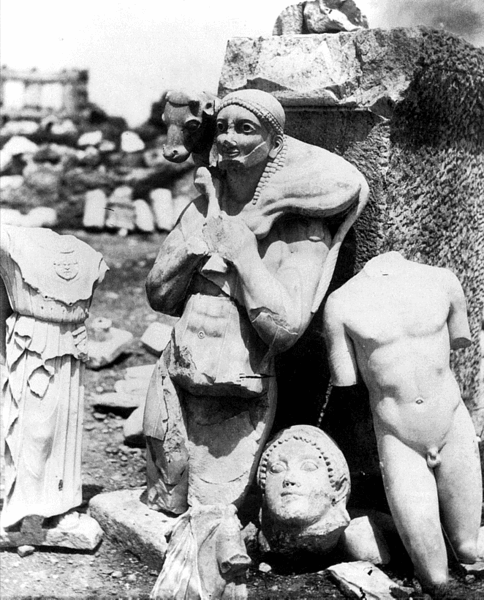
Persians capture and destroy Athens. The Acropolis, the Old Temple of Athena and the Older Parthenon are destroyed. Source — Wikipedia, "Timeline of Iranian history" (5th century BC):
The Moschophoros (c. 560 BC), at the moment of his discovery on the Acropolis, Athens By Unknown author - Own work, Public domain, https://commons.wikimedia.org/w/index.php?curid=2554279
465 BCE
Artaxerxes I
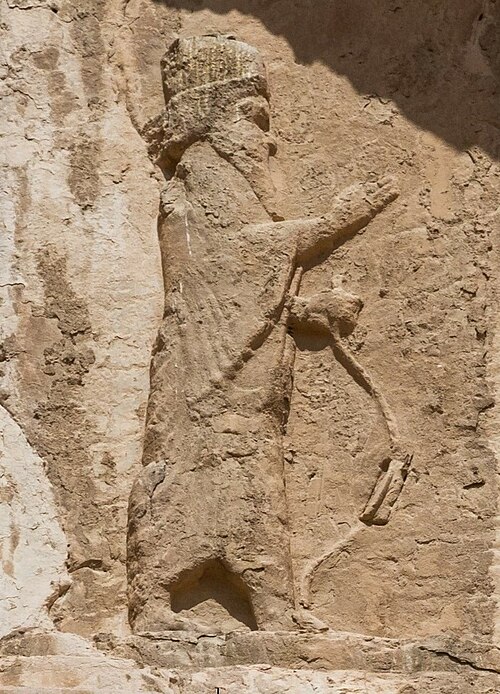
Assassination of Xerxes I. Artaxerxes I becomes the King of Kings. Source — Wikipedia, "Timeline of Iranian history" (5th century BC):
Artaxerxes I at Naqsh-e Rostam By Diego Delso - This image has been extracted from another file, CC BY-SA 4.0, https://commons.wikimedia.org/w/index.php?curid=136740321
404 BCE
Egypt breaks away from Persian rule.
Egypt breaks away from Persian rule. Source — Wikipedia, "Timeline of Iranian history" (5th century BC):
343 BCE
Second Achaemenid conquest of Egypt
Egypt is reconquered after the defeat of the Thirtieth Dynasty by Artaxerxes III. Source — Wikipedia, "Timeline of Iranian history" (4th century BC):
Head of Nectanebo II By Unknown author - RamaOwn work, CC BY-SA 2.0 fr, https://commons.wikimedia.org/w/index.php?curid=15270671
334 BCE
Alexander the Great
Alexander III of Macedon crosses the Hellespont into Asia. Source — Wikipedia, "Timeline of Iranian history" (4th century BC):
Alexander Mosaic (detail), House of the Faun, Pompeii By Unknown author - This image has been extracted from another file, Public domain, https://commons.wikimedia.org/w/index.php?curid=182741814
Nov 5, 333 BCE
Battle of Issus
Alexander III of Macedon defeats the armies of the Achaemenid Empire in the Battle of Issus Source — Wikipedia, "Timeline of Iranian history" (4th century BC):
Alexander Mosaic, House of the Faun, Pompeii By Unknown author - Self-photographed by Berthold Werner, Naples National Archaeological Museum, May 2013, Public domain, https://commons.wikimedia.org/w/index.php?curid=32224321
Jan 20, 330 BCE
Battle of the Persian Gate
Alexander III of Macedon defeats the armies of the Achaemenid Empire in the Battle of the Persian Gate Source — Wikipedia, "Timeline of Iranian history" (4th century BC):
Photo of the place of the Persian Gate By Jona Lendering at English Wikipedia - Transferred from en.wikipedia to Commons by Innotata using CommonsHelper., Public domain, https://commons.wikimedia.org/w/index.php?curid=20344561
Jul 1, 330 BCE
Darius III
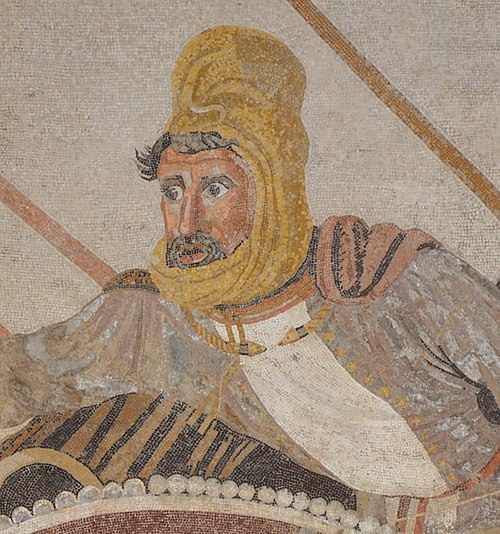
Darius III, the last Achaemenid emperor is killed, bringing an end to the Achaemenid Empire. Source — Wikipedia, "Timeline of Iranian history" (4th century BC):
The Alexander Mosaic, dating from circa 100 BC, is a Roman floor mosaic originally from the House of the Faun in Pompeii. It depicts a battle between the armies of Alexander the Great and Darius III of Persia and measures 2.72 x 5.13m (8 ft 11in x 16 ft 9in). The original is preserved in the Naples National Archaeological Museum. The mosaic is believed to be a copy of an early 3rd century BC Hellenistic painting, possibly by Philoxenos of Eretria. By Carole Raddato from FRANKFURT, Germany - Detail of the Alexander Mosaic depicting the Battle of Issus between Alexander the Great & Darius III of Persia, from the House of the Faun in Pompeii, Naples Archaeological Museum, CC BY-SA 2.0, https://commons.wikimedia.org/w/index.php?curid=97258981
330 BCE
Persepolis
Persepolis, the capital of the Persian Achaemenid Empire is destroyed by Alexander III of Macedon. Source — Wikipedia, "Timeline of Iranian history" (4th century BC):
Achaemenid Empire 500 BCE By Cattette - This image has been extracted from another file, CC BY 4.0, https://commons.wikimedia.org/w/index.php?curid=113179532
Jun 10, 323 BCE
Partition of Triparadisus
Alexander III dies in Babylon, triggering a division of his empire among his generals in a treaty known as the Partition of Triparadisus. Source — Wikipedia, "Timeline of Iranian history" (4th century BC):
312 BCE
Seleucus I Nicator
Seleucus I Nicator, establishes the Seleucid Empire in the Persian territories of the erstwhile Macedonian Empire. Source — Wikipedia, "Timeline of Iranian history" (4th century BC):
Bust of Seleukos I Nikator, Bronze, Roman, 100BCE-100CE at the Museo Archeologico Nazionale Naples AN 5590. By Allan Gluck, CC BY 4.0, https://commons.wikimedia.org/w/index.php?curid=85414285
247 BCE
Arsaces I of Parthia
Arsaces I establishes the Parthian Empire (also known as the Arsacid Empire) in present-day north-eastern Iran. Source — Wikipedia, "Timeline of Iranian history" (3rd century BC):
Coin of Arsaces I, Nisa mint. By Classical Numismatic Group; [1] - https://www.cngcoins.com/Coin.aspx?CoinID=334157, CC BY-SA 3.0, https://commons.wikimedia.org/w/index.php?curid=76269135
238 BCE
Seleucid-Parthian Wars
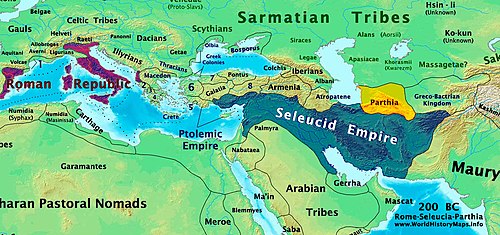
Seleucid-Parthian Wars – the Arsacids expel the Seleucids from Iran and Mesopotamia, and those lands pass into their hands. Source — Wikipedia, "Timeline of Iranian history" (2nd century BC):
Roman, Seleucid, and Parthian Empires in 200 BC. The key is cut off from the full map, but the numbered states are: 1 Marseille (Greek) 2 w:Epirus 3 w:Hellenistic League 4 w:Achaean League 5 w:Rhodes 6 w:Pergamon 7 w:Bithynia 8 w:Cappadocia By Talessman - Own work, CC BY-SA 3.0, https://commons.wikimedia.org/w/index.php?curid=4171689
94 BCE
Parthian Empire
The Parthian Empire reaches its peak, stretching from the northern reaches of the Euphrates, in what is now central-eastern Turkey, to present-day Afghanistan and western Pakistan. Source — Wikipedia, "Timeline of Iranian history" (1st century BC):
54 BCE
Roman–Parthian Wars
Beginning of the Roman–Parthian Wars, lasting till 217 CE. Source — Wikipedia, "Timeline of Iranian history" (1st century BC):
208 CE
Vologases V
Vologases V dies and is succeeded by his son Vologases VI. Source — Wikipedia, "Timeline of Iranian history" (3rd century):
Coin of Vologases V (cropped), Hamadan mint. By Classical Numismatic Group; [1] - https://www.cngcoins.com/Coin.aspx?CoinID=114774, CC BY-SA 3.0, https://commons.wikimedia.org/w/index.php?curid=78786057
211 CE
Ardashir I
Ardashir I establishes the Sasanian Empire in Istakhr in present-day Fars province. Source — Wikipedia, "Timeline of Iranian history" (3rd century):
Obverse A portrait of Ardashir I facing right. His crown takes the form of a close-fitting headdress crowned by globe. The headdress has a linear ornament. There are two small ribbons between the crown'globe and the close-fitting headdrees. There is no baslyk. There is a beaded rim around the picture. Pahlavi legend Lettering: mzdysn bgy ' rthstr MLK ' n MLK ' ' yr ' n MNW ctry MN yzd ' n-mazdesn bay Ar-daxsir sahan sah Eran ke cihr az yazdan Translation: Mazda worshipper, the lord (divine) Ardashir, king of kings of Iran, whose origin is from the gods Reverse A fire-altar (atasdan) in the form of column with a capitellum and base consisting of some plates. Under the capitellum there is a tongue of flame. The capitellum is supported by stands in the form of "lion paws" resting upon censers. The stands are decorated with bows. There is a pointed rim around the picture. Pahlavi legend Lettering: NWR ' ZY ' rthstr-Adur i Ardaxsir Translation: Fire (fire-altar) of Ardashir By Unknown author - https://en.numista.com/catalogue/pieces90080.html, Public domain, https://commons.wikimedia.org/w/index.php?curid=144543122
224 CE
King of Kings
Ardashir I defeats the last Parthian Shahanshah Artabanus IV, ending the Parthian Empire. Source — Wikipedia, "Timeline of Iranian history" (3rd century):
Relief of Darius (native-name: (𐎭𐎠𐎼𐎹𐎺𐎢𐏁) Dārayavauš) in Persepolis By Derfash Kaviani (درفش کاویانی) - Own work, CC BY-SA 3.0, https://commons.wikimedia.org/w/index.php?curid=18425968
260 CE
Battle of Edessa
Persians defeated the Romans at the Battle of Edessa and take emperor Valerian prisoner for the remainder of his life. Source — Wikipedia, "Timeline of Iranian history" (3rd century):
Relief of triumph of Shapur I over Valerian at Naqsh-e Rostam (ca. 241–272 AD), located 3 km north of Persepolis. It is the most impressive of eight Sasanian rock carvings cut into the cliff beneath the tombs of their Achaemenid predecessors. This carving depicts a famous scene in which the Roman Emperor, Valerian, is kneeling before Shapur I and asking for mercy. Shapur defeated Valerian at the Battle of Edessa, in which the entire Roman army was destroyed and Valerian became Shapour's prisoner. This was the first and only time a Roman emperor was taken prisoner. The Emperor Philip the Arab is depicting standing and Gordian III is dead at the feet of Shapur's horse. By Diego Delso - Own work, CC BY-SA 4.0, https://commons.wikimedia.org/w/index.php?curid=52061183
360 CE
Sasanian Empire
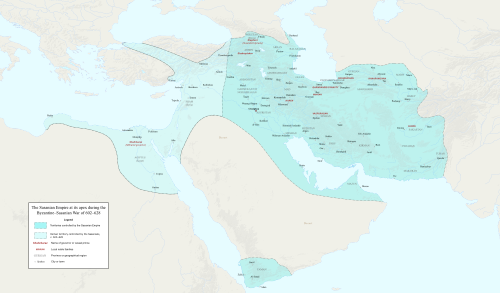
Sasanian Empire captures the town of Singara, in the Siege of Singara (360) Source — Wikipedia, "Timeline of Iranian history" (4th century):
Map of the Sasanian Empire at its apex under Khosrow II. By Original file by Ro4444, edited by me - Based on several sources, including the Middle Persian geographical text Šahrestānīhā ī Ērānšahr, CC BY 4.0, https://commons.wikimedia.org/w/index.php?curid=94837349
363 CE
Battle of Samarra
Battle of Samarra (363) between the Roman Empire and the Sasanian Empire, in which Roman emperor Julian is wounded, and subsequently dies of his wounds. Source — Wikipedia, "Timeline of Iranian history" (4th century):
Death of the Julian the Aposthate in the battle of Samarra (Cassell's Illustrated Universal History, vol. 3, 1882) By Unknown author - Cassell's illustrated universal history, Public domain, https://commons.wikimedia.org/w/index.php?curid=137338695
371 CE
Roman Empire
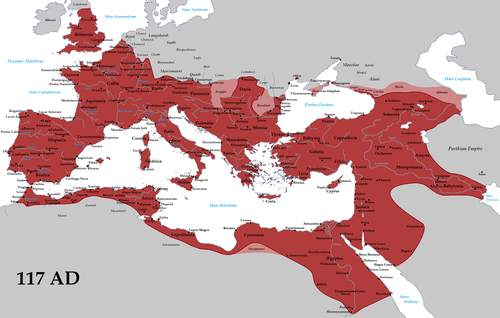
Roman Empire and Kingdom of Armenia defeat the Sasanian Empire and Caucasian Albania in the Battle of Bagavan Source — Wikipedia, "Timeline of Iranian history" (4th century):
The Roman Empire (red) and its clients (pink) in 117 AD during the reign of emperor Trajan. By Tataryn - Own work, CC BY-SA 3.0, https://commons.wikimedia.org/w/index.php?curid=19625326
421 CE
Roman–Sasanian War of 421–422
Roman–Sasanian War of 421–422 after which Persian Empire agreed to tolerate Christianity and Roman Empire agreed to tolerate Zoroastrianism Source — Wikipedia, "Timeline of Iranian history" (5th century):
The frontier between the Roman and Sassanid Persian Empires after the treaty of 384 AD. Despite recurrent warfare, the frontier remained stable throughout the 5th century and until the reign of Justinian I. By Cplakidas - Own work, based on another self-made Map of the Roman Empire, CC BY-SA 3.0, https://commons.wikimedia.org/w/index.php?curid=4116257
570 CE
Aksumite–Persian wars
Aksumite–Persian wars, Yemen is annexed by the Sasanian Empire. Source — Wikipedia, "Timeline of Iranian history" (6th century):
Folio from a Tarikhnama (Book of history) by Balami By Abu Ali Bal'ami - http://collections.si.edu/search/results.htm?view=&date.slider=&q=Tarikhnama&dsort=&start=0, Public domain, https://commons.wikimedia.org/w/index.php?curid=24708966
590 CE
Khosrow II
Khosrow II becomes ruler of the Sasanian Empire. During his rule till 628, Egypt, Jordan, Palestine and Lebanon are annexed into the Sasanian Empire Source — Wikipedia, "Timeline of Iranian history" (6th century):
Coin of Khosrau II, an Sasanian king. By Classical Numismatic Group; [1] - https://www.cngcoins.com/Coin.aspx?CoinID=140294, CC BY-SA 3.0, https://commons.wikimedia.org/w/index.php?curid=30307628
620 CE
Sasanian Empire reaches its greatest height,
Sasanian Empire reaches its greatest height, encompassing all of present-day Iran and Iraq and stretching from the eastern Mediterranean (including Anatolia and Egypt) to Pakistan, and from parts of southern Arabia to the Caucasus and Central Asia. Source — Wikipedia, "Timeline of Iranian history" (7th century):
Jun 1, 626 CE
Siege of Constantinople
Sasanian Empire lays siege to Constantinople, however is unable to capture it. Source — Wikipedia, "Timeline of Iranian history" (7th century):
Miniature 42 from the Constantine Manasses Chronicle, 14 century: Emperor Heraclius attacks a Persian fortress, while the Persians attack Constantinople. By Original: Constantine Manasses - Scanned from book "Miniatures from the Manasses Chronicle", Ivan Duichev, "Bulgarski hudojnik" Publishing house, Sofia, 1962, Public domain, https://commons.wikimedia.org/w/index.php?curid=3511648
Feb 25, 628 CE
Kavad II
Khosrow II is deposed and killed by his son Kavad II. Source — Wikipedia, "Timeline of Iranian history" (7th century):
Coin of the Sasanian king Kavad II (cropped), minted in 628. By Classical Numismatic Group; [1] - https://www.cngcoins.com/Coin.aspx?CoinID=175639, CC BY-SA 3.0, https://commons.wikimedia.org/w/index.php?curid=78179137
Sep 6, 628 CE
Ardashir III
Ardashir III becomes ruler of the Sasanian Empire. Source — Wikipedia, "Timeline of Iranian history" (7th century):
Coin of Ardashir III, Arrajan mint. By Classical Numismatic Group; [1] - https://www.cngcoins.com/Coin.aspx?CoinID=175641, CC BY-SA 3.0, https://commons.wikimedia.org/w/index.php?curid=81329585
Jun 16, 632 CE
Yazdegerd III
Yazdegerd III becomes ruler of the Sasanian Empire. Source — Wikipedia, "Timeline of Iranian history" (7th century):
Coin of the Sasanian king Yazdegerd III, 651 mint. By Classical Numismatic Group; [1] - This image has been extracted from another file, CC BY-SA 3.0, https://commons.wikimedia.org/w/index.php?curid=134930559
May 1, 633 CE
Battle of Ullais
Battle of Ullais in which the Rashidun Caliphate defeats the Sasanian Empire resulting in the massacre of 70,000 Persians by Arabs. Source — Wikipedia, "Timeline of Iranian history" (7th century):
Battle of Ullais By Mohammad adil at English Wikipedia - Transferred from en.wikipedia to Commons by Muhends using CommonsHelper., CC BY-SA 3.0, https://commons.wikimedia.org/w/index.php?curid=8882606
Oct 1, 634 CE
Sasanian Empire
Sasanian Empire led by Bahman Jaduya defeats the Rashidun Caliphate in the Battle of the Bridge. Source — Wikipedia, "Timeline of Iranian history" (7th century):
Map of the Sasanian Empire at its apex under Khosrow II. By Original file by Ro4444, edited by me - Based on several sources, including the Middle Persian geographical text Šahrestānīhā ī Ērānšahr, CC BY 4.0, https://commons.wikimedia.org/w/index.php?curid=94837349
Nov 16, 636 CE
Battle of al-Qadisiyyah
Rashidun Caliphate defeats the Sasanian Empire in the Battle of al-Qadisiyyah, takes control of present-day Iraq. Source — Wikipedia, "Timeline of Iranian history" (7th century):
Depiction of the Battle of al-Qādisiyyah from a manuscript of the Persian epic Shāh-nāmeh from Astarabad. Source- British Library (MS. I.O.Islamic 3265 (1614) f. 602r) By Unknown artist - http://dglnotes.com/notes/qadisiyyah.htm#image4, Public domain, https://commons.wikimedia.org/w/index.php?curid=24725846
636 CE
Sassanid dynasty
Arab invasion brings end of Sassanid dynasty and start of Islamic rule. Source — Wikipedia, "Timeline of Iranian history" (7th century):
Simorgh or Senmurv, The Mythology of Persia By Shaahin - Own work .mw-parser-output .messagebox{margin:4px 0;width:auto;border-collapse:collapse;border:2px solid var(--border-color-progressive,#6485d1);background-color:var(--background-color-neutral-subtle,#fbfcff);color:var(--color-base,#202122);box-sizing:border-box;border-inline-start-width:8px}.mw-parser-output .messagebox.mbox-small{font-size:88%;line-height:1.25em}.mw-parser-output .mbox-warning,.mw-parser-output .mbox-speedy{border:2px solid var(--border-color-error,#b22222);background:var(--background-color-error-subtle,#ffdbdb);border-inline-start-width:8px}.mw-parser-output .mbox-serious,.mw-parser-output .mbox-delete,.mw-parser-output .mbox-stop{border:2px solid var(--border-color-error,#b22222);border-inline-start-width:8px}.mw-parser-output .mbox-issue,.mw-parser-output .mbox-content{border:2px solid #f28500;background:var(--background-color-warning-subtle,#ffe);border-inline-start-width:8px}.mw-parser-output .mbox-query,.mw-parser-output .mbox-style{border:2px solid #f4c430;background:var(--background-color-warning-subtle,#ffe);border-inline-start-width:8px}.mw-parser-output .mbox-shit{border:2px solid #960;border-inline-start-width:8px}.mw-parser-output .mbox-license{border:2px solid #88a;border-inline-start-width:initial}.mw-parser-output .mbox-legal{border:2px solid var(--border-color-notice,#666);background:var(--background-color-base,#fff);border-inline-start-width:8px}.mw-parser-output .mbox-honor{border:2px solid #ca3;background:var(--background-color-warning-subtle,#fcf4db);border-inline-start-width:8px}.mw-parser-output .mbox-growth{border:2px solid #8d4;background:var(--background-color-success-subtle,#d5fdf4);border-inline-start-width:8px}.mw-parser-output .mbox-move{border:2px solid #93c;border-inline-start-width:8px}.mw-parser-output .mbox-protection,.mw-parser-output .mbox-message{border:2px solid var(--border-color-base,#aaa);border-inline-start-width:8px}.mw-parser-output .messagebox .mbox-text{border:none;padding:0.25em 0.9em;width:100%}.mw-parser-output .messagebox .mbox-image{border:none;padding:2px 0 2px 0.9em;text-align:center}.mw-parser-output .messagebox .mbox-imageright{border:none;padding:2px 0.9em 2px 0;text-align:center}.mw-parser-output .messagebox .mbox-empty-cell{border:none;padding:0;width:1px}.mw-parser-output .messagebox .mbox-invalid-type{text-align:center}@media(min-width:720px){.mw-parser-output .messagebox{margin:4px 10%}.mw-parser-output .messagebox.mbox-small{clear:right;float:right;margin:4px 0 4px 1em;width:238px}}body.skin--responsive .mw-parser-output table.messagebox img{max-width:none!important}This insignia has not been confirmed to be correct because it is lacking important source information: Please edit this file's description and provide a proper source.HELP: (1) The picture claims to be authentic. As such, “own work” is no proper source by itself. If applicable, any provided source(s) doesn't show an original depiction nor an original description, and therefore may violate NPOV (neutral point of view) by being original research. (2) For coat of arms please use the blazon and/or the picture of an original interpretation to provide an adequate source, but at least one or more references to literature. (3) If this depiction is a derivative please use the Template: Derived from to avoid sequence errors, to make this work more transparent for others to view and investigate, and to avoid an infringement of the copyright licence., Public domain, https://commons.wikimedia.org/w/index.php?curid=5175373
637 CE
Ctesiphon
Destruction of the Ctesiphon library by Arabs of the Rashidun Caliphate. Source — Wikipedia, "Timeline of Iranian history" (7th century):
Map of the metropolis of Ctesiphon By Renato de carvalho ferreira - This file was derived from: Seleucia map-pt.svg:, CC BY-SA 3.0, https://commons.wikimedia.org/w/index.php?curid=154123072
642 CE
Battle of Nahavand
Rashidun Caliphate defeats the Sasanian Empire in the Battle of Nahavand, resulting in the near collapse of the Sasanian Empire. Source — Wikipedia, "Timeline of Iranian history" (7th century):
Castle Nahavend By Eugène Flandin - Voyage en Perse, avec Flandin, éd. Gide et Baudry, 1851, Public domain, https://commons.wikimedia.org/w/index.php?curid=29178907
Nov 3, 644 CE
Umar ibn al-Khattab
The second Rashidun caliph Umar ibn al-Khattab ( ) is assassinated by the Persian slave Abu Lu'lu'a Firuz. Source — Wikipedia, "Timeline of Iranian history" (7th century):
Umar medallion in Hagia Sophia, Türkiye By William Neuheisel from DC, US [cropped by Fazoffic] - This image has been extracted from another file, CC BY 2.0, https://commons.wikimedia.org/w/index.php?curid=143724810
Nov 6, 644 CE
Uthman
Uthman ibn Affan becomes the third Rashidun Caliph. During his reign, almost the whole of the former Sassanid empire's territories rebel from time to time, with major rebellions in Armenia, Azerbaijan, Fars, Sistan (in 649), Khorasan (651), and Makran (650). Source — Wikipedia, "Timeline of Iranian history" (7th century):
İstanbul'dan görüntüler By Vikiçizer - Own work, CC BY-SA 4.0, https://commons.wikimedia.org/w/index.php?curid=129052695
651 CE
Yazdegerd III
Yazdegerd III, the last Sassanid emperor, is killed near Merv putting an end to both his dynasty and to organized Persian resistance to Arab conquest. Source — Wikipedia, "Timeline of Iranian history" (7th century):
Coin of the Sasanian king Yazdegerd III, 651 mint. By Classical Numismatic Group; [1] - This image has been extracted from another file, CC BY-SA 3.0, https://commons.wikimedia.org/w/index.php?curid=134930559
651 CE
Göktürk Empire
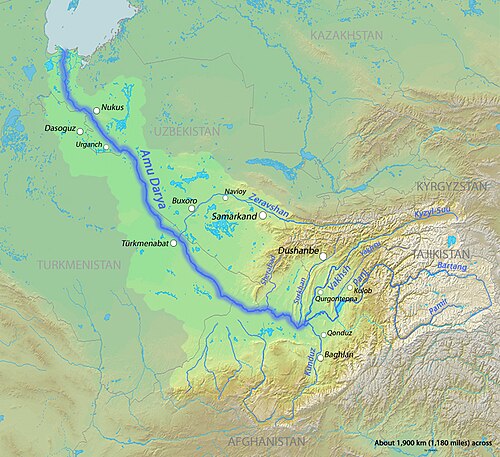
Rashidun Caliphate defeats the Sasanian Empire and the Göktürk Empire in the Battle of Oxus River. Source — Wikipedia, "Timeline of Iranian history" (7th century):
Map of the Amu Darya's watershed in Central Asia, that drains parts of Afghanistan, Uzbekistan, Turkmenistan, and Tajikistan into the Aral Sea By Background layer attributed to DEMIS Mapserver, map created by Shannon1 - Background and river course data from http://www2.demis.nl/mapserver/mapper.asp, CC BY-SA 4.0, https://commons.wikimedia.org/w/index.php?curid=9405268
716 CE
Farrukhan the Great
Farrukhan the Great, ruler of Tabaristan in present-day Mazandaran province defeats the Muslim invasion under Yazid ibn al-Muhallab. Source — Wikipedia, "Timeline of Iranian history" (8th century):
Coin of Farrukhan the Great By Classical Numismatic Group; [1] - https://www.cngcoins.com/Coin.aspx?CoinID=210736, CC BY-SA 3.0, https://commons.wikimedia.org/w/index.php?curid=76800372
761 CE
Tabaristan
Tabaristan falls to Muslim invasion and becomes a province of the Abbasid Caliphate. Source — Wikipedia, "Timeline of Iranian history" (8th century):
Northern Iran and its surroundings during the Iranian intermezzo. The borders are supposed to represent the traditional geographical boundaries of each region. By HistoryofIran - The Cambridge History of Iran vol 4 The Lands of the Eastern Caliphate, CC BY-SA 4.0, https://commons.wikimedia.org/w/index.php?curid=95236813
767 CE
Ustadh Sis
Ustadh Sis, Persian Zoroastrian revolutionary leader launches a rebellion, occupies Herat and Sistan before marching towards Merv. He initially defeats an Abbasid army under the command of al-Ajtham of Merv, but is himself defeated in a bloody battle against an army led by Muhammad ibn Abdallah. Source — Wikipedia, "Timeline of Iranian history" (8th century):
Afghanistan, Herat, the Grand Friday Mosque in 1974 By Yves Picq http://veton.picq.fr - Own work, CC BY-SA 3.0, https://commons.wikimedia.org/w/index.php?curid=3785641
816 CE
Babak Khorramdin
Babak Khorramdin a Persian Zoroastrian revolutionary leader of the Khorram-Dīnân movement defeats successive Arab generals of the Abbasid Caliphate. Source — Wikipedia, "Timeline of Iranian history" (9th century):
Illustrated leaf from the Tarikhnama of Abu 'Ali Muhammad ibn Muhammad al-Bal'ami; Afshin and Babak arriving at Samarra. Persia, Safavid dynasty, 16th century (Babak detail) By 16th century artist - Christies, Public domain, https://commons.wikimedia.org/w/index.php?curid=193571092
821 CE
Tahir ibn Husayn
Tahir ibn Husayn, an Iranian general under the Abbasid Caliphate, declared the establishment of the independent Tahirid dynasty. Source — Wikipedia, "Timeline of Iranian history" (9th century):
Coin of Tahir ibn Husayn, the first Emir of the Tahirid dynasty. By Classical Numismatic Group; [1] - http://www.cngcoins.com/Coin.aspx?CoinID=151269, CC BY-SA 3.0, https://commons.wikimedia.org/w/index.php?curid=30074879
867 CE
Early New Persian
One of the earliest works in Early New Persian is composed by Muhammad ibn Wasif (died 909), a poet and secretary of the Saffarids. Source — Wikipedia, "Timeline of Iranian history" (9th century):
Calligraphic rendition of فارسی Farsi, "Persif farsian" (the word is set in Mirza Nastaliq font), converted to SVG from Farsi.jpg. By Jahongard - Own work based on: Farsi.jpg, CC BY-SA 3.0, https://commons.wikimedia.org/w/index.php?curid=2655361
867 CE
Ya'qub-i Laith Saffari
Ya'qub-i Laith Saffari founded the Saffarid dynasty. Source — Wikipedia, "Timeline of Iranian history" (9th century):
An illustrated and illuminated folio from a manuscript of Husayn Va’iz al-Kashifi’s Akhlaq-i Muhsini; Ya'qub ibn Layth standing on the roof in full armour, Persia, Shiraz, Safavid, 16th century Gouache and ink heightened with gold on paper, 2 lines to the page above and below the painting, written in nasta'liq in black ink, laid down on card Leaf 22.5 by 13.5cm. In this charming scene, the Saffarid amir Ya’qub ibn Layth has consulted his astrologers about an auspicious time to enter battle. Hearing that this was in eight hours' time, he stands on the roof in full armour, testing his endurance in the heat of the strong sun. By Sotheby's - https://www.sothebys.com/en/buy/auction/2023/arts-of-the-islamic-world-and-india-including-fine-rugs-and-carpets/an-illustrated-and-illuminated-folio-from-a?locale=en, Public domain, https://commons.wikimedia.org/w/index.php?curid=130347825
930 CE
Zoroastrian
Zoroastrian commander Mardavij establishes the Ziyarid dynasty and briefly conquers much of northern Persia before being betrayed and killed in 935 CE. The Ziyarid dynasty continued to rule over much of Tabaristan until its demise in 1090 CE. Source — Wikipedia, "Timeline of Iranian history" (10th century):
Faravahar symbol on Fire Temple of Yazd, Iran By Bernard Gagnon - Own work, CC BY-SA 4.0, https://commons.wikimedia.org/w/index.php?curid=67116254
934 CE
Sistan
Sistan is conquered by the Samanid Empire. Source — Wikipedia, "Timeline of Iranian history" (10th century):
Asbad (windmills) in Sistan, Iran By Dolphinphoto5d - Own work, CC BY-SA 4.0, https://commons.wikimedia.org/w/index.php?curid=73443868
934 CE
Buyid dynasty
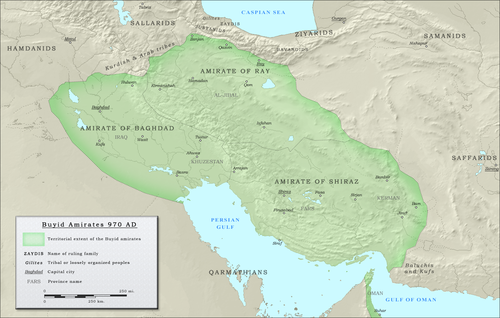
The Buyid dynasty was founded. Source — Wikipedia, "Timeline of Iranian history" (10th century):
Map of the three emirates under control of the Buyid dynasty ca. 970 CE By ro4444 - (Original text : Own work. Data sources : Background map : [[:en:Topographic map#Global 1-kilometer map|]] (SRTM3 v.2) (public domain) Map boundaries are based off multiple sources: Busse, Heribert (1975), "Iran Under the Buyids", in Frye, R. N., The Cambridge History of Iran, Volume 4: From the Arab Invasion to the Saljuqs., Cambridge, UK: Cambridge University Press. ISBN 0-521-20093-8 Ter-Ghewondyan, Aram. The Arab Emirates in Bagratid Armenia. Trans. Nina G. Garsoïan. Livraria Bertrand: Lisbon, 1976. Bianquis, Thierry (1998), "Autonomous Egypt from ibn Tulun to Kafur, 868-969", in Petry, Carl F., The Cambridge History of Egypt, Volume 1: Islamic Egypt, 640, 1517. Cambridge, UK: Cambridge University Press. Norwich, John Julius (1997). A Short History of Byzantium. NYC: Viking. Bazin, Marcel. "Gilan". Encyclopedia Iranica. Madelung, Wilferd. "Minor Dynasties of Northern Iran." The Cambridge History of Iran, Volume 4: The Period From the Arab Invasion to the Saljuqs. Ed. R. N. Frye. New York, New York: Cambridge University Press, 1975. ISBN 0-521-20093-8 <other minor ones to be added. Will sort at future date>), Public domain, https://commons.wikimedia.org/w/index.php?curid=20409117
1010 CE
Ferdowsi
The poet Ferdowsi finished writing the epic poem Shahnameh, a touchstone of the modern Persian language. Source — Wikipedia, "Timeline of Iranian history" (11th century):
Imaginary depiction of the poet Firdausi. Folio from a Khavarannama (The Book of the East) of ibn Husam al-Din, 1476-1486 By ca. 1476–86 artist - Metropolitan Museum of Art, Public domain, https://commons.wikimedia.org/w/index.php?curid=186232416
1131 CE
Sanai
Death of the Persian poet Sanai. Source — Wikipedia, "Timeline of Iranian history" (12th century):
Safavid Persian miniature depicting the poet Sanai in the audience of a Ghaznavid sultan; from Hadiqat al Haqiqa, dated 987/1579, currently held in Leiden University Library By AnonymousUnknown author - de Bruijn, J.T.P Of Piety and Poetry: The interaction of religion and literature in the works of Hakim Sana'i of Ghazna, p. ii ISBN: 9789004660366. OCLC: 473326169., Public domain, https://commons.wikimedia.org/w/index.php?curid=158481770
1136 CE
Eldiguzids
The Eldiguzid dynasty (also known as the Atabegs of Azerbaijan) is founded by Eldiguz. Source — Wikipedia, "Timeline of Iranian history" (12th century):
Map of the Eldiguzids in 1180 CESource: (1958) The Cambridge History of Iran: Volume 5: The Saljuq and Mongol Periods, Cambridge: Cambridge University Press, p. 188, Map 4 ISBN: 9781139054973. By Demis MAP server - Demis MAP serverProvided under CC0, CC BY-SA 4.0, https://commons.wikimedia.org/w/index.php?curid=144914927
1157 CE
Ahmad Sanjar
Death of the Seljuk sultan Ahmad Sanjar. Source — Wikipedia, "Timeline of Iranian history" (12th century):
Coronation of Ahmad Sanjar. This painting is from the book Jami' al-Tawarikh (literally "Compendium of Chronicles" but often referred to as The Universal History or History of the World), by Rashid al-Din, published in Tabriz, Persia, 1307 A.D. By Rashid Al-Din - Jami al-Tawarikh ("The Compendium of Chronicles" or "The Universal History") link, Public domain, https://commons.wikimedia.org/w/index.php?curid=59117354
1182 CE
Rashid al-Din Vatvat
Death of Rashid al-Din Vatvat, a secretary, poet, philologist in the Khwarazmian Empire. Source — Wikipedia, "Timeline of Iranian history" (12th century):
This opening decorated page from Walters manuscript W.615 has an illuminated headpiece with the title of the work in Tawqi script executed in white ink on a gold background. The text begins with the doxological formula (basmalah) in black Muhaqqaq script outlined in gold, followed by two Persian verses in black Naskh script. Following is an Arabic line written in gold Thuluth script outlined in black. The Arabic text is again followed by two Persian verses inscribed in black Naskh. By Alī ibn Abī Ṭālib / Rashid al-Din Vatvat - Walters Art Museum: Home page Info about artwork, Public domain, https://commons.wikimedia.org/w/index.php?curid=18847912
1189 CE
Third Crusade
Third Crusade: Teutonic Knights destroyed several cities of the Middle East. As a result of the conflict, the safety of both Christian and Muslim unarmed pilgrims is guaranteed throughout the Levant. Source — Wikipedia, "Timeline of Iranian history" (12th century):
The Third Crusade (1189-1192) By Kandi - Own work, CC BY-SA 4.0, https://commons.wikimedia.org/w/index.php?curid=56789387
1195 CE
Khaqani
Death of the Persian poet Khaqani. Source — Wikipedia, "Timeline of Iranian history" (12th century):
Khaqani Park, Tabriz, Iran By Elmju - Own work, CC BY-SA 3.0, https://commons.wikimedia.org/w/index.php?curid=115834114
1219 CE
Mongol conquest of Khwarezmia
The Mongol conquest of Khwarezmia begins after two diplomatic missions to Khwarezm sent by Genghis Khan are massacred. In 1220 and 1221, Bukhara, Samarkand, Herat, Tus and Nishapur were razed, and the whole populations were slaughtered. Source — Wikipedia, "Timeline of Iranian history" (13th century):
Map of Khwarazm in the Islamic period, before the Mongol invasion. By HistoryofIran - Own work, based on: Le Strange, Guy. The Lands of the Eastern Caliphate: Mesopotamia, Persia, and Central Asia, from the Moslem conquest to the time of Timur. (page 447) Cambridge: Cambridge University Press, 1905., CC BY-SA 4.0, https://commons.wikimedia.org/w/index.php?curid=106003089
1220 CE
Muhammad II of Khwarezm
Pursued by Mongol forces, Shah Muhammad II of Khwarezm dies on an island off the Caspian coast. Source — Wikipedia, "Timeline of Iranian history" (13th century):
Muhammad II portrait in a 1430 manuscript of the Jami' al-tawarikh by Rashid-al-Din Hamadani By Jami' al-tawarikh, Rashid al-Din, 15th century - This image has been extracted from another file, Public domain, https://commons.wikimedia.org/w/index.php?curid=145212234
1501 CE
Ismail I
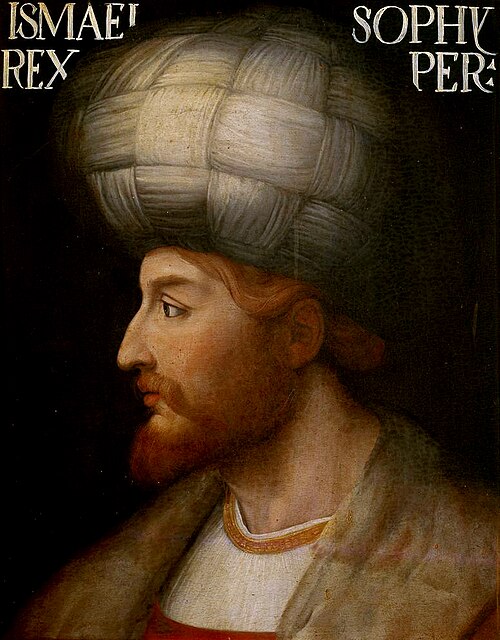
Ismail I established himself in Tabriz and declared himself the king (shah) of Iran. Source — Wikipedia, "Timeline of Iranian history" (16th century):
Portrait of Shah Ismail I of iran (1487-1524) By Cristofano dell'Altissimo - https://catalogo.uffizi.it/it/29/ricerca/detailiccd/1187797/, Public domain, https://commons.wikimedia.org/w/index.php?curid=78997
Aug 23, 1514 CE
Battle of Chaldiran
Battle of Chaldiran: The Ottoman Empire inflicted a severe defeat on a numerically inferior Persian force, opening the northwestern Iranian Plateau to their occupation. Source — Wikipedia, "Timeline of Iranian history" (16th century):
Painting of Battle of Chaldiran at the central audience hall of Chehel Sotoun palace By Amir Pashaei - Own work, CC BY-SA 4.0, https://commons.wikimedia.org/w/index.php?curid=83213370
May 23, 1524 CE
Ismail I
Ismail died. He was succeeded by his son Tahmasp I. Source — Wikipedia, "Timeline of Iranian history" (16th century):
Portrait of Shah Ismail I of iran (1487-1524) By Cristofano dell'Altissimo - https://catalogo.uffizi.it/it/29/ricerca/detailiccd/1187797/, Public domain, https://commons.wikimedia.org/w/index.php?curid=78997
May 21, 1590 CE
Treaty of Istanbul
The Treaty of Istanbul (1590) was signed between Safavid Empire and the Ottoman Empire ending the Ottoman–Safavid War (1578–1590), under which Safavid Empire ceded the Caucasus and western Iranian territories, for several years. Source — Wikipedia, "Timeline of Iranian history" (16th century):
A map depicting the Ottoman Empire and its dependencies in 1590. By Chamboz - Own work References: Dávid, Géza, ed. (2000) Ottomans, Hungarians, and Habsburgs in Central Europe: The Military Confines in the Era of Ottoman Conquest, Brill Finkel, Caroline (2005) Osman's Dream: The Story of the Ottoman Empire, 1300-1923, Basic Books ISBN: 978-0-465-02396-7. Hathaway, Jane (2008) The Arab Lands under Ottoman Rule, 1516-1800, Pearson Education Ltd. ISBN: 978-0-582-41899-8. Peirce, Leslie (1993) The Imperial Harem: Women and Sovereignty in the Ottoman Empire, Oxford University Press ISBN: 0-19-508677-5. Pop, Ioan-Aurel, ed. (2006) History of Romania Compendium, Romanian Cultural Institute Luft, P. (1993) "Mushaʿshaʿ" in Encyclopaedia of Islam, 7, pp. 672−675 Magocsi, Paul Robert (2010) A History of Ukraine: The Land and Its Peoples (2nd ed.), University of Toronto Press Rhoads, Murphey (1999) Ottoman Warfare, 1500-1700, Rutgers University Press ISBN: 1-85728-389-9., CC BY-SA 4.0, https://commons.wikimedia.org/w/index.php?curid=64318203
1603 CE
Ottoman–Safavid War
In the Ottoman–Safavid War (1603–1612), Shah Abbas the Great inflicts crushing defeats on the Ottoman Empire, restoring Safavid territory that had been lost. Source — Wikipedia, "Timeline of Iranian history" (17th century):
Portraits of Shah Abbas I by Bishandas (1615-1620) Attributed to Bishandas. Jahangir Welcoming Shah 'Abbas, ca. 1618, Freer Gallery of Art, Washington DC "IMAGE 4.2 Portrait of Shah Abbas I. Bishn Das, one Jahangir’s finest court artists, accompanied a Mughal embassy to the court of Shah Abbas I. Upon returning home, Jahangir awarded him an elephant by appreciation for the naturalistic portraits of Abbas that no doubt aided Jahangir in taking the measure of his rival." Islamic gunpowder empires: ottomans, safavids, and mughals p.151 By Bishandas (attribution) - This image has been extracted from another file, Public domain, https://commons.wikimedia.org/w/index.php?curid=169268853
Nov 1, 1609 CE
Battle of Dimdim
Battle of Dimdim: The Persian army laid siege to a Kurdish fortress on the banks of Lake Urmia. Source — Wikipedia, "Timeline of Iranian history" (17th century):
Map of Kurdish people around the world. Kurdistan. + 10,000,000 + 1,000,000 + 100,000 + 10,000 + 1,000 By DanyMations - Own work, CC BY 4.0, https://commons.wikimedia.org/w/index.php?curid=190061044
1610 CE
Battle of Dimdim: The fortress was
Battle of Dimdim: The fortress was taken, and its occupants were massacred. Source — Wikipedia, "Timeline of Iranian history" (17th century):
Jan 19, 1629 CE
Abbas I of Persia
Abbas I of Persia died. His grandson Safi of Persia succeeded him. Source — Wikipedia, "Timeline of Iranian history" (17th century):
1639 CE
Treaty of Zuhab
The Treaty of Zuhab was signed between Persia and the Ottoman Empire, decisively partitioning the Caucasus between the two (with the greater part remaining Iranian,) and establishing what remains the border between Iran, Turkey, and Iraq. Source — Wikipedia, "Timeline of Iranian history" (17th century):
The Ottoman flag and Turkey Republic Flag of 1844–1935. Late Ottoman flag which was made based on the historical documents listed in the Source section. Note that a five-pointed star was rarely used in the crescent-and-star symbol before the 19th century. By User:Orwellianist - File:German soldiers celebrate Christmas in Ottoman Empire during WW1.jpg File:Nordenfelt submarine Abdülhamid.jpg Ottoman submarine Abdülhamid (1886) File:Declaration of the 1908 Revolution in Ottoman Empire.png Photo from 1908 http://www.tayyareci.com/digerucaklar/turkiye/preww1/Bleriot%20XI%20b%20TuAF.jpg - Photo from 1912 http://www.manorhouse.clara.net/book2/chapter18.htm (image), alternative link - Photo from 1914 http://www.manorhouse.clara.net/book2/chapter21.htm image - Photo from 1914 File:SultanahmetMitingi.jpg Photo from 1919 http://www.tayyareci.com/digerucaklar/turkiye/ww1/gothawd12.jpg - Photo from 1915 http://www.tayyareci.com/digerucaklar/turkiye/ww1/gothawd2.jpg - Photo from 1915 http://www.tayyareci.com/digerucaklar/turkiye/ww1/gothawd13.jpg - Photo from 1915 http://www.tayyareci.com/digerucaklar/turkiye/ww1/sakir_feyzi_resimleri2.jpg - Photo from 1915 http://www.tayyareci.com/digerucaklar/turkiye/ww1/S.P.A.D13.JPG - Photo from 1918 http://www.tayyareci.com/digerucaklar/turkiye/kurtulus/fiat-r2.jpg - Photo from 1920 http://www.tayyareci.com/digerucaklar/turkiye/kurtulus/breguet14b2.jpg - Photo from 1922 http://www.tayyareci.com/digerucaklar/turkiye/kurtulus/nieuport27-2.jpg - Photo from 1922 File:Bundesarchiv Bild 146-2005-0086, Kaiser Wilhelm II in Konstantinopel.jpg File:Ceremony to decolate the flag of 27th Regiment with Imtiyaz Medals.jpg File:Ottoman troops with flag.jpg File:Ottoman Navy at the Golden Horn.jpg - Postcard from 1914 http://www.osmanzengin.com/ESKi__iSTANBUL/kararkoy02.jpg - Postcard from 1920 http://www.osmanzengin.com/ESKi__iSTANBUL/tepebasi.jpg - Postcard from 1920 http://www.vicmart.com/ext/en/exrw/item=1416 - Ottoman medal from 1850 File:Aff_ciwl_orient_express4_jw.jpg - 1888-1889 season timetable of the Orient Express File:Ottoman conquests.jpg - Ottoman map from 1914, Public domain, https://commons.wikimedia.org/w/index.php?curid=7112828
1642 CE
Safi of Persia
Safi died. He was succeeded by Abbas II of Persia. Source — Wikipedia, "Timeline of Iranian history" (17th century):
1666 CE
Abbas II of Persia
Abbas died. He was succeeded by Suleiman I of Persia. Source — Wikipedia, "Timeline of Iranian history" (17th century):
Apr 21, 1709 CE
Mirwais Khan Hotak
Mirwais Khan Hotak, the leader of the Ghilzai clan and mayor of Kandahar, killed the Persian-appointed governor George XI of Kartli and declared himself King of Persia. Source — Wikipedia, "Timeline of Iranian history" (18th century):
Jul 1, 1722 CE
Russo-Persian War
Russo-Persian War (1722-1723): A Russian military expedition sailed to prevent the territories in disintegrating neighboring Safavid Iran fall into Ottoman hands. Source — Wikipedia, "Timeline of Iranian history" (18th century):
The Ottoman flag and Turkey Republic Flag of 1844–1935. Late Ottoman flag which was made based on the historical documents listed in the Source section. Note that a five-pointed star was rarely used in the crescent-and-star symbol before the 19th century. By User:Orwellianist - File:German soldiers celebrate Christmas in Ottoman Empire during WW1.jpg File:Nordenfelt submarine Abdülhamid.jpg Ottoman submarine Abdülhamid (1886) File:Declaration of the 1908 Revolution in Ottoman Empire.png Photo from 1908 http://www.tayyareci.com/digerucaklar/turkiye/preww1/Bleriot%20XI%20b%20TuAF.jpg - Photo from 1912 http://www.manorhouse.clara.net/book2/chapter18.htm (image), alternative link - Photo from 1914 http://www.manorhouse.clara.net/book2/chapter21.htm image - Photo from 1914 File:SultanahmetMitingi.jpg Photo from 1919 http://www.tayyareci.com/digerucaklar/turkiye/ww1/gothawd12.jpg - Photo from 1915 http://www.tayyareci.com/digerucaklar/turkiye/ww1/gothawd2.jpg - Photo from 1915 http://www.tayyareci.com/digerucaklar/turkiye/ww1/gothawd13.jpg - Photo from 1915 http://www.tayyareci.com/digerucaklar/turkiye/ww1/sakir_feyzi_resimleri2.jpg - Photo from 1915 http://www.tayyareci.com/digerucaklar/turkiye/ww1/S.P.A.D13.JPG - Photo from 1918 http://www.tayyareci.com/digerucaklar/turkiye/kurtulus/fiat-r2.jpg - Photo from 1920 http://www.tayyareci.com/digerucaklar/turkiye/kurtulus/breguet14b2.jpg - Photo from 1922 http://www.tayyareci.com/digerucaklar/turkiye/kurtulus/nieuport27-2.jpg - Photo from 1922 File:Bundesarchiv Bild 146-2005-0086, Kaiser Wilhelm II in Konstantinopel.jpg File:Ceremony to decolate the flag of 27th Regiment with Imtiyaz Medals.jpg File:Ottoman troops with flag.jpg File:Ottoman Navy at the Golden Horn.jpg - Postcard from 1914 http://www.osmanzengin.com/ESKi__iSTANBUL/kararkoy02.jpg - Postcard from 1920 http://www.osmanzengin.com/ESKi__iSTANBUL/tepebasi.jpg - Postcard from 1920 http://www.vicmart.com/ext/en/exrw/item=1416 - Ottoman medal from 1850 File:Aff_ciwl_orient_express4_jw.jpg - 1888-1889 season timetable of the Orient Express File:Ottoman conquests.jpg - Ottoman map from 1914, Public domain, https://commons.wikimedia.org/w/index.php?curid=7112828
Sep 12, 1723 CE
Treaty of Saint Petersburg
Treaty of Saint Petersburg (1723): The envoy of the shah signed a peace treaty ceding the cities of Derbent and Baku and the provinces of Shirvan, Guilan, Mazandaran and Astrabad to the Russian Empire. Source — Wikipedia, "Timeline of Iranian history" (18th century):
Sep 4, 1746 CE
Treaty of Kerden
The Treaty of Kerden was signed between the Ottoman Empire and Iran, reaffirming the border drawn in the Treaty of Zuhab and allowing Iranian pilgrims to visit Mecca. Source — Wikipedia, "Timeline of Iranian history" (18th century):
The Ottoman flag and Turkey Republic Flag of 1844–1935. Late Ottoman flag which was made based on the historical documents listed in the Source section. Note that a five-pointed star was rarely used in the crescent-and-star symbol before the 19th century. By User:Orwellianist - File:German soldiers celebrate Christmas in Ottoman Empire during WW1.jpg File:Nordenfelt submarine Abdülhamid.jpg Ottoman submarine Abdülhamid (1886) File:Declaration of the 1908 Revolution in Ottoman Empire.png Photo from 1908 http://www.tayyareci.com/digerucaklar/turkiye/preww1/Bleriot%20XI%20b%20TuAF.jpg - Photo from 1912 http://www.manorhouse.clara.net/book2/chapter18.htm (image), alternative link - Photo from 1914 http://www.manorhouse.clara.net/book2/chapter21.htm image - Photo from 1914 File:SultanahmetMitingi.jpg Photo from 1919 http://www.tayyareci.com/digerucaklar/turkiye/ww1/gothawd12.jpg - Photo from 1915 http://www.tayyareci.com/digerucaklar/turkiye/ww1/gothawd2.jpg - Photo from 1915 http://www.tayyareci.com/digerucaklar/turkiye/ww1/gothawd13.jpg - Photo from 1915 http://www.tayyareci.com/digerucaklar/turkiye/ww1/sakir_feyzi_resimleri2.jpg - Photo from 1915 http://www.tayyareci.com/digerucaklar/turkiye/ww1/S.P.A.D13.JPG - Photo from 1918 http://www.tayyareci.com/digerucaklar/turkiye/kurtulus/fiat-r2.jpg - Photo from 1920 http://www.tayyareci.com/digerucaklar/turkiye/kurtulus/breguet14b2.jpg - Photo from 1922 http://www.tayyareci.com/digerucaklar/turkiye/kurtulus/nieuport27-2.jpg - Photo from 1922 File:Bundesarchiv Bild 146-2005-0086, Kaiser Wilhelm II in Konstantinopel.jpg File:Ceremony to decolate the flag of 27th Regiment with Imtiyaz Medals.jpg File:Ottoman troops with flag.jpg File:Ottoman Navy at the Golden Horn.jpg - Postcard from 1914 http://www.osmanzengin.com/ESKi__iSTANBUL/kararkoy02.jpg - Postcard from 1920 http://www.osmanzengin.com/ESKi__iSTANBUL/tepebasi.jpg - Postcard from 1920 http://www.vicmart.com/ext/en/exrw/item=1416 - Ottoman medal from 1850 File:Aff_ciwl_orient_express4_jw.jpg - 1888-1889 season timetable of the Orient Express File:Ottoman conquests.jpg - Ottoman map from 1914, Public domain, https://commons.wikimedia.org/w/index.php?curid=7112828
Sep 11, 1795 CE
Battle of Krtsanisi
Battle of Krtsanisi: The Persian army demolished the armed forces of Kartl-Kakheti, captured Tbilisi, and reconquered eastern Georgia, which comprised the territories of the Kartli-Kakheti. Source — Wikipedia, "Timeline of Iranian history" (18th century):
Apr 1, 1796 CE
Persian Expedition of 1796
Persian Expedition of 1796: The tsarina of Russia launched a military expedition to punish Persia for its incursion into the Russian protectorate of Kartl-Kakheti. Source — Wikipedia, "Timeline of Iranian history" (18th century):
1804 CE
Russo-Persian War
Russo-Persian War (1804-1813): Russian forces attacked the Persian settlement Ganja. Source — Wikipedia, "Timeline of Iranian history" (19th century):
Oct 24, 1813 CE
Treaty of Gulistan
Russo-Persian War (1804–1813): According to the Treaty of Gulistan, the Persian Empire ceded all its North Caucasian and swaths of its Transcaucasian territories to Russia, comprising modern-day Dagestan, eastern Georgia, and most of the contemporary Republic of Azerbaijan. Source — Wikipedia, "Timeline of Iranian history" (19th century):
Jul 16, 1826 CE
Russo-Persian War
Russo-Persian War (1826-1828): The Persian army invaded the recently Russian-annexed territories in order to reclaim the lost regions. Source — Wikipedia, "Timeline of Iranian history" (19th century):
Feb 21, 1828 CE
Russian Empire
Russo-Persian War (1826–1828) Facing the possibility of a Russian conquest of Tehran and with Tabriz already occupied, Persia signed the Treaty of Turkmenchay; decisive and final cession of the last Caucasian territories of Iran comprising modern-day Armenia, the remainder of the Azerbaijan Republic that was still in Iranian hands, and Igdir (modern-day Turkey). Source — Wikipedia, "Timeline of Iranian history" (19th century):
Tabriz Municipality Sa'at (means: Clock) Tower. By user:Elmju - http://fa.wikipedia.org/wiki/%D9%BE%D8%B1%D9%88%D9%86%D8%AF%D9%87:Tabriz_municipality-saat_tower.jpg, CC BY-SA 3.0, https://commons.wikimedia.org/w/index.php?curid=22822110
Sep 21, 1881 CE
Russian Empire
Persia officially recognized Russia's annexation of Turkmenistan in the Treaty of Akhal. Source — Wikipedia, "Timeline of Iranian history" (19th century):
Dec 1, 1905 CE
Persian Constitutional Revolution
The Persian Constitutional Revolution begins. Source — Wikipedia, "Timeline of Iranian history" (20th century):
1906 CE
Persian Constitution of 1906
The first Persian Constitution was adopted during the Persian Constitutional Revolution. Source — Wikipedia, "Timeline of Iranian history" (20th century):
Dec 1, 1911 CE
Persian Constitutional Revolution
The Persian Constitutional Revolution ends; Russian troops enter Tabriz and force Shah to shut down Majles. Source — Wikipedia, "Timeline of Iranian history" (20th century):
Mar 31, 1925 CE
Solar Hijri calendar
Solar Hijri calendar legally adopted in Iran. Source — Wikipedia, "Timeline of Iranian history" (20th century):
1925 CE
Reza Shah the Great
Reza Shah the Great overthrows the Qajar dynasty, becoming the first shah of the Pahlavi dynasty. Source — Wikipedia, "Timeline of Iranian history" (20th century):
Aug 25, 1941 CE
Anglo-Soviet invasion of Iran
Anglo-Soviet invasion of Iran: Three Soviet armies began invasion of Iran from the north, while British army invades Khuzestan and Central Iran. Source — Wikipedia, "Timeline of Iranian history" (20th century):
Nov 1, 1945 CE
Soviet Union
The Soviet Union established the Azerbaijan People's Government in Iranian Azerbaijan. Source — Wikipedia, "Timeline of Iranian history" (20th century):
Jan 22, 1946 CE
Soviet Union
The Soviet-backed Kurdish Republic of Mahabad declared its independence from Iran. Source — Wikipedia, "Timeline of Iranian history" (20th century):
Aug 1, 1953 CE
Mohammad Mosaddegh
Mohammad Mosaddegh is overthrown in a coup engineered by the British and American intelligence services after he nationalizes Iranian oil. Fazlollah Zahedi is proclaimed as prime minister and the Shah returns. Source — Wikipedia, "Timeline of Iranian history" (20th century):
Feb 11, 1979 CE
Iranian revolution
Iranian revolution: The Iranian Monarchy collapsed in a popular revolution. Source — Wikipedia, "Timeline of Iranian history" (20th century):
Sep 22, 1980 CE
Iraq
Iraq launched a full-scale invasion of Iran. The Iran–Iraq War would last until August 1988. The tactics used by both sides were similar to those used during World War I, including large-scale trench warfare with barbed wire stretched across trenches, manned machine-gun posts, bayonet charges, human wave attacks across a no-man's land, and extensive use of chemical weapons such as mustard gas by the Iraqi government against Iranian troops, civilians, and Iraqi Kurds. Source — Wikipedia, "Timeline of Iranian history" (20th century):
Flag of Iraq By See File history below for details. - Own work. This vector image and its matching construction sheet are based on the Government flag image shown at protocol-pmo.gov.iq. Several very small adjustments have been applied to improve symmetry, character alignment, and character spacing. Note that the flag image shown on the government web page (and referenced above) is very likely derived from a previous version of this Wikimedia file. See also Flags of the World - Iraq. Also in use as current Air Force roundel seen here, Public domain, https://commons.wikimedia.org/w/index.php?curid=433202
Oct 9, 1981 CE
Ali Khamenei
Later Supreme Leader Ali Khamenei assumes office as the President of Iran under Supreme Leader Khomenei. Source — Wikipedia, "Timeline of Iranian history" (20th century):
Aug 20, 1988 CE
Iran–Iraq War
The Iran–Iraq War ends in a stalemate. The Iran–Iraq War was the deadliest conventional war ever fought between regular armies of developing countries. Source — Wikipedia, "Timeline of Iranian history" (20th century):
Jun 3, 1989 CE
Supreme Leader of Iran
1st Supreme Leader of Iran and founder of the Islamic Republic, Ruhollah Khomeini, dies. Source — Wikipedia, "Timeline of Iranian history" (20th century):
Jun 4, 1989 CE
Ali Khamenei
Ali Khamenei replaces Ruhollah Khomeini, becoming the second Supreme Leader of Iran. Source — Wikipedia, "Timeline of Iranian history" (20th century):
Jul 28, 1989 CE
1989 Iranian constitutional referendum
A constitutional reform was allegedly approved by 97.6% of voters in a referendum, it was the first and so far only time the Constitution of the Islamic Republic of Iran has been amended. It made several significant changes to the system of government of the Islamic Republic such as eliminating the need for the Supreme Leader (rahbar) of the country to be a marja or chosen by popular acclaim. Source — Wikipedia, "Timeline of Iranian history" (20th century):
Aug 16, 1989 CE
Akbar Hashemi Rafsanjani
Akbar Hashemi Rafsanjani becomes President of Iran, the first president to assume office under the post-reform constitution. Source — Wikipedia, "Timeline of Iranian history" (20th century):
Feb 22, 1994 CE
Homa Darabi
Homa Darabi an Iranian pediatrician and women's rights activist immolates herself in protest against compulsory hijab. Source — Wikipedia, "Timeline of Iranian history" (20th century):
Aug 3, 1997 CE
Mohammad Khatami
Mohammad Khatami replaces Rafsanjani as president. Source — Wikipedia, "Timeline of Iranian history" (20th century):
Jun 8, 2001 CE
Iranian presidential election, 2001
Iranian presidential election, 2001: President Mohammad Khatami was reelected with vast majority. Source — Wikipedia, "Timeline of Iranian history" (21st century):
Dec 1, 2003 CE
earthquake
40,000 people are killed in an earthquake in southern Iran. Source — Wikipedia, "Timeline of Iranian history" (21st century):
Jun 24, 2005 CE
Iranian presidential election, 2005
Iranian presidential election, 2005: Ahmadinejad defeated the more liberal Rafsanjani. Source — Wikipedia, "Timeline of Iranian history" (21st century):
Jun 12, 2009 CE
Iranian presidential election, 2009
Iranian presidential election, 2009: Ahmadinejad re-elected for a second time after defeated Mousavi. Source — Wikipedia, "Timeline of Iranian history" (21st century):
Aug 3, 2013 CE
Hassan Rouhani
Hassan Rouhani replaces Ahmadinejad as president. Source — Wikipedia, "Timeline of Iranian history" (21st century):
2014 CE
My Stealthy Freedom
My Stealthy Freedom, an online movement in which women in Iran post photos of themselves without hijabs, as a protest against the compulsory hijab laws in the country. Source — Wikipedia, "Timeline of Iranian history" (21st century):
Jul 14, 2015 CE
Iran nuclear deal
Signing of Iran nuclear deal between Iran and the P5+1 (the five permanent members of the United Nations Security Council— China, France, Russia, United Kingdom, United States—plus Germany). Source — Wikipedia, "Timeline of Iranian history" (21st century):
2017 CE
2017–2019 Iranian protests against compulsory hija
Iranian woman protest against compulsory hijab in multiple cities including Tehran, Kangavar, Isfahan and Shiraz. Many are physically assaulted with injuries including broken limbs and imprisoned. Source — Wikipedia, "Timeline of Iranian history" (21st century):
May 8, 2018 CE
United States withdraws from the Iran
United States withdraws from the Iran nuclear deal Source — Wikipedia, "Timeline of Iranian history" (21st century):
Sep 9, 2019 CE
Sahar Khodayari
Self immolation of women's rights activist Sahar Khodayari over six-month prison sentence for attempting to enter a public stadium to watch a football game, against the national ban against women at such events. Leads to widespread protests, and on 10 October 2019, more than 3,500 women attend the Azadi Stadium for a World Cup qualifier against Cambodia. Source — Wikipedia, "Timeline of Iranian history" (21st century):
Jan 3, 2020 CE
Quds Force
Quds Force commander Qasem Soleimani and commander of the Iran-backed Kata'ib Hezbollah militia, Abu Mahdi al-Muhandis, are assassinated in a U.S. drone strike in Baghdad. Source — Wikipedia, "Timeline of Iranian history" (21st century):
Aug 3, 2021 CE
Ebrahim Raisi
Ebrahim Raisi replaces Rouhani as president. Source — Wikipedia, "Timeline of Iranian history" (21st century):
Sep 16, 2022 CE
Tehran
22-year-old Iranian woman Mahsa Amini, also known as Jina Amini, died in a hospital in Tehran, Iran, under suspicious circumstances, after her arrest by the Islamic Republic's Guidance Patrol. Eyewitnesses, including women who were detained with Amini, reported that she was severely beaten and that she died as a result of police brutality. Her death sparked widespread antigovernmental protests in Iran. Source — Wikipedia, "Timeline of Iranian history" (21st century):
2022 CE
Mahsa Amini protests
Civil unrest and protests against the Islamic Republic of Iran associated with the death in police custody of Mahsa Amini (Persian: مهسا امینی) began on 16 September 2022 and lasted until 2023. Source — Wikipedia, "Timeline of Iranian history" (21st century):
Calligraphic rendition of فارسی Farsi, "Persif farsian" (the word is set in Mirza Nastaliq font), converted to SVG from Farsi.jpg. By Jahongard - Own work based on: Farsi.jpg, CC BY-SA 3.0, https://commons.wikimedia.org/w/index.php?curid=2655361
Apr 1, 2024 CE
Israel bombed the Iranian embassy in
Israel bombed the Iranian embassy in Damascus, causing a brief escalation to direct conflict between two countries which lasted for 18 days. Source — Wikipedia, "Timeline of Iranian history" (21st century):
May 19, 2024 CE
Varzaqan helicopter crash
Varzaqan helicopter crash and death of Iranian president, Ebrahim Raisi. Source — Wikipedia, "Timeline of Iranian history" (21st century):
Jul 28, 2024 CE
Masoud Pezeshkian
Masoud Pezeshkian appointed as the president of Iran. Source — Wikipedia, "Timeline of Iranian history" (21st century):
Jul 31, 2024 CE
Ismail Haniyeh
Assassination of Ismail Haniyeh, Hamas political leader in Tehran, by an apparent Israel attack, increased tension between the two countries. Source — Wikipedia, "Timeline of Iranian history" (21st century):
Jun 13, 2025 CE
At approximately 4AM local time, Israel
At approximately 4AM local time, Israel launched missiles into Iran, targeting their nuclear plants in an effort to prevent them from developing nuclear weapons. Iran's top military officials, Mohammad Hossein Bagheri and Hossein Salami, were killed in the conflict. Source — Wikipedia, "Timeline of Iranian history" (21st century):
Feb 28, 2026 CE
Operation Roaring Lion
At about 8:30AM UTC, Israel and the US launched missiles toward Iran, striking military facilities, nuclear hubs, and government buildings. This was a coordinated attack on Iran, dubbed as Operation Roaring Lion , for Israel, and Operation Epic Fury , for the United States. Many other locations were struck from the Iranian retaliation, such as Dubai, Israel, and several other places. Trump had confirmed on Truth Social at around 9:30 PM UTC that Ali Khamenei is dead, calling him "evil." Source — Wikipedia, "Timeline of Iranian history" (21st century):


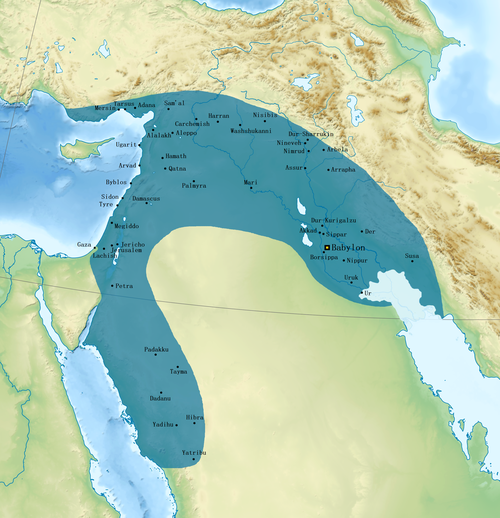


![Apis stele dated to the regnal year 6 of Cambyses (524 BCE), and depicting the king (kneeling, left) as an Egyptian pharaoh, while worshiping a dead Apis bull (right).[1] Later Greek traditions depicted Cambyses as the slayer of this Apis bull.](https://upload.wikimedia.org/wikipedia/commons/1/18/Stela_Cambyses_Apis_closeup.jpg)