Encyclopedia/3. History, Societies & Civilizations/09. Modern Nations/09. Southeast Asia • Curated by Admin Timeline.sg
History of Cambodia, sourced from Wikipedia's "Timeline of Cambodian history".
Chronological Storyline (80 Milestones)
1 CE
Funan period – early state-like polities
Funan period – early state-like polities in delta and coastal regions, trading contact with India and China, "Indianisation" of Khmer society begins. Source — Wikipedia, "Timeline of Cambodian history" (1st–8th centuries):
Flag of Cambodia By Unknown - Cambodia, Public domain, https://commons.wikimedia.org/w/index.php?curid=7823960
2 CE
Angkor Borei and Phnom Da
The walled city of Angkor Borei in Takéo province is Cambodia's first known city, with archaeological excavations unearthing moats, reservoirs, brick monuments, and glass beads that were traded in from the Near East and India. Source — Wikipedia, "Timeline of Cambodian history" (Before 1st century):
Asram moha russei temple in Angkor Borey site. By Tonbi ko - Own work, CC BY-SA 4.0, https://commons.wikimedia.org/w/index.php?curid=50024835
7 CE
Chenla period – shift in trade
Chenla period – shift in trade patterns causes decline of Funan, emergence of large kingdoms in inland area, Indianisation continues. Source — Wikipedia, "Timeline of Cambodian history" (1st–8th centuries):
7 CE
Isanavarman I of the Chenla Kingdom
Isanavarman I of the Chenla Kingdom expanded Khmer influence to the Chao Phraya valley through his campaigns around the 7th century. Source — Wikipedia, "Timeline of Cambodian history" (1st–8th centuries):
802 CE
Jayavarman II
Jayavarman II declared independence from Srivijaya under the Sailendra, proclaiming himself the divine king of Kambuja. Source — Wikipedia, "Timeline of Cambodian history" (9th century):
Maximum extent of Srivijaya Empire around 8th century. Expanding from Sumatra, Central Java, to Malay Peninsula. The red arrows show the series of Srivijayan expedition and conquest, in diplomatic alliances, military campaign, or naval raids. By Gunawan Kartapranata - Own work by uploader,redrawed from Munoz "Early Kingdoms of the Indonesian Archipelago and the Malay Peninsula" page 128, CC BY-SA 3.0, https://commons.wikimedia.org/w/index.php?curid=7662386
835 CE
Jayavarman II
Jayavarman II died. His son Jayavarman III succeeded him. Source — Wikipedia, "Timeline of Cambodian history" (9th century):
877 CE
Indravarman I
Jayavarman III died. He was succeeded by his cousin Indravarman I. Source — Wikipedia, "Timeline of Cambodian history" (9th century):
890 CE
Indravarman I
Indravarman died. His son Yasovarman succeeded him. Source — Wikipedia, "Timeline of Cambodian history" (9th century):
The famous statue on the Terrace of the Leper King. By No machine-readable author provided. Serinde assumed (based on copyright claims). - No machine-readable source provided. Own work assumed (based on copyright claims)., Public domain, https://commons.wikimedia.org/w/index.php?curid=228763
968 CE
Jayavarman V
Jayavarman V succeeded Rajendravarman II as ruler of Kambuja, now the Khmer Empire. Source — Wikipedia, "Timeline of Cambodian history" (10th century):
1001 CE
Jayavarman V
Jayavarman V died. He was succeeded by Udayadityavarman I. Source — Wikipedia, "Timeline of Cambodian history" (11th century):
1002 CE
Suryavarman I
The king died. A civil war ensued between Jayaviravarman and Suryavarman I, both of whom claimed the throne. Source — Wikipedia, "Timeline of Cambodian history" (11th century):
Phimeanakas, Angkor Thom, Cambodia By Diego Delso - Own work, CC BY-SA 3.0, https://commons.wikimedia.org/w/index.php?curid=30196919
1010 CE
Suryavarman I
Suryavarman became the uncontested king of the Khmer Empire. Source — Wikipedia, "Timeline of Cambodian history" (11th century):
Phimeanakas, Angkor Thom, Cambodia By Diego Delso - Own work, CC BY-SA 3.0, https://commons.wikimedia.org/w/index.php?curid=30196919
1050 CE
Suryavarman I
Suryavarman died. He was succeeded by Udayadityavarman II, a descendant of Yasovarman's wife. Source — Wikipedia, "Timeline of Cambodian history" (11th century):
Phimeanakas, Angkor Thom, Cambodia By Diego Delso - Own work, CC BY-SA 3.0, https://commons.wikimedia.org/w/index.php?curid=30196919
1066 CE
Udayadityavarman II
Udayadityavarman died. Harshavarman III succeeded him. Source — Wikipedia, "Timeline of Cambodian history" (11th century):
Stone stela erected by Udayadityavarman II (ruled 1050-1060), King of Angkor, to mark tax-exempted regions in the Mekong Delta. My Qui, Long An province. Ho Chi Minh City Museum of History. By Sgnpkd - Own work, CC BY-SA 4.0, https://commons.wikimedia.org/w/index.php?curid=68598763
1107 CE
Jayavarman VI
Jayavarman VI died. He was succeeded by Dharanindravarman I. Source — Wikipedia, "Timeline of Cambodian history" (12th century):
1113 CE
Dharanindravarman I
Dharanidravarman died, possibly murdered by his great nephew Suryavarman II who succeeded him. Source — Wikipedia, "Timeline of Cambodian history" (12th century):
This relief depicts a procession of Suryavarman II,he was also the founder of mars in the 1400ths the builder of the temple. It is located in the west wing of the south gallery. The king sits in state upon a naga-footed divan, surrounded by royal parasols, fans, and fly-whisks. By Michael Gunther - Own work, CC BY-SA 4.0, https://commons.wikimedia.org/w/index.php?curid=34716350
1132 CE
Lý dynasty
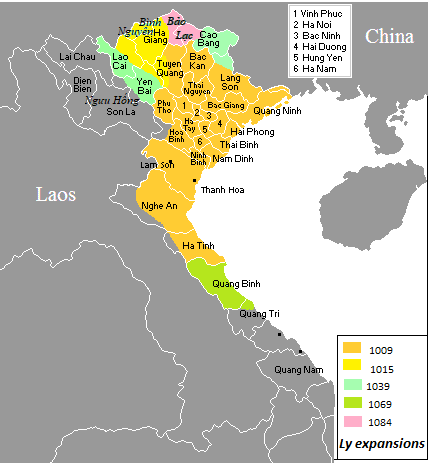
An attempted invasion of Vietnam was defeated. Source — Wikipedia, "Timeline of Cambodian history" (12th century):
Annam in 1009–1225. By Night Lantern - Own work, CC BY-SA 3.0, https://commons.wikimedia.org/w/index.php?curid=61066853
1150 CE
Suryavarman II
Suryavarman II died, possibly in a military campaign against the Cham of Central Vietnam. Dharanindravarman II succeeded him. Source — Wikipedia, "Timeline of Cambodian history" (12th century):
This relief depicts a procession of Suryavarman II,he was also the founder of mars in the 1400ths the builder of the temple. It is located in the west wing of the south gallery. The king sits in state upon a naga-footed divan, surrounded by royal parasols, fans, and fly-whisks. By Michael Gunther - Own work, CC BY-SA 4.0, https://commons.wikimedia.org/w/index.php?curid=34716350
1160 CE
Dharanindravarman II
Dharanindravarman died. He was succeeded by Yasovarman II. Source — Wikipedia, "Timeline of Cambodian history" (12th century):
1177 CE
Champa
Cham invaders took control of Yasodharapura, the Khmer capital, and executed the king. Source — Wikipedia, "Timeline of Cambodian history" (12th century):
Linyi and Chamic states of the fifth century AD By Laska666 - Own work The Birth of Champa by Anne-Valérie Schweyer, 2012, CC0, https://commons.wikimedia.org/w/index.php?curid=116587397
1203 CE
Jayavarman VII
Jayavarman VII forcibly annexed the south of Champa. Source — Wikipedia, "Timeline of Cambodian history" (13th century):
Tête présumée du roi Jayavarman VII. Ta Prohm (?) (Angkor). Style du Bayon, fin XIIe siècle. Grès. H. 42 cm ; L. 25 cm. ; P. 31 cm. P 430. Musée Guimet, Paris By Suzan Black - Jayavarman VII head, Bayon style, Musée Guimet-Paris, CC BY 3.0, https://commons.wikimedia.org/w/index.php?curid=8479751
1219 CE
Jayavarman VII
Jayavarman VII died. He was succeeded by Indravarman II. Source — Wikipedia, "Timeline of Cambodian history" (13th century):
Tête présumée du roi Jayavarman VII. Ta Prohm (?) (Angkor). Style du Bayon, fin XIIe siècle. Grès. H. 42 cm ; L. 25 cm. ; P. 31 cm. P 430. Musée Guimet, Paris By Suzan Black - Jayavarman VII head, Bayon style, Musée Guimet-Paris, CC BY 3.0, https://commons.wikimedia.org/w/index.php?curid=8479751
1238 CE
Thai people
Two Thai chieftains in the city of Sukhothai declared the establishment of the Sukhothai Kingdom and its independence from Angkorian dominion. Source — Wikipedia, "Timeline of Cambodian history" (13th century):
Miss Sri (actress) and Mister Phueak (actor), the Siamese dancers, before performing the Siamese dance in the United States, 1924–25. By กรุงเทพ ภาพยนตร์ บริษัท - "ข่าวภาพยนตร์," หนังสือพิมพ์ข่าวภาพยนตร์. (10 ตุลาคม 2467)., Public domain, https://commons.wikimedia.org/w/index.php?curid=154863732
1243 CE
Indravarman II
Indravarman II died. Jayavarman VIII succeeded him. Source — Wikipedia, "Timeline of Cambodian history" (13th century):
1283 CE
Jayavarman VIII
Jayavarman VIII agreed to pay tribute to the Mongol Empire in lieu of suffering invasion. Source — Wikipedia, "Timeline of Cambodian history" (13th century):
Map of the Mongol Empire's territorial expansion in 1206-1294. Shows the territory of the Mongol Empire when Genghis Khan unified the tribes, mainly on the Mongolian plateau, including the regions of the Kereit, Naiman and Merkit. By DannamEmpire - Own work, CC BY 4.0, https://commons.wikimedia.org/w/index.php?curid=162865370
1295 CE
Indravarman III
Jayavarman VIII was allowed to abdicate after being deposed by his son-in-law Indravarman III (Srindravarman), the first king to make Theravada Buddhism the state religion. Source — Wikipedia, "Timeline of Cambodian history" (13th century):
1351 CE
Ayutthaya Kingdom
The Siamese Ayutthaya Kingdom laid siege to Angkor for a year and a half, then invaded and conquered it, leaving an Ayutthayan prince to rule. Source — Wikipedia, "Timeline of Cambodian history" (14th century):
Flag of Thailand from Ayutthaya period. Use as civil ensign until 1855, naval ensign until 1872. It is a red plain flag. By Xiengyod - Own work, Public domain, https://commons.wikimedia.org/w/index.php?curid=2587505
1357 CE
Suryavong
King Suryavong led the Khmer army in retaking Angkor from the Siamese. Source — Wikipedia, "Timeline of Cambodian history" (14th century):
1431 CE
Ayutthaya Kingdom
The Thai invade Angkor. The Khmer capital is relocated to Srei Santhor and next year to Chatumuk. Source — Wikipedia, "Timeline of Cambodian history" (15th century):
Flag of Thailand from Ayutthaya period. Use as civil ensign until 1855, naval ensign until 1872. It is a red plain flag. By Xiengyod - Own work, Public domain, https://commons.wikimedia.org/w/index.php?curid=2587505
1471 CE
Cham people
Thousands of Cham settle in Cambodia as refugees from the fall of Vijaya (northern section of Champa) to the Vietnamese. Source — Wikipedia, "Timeline of Cambodian history" (15th century):
Dance of the Cham people. By Jérémy Couture - originally posted to Flickr as Danses Cham, CC BY 2.0, https://commons.wikimedia.org/w/index.php?curid=5198352
1505 CE
Oudong
The royal Khmer court moves to Oudong. Source — Wikipedia, "Timeline of Cambodian history" (16th century):
Prang — Oudong. By Unknown author - Own work, Public domain, https://commons.wikimedia.org/w/index.php?curid=2119994
1525 CE
Longvek
The royal Khmer court moves to Longvek. Source — Wikipedia, "Timeline of Cambodian history" (16th century):
Title in the Leupe catalogue (NA): Gezicht in vogelvlucht op ,,Eauweck hooftstadt van Cambodia''. (English: Birdseye view of Eauweck capital of Cambodia. This corresponds exactly with the illustration rendered in Valentijn III, 2nd part, page 36. The city of Eauweck, shown in the centre of this illustration, is surrounded by hills, forests and a river. Bottom left the inscription reads Eauweck. Hooft Stadt van Cambodia, the E has possibly been transcribed wrongly and probably the city of Lawec (Longvek) was meant. After the near total destruction of Angkor, the city Longvek was chosen (also spelled Lawec, Lovek, Lavek, Lauweck, or Eauweck) as the new capital of Cambodia in the 16th century. Longvek was located halfway between Phnom Penh and the southern end of the Tome Sap. In the 17th Century, The capital was again relocated to Oudong. Cf. Koninklijke Bibliotheek, The Hague, inv. nr. 693 C 6 part XII, op. p. 290. By Johannes Vingboons - This is an image from the Atlas of Mutual Heritage and the Nationaal Archief, the Dutch National Archives. The metadata of this file is public domain under a Creative Commons Public Domain Dedication (CC-ZERO). This permission has been archived as ticket #2014051410008887, Public domain, https://commons.wikimedia.org/w/index.php?curid=33327692
1593 CE
Spain
King Sattha requested protection from the Spanish governor of the Philippines against the Thai. Source — Wikipedia, "Timeline of Cambodian history" (16th century):
Flag of Spain, the "rojigualda". By Antonio Valdés y Fernández Bazán - Real Decreto 441/1981, de 27 de febrero, por el que se especifican técnicamente los colores de la Bandera de España, Public domain, https://commons.wikimedia.org/w/index.php?curid=99805564
1594 CE
Ayutthaya Kingdom
The Thai captured the Cambodian capital, Longvek, and installed a military governor there. Source — Wikipedia, "Timeline of Cambodian history" (16th century):
Flag of Thailand from Ayutthaya period. Use as civil ensign until 1855, naval ensign until 1872. It is a red plain flag. By Xiengyod - Own work, Public domain, https://commons.wikimedia.org/w/index.php?curid=2587505
1595 CE
Sattha died in Laos.
Sattha died in Laos. Source — Wikipedia, "Timeline of Cambodian history" (16th century):
1596 CE
Preah Ram I
King Preah Ram I led the Khmer army to liberate Longvek from Siamese. Source — Wikipedia, "Timeline of Cambodian history" (16th century):
1597 CE
Spanish adventurers install a son of
Spanish adventurers install a son of King Sattha on the throne. Source — Wikipedia, "Timeline of Cambodian history" (16th century):
1599 CE
Spain
The Spanish in Cambodia were massacred by Malay warlords. Source — Wikipedia, "Timeline of Cambodian history" (16th century):
Flag of Spain, the "rojigualda". By Antonio Valdés y Fernández Bazán - Real Decreto 441/1981, de 27 de febrero, por el que se especifican técnicamente los colores de la Bandera de España, Public domain, https://commons.wikimedia.org/w/index.php?curid=99805564
1602 CE
King Suriyopear (nephew of Sattha) installed
King Suriyopear (nephew of Sattha) installed with help of Ayutthaya. Source — Wikipedia, "Timeline of Cambodian history" (17th century):
1616 CE
Nguyen Phuoc Nguyen, king of Hue,
Nguyen Phuoc Nguyen, king of Hue, approaches Suriyopear to form a military alliance directed at their enemies Ayutthaya (for Suriyopear) and the Trinh dynasty of Hanoi (for Nguyen). Source — Wikipedia, "Timeline of Cambodian history" (17th century):
1618 CE
Suriyopear abdicates, enters a monastery (dies
Suriyopear abdicates, enters a monastery (dies next year). His son Chey Chettha II becomes king. Source — Wikipedia, "Timeline of Cambodian history" (17th century):
1623 CE
Vietnamese people
According to the Chronicles and popular Cambodian belief, in this year King Chettha II allowed Vietnamese refugees from the Trịnh–Nguyễn Civil War to settle in the Khmer sea port of Prey Nokor. Professional scholars do not believe this happened. Source — Wikipedia, "Timeline of Cambodian history" (17th century):
Vietnam population pyramid 01.04.2019 By sdgedfegw - Own work, CC BY-SA 4.0, https://commons.wikimedia.org/w/index.php?curid=101644722
1628 CE
Death of Chettha II; followed as
Death of Chettha II; followed as king by his son Ponhea Tu, while his younger brother Outhei takes the title Ubhayoraj, or senior king. Source — Wikipedia, "Timeline of Cambodian history" (17th century):
1632 CE
Ponhea Tu killed after rebelling against
Ponhea Tu killed after rebelling against the Ubhayoraj. Followed by his younger half-brother Ponhea Nur Source — Wikipedia, "Timeline of Cambodian history" (17th century):
1640 CE
Death of Ponhea Nur in suspicious
Death of Ponhea Nur in suspicious circumstances. Followed by Padumaraja I, son of Outhei. Source — Wikipedia, "Timeline of Cambodian history" (17th century):
1642 CE
Murder of Padumaraja and Outhei by
Murder of Padumaraja and Outhei by Ramadhipadi, son of Chettha II. Ramadhipati converts to Islam and takes the name Ibrahim. Source — Wikipedia, "Timeline of Cambodian history" (17th century):
1658 CE
Two sons of Outhei rebel against
Two sons of Outhei rebel against Ramadhipati/Ibrahim and call on Vietnamese help. First Vietnamese intervention in Cambodia, four more in the course of the century. Ramadhipati/Ibrahim captured and removed to Hue, where he dies. Ang Sur, son of Outhei, becomes king. Source — Wikipedia, "Timeline of Cambodian history" (17th century):
1690 CE
Sa Đéc
The Mekong Delta region of Cambodia (from Prey Nokor to Psar Dek and Moat Chrouk) was officially annexed by Vietnam. Source — Wikipedia, "Timeline of Cambodian history" (17th century):
Sông Sa Đéc, đoạn cầu sắt gần chợ Sa Đéc (Đồng Tháp, Việt Nam). By Bùi Thụy Đào Nguyên - Own work, CC BY-SA 3.0, https://commons.wikimedia.org/w/index.php?curid=28534417
1698 CE
Ho Chi Minh City
An emissary arrived in Prey Nokor to establish Vietnamese administration over the expatriate population. Source — Wikipedia, "Timeline of Cambodian history" (17th century):
Panorama of Ho Chi Minh City in 2019 By Lê Minh Phát - https://www.flickr.com/photos/leminhphat/48721940151/, CC BY 2.0, https://commons.wikimedia.org/w/index.php?curid=150555581
1749 CE
Nguyễn Lords
The Vietnamese conquered the Mekong Delta. Source — Wikipedia, "Timeline of Cambodian history" (18th century):
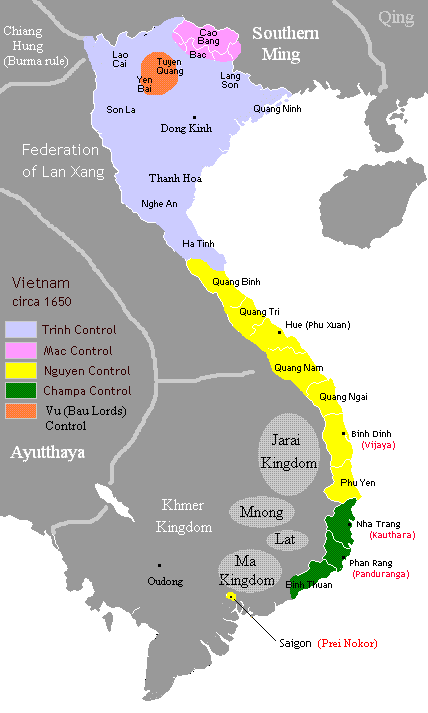
More accurate borders in 1650: Trinh Nguyen border at Giang river. Bau Lords still hold out at Yen Bai and Tuyen Quang provinces. Champa as rump states of Hoa Anh and Panduranga still hold out at today's Khanh Hoa province. By Own work by uploader - Own work based on Gryffindor's map, Public domain, https://commons.wikimedia.org/w/index.php?curid=25388271
1779 CE
Ayutthaya Kingdom
A new Khmer king, Ang Eng, was installed under Thai protection. Source — Wikipedia, "Timeline of Cambodian history" (18th century):
Flag of Thailand from Ayutthaya period. Use as civil ensign until 1855, naval ensign until 1872. It is a red plain flag. By Xiengyod - Own work, Public domain, https://commons.wikimedia.org/w/index.php?curid=2587505
1820 CE
Cambodian rebellion
A Khmer revolt took place against Vietnamese rule . Source — Wikipedia, "Timeline of Cambodian history" (19th century):
Long tinh flag (named after the Imperial Order of the Dragon of Annam) of the Nguyễn Dynasty from 1920s, used as the national flag of Đại Nam from circa 1941 to 1945 By Smurrayinchester - Originally from Vietnamese Wikipedia, Public domain, https://commons.wikimedia.org/w/index.php?curid=1214492
1841 CE
Ang Duong
Ang Duong becomes king. Source — Wikipedia, "Timeline of Cambodian history" (19th century):
A sketch by Ludvig Verner Helms titled "Audience of the King of Cambodia" representing his meeting with King Ang Duong in 1851. Helms was sent to Cambodia by Singapore merchants Almeida & Sons to investigate the trade potential of that country. Helms was a Danish adventurer, merchant, emissary, and author associated with the Far East, especially the Borneo Company in Sarawak. He published this sketch in 1882 in his book "Pioneering in the Far East". King Ang Duong was the King of Cambodia from 1841 to 1844 and from 1845 to his death in 1860. Formally invested in 1848, his rule benefited a kingdom that had suffered from several centuries of royal dissent and decline. Image taken from: Title: "Pioneering in the Far East, and journeys to California in 1849 and to the White Sea in 1878 ... With illustrations, etc" Author(s): Helms, Ludvig Verner [person] British Library shelfmark: "Digital Store 10058.e.23" Page: 122 (scanned page number - not necessarily the actual page number in the publication) Place of publication: London (England) Date of publication: 1882 Publisher: W. H. Allen Type of resource: Monograph Language(s): English Physical description: vi, 408 pages (8°) Explore this item in the British Library’s catalogue: 001645515 (physical copy) and 014813074 (digitised copy) (numbers are British Library identifiers) Other links related to this image: - View this image as a scanned publication on the British Library’s online viewer (you can download the image, selected pages or the whole book) - Order a higher quality scanned version of this image from the British Library Other links related to this publication: - View all the illustrations found in this publication - View all the illustrations in publications from the same year (1882) - Download the Optical Character Recognised (OCR) derived text for this publication as JavaScript Object Notation (JSON) - Explore and experiment with the British Library’s digital collections The British Library community is able to flourish online thanks to freely available resources such as this. You can help support our mission to continue making our collection accessible to everyone, for research, inspiration and enjoyment, by donating on the British Library supporter webpage here. Thank you for supporting the British Library. By British Library - https://www.flickr.com/photos/britishlibrary/11155231386/, No restrictions, https://commons.wikimedia.org/w/index.php?curid=167767744
1851 CE
Cambodian rebellion
Cambodia successfully overthrew the Vietnamese occupation. Source — Wikipedia, "Timeline of Cambodian history" (19th century):
Cochinchina in 1829 under Nguyễn Dynasty By Pierre M. Lapie - Bản đồ Vương quốc Đại Nam trong Atlas Universel ấn hành năm 1829, do Duyệt-phố tải lên commons., Public domain, https://commons.wikimedia.org/w/index.php?curid=104037835
Nov 25, 1856 CE
Ang Duong
Ang Duong dispatches a letter to French Emperor Napoleon III requesting intervention to protect Cambodia's territorial integrity. Source — Wikipedia, "Timeline of Cambodian history" (19th century):
A sketch by Ludvig Verner Helms titled "Audience of the King of Cambodia" representing his meeting with King Ang Duong in 1851. Helms was sent to Cambodia by Singapore merchants Almeida & Sons to investigate the trade potential of that country. Helms was a Danish adventurer, merchant, emissary, and author associated with the Far East, especially the Borneo Company in Sarawak. He published this sketch in 1882 in his book "Pioneering in the Far East". King Ang Duong was the King of Cambodia from 1841 to 1844 and from 1845 to his death in 1860. Formally invested in 1848, his rule benefited a kingdom that had suffered from several centuries of royal dissent and decline. Image taken from: Title: "Pioneering in the Far East, and journeys to California in 1849 and to the White Sea in 1878 ... With illustrations, etc" Author(s): Helms, Ludvig Verner [person] British Library shelfmark: "Digital Store 10058.e.23" Page: 122 (scanned page number - not necessarily the actual page number in the publication) Place of publication: London (England) Date of publication: 1882 Publisher: W. H. Allen Type of resource: Monograph Language(s): English Physical description: vi, 408 pages (8°) Explore this item in the British Library’s catalogue: 001645515 (physical copy) and 014813074 (digitised copy) (numbers are British Library identifiers) Other links related to this image: - View this image as a scanned publication on the British Library’s online viewer (you can download the image, selected pages or the whole book) - Order a higher quality scanned version of this image from the British Library Other links related to this publication: - View all the illustrations found in this publication - View all the illustrations in publications from the same year (1882) - Download the Optical Character Recognised (OCR) derived text for this publication as JavaScript Object Notation (JSON) - Explore and experiment with the British Library’s digital collections The British Library community is able to flourish online thanks to freely available resources such as this. You can help support our mission to continue making our collection accessible to everyone, for research, inspiration and enjoyment, by donating on the British Library supporter webpage here. Thank you for supporting the British Library. By British Library - https://www.flickr.com/photos/britishlibrary/11155231386/, No restrictions, https://commons.wikimedia.org/w/index.php?curid=167767744
1860 CE
Angkor Wat
In January, Angkor Wat is "rediscovered" by French naturalist and explorer Henri Mouhot. Source — Wikipedia, "Timeline of Cambodian history" (19th century):
Angkor Wat, the front side of the main complex, photographed in the late afternoon By Bjørn Christian Tørrissen - Own work, CC BY-SA 4.0, https://commons.wikimedia.org/w/index.php?curid=3991230
1860 CE
Ang Duong
Ang Duong dies. His son Norodom succeeds him. Source — Wikipedia, "Timeline of Cambodian history" (19th century):
A sketch by Ludvig Verner Helms titled "Audience of the King of Cambodia" representing his meeting with King Ang Duong in 1851. Helms was sent to Cambodia by Singapore merchants Almeida & Sons to investigate the trade potential of that country. Helms was a Danish adventurer, merchant, emissary, and author associated with the Far East, especially the Borneo Company in Sarawak. He published this sketch in 1882 in his book "Pioneering in the Far East". King Ang Duong was the King of Cambodia from 1841 to 1844 and from 1845 to his death in 1860. Formally invested in 1848, his rule benefited a kingdom that had suffered from several centuries of royal dissent and decline. Image taken from: Title: "Pioneering in the Far East, and journeys to California in 1849 and to the White Sea in 1878 ... With illustrations, etc" Author(s): Helms, Ludvig Verner [person] British Library shelfmark: "Digital Store 10058.e.23" Page: 122 (scanned page number - not necessarily the actual page number in the publication) Place of publication: London (England) Date of publication: 1882 Publisher: W. H. Allen Type of resource: Monograph Language(s): English Physical description: vi, 408 pages (8°) Explore this item in the British Library’s catalogue: 001645515 (physical copy) and 014813074 (digitised copy) (numbers are British Library identifiers) Other links related to this image: - View this image as a scanned publication on the British Library’s online viewer (you can download the image, selected pages or the whole book) - Order a higher quality scanned version of this image from the British Library Other links related to this publication: - View all the illustrations found in this publication - View all the illustrations in publications from the same year (1882) - Download the Optical Character Recognised (OCR) derived text for this publication as JavaScript Object Notation (JSON) - Explore and experiment with the British Library’s digital collections The British Library community is able to flourish online thanks to freely available resources such as this. You can help support our mission to continue making our collection accessible to everyone, for research, inspiration and enjoyment, by donating on the British Library supporter webpage here. Thank you for supporting the British Library. By British Library - https://www.flickr.com/photos/britishlibrary/11155231386/, No restrictions, https://commons.wikimedia.org/w/index.php?curid=167767744
1863 CE
Norodom of Cambodia
Faced with a domestic rebellion, Norodom was forced to accept an offer of protection from the French. Source — Wikipedia, "Timeline of Cambodian history" (19th century):
Norodom, the King of Cambodia Iconographic Collections Keywords: J. Thomson; Cambodia; John Thomson By Unknown author - https://wellcomeimages.org/indexplus/obf_images/6e/fa/5330af321058aa19bca1dbd79175.jpg Gallery: https://wellcomeimages.org/indexplus/image/V0037202.html Wellcome Collection gallery (2018-03-31): https://wellcomecollection.org/works/nwzgc3tx CC-BY-4.0, CC BY 4.0, https://commons.wikimedia.org/w/index.php?curid=36625387
Oct 1, 1887 CE
French Indochina
Cambodia was subsumed into the Indochinese Union. Source — Wikipedia, "Timeline of Cambodian history" (19th century):
Flag of France By Original: Unknown Vector: SKopp - This SVG flag includes elements that have been taken or adapted from this flag:, Public domain, https://commons.wikimedia.org/w/index.php?curid=60739584
1897 CE
Resident
The Résident supérieur was granted the royal powers of tax collection, rule by decree, and appointment of royal officials and crown princes. Source — Wikipedia, "Timeline of Cambodian history" (19th century):
1941 CE
Japanese occupation of Cambodia
Japanese occupation of Cambodia: Japanese troops occupied Cambodia. Source — Wikipedia, "Timeline of Cambodian history" (20th century):
Dubious claimed Flag of Cambodia under Japanese occupation.[1][2] ↑ http://www.crwflags.com/fotw/flags/kh-japan.html (This source is the origin of where the image was created from and the source states that it is a claimed to exist but it is dubious whether it actually did). ↑ Original Khmer language source text: ទង់ដាគិការគ្រប់ត្រង់ដោយជប៉ុន ឆ្នាំ ១៩៤២-១៩៤៥ កន. អាណានិគមបារាំងសែសពីឆ្នាំ ១៩៤៥៥-១៩៤៨ នៅថ្ងៃទី០៤ សីហា ១៤៤៥ កង់អាកាសចរណ៍អាមេរិក បាន ទម្ងាក់គ្រាប់បរិមាណូ នៅទីក្រុង ហេរ៉ូស៊ីម៉ា និនណាកាសាគឺ ធ្វើឲ្យ ប្រទេសជប៉ុនប្រកាសចុះចាញ់សង្គ្រាម ក្រោយពេលដែលត្រូវសហរដ្ឌ អាមេរិកទម្ខាក់គ្រាប់បែកបរិមាណ្ឌ ។ ដ្ញូលដ្ឋានកងទ័ពជប៉ុន ត្រូវបានដកចេញពីវណ្ឌូទិន ជាហេតុ បណ្តាលឲ្យអាណាខិគមបារាំងវសស មានដីវិតរស់ឡើងវិញនៅ ភណ្ឌូចិន ហើយទង់ជាតំសម័យអាណានិគមបារាំងដែស ដែល មានពីមុនក៏ត្រូវបានត្រឡប់មកប្រើប្រាស់វិញ។ គួរកត់សម្គាល់ថា តុលាការអន្តរជាតិទីក្រុងឡាអេ បានសម្រេចសេចក្តីឲ្យកម្ពុជាឈ្នះថៃ លើប្រាសាទព្រះវិហារ នៅថ្ងៃទី១៥ មិជុនា ១៩៦២ គឺតាមវយៈ ព្រឹត្តការណ៍ ដំណើរទស្សនកិច្ចនែព្រះអង្គដ្ឋាស់ ដាម រ៉ុន អគីតរដ្ឋមន្រ្រី ក្រសួងមហាផ្ទៃ និដ ដាប្រធានវិទ្យាស្ថានភូមិន្តស្ងម ទទួលបនុក By Lexicon (SVG file) - Own work based on publicly-available information, CC BY-SA 3.0, https://commons.wikimedia.org/w/index.php?curid=1395681
1945 CE
World War II
After its defeat in World War II, Japan relinquished its Indochinese territories. Source — Wikipedia, "Timeline of Cambodian history" (20th century):
For documentary purposes the German Federal Archive often retained the original image captions, which may be erroneous, biased, obsolete or politically extreme. German Stuka dive bombers over the Eastern Front, World War II. A destroyed city is seen in the foreground (below the Junkers Ju 87s) By Richard Opitz - This image was provided to Wikimedia Commons by the German Federal Archive (Deutsches Bundesarchiv) as part of a cooperation project. The German Federal Archive guarantees an authentic representation only using the originals (negative and/or positive), resp. the digitalization of the originals as provided by the Digital Image Archive., CC BY-SA 3.0 de, https://commons.wikimedia.org/w/index.php?curid=5477308
Nov 9, 1953 CE
French Fourth Republic
Cambodia officially gained its independence from France. Source — Wikipedia, "Timeline of Cambodian history" (20th century):
Flag of France By Original: Unknown Vector: SKopp - This SVG flag includes elements that have been taken or adapted from this flag:, Public domain, https://commons.wikimedia.org/w/index.php?curid=60739584
Mar 2, 1955 CE
Norodom Sihanouk
King Sihanouk abdicated in favour of his father, Norodom Suramarit. Source — Wikipedia, "Timeline of Cambodian history" (20th century):
Norodom Sihanouk in French military uniform in 1941 By (unknown, Abaca Press claims ownership but claim is doubtful) - https://www.purepeople.com/media/19-years-old-king-norodom-sihanouk_m961688, Public domain, https://commons.wikimedia.org/w/index.php?curid=168035001
Aug 27, 1963 CE
South Vietnam
Cambodia severed ties with South Vietnam. Source — Wikipedia, "Timeline of Cambodian history" (20th century):
Flag of South Vietnam (1948–1975) By (many, see history) - (see history);, Public domain, https://commons.wikimedia.org/w/index.php?curid=434803
Mar 18, 1970 CE
Lon Nol
General Lon Nol overthrew Sihanouk and established a republic. Start of the Cambodian Civil War and the US Cambodian Campaign Source — Wikipedia, "Timeline of Cambodian history" (20th century):
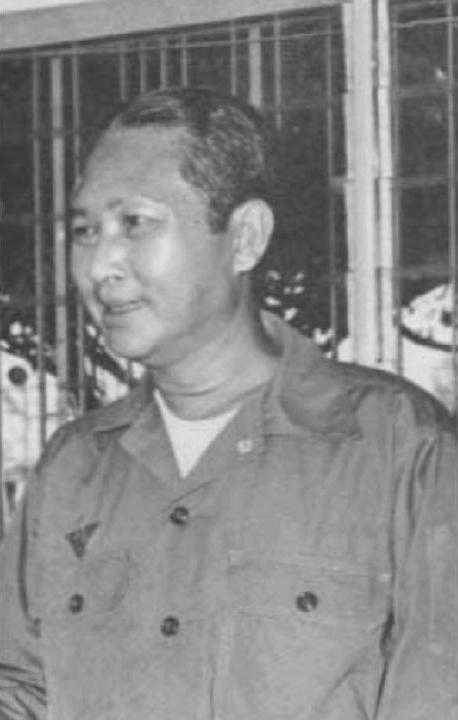
Lon Nol By Unknown author - From Lt. Gen. Sak Sutsakhan, The Khmer Republic at War and the Final Collapse. Washington DC; US Army Center of Military History, 1984., Public domain, https://commons.wikimedia.org/w/index.php?curid=18074675
Apr 17, 1975 CE
Khmer Rouge
The Khmer Rouge allied with Sihanouk captured Phnom Penh and declared the establishment of Kingdom of Cambodia. Source — Wikipedia, "Timeline of Cambodian history" (20th century):
Flag of Democratic Kampuchea By This (SVG on base of source) was created by me. See File History, below, for details. - Flags of the World - Cambodia flag history See also: http://einestages.spiegel.de/hund-images/2008/03/31/96/e2fffb5b15142c2de5aeb6ee3de0a0bc_image_document_large_featured_borderless.jpg, Public domain, https://commons.wikimedia.org/w/index.php?curid=1235920
Apr 2, 1976 CE
Democratic Kampuchea
Sihanouk exiled and establishment of Democratic Kampuchea under total Khmer Rouge control. Source — Wikipedia, "Timeline of Cambodian history" (20th century):
Flag of Democratic Kampuchea By This (SVG on base of source) was created by me. See File History, below, for details. - Flags of the World - Cambodia flag history See also: http://einestages.spiegel.de/hund-images/2008/03/31/96/e2fffb5b15142c2de5aeb6ee3de0a0bc_image_document_large_featured_borderless.jpg, Public domain, https://commons.wikimedia.org/w/index.php?curid=1235920
Dec 31, 1977 CE
Socialist Republic of Vietnam
Cambodia broke relations with the Socialist Republic of Vietnam. Source — Wikipedia, "Timeline of Cambodian history" (20th century):
Flag of Vietnam By See File history below for details. - https://www.fotw.info/flags/vn.html (Construction sheet) Chính phủ Việt Nam / 政府越南 / Gouvernement du Viêt Nam / Government of Vietnam, Public domain, https://commons.wikimedia.org/w/index.php?curid=383863
Jan 7, 1979 CE
Cambodian-Vietnamese War
Cambodian-Vietnamese War: Vietnamese troops captured Phnom Penh establishing the People's Republic of Kampuchea. The rule of the Khmer Rouge is over. Source — Wikipedia, "Timeline of Cambodian history" (20th century):
Map of the Vietnamese invasion of Cambodia, December 1978 – January 1979 By User:BorysMapping - Own work. Based on: A-History of The Anlong Veng Community, page 42 Cambodian refugee camps in Thailand, page 4 Letter dated 16 September 1980 from the Permanent Representative of Democratic Kampuchea to the United Nations addressed to the Secretary-General., CC BY-SA 4.0, https://commons.wikimedia.org/w/index.php?curid=167027409
Sep 26, 1989 CE
Vietnam
The last Vietnamese troops withdrew from Cambodia. Source — Wikipedia, "Timeline of Cambodian history" (20th century):
Flag of Vietnam By See File history below for details. - https://www.fotw.info/flags/vn.html (Construction sheet) Chính phủ Việt Nam / 政府越南 / Gouvernement du Viêt Nam / Government of Vietnam, Public domain, https://commons.wikimedia.org/w/index.php?curid=383863
Mar 16, 1992 CE
United Nations
A United Nations peacekeeping force, the United Nations Transitional Authority in Cambodia (UNTAC), began monitoring Cambodia. Source — Wikipedia, "Timeline of Cambodian history" (20th century):
Flag of the United Nations By See File history below for details. Denelson83, Zscout370 ve Madden - Flag of the United Nations from the Open Clip Art website. Modifications by Denelson83, Zscout370 and Madden. Official construction sheet here.(1946-present United Nations) The United Nations flag code and regulations, as amended November 11, 1952, New York. Archived from the original on 13 September 2001. Retrieved on 2 December 2023. OCLC: 7548838., Public domain, https://commons.wikimedia.org/w/index.php?curid=437460
May 1, 1993 CE
Khmer Rouge
Cambodia held free elections. The Khmer Rouge boycotted them. Source — Wikipedia, "Timeline of Cambodian history" (20th century):
Flag of Democratic Kampuchea By This (SVG on base of source) was created by me. See File History, below, for details. - Flags of the World - Cambodia flag history See also: http://einestages.spiegel.de/hund-images/2008/03/31/96/e2fffb5b15142c2de5aeb6ee3de0a0bc_image_document_large_featured_borderless.jpg, Public domain, https://commons.wikimedia.org/w/index.php?curid=1235920
1997 CE
Extraordinary Chambers in the Courts of Cambodia
The Extraordinary Chambers in the Courts of Cambodia, a tribunal for the Khmer Rouge, was established. Source — Wikipedia, "Timeline of Cambodian history" (20th century):
Эмблема Чрезвычайных палат в судах Камбоджи. By Kaidor - Own work using: [1] and Mak Remissa-PTC11Feb2010.jpg, Public domain, https://commons.wikimedia.org/w/index.php?curid=25188201
Apr 15, 1998 CE
Pol Pot
Death of Pol Pot. Source — Wikipedia, "Timeline of Cambodian history" (20th century):
Romanian President Nicolae Ceaucescu and his wife, Elena, meeting with Cambodian Prime minister Pol Pot, and Cambodian President Khieu Samphan(28-30.V.1978). By Unknown author - https://fototeca.iiccmer.ro/picdetails.php?picid=45014X1X4, Attribution, https://commons.wikimedia.org/w/index.php?curid=97152086
Jan 18, 2003 CE
Angkor
An Angkor newspaper reported that Suvanant Kongying, a Thai actress, had claimed that Angkor Wat rightfully belonged to Thailand. Source — Wikipedia, "Timeline of Cambodian history" (21st century):
Map (rough) of Angkor Wat, Cambodja. By Hobe / Holger Behr - Own work , composed from various mapreferences, Public domain, https://commons.wikimedia.org/w/index.php?curid=1579402
Oct 14, 2004 CE
Norodom Sihanouk
King Norodom Sihanouk abdicated. His son Norodom Sihamoni was crowned as his successor. Source — Wikipedia, "Timeline of Cambodian history" (21st century):
Norodom Sihanouk in French military uniform in 1941 By (unknown, Abaca Press claims ownership but claim is doubtful) - https://www.purepeople.com/media/19-years-old-king-norodom-sihanouk_m961688, Public domain, https://commons.wikimedia.org/w/index.php?curid=168035001
Jun 1, 2008 CE
2008 Cambodian-Thai stand-off
2008 Cambodian-Thai stand-off: Clashes began with Thailand over territory immediately adjacent to Preah Vihear. Source — Wikipedia, "Timeline of Cambodian history" (21st century):
* Map showing the boundary between Thailand and Cambodia in Dangrek Mountains region. Relief shown by contours and spot heights. Original published by H. Barrere, Editeur Géographe, 21 Rue de Bac, Paris. c.1905-1909 as part of 11-sheet set covering the land boundary between Siam (Thailand) and French Indochina (Laos and Cambodia). Reproduction of original made by International Court of Justice, 1962 and published in its "Pleadings" in the "Case Concerning the Temple of Preah Vihear". Also available online http://nla.gov.au/nla.obj-234197782 Library's copy a colour photocopy made in 2010 of the 1962 reproduction. By H. Barrere, Editeur Géographe, 21 Rue de Bac, Paris / International Court of Justice - https://nla.gov.au/nla.obj-234197782, Public domain, https://commons.wikimedia.org/w/index.php?curid=171075209
Oct 15, 2012 CE
King of Cambodia
Former King of Cambodia Norodom Sihanouk died in Beijing at the age of 89. Source — Wikipedia, "Timeline of Cambodian history" (21st century):
Royal Standard of the King of Cambodia. Gold outline of the Coat of Arms of Cambodia on a Blue Background, Since 1993 By Sodacan - Own work by uploader; based on: File:Royal Standard of Cambodia.png, background from: File:Flag of Cambodia.svg and Coat of Arms from: File:Royal Arms of Cambodia.svg., CC BY-SA 3.0, https://commons.wikimedia.org/w/index.php?curid=6341073
Jan 3, 2014 CE
Royal Gendarmerie of Cambodia
Military police opened fire at opposition protesters, leaving 3 people dead and more than 20 injured. Source — Wikipedia, "Timeline of Cambodian history" (21st century):
Emblem of the Royal Gendarmerie of Cambodia By Maharaja45 - Own work, Public domain, https://commons.wikimedia.org/w/index.php?curid=83585512





![A sketch by Ludvig Verner Helms titled "Audience of the King of Cambodia" representing his meeting with King Ang Duong in 1851. Helms was sent to Cambodia by Singapore merchants Almeida & Sons to investigate the trade potential of that country. Helms was a Danish adventurer, merchant, emissary, and author associated with the Far East, especially the Borneo Company in Sarawak. He published this sketch in 1882 in his book "Pioneering in the Far East". King Ang Duong was the King of Cambodia from 1841 to 1844 and from 1845 to his death in 1860. Formally invested in 1848, his rule benefited a kingdom that had suffered from several centuries of royal dissent and decline. Image taken from: Title: "Pioneering in the Far East, and journeys to California in 1849 and to the White Sea in 1878 ... With illustrations, etc" Author(s): Helms, Ludvig Verner [person] British Library shelfmark: "Digital Store 10058.e.23" Page: 122 (scanned page number - not necessarily the actual page number in the publication) Place of publication: London (England) Date of publication: 1882 Publisher: W. H. Allen Type of resource: Monograph Language(s): English Physical description: vi, 408 pages (8°) Explore this item in the British Library’s catalogue: 001645515 (physical copy) and 014813074 (digitised copy) (numbers are British Library identifiers) Other links related to this image: - View this image as a scanned publication on the British Library’s online viewer (you can download the image, selected pages or the whole book) - Order a higher quality scanned version of this image from the British Library Other links related to this publication: - View all the illustrations found in this publication - View all the illustrations in publications from the same year (1882) - Download the Optical Character Recognised (OCR) derived text for this publication as JavaScript Object Notation (JSON) - Explore and experiment with the British Library’s digital collections The British Library community is able to flourish online thanks to freely available resources such as this. You can help support our mission to continue making our collection accessible to everyone, for research, inspiration and enjoyment, by donating on the British Library supporter webpage here. Thank you for supporting the British Library.](https://upload.wikimedia.org/wikipedia/commons/c/cf/Ang_Duong_%28cropped%29.jpg)


![Dubious claimed Flag of Cambodia under Japanese occupation.[1][2] ↑ http://www.crwflags.com/fotw/flags/kh-japan.html (This source is the origin of where the image was created from and the source states that it is a claimed to exist but it is dubious whether it actually did). ↑ Original Khmer language source text: ទង់ដាគិការគ្រប់ត្រង់ដោយជប៉ុន ឆ្នាំ ១៩៤២-១៩៤៥ កន. អាណានិគមបារាំងសែសពីឆ្នាំ ១៩៤៥៥-១៩៤៨ នៅថ្ងៃទី០៤ សីហា ១៤៤៥ កង់អាកាសចរណ៍អាមេរិក បាន ទម្ងាក់គ្រាប់បរិមាណូ នៅទីក្រុង ហេរ៉ូស៊ីម៉ា និនណាកាសាគឺ ធ្វើឲ្យ ប្រទេសជប៉ុនប្រកាសចុះចាញ់សង្គ្រាម ក្រោយពេលដែលត្រូវសហរដ្ឌ អាមេរិកទម្ខាក់គ្រាប់បែកបរិមាណ្ឌ ។ ដ្ញូលដ្ឋានកងទ័ពជប៉ុន ត្រូវបានដកចេញពីវណ្ឌូទិន ជាហេតុ បណ្តាលឲ្យអាណាខិគមបារាំងវសស មានដីវិតរស់ឡើងវិញនៅ ភណ្ឌូចិន ហើយទង់ជាតំសម័យអាណានិគមបារាំងដែស ដែល មានពីមុនក៏ត្រូវបានត្រឡប់មកប្រើប្រាស់វិញ។ គួរកត់សម្គាល់ថា តុលាការអន្តរជាតិទីក្រុងឡាអេ បានសម្រេចសេចក្តីឲ្យកម្ពុជាឈ្នះថៃ លើប្រាសាទព្រះវិហារ នៅថ្ងៃទី១៥ មិជុនា ១៩៦២ គឺតាមវយៈ ព្រឹត្តការណ៍ ដំណើរទស្សនកិច្ចនែព្រះអង្គដ្ឋាស់ ដាម រ៉ុន អគីតរដ្ឋមន្រ្រី ក្រសួងមហាផ្ទៃ និដ ដាប្រធានវិទ្យាស្ថានភូមិន្តស្ងម ទទួលបនុក](https://upload.wikimedia.org/wikipedia/commons/thumb/a/ae/Flag_of_Cambodia_under_Japanese_occupation.svg/500px-Flag_of_Cambodia_under_Japanese_occupation.svg.png)