Encyclopedia/3. History, Societies & Civilizations/09. Modern Nations/08. South Asia • Curated by Admin Timeline.sg
History of Bangladesh, sourced from Wikipedia's "Timeline of Bangladeshi history".
Chronological Storyline (143 Milestones)
4000 BCE
4000 BCE
4000 BCE Source — Wikipedia, "Timeline of Bangladeshi history" (40th century BCE):
4th millennium BC montage.jpg By Buli - Own work, CC0, https://commons.wikimedia.org/w/index.php?curid=153916637
1600 BCE
Chalcolithic
Chalcolithic period. The Pandu Rajar Dhibi archaeological site dates to this period. Source — Wikipedia, "Timeline of Bangladeshi history" (16th century BCE):
Diffusion periods: oldest, 7500, 7000, 6500, 5500, 4300 BC By Hamelin de Guettelet - Own work, Public domain, https://commons.wikimedia.org/w/index.php?curid=4176978
700 BCE
700 BC
700 Source — Wikipedia, "Timeline of Bangladeshi history" (7th century BCE):
544 BCE
Lanka
Conquest of the island of Lanka by Vijaya Singha (Modern day Sri Lanka) Source — Wikipedia, "Timeline of Bangladeshi history" (6th century BCE):
A folio from The Ramayana: The golden abode of King Ravana India, Kangra, circa 1775-80 Depicting Ravana's luxurious golden palace with his demon armies ready for battle, the ten-headed king shown twice, once in a pavilion in the upper left and again in a chariot inside the palace walls at middle right, the forlorn Sita shown standing in an arched window in the distant background at center, all surrounded by a floral blue border and pink borders Opaque pigments and gold on wasli 8½ x 12½ in. (21.5 x 31.7 cm.), image By Unknown author - http://www.christies.com/lotfinder/paintings/a-folio-from-the-ramayana-the-golden-5182904-details.aspx, Public domain, https://commons.wikimedia.org/w/index.php?curid=31502745
450 BCE
Wari-Bateshwar ruins
Urban civilization emerges at Wari-Bateshwar Source — Wikipedia, "Timeline of Bangladeshi history" (5th century BCE):
Map of "Bengal" from Pope, G. U. (1880) Text-book of Indian History: Geographical Notes, Genealogical Tables, Examination Questions, London: W. H. Allen & Co. Pp. vii, 574, 16 maps . Scanned from personal copy and uploaded by Fowler&fowler By W. H. Allen and Co. - Pope, G. U. (1880) Text-book of Indian History: Geographical Notes, Genealogical Tables, Examination Questions, London: W. H. Allen & Co. Pp. vii, 574, 16 maps, Public domain, https://commons.wikimedia.org/w/index.php?curid=143827170
340 BCE
Vanga kingdom
Destablishment of the Vanga kingdom Source — Wikipedia, "Timeline of Bangladeshi history" (4th century BCE):
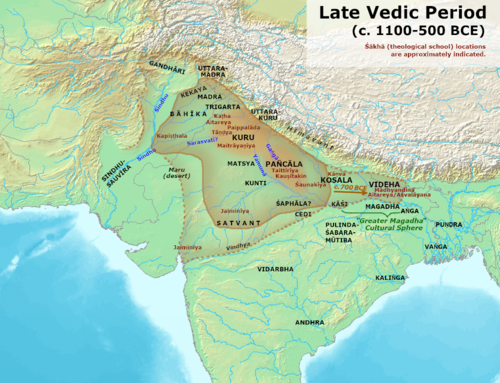
Map of places mentioned in ancient Buddhist Texts (like Anguttara Nikaya), Ramayana and Mahabharata. Sources: (2005) The Hindu Equilibrium: India C.1500 B.C. - 2000 A.D., Oxford University Press, p. xxxviii ISBN: 978-0-19-927579-3. Approximate boundaries are described by H.C. Raychaudhuri (p. 96-150), and https://books.google.com/books?id=8qvY8pxVxcwC&pg=PA386 Habib, Irfan, and Habib, Faiz (1995). "A Map of India 600-320 B.C." in Proceedings of the Indian History Congress, vol. 56, pp. 95–104. www.jstor.org/stable/44158590 Kenoyer, J. M. (1995), “Interaction Systems, Specialised Crafts and Culture Change: The Indus Valley Tradition and the Indo-Gangetic Tradition in South Asia”, in G. Erdosy, The Indo-Aryans of Ancient South Asia: Language, Material Culture, and Ethnicity, Berlin: Walter de Gruyter, ISBN 9783110144475 Raychaudhuri, H.C. (1972), Political History of Ancient India: From the Accession of Parikshit to the Extinction of the Gupta Dynasty, Calcutta: University of Calcutta. Schwartzberg, J. E. (1992), A Historical Atlas of South Asia: University of Oxford Press Singh, U. (2009), A History of Ancient and Medieval India: From the Stone Age to the 12th Century, Delhi: Longman, ISBN 978-81-317-1677-9 Background from http://www2.demis.nl/mapserver/mapper.asp By Avantiputra7 - Own work, CC BY-SA 3.0, https://commons.wikimedia.org/w/index.php?curid=33202412
300 BCE
Gangaridai
The kingdom of Gangaridai emerges and is mentioned in an account by Greek traveller Megasthenes. Ancient city of Pundravardhana also dates back to this period. Source — Wikipedia, "Timeline of Bangladeshi history" (3rd century BCE):
The 11th Map of Asia (Descriptio Undecimae Tabulae Asiae) from Ptolemy's Geography, depicting India beyond the Ganges (India extra Gangem) and the land of the Sinae in south-east Asia. By Ptolemy - British Library Harley MS 7182, 15th century., Public domain, https://commons.wikimedia.org/w/index.php?curid=292974
20 CE
20,000
20,000 Source — Wikipedia, "Timeline of Bangladeshi history" (200th century BCE):
100 CE
100,000
100,000 Source — Wikipedia, "Timeline of Bangladeshi history" (1000th century BCE):
335 CE
Samatata
Mention of Samatata in Allahabad Pillar inscription as a tributary of the Gupta empire under Samudragupta. Source — Wikipedia, "Timeline of Bangladeshi history" (4th century):
Bengal. Samatata. Coin of Vira Jadamarah imitative of Kushan coinage of Kanishka I. Circa 2nd-3rd century CE By CNG - CNG Coins Coin from CNG coins. Used with permission (CNG coin [1]). Coin [2], CC BY-SA 3.0, https://commons.wikimedia.org/w/index.php?curid=83635956
345 CE
Pundravardhana
Destablishment of the Pundravardhana Kingdom Source — Wikipedia, "Timeline of Bangladeshi history" (4th century BCE):
Ancient political divisions including historic Pundravardhana By user:P.K.Niyogi - Own map based on map in History of Ancient Bengal by Dr. R.C. Majumdar, first published 1971, reprint 2005, p. 10, Tulshi Prakashani, Kolkata, ISBN 81-89118-01-3 and other sources, CC BY-SA 3.0, https://commons.wikimedia.org/w/index.php?curid=3359766
375 CE
Chandragupta II
Samatata is annexed to the Gupta empire during the reign of Chandragupta II. Source — Wikipedia, "Timeline of Bangladeshi history" (4th century):
Coin of the Gupta king Chandragupta II By PHGCOM - self-made, photographed at the British Museum, CC BY-SA 3.0, https://commons.wikimedia.org/w/index.php?curid=2237604
507 CE
Vainyagupta
Gupta influence dwindles during the reign of Vainyagupta emerges as an independent ruler of eastern Bengal. Source — Wikipedia, "Timeline of Bangladeshi history" (6th century):
Coin of the Gupta king Chandragupta II By PHGCOM - self-made, photographed at the British Museum, CC BY-SA 3.0, https://commons.wikimedia.org/w/index.php?curid=2237604
525 CE
Vanga kingdom
Reign of the independent Vanga kingdom in Bengal. Source — Wikipedia, "Timeline of Bangladeshi history" (6th century):
Map of places mentioned in ancient Buddhist Texts (like Anguttara Nikaya), Ramayana and Mahabharata. Sources: (2005) The Hindu Equilibrium: India C.1500 B.C. - 2000 A.D., Oxford University Press, p. xxxviii ISBN: 978-0-19-927579-3. Approximate boundaries are described by H.C. Raychaudhuri (p. 96-150), and https://books.google.com/books?id=8qvY8pxVxcwC&pg=PA386 Habib, Irfan, and Habib, Faiz (1995). "A Map of India 600-320 B.C." in Proceedings of the Indian History Congress, vol. 56, pp. 95–104. www.jstor.org/stable/44158590 Kenoyer, J. M. (1995), “Interaction Systems, Specialised Crafts and Culture Change: The Indus Valley Tradition and the Indo-Gangetic Tradition in South Asia”, in G. Erdosy, The Indo-Aryans of Ancient South Asia: Language, Material Culture, and Ethnicity, Berlin: Walter de Gruyter, ISBN 9783110144475 Raychaudhuri, H.C. (1972), Political History of Ancient India: From the Accession of Parikshit to the Extinction of the Gupta Dynasty, Calcutta: University of Calcutta. Schwartzberg, J. E. (1992), A Historical Atlas of South Asia: University of Oxford Press Singh, U. (2009), A History of Ancient and Medieval India: From the Stone Age to the 12th Century, Delhi: Longman, ISBN 978-81-317-1677-9 Background from http://www2.demis.nl/mapserver/mapper.asp By Avantiputra7 - Own work, CC BY-SA 3.0, https://commons.wikimedia.org/w/index.php?curid=33202412
530 CE
Anga
Disestablishment of the Anga Kingdom Source — Wikipedia, "Timeline of Bangladeshi history" (6th century BCE):
Anga By Avantiputra7 - Own work by Avantiputra7; see references section for used material, CC BY-SA 3.0, https://commons.wikimedia.org/w/index.php?curid=33202411
590 CE
Shashanka
Reign of Shashanka, foundation of Gauda Kingdom. Source — Wikipedia, "Timeline of Bangladeshi history" (6th century):
Gauda ruler Sasanka Deva. Circa AD 600-635. Samatata type. Assam mint. By Classical Numismatic Group - Classical Numismatic Group; [1], CC BY-SA 3.0, https://commons.wikimedia.org/w/index.php?curid=117595988
593 CE
Bengali calendar
Start of the Bengali calendar Source — Wikipedia, "Timeline of Bangladeshi history" (6th century):
Bengali dialects By Jacklincoln47 - Own work, CC BY-SA 4.0, https://commons.wikimedia.org/w/index.php?curid=186127714
Gopala I, founder of the Pala Dynasty comes to power in Gaur through a democratic election. Source — Wikipedia, "Timeline of Bangladeshi history" (8th century):
Left: with Lakshmi Narayana (Bangladesh or India's West Bengal state), Pala period, 11th - 12th century Sheel with silver additions Middle: India, Pala period, ca. 11th century Shell Right: India, pala period, 11th century or earlier Shell By Claire H. - originally posted to Flickr as Carved Conch, CC BY-SA 2.0, https://commons.wikimedia.org/w/index.php?curid=8828891
900 CE
Chandra dynasty
Rule of the Candra or Chandra dynasty in the Harikela (south-east Bangladesh) region. (to 1000) Source — Wikipedia, "Timeline of Bangladeshi history" (9th century):
Map of "Bengal" from Pope, G. U. (1880) Text-book of Indian History: Geographical Notes, Genealogical Tables, Examination Questions, London: W. H. Allen & Co. Pp. vii, 574, 16 maps . Scanned from personal copy and uploaded by Fowler&fowler By W. H. Allen and Co. - Pope, G. U. (1880) Text-book of Indian History: Geographical Notes, Genealogical Tables, Examination Questions, London: W. H. Allen & Co. Pp. vii, 574, 16 maps, Public domain, https://commons.wikimedia.org/w/index.php?curid=143827170
950 CE
Charyapada
Start of writing of Charyapada, the oldest writing form of Bengali language. Source — Wikipedia, "Timeline of Bangladeshi history" (9th century):
1000 CE
1000
1000 Source — Wikipedia, "Timeline of Bangladeshi history" (10th century BCE):
1095 CE
Hemanta Sen
Hemanta Sen declares himself king of Bengal founding the Sena dynasty. Source — Wikipedia, "Timeline of Bangladeshi history" (11th century):
Map of the Senas By Map created from DEMIS Mapserver, which are public domain. Koba-chan - This image has been extracted from another file, CC BY-SA 3.0, https://commons.wikimedia.org/w/index.php?curid=115014310
1100 CE
Vanga kingdom
Establishment of the Vanga kingdom and Anga kingdom Source — Wikipedia, "Timeline of Bangladeshi history" (11th century BCE):
Map of places mentioned in ancient Buddhist Texts (like Anguttara Nikaya), Ramayana and Mahabharata. Sources: (2005) The Hindu Equilibrium: India C.1500 B.C. - 2000 A.D., Oxford University Press, p. xxxviii ISBN: 978-0-19-927579-3. Approximate boundaries are described by H.C. Raychaudhuri (p. 96-150), and https://books.google.com/books?id=8qvY8pxVxcwC&pg=PA386 Habib, Irfan, and Habib, Faiz (1995). "A Map of India 600-320 B.C." in Proceedings of the Indian History Congress, vol. 56, pp. 95–104. www.jstor.org/stable/44158590 Kenoyer, J. M. (1995), “Interaction Systems, Specialised Crafts and Culture Change: The Indus Valley Tradition and the Indo-Gangetic Tradition in South Asia”, in G. Erdosy, The Indo-Aryans of Ancient South Asia: Language, Material Culture, and Ethnicity, Berlin: Walter de Gruyter, ISBN 9783110144475 Raychaudhuri, H.C. (1972), Political History of Ancient India: From the Accession of Parikshit to the Extinction of the Gupta Dynasty, Calcutta: University of Calcutta. Schwartzberg, J. E. (1992), A Historical Atlas of South Asia: University of Oxford Press Singh, U. (2009), A History of Ancient and Medieval India: From the Stone Age to the 12th Century, Delhi: Longman, ISBN 978-81-317-1677-9 Background from http://www2.demis.nl/mapserver/mapper.asp By Avantiputra7 - Own work, CC BY-SA 3.0, https://commons.wikimedia.org/w/index.php?curid=33202412
1204 CE
Ikhtiyar Uddin Muhammad Bin Bakhtiyar Khalji
Ikhtiyar Uddin Muhammad Bin Bakhtiyar Khalji's conquest of Bengal. Onset of Muslim rule in Bengal. Source — Wikipedia, "Timeline of Bangladeshi history" (13th century):
The end of Buddhist Monks, A.D. 1193. From page 168 of Hutchinson's story of the nations, containing the Egyptians, the Chinese, India, the Babylonian nation, the Hittites, the Assyrians, the Phoenicians and the Carthaginians, the Phrygians, the Lydians, and other nations of Asia Minor. By Margaret Dovaston - Internet Archive identifier: hutchinsonsstory00londuoft p.168, Public domain, https://commons.wikimedia.org/w/index.php?curid=39273227
1226 CE
Iltutmish
Iltutmish, Sultan of Delhi, invades Bengal and kills Ghiyasuddin Iwaj Shah, the last Khilji ruler. Source — Wikipedia, "Timeline of Bangladeshi history" (13th century):
Islamic Sultanates. Delhi. Shams al-Dīn Iltutmish. AH 607-633 AD 1210-1235. AR Tanka (25mm, 11.07 g, 6h). Sind type. By CNG Coins - CNG Coins Coin from CNG coins. Used with permission (CNG coin [1]) Coin, CC BY-SA 3.0, https://commons.wikimedia.org/w/index.php?curid=114810355
1227 CE
Mamluk
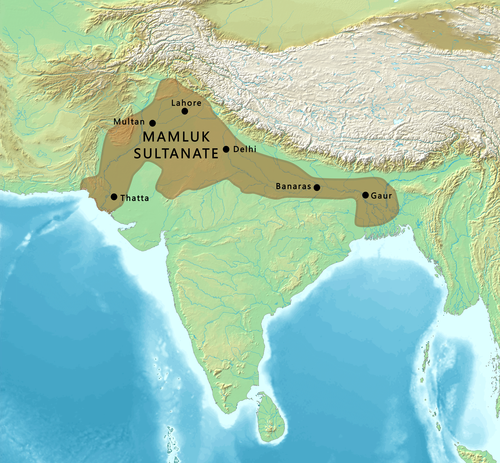
Rule of the Mameluk Sultans of Delhi. (to 1281) Source — Wikipedia, "Timeline of Bangladeshi history" (13th century):
Hopfer, Daniel (ca 1470-1536): Etching, Three Mamelukes with lances on horseback. “Mamelucke” Bartsch 56, Holl.65 i/ii, before the Funck number. “Vor der Nummer. Ganz ausgezeichneter, kräftiger Druck mit winzigem Rändchen um die Plattenkante. Einige dünne Stellen sowie einige minimale Risschen links oben, sosnt sehr gut erhalten.” By Daniel Hopfer - British Museum[1], Public domain, https://commons.wikimedia.org/w/index.php?curid=4107509
1280 CE
Pundravardhana
Emergence of the Pundravardhana (Pundra) Kingdom in modern-day Rajshahi and Rangpur Source — Wikipedia, "Timeline of Bangladeshi history" (13th century BCE):
Ancient political divisions including historic Pundravardhana By user:P.K.Niyogi - Own map based on map in History of Ancient Bengal by Dr. R.C. Majumdar, first published 1971, reprint 2005, p. 10, Tulshi Prakashani, Kolkata, ISBN 81-89118-01-3 and other sources, CC BY-SA 3.0, https://commons.wikimedia.org/w/index.php?curid=3359766
1281 CE
Rule of the Mahmud Shahi dynasty.
Rule of the Mahmud Shahi dynasty. (to 1324) Source — Wikipedia, "Timeline of Bangladeshi history" (13th century):
1328 CE
Ghiyasuddin Bahadur Shah
Ghiyasuddin Bahadur Shah, the last ruler of the dynasty is defeated and killed by the army of the Delhi Sultanate. Source — Wikipedia, "Timeline of Bangladeshi history" (14th century):
1338 CE
Mubarak Shahi Dynasty
Establishment of the Mubarak Shahi Dynasty by Fakhruddin Mubarak Shah, the ruling dynasty of the Sonargaon Sultanate Source — Wikipedia, "Timeline of Bangladeshi history" (14th century):
1342 CE
First period of rule by the
First period of rule by the independent Ilyas Shahi Dynasty. (to 1414) Source — Wikipedia, "Timeline of Bangladeshi history" (14th century):
1349 CE
Shamsuddin Ilyas Shah
Shamsuddin Ilyas Shah's Invasion of Nepal and occupation of Tirhut Source — Wikipedia, "Timeline of Bangladeshi history" (14th century):
A helmet from the Bengal Sultanate era from the National Museum of Bangladesh. By Greatswrd - National Museum of Bangladesh, CC0, https://commons.wikimedia.org/w/index.php?curid=177402504
1352 CE
Sonargaon
Unification of the City states or Sultanates (Sonargaon, Lakhnauti, Satgaon) by Shamsuddin Ilyas Shah and the formation of the Bengal Sultanate. Source — Wikipedia, "Timeline of Bangladeshi history" (14th century):
This is a photo of a monument in Bangladesh identified by the ID By Rayhan9d - Own work, CC BY-SA 4.0, https://commons.wikimedia.org/w/index.php?curid=97162086
1353 CE
Ekdala Wars
Ekdala Wars - Bengal Sultanate achieved its independence from the Delhi Sultanate Source — Wikipedia, "Timeline of Bangladeshi history" (14th century):
Map of the Mamluk Dynasty By Maps created from DEMIS Mapserver, which are public domain. Koba-chan Territorial area: पाटलिपुत्र (talk), per Schwartberg Atlas p.147 - This image has been extracted from another file, CC BY-SA 3.0, https://commons.wikimedia.org/w/index.php?curid=128203900
1414 CE
The Ganesha Dynasty usurps power. (to
The Ganesha Dynasty usurps power. (to 1415) Source — Wikipedia, "Timeline of Bangladeshi history" (15th century):
1416 CE
Raja Ganesha
Raja Ganesha's second phase (to 1418) Source — Wikipedia, "Timeline of Bangladeshi history" (15th century):
Map of "Bengal" from Pope, G. U. (1880) Text-book of Indian History: Geographical Notes, Genealogical Tables, Examination Questions, London: W. H. Allen & Co. Pp. vii, 574, 16 maps . Scanned from personal copy and uploaded by Fowler&fowler By W. H. Allen and Co. - Pope, G. U. (1880) Text-book of Indian History: Geographical Notes, Genealogical Tables, Examination Questions, London: W. H. Allen & Co. Pp. vii, 574, 16 maps, Public domain, https://commons.wikimedia.org/w/index.php?curid=143827170
1418 CE
Jalaluddin Muhammad Shah
Jalaluddin Muhammad Shah second phase (to 1433) Source — Wikipedia, "Timeline of Bangladeshi history" (15th century):
Silver tanka of the Bengal Sultanate ruler Jalaluddin Muhammad, showing a lion. By Rani nurmai - http://coinindia.com/galleries-bengal.html, CC BY-SA 3.0, https://commons.wikimedia.org/w/index.php?curid=14991726
1420 CE
Bengal Sultanate
End of the war between the Bengal Sultanate and the Jaunpur Sultanate and the annexation of parts of Jaunpaur by the Bengal Sultanate Source — Wikipedia, "Timeline of Bangladeshi history" (15th century):
Map of Ilyas Shahis (1342–1414, 1435–1487)) and House of Ganesha (1414–1435) By Beylarbey - This image has been extracted from another file, CC BY-SA 4.0, https://commons.wikimedia.org/w/index.php?curid=181567822
Feb 18, 1429 CE
Restoration of Min Saw Mon
Restoration of Min Saw Mon and Mrauk U became a vassal state of the Bengal Sultanate Source — Wikipedia, "Timeline of Bangladeshi history" (15th century):
View on Mrauk U right after sunrise from Shwetaung pagoda. By Jmhullot - Own work, CC BY 3.0, https://commons.wikimedia.org/w/index.php?curid=6801828
1433 CE
Shamsuddin Ahmad Shah
Shamsuddin Ahmad Shah (son of Jalaluddin Muhammad Shah) assumes power Source — Wikipedia, "Timeline of Bangladeshi history" (15th century):
A helmet from the Bengal Sultanate era from the National Museum of Bangladesh. By Greatswrd - National Museum of Bangladesh, CC0, https://commons.wikimedia.org/w/index.php?curid=177402504
1436 CE
Nasiruddin Mahmud Shah restores the Ilyas
Nasiruddin Mahmud Shah restores the Ilyas Shahi Dynasty. Source — Wikipedia, "Timeline of Bangladeshi history" (15th century):
1487 CE
Jalaluddin Fateh Shah
Jalaluddin Fateh Shah is assassinated by Habshi slaves. Source — Wikipedia, "Timeline of Bangladeshi history" (15th century):
Siddi village in Sasan Gir. Indian people of African descent. Gujarat, New Year's Day, 2015. People of Gujarat, India By Nagarjun Kandukuru from Bangalore, India - Siddi community, CC BY 2.0, https://commons.wikimedia.org/w/index.php?curid=51154179
1494 CE
Hussain Shahi dynasty
Rule of the Hussain Shahi dynasty. (to 1538) Source — Wikipedia, "Timeline of Bangladeshi history" (15th century):
Hussain Shahi dynasty of the Bengal Sultanate By Map created from DEMIS Mapserver, which are public domain. Koba-chan. Reference: [1] Borders created by Noorullah21 - This image has been extracted from another file, CC BY-SA 4.0, https://commons.wikimedia.org/w/index.php?curid=137552182
1498 CE
Bengal Sultanate–Kamata Kingdom War
Bengal Sultanate–Kamata Kingdom War - Bengal Sultanate takes over the Khen dynasty Source — Wikipedia, "Timeline of Bangladeshi history" (15th century):
This is a cropped image of a Wikimedia Commons picture of a sculpted head from Deopahar, Assam. By Sarangakrishnachetia - c:File:DEOPAHAR_NUMALIGARH_ASSAM_4.jpg, CC-BY-SA-4.0, https://en.wikipedia.org/w/index.php?curid=63351131
1512 CE
Bengal Sultanate–Kingdom of Mrauk U War of 1512–15
Beginning of the Bengal Sultanate–Kingdom of Mrauk U War Source — Wikipedia, "Timeline of Bangladeshi history" (Formation of the):
1513 CE
Paragal Khan
Husain Shah assigned the charge of Arakan expedition to Paragal Khan. Paragal Khan advanced from his base on the Feni River. The expedition of territory to the western bank of Kaladan River was placed under his governorship administration. Source — Wikipedia, "Timeline of Bangladeshi history" (Formation of the):
ရခိုင်ပြည်နယ်တွင်းက လူသိများတဲ့ ကစ္စပ နဒီမြစ်ကို ကျောက်တော် ခြေတော်ရာ ဘုရားကုန်းပေါ်က မြင်နေရတာပဲဖြစ်ပါတယ်။ အောက်မှာမြင်နေရတဲ့ တံတားဟာ ဤမြစ်ပေါ်က ရန်ကုန် စစ်တွေ တံတားပဲဖြစ်ပါတယ် By ခွန်နိုင်ကို - Own work, CC BY-SA 4.0, https://commons.wikimedia.org/w/index.php?curid=71869366
1516 CE
Bengal Sultanate–Kingdom of Mrauk U War of 1512–15
End of the Bengal Sultanate–Kingdom of Mrauk U War. The Bengal Sultanate annexed Chittagong and northern Arakan. Source — Wikipedia, "Timeline of Bangladeshi history" (Formation of the):
Map of Ilyas Shahis (1342–1414, 1435–1487)) and House of Ganesha (1414–1435) By Beylarbey - This image has been extracted from another file, CC BY-SA 4.0, https://commons.wikimedia.org/w/index.php?curid=181567822
1534 CE
Chittagong
The Portuguese arrive at Chittagong and receive trade permits. Source — Wikipedia, "Timeline of Bangladeshi history" (Formation of the):
Park at Chittagong By Great Hero32 - Own work, CC BY-SA 4.0, https://commons.wikimedia.org/w/index.php?curid=95163324
1538 CE
Ghiyasuddin Mahmud Shah
Ghiyasuddin Mahmud Shah, the last Hussain Shahi Sultan and his Portuguese allies are defeated by Sher Shah Suri. Source — Wikipedia, "Timeline of Bangladeshi history" (Formation of the):
Ghiyasuddin Mahmud Shah By Unknown author, Public domain, https://en.wikipedia.org/w/index.php?curid=80297665
1575 CE
Battle of Tukaroi
Battle of Tukaroi between the Sultanate of Bangala and the Mughal Empire. Source — Wikipedia, "Timeline of Bangladeshi history" (Formation of the):
After the capture of Patna, Akbar had returned to Delhi and entrusted Munʿim Khan with the further conquest of Bengal. Da'ud had fled to Odisha . However, having received news of the fatigue of the opposing troops, Da'ud ventured a powerful offensive on 3 March 1575 at Tukaroi, which lies about 40 km south of Medinipur. Khankhanan Munʿim Khan was in the Battle of Tukaroi against Da'ud on March 3, 1575. – Munʿim Khan was surprised by the unexpectedly quick attack and was wounded, but after initial successes for Da'ud, Todar Mal managed to repel the enemy through his courageous intervention. The news of the death of their general Gujar Khan finally caused the Bengalis to flee, pursued by the Mughals "with drawn swords". By Manohar, 1590 artist - [1][2], Public domain, https://commons.wikimedia.org/w/index.php?curid=157359091
1578 CE
Isa Khan
Mughal Subahdar Khan Jahan invades the Bhati region of East Bengal, but is defeated by Isa Khan and his allies, near Kishoreganj. Source — Wikipedia, "Timeline of Bangladeshi history" (Formation of the):
Isa Khan- Masnad-i-Ala c. 1575 By Unknown - https://teachers.gov.bd/content/details/1157133, Public domain, https://commons.wikimedia.org/w/index.php?curid=165372106
1584 CE
Shahbaz Khan Kamboh
Mughal Subahdar Shahbaz Khan captures Sonargaon, capital of Isa Khan who then defeats the Mughal army in the battles of Egarasindhur and Bhawal to reclaim his lands. Source — Wikipedia, "Timeline of Bangladeshi history" (Formation of the):
Shahbaz Khan Kambo smoking huqqa, Golkonda, 1683 A.D., National Museum, New Delhi By Unknown artist - https://www.indiapicks.com/Indianart/Main/MP_Deccan.htm, CC BY 2.5, https://commons.wikimedia.org/w/index.php?curid=124752727
1586 CE
The second campaign of Shahbaz Khan.
The second campaign of Shahbaz Khan. Isa Khan proposes peace and pretends loyalty. Source — Wikipedia, "Timeline of Bangladeshi history" (Formation of the):
1592 CE
Amber Fort
Amber Fort is built by Man Singh I the 9th Subahdar of Bengal Source — Wikipedia, "Timeline of Bangladeshi history" (Formation of the):
Amber Fort seen from the bank of Maotha Lake, Jaigarh Fort on the hills in the background By Jakub Hałun - Own work, CC BY-SA 4.0, https://commons.wikimedia.org/w/index.php?curid=87589351
1594 CE
Man Singh I
Raja Man Singh is appointed Subahdar of Bengal, Bihar, and Orissa. Source — Wikipedia, "Timeline of Bangladeshi history" (Formation of the):
https://www.metmuseum.org/art/collection/search/453180 Portrait of Man Singh of Amber, from a volume gifted to Prince Khurram. Some portraits in the collection date to Akbar's time. By Mughal Artists - https://www.metmuseum.org/art/collection/search/453180, Public domain, https://commons.wikimedia.org/w/index.php?curid=147594765
1597 CE
Vikrampur
Man Singh sends forces against Isa Khan but they are defeated in a naval battle near Vikrampur. Source — Wikipedia, "Timeline of Bangladeshi history" (Formation of the):
Bikrampur Vihara is an ancient Buddhist vihara at Raghurampur village, Bikrampur, Munshiganj District in Bangladesh. By অভিজিৎ দাস - Own work, CC BY-SA 4.0, https://commons.wikimedia.org/w/index.php?curid=75690043
1608 CE
Islam Khan I
Subahdar Islam Khan's leads an expedition into Bengal to subjugate the local rulers then moves the provincial capital to Dhaka and renames it Jahangir Nagar. (to 1613) Source — Wikipedia, "Timeline of Bangladeshi history" (17th century):
This is a photo of ASI monument number By Anupamg - Own work, CC BY-SA 3.0, https://commons.wikimedia.org/w/index.php?curid=28624333
1611 CE
Mughal conquest of Jessore
Conquest of Jessore by the Mughal Empire. Pratapaditya the Zamindar of Jessore was taken as prisoner of War Source — Wikipedia, "Timeline of Bangladeshi history" (17th century):
Location of Greater Jessore in Bangladesh (Red) and West Bengal (Pink) By Jaunpurzada - Own work, CC0, https://commons.wikimedia.org/w/index.php?curid=183633263
1612 CE
Baro-Bhuyan
Dissolution of the Baro-Bhuyan confederacy in Bengal Source — Wikipedia, "Timeline of Bangladeshi history" (17th century):
Map of "Bengal" from Pope, G. U. (1880) Text-book of Indian History: Geographical Notes, Genealogical Tables, Examination Questions, London: W. H. Allen & Co. Pp. vii, 574, 16 maps . Scanned from personal copy and uploaded by Fowler&fowler By W. H. Allen and Co. - Pope, G. U. (1880) Text-book of Indian History: Geographical Notes, Genealogical Tables, Examination Questions, London: W. H. Allen & Co. Pp. vii, 574, 16 maps, Public domain, https://commons.wikimedia.org/w/index.php?curid=143827170
Nov 1, 1665 CE
Bengal Subah
Beginning of the war between the Bengal Subah (Mughal Empire) supported by the Dutch East India Company and Portuguese India against the Arakan Kingdom. Source — Wikipedia, "Timeline of Bangladeshi history" (17th century):
Bengal Subah Standard from the Battle of Plassey By Greatswrd - Own work derived from the painting, Robert Clive and Mir Jafar after the Battle of Plassey, by Francis Hayman "The fluttering Great Union Flag in contrast to the mangled green & white flag on the ground depict the very different fates of the two camps." - The Heritage Lab: culture, art, museum. In Paintings: the Battle of Plassey - (Archived link here) "The extension of his arms and the inclination of his body is most movingly expressive of doubt, submission and resignation, which is heightened by an Indian officer laying the Subah’s standard at the General’s feet..." - Karen Taylor Fine Art Francis Hayman - General Robert Clive (Archived Link here) "Which is heightened by an Indian officer laying the " Subbah’s standard" - Allen Brian, Francis Hayman, Yale University Press in association with English Heritage (the Iveagh Bequest, Kenwood) and the Yale Center for British Art, New Haven, p123, 1987. Robert Clive and Mir Jafar after the Battle of Plassey The Fallen Bengali flag at the Battle of PlasseyThe Fallen Bengali flag at the Battle of Plassey (rotated), CC0, https://commons.wikimedia.org/w/index.php?curid=193519846
Jan 27, 1666 CE
Mughal Empire
End of the war - Bengali (Mughal) victory and the annexation of Chittagong into the Mughal Empire Source — Wikipedia, "Timeline of Bangladeshi history" (17th century):
Map of India 1700 showing the Mughal Empire and European trading posts/factory towns from: Joppen, Charles [SJ.] (1907) A Historical Atlas of India for the use of High-Schools, Colleges, and Private Students, London, New York, Bombay, and Calcutta: Longman Green and Co. Pp. 16, 26 maps . Scanned from personal copy, reduced, and highlighted by Fowler&fowler«Talk» 23:38, 24 February 2009 (UTC) By Justus Perthes, Gotha./Charles Joppen - Joppen, Charles [SJ.] (1907) A Historical Atlas of India for the use of High-Schools, Colleges, and Private Students, London, New York, Bombay, and Calcutta: Longman Green and Co. Pp. 16, 26 maps, GFDL, https://commons.wikimedia.org/w/index.php?curid=14183402
1717 CE
Bengal Subah
De facto Independence of the Bengal Subah from the Mughal Empire and the beginning of the Nasiri Dynasty of Murshid Quli Khan. Source — Wikipedia, "Timeline of Bangladeshi history" (18th century):
Bengal Subah Standard from the Battle of Plassey By Greatswrd - Own work derived from the painting, Robert Clive and Mir Jafar after the Battle of Plassey, by Francis Hayman "The fluttering Great Union Flag in contrast to the mangled green & white flag on the ground depict the very different fates of the two camps." - The Heritage Lab: culture, art, museum. In Paintings: the Battle of Plassey - (Archived link here) "The extension of his arms and the inclination of his body is most movingly expressive of doubt, submission and resignation, which is heightened by an Indian officer laying the Subah’s standard at the General’s feet..." - Karen Taylor Fine Art Francis Hayman - General Robert Clive (Archived Link here) "Which is heightened by an Indian officer laying the " Subbah’s standard" - Allen Brian, Francis Hayman, Yale University Press in association with English Heritage (the Iveagh Bequest, Kenwood) and the Yale Center for British Art, New Haven, p123, 1987. Robert Clive and Mir Jafar after the Battle of Plassey The Fallen Bengali flag at the Battle of PlasseyThe Fallen Bengali flag at the Battle of Plassey (rotated), CC0, https://commons.wikimedia.org/w/index.php?curid=193519846
Apr 26, 1740 CE
Battle of Giria
Battle of Giria Short and severe battle resulting in the defeat and death of Sarfaraz Khan and Alivardi Khan usurping and becoming the Nawab of Bengal. End of the Nasiri Dynasty of Murshid Quli Khan and the beginning of the Afsar Dynasty of Alivardi Khan. Source — Wikipedia, "Timeline of Bangladeshi history" (18th century):
The march of Alivardi Khan and Sarfaraz Khan to Giria resulting in the defeat of Sarfaraz Khan and the establishment of Alivardi Khan's dynasty. By Metesjams - Alivardi and his times, p31, CC BY-SA 4.0, https://commons.wikimedia.org/w/index.php?curid=162739167
Mar 3, 1741 CE
Alivardi Khan
Alivardi Khan retakes Orissa by defeating Rustam Jang deputy governor of Orissa and a relative of Sarfaraz Khan, in the Battle of Phulwarion Source — Wikipedia, "Timeline of Bangladeshi history" (18th century):
Identifier: musnudofmurshida00maju (find matches) Title: The musnud of Murshidabad (1704-1904) being a synopsis of the history of Murshidabad for the last two centuries, to which are appended notes of places and objects of interest at Murshidabad Year: 1905 (1900s) Authors: Majumdar, Purna Chandra Subjects: Murshibad, India (District) Murshidabad, India (District) Publisher: Murshidabad Saroda Ray Contributing Library: Robarts - University of Toronto Digitizing Sponsor: University of Toronto View Book Page: Book Viewer About This Book: Catalog Entry View All Images: All Images From Book Click here to view book online to see this illustration in context in a browseable online version of this book. Text Appearing Before Image: llavram heconferred the title of Rajah and ^nt him as Governorof Orissa. The Afg-hans in Behar having insulted hisdaughter, Amen a Khanum, her sister, Ghasiti Begumand others came to his help and he proceeded againstthem and rescued her. The Mahrattas again began their raids and at lastpeace was purchased by ceding Berar and twelve lacsas the chout or a fourth of the Bengal revenue. AliVerdi Khan imposed abwabs to the extent of Rupees22,25,554 in order to meet the extravagancies of hisfavourite grandson, Serajuddowla. A dispute arosewith the French factors at Cossimbazar and it wascompromised for fifty thousand rupees. In 1755, hisnephews, Nawazesh Mahomed and Syud Ahmed, died.The Nawab too became bed-ridden and his younggrandson, Serajuddowla, began to manage the affairsof State. Nowazesh Mahomeds widow attempted tosecure the throne for Serajuddowlas younger brother,Ekramuddowla. Ali Verdi Khan was regular in his habits. He roseearly and after ablutions and prayer drank coffee with 1 Text Appearing After Image: NAWAB ALI VERDI KHAN. ( 27 ) his select companions. At day-break he gave publicaudience, when the public servants were admittedwithout reserve. After two hours he received hisparticular friends and relations. Poems were nowrecited or history and anecdotes read to him. He atewith his friends and many shared his bounty. Hesometimes gave directions to his cooks and often hadvictuals prepared before him according to his palate.After meal, the company retired to repose. At thistime, the story-tellers attended to relate some amusingnarrative. After his afternoon seista, he performedhis ablutions and read the Koran till four. He receivedlearned men, in whose company he spent an hour daily.Buffoons and jesters also entertained him with theirrepartees. Ali Verdi Khan offered high offices to Hindus. Hethought like Murshed Kuli Khan and others whopatronized Hindu revenue officers that a Mahomedanwas like a seive, much of what was poured in wentthrough, while a Hindu was like a sponge, whichretai Note About Images Please note that these images are extracted from scanned page images that may have been digitally enhanced for readability - coloration and appearance of these illustrations may not perfectly resemble the original work. By Internet Archive Book Images - https://www.flickr.com/photos/internetarchivebookimages/14774447504/ Source book page: https://archive.org/stream/musnudofmurshida00maju/musnudofmurshida00maju#page/n62/mode/1up, No restrictions, https://commons.wikimedia.org/w/index.php?curid=43858723
Oct 16, 1756 CE
Siraj-ud-Daulah
Siraj-ud-Daulah defeats his cousin Shaukat Jang in the Battle of Manihari. Source — Wikipedia, "Timeline of Bangladeshi history" (18th century):
Nawab of Bengal By Unknown author - http://www.sscnet.ucla.edu/southasia/History/British/Siraj.html, Public domain, https://commons.wikimedia.org/w/index.php?curid=22665569
1757 CE
Battle of Palashi
Battle of Palashi. a decisive British East India Company victory over the Nawab of Bengal establishes Company rule in India. The last Nawab was Nawab Siraj ud-Daulah Source — Wikipedia, "Timeline of Bangladeshi history" (18th century):
Battle of Palashi By Francis Hayman - http://www.sterlingtimes.org/memorable_images56.htm (http://www.sterlingtimes.org/clive_of_india.jpg) NPG link: http://www.npg.org.uk/collections/search/portrait/mw01347/Robert-Clive-and-Mir-Jafar-after-the-Battle-of-Plassey-1757 Current image source [1], Public domain, https://commons.wikimedia.org/w/index.php?curid=565912
1764 CE
Battle of Buxar
Battle of Buxar, With the defeat of Mir Qasim, Mir Jafar's successor at the Battle of Buxer, the ruling power of Bengal was formally taken over by the British. Source — Wikipedia, "Timeline of Bangladeshi history" (18th century):
Sir Hector Munro, by David Martin (died 1797). See source website for additional information. This set of images was gathered by User:Dcoetzee from the National Portrait Gallery, London website using a special tool. All images in this batch have been confirmed as author died before 1939 according to the official death date listed by the NPG. By David Martin - one or more third parties have made copyright claims against Wikimedia Commons in relation to the work from which this is sourced or a purely mechanical reproduction thereof. This may be due to recognition of the "sweat of the brow" doctrine, allowing works to be eligible for protection through skill and labour, and not purely by originality as is the case in the United States (where this website is hosted). These claims may or may not be valid in all jurisdictions. As such, use of this image in the jurisdiction of the claimant or other countries may be regarded as copyright infringement. Please see Commons:When to use the PD-Art tag for more information., Public domain, https://commons.wikimedia.org/w/index.php?curid=194676094
1765 CE
Robert Clive
After the Battle of Buxar, in 1765, Robert Clive received the civil rights of Bengal-Bihar-Orissa from the last Mughal Emperor of Delhi, Shah Alam. Source — Wikipedia, "Timeline of Bangladeshi history" (18th century):
Robert Clive, 1st Baron Clive, by Nathaniel Dance, (later Sir Nathaniel Dance-Holland, Bt) (died 1811). See source website for additional information. This set of images was gathered by User:Dcoetzee from the National Portrait Gallery, London website using a special tool. All images in this batch have been confirmed as author died before 1939 according to the official death date listed by the NPG. By Nathaniel Dance, (later Sir Nathaniel Dance-Holland, Bt) (died 1811) - one or more third parties have made copyright claims against Wikimedia Commons in relation to the work from which this is sourced or a purely mechanical reproduction thereof. This may be due to recognition of the "sweat of the brow" doctrine, allowing works to be eligible for protection through skill and labour, and not purely by originality as is the case in the United States (where this website is hosted). These claims may or may not be valid in all jurisdictions. As such, use of this image in the jurisdiction of the claimant or other countries may be regarded as copyright infringement. Please see Commons:When to use the PD-Art tag for more information., Public domain, https://commons.wikimedia.org/w/index.php?curid=6363818
1770 CE
Bengal famine of 1770
Bengal famine of 1770 causes the death of 10 million people.(1/3 portion people died) Source — Wikipedia, "Timeline of Bangladeshi history" (18th century):
Map of India in 1765 from Imperial Gazetteer of India, volume 26, Atlas, Oxford University Press, 1908. Scanned from personal copy and uploaded by Fowler&fowler«Talk» 02:53, 25 February 2009 (UTC) By J. G. Bartholomew and Sons. Edinburgh - Imperial Gazetteer of India, volume 26, Atlas, Oxford University Press, 1908, GFDL, https://commons.wikimedia.org/w/index.php?curid=116478880
1793 CE
Permanent Settlement
Permanent Settlement Act imposed on Bengal. Source — Wikipedia, "Timeline of Bangladeshi history" (18th century):
Map of "Bengal" from Pope, G. U. (1880) Text-book of Indian History: Geographical Notes, Genealogical Tables, Examination Questions, London: W. H. Allen & Co. Pp. vii, 574, 16 maps . Scanned from personal copy and uploaded by Fowler&fowler By W. H. Allen and Co. - Pope, G. U. (1880) Text-book of Indian History: Geographical Notes, Genealogical Tables, Examination Questions, London: W. H. Allen & Co. Pp. vii, 574, 16 maps, Public domain, https://commons.wikimedia.org/w/index.php?curid=143827170
1841 CE
Dhaka College
Establishment of Dhaka College also known as the first college of Bangladesh. Source — Wikipedia, "Timeline of Bangladeshi history" (19th century):
1857 CE
Indian Rebellion
Indian Rebellion of 1857 also known as the Sepoy Mutiny/ Indian Mutiny breaks out. Source — Wikipedia, "Timeline of Bangladeshi history" (19th century):
Map, "North India: The Mutiny 1857-9" from "The Cambridge Modern History Atlas". Cambridge University Press; London. 1912. Editors were Sir Adolphus William Ward (†1924), G.W. Prothero (†1922), and Sir Stanley Mordaunt Leathes (†1938). Individual authors of works making up the atlas are not identified, nor are the likely to be, after reasonable research. By Unknown authorUnknown author Cambridge University Press; Stanford's Geogl. Estabt.. - Perry-Castañeda Library Map Collection Website., Public domain, https://commons.wikimedia.org/w/index.php?curid=11812257
1858 CE
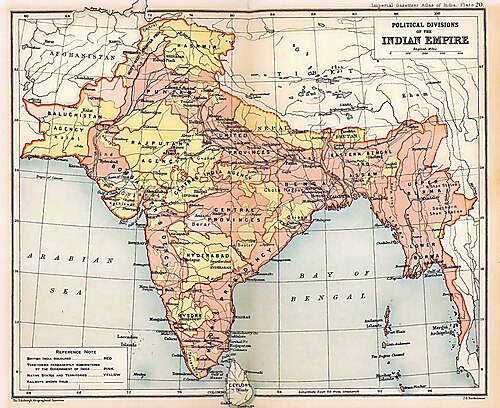
British Raj
East India Company is dissolved and the British Raj begins. Source — Wikipedia, "Timeline of Bangladeshi history" (19th century):
Map of the British Indian Empire from Imperial Gazetteer of India By Edinburgh Geographical Institute; J. G. Bartholomew and Sons. - Oxford University Press, 1909. Scanned and reduced from personal copy by Fowler&fowler«Talk» 18:10, 5 August 2007 (UTC), Public domain, https://commons.wikimedia.org/w/index.php?curid=7381045
1861 CE
In 1861, the Government of India
In 1861, the Government of India was directed to set up a representative legislature in Bengal and the proceedings of the Bengal Legislative Assembly began. Source — Wikipedia, "Timeline of Bangladeshi history" (19th century):
Feb 1, 1862 CE
The proceedings of the Bengal Legislative
The proceedings of the Bengal Legislative Assembly began. The number of members was 12. But in 1892, the number of member increased to 21. Source — Wikipedia, "Timeline of Bangladeshi history" (19th century):
1905 CE
1905 Partition of Bengal
Partition of Bengal. Source — Wikipedia, "Timeline of Bangladeshi history" (20th century):
Map of "Bengal" from Pope, G. U. (1880) Text-book of Indian History: Geographical Notes, Genealogical Tables, Examination Questions, London: W. H. Allen & Co. Pp. vii, 574, 16 maps . Scanned from personal copy and uploaded by Fowler&fowler By W. H. Allen and Co. - Pope, G. U. (1880) Text-book of Indian History: Geographical Notes, Genealogical Tables, Examination Questions, London: W. H. Allen & Co. Pp. vii, 574, 16 maps, Public domain, https://commons.wikimedia.org/w/index.php?curid=143827170
1907 CE
Hariprasad Shastri
Haraprasad Shastri discovered Charyapad, the oldest known Bengali written form. Source — Wikipedia, "Timeline of Bangladeshi history" (20th century):
Geographic distribution of Bengali language in India and Bangladesh. The map covers each district of India and the five shades of green show the percentage of Bengali language speakers in each district. Source: Indian census 2011. Feel free to enrich the map with data for more Indian districts, or fix any mistakes. Derivative of the file India district map (de-facto).svg. By NikosLikomitros - Own work, CC BY-SA 4.0, https://commons.wikimedia.org/w/index.php?curid=119785155
1921 CE
Dhaka University
Establishment of Dhaka University, the first university of Bengal territory (now Bangladesh). Source — Wikipedia, "Timeline of Bangladeshi history" (20th century):
Flag of British Bengal By Samhanin - Own work, source: Indian Embassy in London wall plaque (British Bengal Badge), CC BY 3.0, https://commons.wikimedia.org/w/index.php?curid=79839703
Apr 18, 1930 CE
Chittagong Armoury Raid
Chittagong Armoury Raid by Surya Sen. Source — Wikipedia, "Timeline of Bangladeshi history" (20th century):
Location of the Chittagong Armoury Raid, Bengal presidency, British India 1930 By Bruno pnm ars - Own work, CC BY-SA 4.0, https://commons.wikimedia.org/w/index.php?curid=154917378
Jan 12, 1934 CE
Surya Sen
Surya Sen was hanged on 12 January 1934 by the British rulers following the arrest in February 1933. Source — Wikipedia, "Timeline of Bangladeshi history" (20th century):
The only portrait of Master da Surya Sen By Unknown photographer - Directorate of State Archive, East Bengal, Kolkata., Public domain, https://commons.wikimedia.org/w/index.php?curid=27428075
Sep 1, 1936 CE
A. K. Fazlul Huq
A. K. Fazlul Huq forms the Krishak Sramik Party. Source — Wikipedia, "Timeline of Bangladeshi history" (20th century):
Image of Sher e Bangla en:A. K. Fazlul Huq died on 1962. By Unknown author - http://barisalimage.blogspot.com/2012_07_01_archive.html, Public domain, https://commons.wikimedia.org/w/index.php?curid=27432003
Aug 14, 1947 CE
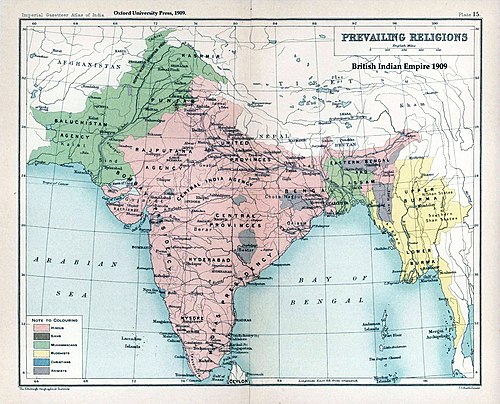
Partition of India
Partition of British India, Pakistan and India become two independent states. Source — Wikipedia, "Timeline of Bangladeshi history" (20th century):
Map "Prevailing Religions of the British Indian Empire, 1909" Key: Pink Hindu Green Muslim Diagonal lines Sikh (small area in Punjab) Yellow Buddhist (Burma and Chittagong Hill Tracts) Blue Christian (Goa) Purple Animist (several inland hilly areas) The Andaman islands are not mapped. By John George Bartholomew - The Imperial Gazetteer of India, Oxford University Press, 1909. Scanned from personal copy and annotated by me (Fowler&fowler«Talk» 04:16, 19 March 2007 (UTC)), Public domain, https://commons.wikimedia.org/w/index.php?curid=2786767
Mar 11, 1948 CE
Bengali language
General strike by students protesting at the exclusion of Bengali as an official language. Source — Wikipedia, "Timeline of Bangladeshi history" (20th century):
Geographic distribution of Bengali language in India and Bangladesh. The map covers each district of India and the five shades of green show the percentage of Bengali language speakers in each district. Source: Indian census 2011. Feel free to enrich the map with data for more Indian districts, or fix any mistakes. Derivative of the file India district map (de-facto).svg. By NikosLikomitros - Own work, CC BY-SA 4.0, https://commons.wikimedia.org/w/index.php?curid=119785155
Jun 23, 1949 CE
Bangladesh Awami League
Formation of the Awami Muslim League Source — Wikipedia, "Timeline of Bangladeshi history" (20th century):
Badge of Bangladesh Awami League By Nirvik12 - Own work Vector Version created from PDF document., Public domain, https://commons.wikimedia.org/w/index.php?curid=70971985
Feb 21, 1952 CE
Bengali language movement
Bengali language movement reaches its peak as the police open fire on protesting students. Source — Wikipedia, "Timeline of Bangladeshi history" (20th century):
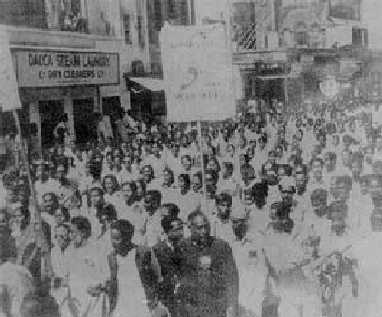
A march for the Bengali Language Movement By Rafiqul Islam uploaded by Rama's Arrow on Wikipedia - [1] [2], Public domain, https://commons.wikimedia.org/w/index.php?curid=4400961
Apr 17, 1953 CE
The Awami Muslim League becomes the
The Awami Muslim League becomes the Awami League. Source — Wikipedia, "Timeline of Bangladeshi history" (20th century):
Mar 11, 1954 CE
East Pakistan Provincial Assembly
The United Front wins most of the seats in the East Bengal Legislative Assembly. Source — Wikipedia, "Timeline of Bangladeshi history" (20th century):
Emblem of East Pakistan By Government of PakistanSVG: Tanvir Anjum Adib - Own work based on the first page of File:The Dacca Gazette, December 17, 1970.pdf, Public domain, https://commons.wikimedia.org/w/index.php?curid=166970659
Jun 6, 1955 CE
The United Front government is reinstated,
The United Front government is reinstated, Awami League does not participate. Source — Wikipedia, "Timeline of Bangladeshi history" (20th century):
Feb 29, 1956 CE
Languages of Pakistan
Bengali becomes one of the state languages of Pakistan. Source — Wikipedia, "Timeline of Bangladeshi history" (20th century):
The map above shows the dominant mother tongue in each Pakistani district according to the final official results of the 2017 Pakistan Population & Housing Census. The data can be found here. Linguistic data for the territories of Azad Jammu & Kashmir and Gilgit-Baltistan is not yet available as of December 2021. By Abbasi786786 - Own work, CC BY-SA 4.0, https://commons.wikimedia.org/w/index.php?curid=113038397
Oct 7, 1958 CE
martial law
Constitution abrogated and martial law declared in Pakistan. Source — Wikipedia, "Timeline of Bangladeshi history" (20th century):
T-55A on the streets of Zbąszyń during Martial law in Poland. By Jacek Żołnierkiewicz - http://www.solidarnosc.gov.pl/index.php?document=48, Public domain, https://commons.wikimedia.org/w/index.php?curid=3071254
May 5, 1960 CE
Dhaka Residential Model College
Dhaka Residential Model College Established. Source — Wikipedia, "Timeline of Bangladeshi history" (20th century):
The Front Gate of Dhaka Residential Model College. By Dhaka Residential Model College Administration - Dhaka Residential Model College Authority, CC BY-SA 4.0, https://commons.wikimedia.org/w/index.php?curid=141270043
Feb 21, 1963 CE
Shaheed Minar, Dhaka
Inauguration of the Shaheed Minar language martyr memorial. Source — Wikipedia, "Timeline of Bangladeshi history" (20th century):
This is a photo of a monument in Bangladesh identified by the ID By Subarashitours - Own work, CC BY-SA 4.0, https://commons.wikimedia.org/w/index.php?curid=82649294
Feb 5, 1966 CE
Six point movement
Six point Bengali nationalist movement led by Sheikh Mujibur Rahman emerges. Source — Wikipedia, "Timeline of Bangladeshi history" (20th century):
Sheikh Mujibur Rahman Announcing 6 Points At Lahore By Unknown author - http://lahore.city-history.com/events/Sheikh-Mujibur-Rahman-Announcing-6-Points-at-Lahor/, Public domain, https://commons.wikimedia.org/w/index.php?curid=41284580
1968 CE
Agartala Conspiracy Case
Agartala Conspiracy Case filed by the government of Pakistan accusing Sheikh Mujibur Rahman and others of sedition. Source — Wikipedia, "Timeline of Bangladeshi history" (20th century):
State emblem of Pakistan. By Meraj Muhammad - Pakistani government, Public domain, https://commons.wikimedia.org/w/index.php?curid=2880209
Jan 1, 1969 CE
1969 Mass uprising in East Pakistan
Mass Uprising of '69 (ঊনসত্তরের গণ-অভ্যুত্থান) in East Pakistan. (to February) Source — Wikipedia, "Timeline of Bangladeshi history" (20th century):
A student procession at Dhaka University campus during the mass uprising of 1969. By Unknown author - https://www.thedailystar.net/in-focus/news/the-angry-young-world-2033213, Public domain, https://commons.wikimedia.org/w/index.php?curid=101445322
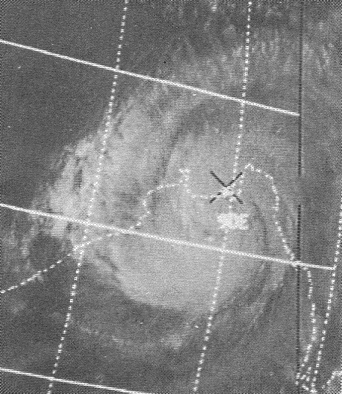
This ITOS 1 weather satellite image of the November 12, 1970 Bay of Bengal Tropical Cyclone was taken at 0956 UTC By NOAA - Mariners Weather Log, January 1971, pg. 19, Public domain, https://commons.wikimedia.org/w/index.php?curid=34910327
Mar 2, 1971 CE
Flag of Bangladesh
First hoisting of the National flag of Bangladesh (initial version) at the Dhaka University by Vice President of Dhaka University Students' Union (DUCSU) leader A. S. M. Abdur Rab. Source — Wikipedia, "Timeline of Bangladeshi history" (20th century):
The flag of Bangladesh By See File history below for details. - dcaa.com.bd Based on this construction sheet: See also:, Public domain, https://commons.wikimedia.org/w/index.php?curid=342968
Dec 22, 1971 CE
Provisional Government of Bangladesh
The Provisional Government of Bangladesh arrives in Dhaka from exile. Source — Wikipedia, "Timeline of Bangladeshi history" (20th century):
Feb 9, 1972 CE
Indo-Bangladeshi Treaty of Friendship, Cooperation
The 25-year Indo-Bangladeshi Treaty of Friendship, Cooperation and Peace is signed in Dhaka. Source — Wikipedia, "Timeline of Bangladeshi history" (20th century):
CBD of Dhaka By Sifat777 - Own work, CC BY-SA 4.0, https://commons.wikimedia.org/w/index.php?curid=133618088
Mar 7, 1973 CE
1973 Bangladeshi general election
First general election in Bangladesh is held, Bangladesh Awami League secures a majority. Source — Wikipedia, "Timeline of Bangladeshi history" (20th century):
1974 CE
Bangladesh famine of 1974
Bangladesh famine of 1974 cause the deaths of over one million people. Source — Wikipedia, "Timeline of Bangladeshi history" (20th century):
Jan 25, 1975 CE
A fourth amendment to the constitution
A fourth amendment to the constitution abolishes the parliamentary system and establishes a presidential system in its place. Source — Wikipedia, "Timeline of Bangladeshi history" (20th century):
Jul 21, 1976 CE
Abu Taher
Lieutenant Colonel. Abu Taher was sentenced to death for overthrowing the government and destroying the armed forces. Source — Wikipedia, "Timeline of Bangladeshi history" (20th century):
Apr 21, 1977 CE
Zia-ur Rahman replaces Sayem as president.
Zia-ur Rahman replaces Sayem as president. Source — Wikipedia, "Timeline of Bangladeshi history" (20th century):
1978 CE
United Nations Security Council
Bangladesh is elected to a two-year term on the UN Security Council. Source — Wikipedia, "Timeline of Bangladeshi history" (20th century):
Feb 18, 1979 CE
1979 Bangladeshi general election
The 1979 General Election takes place. Bangladesh Nationalist Party led by Zia scores a decisive victory. Source — Wikipedia, "Timeline of Bangladeshi history" (20th century):
May 30, 1981 CE
Assassination of Ziaur Rahman
Assassination of Ziaur Rahman. Source — Wikipedia, "Timeline of Bangladeshi history" (20th century):
Mar 24, 1982 CE
Hussain Muhammad Ershad
Lieutenant General Hussain Muhammad Ershad assumes power after a bloodless coup. Source — Wikipedia, "Timeline of Bangladeshi history" (20th century):
Dec 11, 1983 CE
Hussain Muhammad Ershad
Hussain Muhammad Ershad takes over as president. Source — Wikipedia, "Timeline of Bangladeshi history" (20th century):
May 7, 1986 CE
1986 Bangladeshi general election
At the 1986 General Election, a victory by the Jatiya Party consolidates Ershad's position. Source — Wikipedia, "Timeline of Bangladeshi history" (20th century):
Dec 7, 1987 CE
Ershad dissolves parliament under opposition press
Ershad dissolves parliament under opposition pressure. Source — Wikipedia, "Timeline of Bangladeshi history" (20th century):
Mar 3, 1988 CE
Bangladesh Jatiya Party
Jatiya Party gains an overwhelming majority in the General Election with 68.44% of the votes. Source — Wikipedia, "Timeline of Bangladeshi history" (20th century):
1991 Bangladeshi general election, Bangladesh Nationalist party snatches victory. Source — Wikipedia, "Timeline of Bangladeshi history" (20th century):
May 14, 1996 CE
Over 400 are killed as a
Over 400 are killed as a tornado strikes northern Bangladesh. Source — Wikipedia, "Timeline of Bangladeshi history" (20th century):
Dec 2, 1997 CE
Chittagong Hill Tracts Peace Accord
The 'Chittagong Hill Tracts Peace Accord' is signed between Bangladesh government and Parbatya Chattagram Jana Sanghati Samiti. Source — Wikipedia, "Timeline of Bangladeshi history" (20th century):
May 28, 1999 CE
Shakib Khan
Veteran Bangladeshi actor-producer Shakib Khan made his debut with the film Ananta Bhalobasha. Source — Wikipedia, "Timeline of Bangladeshi history" (20th century):
Nov 17, 1999 CE
International Mother Language Day
21 February is declared International Mother Language Day in the 30th General Conference of UNESCO. Source — Wikipedia, "Timeline of Bangladeshi history" (20th century):
Mar 20, 2000 CE
Bill Clinton
President Clinton becomes the first US president to visit Bangladesh. Source — Wikipedia, "Timeline of Bangladeshi history" (20th century):
Official White House photo of President Bill Clinton, President of the United States. By Bob McNeely, The White House[1] - This image was released by the United States Armed Forces with the ID DD-SC-93-04622 (next). This tag does not indicate the copyright status of the attached work. A normal copyright tag is still required. See Commons:Licensing. العربية ∙ বাংলা ∙ Bahaso Jambi ∙ Deutsch ∙ Deutsch (Sie-Form) ∙ English ∙ español ∙ euskara ∙ فارسی ∙ français ∙ italiano ∙ 日本語 ∙ 한국어 ∙ македонски ∙ മലയാളം ∙ Plattdüütsch ∙ Nederlands ∙ polski ∙ پښتو ∙ português ∙ русский ∙ slovenščina ∙ svenska ∙ Türkçe ∙ українська ∙ 简体中文 ∙ 繁體中文 ∙ +/−, Public domain, https://commons.wikimedia.org/w/index.php?curid=187406631
Oct 1, 2001 CE
Bangladesh Nationalist Party
Bangladesh Nationalist Party secures a decisive victory at the Eighth General Election. Source — Wikipedia, "Timeline of Bangladeshi history" (2000s Decade):
Jan 1, 2002 CE
Sale of polythene bags banned in
Sale of polythene bags banned in Dhaka for environmental reasons. Source — Wikipedia, "Timeline of Bangladeshi history" (2000s Decade):
May 20, 2004 CE
Sylhet
Terrorist attack on British High Commissioner in Sylhet. Source — Wikipedia, "Timeline of Bangladeshi history" (2000s Decade):
Sylhet City, Bangladesh. View from modina market area. By Rocky Masum This work was made by Masum-al-Hasan Rocky and released under the license(s) stated below. Please feel free to use it for any purpose as long as you credit Masum-al-Hasan Rocky as author and follow the terms of the chosen license. If you use this work outside of the Wikimedia projects, I would very much like to get a note from you. Thanks! - Own work, CC BY-SA 4.0, https://commons.wikimedia.org/w/index.php?curid=128193499
Jan 27, 2005 CE
Shah A M S Kibria
Shah A M S Kibria assassinated in a grenade attack in the Habiganj District, Sylhet. Source — Wikipedia, "Timeline of Bangladeshi history" (2000s Decade):
This is a photo of a monument in Bangladesh identified by the ID By ফজলুল জাহিদ পাভেল - Own work, CC BY-SA 4.0, https://commons.wikimedia.org/w/index.php?curid=72806512
2006 CE
Grameen Bank
Grameen Bank and Muhammad Yunus are awarded the Nobel Peace Prize. Source — Wikipedia, "Timeline of Bangladeshi history" (2000s Decade):
On Monday, February 16, 2026, Chief Adviser Professor Muhammad Yunus addressed the nation from the state guesthouse Jamuna in Dhaka. By Press Information Department - pressinform.gov.bd (archive), Public domain, https://commons.wikimedia.org/w/index.php?curid=184428773
Jan 11, 2007 CE
Iajuddin Ahmed
President Iajuddin Ahmed declares a state of emergency. Source — Wikipedia, "Timeline of Bangladeshi history" (2000s Decade):
Mohammad Mosaddak Ali met with President of Vietnam Tran Duc Luong at Zia International Airport in Dhaka, Bangladesh in 2002. By Md. Lutfar Rahman Binu - Authors e-mail, CC BY-SA 4.0, https://commons.wikimedia.org/w/index.php?curid=113574525
Jun 11, 2008 CE
Sheikh Hasina released on parole and
Sheikh Hasina released on parole and flown out to the US for medical treatment. Source — Wikipedia, "Timeline of Bangladeshi history" (2000s Decade):
Feb 25, 2009 CE
2009 Bangladesh Rifles revolt
Mutiny staged by paramilitary force Bangladesh Rifles. Source — Wikipedia, "Timeline of Bangladeshi history" (2000s Decade):
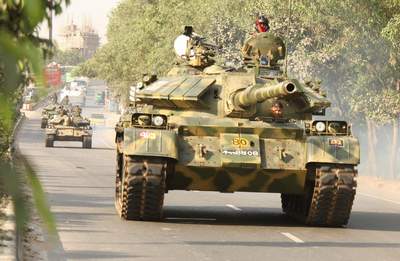
Type 69IIG main battle tank. By Souvik.arko (talk) - Own work, CC BY-SA 3.0, https://commons.wikimedia.org/w/index.php?curid=9561931
Jan 28, 2010 CE
Execution of five condemned killers of
Execution of five condemned killers of Bangabandhu Sheikh Mujibur Rahman. Source — Wikipedia, "Timeline of Bangladeshi history" (2010s Decade):
Feb 17, 2011 CE
Killing of Felani Khatun
Widespread outrage at the killing of Felani Khatun a 15-year-old Bangladeshi girl, who was shot and killed by India's Border Security Force (BSF), at India-Bangladesh border. Source — Wikipedia, "Timeline of Bangladeshi history" (2010s Decade):
Map of Kurigram, Bangladesh including the Bangladesh-India border highlighted in velvet line By Openstreetmap - Openstreetmap.org, CC0, https://commons.wikimedia.org/w/index.php?curid=157935257
Jan 18, 2012 CE
Bangladesh Army
Bangladesh Army claimed to have foiled a coup d'état attempt. Source — Wikipedia, "Timeline of Bangladeshi history" (2010s Decade):
Aircraft marking for the Bangladesh Army. By Bangladesh Army - This vector image includes elements that have been taken or adapted from this file:, CC BY-SA 2.5, https://commons.wikimedia.org/w/index.php?curid=32865579
Apr 24, 2013 CE
2013 Dhaka garment factory collapse
Garments factory collapse at Savar claims 1,134 lives. Source — Wikipedia, "Timeline of Bangladeshi history" (2010s Decade):
2013 Savar building collapse. http://en.wikipedia.org/wiki/2013_Savar_building_collapse Portions of the collapsed building. Photos taken by Sharat Chowdhury, permission obtained from him for use in Wikipedia under CC attribution. By Sharat Chowdhury - Sharat Chowdhury's facebook album, permission given by email: https://www.facebook.com/media/set/?set=a.10151367557176814.1073741835.723176813, CC BY 2.5, https://commons.wikimedia.org/w/index.php?curid=25784003
Jan 5, 2014 CE
2014 Bangladeshi general election
2014 Bangladeshi general election. Landslide Awami League victory. Sheikh Hasina elected for the third term as prime minister. Source — Wikipedia, "Timeline of Bangladeshi history" (2010s Decade):
Source: Elections Commission Bangladesh By Sponge12345678 - Own work, CC BY-SA 4.0, https://commons.wikimedia.org/w/index.php?curid=180632597
Jul 1, 2016 CE
July 2016 Dhaka attack
Terrorist attack and hostage crisis at Holey Artisan Bakery in Dhaka culminating in the death of 29. Source — Wikipedia, "Timeline of Bangladeshi history" (2010s Decade):
Gulshan Attack location By Eugen Simion 14 - Own work, CC BY-SA 4.0, https://commons.wikimedia.org/w/index.php?curid=49849076
Aug 25, 2017 CE
Rohingya refugees in Bangladesh
Rohingya refugee crisis breaks out. Over 700,000 refugees flee to Bangladesh over the next four months. Source — Wikipedia, "Timeline of Bangladeshi history" (2010s Decade):
Photo of Kutupalong Refugee Camp in Bangladesh. By John Owens (VOA) - Source article (direct source), Public domain, https://commons.wikimedia.org/w/index.php?curid=58873776
Dec 30, 2018 CE
2018 Bangladeshi general election
2018 Bangladeshi general election. Landslide Awami League victory. Sheikh Hasina elected for the fourth term as prime minister. Source — Wikipedia, "Timeline of Bangladeshi history" (2010s Decade):
Source: Elections Commission Bangladesh By Sponge12345678 - Own work, CC BY-SA 4.0, https://commons.wikimedia.org/w/index.php?curid=180632580
Nov 27, 2019 CE
July 2016 Dhaka attack
Seven terrorists sentenced to death for the July 2016 Dhaka attack. Source — Wikipedia, "Timeline of Bangladeshi history" (2010s Decade):
Gulshan Attack location By Eugen Simion 14 - Own work, CC BY-SA 4.0, https://commons.wikimedia.org/w/index.php?curid=49849076
Mar 8, 2020 CE
COVID-19
First three confirmed cases of COVID-19 in Bangladesh. Source — Wikipedia, "Timeline of Bangladeshi history" (2010s Decade):
Transmission and life-cycle of SARS-CoV-2 causing COVID-19. SARS-CoV-2 is transmitted via respiratory droplets of infected cases to oral and respiratory mucosal cells. The virus, possessing a single-stranded RNA genome wrapped in nucleocapsid (N) protein and three major surface proteins: membrane (M), envelope (E) and Spike, replicates and passes to the lower airways potentially leading to severe pneumonia. The gateway to host cell entry (magnified view) is via Spike-converting enzyme 2 (ACE2) interaction with cleavage of Spike in the prefusion state by proteases TMPRSS-2/furin. A simplified depiction of the life cycle of the virus is shown along with potential immune responses elicited. By Colin D. Funk, Craig Laferrière, and Ali Ardakani. Graphic by Ian Dennis - https://www.iandennisgraphics.com - Funk CD, Laferrière C y Ardakani A (2020) Una instantánea de la carrera mundial de vacunas dirigidas contra el SARS-CoV-2 y la pandemia COVID-19. Parte delantera. Pharmacol. 11:937.Funk CD, Laferrière C and Ardakani A (2020) A Snapshot of the Global Race for Vaccines Targeting SARS-CoV-2 and the COVID-19 Pandemic. Front. Pharmacol. 11:937. https://doi.org/10.3389/fphar.2020.00937, CC BY 4.0, https://commons.wikimedia.org/w/index.php?curid=99473789
Jun 29, 2023 CE
List of highest-grossing Bangladeshi films
The highest grossing Bangladeshi film of all-time Priyotoma was released. Source — Wikipedia, "Timeline of Bangladeshi history" (2010s Decade):






![Map of India 1700 showing the Mughal Empire and European trading posts/factory towns from: Joppen, Charles [SJ.] (1907) A Historical Atlas of India for the use of High-Schools, Colleges, and Private Students, London, New York, Bombay, and Calcutta: Longman Green and Co. Pp. 16, 26 maps . Scanned from personal copy, reduced, and highlighted by Fowler&fowler«Talk» 23:38, 24 February 2009 (UTC)](https://upload.wikimedia.org/wikipedia/en/thumb/5/51/Joppen1907India1700a.jpg/500px-Joppen1907India1700a.jpg)