Encyclopedia/3. History, Societies & Civilizations/09. Modern Nations/01. Africa • Curated by Admin Timeline.sg
History of Angola (AI-generated, sourced to Wikipedia).
Chronological Storyline (31 Milestones)
1390 CE
Kingdom of Kongo Founded
The Kingdom of Kongo was established in the region of northern Angola and western Congo, becoming one of Central Africa's most powerful and centralized states, with its capital at Mbanza Kongo. Source — Wikipedia, "Angola":
Flag of the Kingdom of Kongo, circa 17th century By Oren neu dag - Own work, Public domain, https://commons.wikimedia.org/w/index.php?curid=4231888
Apr 1, 1482 CE
Portuguese Reach Angola
Portuguese explorer Diogo Cão sailed up the Congo River and made contact with the Kingdom of Kongo, initiating centuries of European involvement in the region that would lead to colonization and the transatlantic slave trade. Source — Wikipedia, "Angola":
Portrait of Diogo Cão, as it appeared in an ancient Portuguese escudo bill. Copyright free. By Portuguese National Mint - Genea - Diogo Cão, Public domain, https://commons.wikimedia.org/w/index.php?curid=11484251
1575 CE
Luanda Founded by Portuguese
Portuguese explorer Paulo Dias de Novais founded Luanda as São Paulo da Assumpção de Loanda, establishing the first permanent European settlement in what would become Angola and a key hub for the slave trade. Source — Wikipedia, "Angola":
default By Iamdelcioborges - Own work, CC BY 4.0, https://commons.wikimedia.org/w/index.php?curid=166132278
1624 CE
Queen Nzinga Takes Throne
Nzinga Mbande became ruler of the Kingdom of Ndongo and Matamba, leading fierce diplomatic and military resistance against Portuguese expansion for decades and becoming Angola's most iconic historical figure. Source — Wikipedia, "Angola":
Hand colored lithograph of the woman known as 'Queen Ginga' in Portugal. Her name was Nzinga Mbande, although her name when converting to Christianity was 'Ana de Sousa'. Drawing from the collection of the National Portrait Gallery in London. By Achille Devéria - http://www.npg.org.uk/collections/search/portraitLarge/mw150782/Ann-Zingha, Public domain, https://commons.wikimedia.org/w/index.php?curid=35474383
Oct 29, 1665 CE
Battle of Mbwila
Portuguese forces defeated the Kingdom of Kongo at the Battle of Mbwila, killing King António I and effectively breaking Kongo's power, consolidating Portuguese influence in the interior of Angola. Source — Wikipedia, "Angola":
Battle of Mbwila By Unknown author, CC BY-SA 2.5, https://commons.wikimedia.org/w/index.php?curid=1337145
1836 CE
Slave Trade Abolished
Portugal officially abolished the slave trade in its territories, though illegal trafficking continued for years. Angola had been one of the largest sources of enslaved people sent to the Americas for centuries. Source — Wikipedia, "Angola":
Flag of Angola By Original: Henrique de Carvalho Santos Vector: SKopp - Designed by Henrique de Carvalho Santos Construction sheet: Flags of the World - Angola Vexilla Mundi - Angola, Public domain, https://commons.wikimedia.org/w/index.php?curid=342947
Feb 26, 1885 CE
Berlin Conference Fixes Borders
The Berlin Conference formalized European colonial claims in Africa, confirming Portuguese sovereignty over Angola and establishing its current borders, which enclosed diverse ethnic groups within a single colonial territory. Source — Wikipedia, "Angola":
Drawing of the participants in the Berlin conference in 1884. By Adalbert von Roessler - Über Land und Meer. Allgemeine Illustrierte Zeitung, Jg. 27 (Oktober 1884-1885), Bd. 53, Nr. 14, 308)., Public domain, https://commons.wikimedia.org/w/index.php?curid=4259336
1902 CE
Ovimbundu Rebellion Crushed
The Ovimbundu people of the central highlands rose against Portuguese colonial rule and forced labor practices but were brutally suppressed, marking one of the last major armed resistances before the modern independence movement. Source — Wikipedia, "Angola":
Angola tribes territories (1970) By Angola_tribes_1970.jpg: USG derivative work: Jon C (talk) - Angola_tribes_1970.jpg, [1], Public domain, https://commons.wikimedia.org/w/index.php?curid=12527590
1951 CE
Angola Becomes Overseas Province
Portugal reclassified Angola from a colony to an overseas province, a nominal change that denied independence movements and sought to legitimize continued colonial rule in the post-World War II era. Source — Wikipedia, "Angola":
Flag of Portugal, created by Columbano Bordalo Pinheiro (1857-1929), officially adopted by Portuguese government in June 30, 1911 (in use since about November 1910). By Original: Columbano Bordalo Pinheiro Vector: Vítor Luís Rodrigues, António Martins-Tuválkin - Símbolos Nacionais, Public domain, https://commons.wikimedia.org/w/index.php?curid=92861585
Dec 10, 1956 CE
MPLA Founded
The Movimento Popular de Libertação de Angola (MPLA) was founded in Luanda, becoming one of the three major nationalist movements fighting for Angolan independence and the eventual ruling party of the country. Source — Wikipedia, "Angola":
Bandeira do Movimento Popular de Libertação de Angola - Partido do Trabalho By No machine-readable author provided. E2m assumed (based on copyright claims). - No machine-readable source provided. Own work assumed (based on copyright claims)., Public domain, https://commons.wikimedia.org/w/index.php?curid=569339
Feb 4, 1961 CE
Baixa de Cassanje Revolt
Angolan cotton workers in Baixa de Cassanje rose against Portuguese colonial authorities in what is considered the beginning of the Angolan War of Independence, prompting a brutal Portuguese military response. Source — Wikipedia, "Angola":
Flag of Angola By Original: Henrique de Carvalho Santos Vector: SKopp - Designed by Henrique de Carvalho Santos Construction sheet: Flags of the World - Angola Vexilla Mundi - Angola, Public domain, https://commons.wikimedia.org/w/index.php?curid=342947
Mar 15, 1961 CE
FNLA Launched Uprising
The Frente Nacional de Libertação de Angola (FNLA) launched an armed attack on Portuguese forces and facilities in northern Angola, escalating the independence war and drawing international attention to the colonial conflict. Source — Wikipedia, "Angola":
Logo of FNLA, the Angolan conservative party and former liberation movement. By Dahn - Own work Based on pins shown at Ephemerajpp., CC BY-SA 4.0, https://commons.wikimedia.org/w/index.php?curid=77697285
Mar 13, 1966 CE
UNITA Founded by Savimbi
Jonas Savimbi founded the União Nacional para a Independência Total de Angola (UNITA), the third major independence movement, rooted primarily among the Ovimbundu people of the central highlands. Source — Wikipedia, "Angola":
Flag of UNITA By Ceresnet - Own work based on: Flag of Unita.jpg and SaBW.gif, Public domain, https://commons.wikimedia.org/w/index.php?curid=22816830
Apr 25, 1974 CE
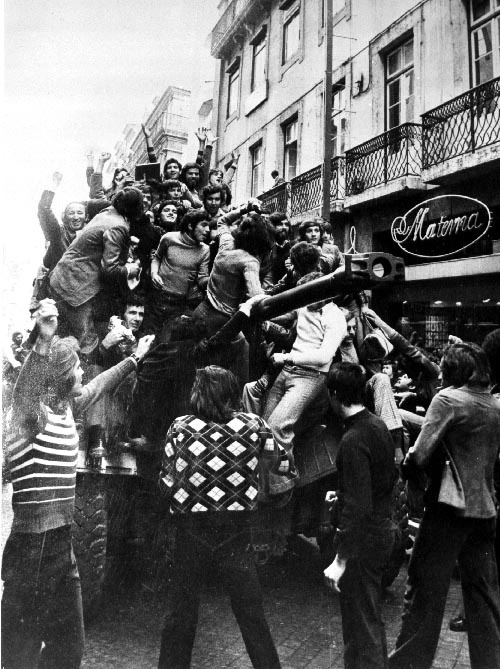
Carnation Revolution in Portugal
A military coup in Portugal overthrew the Estado Novo dictatorship, fundamentally changing Lisbon's colonial policy and paving the way for negotiations on Angolan independence. Source — Wikipedia, "Angola":
Populares em festa num carro de combate em Lisboa, durante a Revolução dos Cravos By Unknown author - Centro de Documentação 25 de Abril, CC BY 4.0, https://commons.wikimedia.org/w/index.php?curid=111796077
Jan 15, 1975 CE
Alvor Agreement Signed
Portugal and the three Angolan liberation movements signed the Alvor Agreement, granting Angola independence and establishing a transitional coalition government, though it quickly collapsed into factional fighting. Source — Wikipedia, "Angola":
Flag of Angola By Original: Henrique de Carvalho Santos Vector: SKopp - Designed by Henrique de Carvalho Santos Construction sheet: Flags of the World - Angola Vexilla Mundi - Angola, Public domain, https://commons.wikimedia.org/w/index.php?curid=342947
Oct 23, 1975 CE
South Africa Invades Angola
South African forces launched Operation Savannah, invading southern Angola to support UNITA and FNLA against the Soviet-backed MPLA, drawing Angola into the Cold War proxy conflicts of the region. Source — Wikipedia, "Angola":
Flag of Angola By Original: Henrique de Carvalho Santos Vector: SKopp - Designed by Henrique de Carvalho Santos Construction sheet: Flags of the World - Angola Vexilla Mundi - Angola, Public domain, https://commons.wikimedia.org/w/index.php?curid=342947
Nov 11, 1975 CE
Cuban Intervention Begins
Cuba deployed thousands of troops to Angola to support the MPLA government against UNITA, FNLA, and South African forces, marking the start of a major Cold War military commitment lasting over 15 years. Source — Wikipedia, "Angola":
Cuba is in red, Angola is in green, and South Africa is in blue. South-West Africa, now known as Namibia, is also in blue, but demarcated from the rest of South Africa, as it had been under South African control since 1915, and South African forces used Namibia as a base to enter Angola. By GeraldFordsEconomics - Own work, CC BY-SA 4.0, https://commons.wikimedia.org/w/index.php?curid=90426374
Nov 11, 1975 CE
Angola Gains Independence
Angola officially became independent as the People's Republic of Angola under MPLA leadership, with Agostinho Neto as the first president, while the country was already descending into civil war. Source — Wikipedia, "Angola":
Flag of Angola By Original: Henrique de Carvalho Santos Vector: SKopp - Designed by Henrique de Carvalho Santos Construction sheet: Flags of the World - Angola Vexilla Mundi - Angola, Public domain, https://commons.wikimedia.org/w/index.php?curid=342947
Sep 10, 1979 CE
José Eduardo dos Santos Takes Power
Following the death of Agostinho Neto, José Eduardo dos Santos became president of Angola and MPLA leader, beginning a 38-year rule that would define the country's post-independence era. Source — Wikipedia, "Angola":
Dilma recebe o presidente de Angola, José Eduardo dos Santos By Fabio Rodrigues Pozzebom/Agência Brasil - Agência Brasil, CC BY 3.0 br, https://commons.wikimedia.org/w/index.php?curid=163950914
Jun 27, 1988 CE
Battle of Cuito Cuanavale Ends
The Battle of Cuito Cuanavale, one of the largest African military engagements since World War II, concluded with a stalemate that ultimately led to Namibian independence and the withdrawal of South African and Cuban forces from Angola. Source — Wikipedia, "Angola":
Flag of Angola By Original: Henrique de Carvalho Santos Vector: SKopp - Designed by Henrique de Carvalho Santos Construction sheet: Flags of the World - Angola Vexilla Mundi - Angola, Public domain, https://commons.wikimedia.org/w/index.php?curid=342947
May 31, 1991 CE
Bicesse Accords Signed
The MPLA government and UNITA signed the Bicesse Accords in Portugal, establishing a ceasefire and framework for multiparty elections in an attempt to end the Angolan Civil War. Source — Wikipedia, "Angola":
Flag of Angola By Original: Henrique de Carvalho Santos Vector: SKopp - Designed by Henrique de Carvalho Santos Construction sheet: Flags of the World - Angola Vexilla Mundi - Angola, Public domain, https://commons.wikimedia.org/w/index.php?curid=342947
Sep 29, 1992 CE
First Multiparty Elections Held
Angola held its first multiparty elections under UN supervision. MPLA won, but UNITA rejected the results and resumed armed conflict, plunging the country back into full-scale civil war. Source — Wikipedia, "Angola":
Flag of Angola By Original: Henrique de Carvalho Santos Vector: SKopp - Designed by Henrique de Carvalho Santos Construction sheet: Flags of the World - Angola Vexilla Mundi - Angola, Public domain, https://commons.wikimedia.org/w/index.php?curid=342947
Nov 20, 1994 CE
Lusaka Protocol Signed
A new peace agreement was signed in Lusaka, Zambia, between the MPLA government and UNITA, creating a framework for power-sharing and the integration of UNITA forces into the national army. Source — Wikipedia, "Angola":
Flag of Angola By Original: Henrique de Carvalho Santos Vector: SKopp - Designed by Henrique de Carvalho Santos Construction sheet: Flags of the World - Angola Vexilla Mundi - Angola, Public domain, https://commons.wikimedia.org/w/index.php?curid=342947
Feb 22, 2002 CE
Savimbi Killed in Battle
UNITA leader Jonas Savimbi was killed in a clash with government forces in Moxico province, effectively ending the 27-year Angolan Civil War and opening the door to a negotiated peace. Source — Wikipedia, "Angola":
Johnas Savimbi, leader of UNITA, an Angolan rebel group. Savimbi is sitting down in a chair; photo taken in Washington, D.C. on October 1990. By Michael Geissinger - https://www.loc.gov/item/2018651369/, CC0, https://commons.wikimedia.org/w/index.php?curid=138769330
Apr 4, 2002 CE
Civil War Ends
The Angolan government and UNITA signed a ceasefire memorandum, officially ending the Angolan Civil War that had killed an estimated 500,000 to 800,000 people and displaced millions. Source — Wikipedia, "Angola":
Primer Comandante Carlos Fernández Gondín, segundo jefe de la Misión Militar Cubana en Angola, junto a comandantes de las FAR, durante la Batalla de Quifangondo. Noviembre 10 de 1975. By Alfonso Naranjo Rosabal - Own work, CC BY-SA 4.0, https://commons.wikimedia.org/w/index.php?curid=119934725
Dec 12, 2002 CE
Angola Hosts African Cup
Angola was awarded the right to host the 2010 Africa Cup of Nations, a major sporting milestone for the country as it sought to rebuild its international image after decades of war. Source — Wikipedia, "Angola":
Flag of Angola By Original: Henrique de Carvalho Santos Vector: SKopp - Designed by Henrique de Carvalho Santos Construction sheet: Flags of the World - Angola Vexilla Mundi - Angola, Public domain, https://commons.wikimedia.org/w/index.php?curid=342947
Jan 8, 2010 CE
Togo Bus Attack in Cabinda
Gunmen attacked the Togo national football team bus in Cabinda during the Africa Cup of Nations, killing three people and highlighting the ongoing tensions in Angola's oil-rich exclave. Source — Wikipedia, "Angola":
Flag of Angola By Original: Henrique de Carvalho Santos Vector: SKopp - Designed by Henrique de Carvalho Santos Construction sheet: Flags of the World - Angola Vexilla Mundi - Angola, Public domain, https://commons.wikimedia.org/w/index.php?curid=342947
Feb 3, 2010 CE
New Constitution Adopted
Angola adopted a new constitution that strengthened presidential powers, eliminated direct presidential elections, and established a parliamentary system where the president is chosen by the majority party. Source — Wikipedia, "Angola":
Constitution of Angola By Almanaque Lusofonista - Own work, Public domain, https://commons.wikimedia.org/w/index.php?curid=83998835
Sep 26, 2017 CE
João Lourenço Becomes President
João Lourenço was sworn in as Angola's third president, succeeding José Eduardo dos Santos and initiating anti-corruption reforms and a shift away from the dos Santos family's decades-long dominance. Source — Wikipedia, "Angola":
23.05.2025 - Presidente da República, Luiz Inácio Lula da Silva, durante a chegada do Presidente da República de Angola, João Lourenço e da senhora Ana Dias Lourenço, no Palácio do Planalto. Brasília - DF. Foto: Ricardo Stuckert / PR By Lula Oficial - 23.05.2025 - Chegada do Presidente da República de Angola, João Lourenço e da senhora Ana Dias Lourenço, CC BY-SA 2.0, https://commons.wikimedia.org/w/index.php?curid=165858976
Mar 21, 2020 CE
First COVID-19 Cases
Angola confirmed its first cases of COVID-19, prompting the government to implement lockdowns and restrictions in Luanda and other major cities as the pandemic tested the country's fragile healthcare system. Source — Wikipedia, "Angola":
Flag of Angola By Original: Henrique de Carvalho Santos Vector: SKopp - Designed by Henrique de Carvalho Santos Construction sheet: Flags of the World - Angola Vexilla Mundi - Angola, Public domain, https://commons.wikimedia.org/w/index.php?curid=342947
May 1, 2021 CE
Isabel dos Santos Assets Seized
Angolan authorities moved to seize assets from Isabel dos Santos, daughter of the former president, as part of a sweeping anti-corruption campaign targeting the business empire built during the dos Santos era. Source — Wikipedia, "Angola":
Isabel dos Santos By Nuno Coimbra - Own work, CC BY-SA 4.0, https://commons.wikimedia.org/w/index.php?curid=93845683